
Note: This article contains affiliate links. If you click on these links and make a purchase, we may earn a small commission at no extra cost to you. This helps support our research and content. Read our full affiliate disclosure here.
If your household uses a private well, choosing the right under-sink reverse osmosis water filter for home well water matters for taste, safety, and appliance longevity. Well water can contain a mix of dissolved minerals, sediment, and occasional contaminants that standard carbon-only filters may not fully address. A dedicated under-sink RO system gives you a targeted point-of-use solution that reduces dissolved solids and many common well contaminants while delivering near-plumbing water quality at a kitchen faucet. This guide covers our shortlist of the top under-sink reverse osmosis water filters for home well water, explaining the evaluation criteria and practical tradeoffs. You will find clear guidance on flow rate, contaminant reduction, maintenance needs, and installation factors to help you pick the right system for your household. Read on for what to expect from each type of setup and how to match a system to your well water conditions and daily use.
Top Picks at a Glance
| Best Overall The best all-around choice for most situations | Waterdrop G2P600 RO System |  |
| Best Quality Built to a higher standard if you want something more solid | Home Master HydroPerfection TMHP |  |
| Best Value The sweet spot between price and what you get | APEC Water ROES-50 |  |
| Best Budget The cheapest option that still gets the job done reliably | FS-TFC 5-Stage RO System |  |
| Top Rated A top-rated pick with lots of positive feedback | iSpring RCC7-BN RO System |  |
| Most Popular A crowd favorite that many people choose with confidence | Waterdrop G3P600 Reverse Osmosis |  |
| Best Seller A high-volume bestseller chosen again and again | Express Water RO5DX Reverse Osmosis |  |
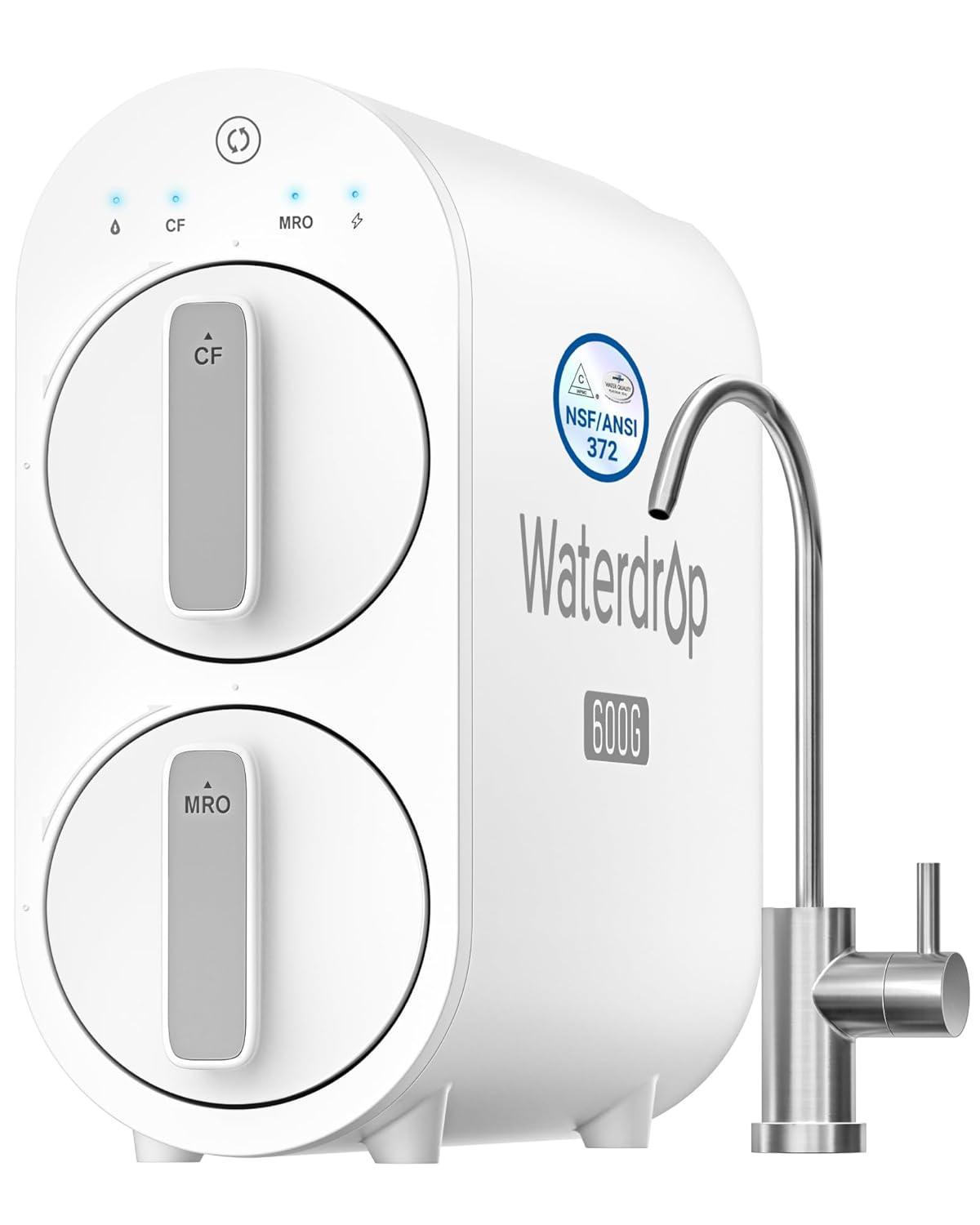
Waterdrop G2P600 RO System
| Purification Method | Reverse Osmosis |
|---|---|
| Power Source | Corded Electric |
| Other Special Features of the Product | Tankless, 2:1 Pure to Drain Ratio, Reduced Waste Water Production |
| Capacity | 600 gallons |
| Supported Water TDS Level Maximum (PPM) | 500 |
The Waterdrop G2P600 is a tankless under-sink RO system designed for steady, high-volume filtered water without a storage tank. It uses seven-stage reverse osmosis filtration and a 2:1 pure-to-drain ratio to reduce wastewater compared with traditional RO units, and the system is rated to produce up to 600 gallons per day so it can keep up with a busy household or small office. The unit requires a standard electrical outlet and installs under the sink; filters twist and pull for tool-free replacement and built-in indicators show when to change them. Because it is tankless it provides a continuous flow and fills a cup quickly, and the included faucet lets you draw purified water directly. Practical limitations include the need for power and occasional filter replacement, and like all RO systems it will need periodic maintenance when treating very hard or high-TDS well water. For buyers who want a compact, fast RO setup with lower waste water and easy filter changes, the G2P600 is a solid balanced choice.
Best for: Homeowners who want a compact, high-capacity under-sink RO that balances fast flow, lower wastewater, and easy maintenance for everyday drinking and cooking water.
Less Ideal for: People who need a passive, nonpowered filter or who prefer an RO system with a pressurized storage tank for long-term backup supply.
- Tankless design delivers continuous filtered water without a storage tank
- High production rate up to 600 gallons per day suitable for large households
- 2:1 pure-to-drain ratio reduces wastewater compared with traditional RO systems
- Twist-and-pull filters and lifespan indicators enable quick, tool-free replacements
- Requires an electrical outlet to operate
- RO systems still need regular maintenance and filter changes when used on high-TDS well water
Verdict: Choose the G2P600 if you want a compact, tankless under-sink RO that delivers fast, high-volume purified water while minimizing wastewater.
Home Master HydroPerfection TMHP

| Purification Method | Reverse Osmosis, Ultraviolet |
|---|---|
| Operating Pressure Range | 40-100 psi |
| Maximum Flow Rate | 1 gpm |
| Supported Water TDS Level Maximum (PPM) | 600 |
| Capacity | 2000 gallons |
The Home Master HydroPerfection TMHP is a comprehensive under-sink reverse osmosis system built for demanding water sources like wells. It combines sediment, catalytic carbon, iron and RO stages plus a UV sterilizer and a patented two-pass remineralization to remove contaminants then add beneficial minerals for better taste. The included permeate pump boosts production and cuts wastewater compared with standard RO setups, while modular canister housings and quick-change filters simplify maintenance. Notable practical benefits include targeted iron removal to protect the membrane, an always-on UV chamber for microbial control, and a faster faucet fill rate that feels closer to filtered tap water than many RO units. Trade-offs are its larger under-sink footprint and the need for electrical power for the UV and pump, and replacement filters and UV lamp add ongoing service costs. For well water users who need robust contaminant removal including iron and bacteria, this system offers a high-performance, serviceable solution.
Best for: Homeowners with well water or high-iron municipal supplies who prioritize thorough contaminant removal, microbial protection, and better-tasting remineralized water from an under-sink system.
Less Ideal for: People who need a purely passive, compact, no-power under-sink filter or who want the lowest upfront cost and minimal ongoing filter replacement management.
- Nine-stage filtration including iron-specific prefilter and RO membrane for broad contaminant removal
- UV sterilizer that inactivates bacteria and viruses for microbiologically safer water
- Patented two-pass remineralization for improved taste and pH balance
- Permeate pump reduces wastewater and increases water production compared with standard RO units
- Modular canister design and easy-to-change filters simplify maintenance
- Requires AC power for UV and pump so it needs an outlet under sink
- Larger footprint than simple 3- or 4-stage RO systems which may not fit small cabinets
- Replacement filters and UV lamp incur ongoing maintenance costs
Verdict: For well water homeowners who need high-performance contaminant and microbial removal plus better-tasting remineralized water, this TMHP system delivers robust, serviceable under-sink purification.
APEC Water ROES-50

| Purification Method | Reverse Osmosis |
|---|---|
| Filtration Stages | 5-Stage |
| Capacity | 50 gallons |
| Operating Pressure Range | 40-85 psi |
| Supported Water TDS Level Maximum (PPM) | 2000 |
The APEC ROES-50 is a 5-stage under-sink reverse osmosis system designed to deliver very pure drinking water for a household tap. It uses a sequence of prefilters, an RO membrane, and a postfilter to remove chlorine, lead, arsenic, fluoride, PFAs, microplastics, and hundreds of other contaminants, and it ships with a storage tank and a brushed nickel faucet for a complete install. Typical use is straightforward: mount the unit under the sink, connect the supply and drain lines, and the system produces up to 50 gallons per day with steady flow from the tank. Notable practical features include WQA/NSF-aligned construction, quick-connect fittings and color-coded tubing for easier DIY installation, and long-life filters that extend membrane life by protecting it with upstream filtration. Important limitations are the 50 GPD output which may be modest for very large households or heavy well-water demand, and the need to monitor and replace prefilters and the membrane on a schedule that depends on incoming water quality. The system offers reliable, high-rejection RO performance for homeowners who want clean tap water without complex maintenance.
Best for: Homeowners on well water who prioritize dependable contaminant removal and prefer a system they can install and maintain themselves to optimize household water quality.
Less Ideal for: People who need very high continuous flow for multiple simultaneous uses or who want a no-maintenance countertop solution.
- 5-stage filtration removes a wide range of contaminants including heavy metals, fluoride, PFAs, and microplastics
- Includes tank, faucet, installation kit, and a Filter-Max-ES50 set for a complete under-sink setup
- Quick-connect fittings and color-coded tubing simplify DIY installation and servicing
- WQA/NSF-aligned construction and tested components for reliable contaminant rejection
- 50 GPD production may be limiting for very large households or heavy continuous use
- Requires periodic filter and membrane replacements based on incoming water quality
Verdict: Choose the ROES-50 when you want a reliable, DIY-friendly under-sink RO that delivers high contaminant rejection for well water in an average household.
FS-TFC 5-Stage RO System

| Purification Method | Reverse Osmosis |
|---|---|
| Maximum Flow Rate | 18 liters per hour |
| Operating Pressure Range | 30-85 psi |
| Supported Water TDS Level Maximum (PPM) | 500 |
| Capacity | 100 gallons |
This FS-TFC 5-stage reverse osmosis unit is an under-sink purifier built to strip out common and heavy contaminants for drinking and cooking use. It uses a five-stage filtration train and a pressurized storage tank to deliver steady purified water at a claimed 100 GPD maximum and about 18 liters per hour flow under standard pressure. The kit includes a faucet, tank, feedwater adapter and extra tool and filter set, and the seller bundles four replacement filters that cover roughly a year of upkeep. Installation is intended to be DIY-friendly with tool-free connections and illustrated instructions that fit most standard sinks. The system runs without electricity and reports a low 1:1 drain ratio, which helps reduce wastewater compared with many RO units. Important limits are that it is sized for household or light commercial use and depends on adequate feed pressure and TDS below the specified max to reach claimed flow rates, and filter life is listed as about one year so replacements are an ongoing cost. Overall it is a compact, economical RO option for producing high-purity tap water when well matched to your water pressure and TDS levels.
Best for: Buyers who need an affordable under-sink RO for producing very clean drinking water at home and who prioritize straightforward DIY installation and low ongoing operating complexity.
Less Ideal for: Homes with very high TDS or inconsistent low water pressure should consider a system designed for higher TDS handling or boosted feed pressure instead.
- Five-stage filtration that targets a broad range of contaminants including heavy metals and VOCs.
- Compact under-sink design with a dedicated faucet and pressurized storage tank for steady delivery.
- Tool-free, illustrated installation kit lets most homeowners install without a plumber.
- Includes four extra replacement filters to cover about a year of standard filter changes.
- Operates without electricity and advertises a low 1:1 drain ratio to reduce wastewater.
- Filter life listed as roughly one year, so recurring replacement costs apply.
- Performance depends on sufficient feed water pressure and TDS below the stated maximum for best flow rates.
Verdict: A compact, budget-oriented under-sink RO that delivers high-purity drinking water with easy DIY installation and low-waste operation.
iSpring RCC7-BN RO System

| Purification Method | Reverse Osmosis, Activated Carbon, Carbon block |
|---|---|
| Power Source | No Power Needed |
| Maximum Flow Rate | 3.4 liters per minute |
| Supported Water TDS Level Maximum (PPM) | 750 |
| Capacity | 75 gallons |
The iSpring RCC7-BN is a 5-stage under-sink reverse osmosis system that produces high-quality drinking water by running feed water through sediment, granular activated carbon, carbon block, RO membrane, and a final GAC polishing filter before storing treated water in a pressurized tank. It is typically installed under a kitchen sink and uses no electricity, relying on pressure to push water through the RO membrane and a check valve to prevent backflow. Notable features include an NSF/ANSI 58 certification, a transparent first-stage housing for quick filter checks, push-to-connect fittings intended to reduce leaks, and a 100% lead-free designer faucet. In real-world use it delivers substantially reduced TDS and removes many contaminants including chlorine, lead, and PFAS, improving taste and reducing scale for kettles and appliances. Important limitations for this application: the RCC7-BN is designed for municipal tap water and is not intended for untreated well water without pre-treatment, so homes on well water should add proper whole-house or point-of-entry pre-filtration before using this RO unit to avoid membrane damage and premature clogging.
Best for: Homeowners who prioritize reliable, certified under-sink water purification for treated municipal supplies and want a durable, low-maintenance RO system that consistently delivers bottled-quality drinking water.
Less Ideal for: Homes using untreated well water without an upstream sediment and iron removal system should avoid relying on this unit alone and instead choose a system specifically engineered for well-water conditions or add pre-filtration.
- NSF/ANSI 58 certified for reverse osmosis performance
- Five-stage filtration removes a broad range of contaminants down to 0.0001 microns
- Transparent first-stage housing lets you visually inspect sediment filter condition
- Push-to-connect fittings and check valve reduce installation leaks and backflow risk
- Not designed for untreated well water without additional pre-treatment
- Requires periodic filter and membrane replacement to maintain performance
Verdict: Choose the iSpring RCC7-BN when you need a certified, five-stage under-sink RO that reliably produces high-quality drinking water from municipal supplies after minimal maintenance.
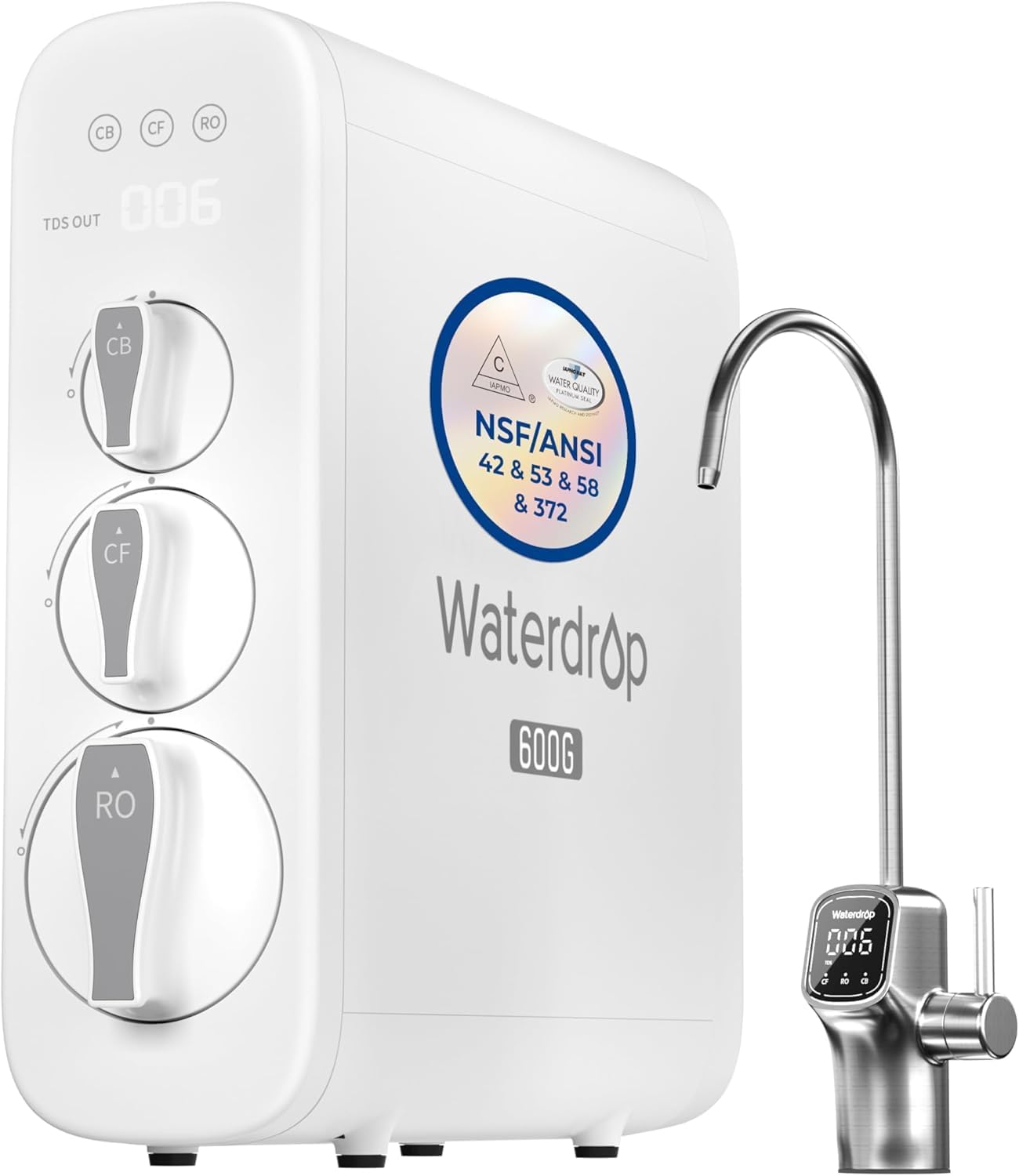
Waterdrop G3P600 Reverse Osmosis
| Filtration stages | 8-stage Filtration |
|---|---|
| Flow rate | 600 GPD |
| Pure to drain ratio | 2:1 |
| Power source | Corded Electric |
| Maximum supported TDS | 1500 ppm |
The Waterdrop G3P600 is a tankless under-sink RO system designed for high-capacity home use and well water concerns. It uses an 8-stage filtration train including a reverse osmosis membrane and carbon block stages to reduce TDS, heavy metals, PFAS, fluoride, chlorine and other contaminants, and the unit produces a cup of water in about 8 seconds. Its tankless layout saves under-sink space and the smart faucet displays TDS and filter-life information so you can monitor water quality and replacement timing. The system requires a plug-in power source and operates at typical household pressures, offering a 2:1 pure-to-drain ratio to reduce waste compared with many RO units. Installation needs two drilled holes (faucet and drain) and occasional filter changes on the specified schedule, but the twist-to-replace cartridges simplify swaps. The practical benefits are fast flow, strong contaminant removal, and a compact footprint, while buyers should be prepared for electrical hookup under the sink and to confirm cabinet clearance for the unit.
Best for: Buyers who want a compact, high-capacity under-sink RO that provides strong contaminant removal with visible filter and TDS feedback so they can trust water quality for drinking and cooking.
Less Ideal for: Homes without convenient under-sink power or where drilling a secondary faucet hole is not possible should consider alternative filtration approaches.
- High output up to 600 gallons per day for steady household demand
- 8-stage filtration certified to reduce TDS, chlorine, lead and PFAS
- Tankless design frees up under-sink storage space
- Smart faucet with TDS readout and filter life indicator for easy monitoring
- Requires under-sink electrical connection which may need outlet access
- Installation requires drilling a faucet hole and drain connection
Verdict: Pick this tankless RO if you want fast, high-capacity under-sink filtration with strong contaminant reduction and an easy-to-read faucet monitor.
Express Water RO5DX Reverse Osmosis

| Purification Method | Reverse Osmosis |
|---|---|
| Installation Type | Under Sink |
| Power Source | No Power Needed |
| Gallons Per Day | 50 GPD |
| Maximum Flow Rate | 0.8 gpm |
The Express Water RO5DX is a compact five-stage under-sink reverse osmosis system designed to deliver very high-purity drinking water for a household or well water setup. It installs under the sink and uses sediment, granular and block carbon pre-filters, a reverse osmosis membrane, and a post-activated carbon polish to remove a wide range of contaminants, with independent NSF testing for many common impurities. The unit includes quick-connect fittings, a brass/chrome faucet, a 4 gallon storage tank and a built-in leak stop valve with a fabric disk for early detection. It requires no electricity and can produce up to 50 GPD with a 0.8 gpm faucet flow, though actual output and wastewater ratio depend on feed pressure and water quality and you may need a booster pump if pressure is low. Filter changes are straightforward and most replacements are yearly or semiannual, but the system does produce wastewater and needs space under the sink for the tank and plumbing. For buyers wanting lab-grade impurity reduction from a self-installed under-sink system, this is a practical, well-documented option.
Best for: Buyers who prioritize independently tested impurity removal and want a durable, install-it-yourself under-sink RO system for clean drinking water from municipal or well sources.
Less Ideal for: Homes with very low under-sink water pressure that cannot accommodate a booster pump or households that lack space under the sink for a storage tank and related plumbing.
- Five-stage filtration including RO membrane and post-carbon polish for broad contaminant reduction
- NSF/ANSI tested claims for reduction of heavy metals, fluoride, pharmaceuticals and VOCs
- Includes storage tank, brass/chrome faucet, extra filter set and quick-connect fittings for easier installation
- No electricity required and has a leak stop valve with fabric sensor for added safety
- Produces up to 50 gallons per day with a 0.8 gpm faucet flow for typical household use
- System produces wastewater (typically 1–3 gallons discharged per gallon produced) which increases water use
- May require a booster pump or pressure regulator if household water pressure falls outside the 40–80 psi operating range
Verdict: Choose the RO5DX if you want a thoroughly tested five-stage under-sink RO system that delivers high-purity water and includes the fittings and tank needed for homeowner installation.
Choosing the Right Under-Sink Reverse Osmosis Water Filter for Home Well Water: Key Factors to Consider
Contaminant Profile and Water Testing
Know what is in your well before selecting a system. A certified lab test identifies dissolved solids, nitrates, iron, manganese, hardness, pH, and any volatile organics. Different RO membranes and prefilters target different contaminants, so matching the system to your actual water profile prevents underperformance.
Testing also determines whether pre-treatment is required. For example, high iron or heavy sediment loads can foul membranes quickly, so sediment or iron-removal pretreatment may be necessary. Regular testing after installation helps verify system performance and signals when membrane replacement or service is needed.
System Capacity and Daily Output
Consider how much treated water you use daily at the tap. Under-sink RO units produce varying volumes of permeate per day and may include a pressurized storage tank to smooth faucet flow. If you drink most of your household water from the RO faucet and also use it for cooking or pets, choose a system with adequate daily output or a larger storage tank.
Remember that manufacturer throughput ratings assume ideal conditions. Real-world production depends on feed water pressure, temperature, and membrane condition. If your well has low pressure, a booster pump can increase output but adds cost and maintenance.
Feed Water Pressure and Need for a Booster
RO membranes require a minimum feed pressure to operate efficiently. Many under-sink systems perform well at normal household pressures, but well systems with low or inconsistent pressure may need a dedicated booster pump. A booster improves permeate flow and recovery rate but adds another component to service schedules.
Plan for electrical access and placement if a booster pump is likely. Confirm pump compatibility with the RO system and ensure pump controls prevent rapid cycling or dry-run conditions that could damage the pump or membrane.
Prefiltration and Fouling Protection
Well water often carries sediment, iron, and biological material that can clog membranes. Good prefiltration extends membrane life by removing large particles and oxidized metals before they reach the RO stage. Look for systems with multi-stage filtration that include a sediment filter and an activated carbon filter ahead of the membrane.
Some homeowners add an iron filter or water softener ahead of the RO when hardness or iron concentrations are high. Proper prefiltration reduces frequency of membrane changes and maintains steady flow over time.
Maintenance Requirements and Consumables
Understand scheduled filter and membrane replacement intervals and what each change involves. Prefilters usually need replacement every 6 to 12 months, while membranes often last 2 to 5 years depending on feed water quality. Factor in ease of accessing cartridges and whether hand-tight fittings allow tool-free changes.
Also verify availability and cost of replacement filters and membranes. Systems with proprietary cartridges can be convenient but may limit sourcing options. Clear labeling and simple valve access for shutoff and flushing make routine maintenance faster and less prone to error.
Faucet Flow, Footprint, and Installation Constraints
Under-sink setups vary in tank size and the number of filter housings, which determines how much cabinet space is required. Measure under-sink clearance and check whether a dedicated faucet hole is needed. Some systems offer smaller tanks or tankless designs that save space but need higher feed pressure.
Faucet flow rate affects daily convenience. A slow trickle can be frustrating for filling pitchers. Systems with a larger tank or higher membrane throughput provide quicker access to treated water at the faucet.
Understanding RO Performance Metrics
RO systems are often rated by percent rejection, gallons per day, and recovery ratio. Percent rejection indicates how effectively the membrane removes dissolved solids, while gallons per day reflects theoretical output under lab conditions. Recovery ratio shows how much of the feed becomes potable water versus wastewater.
When evaluating systems for well water, pay attention to real-world factors that affect those metrics. Lower water temperature, low feed pressure, or high dissolved solids will reduce output. The published numbers are a starting point, not a guarantee, so base decisions on typical household conditions.
- Percent rejection measures contaminant removal efficiency
- Gallons per day is an idealized output number
- Recovery ratio affects wastewater volume and water use
Tankless Vs. Tank-Based Systems
Tankless under-sink RO units deliver treated water on demand without a storage tank, which saves cabinet space and can feel more modern. They typically require higher feed pressure or an integrated booster to achieve acceptable flow. Tankless units often produce less instantaneous flow if pressure is marginal.
Tank-based systems provide a buffer of stored water and generally offer a faster faucet experience when demand is intermittent. The tradeoff is the cabinet footprint and the need to sanitize and occasionally replace the tank bladder if service issues arise.
- Tankless: smaller footprint, pressure-dependent, no storage
- Tank-based: steady faucet flow, larger footprint, periodic tank care
Pretreatment Options for High-Iron or Hard Water
If your well shows elevated iron or hardness, pretreatment protects the RO membrane and extends consumable life. Iron can coat membranes and carbon filters, while hardness leads to scaling that reduces flow and membrane efficiency. Common pretreatment choices include sediment filtration, oxidizing filters for iron, and water softeners for hardness.
Choose pretreatment based on your water test results. An iron filter or chemical injection system may be necessary in heavily ironed wells. For moderate hardness, a small water softener upstream of the RO often strikes the right balance between membrane protection and operational complexity.
- Sediment filters protect membranes from particle fouling
- Iron-specific pretreatment prevents membrane coating
- Softening reduces scale formation on RO membranes
Installation Checklist for Homeowners
Plan the installation layout before purchasing. Confirm sink faucet hole availability, under-sink clearance, and location of the cold-water feed. Ensure you have shutoff valves and consider adding a water hammer arrestor if your plumbing is prone to pressure spikes.
Decide whether you will do a DIY install or hire a professional. DIY is possible for many homeowners with basic plumbing skills, but low-pressure wells, booster pump installs, or complicated pretreatment may require a trained technician.
- Measure cabinet space and faucet mounting requirements
- Check feed water pressure and plan for a pump if needed
- Have basic tools and shutoff valves accessible for service
Sanitation and Post-Installation Testing
After installation, sanitize the system and run a follow-up water test to confirm contaminant reduction. Sanitizing prevents bacterial growth in the storage tank and housings, particularly important for well water. Check manufacturer guidance for sanitizing procedures and time intervals.
Run periodic bench tests for TDS and specific contaminants relevant to your well. Simple TDS meters give a quick check on total dissolved solids, while lab tests verify removal of targeted contaminants like nitrates or lead.
- Sanitize at installation and during major service events
- Use a TDS meter for quick, ongoing checks
- Schedule lab tests annually or when water conditions change
How We Chose the Best Under-Sink Reverse Osmosis Water Filter for Home Well Water
We focused on features and performance characteristics that most affect long-term satisfaction for homeowners using private wells. First, contaminant reduction capability was a primary filter: we prioritized systems designed to remove total dissolved solids, nitrates, lead, and common organic contaminants found in well water. Second, flow performance and permeate output were central, since point-of-use RO systems vary widely in usable faucet flow and storage needs. Third, maintenance burden and parts accessibility were evaluated, looking for systems with clear filter-change intervals and widely available consumables. Fourth, build quality and materials were considered, with emphasis on NSF-style construction practices and corrosion-resistant fittings for well-water contexts. We also weighed installation complexity and whether the system requires a booster pump for low-pressure wells. We excluded systems intended only for municipal or treated water where dissolved-solids rejection was not a design priority. We did not include whole-house treatment units in this selection because the scope is under-sink point-of-use solutions. The resulting shortlist reflects systems that balance strong contaminant reduction, practical daily flow, manageable maintenance, and straightforward installation options for typical well-household setups.
Our full evaluation process is outlined in our review methodology.
FAQ
How often should I change prefilters and the RO membrane for well water?
Prefilters typically need replacement every 6 to 12 months depending on sediment load, while membranes often last 2 to 5 years based on feed water quality. Heavy sediment or iron will accelerate replacement intervals, so monitor flow and TDS to time changes.
Will an under-sink RO remove iron and hardness from my well?
RO membranes reduce dissolved iron and hardness to some degree, but high iron or hardness levels can foul or scale membranes. For elevated concentrations, install appropriate pretreatment such as sediment removal, iron-specific filters, or a water softener before the RO.
Do I need a booster pump for my under-sink RO on a well?
A booster pump is advisable when feed pressure is consistently below the membrane's recommended operating range. Low pressure reduces permeate production and increases wastewater. If your well system has modest pressure, a booster can improve performance but adds complexity and maintenance.
How much wastewater will an RO system produce with well water?
Wastewater volume varies by system recovery ratio and feed conditions. Typical point-of-use RO units produce more wastewater than potable water, especially with older membranes or low-pressure feeds. Higher-recovery designs and booster pumps can improve efficiency, reducing wastewater volume.
Can I install an under-sink RO myself?
Many homeowners can install an under-sink RO with basic plumbing skills and the right tools. However, installations that require a booster pump, pretreatment hookup, or modifications to the well system may be better handled by a professional to ensure reliable performance.
Final Verdict
Prioritize matching system capability to your well's water profile when choosing an under-sink reverse osmosis water filter for home well water. Focus on contaminant reduction, adequate daily output, and appropriate pretreatment to protect the membrane. Balance installation complexity and maintenance demands against your household flow needs and space constraints. Choosing a system that aligns with your water test results and pressure conditions will minimize service interventions and deliver reliable, high-quality drinking water at the kitchen faucet. Prioritize the factors discussed here to make a confident selection for your home well.