
Note: This article contains affiliate links. If you click on these links and make a purchase, we may earn a small commission at no extra cost to you. This helps support our research and content. Read our full affiliate disclosure here.
Choosing the right walk behind floor scrubber makes daily floor care faster, safer, and more consistent for commercial spaces. The wrong machine can waste labor, damage finishes, or leave residue that attracts dirt. This guide focuses on the best walk behind floor scrubbers available for common commercial needs and traffic patterns. We shortlisted top-performing scrubbers across common facility situations and prioritized proven cleaning effectiveness, uptime, and ease of use. Below you will find the top picks and the evaluation criteria we used to compare them, followed by practical guidance to match a machine to your space.
Top Picks at a Glance
| Best Overall The best all-around choice for most situations | Dapper Supply Walk-Behind Floor Scrubber |  |
| Best Quality Built to a higher standard if you want something more solid | IPC CT50 Walk-Behind Scrubber |  |
| Best Value The sweet spot between price and what you get | PENNONCLEAN N3 20" Floor Scrubber |  |
| Best Budget The cheapest option that still gets the job done reliably | Lissontine 18" Commercial Floor Scrubber |  |
| Top Rated A top-rated pick with lots of positive feedback | SUNMAX RT50 Floor Scrubber |  |
| Most Popular A crowd favorite that many people choose with confidence | Global Industrial Walk-Behind Floor Scrubber |  |
Dapper Supply Walk-Behind Floor Scrubber

| Power Source | Battery Powered |
|---|---|
| Speed | 200 rpm |
| Voltage | 24 volts |
| Maximum Power | 500 watts |
This walk-behind scrubber is built for commercial cleaning tasks where coverage and drying speed matter. It uses a 20-inch brush with a 200 RPM motor and heavy brush pressure to tackle grease and ground-in dirt, while a 500 W vacuum and wide squeegee help leave floors dry quickly. Dual tanks (14.5 gal solution, 17 gal recovery) and an 85 Ah 24 V battery provide long run times between refills and recharges, and the included spray hose and automatic features such as solenoid water control, auto squeegee lift, and eco-mode make routine operation straightforward. The unit is designed for high productivity up to about 27,000 sq ft per hour and runs at a relatively quiet 60 dB, which helps in public spaces. Trade-offs include the machine bulk and weight typical of commercial scrubbers and an 8-hour full recharge time, so it is best for planned cleaning shifts rather than quick intermittent touch-ups.
Best for: Commercial cleaning teams and facility managers who need a durable, high-coverage scrubber for scheduled cleaning of warehouses, retail stores, schools, or similar large spaces.
Less Ideal for: Small businesses or homeowners with infrequent light cleaning needs who prefer compact, easily storable machines or faster-charging battery systems.
- Wide 20-inch cleaning path and 31.5-inch squeegee for faster coverage
- Strong scrubbing force with 66 lb brush pressure and 200 RPM brush speed
- Large dual solution and recovery tanks reduce refill frequency
- Powerful 500 W vacuum and wide squeegee for fast floor drying
- Onboard features like spray hose, auto squeegee lift, and eco-mode simplify operation
- Bulky and heavy, requiring storage space and effort to transport
- Long 8-hour full recharge time limits multiple-shift use without spare batteries
Verdict: Choose this scrubber if you need a durable, high‑productivity battery walk‑behind that covers large commercial floors and leaves them drying fast.
IPC CT50 Walk-Behind Scrubber

| Cleaning path | 20 inches |
|---|---|
| Capacity | 13 gallons |
| Power source | Battery Powered |
| Input voltage | 24 volts |
The IPC CT50 is a compact, battery-powered walk-behind scrubber built for productive, repeated cleaning in large open areas. It uses a 20-inch cleaning path and a 550 W brush motor to scrub surfaces while a 400 W vacuum motor and aluminum squeegee recover and dry the floor in a single pass, which helps crews cover up to 21,000 sq ft per hour under ideal conditions. The unit is operator-friendly with intuitive controls, a self-leveling brush head, and comes with two 12V AGM batteries plus a charger for cord-free operation. Its 13-gallon solution/recovery capacity reduces refill cycles on long shifts and the included brush and pad driver let you switch cleaning media quickly. Expect the usual commercial-scrubber trade-offs: it is sizable to maneuver in very tight aisles, requires battery maintenance and periodic service on moving parts, and is a heavier-duty machine than models intended for light janitorial tasks. For facilities that need consistent, high-throughput floor maintenance, the CT50 delivers reliable, no-frills performance.
Best for: Facility managers and cleaning crews who prioritize high throughput and consistent, commercial-grade cleaning across large open areas.
Less Ideal for: Small businesses or locations with tight, congested spaces or infrequent light cleaning needs should consider smaller, lighter machines instead.
- 20-inch cleaning path and 550 W brush motor for efficient scrub coverage
- Battery-powered with two 12V AGM batteries and charger for cord-free operation
- 13-gallon tank reduces refill frequency during long cleaning runs
- Integrated 400 W vac motor and aluminum squeegee recover and dry floors in one pass
- Large, commercial footprint can be awkward in very tight or cluttered spaces
- Requires battery upkeep and periodic mechanical servicing
Verdict: Choose the IPC CT50 when you need a durable, battery walk-behind scrubber that maximizes cleaning throughput in large commercial spaces.
PENNONCLEAN N3 20" Floor Scrubber

| Power Source | Battery Powered |
|---|---|
| Capacity | 13.21 gallons |
| Wattage | 550 watts |
| Control Method | Touch |
| Form Factor | Walk Behind |
The PENNONCLEAN N3 is a compact 20-inch walk-behind floor scrubber built for daily commercial cleaning in small to medium spaces. It runs on a detachable battery and uses a 20-inch brush head plus a 31-inch aluminum squeegee to scrub and recover water from hard surfaces like tile, concrete, epoxy, and hardwood. The unit has a large 13.21-gallon solution tank with a full-tank sensor, cartridge filtration, touch controls on a single-screen panel, and built-in circuit protection for safer, lower-maintenance operation. Practical features such as an aluminum squeegee and reinforced tank walls point to durability for frequent use, while the included heavy-duty brush and charger make it ready for site work. Trade-offs are its substantial physical footprint and factory-listed weight, which mean it is less suited to very tight closets or multi-floor carrying; battery runtime is unspecified so continuous long-shift operation may require spare batteries or recharging. For operators who need a cost-effective, maneuverable scrubber for routine cleaning, the N3 covers core tasks without unnecessary complexity.
Best for: Buyers seeking a practical, no-frills walk-behind scrubber to reduce daily cleaning time in small to medium commercial spaces and who prioritize durability and easy operation.
Less Ideal for: Facilities that need ultra-light, easily carried machines for multi-floor jobs or those requiring documented long continuous runtimes without spare batteries.
- Compact 20-inch cleaning path balances coverage and maneuverability for small to medium spaces
- Detachable battery power enables cordless operation and simpler positioning
- Large 13.21-gallon solution tank with full-tank sensor reduces refill frequency and prevents flooding
- Aluminum squeegee and reinforced tank construction improve durability for daily commercial use
- Touch-control panel and circuit protection simplify operation and protect electronics
- Hefty overall weight and footprint limit portability and stair access
- Battery runtime is not specified which may require additional batteries for long shifts
Verdict: A durable, easy-to-operate 20-inch walk-behind scrubber that delivers practical daily cleaning performance for small to medium commercial spaces.
Lissontine 18" Commercial Floor Scrubber
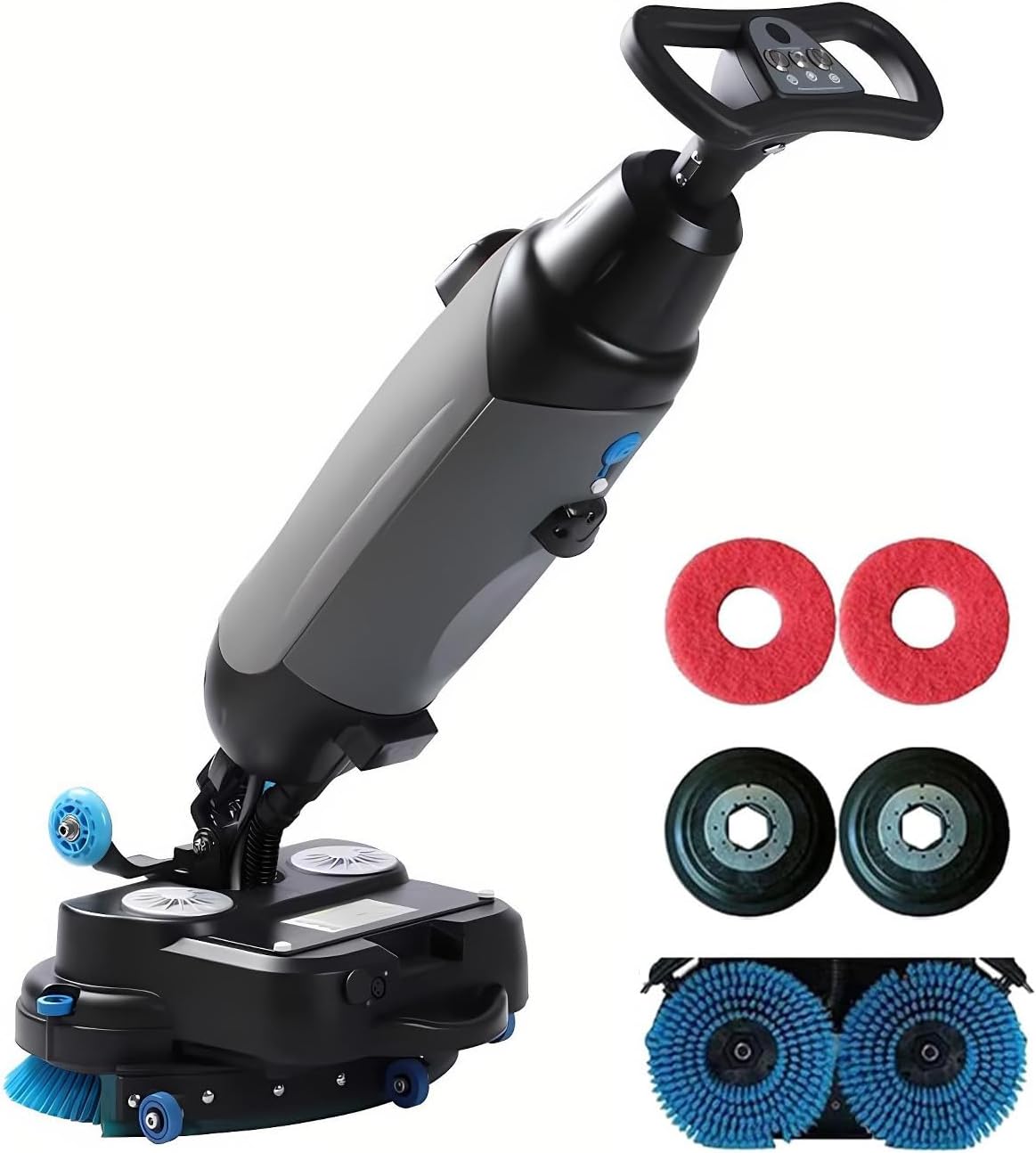
| Cleaning width | 18" |
|---|---|
| Cleaning capacity | 13000 Sqft/H |
| Clean water tank | 1.2 gallon |
| Dirty water tank | 1.8 gallon |
| Battery runtime | Up to 120 minutes |
This 18-inch Lissontine floor scrubber is a walk-behind machine built for medium-area commercial cleaning where speed and ease of use matter. It combines rotary double brushes, an 18" cleaning path, and a dual water tank system so you can scrub with clean solution while collecting dirty water separately, which speeds up repeated passes in retail, office, or gym spaces. The rechargeable lithium battery claims up to 120 minutes runtime and a three-hour recharge, making it suitable for multi-room shifts without a cord. The unit is relatively lightweight for its class and uses a squeegee and adjustable vacuum pressure to leave floors dry and reduce surface damage. Practical limitations are typical for compact scrubbers: it is best for flat, open floors rather than tight corners or heavy industrial soils, and the listed runtime and cleaning-rate figures assume ideal conditions. Controls and removable tanks are geared toward fast servicing, but buyer support and long-term durability depend on maintenance and usage patterns.
Best for: Practical buyers looking for an affordable, battery-powered walk-behind scrubber to speed up routine cleaning in retail, office, or gym spaces and reduce labor time.
Less Ideal for: Facilities that need heavy-duty industrial scrubbing, intricate edge cleaning, or very large continuous operation without intermediate maintenance should consider larger, more specialized machines.
- Dual clean and dirty water tanks for continuous cleaning without frequent refills
- 18-inch cleaning width with rotary double brushes for faster coverage
- Rechargeable lithium battery with up to 120 minutes runtime and 3-hour recharge
- Lightweight, ergonomic hand-push design for easier handling and reduced operator fatigue
- Not optimized for tight corners or heavily soiled industrial settings
- Performance figures such as 13000 sqft/h and 120 minute runtime depend on real-world conditions and may vary
Verdict: A compact, battery-powered commercial scrubber that delivers continuous, faster cleaning for budget-focused facilities that need reliable, walk-behind performance.
SUNMAX RT50 Floor Scrubber

| Scrubbing Width | 22 inches |
|---|---|
| Suctioning Width | 31 inches |
| Vacuum Motor Power | 550 W |
| Continuous working time | 5 hours |
| Clear Water Tank Capacity | 13.2 gallon |
The SUNMAX RT50 is a cordless walk-behind scrubber built for daily commercial cleaning of sealed hard floors like tile, concrete, epoxy, and VCT. It uses a 22-inch brush to scrub while a 31-inch squeegee recovers dirty water, allowing scrubbing and drying in one pass and reducing labor compared with mop-and-bucket methods. The machine runs on a 24 V/200 Ah battery with up to five hours continuous work and an eight-hour full charge, making it suitable for routine routes and aisles without frequent recharges. Included accessories such as a heavy-duty brush plus interchangeable white, red, and black pads make it adaptable from polishing to heavy soil removal, and the 13.2 gallon solution tank and 14.5 gallon recovery tank cut down refill trips. Practical limits include its heavy weight and substantial footprint, which require adequate doorway and storage clearance, and the recommendation to use low-foaming neutral pH cleaners to protect internal components. For facilities prioritizing reliable, one-pass cleaning with U.S.-based support and a two-year protection plan, the RT50 is a workhorse option.
Best for: Facilities managers and cleaning teams who need a reliable, cordless scrubber for regular floor maintenance across large indoor areas and who value long runtime and support coverage.
Less Ideal for: Small businesses with tight storage or narrow doorways and users who prefer lightweight portable cleaners or need equipment for unsealed or highly porous floors.
- Scrubs and recovers water in one pass using a 22-inch brush and 31-inch squeegee
- Long continuous runtime up to 5 hours on a rechargeable 24 V/200 Ah battery
- Comes with heavy-duty brush and three interchangeable pads for different floor types
- Large solution and recovery tanks (13.2 gal and 14.5 gal) reduce refill frequency
- Backed by U.S.-based support and a 2-year manufacturer protection plan
- Heavy and bulky unit that needs adequate doorway and storage space
- Requires low-foaming, neutral pH cleaners and regular maintenance to avoid damage
Verdict: Choose the RT50 when you need a durable, cordless walk-behind scrubber that reliably cleans and dries large sealed hard-floor areas in a single pass.
Global Industrial Walk-Behind Floor Scrubber

| Power Source | Corded Electric |
|---|---|
| Cleaning Width | 20"W |
| Solution Tank Capacity | 12 Gal. |
| Recovery Tank Capacity | 15 Gal. |
| Cleaning Capacity | 18,800 ft²/hr |
This Global Industrial walk-behind auto floor scrubber is a heavy-duty corded machine built to clean large, high-traffic areas quickly. It uses a 20" pad cleaning path with a pad-assist drive so the operator only needs to tilt the unit to engage the spinning pad, and a 30" cast-aluminum squeegee and vacuum motor evacuate solution into the 15-gallon recovery tank. The unit includes an 82' safety-yellow power cord with GFCI plug for long runs without needing extension reels, and rotationally molded polyethylene tanks resist corrosion and impact. With a stated cleaning rate near 18,800 sq ft per hour this is appropriate for retail floors, warehouses, and large institutional spaces; brushes and pads are purchased separately so you can choose aggressive or soft cleaning media. Be aware it is a heavy, commercial-class machine that requires a trained operator for safe handling and periodic maintenance, and is corded only so it needs access to mains power during use.
Best for: Buyers who need a proven, professional-grade scrubber for frequent cleaning of large commercial or institutional floors and who value documented performance and durable construction.
Less Ideal for: Small businesses with limited storage or occasional cleanups and users who need cordless portability or a lightweight machine for tight spaces should consider other options.
- Wide 20" cleaning path and pad-assist deck speed up coverage
- Large 12 gal solution and 15 gal recovery tanks reduce refill and dump frequency
- Heavy-duty 30" cast-aluminum squeegee and vacuum motor improve water pickup
- Long 82' power cord with GFCI lets you work far from outlets without aftermarket cords
- Durable rotationally molded tanks resist corrosion and impacts
- Scrub brushes and pads are not included and must be purchased separately
- Corded design limits mobility compared with battery models
- Large, heavy unit requires storage space and trained handling
Verdict: Choose this unit when you need a rugged, corded commercial scrubber that covers large floor areas quickly and reliably.
Choosing the Right Walk Behind Floor Scrubber: Key Factors to Consider
Cleaning Method and Head Type
Whether a scrubber uses rotating brushes, oscillating pads, or cylindrical heads affects how it agitates and lifts soil. Brushes are better for heavy soil and textured floors, while pads can provide a gentler finish on coated surfaces. Cylindrical heads can sweep debris into the recovery channel, reducing pre-sweeping in some environments.
Match the head type to your floor finish and soil load. Heavier agitation requires more water and solution control, so consider how easily you can swap heads or change brush pressure for different shifts or floor areas.
Solution and Recovery Capacity
Tank sizes determine how long a machine can clean between fills and dumps. Larger tanks reduce downtime in big spaces but increase machine weight and may reduce maneuverability. The recovery tank design and water lift of the vacuum system impact how dry the floor is after a pass, which affects safety and drying time.
Think about your facility layout and whether long uninterrupted runs are more valuable than a lighter, easier-to-steer cleaner. Also note how easy tanks are to access and empty for daily cleaning cycles.
Battery Type and Charging
Battery chemistry, capacity, and charging options govern shift coverage and total lifecycle cost. Lead-acid batteries are common and cost-effective but often require scheduled watering and longer charging periods. Lithium batteries typically offer faster charging, more usable runtime, and less maintenance but have higher upfront costs.
Consider whether you need multi-shift operation, opportunity charging, or a hot-swap battery workflow. Also factor in the availability of charging infrastructure and safe charging locations within your facility.
Maneuverability and Path Width
Path width determines how many passes you must make to cover an area. Wider paths improve productivity in open spaces but can be harder to maneuver in tight aisles, restrooms, or cluttered rooms. Turning radius and overall machine footprint matter when working around shelving, fixtures, or parked equipment.
Choose a width that balances coverage with access. For mixed environments, a mid-width machine often gives the best compromise between speed and control.
Maintenance and Consumables
Routine maintenance tasks such as changing squeegees, replacing brushes or pads, and clearing solution lines should be quick and require minimal tools. The cost and availability of consumables affect long-term operating expense. Machines designed for easy daily checks and tool-free consumable swaps reduce technician time and keep machines in service longer.
Inspect service access, recommended maintenance intervals, and whether commonly replaced parts are modular. A machine that simplifies daily upkeep reduces unplanned downtime and keeps cleaning quality consistent.
Safety Features and Noise
Good machines include features that enhance operator safety and occupant comfort, such as clear indicator lights, emergency shutoffs, and effective water recovery to reduce slip risk. Noise level is also important in active environments; quieter operation allows daytime cleaning in occupied spaces.
Review the machine's safety interlocks, visibility of controls, and manufacturer guidance on safe operation around people and sensitive equipment. Lower noise can widen acceptable operating windows and reduce disruption.
Choosing the Right Capacity for Your Facility
Estimate the typical contiguous area you need to clean in a single session and map out how often you must cover that space. Large open areas such as warehouses benefit from machines with larger tanks and wider cleaning paths to minimize refill cycles and labor time. Smaller or high-obstruction spaces require more compact machines with tight turning radii.
Also consider the floor finish. Some finishes tolerate aggressive agitation and higher water use, while others need gentler approaches. Balancing capacity with gentler cleaning options helps maintain floor life while still achieving the required cleanliness standards.
- Measure longest uninterrupted run to pick appropriate tank size
- Balance path width against aisle and fixture spacing
- Choose head type based on floor texture and finish durability
Operation and Ergonomics for Daily Use
Operator comfort and intuitive controls speed training and reduce fatigue. Look for adjustable handle height, simple control layouts, and clear on-board indicators for battery and solution levels. Machines with programmable settings let teams standardize cleaning passes and reduce operator variance.
Consider required training and whether your staff will need frequent supervision. Machines that offer straightforward diagnostics and easy access for basic checks lower the total cost of ownership by reducing service calls for minor issues.
- Adjustable ergonomics minimize strain on operators
- Simple control clusters reduce training time
- On-board diagnostics help troubleshoot common issues quickly
Maintenance Workflow and Spare Parts Planning
Plan routine maintenance into your cleaning schedule to avoid unexpected downtime. Identify which tasks are daily versus weekly and which require tools or technician-level skills. Machines that allow tool-free removal of brushes, squeegees, and filters shorten service routines.
Maintain an inventory of high-wear consumables and key spare parts so small failures do not take a machine out of service for extended periods. A basic spare parts kit typically includes squeegees, brushes or pads, hoses, and common fasteners.
- Categorize maintenance tasks by frequency and skill level
- Keep essential consumables on-site to minimize machine downtime
- Prefer machines with easily accessible service points
Optimizing Cleaning Productivity
Productivity is a function of effective path width, operator speed, refill frequency, and how well the machine recovers solution. To maximize coverage per shift, combine an appropriate path width with sufficient tank capacity and battery runtime. Programmable solution metering reduces overuse and ensures consistent results.
Workflow planning also matters. Sequence cleaning to reduce travel between fill and dump stations and use machines during windows where traffic is lower. Training operators in efficient patterns and overlap reduction makes existing equipment far more productive.
- Match path width to typical open area sizes
- Use solution metering to control chemical use and drying times
- Plan routes to minimize nonproductive travel
Using Machines Safely Around Occupants
When cleaning in occupied facilities, prioritize machines that leave floors drier and include visible signage and warning lights. Effective recovery and squeegee performance shorten drying times and reduce slip hazards. Keep operation speeds moderate in high-traffic areas and designate temporary barriers when necessary.
Also consider noise levels and emissions. Quieter machines allow cleaning during business hours with less disruption. Ensure your staff follow manufacturer guidance for safe operation, including proper startup checks and emergency shutoff familiarity.
- Use machines with strong recovery for faster drying
- Employ temporary barriers in busy zones
- Train staff on emergency stop and safe operation procedures
How We Chose the Best Walk Behind Floor Scrubber
We evaluated machines using criteria that matter to facility managers and janitorial teams in real-world daily use. Key considerations included cleaning performance, which covers brush or pad agitation, solution delivery, and squeegee design to remove soil and residue effectively. Runtime and battery system reliability were assessed to reflect continuous coverage and minimize mid-shift downtime. Ease of operation and ergonomics looked at intuitive controls, adjustable handle and speed settings, and service access for routine maintenance. Durability and serviceability covered frame and component robustness plus how readily consumables like squeegees and brushes can be replaced. Finally, productivity features such as path width, water capacity, and on-board solution metering were reviewed because they directly affect labor time per area. We excluded small consumer floor cleaners and machines not designed for commercial, high-frequency use. We also filtered out equipment lacking adequate replacement parts availability or clear service documentation. The result is a list of machines that meet higher standards for consistent cleaning, uptime, and manageable ongoing maintenance.
Our full evaluation process is outlined in our review methodology.
FAQ
How often should I replace squeegees and brushes?
Replacement frequency depends on use intensity and floor conditions. High-traffic or gritty environments wear consumables faster, often requiring monthly or bi-monthly changes, while lighter use can stretch intervals to several months. Inspect components weekly and replace when performance drops to maintain drying and cleaning quality.
Can a walk behind scrubber run a full shift on one charge?
It often depends on battery capacity, machine size, and the area being cleaned. Smaller machines with large battery packs or lithium options can often cover a full shift, while heavy-duty runs may require opportunity charging or battery swaps. Evaluate your typical runtime needs against the battery specifications.
Do I need to pre-sweep before scrubbing?
Pre-sweeping is generally recommended in environments with loose debris to prevent clogging and extend squeegee and brush life. Some cylindrical-head machines can handle light debris without pre-sweeping, but most facilities still benefit from a quick pass with a broom or sweeper before scrubbing.
How wet will the floor be after a pass?
How dry the floor is depends on squeegee condition, vacuum power, and machine speed. Properly adjusted and well-maintained squeegees combined with adequate vacuum lift usually leave floors nearly dry to touch, suitable for reopening areas quickly. Poorly maintained recovery systems will leave more residual moisture.
What safety checks should operators perform daily?
Daily checks should include verifying battery charge and fluid levels where applicable, inspecting squeegees and brushes for wear, ensuring solution lines are clear, and confirming that emergency stop and indicator lights function. Doing a brief operational test in a safe area helps catch issues before full-area cleaning.
Final Verdict
Pick a walk behind floor scrubber that aligns with your facility's layout, traffic patterns, and available maintenance resources. Prioritize cleaning effectiveness and reliable recovery to reduce rework and drying time, then weigh battery runtime and serviceability according to shift requirements. Remember that the right balance between path width and maneuverability will determine both productivity and ease of use. Focus on machines that simplify routine maintenance and have clear consumable availability. That approach keeps machines running longer, lowers unplanned downtime, and helps your team deliver consistent, safe floor care.