
Note: This article contains affiliate links. If you click on these links and make a purchase, we may earn a small commission at no extra cost to you. This helps support our research and content. Read our full affiliate disclosure here.
A Whole-House Fan can cut indoor temperatures quickly and reduce reliance on air conditioning when the outdoor air is cool. Choosing the right fan matters because capacity, noise, and how it integrates into your attic and ductwork determine real-world comfort and operating cost. This guide shortlists the top options for whole-home ventilation and explains the performance and installation tradeoffs to weigh. Below you will find our top picks, plus the evaluation criteria used to judge airflow, acoustic impact, and installation practicality.
Top Picks at a Glance
| Best Overall The best all-around choice for most situations | Tamarack HV1000 Whole House Fan |  |
| Best Quality Built to a higher standard if you want something more solid | QuietCool QC ES-7000 RF | 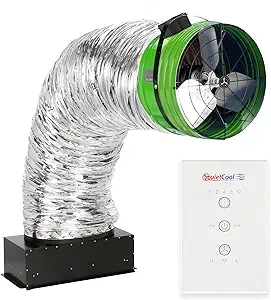 |
| Best Value The sweet spot between price and what you get | Centric Air QA-Deluxe 3300 Whole House Fan |  |
| Best Budget The cheapest option that still gets the job done reliably | Master Flow WHFS24M Whole House Fan |  |
| Top Rated A top-rated pick with lots of positive feedback | QA-Deluxe 5500 Whole House Fan |  |
| Most Popular A crowd favorite that many people choose with confidence | AC Infinity CLOUDWAY T12 |  |
| Best Seller A high-volume bestseller chosen again and again | QuietCool GA PRO-2.0 Garage Whole House Fan |  |
Tamarack HV1000 Whole House Fan

| Power Source | Corded Electric |
|---|---|
| Air Flow Capacity | 1000 cfm |
| Number of Speeds | 2 |
| Noise Level | 45 db |
| Wattage | 250 watts |
The Tamarack HV1000 is a built-in whole house fan intended to cool a home by pulling cooler outside air through living spaces and exhausting hot indoor air into the attic and out through vents. It installs on joists either horizontally or vertically and runs on a brushless motor with two selectable speeds, delivering up to about 1000 cfm while producing roughly 45 dB of noise. The fan uses R38 insulated, self-sealing doors that open when the unit runs and close when off to preserve conditioned air, and it is powered via a standard NEMA 5-15P cord. Practical benefits include lower energy use compared with central air conditioning, simpler operation via push-button controls, and an aluminum housing with plastic blades for durability. Expect basic installation work in the attic and the need for adequate attic ventilation to exhaust the airflow. The two-speed design limits fine-grained airflow control compared with variable-speed units, and the fan will still produce audible sound when running at higher speed, so placement and mounting matter for comfort.
Best for: Buyers who want a straightforward energy-saving whole-house ventilation solution to reduce air-conditioning runtime and improve indoor air exchange without complex controls.
Less Ideal for: People who need whisper-quiet, variable-speed airflow or who cannot provide sufficient attic venting and installation access should look elsewhere.
- High airflow capacity (~1000 cfm) for whole-house ventilation
- R38 insulated self-sealing doors reduce heat loss when off
- Brushless motor for durable, energy-efficient operation
- Two-speed control keeps operation simple while lowering energy use compared with AC
- Only two fixed speeds so airflow adjustment is coarse
- Requires attic installation and adequate attic venting to perform properly
Verdict: Choose the Tamarack HV1000 if you want a robust, energy-saving whole-house fan with insulated doors and simple two-speed operation.
QuietCool QC ES-7000 RF
| Air Flow Capacity | 6878 cfm |
|---|---|
| Number of Speeds | 2 |
| Wattage | 727 watts (high) / 164 watts (low) |
| Control Method | Remote |
| Motor Type | brushless ECM |
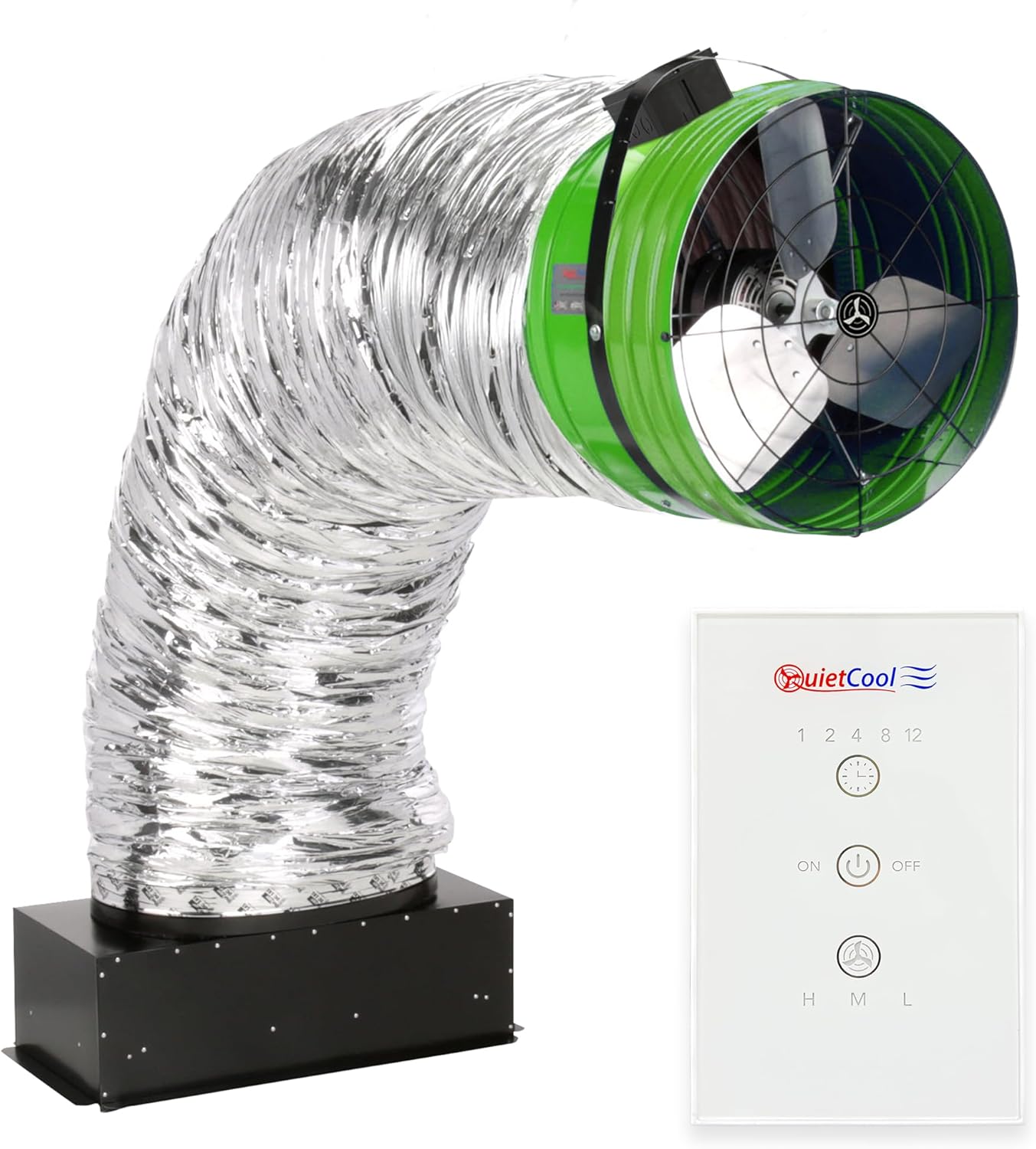
The QuietCool QC ES-7000 RF is a ceiling-mounted whole-house fan that pulls fresh outdoor air through open windows and exhausts it into the attic to replace indoor air quickly. It delivers up to 6,878 CFM on high and 4,304 CFM on low, driven by an ECM brushless motor that provides strong airflow while keeping power draw relatively low (727W peak, as low as 164W on low). Typical use is seasonal ventilation to cool a home rapidly, remove odors, dry floors, or exhaust fumes; the kit includes a wireless RF control with a glass switch and a countdown timer for convenient operation. Installation is intended to be straightforward without joist cutting, and the damper box with insulated doors helps stop attic air loss when the fan is off. Important trade-offs are that it requires substantial attic venting and a large ceiling grille cutout, and it relies on open windows and sufficient attic vent area to work effectively in hot or humid climates where outdoor air may not be cool enough.
Best for: Buyers who prioritize maximum ventilation and fast whole-house air exchange for large homes and want a high-performance, energy-conscious fan backed by simple controls.
Less Ideal for: Those in very humid climates or homeowners who cannot provide the recommended attic venting and window openings should consider other cooling or ventilation options.
- Very high airflow capacity up to 6,878 CFM for rapid whole-house air exchange
- Energy-efficient ECM brushless motor that delivers strong airflow with lower wattage on low speed
- Includes wireless RF control with countdown timer for easy on/off and timed runs
- Damper box with R5 insulated doors reduces attic heat transfer when the fan is off
- Designed for simple installation with no joist cutting and a compact attic-mounted motor head
- Requires significant net free attic venting to perform as rated
- Needs windows open and favorable outdoor conditions to provide cooling benefits
Verdict: If you need top-tier airflow to quickly ventilate and cool a large home, the QC ES-7000 RF delivers professional-level performance with energy-efficient motor technology.
Centric Air QA-Deluxe 3300 Whole House Fan

| Power Source | Corded Electric |
|---|---|
| Number of Speeds | 2 |
| Noise Level | 51 db |
| Air Flow Capacity | 3219 cfm |
| Motor Type | brushless |
The Centric Air QA-Deluxe 3300 is a ceiling-mounted whole-house fan built to move a lot of air quickly for natural cooling and ventilation. It delivers 3219 CFM using a brushless motor and three metal blades, and comes with a 2-speed wall switch, timer and a remote for simple control. Typical installation places it between joists and uses the included R-5 insulated damper to limit attic heat backflow when the fan is off. In practice the unit is aimed at reducing reliance on air conditioning by exchanging indoor air with cooler outside air during evenings and mild days, and its claimed 51 dB noise level keeps operation relatively unobtrusive on low speed. Energy efficiency and the heavy-duty fan guard add durability and safety for long-term use. Limitations to consider are that effective cooling depends on having access to cooler outdoor air and open windows or vents, and the advertised fitment limits mean it is sized for mid-sized homes rather than very large houses or apartments with restrictive ceiling access.
Best for: Buyers who want a practical, lower-energy way to cool and ventilate a mid-sized home and prefer a durable, easy-to-control ceiling-mounted solution.
Less Ideal for: People who cannot provide sufficient intake ventilation or who need forced cooling for very large homes or spaces with limited ceiling access should consider other HVAC options.
- High airflow capacity (3219 CFM) for rapid whole-house air exchange
- Energy-efficient brushless motor that reduces running costs compared with AC
- Includes 2-speed wall switch, timer and remote for convenient control
- R-5 insulated damper reduces attic heat transfer when the fan is idle
- Heavy-duty fan guard improves safety and protects blades
- Performance depends on having cooler outdoor air and adequate ventilation paths
- Not sized for very large homes beyond the stated coverage limits
Verdict: Choose this fan if you want a high‑flow, energy‑efficient whole‑house fan with convenient controls to cut cooling costs in a mid‑sized home.
Master Flow WHFS24M Whole House Fan

| Air Flow Capacity | 2920 cfm |
|---|---|
| Number of Speeds | 2 |
| Number of Blades | 3 |
| Power Source | Corded Electric |
| Motor Type | Permanent split-capacitor |
The Master Flow WHFS24M is a straightforward ceiling whole-house fan meant to ventilate living spaces by pulling cool air from the attic and exhausting warm indoor air. It installs between the living area and attic and ships preassembled with a white automatic ceiling shutter, plenum boards, and hardware to simplify DIY installation. The unit uses a permanent split-capacitor direct-drive motor with two speeds operated by a pull-chain, delivering up to 2,920 CFM for homes in the roughly 1,000 to 2,000 sq ft range while aiming for low vibration and quieter operation thanks to a balanced aluminum blade assembly. Practical benefits include reduced cooling load compared with air conditioning, simple two-speed control, and UL certification for safety. Limitations are the hard-wired power requirement and need for adequate attic exhaust (minimum 562 sq in NFA), plus modest reuse and simple pull-chain control rather than remote or smart options.
Best for: Buyers wanting an affordable, no-frills whole-house fan to lower cooling costs and ventilate a typical single-family home without professional customization.
Less Ideal for: Those seeking smart controls, variable speed modulation, or a plug-and-play unit that avoids any attic ventilation upgrades should look elsewhere.
- High airflow up to 2,920 CFM suitable for whole-house ventilation in typical mid-size homes
- Preassembled package with ceiling shutter, plenum boards, and installation hardware for easier DIY install
- Two-speed permanent split-capacitor direct-drive motor designed for low vibration and quieter operation
- UL and UL Canada listed for certified safety
- Requires hard-wired power and a minimum 562 sq in attic exhaust, which may need additional attic work
- Control limited to a pull-chain two-speed switch with no remote or smart connectivity
Verdict: A budget-friendly, UL-listed whole-house fan that delivers strong airflow and simple two-speed operation for homeowners who want effective, low-complexity ventilation.
QA-Deluxe 5500 Whole House Fan

| Air Flow Capacity | 5500 cfm |
|---|---|
| Number of Speeds | 2 |
| Noise Level | 51 db |
| Wattage | 630 |
| Voltage | 120 volts |
The QA-Deluxe 5500 is a heavy-duty whole-house attic fan built to exhaust hot indoor air and draw cooler outdoor air through the living space. It mounts between joists and is typically used in evenings or cooler periods to rapidly lower indoor temperature and reduce air conditioning runtime. Notable features include a 5500 CFM airflow rating, two speed settings controlled by a wall switch and built-in timer, an insulated R-5 damper to block attic heat when off, and a protective metal fan guard. The unit is powered by a brushed motor that delivers strong airflow but will be louder and use more power than variable-speed ECM motors. Installation is straightforward for standard joist spacing and the metal construction and USA assembly contribute to a robust feel, backed by a 10-year motor warranty and three-year parts coverage. Expect effective whole-house ventilation and long-term reliability, with the trade-off that the two-speed brushed motor limits fine speed control and the unit is relatively heavy compared with lighter models.
Best for: Buyers who prioritize long-lasting, built-like-a-tank components and want a proven, warranty-backed whole-house fan to reliably ventilate large homes without relying on advanced variable-speed controls.
Less Ideal for: If you want ultra-quiet operation or precise multi-speed control, or need the lightest possible unit for DIY installs, this heavier two-speed model is not the best choice.
- High airflow capacity rated at 5500 CFM for fast cooling of large homes
- R-5 insulated damper to reduce attic heat infiltration when the fan is off
- Sturdy metal construction with a heavy-duty fan guard for durability and safety
- Simple user controls: 2-speed wall switch plus timer for scheduled operation
- Long motor warranty (10 years) and 3-year parts coverage for peace of mind
- Brushed motor offers only two fixed speeds and is noisier than ECM or variable-speed alternatives
- Relatively heavy unit may be more difficult to handle during installation
Verdict: Choose the QA-Deluxe 5500 when you want a robust, warranty-backed whole-house fan that reliably moves large volumes of air for dependable natural cooling.
AC Infinity CLOUDWAY T12

| Duct Size | 12" |
|---|---|
| Airflow | 1250 CFM |
| Noise | 62 dBA |
| Power Usage | 244 W |
| Motor Type | EC (PWM-controlled) |
The AC Infinity CLOUDWAY T12 is a mixed-flow whole-house attic fan packaged as a plug-and-play kit for attic installation to pull hot indoor air into the attic and exhaust it outside. It pairs a PWM-driven EC motor with a dynamic temperature and humidity controller that supports schedules, timers, cycle modes, minimum-speed baseline operation, and WiFi/Bluetooth app access for remote monitoring and automation. The fan is built for higher static-pressure situations thanks to its mixed-flow design and includes a damper, grille, 4-layer ducting, and clamps so the main components are included for installation. Practical benefits include quieter, more efficient operation than many traditional AC fans, long rated runtime from dual ball bearings, and smart triggers that can run the fan only when needed. Important limitations are that the reported high-speed noise reaches about 62 dBA and the system consumes more power at full speed than smaller models, so expect noticeable sound and energy use at the top end; professional-grade attic sealing and proper intake sizing are still required to get the claimed cooling effect for a whole house.
Best for: Buyers who prioritize system-level performance and want a demonstrably controllable, app-connected whole-house fan that can be scheduled and automated to reduce cooling load.
Less Ideal for: People seeking a near-silent or ultra-low-power bedroom fan or those unwilling to handle attic installation and intake sizing should consider other solutions.
- Smart temperature and humidity controller with scheduling and remote app control
- EC motor with PWM control for quieter, more energy-efficient operation
- Mixed-flow design suited to higher static-pressure duct runs
- Complete kit includes damper, grille, ducting, clamps, and a remote for simpler installation
- Maximum noise around 62 dBA at full speed can be noticeable indoors
- Higher power draw at top speeds compared with smaller whole-house models
Verdict: Choose the CLOUDWAY T12 when you want a WiFi-enabled, energy-efficient whole-house attic fan with programmable controls and robust airflow for whole-home ventilation.
QuietCool GA PRO-2.0 Garage Whole House Fan

| Air Flow Capacity | 1834 cfm |
|---|---|
| Wattage | 133 watts |
| Number of Speeds | 2 |
| Controller Type | RF Controller |
| Mounting Type | Ceiling Mount |
The QuietCool GA PRO-2.0 is a ceiling-mounted garage whole-house fan sized for multi-car garages that delivers strong airflow while using relatively low power. It pulls cooler outside air into the garage and attic and exhausts it through attic vents, offering up to 1,834 CFM on high and 1,396 CFM on low via a two-speed PSC motor. The unit includes a built-in fire damper and damper ceiling grille to reduce pest and debris entry and a wireless RF switch for simple on/off and speed control. Installation is designed to be straightforward with an integrated ceiling box and a plug-and-play cord, but it does require an attic above the garage for proper venting. Practical benefits include significant ventilation and reduced indoor heat, lower A/C load, and long-term reliability backed by an industry-leading 15-year warranty. Expect typical trade-offs of a powerful blower: it needs adequate attic venting to work well and produces noticeable noise and airflow when running on high.
Best for: Buyers who want a reliable, high-capacity garage whole-house fan that prioritizes straightforward installation, safety features, and long-term durability for keeping large garages and attached attics cooler.
Less Ideal for: People without an attic above the garage or those who need whisper-quiet, infinitely variable-speed ventilation should consider other solutions.
- High airflow up to 1,834 CFM suitable for large garages
- Energy-efficient operation with as low as 133 watts on high
- Built-in fire damper and damper ceiling grille for safety and pest control
- Wireless RF controller for convenient remote operation
- Simple installation with integrated ceiling box and plug-and-play cord
- Requires an attic above the garage and adequate attic venting to perform properly
- Two-speed PSC motor offers limited speed granularity compared with variable-speed ECM units
- Will produce noticeable noise and strong airflow on high settings
Verdict: Choose the QuietCool GA PRO-2.0 if you need a high-capacity, easy-to-install garage whole-house fan with built-in safety features and proven long-term reliability.
Choosing the Right Whole-House Fan: Key Factors to Consider
Airflow Capacity and Home Size
Airflow capacity, typically measured in cubic feet per minute, determines how quickly a whole-house fan can replace indoor air with cooler outside air. A fan that is undersized for the conditioned volume will run continuously and fail to deliver the drafting effect you expect, while an oversized unit can cause uncomfortable pressure swings and require larger intake openings.
When matching capacity to home size, calculate your house volume and aim for multiple air changes per hour depending on climate and usage. Consider ceiling heights, open-plan areas, and whether you will close interior doors, since these factors change how much CFM you actually need.
Noise and Acoustic Management
Noise matters for night-time comfort and overall household acceptance. Look for published decibel ratings and designs that isolate motor vibration with rubber mounts or acoustic housing. Lower-speed, high-blade-count fans often run quieter at a given airflow than compact high-speed units.
Also evaluate where the fan will be installed. Attic placement with proper baffling and insulated attic access can reduce perceived noise. If you plan to run the fan while sleeping, prioritize units and installation methods rated for low acoustic output.
Installation Requirements and Attic Impact
Whole-house fans require an attic opening, intake vents, and usually direct mounting to roof joists or ceiling framing. Installation complexity varies: some units fit within common joist bays and use compact housings, while others need larger framed openings, structural reinforcement, or professional electrical work.
Attic clearance, existing insulation, and access routes affect cost and feasibility. Also consider how the fan interacts with attic ventilation and air sealing; poorly planned installs can reduce attic insulation effectiveness or create unwanted drafts.
Energy Use and Motor Efficiency
Even though whole-house fans typically use less energy than central air conditioning, motor efficiency impacts running cost if you plan frequent use. Look for high-efficiency motors, multiple speed controls, or variable-speed drives that allow tailoring airflow to conditions.
Lower-wattage fans with comparable CFM output are preferable. Also consider controls that enable timers or thermostat-linked operation to avoid unnecessary runtime during periods when outside air is not beneficial.
Intake Venting and Home Airtightness
A whole-house fan needs adequate intake vent area to pull fresh air without creating negative pressure. Insufficient intake causes poor airflow and can draw air through leaks in walls or crawlspaces instead of through designated vents.
Assess existing soffit, gable, or roof vents and plan for additional intake louvers if required. Consider how the fan will affect home airtightness and whether you need to add backdraft dampers or sealing measures for winter months.
Maintenance and Long-Term Reliability
Maintenance needs like periodic filter changes, motor lubrication, and cleaning of louvers affect ownership burden. Choose designs with accessible service points and replaceable parts to simplify upkeep.
Durable materials for housings and blades, plus a straightforward warranty policy, reduce the risk of early failure. Consider how easy it will be to access the attic fan for inspection and repair before finalizing a purchase.
Sizing a Whole-House Fan for Your Home
Proper sizing starts with calculating your home volume and the number of air changes per hour you want. A common rule of thumb is to target between 10 and 30 air changes per hour depending on climate, ceiling height, and how quickly you need to cool down the house.
After estimating required CFM, review the layout of interior rooms and doors. Homes with many closed-off rooms may need higher capacity or multiple intake strategies to ensure even ventilation throughout the living space.
- Measure square footage and multiply by average ceiling height to get volume.
- Decide target air changes per hour based on how aggressively you want to cool.
- Allow extra capacity for higher ceilings and open-plan areas.
Placement and Attic Considerations
Ideal placement balances short duct runs, structural support, and minimal disruption to attic insulation. Many homeowners position the fan near a central hallway or stairwell to use natural paths for air movement, but attic framing and joist spacing can constrain options.
Account for attic insulation and vapor barriers. A fan installed without proper flashing or sealing can compress insulation or create moisture migration paths, so plan for corrective insulation work as part of the installation if needed.
- Central locations promote balanced airflow.
- Avoid areas that block existing attic insulation.
- Plan for access panels for service and seasonal sealing.
Controls, Automation, and Convenience
Modern whole-house fans offer multiple-speed controls, wall switches, and remote or thermostat-enabled operation. Variable-speed control helps match airflow to outdoor conditions and reduces noise and energy use at lower demands.
Consider integrating timers or humidity/temperature sensors so the fan runs only when outdoor conditions are favorable. Simple manual controls work fine, but automation increases convenience and prevents inefficient operation.
- Look for variable-speed or multi-speed controls.
- Consider thermostatic or humidity-based automation.
- Remote or wall-mounted controls improve day-to-day usability.
Noise Mitigation Techniques
Beyond choosing a quiet unit, installation details influence perceived noise. Use vibration isolators, sound-absorbing baffles, and insulated attic access panels to cut transmission into living spaces. Proper intake grille placement away from bedroom walls also reduces sleep disruption.
When noise is a priority, opt for larger-diameter blades running at lower RPMs and invest in professional installation that includes acoustic treatments in the attic.
- Install rubber or spring isolators to reduce vibration transfer.
- Use insulated attic doors or baffles to block sound paths.
- Place intakes and grilles to minimize direct sound toward bedrooms.
Seasonal Use and Winter Considerations
Whole-house fans are primarily a warm-season solution. In cooler months you must ensure the fan opening is sealed to prevent heat loss. Some installations use a removable cover or a built-in backdraft damper to block attic air when the fan is not in use.
Plan for a winter strategy that includes sealing or insulating the fan housing and confirming that attic ventilation is not compromised by seasonal changes.
- Install a backdraft damper or insulated access cover for winter.
- Verify that attic venting remains adequate year-round.
- Consider how the fan affects heating system balance in winter.
How We Chose the Best Whole-House Fan
We picked whole-house fans by focusing on measurable, homeowner-relevant features that affect everyday use and long-term satisfaction. First, we prioritized airflow capacity rated in cubic feet per minute because a fan must move enough air to exchange interior volume several times per hour. Next, we evaluated acoustic performance using manufacturer noise ratings and design features that reduce vibration because noise often determines whether a fan is usable at night. Installation complexity and required attic space were another core filter; fans that demand minimal structural changes are more widely suitable. Energy use and motor efficiency were included to reflect operating cost differences across typical seasonal use. Finally, build quality and durability factors such as housing material and warranty length were considered to identify units likely to last in attic environments. We excluded specialty ventilation devices intended for spot cooling or commercial rooftop units that are not designed for residential whole-home use. We also set aside fans lacking clear capacity or noise specifications because those metrics are essential for fair comparison. The final shortlist balances raw airflow, acoustic comfort, installation practicality, energy efficiency, and expected longevity.
Our full evaluation process is outlined in our review methodology.
FAQ
How do I know what CFM rating I need?
Estimate your home's volume by multiplying square footage by ceiling height, then choose a fan that provides the number of air changes per hour you want. Typical targets range from 10 to 30 air changes per hour depending on climate and cooling goals.
Will a whole-house fan replace my air conditioner?
Often a whole-house fan reduces air conditioner use by providing cooling during cool evenings and mornings, but it does not replace AC in very hot or humid climates where outside air is warmer than indoors.
Can I install a whole-house fan myself?
Some homeowners with carpentry and electrical experience can install a whole-house fan in an existing attic, but many installations require framing changes and electrical work, so professional installation is common to ensure safety and proper sealing.
How loud are whole-house fans typically?
Noise varies widely by design and operating speed. Decibel ratings and design features such as vibration isolation help predict perceived sound, and many modern units offer low-speed settings intended for quieter night use.
Do whole-house fans need special attic venting?
Yes. Adequate intake vent area is essential to avoid negative pressure and ensure efficient airflow. You may need to add soffit or gable vents to provide sufficient intake when installing a whole-house fan.
Final Verdict
When choosing a whole-house fan, prioritize matching airflow capacity to your home volume, minimizing noise, and selecting an installation approach that preserves attic insulation and ventilation. Balance energy-efficient motor options with the installation complexity you are willing to manage. If quiet night-time use is important, favor units with lower dB ratings and better vibration isolation. Ultimately, pick the configuration that provides adequate CFM for your layout while keeping noise and installation tradeoffs within your comfort range. That approach helps ensure you get effective whole-home cooling without unexpected complications.