
Note: This article contains affiliate links. If you click on these links and make a purchase, we may earn a small commission at no extra cost to you. This helps support our research and content. Read our full affiliate disclosure here.
If you need consistent hot water for an entire home without the footprint of a storage tank, a whole-house propane tankless water heater is a practical choice. These systems deliver on-demand hot water and can reduce standby energy loss, but choosing the right unit depends on your household hot-water demand and how the unit will be installed. This guide shortlists the top whole-house propane tankless water heaters and evaluates them by real-world metrics like peak flow capacity and installation requirements. Read on to see which models best match your flow needs, venting constraints, and serviceability expectations before you pick one.
Top Picks at a Glance
| Best Overall The best all-around choice for most situations | Ranein Propane Tankless Water Heater RH19K-LPG |  |
| Best Quality Built to a higher standard if you want something more solid | Rinnai RX199iN 11.1 GPM Tankless |  |
| Best Value The sweet spot between price and what you get | ThermoMate CZ422LP 5 GPM |  |
| Best Budget The cheapest option that still gets the job done reliably | VEVOR Tankless Propane Water Heater JSQ30-B |  |
| Top Rated A top-rated pick with lots of positive feedback | Rheem RTGH-68DVLP-3 Tankless Water Heater |  |
| Most Popular A crowd favorite that many people choose with confidence | MIZUDO Propane Tankless Water Heater HW180A0W-LP |  |
| Best Seller A high-volume bestseller chosen again and again | Rinnai V53DeP Propane Tankless Heater |  |
Ranein Propane Tankless Water Heater RH19K-LPG

| Power Source | Propane Gas |
|---|---|
| Flow Rate | 8.5 gpm |
| Heat Output | 190000 BTU |
| Maximum Temperature | 155 °F |
| Maximum Pressure | 116 psi |
This Ranein RH19K-LPG is a high‑capacity indoor propane tankless heater designed to supply continuous hot water for larger homes. It delivers up to 190,000 BTU and a peak flow of 8.5 gpm, which the manufacturer positions for 4 to 6 outlets such as multiple bathrooms and a kitchen. The unit uses a bottom-mounted blower and staged burners with an oxygen-free copper heat exchanger for full combustion and quieter operation, and an LED display for basic status and temperature control. Installation uses standard 3/4" NPT plumbing and a 120V AC electrical connection for controls, and the compact wall‑mount design saves space compared with tank systems. Important tradeoffs are that it requires propane supply and proper venting, may need professional gas sizing and installation for safe operation, and the product notes it is not recommended above 2,000 ft elevation. It includes a 2‑year manufacturer warranty and an assembly kit, making it a practical factory‑replacement style option for homeowners who need high flow and continuous hot water.
Best for: Buyers who want a high‑flow, continuous hot water solution for a larger single‑family home and prioritize steady performance across multiple bathrooms and fixtures.
Less Ideal for: Renters, small-apartment households, or anyone without access to a propane supply or who cannot accommodate required venting and professional gas installation.
- High heat output (190,000 BTU) supports whole‑house use and multiple simultaneous outlets.
- Up to 8.5 gpm flow rate suitable for 4–6 water points in larger homes.
- Compact wall‑mount design saves space compared with tank heaters.
- Bottom blower and staged burners designed for efficient combustion and relatively quiet operation.
- LED display and standard 3/4" NPT fittings simplify basic monitoring and installation connections.
- Requires a propane supply and proper venting which can add installation complexity and cost.
- Not recommended for use above 2,000 ft elevation according to the product notes.
Verdict: A powerful, space‑saving propane tankless unit built to deliver continuous hot water for larger homes with multiple simultaneous outlets.
Rinnai RX199iN 11.1 GPM Tankless

| Flow Rate | 11 gpm |
|---|---|
| Heat Output | 199000 BTU |
| Efficiency | UEF 0.98 |
| Power Source | Gas Powered |
| Mount Type | Wall |
The Rinnai RX199iN is a high-capacity condensing tankless heater aimed at whole-house performance, delivering up to 11.1 gallons per minute and a peak heat output of 199,000 BTU. It uses a Smart Sense gas control system that supports conversion between natural gas and propane and a Versa Vent option for indoor or outdoor mounting, so installation can be adapted to many homes. The unit's UEF 0.98 efficiency and condensing design maximize energy savings, while features like an easy interface, Quick Flush service routine, and optional Wi-Fi control via a separate module simplify maintenance and remote diagnostics. Because it is compact it reclaims utility space compared with tanks. Expect professional installation and proper venting for safe operation, and note that Wi-Fi requires an additional Control-R module. For buyers seeking strong, continuous hot water output and top-tier efficiency, this model suits demanding households but requires correct installation and periodic flushing to maintain peak performance.
Best for: Buyers who prioritize continuous, whole-house hot water delivery and top thermal efficiency for a performance-focused household that needs multiple fixtures running at once.
Less Ideal for: Households that want a plug-and-play or DIY water heater solution or those that only need minimal hot water for one or two fixtures should consider simpler non-condensing or lower-capacity options.
- High flow rate up to 11.1 GPM for supporting multiple fixtures simultaneously
- Condensing design with UEF 0.98 for superior energy efficiency
- Convertible gas control supports both natural gas and propane
- Versa Vent allows indoor or outdoor installation flexibility
- Quick Flush feature and compact footprint simplify maintenance and save space
- Wi‑Fi control requires a separately sold Control‑R module
- Professional installation and correct venting are required for safe operation
Verdict: Choose the RX199iN when you need reliable whole-house propane tankless performance with industry-leading efficiency.
ThermoMate CZ422LP 5 GPM

| Power Source | Propane |
|---|---|
| Flow Rate | 5 gpm |
| Heat Output | 113000 BTU |
| Maximum Temperature | 140 °F |
| Mount Type | Wall |
The ThermoMate CZ422LP is a compact indoor propane tankless water heater designed to supply continuous hot water for small to medium households. It heats water on demand with a stated maximum flow of 5 gallons per minute and a 113,000 BTU burner, which the manufacturer says can run two showers simultaneously under moderate inlet temperatures. The unit includes a 3.5-inch LED touchscreen for temperature control and diagnostics, multiple safety protections (freeze, flame failure, dry combustion and more), and a high-efficiency oxygen-free copper heat exchanger claimed to reach 98 percent thermal efficiency and a UEF around 0.81. Installation uses standard NPT plumbing and a 3-inch vent, and the compact wall-mount design saves space compared with tanks. Practical buyers will appreciate the built-in error codes and wind-resistant fan for reliable outdoor venting performance. Note that performance depends on inlet temperature and proper venting, and you will need to supply a 150 psi pressure relief valve and appropriate venting pipe for a code-compliant install.
Best for: Value-focused homeowners who want an efficient, space-saving propane tankless heater that reliably serves a small to medium household and prioritizes diagnostic controls and built-in safety.
Less Ideal for: Large households or installations that need higher peak flow rates or simultaneous heavy demand should choose a higher-capacity unit or multiple units instead.
- High BTU input (113,000) supports simultaneous fixtures at moderate temperature rise
- Oxygen-free copper heat exchanger for strong thermal conductivity and corrosion resistance
- Multiple built-in safety protections including anti-freezing and flame failure shutoff
- 3.5-inch LED touchscreen with real-time diagnostics and precise temperature control
- Compact wall-mounted design frees space compared with tank-style heaters
- 5 GPM max limits use in larger households with high simultaneous demand
- Requires proper venting and additional parts (pressure relief valve, vent pipe) for installation
Verdict: A compact, feature-rich propane tankless heater that delivers efficient on-demand hot water for small to medium whole-house needs.
VEVOR Tankless Propane Water Heater JSQ30-B
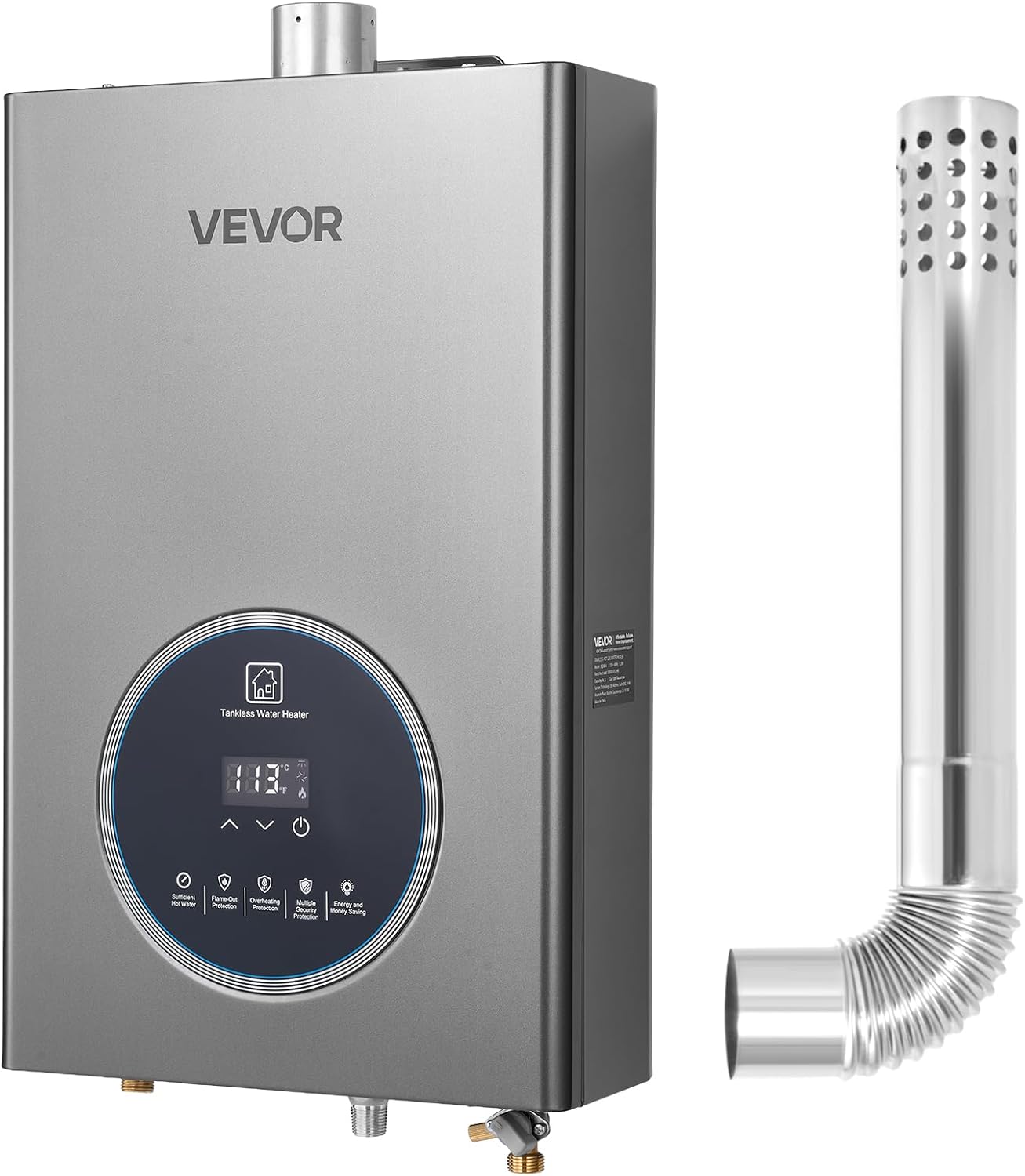
| Power Source | Liquid Propane |
|---|---|
| Flow Rate | 16 liters per minute |
| Maximum Temperature | 149 °F |
| Heat Output | 100000 british thermal units |
| Voltage | 120 volts |
This VEVOR tankless propane unit is designed to deliver continuous hot water for household use by heating on demand rather than storing a large volume. It uses a high-output 100,000 BTU burner and an oxygen-free copper heat exchanger to reach a maximum temperature of 149°F and supports flow rates up to 16 L/min, so it can run multiple outlets in typical homes. The unit's LED display and ±1°F precision control make setting and maintaining a steady temperature straightforward, and the built-in safety features cover flameout, overheating, dry burn, leakage, and anti-freeze scenarios. It mounts to the wall and connects with standard 1/2-inch NPT fittings, which simplifies installation for setups with a direct vent. Expect practical benefits like endless hot water, responsive temperature control, and a compact footprint for tight mechanical spaces. Limitations include its indoor-only orientation and the need for proper propane venting and professional gas hookup; buyers should also confirm the flow rate matches their peak hot-water demand before replacing a larger system.
Best for: Buyers seeking a value-oriented whole-house propane tankless heater who prioritize continuous hot water and precise temperature control on a budget.
Less Ideal for: Homes without safe indoor venting options or households that need very high simultaneous hot-water flow where a larger-capacity unit is required.
- High heat output (100,000 BTU) suitable for whole-house demand in many homes
- Precise ±1°F temperature control with clear LED display for stable comfort
- Multiple safety protections including flameout, overheating, dry burn, and anti-freeze
- Compact wall-mounted design saves space and uses standard 1/2-inch NPT connections
- Indoor-only unit requires correct venting and professional gas installation
- Flow rate (16 L/min) may be marginal for very large households with simultaneous high demand
Verdict: A compact, budget-friendly propane tankless heater that delivers high BTU output and precise digital temperature control for whole-house hot water needs.
Rheem RTGH-68DVLP-3 Tankless Water Heater

| Flow Rate | 6.8 gpm |
|---|---|
| Maximum Temperature | 140 °F |
| Heat Output | 120,000 BTU/hr |
| Efficiency | High Efficiency |
| Power Source | Fuel powered |
The Rheem RTGH-68DVLP-3 is an indoor condensing liquid propane tankless water heater designed for whole-house hot water on demand. It produces up to 6.8 gallons per minute at a 35°F rise and uses a 120,000 BTU/hr burner with condensing technology for high uniform energy factor efficiency. Built-in features like Hot Start Programming reduce cold-water bursts during back-to-back uses, and an Overheat Film Wrap protects the heat exchanger for longer life. The unit is wall-mounted and compact for small mechanical closets and includes digital LED temperature control with precise temperature regulation. Practical benefits include lower standby energy loss compared with tank systems, reduced water waste via a water-saver setting, and ultra-low NOx emissions for cleaner operation. Important limitations are that it requires professional installation, direct venting for indoor placement, and it is fuel-specific to liquid propane so a different fuel setup would be needed for natural gas or electric applications. The product carries a long heat exchanger warranty and is best suited to homes needing reliable continuous hot water for multiple simultaneous uses.
Best for: Buyers who prioritize a dependable, long-lasting whole-house solution that delivers continuous hot water with high efficiency and built-in heat-exchanger protection.
Less Ideal for: Homes without access to liquid propane or without the ability to install direct venting should consider alternative fuel or non-condensing models.
- High-efficiency condensing design reduces gas use and operating costs.
- Hot Start Programming minimizes cold-water bursts between uses.
- Compact wall-mount design fits small mechanical spaces and frees floor space.
- Digital LED temperature control with ±1°F precision for steady set temperatures.
- Requires professional installation and direct venting for indoor use.
- Operates only on liquid propane fuel configuration.
Verdict: Choose the Rheem RTGH-68DVLP-3 if you want a reliable, high-efficiency propane tankless heater that delivers continuous whole-house hot water with factory-grade heat-exchanger protection.
MIZUDO Propane Tankless Water Heater HW180A0W-LP

| Power Source | Liquid Propane |
|---|---|
| Flow Rate | 7.9 gpm |
| Maximum Temperature | 149 °F |
| Voltage | 120 volts |
| Mount Type | Wall |
The MIZUDO HW180A0W‑LP is a high‑output propane tankless unit designed to supply continuous hot water for a medium to large household. It produces up to 180,000 BTU and about 7.9 GPM, which the manufacturer rates to support three to five fixtures simultaneously. The unit uses a sealed combustion design drawing outside air, a copper heat exchanger for efficient heat transfer, and built‑in protections such as freeze prevention, auto‑relight and flue obstruction detection. Wi‑Fi and app control let you monitor and change temperature settings remotely, and the compact wall mount saves space compared with tank heaters. Practical benefits include steadier temperature control for showers and faster recovery than tank systems, plus CSA certification and a factory warranty that covers the heat exchanger for five years. Expect professional installation to handle gas and venting correctly and to meet local code; temperature stability and GPM will depend on inlet water temperature and home plumbing layout, so sizing carefully for your household is important.
Best for: Buyers who prioritize a proven, safety‑certified whole‑house propane tankless solution with remote control and want reliable performance for multiple simultaneous hot water uses.
Less Ideal for: Those seeking a simple DIY swap for a tank heater without professional gas or venting work, or households that need very low‑flow activation below the unit's minimum flow threshold.
- High heat output (180,000 BTU) with up to 7.9 GPM for multi‑fixture use
- Advanced sealed combustion and CSA certification improve safety and indoor air quality
- Wi‑Fi app control for remote monitoring and temperature adjustment
- Copper heat exchanger for efficient heat transfer and durability
- Compact wall‑mounted design saves space compared with tank heaters
- Requires correct venting and professional gas installation
- Performance depends on inlet water temperature and plumbing layout, so real flow may be lower than peak rating
Verdict: A safety‑focused, Wi‑Fi enabled propane tankless heater built to supply steady hot water for families needing three to five simultaneous fixtures.
Rinnai V53DeP Propane Tankless Heater

| Power Source | Gas Powered |
|---|---|
| Flow Rate | 5.3 gpm |
| Special Features | Tankless, Wi‑Fi Capable, Enhanced Scale Detection |
| Material Type | Stainless Steel |
| Mount Type | Wall |
The Rinnai V53DeP is a wall‑mounted propane tankless water heater designed to supply continuous hot water for small to medium households. It produces up to 5.3 gallons per minute, so it can run multiple fixtures at once in many homes without a storage tank. The unit emphasizes energy efficiency by heating only when water is needed and includes enhanced scale detection to reduce mineral buildup and extend life. It is Wi‑Fi capable for remote monitoring when paired with the optional module and has a stainless steel construction with a compact, space-saving profile suited to outdoor installation. Professional installation is recommended to ensure safe gas and exhaust connections. Limitations to consider are the 5.3 GPM ceiling, which may not support very large simultaneous loads, and the need for a qualified installer to realize warranty coverage and proper venting. The robust factory warranty on the heat exchanger and parts gives extra reassurance to buyers who prioritize long-term reliability.
Best for: Buyers who want a reliable, factory‑backed propane on‑demand heater that reduces energy use and minimizes long‑term maintenance concerns and prefer proven durability over cutting‑edge, high‑flow capacity.
Less Ideal for: Those who need very high simultaneous hot water flow for large households or multiple heavy fixtures should consider higher‑capacity units instead.
- Provides continuous on‑demand hot water up to 5.3 GPM for multiple fixtures
- High efficiency design that heats only when needed to reduce energy use
- Enhanced scale detection helps limit mineral buildup and prolongs component life
- Compact wall‑mounted form frees up space compared with tank models
- Wi‑Fi capable for remote monitoring when the optional module is added
- 5.3 GPM limit may be insufficient for very large homes or simultaneous high‑flow demands
- Requires professional installation for safe gas/exhaust setup and to secure full warranty
Verdict: Choose the Rinnai V53DeP if you want a space‑saving, factory‑backed propane tankless heater that reliably delivers efficient, low‑maintenance hot water for typical whole‑house needs.
Choosing the Right Whole-House Propane Tankless Water Heater: Key Factors to Consider
Flow Capacity and Temperature Rise
Flow capacity is the most important factor for whole-house applications because it determines how many fixtures can run at once without running out of hot water. Manufacturers publish maximum flow rates, but those numbers assume a specific temperature rise. You should calculate expected temperature rise by subtracting incoming groundwater temperature from the desired hot-out temperature, then check published performance at that rise. Larger homes or households with simultaneous showers, laundry, and dishwasher use need units rated for higher flow at the expected temperature rise.
Under-sizing the unit leads to short showers and inconsistent water temperature during peak use, while oversizing wastes equipment capacity and can increase installation complexity. Balance realistic peak demand against typical daily use when selecting capacity.
Venting Type and Installation Requirements
Propane tankless water heaters require proper venting and combustion-air arrangements that differ from electric units. Some models support direct-vent, concentric, or power-vent configurations. The venting choice affects where you can place the unit and what materials and clearances are required. Long or complex vent runs may require larger-diameter venting or additional components.
Installation requirements also include clearances to combustibles, appropriate gas line sizing, and potential need for outdoor-rated models in unheated spaces. Confirm whether the location needs a dedicated combustion-air source or sealed-venting to meet code and ensure safe operation.
Gas Supply and Pressure Capacity
A whole-house propane tankless water heater draws substantial gas flow under peak demand. Ensuring your propane supply and regulator can deliver adequate pressure and volume is critical. Inadequate gas supply causes frequent shutdowns or reduced output, and may mimic other faults.
Before installation, confirm tank size, regulator settings, and pipe sizing are sufficient for the unit's maximum BTU or GPH demand. In some situations, upgrades to the regulator or larger supply piping are necessary to achieve rated performance.
Maintenance Needs and Water Quality
Tankless units require periodic maintenance such as descaling, flushing, and cleaning of inlet filters to maintain efficiency and prevent heat exchanger fouling. The frequency depends on your local water hardness and usage patterns. Hard water increases the need for descaling and can shorten service intervals.
Consider whether you will install a water-softening or pre-filter system to reduce maintenance and protect internal components. Also check how accessible covers, filters, and service ports are for routine service or technician visits.
Serviceability and Parts Availability
Long-term ownership depends on how easy it is to access replaceable parts and get qualified service. Units with modular components and clear service panels are faster and less costly to repair. Verify that common replacement parts such as ignition modules, heat exchanger components, and sensors are readily available from distributors or service networks.
Also consider whether local technicians are familiar with the combustion systems and controls used in propane tankless units so that routine maintenance and repairs can be performed promptly.
Sizing Your Whole-House System
Start by listing simultaneous hot-water demands you expect at peak times. Combine flow rates for showers, sinks, dishwashers, and washing machines to estimate peak gallons per minute. Then calculate the required temperature rise from incoming groundwater temperature to your desired hot water output. Match that flow at the expected temperature rise to published performance curves to choose the right capacity.
If you have variable household patterns, consider a modest buffer above estimated peak demand to accommodate occasional spikes. Avoid relying on maximum short-duration surge numbers; use continuous flow performance at the temperature rise you calculated.
- Measure incoming water temperature in winter for a conservative temperature-rise estimate
- Add flows for simultaneous fixtures rather than averaging
- Include growth allowance if household size may increase
Venting Options and Placement Considerations
Venting constraints often dictate where the unit can be installed. Direct-vented units draw combustion air from outside and exhaust combustion gases through a dedicated vent. Power-venting uses a fan to push exhaust through ducts, which can allow greater venting flexibility but requires electrical backup and periodic fan maintenance. Choose a location where vent runs are practical and meet clearance requirements.
Also consider noise, service access, and proximity to gas and water lines. An outdoor-rated model may simplify venting but exposes components to weather and can affect freeze protection strategies.
- Short, straight vent runs are simplest and most reliable
- Avoid long horizontal runs that can accumulate condensate
- Check local code for vent termination clearances
Dealing With Hard Water
Hard water accelerates scale buildup in the heat exchanger, reducing efficiency and shortening service life. Regular descaling and flushing schedules are essential in hard-water areas, and many installers recommend a water-softening or scale-inhibition system when hardness exceeds moderate levels.
If a softener is not feasible, choose maintenance schedules and access plans that allow frequent descaling. Also confirm whether the unit has accessible inline filters and easy-to-service drain points to simplify maintenance.
- Install a sediment filter on the cold-water inlet to trap particulates
- Plan a descaling interval based on local hardness and usage
- Consider a scale-prevention system if hardness is high
Electrical Requirements and Backup
Although these units run on propane, most require electricity for controls, ignition, and pumps. Ensure you have a reliable electrical supply and consider how power outages will affect hot-water availability. For locations with frequent outages, evaluate options for backup power or manual bypasses if maintaining hot water during outages is critical.
Also check whether the unit's electrical needs require dedicated circuits and whether its controls are compatible with smart home or monitoring systems you plan to use.
- Verify voltage and circuit requirements before installation
- Consider adding a small UPS for control electronics in outage-prone areas
- Confirm pump and control wiring accessibility for technicians
Permits, Codes, and Safety
Propane combustion systems are regulated for safety reasons. Permits and inspections are commonly required for new installations and often for gas-line or venting changes. Work with a licensed installer who understands local codes and permitting processes to reduce delays and ensure safe operation.
Installers should verify clearances, combustion-air provisions, and proper venting termination locations. Carbon monoxide detection and appropriate combustion-air pathways are critical safety elements to address during installation.
- Obtain required permits before installation
- Use licensed gas technicians for line and regulator work
- Install CO detectors in accordance with local code
How We Chose the Best Whole-House Propane Tankless Water Heater
We focused on selection factors that reflect how whole-house propane tankless water heaters perform in daily residential use. Our evaluation prioritized accurate published flow rates at realistic temperature rises, as that directly determines whether a unit can handle simultaneous showers, dishwasher runs, and laundry. We also assessed venting and installation complexity since propane tankless units often require specific flue and combustion-air provisions that affect installation time and cost. Reliability considerations included build quality indicators and access for routine maintenance, such as filter cleaning and descaling. Fuel efficiency and certification data were reviewed to estimate operating cost differences and combustion safety. Finally, we considered parts availability and serviceability, because long-term repairs or component replacement can materially affect ownership experience. We excluded point-of-use and small-capacity units that are not sized for whole-house service, and units intended only for indoor electric or natural gas setups. The final short list reflects models that met minimum whole-house flow and venting standards while offering reasonable service access and efficiency.
Our full evaluation process is outlined in our review methodology.
FAQ
How do I calculate the right size for a whole-house propane tankless water heater?
Estimate peak simultaneous fixture flow by adding shower, sink, dishwasher, and laundry flows. Determine temperature rise by subtracting incoming water temperature from desired hot output. Match required GPM at that temperature rise to manufacturer performance curves to pick a unit sized for continuous peak demand.
Can a propane tankless unit run out of hot water?
Yes, if the unit is undersized for simultaneous demand or if gas supply is limited. Proper sizing for expected peak flow and ensuring adequate propane pressure and regulator capacity will prevent most shortages.
How often do these units need maintenance?
Maintenance frequency depends on water hardness and usage but typically includes annual inspections and periodic descaling. Hard-water areas may require more frequent flushing and filter checks to maintain efficiency.
Do I need to upgrade my propane supply for a whole-house unit?
Possibly. Whole-house units have higher BTU demand than point-of-use heaters. Verify tank size, regulator settings, and pipe sizing can deliver the required gas flow. Some installations require regulator upgrades or larger supply piping.
Are indoor installations safe with propane tankless water heaters?
Indoor installations are safe when venting, combustion-air supply, and clearances meet code and the unit is installed by a qualified technician. Sealed combustion and direct-vent options improve indoor safety by isolating combustion from indoor air.
Final Verdict
Choosing the right whole-house propane tankless water heater comes down to matching realistic peak flow at your expected temperature rise, ensuring your propane supply and venting options support rated performance, and planning for water-quality-driven maintenance. Prioritize accurate sizing, adequate gas delivery, and accessible service points to reduce downtime and maintain efficiency. With those tradeoffs in mind, you can select a unit that reliably meets household needs while minimizing long-term upkeep.