
Note: This article contains affiliate links. If you click on these links and make a purchase, we may earn a small commission at no extra cost to you. This helps support our research and content. Read our full affiliate disclosure here.
If you rely on a horizontal sliding window for ventilation, the right window fan can make a big difference in airflow, noise, and daily convenience. Choosing a fan designed for horizontal sliding windows ensures a better seal, simpler mounting, and optimal air direction compared with using a generic unit. This guide covers seven shortlisted window fans chosen for their fit, airflow performance, noise control, and installation simplicity. Read on to see how we evaluated each option across installation, airflow, and user convenience so you can pick the best fan for your sliding window and living space.
Top Picks at a Glance
| Best Overall The best all-around choice for most situations | shinic Window Fan WD19-24R |  |
| Best Quality Built to a higher standard if you want something more solid | Vornado Transom Window Fan |  |
| Best Value The sweet spot between price and what you get | BLACK+DECKER 9" Dual Window Fan BFW9M |  |
| Best Budget The cheapest option that still gets the job done reliably | Amazon Basics Twin Window Fan FN922 |  |
| Top Rated A top-rated pick with lots of positive feedback | shinic WD18-9T Window Fan |  |
| Most Popular A crowd favorite that many people choose with confidence | Comfort Zone 9" Twin Window Fan |  |
| Best Seller A high-volume bestseller chosen again and again | Comfort Zone 9" Twin Window Fan CZ319WT2 |  |
shinic Window Fan WD19-24R

| Number of Speeds | 4 |
|---|---|
| Noise Level | 47 db |
| Wattage | 70 watts |
| Air Flow Capacity | 450 cfm |
| Control Method | Remote |
This shinic window fan is designed to fit horizontal sliding windows and alternates between intake and exhaust to help circulate air without running an air conditioner. It installs quickly using the included foam spacer blocks to adapt to window widths from 26.0 to 39.7 inches and sits low-profile with no exposed blades, which keeps bedrooms and living rooms looking tidy. Controls include a basic button panel plus a remote and an LED thermostat/timer so the fan can kick on or off automatically based on room temperature or set run times. The 4-speed motor produces up to 450 CFM while claiming a modest noise level around 47 dB, which is reasonable for background use during work or sleep. Build materials are standard ABS plastic and the unit is rated ETL. Limitations to note are the horizontal-only installation and the relatively simple control set compared with smart or app-enabled models, and the wattage and airflow are typical rather than exceptional for high-volume ventilation needs. For someone wanting straightforward, reversible airflow for a sliding window, this is a practical option.
Best for: Buyers who want a straightforward, plug-in solution to improve airflow in a horizontal sliding window and value simple automated control and a low-profile appearance.
Less Ideal for: People seeking smart-home connected fans, high-output ventilation for large, hot spaces, or models that fit vertical or unconventional window types should look elsewhere.
- Reversible intake and exhaust modes for daytime cooling or nighttime ventilation
- Remote control plus LED thermostat and timer for automated on/off based on temperature
- Adjustable width with foam spacer blocks fits 26.0" to 39.7" horizontal windows
- Low-profile design with no exposed blades improves bedroom privacy and aesthetics
- Horizontal installation only, not suitable for vertical or casement window types
- Controls are basic and lack smart app or Wi‑Fi connectivity
Verdict: A practical reversible window fan for horizontal sliding windows that delivers automated, low‑profile airflow without smart-home complexity.
Vornado Transom Window Fan

| Number of Speeds | 4 |
|---|---|
| Air Flow Capacity | 185 cfm |
| Wattage | 25 watts |
| Noise Level | 45 db |
| Motor Type | Brushless |
The Vornado Transom is a low-profile horizontal window fan built for whole-room air exchange and continuous circulation. It installs in single- or double-hung windows using a Soft-Fit foam block system and can be set to intake or exhaust via an electronically reversible chamber. In daily use it offers four speed settings, a brushless motor, and a remote plus touchpad controls for convenient adjustments from across the room. Vornado highlights a weather-resistant case and a design focused on vortex circulation, which helps push a concentrated airstream into living spaces rather than just moving air locally. Practical benefits include moderate power draw at 25 watts, a claimed 185 cfm airflow, and a compact low-profile that keeps the fan tucked into the sill without sticking far into the room. Important limitations are that it must be mounted horizontally and may require screen removal on some windows, and noise at higher speeds is noticeable around the listed 45 dB level, which could matter in very quiet bedrooms.
Best for: Buyers who prioritize steady whole-room airflow and flexible ventilation control for horizontal windows and want a durable fan with remote operation.
Less Ideal for: People seeking a truly silent bedroom fan or those needing a fan that can be mounted vertically or in nonstandard window openings.
- Electronically reversible chamber for easy intake or exhaust switching
- Four speed settings with remote control and touchpad for convenient operation
- Low-profile Soft-Fit system designed to seal windows 26"–40" wide
- Brushless motor and weather-resistant case for durable, reliable operation
- Requires horizontal installation and may need window screen removal on some frames
- Higher speeds produce noticeable noise that may be distracting in very quiet rooms
Verdict: A performance-focused horizontal window fan that delivers strong, reversible whole-room airflow with convenient remote control.
BLACK+DECKER 9" Dual Window Fan BFW9M
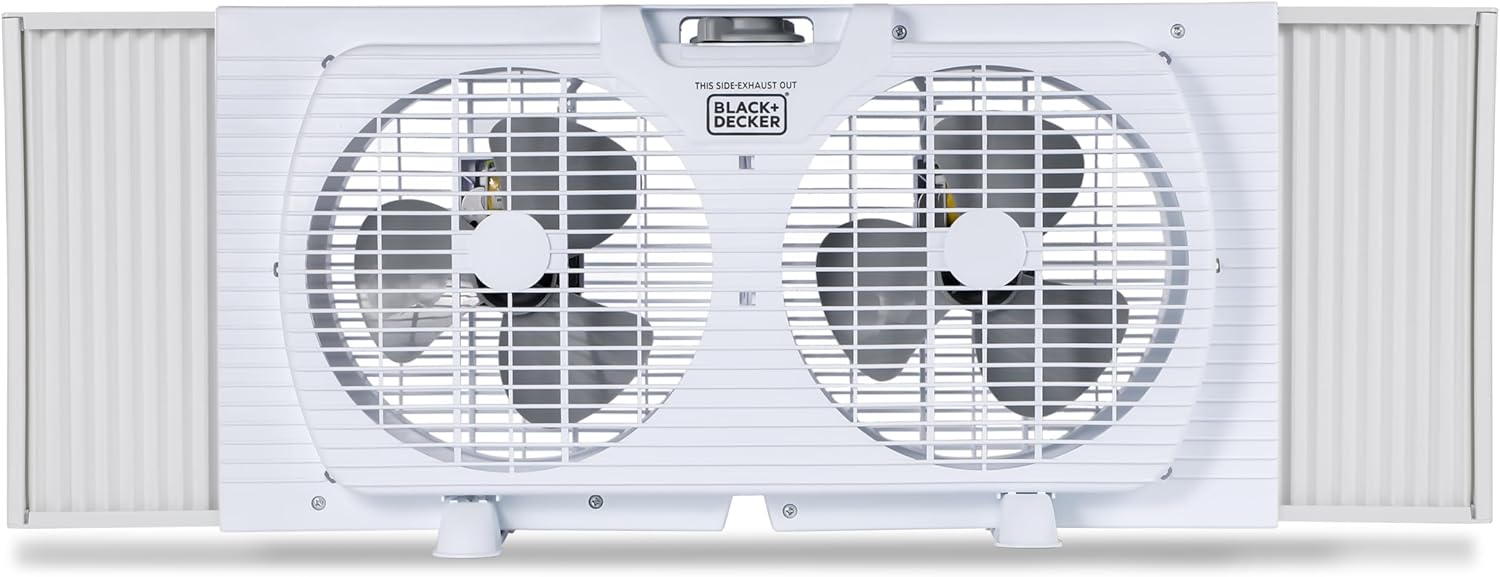
| Power Source | Corded Electric |
|---|---|
| Number of Speeds | 2 |
| Wattage | 56 watts |
| Mounting Type | Window Mount |
| Accordion Expander Range | 22.5" – 33" |
The BLACK+DECKER 9" Dual Window Fan is a lightweight, window-mounted fan designed to boost air circulation in rooms with horizontal sliding windows. It installs using accordion expanders that fit openings from 22.5" to 33" and includes removable legs so you can also use it on a floor or shelf. Each of the twin 9" poly blades is driven by a brushless motor and the dial offers two speeds for simple low or high airflow control. Flip the unit to switch between drawing fresh air in or exhausting stale room air, which makes it useful for cooling, ventilating kitchens, or clearing stuffy bedrooms. At 56 watts it is energy efficient for continuous use, and the plastic housing keeps it light for moving between rooms. Important limits are the simple two-speed control and manual reversal, so you will not get variable fan curves, quiet low-power operation like specialty fans, or smart controls. The fan is best when you need straightforward, portable window ventilation without extra features.
Best for: Buyers who want a simple, portable window fan to improve ventilation in sliding windows and prioritize easy installation, energy efficiency, and straightforward operation.
Less Ideal for: People who need precise speed control, app or smart-home integration, or ultra-quiet operation for bedrooms should consider alternative fan types.
- Twin 9" fans provide stronger cross-room airflow than a single fan
- Accordion expanders fit horizontal sliding windows from 22.5" to 33"
- Removable legs let you convert from window mount to floor or shelf placement
- Brushless motor with poly blades at 56W offers efficient, portable operation
- Only two speeds and manual dial control limit fine-tuned airflow adjustment
- Plastic construction may be less durable or quieter than higher-end metal fans
Verdict: A practical, easy-to-install dual window fan that delivers straightforward ventilation for horizontal sliding windows without unnecessary extras.
Amazon Basics Twin Window Fan FN922

| Wattage | 68 watts |
|---|---|
| Number of Blades | 6 |
| Blade Length | 9 inches |
| Number of Speeds | 2 |
| Power Source | AC |
This Amazon Basics twin window fan is a basic, no-frills option for improving airflow in horizontal sliding windows. It installs using expandable side panels that fit standard windows about 25 to 32 inches wide and sits in the opening to either pull air in or push air out by reversing the fan direction. The unit uses two 9-inch blades driven by a 68W motor and offers two manual speed settings controlled with simple push buttons, so it is straightforward to operate. Plastic construction and included feet keep weight down and make it easy to move or store when not in use. Practical benefits include quick installation without tools for many windows, effective cross-ventilation in small to medium rooms, and reliable single-purpose performance. Limitations are its simple control set and plastic build, which mean fewer comfort refinements and shorter perceived longevity compared with higher-end metal or multi-speed models, and it is intended for indoor window-mounted use only.
Best for: Buyers seeking an affordable, easy-to-install window fan to boost ventilation in a bedroom or small living space and who prioritize low cost and simple operation.
Less Ideal for: If you need precise speed control, a heavier-duty metal fan for long daily runtime, or outdoor-rated equipment, look at higher-end or purpose-built alternatives.
- Expandable side panels fit most horizontal sliding windows without additional hardware
- Reversible airflow for intake or exhaust to support ventilation or heat purge
- Simple push-button controls and two speeds make it easy to use
- Included feet and lightweight design make installation and storage straightforward
- Only two speed settings limit fine control of airflow
- Plastic construction may feel less durable than metal-bodied fans
- Designed for indoor window use only, not for outdoor exposure
Verdict: A budget-friendly, easy-to-install twin window fan that delivers straightforward intake or exhaust airflow for horizontal sliding windows.
shinic WD18-9T Window Fan

| Number of Speeds | 3 |
|---|---|
| Noise Level | 38 db |
| Wattage | 70 watts |
| Air Flow Capacity | 450 cfm |
| Mounting Type | Window Mount/Free Standing |
The shinic WD18-9T is a compact dual-head window fan designed to fit horizontal sliding windows and provide flexible ventilation. Each 9-inch head rotates (up to 270°) so you can point intake and exhaust where needed and manually set the unit to intake, exhaust, or a mix of both for through-ventilation. A simple knob and push-button controls offer three speeds and quiet operation around the stated 38 dB level, while the included rigid and accordion expanders let the frame extend from 21.65 to 33.27 inches to match different openings. The fan can sit in the window or use the detachable feet for tabletop placement, and a carry handle makes it easy to move between rooms. At 70 watts and ETL certified, it delivers solid airflow (450 CFM) without complex setup. Expect basic manual controls and the need to tilt/adjust the heads for precise airflow rather than automatic sensing or remote control; the finish and plastic construction are serviceable but not premium. For buyers who want reliable, straightforward ventilation for sliding windows, this is a practical, easy-to-install option.
Best for: Buyers who prioritize a dependable, no-frills ventilation solution for horizontal sliding windows and want flexible intake/exhaust control without advanced electronics.
Less Ideal for: Users who need app/remote control, programmable schedules, or a premium metal-finish unit should look elsewhere.
- Dual rotatable fan heads let you configure intake, exhaust, or simultaneous flow for cross-ventilation.
- Adjustable width with auto-locking expander and rigid panels fits many horizontal sliding windows.
- Three straightforward speeds with push-button/knob control and quiet operation for bedroom use.
- Includes detachable feet and carry handle for tabletop portability and easy repositioning.
- ETL certification and 450 CFM airflow provide dependable, tested ventilation performance.
- Controls are manual only with no remote, timer, or smart features.
- Plastic construction and painted finish feel utilitarian rather than premium.
Verdict: A dependable, easy-to-install dual-head window fan that delivers flexible intake/exhaust airflow for horizontal sliding windows.
Comfort Zone 9" Twin Window Fan

| Number of Speeds | 2 |
|---|---|
| Air Flow Capacity | 272 cfm |
| Wattage | 45.9 watts |
| Noise Level | 53.3 db |
| Power Source | Corded Electric |
The Comfort Zone 9" Twin Window Fan is a plug-in window-mounted fan designed to move air in or out of a room with its reversible twin-blade setup. It installs with accordion expanders that lock to fit a wide range of horizontal sliding windows and offers two speeds controlled by a push-button/dial. The fan includes removable fabric and screen covers to block insects when not in use and attachable feet plus a carry handle for temporary tabletop placement. At 272 cfm and roughly 46 watts it can provide a noticeable breeze on high while the low setting is suitable for gentler circulation, though noise at 53.3 dB may be noticeable in very quiet rooms. The plastic housing and blades keep weight down for easier installation but mean the unit is not as durable-feeling as heavier metal fans. This model is simple to operate and versatile for cooling or exhausting rooms, but it lacks more advanced speed or quiet modes found on higher-end models.
Best for: Buyers who value a proven, easy-to-install window fan that fits many horizontal sliding windows and prefers a straightforward plug-and-play cooling or exhaust solution backed by many user reviews.
Less Ideal for: Those wanting near-silent operation, fine-grained speed control, or a heavy-duty, long-lasting metal build should consider more feature-rich or premium models instead.
- Auto-locking accordion expanders fit a wide range of horizontal sliding windows securely
- Reversible intake/exhaust function lets you bring in fresh air or push out stale hot air
- Removable fabric and screen covers protect against bugs and are easy to clean
- Portable design with carry handle and attachable feet for quick tabletop use
- Only two speeds and no dedicated quiet mode on this variant
- Plastic construction is lightweight but less rugged than metal alternatives
Verdict: A simple, widely used twin window fan that reliably fits horizontal sliding windows and delivers effective intake or exhaust airflow with easy installation.
Comfort Zone 9" Twin Window Fan CZ319WT2

| Number of Speeds | 3 |
|---|---|
| Air Flow Capacity | 272 cfm |
| Wattage | 45.9 watts |
| Noise Level | 53.3 db |
| Power Source | Corded Electric |
The Comfort Zone 9" Twin Window Fan is a practical window-mounted fan that pulls fresh outside air in or exhausts stale indoor air when reversed. It uses two 9-inch blade assemblies driven by a simple dial offering three speeds including a quieter low setting, and the unit delivers up to 272 CFM at its rated speed. Installation is straightforward: accordion expanders adjust from about 22.25" to 33" and auto-lock into the frame of a horizontal sliding window, while a removable bug screen and fabric cover block pests and debris. The fan can also convert to a freestanding desk or floor fan using the included tabletop feet and carry handle, and the 5-foot cord gives placement flexibility. Construction is plastic, so it is lightweight and easy to move but not as rugged as metal alternatives. Noise at higher speeds is noticeable, and the manual reverse requires physically turning the unit in the window rather than a motorized switch. For buyers wanting a simple, safety-tested ETL-certified way to improve airflow in sliding windows, this unit covers the basics reliably.
Best for: Buyers who prioritize a reliable, easy-to-install airflow solution for horizontal sliding windows and want a low-friction, safety-tested product that can also be used freestanding.
Less Ideal for: Those seeking a premium, heavy-duty metal fan, automated reversal, or integrated remote/Wi‑Fi control should consider other options.
- Reversible intake/exhaust airflow for fresh air or ventilation
- Auto-locking accordion expanders fit a wide range of horizontal sliding windows
- Three-speed dial control including a quiet setting for nighttime use
- Includes removable bug screen and tabletop feet for freestanding use
- ETL certified for basic safety and performance
- Plastic construction is lightweight but less durable than metal-bodied fans
- No motorized reversal or remote control on this model, reversing is manual
- Higher speeds produce noticeable noise
Verdict: A straightforward, ETL-certified reversible twin window fan that reliably boosts ventilation in horizontal sliding windows with simple installation and three-speed control.
Choosing the Right Window Fan for Horizontal Sliding Window: Key Factors to Consider
Fan Size and Airflow
Fan size determines how much air the unit can move and how it distributes airflow across a room. Larger fans generally push more air but may not fit narrower sliding-window openings, so measure the available sash opening width and sill depth before selecting a unit.
Look for published airflow figures and consider how multiple lower-speed settings compare to a single high-speed rating. Higher CFM helps cool larger rooms and support cross-ventilation when paired with another fan, while smaller fans can work well in compact rooms or for spot ventilation.
Mounting Type and Seal
The mounting design matters more for sliding windows than for vertical sash windows because the fan must accommodate a horizontally moving sash. Check whether the fan includes adjustable mounting brackets, compressible seals, or expandable panels to close gaps around the unit.
A tight seal reduces drafts, prevents insects from entering, and improves the effectiveness of intake versus exhaust configurations. Also consider whether the installation requires drilling or can be done with clamps and screws that preserve the window frame.
Noise and Acoustic Performance
Noise is a frequent dealbreaker for fans used in bedrooms and living areas. Evaluate reported decibel levels at typical operating speeds and whether the fan offers low-speed options for quieter background ventilation.
Pay attention to motor type and blade design, as these affect tonal quality and perceived loudness. Features such as rubber mounting gaskets or vibration-damping feet can reduce rattles and improve comfort during extended use.
Controls and Directional Options
Flexible controls let you adapt the fan to different ventilation tasks. Important control features include multiple speed settings, reversible airflow to switch between intake and exhaust, and timers or thermostatic triggers for automated operation.
Reversible airflow is especially useful for sliding-window setups when you want to draw cool night air in and push hot air out during the day. Remote controls and simple knob interfaces reduce the need to repeatedly open or adjust the window.
Durability and Weather Resistance
Because a window fan sits directly in the opening, it is exposed to sunlight, temperature swings, and occasional moisture. Look for corrosion-resistant materials, UV-stable plastics, and motors designed for continuous or intermittent duty.
A robust casing and quality seals extend the fan's usable life and reduce the chance of failure during peak seasons. Consider how easy it is to access the motor and blades for cleaning, since accumulated dust affects performance and longevity.
Ease of Cleaning and Maintenance
Regular cleaning preserves airflow and reduces noise from imbalance caused by dust buildup. Check whether the unit has removable grills or an easily accessible fan assembly for quick maintenance.
Screwless or tool-free access panels speed routine cleaning. Also consider the availability of replacement parts such as filters or seals, and whether the manufacturer documents basic service steps clearly.
Sizing Your Sliding Window Opening
Measure both the horizontal width and the vertical clearance of your sliding window opening before shopping. Many window fans are sized for specific widths and include telescoping panels or foam gaskets to fill small gaps, but others require a close match to the sash opening.
Also check the sill depth and whether the fan's housing will protrude into the room or onto the exterior. A shallow sill can complicate mounting, while a deeper sill usually provides more secure screw or bracket options.
- Measure with the sash fully open to the intended operating position
- Note any obstructions like handles or storm-window tracks
- Account for the finished interior trim thickness
Installation Tips for a Secure Fit
Plan the mounting so the movable sash securely presses against the fan's sealing strip or panel. Some fans use a clamping bracket that tightens without drilling; others need small fasteners into the frame. If you prefer a noninvasive installation, select a model with robust clamp hardware and foam seals.
Seal any remaining gaps with weatherstripping or adhesive foam tape to prevent drafts and insect entry. Verify the fan sits squarely in the opening to avoid vibration and noise during operation.
- Test fit the unit before final fastening
- Use nonpermanent clamps when renting or when window warranty prohibits drilling
- Tighten brackets incrementally to keep the unit level
Using Fans for Intake Vs Exhaust
Decide whether you will primarily use the fan to draw cool air in or to push hot air out. Intake mode brings fresh air into the room and works well at night or when the outdoor temperature is lower than indoors. Exhaust mode helps remove hot, stale air and is useful in the heat of the day or to clear cooking odors.
A reversible fan simplifies switching between modes. If your unit is not reversible, pairing two fans—one set to intake and one to exhaust—can establish effective cross-ventilation, provided your window and room layout allow it.
- Use intake at night for cooler outdoor air
- Use exhaust during peak indoor heat periods
- Combine with other vents for whole-home airflow
Managing Noise Without Sacrificing Airflow
To balance quiet operation and cooling performance, run the fan at the lowest speed that produces meaningful airflow for the room size. Many fans have multiple speed steps that provide a compromise between decibels and CFM.
If noise is a primary concern, prioritize models with vibration isolation features and aerodynamic blades. Minor mounting adjustments, like tightening loose screws or adding a thin gasket, can significantly reduce rattles and tonal peaks.
- Start at low speed and increase gradually
- Check and tighten mounting hardware after installation
- Clean blades regularly to prevent imbalance noise
Seasonal Use and Storage
Window fans used seasonally benefit from basic off-season storage to prolong life. Before storing, clean the blades and housing, dry all parts thoroughly, and remove batteries from remote controls.
Store the unit in a dry place away from direct sunlight and extreme temperatures. Consider covering the fan or keeping it in a box to prevent dust accumulation. Before reinstallation, inspect seals and mounting hardware for wear and replace any compressed foam or cracked gaskets.
- Clean and dry before storage
- Keep remotes and small parts together
- Inspect seals before reinstalling
How We Chose the Best Window Fan for Horizontal Sliding Window
We prioritized features and measurements that directly affect performance and fit for horizontal sliding windows. Key evaluation metrics included actual airflow output under typical operating conditions, the adaptability of mounting hardware and seals for different sill depths, and noise levels measured during low and high settings. We also assessed installation complexity, including whether the fan can be mounted without permanent modifications, and durability factors such as materials and motor cooling. Products were excluded if they lacked clear guidance for horizontal sliding window mounting or relied solely on universal accessory kits with poor sealing. We did not consider ceiling, tower, or inline fans because those are outside the sliding-window use case. In short, the list favors fans that balance measurable airflow and low noise, provide secure, weather-tight mounting for sliding sashes, and offer durable controls and construction for frequent seasonal use.
Our full evaluation process is outlined in our review methodology.
FAQ
Can a window fan fit any horizontal sliding window?
Not necessarily. Fit depends on the opening width, sill depth, and whether the fan's mounting system is compatible with a sliding sash. Measure the opening and confirm the fan includes adjustable panels or clamps designed for horizontal sliding windows.
Is a reversible fan worth it for a sliding window?
Often yes. Reversible airflow adds flexibility so you can switch between intake and exhaust without reinstalling the unit. It is particularly useful if you want to pull cool night air in and exhaust hot air during the day.
How do I reduce vibration and rattling after installation?
Check that the fan is square in the opening and that the mounting hardware is snug but not over-tightened. Add thin foam gaskets where the fan contacts the sash to damp vibration, and tighten any loose screws on the frame or housing.
Are window fans energy efficient compared with other cooling options?
Window fans typically use less electricity than room air conditioners and can be efficient for ventilating or creating cross-breezes. Efficiency depends on airflow at a given power draw, so look for models that offer high CFM per watt and variable speed controls.
How often should I clean a window fan?
Clean the grille and blades at least once per season, more often in dusty environments. Regular cleaning maintains airflow and prevents noise from imbalanced blades. Follow the manufacturer's instructions for safe access to the motor and fan assembly.
Final Verdict
Choose a window fan that matches your sliding sash dimensions, delivers sufficient airflow for the room size, and offers the mounting and sealing features you need. Balance CFM against noise and prioritize reversible airflow if you plan to alternate intake and exhaust. Durable materials and accessible maintenance points extend service life. Focus on installation ease and acoustic performance as primary tradeoffs. With careful measurement and attention to sealing, you can confidently select a fan that improves ventilation and comfort for your horizontal sliding window.