
Note: This article contains affiliate links. If you click on these links and make a purchase, we may earn a small commission at no extra cost to you. This helps support our research and content. Read our full affiliate disclosure here.
If you want dependable, creamy plant-based yogurt without trial and error, choosing the right Yogurt Maker for Non-Dairy Milk matters. Non-dairy milks require steadier temperatures and sometimes longer incubation than dairy, so not all yogurt makers deliver consistent results. This guide covers seven shortlisted yogurt makers that handle plant-based bases well and highlights the practical features that make them suitable for soy, almond, oat, coconut, and other milks. You will find concise guidance on temperature control, vessel options, and cleaning, plus the specific criteria we used to evaluate these units. Read on to see which features matter most when making non-dairy yogurt at home.
Top Picks at a Glance
| Best Overall The best all-around choice for most situations | Euro Cuisine GY50 Greek Yogurt Maker |  |
| Best Quality Built to a higher standard if you want something more solid | TANICA YOGURTiA Yogurt Maker |  |
| Best Value The sweet spot between price and what you get | Mueller Ultra Yogurt Maker |  |
| Best Budget The cheapest option that still gets the job done reliably | JoyMech Yogurt Maker |  |
| Top Rated A top-rated pick with lots of positive feedback | GDOR Yogurt Maker SNJ159 |  |
| Most Popular A crowd favorite that many people choose with confidence | Euro Cuisine YM80 Yogurt Maker |  |
| Best Seller A high-volume bestseller chosen again and again | Ultimate Probiotic Yogurt Maker |  |
Euro Cuisine GY50 Greek Yogurt Maker

| Included Components | Bowl, strainer, lid |
|---|---|
| Material Type | Plastic |
| Model Number | GY50 |
| Capacity | Up to 2 quarts |
The Euro Cuisine GY50 is a simple, refrigerator-based yogurt strainer designed to turn plain yogurt into thick Greek-style yogurt without electricity or complicated steps. You pour up to 2 quarts of homemade or store-bought yogurt into the ultra-fine mesh strainer, let it sit in the fridge for several hours while whey drains into the outer bowl, then remove the strainer to reveal thicker, creamier yogurt. Its stackable, flat-top design saves fridge space and the BPA-free plastic parts are lightweight and easy to rinse clean. The included recipe booklet gives ideas for dips and desserts, and the fine mesh helps retain solids while removing whey for a reliably dense result. Limitations are its manual process and refrigerator time, so it is not a fast, automated maker and it does not heat, culture, or incubate non-dairy milks on its own; you must prepare or purchase suitable yogurt or cultured base first. For those who want a no-frills way to thicken yogurt and reduce waste, it performs the task well, but it is not a full yogurt-making appliance for culturing plant milks from scratch.
Best for: Buyers who want a straightforward, low-effort way to turn plain or store-bought yogurt into thick Greek-style yogurt and value simplicity and compact fridge-friendly storage.
Less Ideal for: People seeking an all-in-one yogurt maker that heats, cultures, or specifically ferments non-dairy milks from scratch should look at incubating appliances instead.
- Ultra-fine mesh achieves thick, consistent straining without losing solids
- BPA-free, lightweight plastic that is easy to rinse and air dry
- Flat-top, stackable design conserves refrigerator space
- Handles up to 2 quarts so you can strain multiple servings at once
- Manual, passive straining requires several hours in the refrigerator and no heating or culturing functions
- Plastic construction may feel less durable than stainless-steel alternatives
Verdict: If you want an inexpensive, fridge-friendly way to reliably thicken yogurt into Greek-style texture, the GY50 is an easy and effective manual strainer.
TANICA YOGURTiA Yogurt Maker

| Capacity | 1100 ml |
|---|---|
| Temperature range | 25–70°C (77–158°F) |
| Temperature increment | 1°C/1°F |
| Power supply | AC100V–240V |
| Power consumption | 36W |
The TANICA YOGURTiA is a compact, made-in-Japan fermentation appliance designed for repeatable results across yogurt and other low-temperature ferments. It uses microcomputer temperature control adjustable in 1°C/1°F increments from 25–70°C (77–158°F) and a flexible timer (10–50 minutes or 1–48 hours), which makes it easy to dial in the exact conditions required for dairy and non-dairy cultures. The unit stores the last three settings and offers an optional completion buzzer, and it ships with two 1,100 ml glass pots, a spoon, an eggs stand and a recipe booklet so you can start right away. Glass pots resist odors and scratches and can be thermally disinfected before use. Practical limits: its single small chamber only fits the two supplied jars so batch size is limited, and delicate plant-based milks may still need recipe adjustments for thickness and culture activity. For someone who prioritizes precise, repeatable temperature control and clean glass containers, YOGURTiA makes testing different non-dairy recipes straightforward, but expect to tweak cultures and thickeners for consistently firm results with some plant milks.
Best for: Buyers who value precise temperature control and consistent results when experimenting with yogurt and other ferments, especially those who will test different non-dairy recipes and want clean glass containers.
Less Ideal for: Those who need to make large batches at once or want a multi-jar commercial-capacity unit; people seeking an all-in-one incubator with many jar sizes included.
- 1°C/1°F precise temperature control (25–70°C) for repeatable fermentation
- Includes two 1100 ml glass pots that resist odors and can be thermally disinfected
- Flexible timer range and memory for storing the last three settings
- Worldwide 100–240V support lets it run on standard voltages without a converter
- Small single chamber limits total batch volume to the included jars
- Plant-based milks often require additional thickeners or recipe tweaks for firm yogurt
Verdict: Choose YOGURTiA when precise, repeatable temperature control and glass fermentation jars matter most for perfecting non-dairy yogurts.
Mueller Ultra Yogurt Maker
| Jar capacity | 6 oz per jar |
|---|---|
| Number of jars | 8 jars |
| Material | Stainless steel housing; glass jars |
| Dishwasher safe | Top-rack for jars |
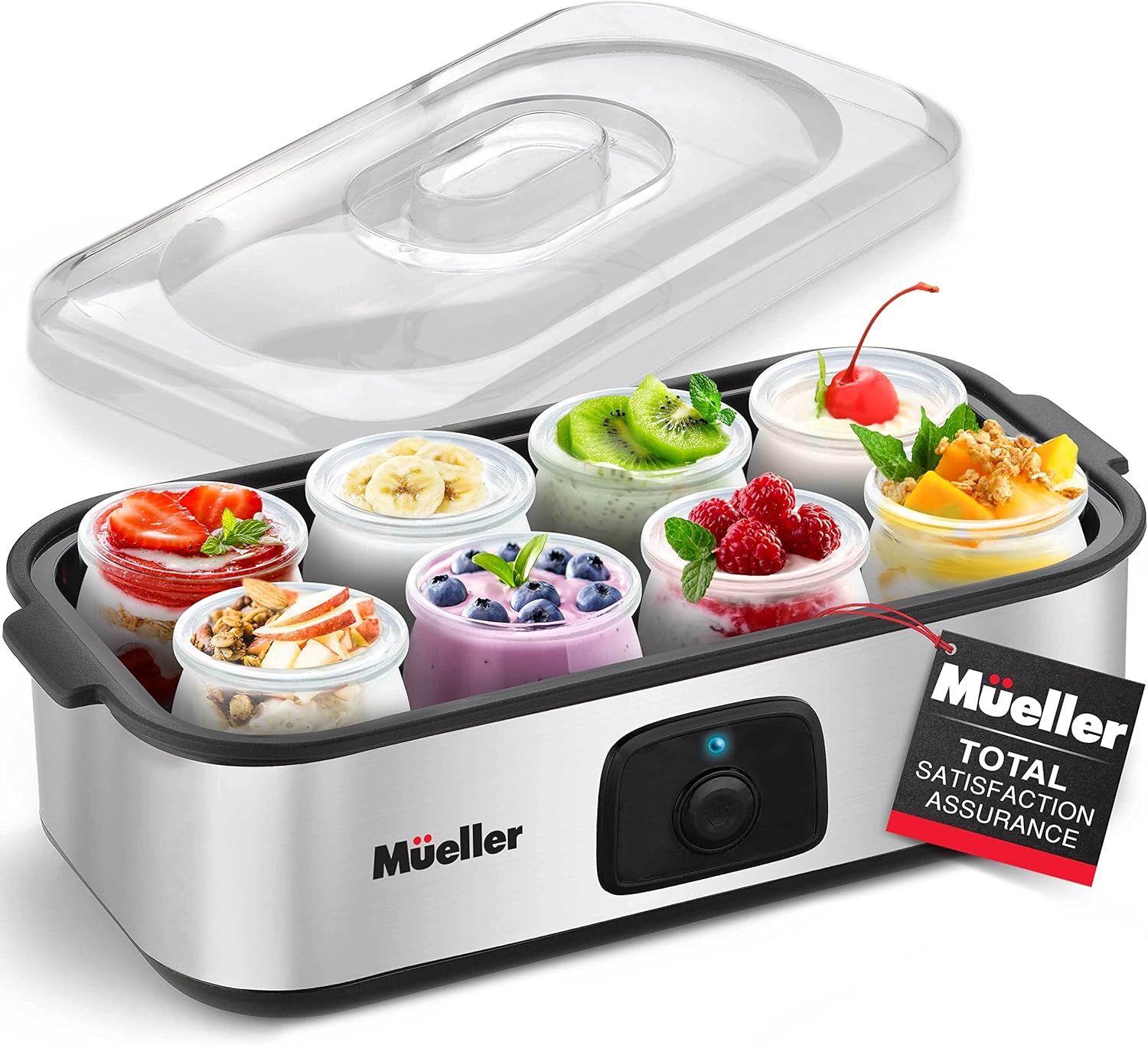
The Mueller Ultra Yogurt Maker is a simple, all-in-one appliance for making individual jars of homemade yogurt using your choice of milk and starter. You fill the eight 6 oz glass jars, set the jar lids and cover, press the single control, and let the unit maintain a steady warm environment for roughly 8 to 12 hours depending on milk type and how thick you want the yogurt. The stainless steel housing and glass jars give a durable, easy-to-clean feel and the jars are top-rack dishwasher safe for quick cleanup. Because it uses a passive timed heating environment rather than smart temperature programming, it is straightforward but requires you to judge time for non-dairy milks that often need slightly different incubation or thickness adjustments. The individual jars are convenient for portioning, flavoring, or making kefir-like textures, and the reusable lids keep jars stored safely in the fridge after fermenting. If you want a no-fuss unit for experimenting with almond, soy, oat, or coconut milks and prefer individual servings, this model covers the basics well, though power users who want precise temperature control or faster cycles may find its single-button design limiting.
Best for: Buyers who want a simple, low-effort way to make single-serve homemade yogurt from alternative milks and prefer portion control and easy cleanup over technical controls.
Less Ideal for: Users who need exact temperature settings, programmable cycles, or rapid fermentation for advanced dairy-free recipes should consider models with adjustable temperature control.
- Eight 6 oz glass jars for individual portions and easy storage
- Top-rack dishwasher safe jars and BPA-free lids for straightforward cleanup
- Stainless steel housing offers a durable, compact countertop design
- One-touch automatic operation makes yogurt production easy for beginners
- Single-button control lacks precise temperature or custom time programming
- May require trial-and-error to get consistent texture with different non-dairy milks
Verdict: A straightforward, countertop yogurt maker that makes multiple individual jars with minimal fuss, ideal for someone optimizing for portioned homemade yogurt from non-dairy milks.
JoyMech Yogurt Maker

| Capacity | 25-30 fl oz |
|---|---|
| Container material | Stainless steel |
| Power consumption | Low energy |
The JoyMech Yogurt Maker is a simple countertop appliance that ferments milk and probiotic culture into yogurt using a constant temperature control system and a stainless steel container. It is used by pouring milk and probiotic powder into the container, setting the unit to run for the desired time, and letting the 3D constant temperature control produce an even, mild-tasting yogurt in roughly 12 hours. The unit is compact and low-energy with a transparent lid and an air switch for easy monitoring, and its stainless container and BPA-free body make cleanup straightforward compared with jar-by-jar methods. With a family-capacity batch of about 25 to 30 fluid ounces it suits small households or testing non-dairy recipes in single batches, but the single container means you cannot make multiple flavored portions simultaneously and the fixed capacity may require multiple runs for larger families. The straightforward controls and quiet operation make it approachable for first-time yogurt makers, especially when experimenting with non-dairy milks and different probiotic blends.
Best for: Buyers looking for an affordable, easy-to-use machine to experiment with small batches of dairy or non-dairy yogurt and who prioritize simplicity over multi-batch capacity.
Less Ideal for: Households that need larger daily quantities, want to make several flavored yogurts at once, or require advanced temperature programming.
- Constant temperature control for even fermentation and milder flavor
- Food-grade stainless steel container for easier cleaning and neutral taste
- Compact, low-energy and quiet operation that fits small kitchens
- Transparent lid allows monitoring without opening the unit
- Single 25–30 fl oz container limits batch size and prevents making multiple flavors at once
- Minimal controls and single preset-style operation reduce flexibility for precise timing or temperature adjustments
Verdict: A compact, budget-friendly yogurt maker that makes reliable small batches with even fermentation, ideal for trying non-dairy recipes and first-time yogurt makers.
GDOR Yogurt Maker SNJ159

| Temperature range | 68–131°F |
|---|---|
| Timer | Up to 48 hours |
| Jars included | 8×6 oz glass jars |
| Body material | Stainless steel |
This GDOR yogurt maker is designed to give you precise control over fermentation by letting you set temperature from 68 to 131°F and a timer up to 48 hours. You use it by inoculating dairy or non-dairy milk in the included 6 oz glass jars, selecting the desired temperature and duration on the clear digital display, and letting the unit maintain steady heat until auto shut-off. The stainless steel body and food-grade, BPA-free glass jars make it suitable for everyday use and easy rinsing; eight jars let you make several flavors at once or portion yogurt for meal prep. Practical benefits include repeatable results from consistent heat distribution and the ability to tune tanginess and thickness by adjusting time and temperature. Important limitations are that jars are small for family-size batches and thicker Greek-style yogurt may require straining, and the unit does not list any preset cycles for specific non-dairy types which means users should monitor new recipes the first few times.
Best for: Home cooks who prioritize consistent, repeatable yogurt fermentation and want precise temperature and time control to experiment with non-dairy milks and flavor batches.
Less Ideal for: People who need large single-batch quantities or fully automated presets for specific plant milks should consider larger-capacity or preset-focused alternatives.
- Adjustable temperature range (68–131°F) for tailoring fermentation.
- Up to 48-hour digital timer with auto shut-off for hands-off batches.
- Includes eight 6 oz BPA-free glass jars to make multiple flavors or portions.
- Stainless steel body and consistent heat distribution support reliable, repeatable results.
- Small 6 oz jars are limiting for large batches or families.
- No listed presets for specific non-dairy milks, requiring experimentation for best results.
Verdict: Choose this unit if you want a reliable, hands-off yogurt maker that delivers consistent fermentation through precise temperature and long-timer control.
Euro Cuisine YM80 Yogurt Maker

| Capacity | 2 pounds |
|---|---|
| Unit Count | 7 Count |
| Material | Glass |
| Operation Mode | Automatic |
| Other Special Features of the Product | Built-In Timer |
The Euro Cuisine YM80 is a straightforward countertop yogurt maker that uses seven individual 6‑ounce glass jars so you can incubate multiple flavors or batches at once. It is designed for simple operation — an on/off switch, indicator light, and a mechanical timer let you set and walk away while the unit maintains gentle heat for fermentation. The glass jars and BPA‑free lids make portioning and refrigerator storage convenient, and the jars are dishwasher safe for easy cleanup. For someone experimenting with non-dairy milks, the separate jars let you test different plant bases, cultures, and sweeteners without cross‑contamination. Limitations are its basic control set — there is no adjustable temperature or digital programming for precise culturing times — so you may need to monitor recipes that require tighter temperature control or longer ferment times for thicker non-dairy styles. The YM80 is compact and affordable, making it a low‑risk way to try homemade non‑dairy yogurt while accepting that advanced customization is limited.
Best for: Home cooks who want an easy, low‑risk way to experiment with making small batches of non‑dairy yogurt and test multiple recipes simultaneously.
Less Ideal for: People seeking precise temperature control, large single‑batch production, or advanced programmable features for specialized cultures should consider more configurable units.
- Seven individual 6‑oz glass jars for separate flavors and easy portioning
- Included BPA‑free lids and dishwasher‑safe glass simplify storage and cleanup
- Built‑in timer, indicator light, and simple controls make it easy for beginners
- No adjustable temperature control or precise programming for tricky non‑dairy cultures
- Limited batch size per jar may require multiple runs for larger households
Verdict: A simple, budget‑friendly way to test and produce small, separate batches of non‑dairy yogurt without fuss.
Ultimate Probiotic Yogurt Maker

| Temperature range | 68–131°F |
|---|---|
| Maximum run time | Up to 48 hours |
| Container capacity | Two 1-quart glass containers (up to 2 quarts) |
| Materials | Stainless-steel casing, glass containers, BPA-free lids |
This yogurt maker provides precise temperature control and a long run time to culture yogurt and other cultured dairy alternatives at home. It ships with two 1-quart glass containers and a digital timer and temperature control that range from 68 to 131°F and can run up to 48 hours, which helps when making longer-ferment batches or probiotic-forward recipes. The stainless-steel exterior and glass jars make it easy to clean and avoid plastic contact with non-dairy milks, and the included recipe ebook and setup video simplify first-time use. Because the unit emphasizes steady, accurate heat it is suitable for experimenting with different cultures and extended fermentation needed for some non-dairy yogurts, though very thin plant milks may still require thickeners or strainers to reach traditional yogurt texture. The maker is straightforward to operate and is geared to home cooks who want consistent results and low fuss maintenance rather than advanced programmability or app control.
Best for: Buyers who want a dependable, easy-to-use yogurt maker that delivers consistent temperatures for making probiotic-rich batches and who value simple setup and glass containers for food safety.
Less Ideal for: People seeking app-controlled devices, one-touch presets for many plant-milk recipes, or those expecting fully set, spoonable non-dairy yogurt without using thickeners or strainers.
- Adjustable temperature (68–131°F) and timer up to 48 hours for precise culturing
- Comes with two 1-quart glass containers to avoid plastic contact and simplify storage
- Stainless-steel casing and simple controls make cleaning and operation easy
- Large capacity option (up to 2 quarts) suitable for making bigger batches
- No smart connectivity or advanced program presets for specific non-dairy recipes
- Thinner plant milks may still need thickeners or additional steps to achieve yogurt-like thickness
Verdict: Choose this maker if you want reliable, accurate temperature control and glass jars for safe, consistent homemade probiotic and non-dairy yogurt batches.
Choosing the Right Yogurt Maker for Non-Dairy Milk: Key Factors to Consider
Temperature Control Precision
Steady, accurate temperature is crucial when making yogurt from plant-based milks. Unlike cow's milk, many non-dairy bases rely on texturizers or specific incubation windows to thicken. A yogurt maker that maintains a consistent temperature within a narrow range prevents under- or over-fermentation, which can cause watery texture or off flavors.
Look for units that advertise exact temperature settings or have verified thermostats. Digital controls and internal sensors typically outperform simple plug-and-play warmers. The better the precision, the more predictable your final texture will be across different milk types.
Vessel Versatility and Batch Size
The type of container a yogurt maker uses affects convenience and final product handling. Individual jars let you make multiple small portions and flavor them separately, while a single large crock is convenient for larger batches but requires more effort to transfer and cool.
Consider how much yogurt you typically consume, how you store it, and whether you want to flavor batches separately. Removable glass jars or dishwasher-safe containers simplify cooling and storage and reduce contamination risk during transfer.
Ease of Cleaning and Maintenance
Regular yogurt making means frequent cleaning. Models with few parts, smooth interiors, and dishwasher-safe jars reduce the time between batches. Components that trap curds or have awkward seams can harbor starter residue and make maintenance tedious.
Evaluate whether the lid, insert trays, and jars are easily removable and rated for dishwasher use. Also consider how accessible internal surfaces are for hand washing, since some compact units hide crevices that require extra effort to sanitize.
Control Options and Presets
Different plant milks and starter cultures may need varying incubation times and temperatures. A yogurt maker with adjustable timers and temperature presets for different styles gives you flexibility without guesswork. Simple mechanical timers are fine for consistent recipes, but digital timers and distinct presets for Greek-style or regular yogurt save time and reduce mistakes.
User-friendly controls with clear feedback reduce the learning curve when adapting recipes for oat, almond, coconut, or soy milks.
Build Quality and Safety
Durable construction and food-safe materials matter for long-term use. Units with stable bases, secure lids, and BPA-free components are safer and less likely to warp after repeated heating cycles. Poorly built machines can develop hot spots or leaks that affect fermentation.
Check for sturdiness of the housing, secure jar seals, and confidence in the materials that contact the milk. A well-built unit will offer consistent performance and lower long-term maintenance needs.
How Non-Dairy Milks Differ From Dairy
Plant-based milks lack the same protein and fat structure as cow's milk, so they do not naturally form yogurt texture on their own. Many non-dairy recipes use thickeners such as agar, tapioca, or powdered milk substitutes, or they rely on specific starter strains that can work with lower-protein bases. Understanding these differences helps set realistic expectations for incubation time and final texture.
Because of these compositional differences, a yogurt maker that provides steady warmth and the option to extend incubation without heating fluctuation makes it easier to achieve a firmer result. Some makers can also accommodate pre-thickening steps or brief post-incubation refrigeration that enhances firmness.
- Plant milks typically need stabilization or thickeners to match dairy yogurt texture
- Longer or more precise incubation can improve structure with lower-protein bases
- Post-incubation cooling is often required to let gels set fully
Best Starter Practices for Plant-Based Yogurt
Use starters formulated for non-dairy use or high-activity cultures that can acidify quickly. Follow starter manufacturer's instructions for ratios and incubation windows. Preheating the milk with a thickener or stabilizer and cooling to the target incubation temperature before adding cultures improves consistency.
Avoid introducing temperature shock when transferring jars. A yogurt maker that allows you to incubate in removable jars eliminates extra handling and reduces contamination risk. Also plan for a refrigeration period after incubation to firm the texture.
- Preheat and add thickeners before inoculating with starter
- Cool to target temperature to avoid killing cultures
- Refrigerate after incubation to allow gel formation
Cleaning and Storage Tips for Yogurt Makers
Clean all contact parts after each use to prevent microbial buildup. If your unit uses individual jars, remove and wash them immediately. For integrated crocks, wipe and sanitize interior surfaces and let the unit fully dry before storing.
Store unused starters in the refrigerator and label prepared jars with dates. Frequent small batches are easier to manage for households with variable consumption, while larger batches require more careful cold-chain handling to prevent spoilage.
- Dishwasher-safe jars speed up cleaning
- Sanitize hands and utensils when handling cultured milk
- Label jars with date and flavor to track freshness
Troubleshooting Common Problems
If yogurt turns out too thin, check incubation temperature, starter viability, and thickener proportion. Low temperature or weak starters often cause under-set yogurt. Increasing incubation time slightly or using a higher-activity culture can help.
If you notice off flavors or unexpected separation, ensure your equipment is clean and that milks were fresh before inoculation. Some plant milks separate more readily; gentle whisking after cooling can help restore uniform texture before refrigeration.
- Thin texture: extend incubation or adjust thickener
- Off flavors: verify cleanliness and starter freshness
- Separation: stir gently and chill to set
Adapting Recipes for Different Plant Milks
Soy and pea-based milks generally yield the best structure because of higher protein content, while almond, oat, and coconut often need stabilizers. Start with small test batches when converting a dairy recipe to a plant base and incrementally adjust thickeners and incubation time.
Document your adjustments so you can reproduce successful batches. A reliable yogurt maker reduces one variable in this process by maintaining stable temperature, letting you isolate recipe tweaks as the primary change.
- High-protein bases need less thickener
- Oat and coconut may require hydrocolloids for firmness
- Keep notes to refine recipes across batches
How We Chose the Best Yogurt Maker for Non-Dairy Milk
We prioritized features that directly affect the success of making yogurt from plant-based milks. Temperature control quality was a primary filter because non-dairy bases often need a narrower, steady incubation range to develop structure. We also assessed vessel and batch flexibility, since removable glass or individual jars simplify cooling and storage. Ease of cleaning and dishwasher-safe parts were required to avoid extra maintenance that discourages regular use. We considered build quality and safety features such as BPA-free contact parts and stable housings that resist heat warping. Finally, we evaluated user-facing controls and preset options to support consistent timing without constant monitoring. We excluded devices that lack precise temperature regulation, single-use novelty items, or units designed only for dairy starter cultures without adaptable settings. Our process filtered for units that provide repeatable results with common plant milks and that meet practical kitchen durability and maintenance expectations.
Our full evaluation process is outlined in our review methodology.
FAQ
Can I use any yogurt starter with non-dairy milk?
Often, but results depend on the starter strain. Some cultures are formulated to perform better with plant milks. Using a starter labeled or recommended for non-dairy applications increases the chance of a good set.
How long should I incubate non-dairy yogurt?
It usually depends on the milk and the starter, typically ranging from six to twelve hours. Lower-protein milks may need longer incubation or added thickeners to reach a desirable texture.
Do I need to preheat plant milk before inoculating?
Preheating helps dissolve thickeners and can improve texture. Heat to the temperature specified in your recipe, add thickeners if used, cool to the starter's recommended temperature, then add the culture.
Is refrigeration required after incubation?
Yes. Cooling after incubation helps the yogurt firm up and stabilizes flavor. Most plant-based yogurts improve in texture and taste after several hours of refrigeration.
Will a yogurt maker designed for dairy work with plant milks?
Sometimes. The critical factor is whether the unit maintains a steady, appropriate incubation temperature. Units with precise temperature control and suitable vessel options are more likely to succeed with plant-based milks.
Final Verdict
Choosing the right Yogurt Maker for Non-Dairy Milk comes down to controlling temperature, selecting the right vessel style, and minimizing cleanup friction. Expect to trade off convenience and batch size against the need for precise incubation and easy maintenance. Prioritize models with accurate temperature control, removable jars or easy-to-clean interiors, and flexible timer options to match different plant milks and starter strains. With those priorities in mind, you can reliably produce creamy, consistent plant-based yogurt at home.