
Note: This article contains affiliate links. If you click on these links and make a purchase, we may earn a small commission at no extra cost to you. This helps support our research and content. Read our full affiliate disclosure here.
A garage chest freezer can be the difference between wasted food and a well-stocked reserve of frozen meals, bulk meat, and seasonal produce. Choosing the right 10-cu.-ft. chest freezer for garages matters because these units face wider temperature swings, limited indoor insulation, and different placement constraints than kitchen freezers. In this guide we shortlisted the top options for garage use and evaluated each against the needs most owners will face: cold stability, insulation and energy efficiency, build robustness, and usable storage organization. Below you will find the top picks we vetted plus clear buying guidance to match a model to your garage conditions and storage habits.
Top Picks at a Glance
| Best Overall The best all-around choice for most situations | Avanti 10 cu. ft. Chest Freezer |  |
| Best Quality Built to a higher standard if you want something more solid | BLACK+DECKER 10 Cu. Ft. Chest Freezer BCF1000E |  |
| Best Value The sweet spot between price and what you get | TABU 10.0 Cu.Ft. Chest Freezer |  |
| Best Budget The cheapest option that still gets the job done reliably | Generic 10 Cu.Ft Chest Freezer |  |
| Top Rated A top-rated pick with lots of positive feedback | Danby Diplomat 10 cu. ft. Chest Freezer |  |
| Most Popular A crowd favorite that many people choose with confidence | Kismile 10-Cu Ft Chest Freezer |  |
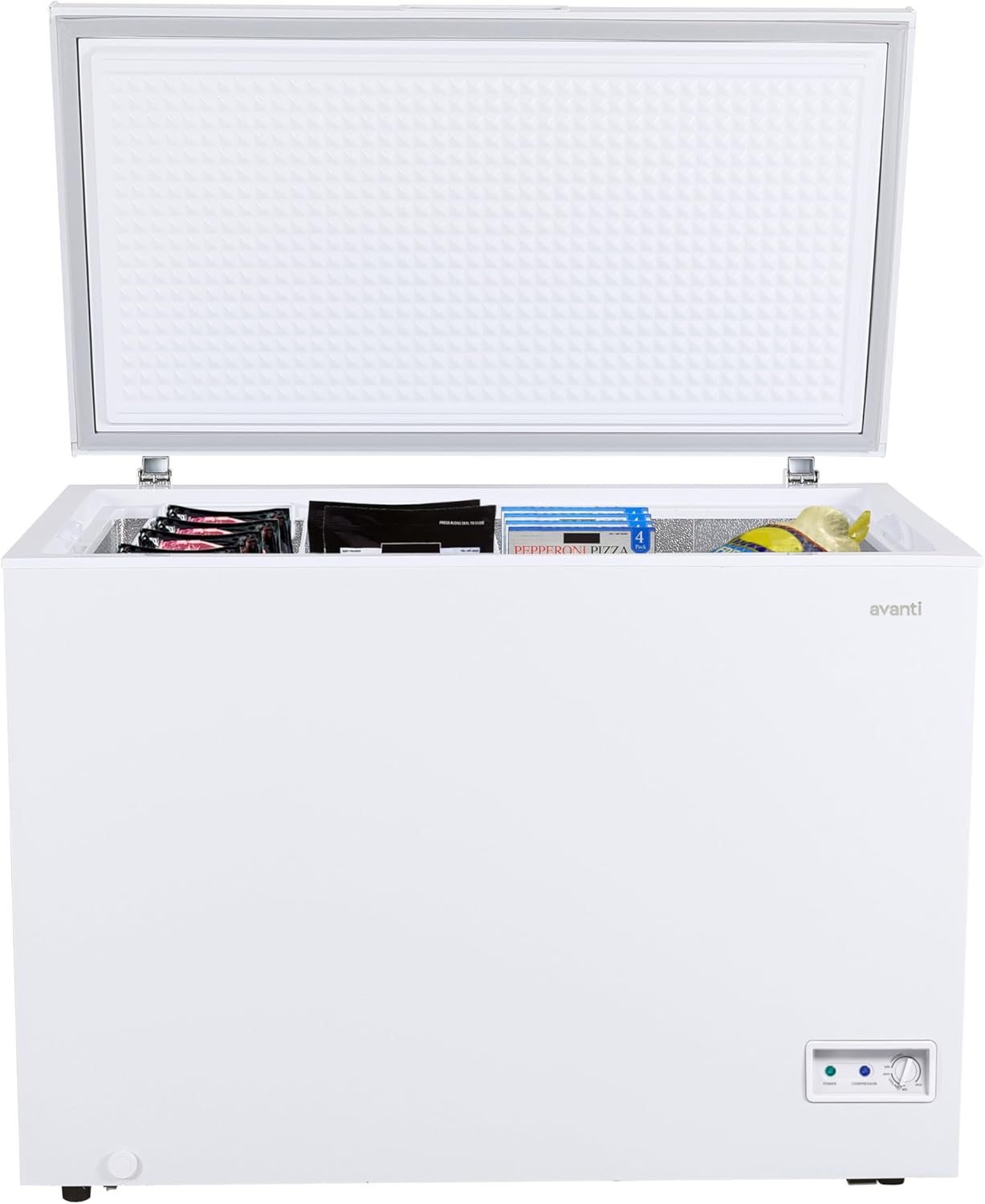
Avanti 10 cu. ft. Chest Freezer
| Capacity | 10 cubic feet |
|---|---|
| Wattage | 130 watts |
| Voltage | 110 volts |
| Door Orientation | Top |
This Avanti 10 cu. ft. chest freezer is built for extra storage in garages, basements, or utility spaces and doubles as a convertible fridge with an adjustable thermostat. It features a lift-up stay-open lid with an integrated handle and a removable storage basket for organizing frequently used items. The external temperature control and power indicator let you fine-tune settings without opening the lid, while manual defrost and a defrost drain simplify cleaning and maintenance. The unit is labeled garage-ready, meaning it is engineered to operate in non-climate-controlled spaces and its cooling ranges support both freezer and fridge modes across wide ambient temperatures. Practical benefits include straightforward controls, decent usable capacity for a household needing overflow frozen storage, and easy maintenance. Important limitations are manual defrosting rather than frost-free operation and the absence of advanced features like digital controls, alarms, or interior lighting, so buyers wanting low-maintenance or high-tech monitoring may prefer other models.
Best for: Buyers who want a sturdy, no-frills secondary freezer for a garage or basement and value flexible use as either a freezer or fridge.
Less Ideal for: Users who need a frost-free, low-maintenance freezer or advanced features like digital temp control, Wi‑Fi monitoring, or interior lighting should look elsewhere.
- Garage-ready design rated for non-climate-controlled spaces
- Convertible freezer-to-fridge thermostat for flexible storage
- Removable storage basket keeps items organized and easy to reach
- External temperature control and power indicator for quick checks and adjustments
- Defrost drain and manual defrost make cleaning straightforward
- Manual defrost requires periodic maintenance to remove ice buildup
- No digital controls, alarms, or interior lighting for convenience
Verdict: A practical, garage-ready 10 cu. ft. chest freezer that converts to a fridge for buyers who prioritize flexible, reliable overflow storage.
BLACK+DECKER 10 Cu. Ft. Chest Freezer BCF1000E

| Capacity | 10 cubic feet |
|---|---|
| Wattage | 72 watts |
| Voltage | 120 volts |
| Refrigerant | R600a |
| Installation Type | Freestanding |
This BLACK+DECKER 10 cu. ft. chest freezer is a straightforward deep-freeze solution for homeowners who need extra cold storage in a garage or basement. It stores bulk items like bags of ice, large cuts of meat or multiple gallons of ice cream in a low-footprint chest layout and includes a removable storage basket to keep frequently used items accessible. Temperature is adjusted with an exterior mechanical dial offering seven settings and power and compressor indicator lights show operating status without opening the lid. The unit uses R600a refrigerant, has an easy-access drain and requires manual defrosting, which keeps electronics simple but means occasional maintenance to remove frost. At about 72 watts running power it is efficient for continuous use, and adjustable leveling legs help on uneven garage floors. Practical limits include manual defrost and the need to allow clearance for airflow, so it is best where occasional maintenance and dedicated floor space are acceptable.
Best for: Buyers who prioritize reliable, low-complexity cold storage for a garage or basement and value straightforward controls and capacity over advanced features.
Less Ideal for: Those who need zero-maintenance frost-free operation, precise digital temperature control, or very frequent door access in tight spaces should consider other freezer types.
- Generous 10 cu. ft. capacity for bulk frozen storage
- Mechanical temperature dial with seven settings for easy control
- Removable storage basket keeps small items organized and accessible
- Easy-access drain simplifies manual defrosting and cleaning
- Uses low-GWP R600a refrigerant and meets ETL safety standards
- Manual defrost requires periodic thawing and water removal
- No digital controls or fast-freeze function for rapid temperature recovery
Verdict: A solid, no-frills 10 cu. ft. chest freezer built for dependable bulk storage in garages where simple controls and capacity matter most.
TABU 10.0 Cu.Ft. Chest Freezer

| Capacity | 10 cubic feet |
|---|---|
| Door Orientation | Top |
| Installation Type | Freestanding |
This TABU 10.0 cu.ft. chest freezer is a straightforward freestanding deep freezer intended for extra cold storage in kitchens or garages. It opens from the top with a hinge that supports multiple angles, includes a removable plastic basket for small items, and offers a 7-level front temperature control that ranges roughly from -7.6°F to 6.8°F to keep foods frozen. The R600a compressor is designed to be energy efficient and runs quietly at about 40 dB, making the unit suitable for spaces where low noise matters. Practical touches include a fully sealed door to retain cold and leveling legs for uneven floors, while the compact footprint lets it tuck into tighter garage spots. Limitations to consider are the basic feature set—there is no internal organization beyond the single basket, and the temperature control is manual rather than digital, so precise set-and-forget control is limited compared with premium models.
Best for: Buyers who want a no-frills, space-efficient freezer to expand cold storage in a garage or utility area and prioritize reliable cooling and low noise over advanced features.
Less Ideal for: Users wanting advanced organization, precise digital temperature control, or specialty features like auto-defrost or separate compartments should consider other models.
- 10.0 cu.ft. capacity fits a substantial amount of bulk food for a compact footprint
- Low-noise operation around 40 dB suitable for garage or utility placement
- 7-level adjustable thermostat lets you tailor freezer temperature for different items
- Removable basket and top-opening layout make quick access to frequently used items easier
- Fully sealed door helps maintain consistent interior temperatures
- Simple interior with only one removable basket limits organized storage options
- Manual dial thermostat lacks the precision of digital controls
Verdict: A practical, quiet 10 cu.ft. chest freezer that delivers straightforward bulk storage and energy-efficient cooling for garage use.
Generic 10 Cu.Ft Chest Freezer

| Capacity | 10 cubic feet |
|---|---|
| Door Orientation | Top |
| Temperature Range | -11.2°F to 10.4°F |
| Compressor Type | R600a |
| Installation Type | Freestanding |
This 10 cu ft chest freezer is a straightforward, no-frills unit for extra cold storage in a garage or utility space. It offers an 8-level external temperature knob that spans roughly -11.2°F to 10.4°F so you can switch between refrigeration and deep-freeze modes, and a removable wire basket helps keep frequently used items reachable. The R600a compressor is described as energy efficient with a daily consumption of about 0.56 kWh, and the sealed lid plus recessed handle and caster wheels make it easy to move and keep cold. Practical touches include an external drain cap for defrosting and a smooth white finish that wipes clean. Expect a basic manual control layout without advanced features like digital thermostats, alarm systems, or smart connectivity. Build appears utilitarian with a metal top and simple controls, so sound insulation and long-term durability may be average compared with higher-end models. For buyers who need affordable extra freezer capacity for a garage, this unit covers the essentials reliably.
Best for: Buyers who need low-cost, extra frozen storage for a garage or small commercial spot and prioritize straightforward controls, energy efficiency, and mobility over premium features.
Less Ideal for: Shoppers who want precise digital temperature control, connected features, or heavy-duty commercial reliability should consider higher-end models.
- Dual-use temperature range for refrigeration and deep freezing
- Energy-efficient R600a compressor with low daily power consumption
- Detachable storage basket and recessed handle for everyday convenience
- External drain plug and caster wheels simplify defrosting and moving
- Manual temperature knob only, no digital readout or precise temperature control
- Basic construction with no advanced noise or insulation features
Verdict: A practical, energy-efficient 10 cu ft chest freezer that delivers affordable extra cold storage for garages and small commercial spaces.
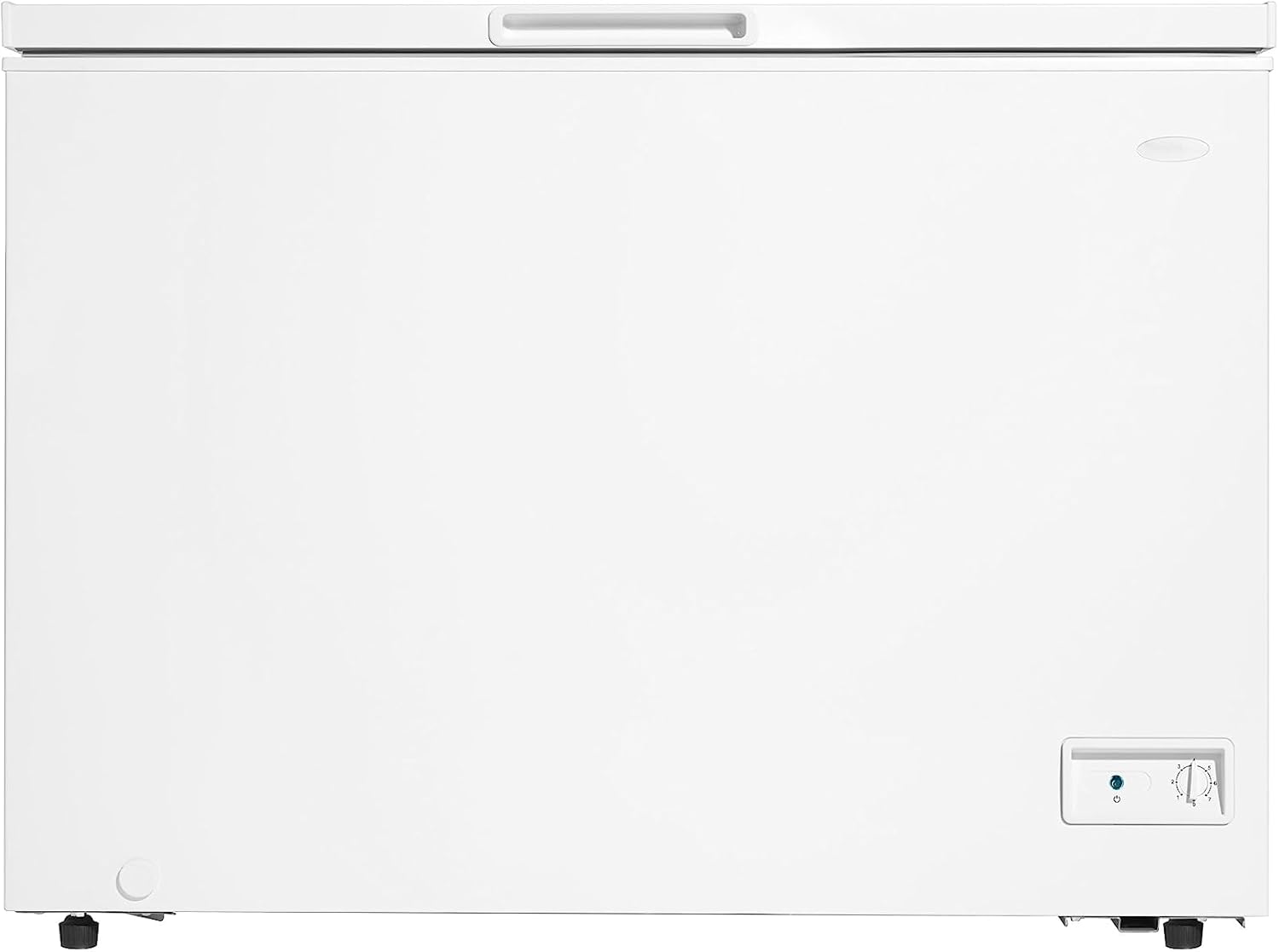
Danby Diplomat 10 cu. ft. Chest Freezer
| Capacity | 10 cubic feet |
|---|---|
| Voltage | 115 volts |
| Wattage | 234 kwh |
| Number Of Shelves | 1 |
The Danby Diplomat 10 cu. ft. chest freezer is a straightforward, no-frills unit built for reliable cold storage in homes and garages. It stores bulk frozen goods in a single large cavity with a removable basket for small items, and a front-mounted mechanical thermostat makes temperature adjustment easy and intuitive. The manual defrost and front drain simplify routine thaw cycles, though manual defrost requires occasional maintenance compared with auto-defrost models. Danby rates this model as garage ready, able to operate in a wide ambient range so it can sit in unconditioned spaces, and the 360-degree D-shaped coil system is designed to speed freezing of newly added items. Practical touches include counter-balance hinges that hold the lid open, a power-on indicator light, and leveling legs with rear rollers for positioning. Expect steady, energy-conscious operation thanks to DOE compliance, but be prepared to manage defrosting by hand and allow clearance for the lid and service access.
Best for: Buyers who prioritize dependable, energy-conscious frozen storage for a garage or utility space and prefer simple, serviceable controls over smart features.
Less Ideal for: Shoppers who want frost-free convenience, hands-off maintenance, or compact upright organization should consider other freezer styles.
- Garage ready rating supports operation in unconditioned spaces from 0°F to 110°F
- Front-mounted mechanical thermostat is simple to use and adjustable
- 360-degree D-shaped coil system helps freeze newly added foods faster
- Power-on indicator and counter-balance hinges improve day-to-day usability
- Manual defrost requires periodic draining and cleanup instead of automatic defrosting
- Thinner-profile design may require clearance planning for lid access and placement
Verdict: A dependable, garage-ready 10 cu. ft. chest freezer that delivers simple, energy-efficient cold storage with user-friendly mechanical controls.
Kismile 10-Cu Ft Chest Freezer

| Capacity | 10 cubic feet |
|---|---|
| Door Orientation | Top |
| Installation Type | Freestanding |
This Kismile 10.0 cubic foot chest freezer is a compact freestanding deep freezer designed for household or garage use where extra frozen storage is needed. It uses a low-energy compressor that the listing says consumes about 0.68 kWh per day and operates under 40 dB, so it is suited to locations where noise and energy draw matter. The top-opening hinge door has balanced support to hold open between roughly 45 and 90 degrees and three removable baskets help keep smaller items organized while larger items sit below. A seven-step thermostat lets you dial approximate temperatures from about 6.8°F to -7.6°F and the front panel lights show power and run status. Practical limits include the single-chamber layout, which requires bending to access lower items, and a simple mechanical thermostat rather than precise digital control. For a garage freezer the unit offers good usable capacity and quiet, energy-conscious operation but lacks advanced features like a fast-freeze function, interior lighting, or smart monitoring.
Best for: Buyers who want a straightforward, energy-conscious 10 cu ft chest freezer for extra frozen storage in a garage or household and value quiet operation and simple controls backed by many user reviews.
Less Ideal for: Shoppers who need precise digital temperature control, fast-freeze capability, interior lighting, or frequent upright-style access should consider other freezer styles.
- 10 cubic feet of usable chest-style storage with three removable baskets for organization
- Adjustable 7-step thermostat giving a range from about 6.8°F to -7.6°F
- Low energy consumption reported (~0.68 kWh per day) which helps running costs
- Relatively quiet operation under 40 dB suitable for garages or near living spaces
- Mechanical thermostat lacks precise digital temperature readout or programmable modes
- Single-chamber chest design makes accessing items at the bottom less convenient
Verdict: A quiet, energy-efficient 10 cu ft chest freezer that delivers simple, reliable extra frozen storage for garages and homes.
Choosing the Right 10-Cu.-Ft. Chest Freezer for Garages: Key Factors to Consider
Temperature Stability
A garage chest freezer must hold a steady internal temperature even when ambient conditions shift. Strong temperature stability lowers the risk of partial thawing and freezer burn during daytime heat or cold snaps. Look for units with precise thermostats and a proven ability to recover quickly after the lid is opened. In practice, better stability means food stays safe for longer and you avoid wasting inventory.
Temperature control matters more in a garage because ambient temperatures can swing farther outside typical home HVAC ranges. Consider how often the freezer will be accessed and whether it will be in a finished, insulated portion of the garage or in an unheated area when evaluating stability requirements.
Insulation and Seal Quality
Insulation thickness and the quality of the lid gasket determine how resistant the freezer is to heat gain from the surrounding space. Higher-quality insulation reduces compressor runtime and improves long-term energy use. A tight gasket prevents moist, warm garage air from entering and causing frost buildup, which reduces usable capacity and forces more frequent manual defrosting.
For garage use, prioritize models with foamed-in-place insulation and a robust, replaceable gasket. Also check for lid locking or clamping mechanisms that maintain a secure seal even if the unit is bumped by tools, boxes, or carts in a busy garage.
Energy Efficiency and Running Cost
Running a chest freezer in a garage can increase its workload if ambient temperatures rise, so energy efficiency is a practical buying factor. Look at the unit's rated energy consumption and any efficiency features such as adaptive defrost cycles or low-wattage compressors. Efficient models reduce monthly operating costs and put less strain on the compressor, extending useful life.
Estimating annual running cost based on your local electricity rates and expected ambient conditions will help you compare likely long-term expenses between otherwise similar units.
Storage Capacity and Organization
A 10-cu.-ft. chest freezer offers a fixed total volume, but interior layout affects how usable that space is. Baskets, dividers, and a flat floor make it easier to organize packages and rotate stock so older items are used first. Deep, uninterrupted cavities maximize bulk storage but can hide smaller packages; conversely, more baskets improve access but reduce overall bulk capacity.
Consider the types of items you freeze most often. If you store many small packages, prioritize accessible baskets. For whole cuts of meat or large boxes, look for a model with unobstructed depth and a wide opening to simplify loading and unloading.
Durability and Garage-Specific Construction
Garages expose appliances to dust, occasional impacts, and sometimes humidity. Durable exterior finishes that resist scratching and corrosion will keep the unit serviceable for longer. Reinforced hinges and a rugged lid are important because garage floors and storage areas often see more physical activity than an interior room.
Also consider serviceability features such as an accessible compressor compartment and replaceable gaskets. A unit that is easy to maintain will hold up better over years of garage use.
Placement Constraints and Noise
Plan where the freezer will sit in the garage before buying. Measure doorways and walkway clearances since chest freezers are wider and deeper than upright models. Allow for recommended clearance around the compressor area to maintain airflow and cooling efficiency. Noise levels matter if the garage is attached to living space or used as a workshop where conversations or media occur nearby.
If the garage is unconditioned, think about elevating the unit on a platform to avoid cold slab contact or moisture pooling. Check the manufacturer's guidance on minimum ambient operating temperatures to ensure reliable performance where you plan to place it.
Garage Placement Best Practices
Choose a site that keeps the freezer out of direct sun and away from heat sources such as vehicle exhaust or hot water heaters. Direct sunlight and nearby heat can force the compressor to run more frequently and shorten the unit's lifespan.
Maintain at least the manufacturer-recommended clearance around the rear and sides for proper airflow. In tight garages, consider positioning the unit so vents are unobstructed and dust accumulation is minimized.
- Avoid placing the freezer directly on bare concrete if condensation or moisture is common.
- Use a small platform or rubber feet to reduce cold transfer and improve drainage under the unit.
- Leave enough room to fully open the lid and comfortably remove baskets or large items.
Defrosting, Frost Management, and Maintenance
Manual defrost models can have lower initial costs and simpler mechanics, but they require periodic thawing to remove frost buildup which can reduce usable space and cooling efficiency. In a garage environment where humidity can vary, check how easy it is to drain and clean the interior after defrosting.
Automatic or frost-free models reduce upkeep but may use slightly more energy. Whichever system you choose, regular gasket checks and occasional coil cleaning will improve performance and longevity.
- Keep a shallow pan or towel on hand during manual defrost to capture meltwater.
- Inspect the lid gasket for cracks and compress it gently to confirm a tight seal.
- Schedule a quarterly exterior dust wipe and an annual compressor compartment check.
Organizing a 10-Cu.-Ft. Chest Freezer for Efficiency
Maximize access by grouping like items together and labeling containers with dates. Use shallow baskets for frequently accessed items and place long-term storage toward the bottom. A simple inventory list taped to the lid helps avoid unnecessary rummaging that raises internal temperature.
Consider portioning large purchases into meal-sized packages before freezing. This reduces the time you keep the lid open during retrieval and helps maintain internal temperature stability.
- Store high-use items near the top for quick access.
- Stack flat packages horizontally to make better use of depth.
- Use clear, freezer-grade containers or vacuum bags to reduce space and prevent freezer burn.
Winter and Cold-Weather Considerations
Cold ambient temperatures can also be a problem if a model's compressor is not designed to run in low temperatures. Some freezers may enter a low-activity mode or struggle to maintain proper defrost cycles in very cold garages. Verify the minimum ambient operating temperature if your garage drops below freezing in winter.
If your garage routinely sees sub-freezing conditions, consider models rated for low-temperature operation or plan to move the unit to a conditioned space during extreme cold spells to avoid compressor strain or performance loss.
- Check manufacturer guidance for recommended minimum ambient temperatures.
- Keep the thermostat setting moderate; excessive adjustments do not necessarily improve low-temp reliability.
- In very cold garages, an insulated enclosure or wrapping can help stabilize the immediate environment around the freezer.
Energy-Saving Habits for Garage Freezers
Small daily habits add up: avoid long open-lid periods, organize items so retrieval is fast, and keep the unit reasonably full but not packed solid. A well-filled freezer uses less energy because frozen items help stabilize temperature during door openings.
Set the thermostat to the manufacturer-recommended temperature for long-term storage rather than colder-than-necessary temps. Regularly removing frost and ensuring seals are tight also keeps the unit from overworking.
- Do a monthly quick check of seals and external vents.
- Group items and label them to reduce lid-open time.
- Consider a freezer thermometer to verify setpoint and spot temperature fluctuation early.
How We Chose the Best 10-Cu.-Ft. Chest Freezer for Garages
We focused on features that matter for storing frozen food in a garage environment where temperatures can vary and access is often less convenient than inside the house. Our selection filters prioritized strong insulation and temperature stability because these directly affect how well a chest freezer maintains safe temperatures during heat swings. We also looked for durable exterior and interior finishes that resist condensation, rust, and dents from typical garage traffic. Energy efficiency and rated power draw were included because a hard-working unit in a less-insulated space can add meaningful utility cost. Practical storage features such as removable baskets, layout flexibility, and clear volume-to-footprint ratios were used to assess user convenience. Noise and compressor reliability were considered for attached or partially enclosed garages where sound matters. We excluded undersized or oversized models outside the roughly 10-cubic-foot capacity, and we omitted units lacking any garage-capable insulation or temperature-rating guidance. The final list emphasizes balanced performance on temperature control, durability, usable storage, energy consumption, and everyday convenience.
Our full evaluation process is outlined in our review methodology.
FAQ
Can a chest freezer be used in an unheated garage year-round?
Often it can, but it depends on the model's minimum ambient operating temperature and local climate. Some units are designed to cope with wider temperature ranges, while others may struggle during extreme heat or cold.
How often should I defrost a manual chest freezer in a garage?
Usually when frost buildup reaches about a quarter-inch thickness or when you notice reduced usable space. In humid garages you may need to defrost more frequently than in conditioned indoor spaces.
Will placing the freezer on a raised platform help in a garage?
Yes. Elevating the unit can reduce moisture contact from a cold concrete slab, improve airflow, and make cleaning easier. Use a stable, level platform rated for the freezer's weight.
Are frost-free freezers better for garage use?
Frost-free models reduce maintenance by preventing ice buildup but can be slightly less energy efficient. They are convenient in humid environments, but check that the unit's defrost system and compressor are rated for garage ambient conditions.
How do I estimate the running cost of a garage chest freezer?
Multiply the freezer's rated annual energy use by your electricity rate to estimate yearly cost. Factor in higher use during hot months if your garage is unconditioned, and compare energy ratings between models for a practical approximation.
Final Verdict
Choosing the right 10-cu.-ft. chest freezer for garage use means balancing temperature stability, insulation quality, and usable storage against energy consumption and durability. Prioritize models with strong seals and verified ambient operating ranges if your garage is unheated or subject to wide temperature swings. Organize and maintain the unit to minimize lid-open time and frost buildup, and plan placement to protect the freezer from direct heat and moisture. Ultimately, match the freezer features to how you use the garage and what you store. Focus on long-term reliability and low maintenance to keep food safe and operating costs predictable.