
Note: This article contains affiliate links. If you click on these links and make a purchase, we may earn a small commission at no extra cost to you. This helps support our research and content. Read our full affiliate disclosure here.
If you need compact, dependable frozen storage in a garage, picking the right 5-cu.-ft. chest freezer matters. Garages face wider temperature swings, dust, and irregular use compared with indoor utility rooms, so a garage-rated freezer needs robust insulation, reliable temperature control, and efficient compressors that can tolerate the ambient extremes. This guide covers seven shortlisted 5-cu.-ft. chest freezers built for garage use and evaluates them on the criteria that matter: temperature stability, energy efficiency, durability, and ease of maintenance. Below you will find practical notes to help you match a freezer to your garage conditions and storage habits before the detailed product list.
Top Picks at a Glance
| Best Overall The best all-around choice for most situations | BLACK+DECKER 5.1 Cu. Ft. Chest Freezer |  |
| Best Quality Built to a higher standard if you want something more solid | Frigidaire Chest Freezer EFRF5003 |  |
| Best Value The sweet spot between price and what you get | WANAI 5.0 Cu Ft Chest Freezer |  |
| Best Budget The cheapest option that still gets the job done reliably | KRIB BLING Chest Freezer 5.0 cu ft |  |
| Top Rated A top-rated pick with lots of positive feedback | Kenmore Convertible Chest Freezer 5.1 Cu Ft |  |
| Most Popular A crowd favorite that many people choose with confidence | WANAI Chest Freezer 5.0 Cu.Ft |  |
| Best Seller A high-volume bestseller chosen again and again | BODACIOUS 5.0 Cu Ft Chest Freezer |  |
BLACK+DECKER 5.1 Cu. Ft. Chest Freezer

| Capacity | 5.1 cubic feet |
|---|---|
| Voltage | 115 volts |
| Number Of Shelves | 1 |
| Installation Type | Freestanding |
The BLACK+DECKER 5.1 cu. ft. chest freezer is a compact deep-freeze option for adding extra cold storage in a garage, laundry room, or small kitchen. It opens from the top and includes a removable organizer basket for sorting packages and trays, while mechanical temperature control with multiple settings and a power-on indicator light let you manage storage conditions without electronics. The unit is freestanding, uses R600a refrigerant, and requires manual defrost and occasional draining, so it keeps things simple but needs routine maintenance to avoid ice buildup. Two adjustable leveling legs help sit the freezer securely on uneven garage floors, and the modest footprint fits tighter spaces while still claiming roughly 175 lb. of storage capacity. Expect straightforward installation and reliable cooling performance for frozen meals, bulk staples, and overflow meat storage, but plan for periodic defrosting and no automated frost management features.
Best for: Buyers who want an uncomplicated, space-efficient chest freezer for garage or utility use and prioritize straightforward controls and reliable cold storage over smart features.
Less Ideal for: People who need fully automatic frost-free operation, precise digital temperature monitoring, or large-capacity commercial storage should look elsewhere.
- Compact 5.1 cu. ft. capacity fits small garages and tight spaces
- Removable organizer basket makes sorting and accessing items easier
- Mechanical temperature control with multiple settings for simple adjustments
- Adjustable leveling legs for stable placement on uneven floors
- Uses R600a refrigerant which has low ozone impact
- Manual defrost requires periodic thawing and maintenance
- No automatic frost-management or advanced digital controls
Verdict: A no-frills, compact chest freezer that delivers reliable cold storage and easy organization for garage or utility-room use.
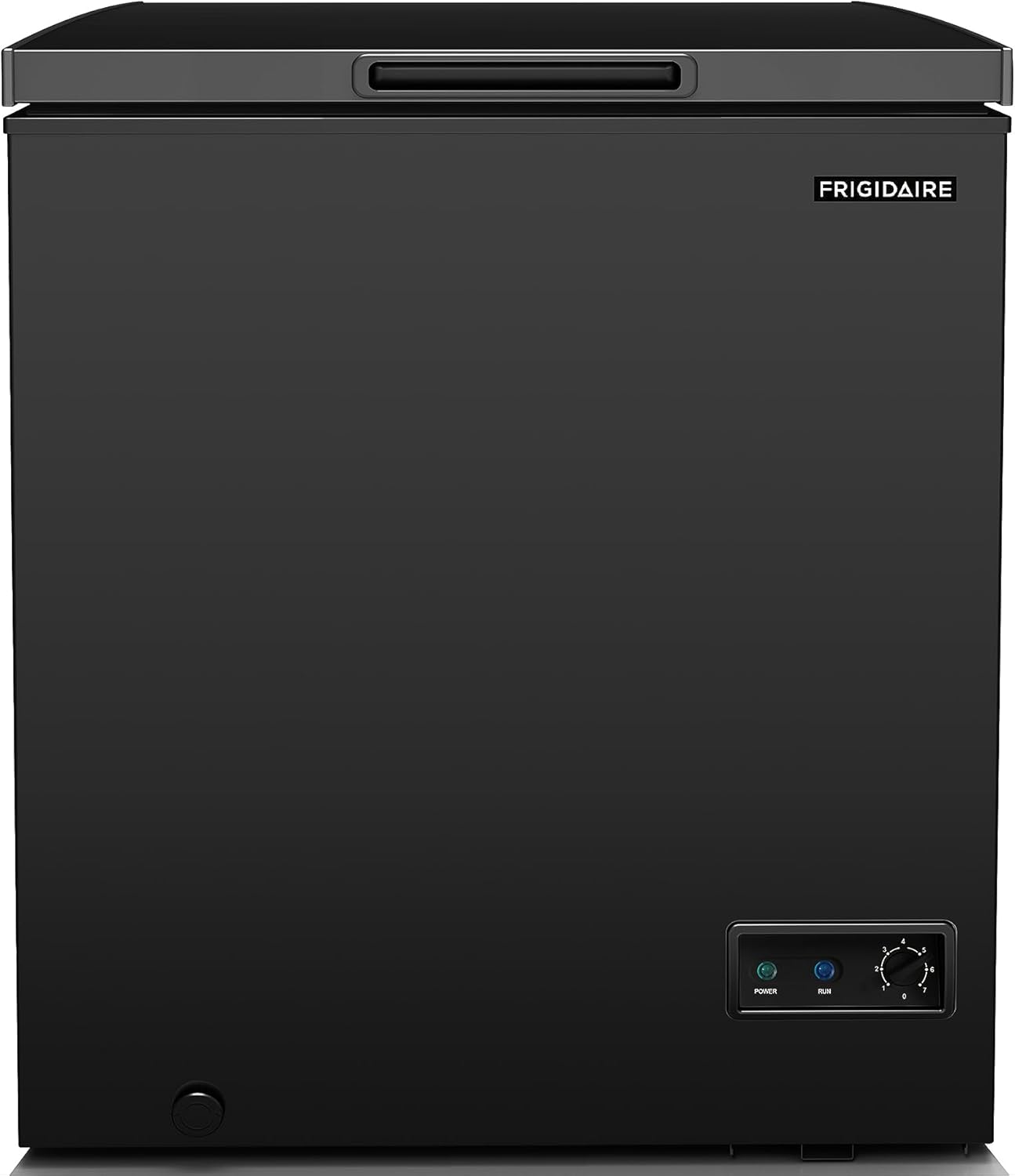
Frigidaire Chest Freezer EFRF5003
| Capacity | 5 cubic feet |
|---|---|
| Voltage | 120 volts |
| Installation Type | Freestanding |
| Number Of Shelves | 1 |
This Frigidaire 5.0 cu. ft. chest freezer gives straightforward, reliable frozen storage for garage or utility-room use. It uses a manual adjustable thermostat with a front external control and a power-on indicator light so you can monitor and dial in temperature without opening the lid. The removable vinyl-coated wire basket keeps small or frequently used items organized near the top, while the simple interior and aluminum liner make cleaning and maintenance easier. Defrosting is manual but routed through an exterior drain to speed the process and reduce mess. Adjustable legs help stabilize the unit on uneven floors and the recessed handle keeps the lid low-profile. Expect efficient, no-frills performance rather than advanced temperature management or auto-defrost convenience, but for buyers who need solid cold storage in a garage or basement this model balances capacity and practicality well.
Best for: Buyers who prioritize dependable cold storage for a garage or utility space and want a simple, easy-to-maintain chest freezer without smart features.
Less Ideal for: Those who want automatic defrost, precise digital temperature control, or a built-in style freezer should look at other options.
- 5.0 cubic feet capacity offers useful extra freezer space for meal prep and bulk goods
- External adjustable thermostat and power indicator let you set and check temperature without opening the lid
- Removable vinyl-coated wire basket improves organization and quick access to small items
- Exterior defrost drain simplifies manual defrosting and cleanup
- Manual defrost requires periodic maintenance and is less convenient than auto-defrost models
- No advanced temperature controls or digital readout for precise monitoring
Verdict: A practical, garage-ready 5.0 cu. ft. chest freezer that delivers straightforward, reliable frozen storage with easy manual maintenance.
WANAI 5.0 Cu Ft Chest Freezer

| Capacity | 5 cubic feet |
|---|---|
| Wattage | 70 watts |
| Voltage | 120 volts |
| Number Of Shelves | 1 |
| Installation Type | Freestanding |
This WANAI 5.0 cu ft chest freezer is a compact, freestanding deep-freeze solution intended for extra food storage in kitchens, garages, or small apartments. It uses an R600a compressor and offers seven temperature settings that cover refrigerator and freezer ranges, letting you store beverages or freeze meats and fish. The removable plastic storage basket keeps small items accessible while the top-open door and built-in handle make loading and cleaning straightforward; a defrost drain helps with manual defrosting. WANAI claims a quiet operation (about 40 dB) and modest energy use at 0.67 kWh per 24 hours, which helps keep running costs down in continuous-use locations like a garage. Practical limitations include manual defrosting and a single interior shelf, so you trade some convenience for compact capacity. Fit and footprint are small, but this model is best when you need straightforward, efficient frozen storage rather than advanced features like auto-defrost or internal organization systems.
Best for: Buyers who want a no-frills, energy-conscious supplemental freezer for a garage or small space and prioritize compact footprint and low running costs.
Less Ideal for: Users who need automatic defrosting, extensive internal shelving, or advanced temperature management for long-term bulk freezing should look at larger or feature-rich models.
- Compact 5.0 cu ft capacity that maximizes storage while keeping a small footprint
- Seven-level temperature control covering refrigeration and deep-freeze ranges
- Energy-efficient R600a compressor with low daily power consumption (0.67 kWh/24h)
- Removable storage basket and defrost drain make access and cleaning easier
- Quiet operation around 40 dB suitable for attached garages or basements
- Requires manual defrosting rather than having an auto-defrost cycle
- Limited internal organization with only one shelf and a single removable basket
Verdict: A compact, energy-efficient 5.0 cu ft chest freezer that delivers quiet, low-cost supplemental frozen storage ideal for garages and small spaces.
KRIB BLING Chest Freezer 5.0 cu ft

| Capacity | 5 cubic feet |
|---|---|
| Wattage | 70 watts |
| Voltage | 110 volts |
| Door Orientation | Top |
| Number Of Shelves | 1 |
This KRIB BLING 5.0 cu ft chest freezer provides simple, no-frills frozen storage for garages or small households. It uses a top-opening design with a manual defrost system and a 7-position thermostat so you can dial in colder or slightly warmer settings depending on what you store. The removable basket helps keep smaller items organized while the single shelf layout and boxy interior give plenty of room for bulk items or frozen cases. At 70 watts and standard 110V operation it is relatively efficient for continuous garage use, and the unit is freestanding so installation is just placing it on a level surface and plugging in. Expect low noise and straightforward operation, but plan for occasional manual defrosting and some energy use compared with frost-free models. Build and features are focused on value rather than premium extras like auto-defrost, digital controls, or fast-freeze modes, which keeps this a practical choice if you need basic, reliable frozen storage in a garage or utility area.
Best for: Buyers who want an affordable, straightforward chest freezer for a garage, basement, or small household and prioritize usable capacity and low initial cost over advanced features.
Less Ideal for: People who need a frost-free freezer, precise digital control, or rapid deep-freeze capability for high-volume or sensitive freezing needs.
- Generous usable capacity in a compact footprint for garage or apartment use
- Removable basket for organizing small items
- Seven-position adjustable thermostat for flexible temperature control
- Low operating wattage (70W) and simple plug-in freestanding installation
- Manual defrost requires periodic thawing and maintenance
- No digital controls or fast-freeze feature for rapid temperature recovery
Verdict: A budget-focused, no-frills 5.0 cu ft chest freezer that delivers roomy, reliable cold storage for garages and utility spaces.
Kenmore Convertible Chest Freezer 5.1 Cu Ft

| Capacity | 5.1 cubic feet |
|---|---|
| Voltage | 115 volts |
| Number Of Shelves | 1 |
| Installation Type | Freestanding |
This compact Kenmore convertible chest freezer provides flexible cold storage for garages, basements, cottages, or tight spaces. It is used like a small chest freezer but can be converted to refrigeration with a simple front-mounted dial, giving a temperature range suitable for freezing or chilling. The balanced hinge lid holds open at multiple angles so you can load and unload hands-free, and the removable hanging basket keeps small items within easy reach. Practical maintenance features include a front-access defrost drain with a leakproof plug for manual defrosting and a flat-back design that tucks against a wall. The unit is garage-ready with insulation and sealing designed to handle non-climate-controlled spaces, and external controls let you change modes without opening the lid. Trade-offs are manual defrosting and a basic mechanical dial instead of digital controls, but for straightforward, dependable extra cold storage this model focuses on durability and usability rather than smart features.
Best for: Buyers who prioritize dependable, no-frills cold storage for a garage or basement and want a unit that will run reliably in unconditioned spaces.
Less Ideal for: Users who want fully automatic defrosting, precise digital temperature control, or smart features for remote monitoring should look elsewhere.
- Convertible fridge/freezer with simple front dial for easy mode switching
- Garage-ready insulation and sealing for reliable operation in unconditioned spaces
- Balanced hinge lid that stays open for hands-free loading
- Front-access defrost drain with leakproof plug simplifies manual defrosting
- Removable hanging basket helps organize small, frequently used items
- Manual defrost requires periodic maintenance rather than automatic defrosting
- No digital thermostat or advanced temperature readout; control is mechanical
Verdict: A rugged, garage-ready 5.1 cu ft convertible chest freezer that delivers reliable, flexible cold storage without complexity.
WANAI Chest Freezer 5.0 Cu.Ft

| Capacity | 5 cubic feet |
|---|---|
| Voltage | 110 volts |
| Number Of Shelves | 1 |
| Installation Type | Freestanding |
This WANAI 5.0 cu.ft. chest freezer is a compact, freestanding unit aimed at extra frozen storage in garages, basements, apartments, or dorms. It uses a top-opening lid with a built-in handle, a removable plastic storage basket for smaller items, and a seven-position adjustable thermostat covering a wide temperature range so you can deep-freeze meats or keep prepared meals. The unit is manually defrosted via a drain for easier cleaning and claims quiet operation under 40 dB thanks to intermittent compressor cycles. It is energy-focused and sized to hold a substantial amount of food while remaining compact. Expect basic, reliable performance rather than advanced features: there is no auto-defrost, digital controls, or interior lighting, and setup is straightforward as a plug-in freestanding appliance. For garage placement, the robust door and simple thermostat make it practical, but users should plan for periodic manual defrosting and allow room for airflow around the cabinet.
Best for: Buyers who want an affordable, no-frills chest freezer to add reliable extra frozen storage in a garage or small space and who value quiet, energy-conscious operation backed by reviewer traction.
Less Ideal for: If you need smart features, automatic defrost, precise digital temperature readouts, or a built-in lock and lighting, look at higher-end models instead.
- Generous 5.0 cu.ft. capacity in a compact footprint suitable for garages or small kitchens
- Adjustable seven-position thermostat for flexible temperature control down to deep-freeze
- Removable plastic storage basket keeps small items accessible and resists rust
- Designed for quiet operation with compressor cycling that stays around 40 dB
- Manual defrost requires occasional draining and more maintenance than auto-defrost units
- No digital controls, interior light, or advanced temperature monitoring features
Verdict: A compact, quiet, and practical 5.0 cu.ft. chest freezer that delivers straightforward extra frozen storage for garages and small spaces.
BODACIOUS 5.0 Cu Ft Chest Freezer

| Capacity | 5 cubic feet |
|---|---|
| Wattage | 58 watts |
| Voltage | 110 volts |
| Number Of Shelves | 1 |
| Specification Met | ETL |
This 5.0 cu ft BODACIOUS chest freezer is aimed at buyers who need extra frozen storage in tight spaces like garages or small kitchens. It offers a top-opening chest layout with one removable shelf and a fast-freeze mode to quickly lock in freshness, and the unit is ETL-certified for basic safety. In everyday use it sits freestanding or countertop and is marketed as very quiet (below 40 dB) so it will not be intrusive in a garage or apartment. Energy consumption is low (about 0.36 kWh/24h), which keeps running costs down for long-term storage of bulk groceries, game, or meal-prep items. Practical touches include a built-in hidden handle and drain for easier cleaning. Limits to consider are the single-shelf interior and compact footprint, which constrain organization compared with larger freezers, and the product page recommends letting the unit sit 24 hours after delivery before first use. For someone who prioritizes quiet operation, low energy use, and simple, reliable freezing in a garage setting, this freezer is a sensible, conservative choice.
Best for: Buyers who want a reliable, energy-efficient secondary freezer for a garage or small space and who value quiet operation and straightforward, low-maintenance performance.
Less Ideal for: Households that need large-volume freezer capacity or advanced internal organization features should consider larger or differently configured models instead.
- Compact 5.0 cu ft capacity fits small garages and apartments
- Ultra-quiet operation (under 40 dB) suitable for noise-sensitive locations
- Low energy use (~0.36 kWh per 24 hours) keeps operating costs down
- Fast-freeze function helps preserve food quality
- ETL certification and included drain simplify maintenance and safety compliance
- Basic interior with only one shelf limits organization options
- Compact footprint reduces total storage compared with larger freezers
Verdict: A quiet, energy-efficient 5.0 cu ft chest freezer built for reliable, low-maintenance frozen storage in garages and small spaces.
Choosing the Right 5-Cu.-Ft. Chest Freezer for Garages: Key Factors to Consider
Ambient Temperature Tolerance
Garages typically experience wider temperature swings than conditioned rooms. A freezer rated for garage use will list an acceptable ambient range or include features such as a more robust thermostat and compressor that can run efficiently in heat or cold. If a unit cannot keep stable temperatures when the surrounding air is hot or very cold, stored items risk partial thawing or freezer-burn.
Consider where the garage sits in relation to the house, whether it is insulated, and how often temperatures reach extremes. If your garage is uninsulated or subject to direct sun, choose a freezer with explicit ambient-temperature ratings and a compressor designed for heavy-duty cycles.
Insulation Thickness and Seal Quality
Thicker insulation and a well-machined lid seal reduce temperature fluctuation and compressor runtime. Good insulation decreases energy use and helps the cabinet resist condensation when the outside air is humid. Pay attention to lid construction and whether the gasket is replaceable, since gasket wear can degrade performance over time.
A freezer with a tight, well-designed seal and ample cabinet insulation gives you more reliable long-term storage and lower running costs. In garages where pests or dust are a concern, a secure seal also prevents contamination and reduces the need for frequent interior cleaning.
Compressor Type and Duty Cycle
Not all compressor designs are equally suited to garage environments. Look for compressors with ratings that indicate tolerance for extended run times and higher ambient temperatures. A compressor with a short duty cycle can overheat in a hot garage and fail prematurely.
A robust compressor reduces the risk of breakdowns and helps the unit recover faster after door openings or warm spells. Consider whether the compressor has an automatic defrost mode or thermal protection features that improve longevity in tougher conditions.
Energy Consumption and Operating Cost
Energy draw matters because a garage freezer may operate more often to maintain target temperatures. Choose a model with efficient insulation and an economical compressor to keep electric bills predictable. Look for specifications like estimated annual energy consumption or wattage under typical conditions as a baseline for comparison.
Operating cost should be weighed against expected use. If you store large quantities for months at a time, investing in better efficiency will pay off. For occasional use, a simpler unit with adequate insulation may be acceptable.
Size, Capacity, and Interior Organization
A 5-cu.-ft. chest freezer is compact but internal layout affects usability. Consider the basket and divider options, ramped floors, or flat interior designs depending on whether you store bulk packages, long items, or many small frozen groceries. A removable basket helps keep frequently used items accessible and reduces time spent with the lid open.
Think about how much clearance you have in the garage for the lid swing and ventilation. Allow space for airflow around the compressor and for routine maintenance access.
Maintenance, Serviceability, and Noise
In a garage setting, easier maintenance reduces downtime and prevents odor or hygiene issues. Replaceable gaskets, accessible drain plugs, and simple interior surfaces speed cleaning. Consider units with easily accessible condensers so you can clear dust buildup that would otherwise reduce efficiency.
Noise level is also a practical concern. While garages tolerate more sound than living areas, excessively loud compressors or rattles can be a nuisance. Balance durability with acceptable noise for your household.
Preparing Your Garage for a Freezer
Before you install a freezer, assess the garage environment. Check for direct sunlight, sources of heat such as water heaters, and drafts that expose the unit to temperature swings. If the garage is uninsulated, adding simple insulation and sealing gaps can significantly improve freezer performance and reduce compressor workload.
Also plan for electrical capacity and placement. A dedicated outlet on a properly rated circuit reduces the chance of nuisance trips. Position the freezer where the lid can open fully and where there is at least a few inches of clearance around the cabinet for ventilation and servicing.
- Avoid placing the freezer in direct sunlight or next to heat sources
- Leave clearance for airflow and lid movement
- Use a grounded outlet on an adequate circuit
- Keep the area clean and dust-free to protect the condenser
Installation Tips Specific to Garages
Garages present unique installation challenges because floors may be uneven and ambient humidity can be high. Use a level to ensure the freezer sits flat so the lid closes evenly and the gasket seals properly. If your garage floor slopes, consider a small platform or shims rated for the freezer load.
Elevating the freezer a few inches off a damp floor protects the cabinet from condensation and rust. Avoid placing heavy objects on the lid and maintain easy access to the plug and back panel for routine cleaning and inspection.
- Use a level and shims if needed
- Elevate slightly on a stable platform if the floor gets damp
- Avoid storing chemicals or gasoline nearby
- Check the plug and cord condition periodically
Managing Temperature and Defrosting
Chest freezers in garages will accumulate frost over time, especially if the lid is opened frequently or the garage is humid. Manual defrost cycles are normal for many compact freezers. Plan a regular defrost schedule based on how much frost builds up; heavy frost reduces usable space and increases energy use.
Keep a thermometer inside the freezer so you can verify temperature stability. If temperatures drift frequently, check the gasket, ensure proper airflow, and confirm the compressor is running without excessive cycles.
- Defrost when frost reaches about 1/4 inch
- Use a chest freezer thermometer to monitor internal temperature
- Limit lid openings to reduce humidity ingress
- Clean the condenser fins periodically to maintain efficiency
Organizing Frozen Storage for Efficiency
Organizing items inside a small chest freezer improves access and reduces the time the lid remains open. Use labeled bins or a removable basket for high-turnover items. For long-term storage, pack items flat and stackable to maximize cubic inches and encourage even cooling.
Inventory and rotation help prevent forgotten items. Keep frequently used foods near the top and less-used bulk storage at the bottom. Consider a simple dry-erase board nearby to track contents and reduce unnecessary lid openings.
- Use removable baskets for small items
- Pack flat for efficient stacking
- Label and rotate contents to avoid waste
- Keep a thermometer visible and a log of contents
Safety and Longevity Considerations
Routine checks increase a freezer's usable life. Inspect gaskets for cracks, clean condenser coils every few months, and watch for unusual noises that may indicate mechanical issues. Addressing minor problems early prevents sudden failures and preserves stored goods.
Ensure proper ventilation and do not block condenser airflow. In colder climates, some freezers include a low-temperature kit or thermostat setting to help the compressor cycle correctly when ambient temps fall below typical room levels.
- Inspect and replace worn gaskets
- Clean condenser coils to prevent overheating
- Monitor unusual sounds or frequent cycling
- Follow manufacturer guidance for low-temperature operation
How We Chose the Best 5-Cu.-Ft. Chest Freezer for Garages
Our selection process focused on features and specifications that directly affect long-term frozen storage performance in garage environments. We prioritized temperature stability because garages can get hot or cold, and a freezer that maintains setpoint under varying ambient conditions reduces food spoilage. Energy efficiency was the next filter since compressors that work overtime in extreme temps can otherwise drive up operating costs. We also evaluated insulation quality and cabinet construction for resistance to condensation and dust, plus compressor type and duty-cycle ratings to gauge durability under irregular usage. Practical serviceability and ease of cleaning were considered so owners can maintain hygiene without complex procedures. Noise level and footprint were checked to ensure the unit fits typical garage setups without creating nuisance. Excluded from our shortlist were units lacking temperature-range data or those without clear specifications for ambient-temperature tolerance. We did not include freezers designed only for indoor climate-controlled spaces. The guiding dimensions for choices were temperature hold, energy draw, build durability, serviceability, and garage-suitable installation features.
Our full evaluation process is outlined in our review methodology.
FAQ
Can I use a standard chest freezer in an uninsulated garage?
Often it depends on the unit. Many standard freezers are designed for indoor use and may not tolerate extreme garage temperatures. Choose a model rated for wider ambient ranges or add insulation and temperature control in the garage to protect indoor-only units.
How often should I defrost a chest freezer in a humid garage?
Defrosting frequency depends on humidity and lid openings, but a practical rule is to defrost when frost reaches about 1/4 inch. Humid garages may require more frequent defrosts to keep efficiency high and usable space available.
What temperature should I set a freezer used in a garage?
Aim for the standard freezer target of 0 degrees Fahrenheit for food safety. If ambient temperatures are extreme, monitor with an internal thermometer and adjust as needed to maintain a stable internal temperature rather than relying solely on the dial setting.
Will a freezer in a garage increase my energy bills significantly?
Energy use can rise if the freezer works harder to maintain temperature in hot or cold ambient conditions. Choosing a model with good insulation and a compressor rated for garage temperatures limits extra energy use. Regular maintenance also helps keep consumption lower.
How much clearance does a chest freezer need in a garage?
Provide a few inches of clearance on all sides for airflow and at least enough space behind the unit to access the cord and service panels. Exact clearance can vary by model, so leave extra room to simplify maintenance and airflow for the compressor.
Final Verdict
For garage installations, prioritize freezers that explicitly tolerate wider ambient temperatures, offer solid insulation and a durable compressor, and are easy to service. Expect tradeoffs between upfront efficiency and long-term operating cost; better insulation and a robust compressor reduce running time and maintenance needs. Choose a 5-cu.-ft. chest freezer that fits your garage layout, offers straightforward maintenance features, and has explicit ambient-temperature guidance. That approach will give you reliable, low-hassle frozen storage suited to the garage environment.