
Note: This article contains affiliate links. If you click on these links and make a purchase, we may earn a small commission at no extra cost to you. This helps support our research and content. Read our full affiliate disclosure here.
A 10-year battery smoke detector simplifies home fire protection by eliminating annual battery swaps and reducing maintenance stress. If you want an alarm that stays powered for its full service life, choosing the right long-life detector matters for both everyday safety and peace of mind. This guide shortlists top-performing 10-year battery smoke detectors and explains the practical differences in sensing technology, mounting, and upkeep. We evaluated units for dependable sensing, simple installation, and long-term reliability so you can pick an alarm that fits your home and maintenance preferences. Read on for compact summaries of the best options, plus the criteria we used and what to consider before you buy.
Top Picks at a Glance
| Best Overall The best all-around choice for most situations | X-Sense SC01 Combination Alarm |  |
| Best Quality Built to a higher standard if you want something more solid | X-Sense SC07 Combination Detector |  |
| Best Value The sweet spot between price and what you get | First Alert SM210 10-Year Smoke Alarm |  |
| Top Rated A top-rated pick with lots of positive feedback | HEIMAN Smoke Detector HM-636PHS |  |
| Most Popular A crowd favorite that many people choose with confidence | Kidde 20SD10 Smoke Detector 3-Pack |  |
X-Sense SC01 Combination Alarm

| Power Source | 10-Year Sealed Battery |
|---|---|
| Sensor Type | electrochemical, photoelectric |
| Alarm | Audible |
| Battery Type | Lithium metal |
The X-Sense SC01 is a straightforward combination smoke and carbon monoxide alarm designed for simple, maintenance-light home protection. It uses a sealed 10-year lithium battery so you install it once and do not need annual battery swaps, and its photoelectric smoke sensor plus electrochemical CO sensor aim to detect threats quickly while reducing nuisance alerts. Installation is tool-light using the included mounting bracket, screws, and anchors and the unit emits an 85 dB audible alarm for bedroom and hallway coverage. A small LCD shows real-time CO and battery information, which helps you confirm status at a glance. The SC01 is a true standalone unit so it will not interconnect with other alarms or a smart system, which simplifies setup but limits whole-home alerting. Its compact, heat-resistant plastic enclosure and UL 217 and UL 2034 certifications match typical safety expectations. For buyers who prioritize a long-life, low-maintenance detector with clear local readouts, the SC01 delivers dependable basic protection; buyers wanting smart features or interconnected systems should choose a different model.
Best for: Buyers who want a low-maintenance, reliable single-unit detector that provides long-term protection and easy visual confirmation of CO and battery status for bedrooms, hallways, or individual rooms.
Less Ideal for: Homes that require linked alarms or smart monitoring should choose an interconnected or Wi‑Fi model instead.
- 10-year sealed lithium battery eliminates regular battery changes
- Combination smoke (photoelectric) and electrochemical CO sensing covers both hazards
- Built-in LCD shows real-time CO level and battery status
- Simple mounting with included bracket, screws, and anchors
- UL 217 and UL 2034 certifications for smoke and CO detection
- Does not support wireless interconnection or smart/home network integration
- No AC hardwiring option for continuous powered installations
Verdict: Choose the SC01 if you want a simple, low-maintenance 10-year battery combo alarm with on-device CO and battery readouts for dependable local protection.
X-Sense SC07 Combination Detector

| Power Source | 10-Year Sealed Battery |
|---|---|
| Alarm | 85 dB |
| Sensor Type | Photoelectric, Electrochemical |
| Battery Type | Lithium metal |
The X-Sense SC07 combines a photoelectric smoke sensor and an electrochemical CO sensor in a compact standalone unit powered by a sealed 10-year lithium battery, so you get a decade of maintenance-free protection without battery swaps or low-battery chirps. It mounts on a ceiling or wall with the included bracket and hardware and offers an 85 dB alarm and an easy-to-read LCD for status and alerts. The photoelectric sensor design helps the unit respond faster to smoldering fires and reduces cooking-related false alarms compared with ionization sensors, while the electrochemical CO sensor provides continuous monitoring for carbon monoxide. It is UL 217 and UL 2034 certified, which supports code-compliant installation. Limitations include the lack of wireless interconnect, Wi-Fi, or app control, so it functions as a single-room standalone alarm rather than part of a linked system. For buyers who prioritize a long-life, low-maintenance detector that focuses on reliable sensing and clear local alerts, the SC07 is a practical choice.
Best for: Buyers who want a high-performance, low-maintenance smoke and CO detector that reliably detects smoldering fires and CO without the hassle of battery changes or smart-home setup.
Less Ideal for: People who need a networked or app-connected alarm system or a detector that links wirelessly with other units should consider interconnected or Wi-Fi models instead.
- 10-year sealed lithium battery eliminates battery replacements and low-battery chirps
- Photoelectric smoke sensor reduces false alarms from cooking and detects smoldering fires faster
- Includes electrochemical CO sensor for simultaneous carbon monoxide monitoring
- UL 217 and UL 2034 certification supports safety and code compliance
- Simple, no-wires installation with mounting bracket and hardware included
- Not capable of wireless interconnection or smart home integration
- Functions only as a standalone unit, so multiple detectors will not communicate
Verdict: A durable, maintenance-free combination smoke and CO detector that delivers reliable local protection for a full decade without battery changes.
First Alert SM210 10-Year Smoke Alarm

| Power Source | Battery Powered |
|---|---|
| Sensor Type | Photoelectric |
| Operating Humidity | 10-95% RH |
The First Alert SM210 is a battery-powered photoelectric smoke alarm designed for long-term, low-maintenance home safety. It uses First Alert's Precision Detection sensing to cut down on cooking nuisance alarms while still providing timely warning for smoky or smoldering fires. The unit ships with a sealed 10-year battery, so you avoid annual battery changes and low-battery chirps for the life of the alarm, and an end-of-life warning tells you when the whole alarm needs replacing. Its slim profile is noticeably shallower than standard alarms, which makes it less obtrusive on ceilings and easier to fit near fixtures. Installation is straightforward and it includes a test/silence button for quick checks and temporary silencing during nuisance events. The main limitations are that it is a standalone, single-unit alarm without interconnect capability and it relies on a sealed battery so the entire alarm must be replaced at end of life rather than swapping batteries.
Best for: Buyers who want a low-maintenance, reliable smoke alarm that minimizes nuisance alerts and avoids yearly battery chores for long-term peace of mind.
Less Ideal for: Households that need hardwired, interconnectable, or smart/connected alarms for whole-home integration should consider other options.
- Sealed 10-year battery eliminates annual battery changes and low-battery chirps
- Photoelectric sensor with Precision Detection reduces cooking nuisance alarms
- Slim, low-profile design sits flatter on ceilings and around fixtures
- Simple test/silence button and clear end-of-life warning for straightforward maintenance
- Not designed for wired interconnect or smart-home integration
- Sealed battery means the entire alarm must be replaced when the 10-year life ends
Verdict: Choose the SM210 if you want a slim, low-maintenance photoelectric smoke alarm with a sealed 10-year battery to avoid yearly battery swaps.
HEIMAN Smoke Detector HM-636PHS
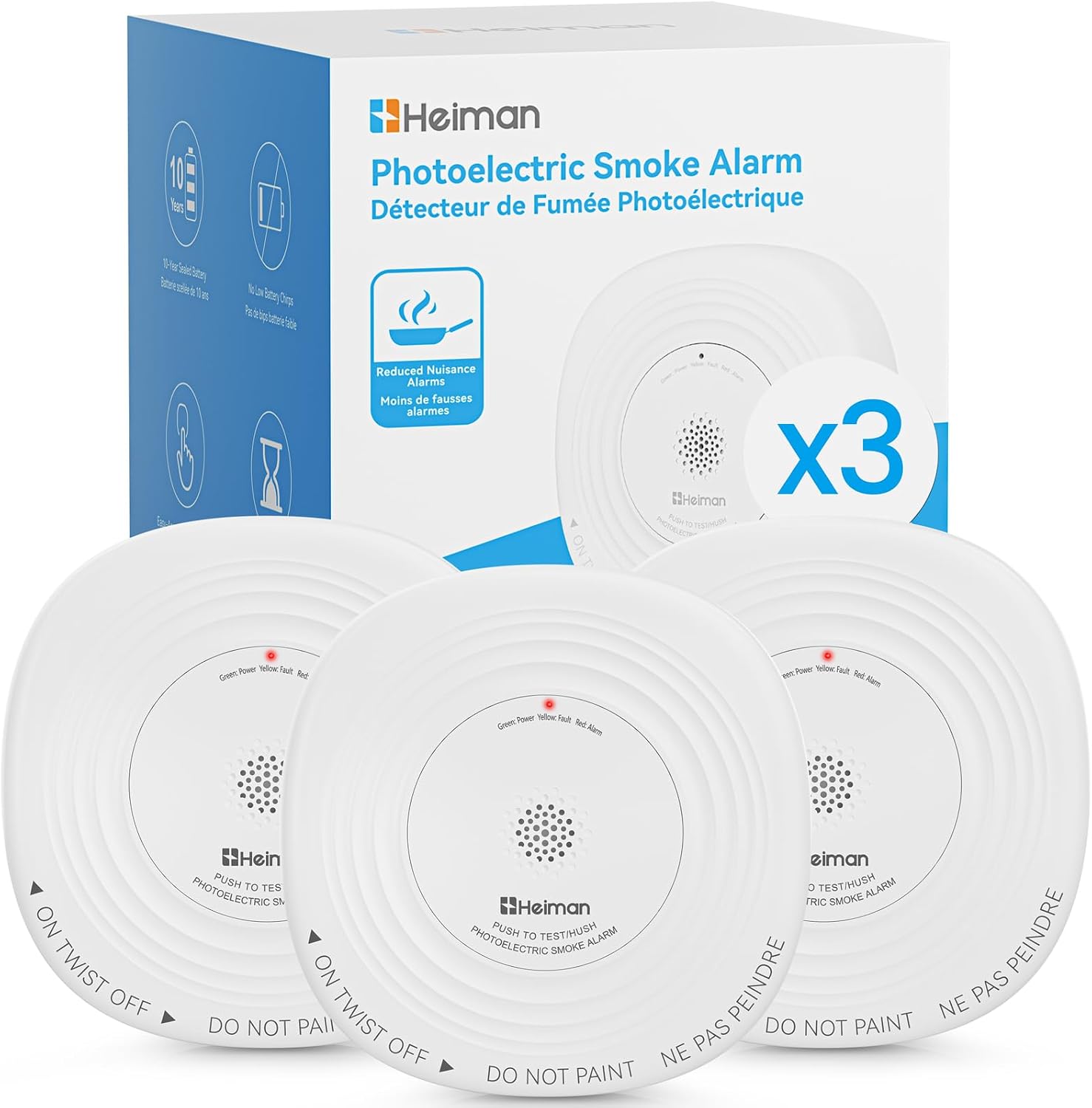
| Power Source | 10-Year Sealed Battery Powered |
|---|---|
| Alarm | Audible |
| Battery Average Life | 10 years |
| Operating Humidity | ≤95% RH (non-condensing) |
| Upper Temperature Rating | 100 °F |
This HEIMAN 3-pack supplies long-term smoke protection intended to minimize maintenance and false alarms. The units use a dual-beam photoelectric sensor, which focuses on detecting smoldering fires and reduces nuisance triggers from cooking, and each alarm is powered by a sealed lithium battery rated to last 10 years so you do not need annual battery changes. Installation is simple with the included mounting kit and the test/silence button makes on-site checks and temporary mute easy. When triggered the alarm emits an 85 dB tone and a flashing red LED, and the product includes automated fault reminders and an end-of-life warning to help you know when replacement is due. The housing is heat resistant (UL94 V-0 rated) and the design is compact for ceiling or wall mounting. Limitations: these are standalone battery units without hardwired interconnect or app control, and the alarms are specifically photoelectric so they are less sensitive to fast flaming fires than ionization-style units.
Best for: Buyers who prioritize low maintenance and dependable, code-compliant smoke detection for homes, rentals, or small commercial spaces and want devices that minimize nuisance alarms.
Less Ideal for: People who need hardwired, interconnected alarms or remote monitoring via an app should consider alternatives with interconnect or smart features.
- Sealed lithium battery rated for 10 years eliminates annual battery replacements
- Dual-beam photoelectric sensor reduces false alarms from cooking and detects smoldering fires
- Built to UL 217 10th edition and CSFM standards for compliant protection
- Automated fault reminders and end-of-life warning provide long-term status visibility
- No hardwired interconnect or wireless app integration for whole-home signaling
- Photoelectric-only sensing is less reactive to very fast flaming fires compared with other sensor types
Verdict: A low-maintenance, code-compliant photoelectric smoke alarm pack designed to deliver reliable 10-year protection with minimal servicing.
Kidde 20SD10 Smoke Detector 3-Pack

| Power Source | Battery Powered (10-year sealed) |
|---|---|
| Sensor Type | Photoelectric |
| Alarm | 85 dB Audible |
| Operating Humidity | Up to 95% RH, non-condensing |
The Kidde 20SD10 is a photoelectric smoke detector packaged as a three-unit set that prioritizes long-term, low-maintenance protection. Each alarm uses a sealed 10-year battery so you do not need periodic battery replacements and you avoid low-battery chirps for the rated service life. The unit emits an 85 dB alarm with a red LED for clear audible and visual alerts and Kidde says its sensing responds faster to smoldering fires and uses advanced sensing to cut down on nuisance triggers from cooking or steam. Installation is straightforward using the included mounting base and wiring harness where needed, and the detectors meet UL 217 10th Edition testing. The main limitations are that these are basic, non-networked alarms with no smart features or interconnect across multiple units unless you select a wired setup, and the built-in battery means the whole alarm is replaced at end of life rather than swapping cells. For buyers who want a low-maintenance, code-compliant detector that reduces false alarms, this set is a practical choice.
Best for: Buyers who prioritize reliable, low-maintenance home protection and want detectors that reduce nuisance alarms while meeting current safety standards.
Less Ideal for: Households that need smart monitoring, remote alerts, or seamless wireless interconnect across multiple alarms should consider networked alternatives.
- Sealed 10-year battery eliminates regular battery replacements and low-battery chirps
- Photoelectric sensor designed to detect smoldering fires faster than standard models
- Advanced sensing reduces false alarms from cooking and steam
- Meets UL 217 10th Edition testing for code-compliant performance
- No built-in smart features or wireless interconnect for app alerts
- Built-in battery requires replacing the entire unit at end of life
Verdict: Choose the Kidde 20SD10 3-pack if you want dependable, low-maintenance smoke detection with a 10-year sealed battery and reduced false alarms.
Choosing the Right 10-Year Battery Smoke Detector: Key Factors to Consider
Sensor Type
The sensor type determines how the detector responds to different fire conditions. Photoelectric sensors are typically better at detecting smoldering fires that produce lots of smoke but less flame, while ionization sensors respond faster to fast-flaming fires. Some long-life alarms pair sensors or use dual-sensor designs to broaden detection capabilities.
Choosing the right sensor affects nuisance alarms and detection speed in real scenarios like kitchen smoke or slow, smoldering upholstery fires. Consider which sensor behavior matches the rooms where you will install the units, and whether a combined-sensor approach is worth the added complexity.
Battery Sealing and End-of-Life Power
A true 10-year battery smoke detector uses a sealed long-life power source designed to last the unit's rated life without replacement. Check how the battery is sealed and whether the device includes clear end-of-life alerts. A well-implemented sealed battery prevents accidental removal and reduces the chance of a low-battery failure between recommended replacements.
End-of-life behavior matters because a detector must clearly indicate when the unit needs replacement. Look for audible and visual end-of-life signals and for user guidance on what to do when the alarm reaches its service limit.
Installation and Placement Flexibility
Installation ease can determine whether the detector is mounted correctly and maintained. Consider whether the unit uses a simple twist-and-lock bracket, included hardware, or requires special tools. Some detectors are lightweight and suitable for ceilings or high walls, while heavier units may need sturdier anchors.
Placement flexibility also includes whether the detector can be interconnected (hardwired or wirelessly) with other alarms, and how the mounting footprint affects locating the alarm in hallways, bedrooms, and living areas for optimal coverage.
Alarm Volume and Silence Features
Audible output and silence functions affect how quickly occupants are alerted and how manageable nuisance alarms are. Look for alarms that meet recommended decibel levels for residential spaces and that provide a temporary hush or silence feature for non-emergency triggers. A clear test button and easy-to-use hush function help keep the detector active without disabling protection.
Balance loudness for waking sleeping occupants with features that allow temporary muting during cooking or shower steam events so you do not disable the alarm entirely.
Maintenance and Durability Over Ten Years
Over a decade, dust, humidity, and temperature cycles can affect sensor performance. Choose detectors with user-cleanable exteriors or recommended maintenance steps and that are rated for the environments where you will install them. Durable housings and corrosion-resistant contacts reduce the risk of failure before the end-of-life date.
Also consider whether the manufacturer provides a clear replacement timeline and supports straightforward disposal or recycling at end-of-life because the sealed battery cannot be removed safely by the user.
Where To Install 10-Year Battery Smoke Detectors
Place detectors on every level of the home and inside each sleeping area for full coverage. Ceiling mounting near the center of a room is usually best because smoke rises and spreads along the ceiling plane. When mounting on a wall, position the unit high, near the ceiling, and follow the manufacturer's clearance distances from corners and fixtures.
Avoid installing directly above kitchens or bathrooms where routine cooking or steam can cause nuisance alarms. If installation in those areas is unavoidable, consider a detector with a hush function or a sensor type less prone to false alarms.
- Ceiling center for living rooms and hallways
- Inside or immediately outside each bedroom
- Avoid within 3 feet of kitchen appliances and 3 feet of bathroom fans
Interconnection and Smart Features
Some long-life detectors offer wireless interconnection so that when one alarm senses smoke, all alarms in the network sound. This can improve response time in larger homes. If you plan to interconnect alarms, verify that the 10-year battery model supports the chosen interconnect method and that pairing is straightforward.
A few models also have smart notifications or can link to home systems. These features can send remote alerts if you are away, but they require careful consideration of network security and ongoing connectivity. Evaluate whether remote alerts are necessary for your lifestyle, and whether they function independently of the alarm's critical detection systems.
- Wireless interconnect for whole-home alerts
- Smart notifications can add remote awareness
- Confirm independent alarm operation during network outages
Handling Nuisance Alarms
Nuisance alarms are a common reason people disable detectors, so choose a model with features that reduce false triggers. Photoelectric sensors and units with temporary hush modes often perform better in kitchens and near bathrooms. Also look for alarms with clear diagnostic LEDs and test modes so you can identify the cause of a trigger.
Regular cleaning reduces false alarms from dust buildup. Follow manufacturer directions for vacuuming vents or wiping housings, and use the test function periodically to ensure proper operation.
- Use hush mode instead of removing batteries
- Clean exterior vents regularly to reduce dust-triggered alarms
- Test monthly to confirm proper function
End-of-Life Replacement Planning
A sealed 10-year unit requires full replacement at the end of its service life. Plan for replacing the entire detector when it reaches its end-of-life signal rather than attempting battery swaps. Keep a simple log of installation dates so you know when each unit is due for replacement.
When replacing, ensure the new unit meets the same coverage and mounting location. Dispose of spent detectors according to local regulations for devices containing sealed batteries.
- Note installation date to track service life
- Do not open sealed battery compartments
- Follow local disposal guidelines for sealed-battery devices
Maintaining Performance Without Battery Swaps
Although the battery is sealed for 10 years, routine visual checks and monthly tests are still necessary. Confirm the alarm chirps during a test and that indicator LEDs behave as documented. Clean the exterior every few months to prevent dust accumulation around the sensing chamber.
Document any intermittent chirps or unusual behavior immediately. Even with a long-life battery, environmental factors or manufacturing defects can prompt early replacement, and addressing issues promptly keeps protection reliable.
- Monthly alarm tests
- Quarterly exterior cleaning
- Log unusual chirps and replace if diagnostics indicate
How We Chose the Best 10-Year Battery Smoke Detector
We focused on attributes that matter for long-life, low-maintenance smoke protection and applied practical filters to narrow the field. Primary evaluation criteria included sensor accuracy and response, battery longevity verification, installation and mounting options, alert clarity and hush functions, and long-term durability under typical home conditions. We prioritized detectors that use proven sensing technologies and that include a sealed 10-year battery or integrated long-life power source rated for the device lifespan. We excluded units without a verified 10-year sealed power source or devices that rely on replaceable batteries as their primary power. We also filtered out alarms that lacked basic user-friendly features such as an accessible test button, clear end-of-life notification, or straightforward mounting hardware. For each shortlisted product we considered build quality, warranty terms, and whether the unit provides clear audible alerts and visual status indicators. The resulting picks represent a balance of reliable detection, simple installation, and minimal upkeep over a decade of service.
Our full evaluation process is outlined in our review methodology.
FAQ
How long will a 10-year battery smoke detector actually last?
A properly installed sealed 10-year battery detector should remain powered for its rated service life, typically ten years from the manufacture or installation date. End-of-life alerts will tell you when the unit must be replaced. Environmental extremes can shorten lifespan, so follow placement and maintenance guidance.
Can I replace the battery when the unit chirps near the end of life?
No. Sealed 10-year battery detectors are designed for the battery to be non-user-replaceable. When the end-of-life or persistent low-battery signals begin, replace the entire unit according to the manufacturer's instructions.
Are 10-year battery detectors safe in kitchens and bathrooms?
They are safe, but kitchens and bathrooms can produce steam and cooking smoke that trigger nuisance alarms. Choose an appropriate sensor type or use units with hush features and follow recommended clearances to minimize false alarms in these areas.
Do 10-year detectors need monthly testing?
Yes. Even with a sealed battery, monthly testing verifies that the sensing chamber, electronics, and alarm sounder are functioning. Regular tests are the best way to ensure ongoing protection during the service life.
Can I interconnect 10-year battery detectors with other alarms?
Many long-life alarms support wireless interconnect, but capabilities vary. Confirm that the specific model supports interconnection and that pairing instructions are compatible with your planned configuration.
Final Verdict
For long-term, low-maintenance home fire protection, prioritize a sealed 10-year battery detector with the sensor type that matches your household risk profile, clear end-of-life alerts, and straightforward installation. Balance alarm loudness and nuisance-reduction features so occupants are reliably alerted without disabling protection. Maintain monthly tests and periodic cleaning to preserve performance over the device's service life. With these priorities, you can confidently choose a long-life smoke detector that minimizes upkeep while keeping your home protected.