
Note: This article contains affiliate links. If you click on these links and make a purchase, we may earn a small commission at no extra cost to you. This helps support our research and content. Read our full affiliate disclosure here.
Choosing the right 2-Stage thermostat matters because it directly affects comfort, energy use, and how well your heating and cooling system runs. A properly matched thermostat coordinates the low and high stages efficiently to avoid short cycling and to hold steady temperatures during shoulder seasons. This guide covers seven carefully shortlisted 2-Stage thermostats that suit a range of homes and HVAC setups. We evaluated each option for system compatibility, staging accuracy, installation practicality, and features that matter day to day. Below you will find the top picks followed by clear buying guidance to help you pick the thermostat that fits your system and comfort goals.
Top Picks at a Glance
| Best Overall The best all-around choice for most situations | Honeywell VisionPRO 8000 TH8321WF1001 |  |
| Best Quality Built to a higher standard if you want something more solid | Honeywell Home Smart Color Thermostat |  |
| Best Value The sweet spot between price and what you get | Suuwer S715 Programmable Thermostat |  |
| Best Budget The cheapest option that still gets the job done reliably | Riseem STN615 Programmable Thermostat |  |
| Top Rated A top-rated pick with lots of positive feedback | Mroinge M711 Thermostat |  |
| Most Popular A crowd favorite that many people choose with confidence | ecobee Smart Thermostat Enhanced |  |
| Best Seller A high-volume bestseller chosen again and again | Sensi Smart Thermostat ST55 |  |
Honeywell VisionPRO 8000 TH8321WF1001

| Connectivity Technology | Wi‑Fi |
|---|---|
| Power Source | Battery Powered |
| Voltage | 24 volts |
| Control Type | Touchpad Control |
The Honeywell VisionPRO 8000 (TH8321WF1001) is a wall‑mounted programmable thermostat with a large touchscreen and built‑in Wi‑Fi for remote temperature control. It supports up to 3 stages of heat and 2 stages of cool, making it suitable for 2‑stage and multi‑stage HVAC systems, and it requires a C‑wire for continuous power. Programming can be done per day of the week on the device or through the Total Connect Comfort app for remote adjustments and scheduling, and the touchpad display makes day‑to‑day changes straightforward. Practical benefits include multi‑stage compatibility for better comfort control in homes with more complex heating or cooling setups and a familiar Honeywell interface that installers recognize. Limitations to consider are the C‑wire requirement and that advanced HVAC integrations or proprietary HVAC brand features may not be supported. For buyers who want a straightforward, Wi‑Fi enabled multi‑stage thermostat with a touchscreen and reliable app control, the VisionPRO 8000 is a solid choice.
Best for: Homeowners who want a reliable, easy‑to‑use touchscreen thermostat with Wi‑Fi and multi‑stage support for improved comfort control in typical residential systems.
Less Ideal for: People without an available C‑wire or those who need deep integration with proprietary HVAC controls should consider other options or a professional installer.
- Supports up to 3 heat stages and 2 cool stages for multi‑stage HVAC systems
- Large touchscreen makes local control and programming easy
- Built‑in Wi‑Fi allows remote control and scheduling via the Total Connect Comfort app
- Programmable weekly schedules for day‑by‑day temperature management
- Requires a common C‑wire for reliable power
- Not designed for advanced brand‑specific HVAC integrations
Verdict: Choose the VisionPRO 8000 if you want a touchscreen Wi‑Fi thermostat that reliably handles multi‑stage heating and cooling with straightforward scheduling and remote control.
Honeywell Home Smart Color Thermostat

| Connectivity Technology | Wi-Fi |
|---|---|
| Controller Type | Touch Screen, Voice |
| Temperature Control Type | Heating and Cooling |
| Power Source | AC Power Supply |
| Specification Met | Energy Star |
The Honeywell Home Smart Color Thermostat is a Wi‑Fi programmable thermostat designed for homeowners who want a customizable touchscreen interface plus remote control via an app or voice assistant. It installs as a wall‑mounted low‑voltage thermostat and requires a C‑wire, and once configured it offers 7‑day scheduling, Smart Response learning to anticipate temperature changes, and on‑screen weather and humidity readouts. The full‑color display can be personalized to match décor and the touch controls make daily adjustments straightforward. Connectivity with Alexa and Google Home lets you change setpoints hands‑free and the app provides remote control, energy reports and equipment alerts for filter changes or extreme temperatures. Limitations include incompatibility with line‑voltage electric baseboard systems and the need for a C‑wire, so it is not suitable for every older installation, and advanced multi‑stage HVAC setups may require professional verification for full feature support.
Best for: Homeowners who prioritize smart control and comfort automation and want a color touchscreen thermostat that learns schedules and integrates with voice assistants.
Less Ideal for: Homes without a C‑wire or with 120–240V electric baseboard heating, and buyers who need a simple non‑networked or battery‑powered thermostat.
- Customizable full‑color touchscreen that can match room décor
- Wi‑Fi and app control with Alexa and Google Home voice integration
- Smart Response learning and programmable 7‑day scheduling for comfort
- Energy Star certified with energy reports and utility rebate eligibility
- On‑screen local weather and humidity readouts plus equipment alerts
- Requires a C‑wire and does not work with line‑voltage electric baseboard systems
- May need professional compatibility check for complex or multi‑stage HVAC systems
Verdict: Choose this thermostat if you want a performance‑focused, Wi‑Fi smart thermostat with a customizable color touchscreen and intelligent scheduling for improved comfort and energy tracking.
Suuwer S715 Programmable Thermostat

| Temperature display range | 41°F to 95°F |
|---|---|
| Temperature control range | 44°F to 90°F |
| Program type | 5-1-1 day programmable |
| Power source | 24VAC or 2 AAA batteries |
| Terminal designations | RH, RC, G, Y, Y2, C, O, B, W, W2 |
The Suuwer S715 is a straightforward 5-1-1 day programmable thermostat built for homes with up to two heat and two cool stages. It provides four daily program periods (wake, leave, return, sleep) with separate weekday/weekend scheduling, selectable 5-minute compressor delay, and adjustable heating/cooling swing for finer temperature control. The large 4.5-inch backlit LCD and simple button controls make programming and reading the setpoint easy for most users, and selectable reminders for air filter changes and low battery help with maintenance. Wiring is clear with color-coded terminals and a universal sub-base for wall or junction-box mounting, and the unit runs on 24VAC or two AAA batteries so it often does not require a common wire. Limitations include its basic push-button interface rather than a touchscreen or app connectivity, and it is not compatible with heat pump systems that use auxiliary or emergency heat or with 120–240V electric baseboard systems, so confirm system type before buying. For buyers who want reliable, no-frills multistage scheduling and clear on-device controls, it covers core needs at a modest level of complexity.
Best for: Homeowners who want reliable, programmable temperature control for conventional multistage HVAC systems and prefer a simple, on-device interface over smart features.
Less Ideal for: People who need remote control, smart-home integration, or compatibility with heat pumps that use auxiliary/emergency heat should look at connected or heat-pump–specific models.
- Supports 2 heat and 2 cool stages for multistage conventional systems.
- 5-1-1 day programming with four periods per day for weekday/weekend scheduling.
- Large 4.5-inch backlit LCD that is easy to read and use.
- Selectable 5-minute compressor delay and adjustable heat/cool swing for equipment protection and comfort tuning.
- Dual power: 24VAC or battery operation so a common wire is not required in many installs.
- No Wi-Fi or app control for remote scheduling or smart-home integration.
- Push-button interface is more basic compared with touchscreens or modern smart thermostats.
Verdict: A practical, easy-to-program multistage thermostat that delivers reliable 2-heat/2-cool scheduling and clear on-device controls without smart features.
Riseem STN615 Programmable Thermostat

| Temperature Control Type | 24V Conventional Multi Stage Thermostat |
|---|---|
| Power Source | Dual Power Supply |
| Display Type | LCD |
| Number of Batteries | 2 AAA batteries required. |
The Riseem STN615 is a straightforward wall-mount programmable thermostat built for 24V conventional multi-stage heating and cooling systems. It provides 5-1-1 day programming so you can set weekday, Saturday and Sunday schedules and includes separate heating and cooling swing adjustments to reduce short cycling. The LCD with white backlight and simple button controls make daily use and programming clear, and the large terminal blocks and universal sub-base simplify installation for most forced-air or heat pump setups that do not require auxiliary/emergency heat. Dual power support means it can run on house 24VAC or two AAA batteries, so a common wire is not required in many installations. Limitations include no Wi-Fi or smart-home integration, no support for systems with auxiliary/emergency heat or line-voltage/baseboard systems, and a fairly basic interface compared with touchscreen or app-driven thermostats. For budget buyers who need reliable, no-frills temperature scheduling and broad compatibility with standard 2 heat/2 cool systems, it delivers useful features without extras you do not need.
Best for: Buyers looking for an inexpensive, reliable programmable thermostat to replace a basic 2-heat/2-cool or similar 24V system and who prioritize simple scheduling over smart features.
Less Ideal for: Users who want remote control, energy tracking, or thermostats that work with auxiliary/emergency heat, line-voltage systems, or mini-split setups should look elsewhere.
- 5-1-1 day programmable schedule for weekday/ weekend control
- Works with 24V multi-stage systems including forced-air and heat pumps without auxiliary heat
- Dual power supply accepts 24VAC or 2 AAA batteries so a C-wire is not required in most installs
- Large terminal blocks and universal sub-base make installation straightforward
- No Wi-Fi, app control, or smart-home integration
- Not compatible with systems that require auxiliary/emergency heat or line-voltage baseboard systems
Verdict: A no-frills, budget-friendly programmable thermostat that gives dependable 2-stage control and easy installation without smart-home features.
Mroinge M711 Thermostat
| Controller Type | Push Button |
|---|---|
| Display Type | LCD |
| Power Source | AC Adapter or 2 AAA batteries |
| Voltage | 24 volts AC |
| Specific Uses For Product | Non Programmable Thermostat |
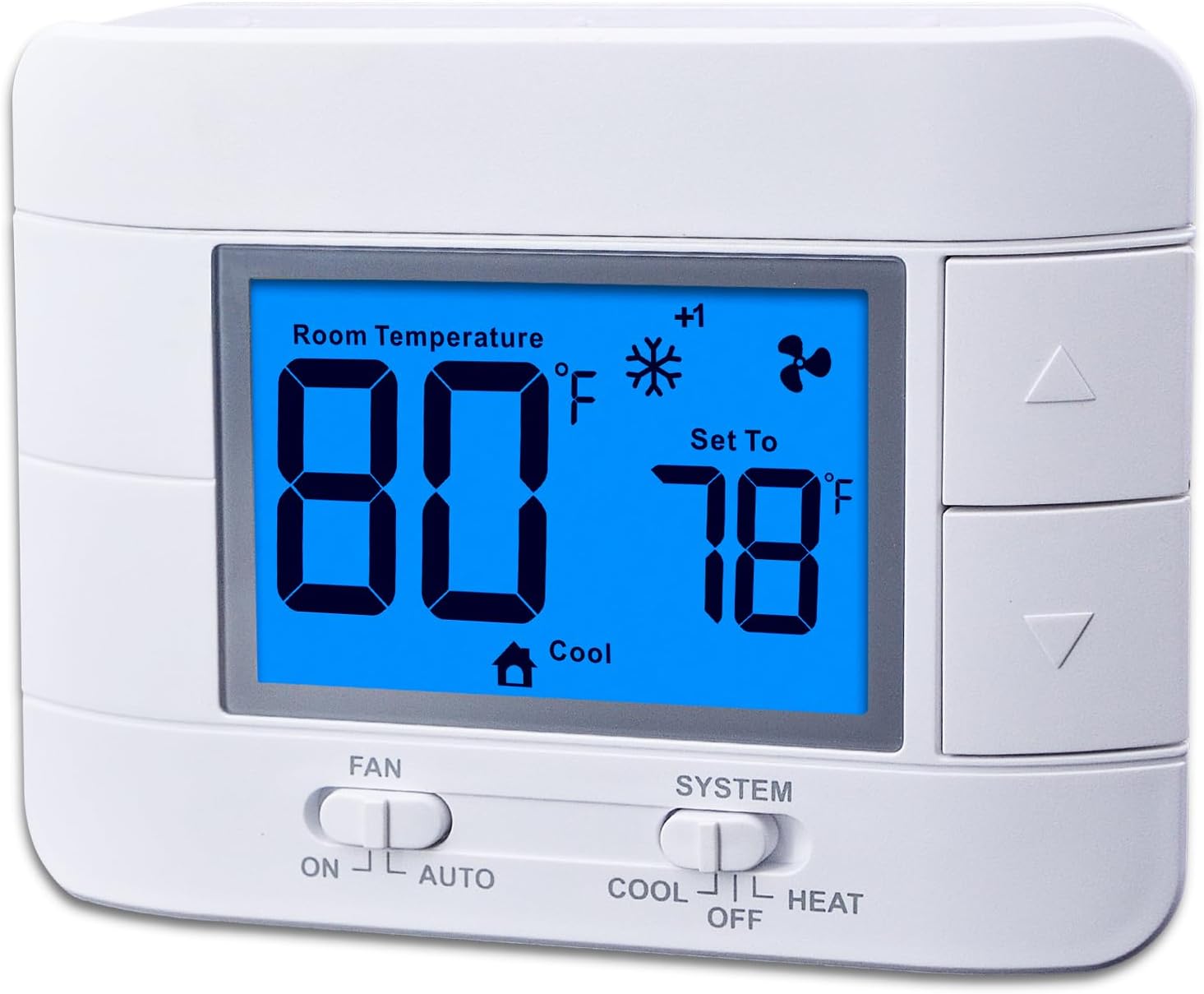
The Mroinge M711 is a basic wall thermostat built for straightforward temperature control in homes with conventional gas, oil, or electric furnaces. It operates as a non-programmable manual thermostat and is typically used to set and maintain a target temperature with large, easy-to-read digits and a humidity readout on its LCD. Installation is intended to be simple and it can run on 24VAC or two AAA batteries so a C-wire is not required in most installs. Notable features include multi-stage support (2 heat/2 cool), temperature calibration for fine tuning, and a compressor delay protection to reduce short cycling and protect HVAC equipment. Practical benefits are its clear display, compatibility with common furnace systems, and a straightforward control layout that suits users who want reliable manual operation rather than scheduling. Limitations: it does not work with heat pump systems, auxiliary or emergency heat, RVs, or 120/240V line-voltage baseboard systems, and it lacks programmable scheduling or smart connectivity for remote control or energy optimization.
Best for: Buyers who prioritize a reliable, no-frills thermostat to directly control conventional home heating and cooling systems and who prefer simple setup and operation over smart features.
Less Ideal for: Users who want programmable schedules, app or voice control, or those with heat pump, auxiliary/emergency heat, RV, or line-voltage heating systems should look elsewhere.
- Large, easy-to-read LCD display for quick temperature and humidity checks
- Supports 2 heat/2 cool multi-stage systems for broader furnace compatibility
- Can run on 24VAC or two AAA batteries so no C-wire is required in many homes
- Includes compressor delay protection to reduce short cycling and help extend HVAC life
- No programmable schedules or Wi‑Fi/smart home integration
- Not compatible with heat pump systems, auxiliary/emergency heat, RVs, or line-voltage baseboard systems
Verdict: A straightforward, reliability-focused 2-stage thermostat that protects HVAC equipment and delivers clear manual control without smart features.
ecobee Smart Thermostat Enhanced

| Controller Type | Amazon Alexa, Android, Apple HomeKit, Google Assistant, iOS |
|---|---|
| Connectivity Technology | Wi-Fi |
| Voltage | 24 volts |
| Display Type | LCD |
| Power Source | Corded Electric |
The ecobee Smart Thermostat Enhanced is a wall-mounted, hardwired smart thermostat that automates heating and cooling based on occupancy and schedules while giving remote control through the ecobee app and common smart assistants. It uses built-in radar and the included SmartSensor support to detect occupied rooms and preheat or precool specific zones, which helps keep living spaces comfortable without running the whole system. eco+ features and schedule suggestions aim to reduce HVAC energy use, and the unit supports common 24VAC systems with a Power Extender Kit included for installs missing a C wire. Setup is designed for DIY installers with a backplate, wire labels, trim kit, and clear guidance, and the 4-inch LCD provides straightforward local control. Limitations to note are system compatibility requirements—line-voltage and specialty low-voltage systems are not supported—so you should run the compatibility checker before buying, and advanced multi-stage HVAC features depend on your system wiring and controls. For homeowners who want occupancy-aware scheduling and robust smart home integrations, it is a practical, energy-focused upgrade.
Best for: Homeowners who prioritize verified performance and want a proven smart thermostat that saves energy while integrating with popular voice assistants and remote apps.
Less Ideal for: Homes with nonstandard HVAC control voltages or owners who need a simple battery-powered thermostat with no wiring changes.
- Built-in radar occupancy sensing and SmartSensor support for room-level comfort
- Dual-band Wi‑Fi and app plus voice assistant integrations for remote control
- Power Extender Kit and full installation kit included for easier DIY wiring
- Energy-saving features and eco+ schedule suggestions to reduce heating and cooling costs
- Not compatible with line-voltage, millivolt, or some low-voltage control systems
- Advanced multi-stage capability depends on existing HVAC wiring and may require professional setup
Verdict: A feature-rich, occupancy-aware smart thermostat that delivers measurable energy savings and strong smart-home integration for compatible 24VAC systems.
Sensi Smart Thermostat ST55

| Connectivity Technology | Wi-Fi (2.4 GHz) |
|---|---|
| Control Method | App, Touch, Voice |
| Power Source | Corded Electric |
| Temperature Control Type | Programmable, Smart/Remote |
| Number of Batteries | 2 AA batteries required (included) |
The Sensi ST55 is a wall‑mounted smart thermostat that replaces a conventional control to give remote scheduling, usage reports, and voice control through Alexa, Google Assistant, Apple HomeKit, and other hubs. It is used like a traditional thermostat with buttons and a simple LED display, but adds a companion app for setting schedules, viewing runtime reports, and receiving maintenance alerts such as filter reminders. Installation is pitched at DIYers and includes mounting hardware, wire stickers, and step‑by‑step in‑app guidance; a common wire is not required for most homes. Notable features include 2.4 GHz Wi‑Fi connectivity for remote access, Energy Star certification for potential HVAC savings, and smart alerts that help spot equipment issues. Practical benefits are straightforward setup, broad smart‑home integration, and clear usage reporting that can help reduce energy bills. Limitations include a basic LED screen rather than a full color touchscreen and dependence on the 2.4 GHz Wi‑Fi band, which may be restrictive in networks that favor 5 GHz or segmented guest networks.
Best for: Buyers who want a reliable, easy‑to‑install smart thermostat that integrates with major voice assistants and prioritizes straightforward setup and energy reporting.
Less Ideal for: People who want a high‑end touchscreen interface or who need built‑in support for 5 GHz‑only Wi‑Fi networks should look elsewhere.
- Easy DIY installation with included hardware and in-app guidance
- Works with major voice assistants and smart‑home platforms
- Energy Star certification and usage reports for potential HVAC savings
- Includes batteries and mounting accessories for a ready install
- Simple LED display lacks a full color touchscreen
- Requires 2.4 GHz Wi‑Fi which may not work on some modern networks
Verdict: Choose the Sensi ST55 when you want a straightforward, Energy Star‑rated smart thermostat that is easy to install and integrates with popular voice assistants.
Choosing the Right 2-Stage Thermostat: Key Factors to Consider
System Compatibility
Confirming compatibility with your specific two-stage heating and cooling equipment is essential because not every thermostat supports the same control schemes. Two-stage systems may use separate terminals for first and second stages, or they may rely on integrated control boards that expect particular signal types. Verifying that the thermostat provides the required stage outputs and supports your system type reduces the chance of installation rework or improper staging.
Compatibility also extends to power method. Some thermostats require a common wire for continuous power, while others operate on batteries or use power-stealing techniques. The available wiring in your wall and the HVAC control board terminals will determine which thermostat designs are viable, so matching those details saves time and prevents performance issues.
Staging Logic and Accuracy
How a thermostat decides when to move from stage one to stage two and back again determines comfort and equipment stress. Good staging logic uses both temperature differential and time-based criteria to avoid rapid cycling between stages. Look for thermostats that offer adjustable staging thresholds and programmable minimum runtimes so compressors and burners are protected while still delivering the extra output when needed.
Accuracy in temperature sensing and repeatable staging transitions matter most during weather swings. Thermostats with refined algorithms reduce overshoot and undershoot by anticipating when a second stage will be needed rather than reacting only after a setpoint is missed. This leads to steadier indoor temperatures and less wear on the HVAC system.
Installation Requirements
Installation complexity affects both upfront cost and long-term reliability. Thermostats that require extra wiring or uncommon terminal configurations may force an electrician or HVAC technician hire. Check terminal labeling, whether a common wire is needed, and how the thermostat handles multiple control relays. Units with clear wiring diagrams and robust terminal screws reduce installation errors.
Also consider physical fit: wallplate size, mounting depth, and whether the thermostat includes adapters for standard junction boxes. Simpler installations reduce the chance of loose connections that can lead to intermittent staging or erratic behavior.
Control Features and Programmability
Control and programmability influence both comfort and efficiency. Scheduling options, adaptive recovery, and setback modes help balance comfort with reduced runtime. For two-stage systems, programmable features that tie into staging logic—such as allowing the thermostat to delay second-stage activation during certain schedules—can improve efficiency without sacrificing comfort.
Remote access and mobile control can be valuable but should not replace solid local staging behavior. When evaluating features, prioritize those that strengthen stage control and provide clear feedback on current stage, runtime, and system status.
Durability and Serviceability
A thermostat is a long-term component of an HVAC system, so build quality and the ability to service or update the unit matter. Terminals that resist corrosion and a solid enclosure reduce failure points. Firmware update capability and accessible support documentation help address software bugs or compatibility issues that may appear after installation.
Serviceability also includes replaceable batteries, removable faceplates, and easy-to-access wiring. These traits make routine maintenance and troubleshooting simpler for both homeowners and service technicians.
Why Two-Stage Control Matters
Two-stage thermostats allow HVAC systems to run at a lower output when demand is mild and ramp up only when needed. That capability reduces short cycling, improves temperature stability, and can extend equipment life by avoiding frequent on-off cycles.
Understanding the practical benefits helps you select a thermostat that matches your daily usage patterns and climate. In moderate conditions, good two-stage control often achieves comfort with lower energy use because the system runs longer at the efficient low stage rather than frequently switching to high stage.
- Better temperature stability during swing conditions
- Reduced short cycling for compressors and burners
- Potential for modest efficiency gains in many climates
Wiring Checklist Before You Buy
Inventory your existing thermostat wiring and label each conductor. Typical two-stage systems use separate terminals for stage one and stage two calls for heating and cooling, plus common, fan, and power connections. Note any nonstandard or proprietary terminals on your control board.
If you do not have a common wire, look for thermostats that either operate on batteries or include a power adapter option. Confirm that the chosen thermostat's wiring scheme maps cleanly to your HVAC control board to avoid ad hoc rewiring.
- Identify R, C, W1, W2, Y1, Y2, G, and other terminals
- Check for required power method: battery, C-wire, or adapter
- Match fan control and auxiliary heat configurations if present
Optimizing Settings for Comfort and Efficiency
After installation, spend time tuning staging thresholds, minimum runtimes, and cycle delays. Conservative settings can protect equipment but may delay comfort; aggressive settings may improve responsiveness but raise the risk of short cycling. Adjust in small steps and monitor indoor conditions over several days.
Use setback schedules thoughtfully. In many homes, modest setbacks combined with predictable staging behavior deliver energy savings without noticeable comfort loss. If the thermostat supports adaptive recovery, allow it to learn how long it takes your system to reach setpoints so it can manage staging proactively.
- Set minimum runtime to protect compressors and burners
- Adjust stage differential to reduce unnecessary second-stage calls
- Use adaptive recovery if available to smooth temperature changes
Common Installation Pitfalls
Mixing up stage terminals during wiring is a frequent cause of improper operation. Wires for first and second stages must be connected to the corresponding terminals on both thermostat and control board. A mislabeled or swapped wire can cause a unit to call the wrong stage at the wrong time.
Another common issue is relying on power-stealing thermostats without confirming the HVAC system supplies enough idle current. That can cause intermittent resets or erratic staging. Finally, neglecting to update thermostat firmware when recommended can leave you with avoidable bugs that affect staging logic.
- Double-check terminal labels and continuity before finalizing installation
- Confirm power method and avoid power-steal reliance if system current is low
- Install firmware updates when available to fix staging logic issues
When to Consult an HVAC Technician
Call a professional if your system uses complex control boards, variable-speed compressors, or multi-zone arrangements. These configurations often require technician-level configuration to ensure the thermostat and system communicate correctly and staging is optimized.
Also consult a technician when your wiring is incomplete or if you detect unusual behavior such as repeated short cycling after installation. A technician can verify control voltages, test stage outputs, and recommend wiring or control board changes to achieve proper staging.
- Complex control boards and variable-speed equipment
- Multi-zone systems with dampers or zone control panels
- Persistent short cycling or erratic stage changes after installation
How We Chose the Best 2-Stage Thermostat
We focused on practical, HVAC-specific criteria that determine whether a 2-Stage thermostat will deliver reliable staging and long-term comfort. Core factors included electrical and control compatibility with common two-stage furnaces and heat pumps, the accuracy and repeatability of stage-change logic, and how well thermostats prevent short cycling through staging delays and smart algorithms. We also evaluated installation requirements, including wiring terminals and whether the unit supports common control voltages and equipment configurations, since a mismatch at installation is a frequent reason for returns. Usability and control features were another filter: clear display and intuitive setup are important for homeowners and technicians. We considered build quality and durability indicators, such as robust terminal blocks and firmware update capability. Connectivity and programmability were weighed moderately, focusing on whether remote access or scheduling functions improved staging performance or energy control. We excluded single-stage-only thermostats, units lacking true two-stage control logic, and devices with incompatible wiring for typical two-stage HVAC systems. Final selections prioritize reliable staging, straightforward installation, and clear operational controls.
Our full evaluation process is outlined in our review methodology.
FAQ
How does a 2-stage thermostat differ from a single-stage thermostat?
A two-stage thermostat can call for a lower-capacity first stage most of the time and a higher-capacity second stage only when demand increases. This reduces cycling and provides steadier temperatures compared with a single-stage thermostat that only has on and off commands.
Will a 2-stage thermostat work with my existing two-stage furnace or heat pump?
Often yes, provided the thermostat supports the same terminal outputs and control signals your equipment uses. Verify that stage terminals, power method, and any auxiliary or emergency heat wiring are compatible before purchase or installation.
Do I always need a common wire for a 2-stage thermostat?
Not always. Some models run on batteries or use power-stealing circuits, but many modern thermostats require a common wire for reliable power. Check the unit's power requirements and your wall wiring before selecting a thermostat.
Can I program staging thresholds and minimum runtimes?
Many two-stage thermostats offer adjustable staging differentials, minimum runtimes, and cycle delays. These settings let you tune responsiveness and equipment protection, and they are worth adjusting after installation to match your system and comfort preferences.
Will smart features improve staging performance?
Smart features like adaptive recovery and learning schedules can complement good staging logic, but they do not replace proper hardware compatibility. Prioritize thermostats whose core staging algorithms are reliable, then consider connectivity features for convenience.
Final Verdict
Prioritize compatibility and staging logic when choosing a 2-stage thermostat. Matching terminal outputs and power requirements prevents installation problems, while accurate staging thresholds and minimum runtimes protect equipment and improve comfort. Balance advanced programmability and remote access against the thermostat's ability to manage stages reliably. Focus on the criteria that matter most for your system: compatibility, staging accuracy, and straightforward installation. Choose a thermostat that provides clear stage feedback and adjustable settings so you can tune performance to your home and climate with confidence.