
Note: This article contains affiliate links. If you click on these links and make a purchase, we may earn a small commission at no extra cost to you. This helps support our research and content. Read our full affiliate disclosure here.
If you need on-demand hot water without a large storage tank, a 220V tankless water heater can free up space and cut standby losses. Choosing the right unit matters because capacity, electrical requirements, and installation constraints determine whether a tankless system will actually meet your household hot-water needs. This guide shortlists the top 220V tankless water heaters for typical home installations and evaluates them against practical criteria like flow performance, electrical efficiency, and installation flexibility. Read on for an overview of what matters and which features to prioritize before you pick a unit.
Top Picks at a Glance
| Best Overall The best all-around choice for most situations | Titan N-120 Tankless Water Heater |  |
| Best Quality Built to a higher standard if you want something more solid | Stiebel Eltron Tempra 36 Plus |  |
| Best Value The sweet spot between price and what you get | ThermoMate ET080 8kW Tankless Water Heater |  |
| Best Budget The cheapest option that still gets the job done reliably | BAIODNB 5.5KW Tankless Water Heater |  |
| Top Rated A top-rated pick with lots of positive feedback | EcoSmart ECO 11 Tankless Water Heater |  |
| Most Popular A crowd favorite that many people choose with confidence | Rheem RTEX-18 Tankless Electric |  |
| Best Seller A high-volume bestseller chosen again and again | Rheem RTEX-11 Tankless Electric |  |
Titan N-120 Tankless Water Heater

| Power Source | Corded Electric |
|---|---|
| Wattage | 11800 watts |
| Voltage | 220 volts |
| Mount Type | Wall |
| Material Type | Titanium |
The Titan N-120 is a compact wall-mounted 220 V electric tankless water heater intended to provide on-demand hot water for indoor installations. It uses dual heating chambers and a rated 11,800 watts (54 max amps) to heat water as it flows, which reduces standby losses compared with tank heaters and suits homes that can supply the required 220 V circuit and amperage. Installation is straightforward when replacing a similar hardwired unit and its small footprint frees utility space. Practical benefits include energy savings from on-demand heating, titanium components for corrosion resistance, and a control approach that stabilizes temperature under varying flow. Important limitations are the need for a dedicated 220 V, high-amp electrical supply and that output depends on inlet water temperature and flow rate, so it may not meet simultaneous high-demand uses without proper sizing. The unit is best for buyers wanting a compact, efficient electric tankless solution where the home electrical system supports its power requirements.
Best for: Homeowners wanting an efficient, space-saving electric tankless heater who prioritize on-demand hot water and have or can provide a 220 V high-amp electrical connection.
Less Ideal for: Homes without a 220 V high-amperage circuit or buyers who need high simultaneous hot-water output without upgrading electrical service.
- On-demand heating reduces standby energy loss compared with tank heaters
- Dual heating chambers for more consistent temperature control under load
- Titanium material improves corrosion resistance and durability
- Compact wall-mounted design saves space in utility areas
- Requires a dedicated 220 V circuit with high amperage which may need electrical upgrades
- Output varies with inlet water temperature and flow so sizing is critical for multiple simultaneous uses
Verdict: A compact, titanium-bodied 220 V electric tankless heater that delivers efficient on-demand hot water when installed on a properly sized electrical circuit.
Stiebel Eltron Tempra 36 Plus

| Wattage | 36 KW |
|---|---|
| Voltage | 240 volts |
| Flow Rate | 1.5 gpm |
| Maximum Temperature | 140 °F |
| Maximum Pressure | 150 psi |
The Stiebel Eltron Tempra 36 Plus is a high‑output electric tankless heater built for whole‑home hot water delivery. It uses self‑modulating German technology to adjust power to demand, maintaining set temperature even when multiple fixtures run at once, and the LED display makes temperature control straightforward. With 36 kW at 240 volts it can handle several showers or simultaneous laundry/dishwasher cycles in many climates, and the unit requires hard wiring and wall mounting. The compact, vent‑free design simplifies installation location choices, and the copper heat exchanger and 99% claimed efficiency target energy savings versus tank systems. Important practical limits are the electrical requirements — three 50A breakers/150A draw are needed — and the published 1.5 gpm minimum flow means very low flow fixtures may not trigger heating. Overall it is a robust, performance‑focused electric option for homes that can support the required wiring and need reliable multi‑fixture hot water.
Best for: Buyers who prioritize delivery of consistent, high‑capacity hot water across multiple fixtures and are prepared to provide upgraded electrical service and professional installation.
Less Ideal for: Homes without the necessary 240V high‑amp electrical capacity or buyers who need a simple retrofit to existing low‑amp wiring.
- High 36 kW heat output suitable for whole‑home demand
- Self‑modulating control maintains stable set temperature under varying flow
- Compact, vent‑free wall mount design eases installation placement
- LED display for straightforward temperature adjustment
- Copper construction and high claimed efficiency for energy savings
- Requires substantial electrical service (three 50A breakers/150A draw) for installation
- Minimum flow rate of 1.5 gpm may not activate at very low‑flow fixtures
Verdict: Choose the Tempra 36 Plus when you need a high‑output, performance‑focused electric tankless heater that delivers steady hot water for whole‑home use and you can support its heavy electrical requirements.
ThermoMate ET080 8kW Tankless Water Heater

| Wattage | 8 KW |
|---|---|
| Voltage | 240 volts |
| Flow Rate | 1.9 gpm |
| Maximum Temperature | 131 °F |
| Water connections | 1/2" NPT |
The ThermoMate ET080 is a small, wall-mounted 8 kW electric tankless unit designed for point-of-use hot water at a sink or nearby fixture. It self-modulates power based on incoming water temperature and flow to maintain output and improve efficiency, and it can produce roughly 1.56 gallons (about 1.9 gpm listed) at a 35°F rise with a maximum outlet temperature near 131°F. Installation requires a 240V supply with a 40A double-pole breaker and 8 AWG wiring, and the unit uses 1/2 inch NPT side water connections and a cast aluminum heating chamber designed to separate the element from the water stream for reduced scaling and leakage risk. Practical features include ETL-listed safety protections, overheat cutoff and no-flow shutdown, and a compact wall footprint that frees floor space. Limits are inherent to its power: it is intended for one or two low-flow fixtures rather than whole-house use, and cold climates or high-flow demands will reduce delivered temperature. For someone optimizing space and energy at a single sink or small laundry hookup, it is a sensible, efficient choice.
Best for: Buyers looking to replace or add a compact, energy-conscious point-of-use heater for a sink or small laundry hookup who prioritize space savings and lower operating cost.
Less Ideal for: Users who need whole-house hot water, multiple simultaneous showers, or higher flow and temperature at colder inlet temperatures should choose a higher-power solution.
- Self-modulating control for more consistent water temperature and improved energy efficiency
- Compact wall-mounted design that saves floor space and fits tight locations
- Cast aluminum heating chamber that separates element from water to reduce scaling and leakage
- Built-in safety features including overheat protection and auto shutoff when no water flow is detected
- 8 kW output limits usable flow and temperature rise, so it is not suitable for multiple full-flow fixtures or whole-house use
- Requires a 240V, 40A double-pole circuit and 8 AWG wiring which may need electrical upgrades
Verdict: A compact, energy-efficient 240V point-of-use tankless that delivers reliable hot water for one or two low-flow fixtures while saving space and operating cost.
BAIODNB 5.5KW Tankless Water Heater

| Wattage | 5500 watts |
|---|---|
| Voltage | 219.98 volts |
| Temperature Range | 30-55°C (86-131°F) |
| Waterproof Level | IPX4 |
| Working Pressure | 0.1-0.6 mpa |
This compact tankless unit heats water on demand using a 5.5 kW element and is intended for point-of-use installs such as kitchen or bathroom sinks. It mounts to the wall, connects to a 220V circuit, and uses a touch panel with an LED readout to set temperatures between about 30 and 55°C (86 to 131°F). The ABS shell and cast-aluminum heat emitter aim to resist corrosion while an IPX4 rating helps protect the electronics in wet locations. Built-in safeguards include leakage, dry-burn, and overheat protections and the heater can start at low water pressure, which is helpful in high-rise plumbing. Because it is a small, single-point unit it provides continuous hot water for a sink without a storage tank and avoids the standby losses of a conventional boiler. Important limits are its 220V power requirement and rated output, which make it unsuitable as a whole-house or bath supply, and installation needs a suitably sized dedicated circuit and properly rated wiring.
Best for: Buyers looking to add an inexpensive, space-saving source of instant hot water at a single sink or small utility point who prioritize low upfront cost and simple installation for a 220V circuit.
Less Ideal for: Those who need whole-house or high-flow hot water, or who cannot accommodate a dedicated 220V circuit should consider larger-capacity or different power-spec appliances.
- Instant on-demand hot water suitable for sinks and other point-of-use fixtures
- Touch control with LED display for straightforward temperature setting
- Compact wall-mount design saves space in small kitchens or utility areas
- IPX4 splash resistance and multiple safety protections for wet-location use
- Requires a 220V, 25A+ circuit and 2.5 mm² copper wiring for safe installation
- Not sized for whole-house or bathtub use due to 5.5 kW output
Verdict: A budget-friendly 220V point-of-use tankless heater that delivers instant sink-level hot water with basic safety features and a very small footprint.
EcoSmart ECO 11 Tankless Water Heater

| Wattage | 13000 watts |
|---|---|
| Voltage | 220 volts |
| Flow Rate | 3.1 gpm |
| Maximum Temperature | 140 °F |
| Mount Type | Wall |
The EcoSmart ECO 11 is a small, wall‑mounted electric tankless heater designed to provide endless hot water at a single sink or a bathroom in warmer climates or as a point‑of‑use unit in colder areas. It uses self‑modulating technology to vary power with flow and temperature demand, and a digital temperature control lets you dial setpoints to the degree. At 13 kW (11 kW heat output listed) and 240 volts it supplies roughly 1.3–3.1 gpm depending on inlet water temperature, which is enough for a shower plus a low‑flow sink in many situations. The unit is slim and space‑saving, includes an LED display, and is straightforward to mount on a wall near the point of use. Limitations are electrical: it draws significant amperage and requires proper breaker and wire sizing, and its flow rate is intentionally limited so it is not suitable for whole‑house use in cold climates. Expect simple installation when electrical capacity and sizing are appropriate, and reliable, efficient on‑demand hot water for single‑fixture or low‑flow needs.
Best for: Buyers who prioritize a dependable, compact on‑demand heater for a single bathroom, sink, or office breakroom and value consistent temperature control and energy efficiency.
Less Ideal for: Homes that need high flow or whole‑house hot water in cold climates or buyers without sufficient electrical capacity for the required breaker and wiring should look elsewhere.
- Compact wall‑mounted design saves floor space and fits near points of use.
- Self‑modulating technology adjusts power to demand for higher efficiency.
- Digital temperature control and LED display allow precise temperature setting.
- Provides continuous on‑demand hot water for single‑fixture or low‑flow applications.
- Lifetime warranty on key internal components (electronics, exchanger, element).
- Limited flow rate not suited for whole‑house use in cold climates.
- Requires high amperage and correctly sized breakers and wiring for safe installation.
Verdict: A compact, energy‑efficient 220V tankless unit that reliably delivers on‑demand hot water for single fixtures and low‑flow uses when properly sized and wired.
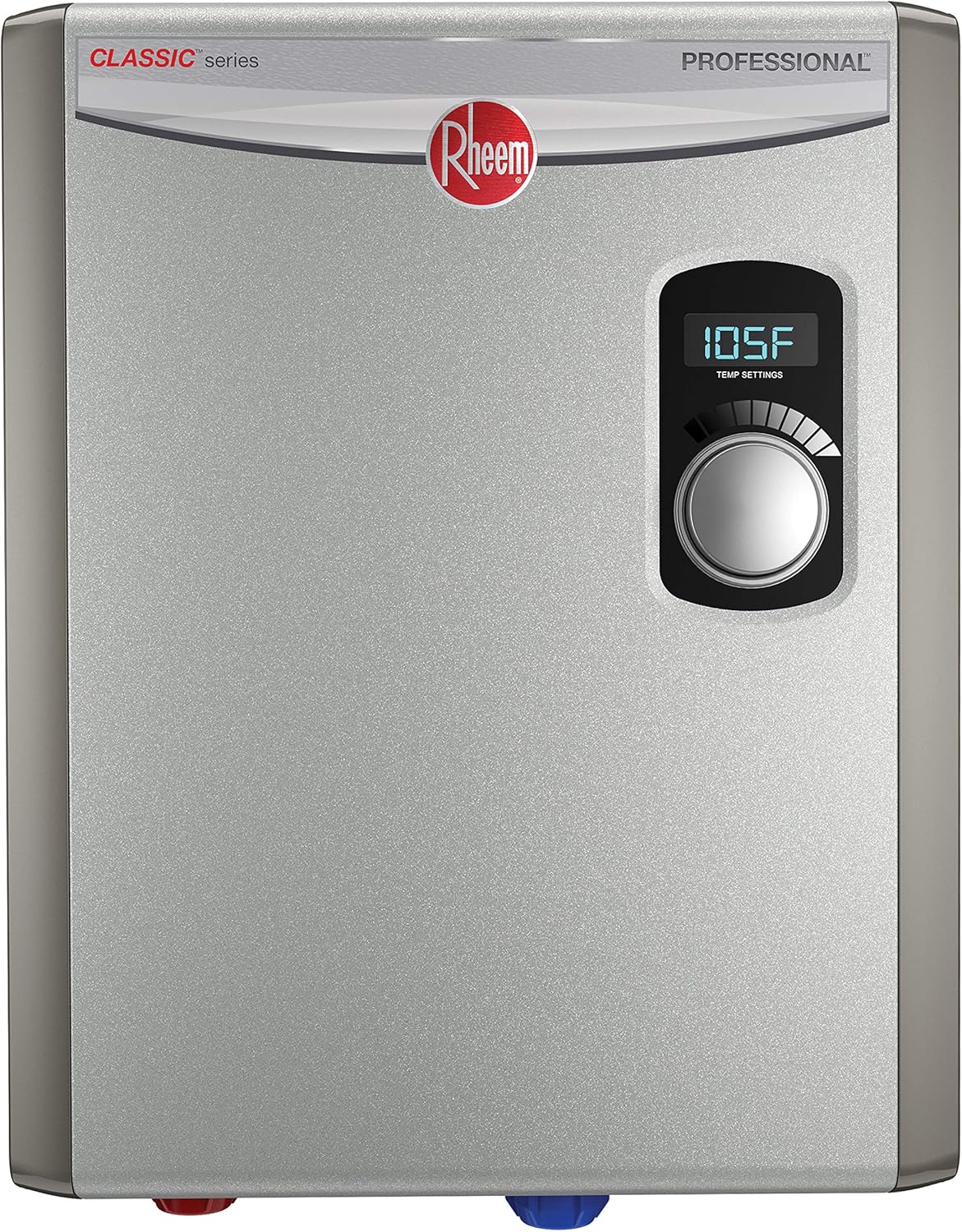
Rheem RTEX-18 Tankless Electric
| Wattage | 18000 watts |
|---|---|
| Voltage | 240 volts |
| Flow Rate | 4.4 gpm |
| Maximum Temperature | 140 °F |
| Mount Type | Wall |
The Rheem RTEX-18 is a compact wall‑mounted tankless electric heater intended for whole‑home or single‑shower applications in moderate climates. It uses self‑modulating 18 kW heating with two field‑serviceable copper immersion elements and an external LED temperature control for one degree accuracy, so the unit only draws the power needed to meet flow demand. With a quoted peak flow of up to 4.4 gpm it can handle typical shower and sink combinations but may struggle with simultaneous high‑flow demands in colder inlet conditions. Installation is straightforward with bottom 3/4 inch NPT water connections and no venting is required, which makes placement flexible. Practical benefits include reduced standby energy use compared with tanks and a small footprint that frees up space. Buyers should note the flow rate and required electrical service when planning a replacement for larger households, and professional wiring to the specified multi‑breaker circuit layout is essential. For buyers seeking reliable on‑demand hot water within the RTEX 240V ecosystem, this is a sensible mid‑capacity choice.
Best for: Buyers who prioritize dependable, energy‑efficient on‑demand hot water with proven reviews and want a compact 240V whole‑home unit for typical mid‑size households.
Less Ideal for: Large households or owners planning to run multiple showers and high‑flow appliances at once should consider higher kW models or alternative solutions.
- Self‑modulating 18 kW design reduces energy use by matching power to demand
- External LED digital temperature control with +/-1° accuracy for easy setpoint changes
- Compact wall‑mount form factor requires no venting and saves space
- Field‑serviceable copper immersion elements simplify maintenance
- Maximum flow of 4.4 gpm may be insufficient for simultaneous high‑flow fixtures in cold climates
Verdict: A compact, energy‑saving 240V tankless heater that delivers reliable mid‑capacity on‑demand hot water for typical households.
Rheem RTEX-11 Tankless Electric

| Wattage | 11 KW |
|---|---|
| Voltage | 240 volts |
| Flow Rate | 2.68 gpm |
| Maximum Temperature | 140 °F |
| Mount Type | Wall |
The Rheem RTEX-11 is a compact 240V tankless electric unit intended for point-of-use installation where space is limited. It provides up to 2.68 gallons per minute, enough for one shower plus a sink or multiple sink fixtures, and uses digital thermostatic controls that let you set temperature in 1-degree increments between 80 and 140°F. Installation requires a dedicated 50-amp double-pole breaker and proper 240V wiring, so plan for a qualified electrician. Because the heater only runs when water flows it can cut energy waste compared with tank heaters, and its wall-mount design frees up floor space and needs no venting. The unit is stainless steel with an LED display and claims very high efficiency. Limitations to consider are the modest flow rate — it will not support simultaneous high-demand whole-house use — and the electrical requirements that may need panel or breaker upgrades. For a homeowner seeking a reliable, compact point-of-use electric heater, the RTEX-11 balances steady temperature control and energy-on-demand performance.
Best for: Buyers who want a reliable, compact point-of-use electric heater that delivers precise temperature control and energy savings for a single bathroom or nearby sink.
Less Ideal for: Homes needing a whole-house solution or multiple simultaneous high-flow fixtures should choose a higher-kW model or a different system.
- Compact wall-mount design saves floor space and can be installed near the fixture
- Digital thermostatic control with 1°F increments for precise outlet temperature
- High claimed efficiency and heats only when water flows to reduce standby energy use
- No venting required, simplifying indoor installation compared with gas models
- Maximum flow rate of 2.68 GPM limits simultaneous use to a shower plus sink, not whole-house demand
- Requires a dedicated 240V, 50-amp circuit and appropriate wiring which may need electrical upgrades
Verdict: Choose the RTEX-11 when you need a compact, energy-efficient 240V point-of-use tankless heater that delivers precise on-demand hot water for a single bathroom or nearby fixtures.
Choosing the Right 220V Tankless Water Heater: Key Factors to Consider
Flow Capacity and Temperature Rise
Flow capacity defines how many fixtures the unit can supply simultaneously at a given temperature rise. A unit rated for a high flow at a small rise may not sustain hot water if incoming groundwater is cold. Match the heater's flow capacity to the number and type of fixtures you expect to run at once, and check published flow curves or rated gallons-per-minute figures at realistic temperature increases.
Underestimating required temperature rise is a common cause of disappointment. In cold climates a 30 to 50 F rise may be needed for showers and sinks, while milder regions need less. Choose a model whose flow-at-rise performance aligns with your peak simultaneous demand rather than just its maximum flow spec.
Electrical Supply and Circuit Requirements
A 220V tankless water heater needs dedicated circuit capacity sized for its maximum current draw. Confirm the home's panel has space for the required breakers and that wire gauge and breaker sizing match the unit's specified amperage. Some high-capacity units require multi-breaker arrangements or multiple dedicated circuits.
Circuit capacity affects both safety and performance. Undersized wiring or shared circuits can cause nuisance trips, voltage drop, or limited heating performance. Factor in the potential need for panel upgrades or additional breakers when budgeting installation time and costs.
Installation Location and Venting
Tankless units are compact but their performance depends on proper siting. Indoor installations need adequate clearances for servicing and may require condensation management. For electric 220V models, combustion venting is not required, but think about moisture, freeze risk, and proximity to high-use fixtures.
Mounting surface, water-line routing, and accessibility for electrical connections should be planned before purchase. Installing in a garage, utility closet, or under a sink each has different pros and cons for condensation management and service access.
Controls, Water Tempering, and Safety Features
Precise electronic controls and temperature sensors produce steadier delivery and reduce temperature swings when multiple fixtures operate. Look for models with adjustable setpoints, digital displays, and anti-scald protection if households include children or older adults.
Built-in safety features such as over-temperature cutout, ground-fault protection compatibility, and freeze protection safeguard the unit and occupants. Consider whether the unit supports external mixing valves or integrated tempering to meet local plumbing codes and safety preferences.
Hard-Water Tolerance and Serviceability
Mineral buildup reduces heat transfer efficiency and flow over time. Models that are easier to descale or that include removable inlets, service ports, or included descaling kits reduce long-term maintenance hassle. In areas with hard water, plan for regular maintenance intervals and check whether the unit has a recommended service schedule.
Access to replaceable components and clear service instructions can extend the unit's usable life. Consider whether you are comfortable performing periodic descaling or would prefer a model designed for simpler professional servicing.
Sizing a 220V Tankless Heater for Your Home
Start by calculating your peak simultaneous demand in gallons per minute and the required temperature rise. Add up typical flows for fixtures you expect to run together, for example a shower plus a kitchen sink, and then choose a unit whose flow-at-rise performance covers that total. Avoid choosing based only on maximum flow numbers without checking the temperature-rise curve.
Also consider seasonal changes. Groundwater temperatures drop in winter, which increases the required temperature rise and reduces effective flow. If you live where inlet water gets cold, build extra capacity into your sizing calculations to avoid reduced performance during colder months.
- Estimate peak simultaneous GPM for likely fixture combinations
- Check unit flow charts at the expected temperature rise
- Account for colder inlet water in winter when sizing
Electrical Setup and Panel Considerations
Verify the breaker and wiring requirements before buying. Many 220V electric tankless models demand dedicated breakers sized to the unit's maximum amperage and specific wire gauges. If your electrical panel lacks spare spaces or capacity, you may need to install subpanels or upgrade the main panel.
Voltage drop over long cable runs can reduce heater performance. Keep the supply run short or upsized to minimize drop. Coordinate with a licensed electrician to confirm that the home's service can safely handle the added load.
- Confirm breaker count and wire gauge requirements
- Assess panel capacity and available breaker spaces
- Minimize long cable runs to avoid voltage drop
Maintenance Routines and Descaling
Regular maintenance preserves efficiency and prevents premature failure. For electric tankless units, descaling frequency depends on local water hardness and usage. Establish a descaling schedule and follow manufacturer guidance for flushing and cleaning heat-exchange surfaces when needed.
Keep service access clear. Install the unit where you can reach water connections and service ports without removing permanent fixtures. Document maintenance dates and any parts replaced to simplify future servicing.
- Plan descaling intervals based on local water hardness
- Install with service access in mind
- Log maintenance and component changes for warranty support
Temperature Controls and User Experience
Digital thermostats and precise flow sensors produce a better user experience than basic analog controls. Look for models with incremental temperature adjustment and clear displays so household members can set preferred temperatures easily.
Consider whether integrated tempering or compatibility with external mixing valves is desired. A tempering device can stabilize delivered water temperature and reduce scald risk, particularly when the same unit serves multiple outlets with varying flow demands.
- Prefer digital or precise temperature controls for consistent output
- Check compatibility with tempering valves or external controls
- Consider user interface location and accessibility
Installation Tips to Avoid Common Pitfalls
Plan the final location before buying. Mounting near the main point of use reduces lag and pipe heat loss. Ensure there is adequate clearance for electrical hook-ups and future servicing. Avoid cramped spots that make routine maintenance difficult.
Work with a qualified electrician for wiring, and follow local codes for breaker sizing and grounding. Even though electric tankless units do not require exhaust venting, they still require attention to condensation management and protection against freezing in unheated spaces.
- Place units close to high-use outlets to reduce lag
- Allow service clearances for routine maintenance
- Hire licensed electricians and follow local electrical codes
How We Chose the Best 220V Tankless Water Heater
We selected units that deliver reliable on-demand hot water for typical residential settings while respecting common 220V electrical constraints. Our editorial filters prioritized measured or manufacturer-rated flow performance under realistic temperature rises, efficient electrical use and heat delivery, and installation flexibility including mounting options and water connection layouts. Durability and serviceability were also important, so we favored designs with accessible components and clear maintenance needs. Safety features such as over-temperature protection, ground-fault interruption compatibility, and built-in freeze protection were required for inclusion. Finally, we considered sensor and control precision because consistent outlet temperatures matter more than peak theoretical capacity. We excluded low-quality or underspecified models that lacked clear performance data, had limited safety features, or required nonstandard electrical configurations. Our focus is on units suitable for standard 220V residential circuits and typical domestic hot-water duties. The criteria we used translate directly into the scoring metrics below and reflect what most buyers need to compare when choosing a tankless water heater.
Our full evaluation process is outlined in our review methodology.
FAQ
Will a 220V tankless water heater work for multiple showers at once?
It depends on the unit's flow-at-temperature-rise rating and your inlet water temperature. Many 220V electric models are sized for one or two fixtures simultaneously. Check the heater's rated GPM at your expected temperature rise to determine if it meets peak simultaneous demand.
Do 220V electric tankless heaters need venting?
No. Electric 220V tankless units do not require combustion venting because they do not burn fuel. However, you should consider moisture and condensation management and avoid installing in locations prone to freezing without protection.
How often should I descale an electric tankless water heater?
Descaling frequency depends on local water hardness and usage patterns. In hard-water areas, descaling every 6 to 12 months is common. Follow the manufacturer's maintenance recommendations and monitor flow and temperature stability as indicators for service.
Can my existing electrical panel support a 220V tankless unit?
That depends on available breaker spaces, total service capacity, and the unit's amperage requirements. A licensed electrician can evaluate panel capacity, determine if additional breakers or a panel upgrade are needed, and advise on proper wire sizing.
Are there safety features I should require in a unit?
Yes. Look for over-temperature shutoff, ground-fault protection compatibility, and freeze-protection features. Precise temperature controls and anti-scald options improve safety for households with children or older adults.
Final Verdict
Prioritize matching the heater's flow-at-temperature-rise performance to your peak demand and confirm your home's electrical capacity before purchase. Balance compact installation benefits against the need for adequate circuit sizing and regular descaling when you live in hard-water areas. Choosing a 220V tankless water heater comes down to realistic sizing, safe electrical installation, and planned maintenance. Focus on flow performance, installation constraints, and serviceability to pick a unit that will deliver reliable hot water for years.