
Note: This article contains affiliate links. If you click on these links and make a purchase, we may earn a small commission at no extra cost to you. This helps support our research and content. Read our full affiliate disclosure here.
If your household has hard water, choosing the right water heater matters more than picking the biggest tank or the flashiest efficiency rating. Hard water accelerates mineral buildup that reduces capacity, raises energy use, and shortens component life. You need a heater engineered to resist scale and corrosion or designed to make scale management simple. This guide shortlists the top water heaters for hard water, assessing build materials, tank protection, heating efficiency under mineral buildup, and maintenance needs. Read on for practical guidance and the key factors we used to pick these durable, low-maintenance options.
Top Picks at a Glance
| Best Overall The best all-around choice for most situations | Westinghouse 18kW Tankless Water Heater |  |
| Best Quality Built to a higher standard if you want something more solid | Titan N-85 Tankless Water Heater |  |
| Best Value The sweet spot between price and what you get | thermomate ES800 8-Gallon Water Heater |  |
| Top Rated A top-rated pick with lots of positive feedback | MRCOOL 50-Gallon Electric Water Heater |  |
| Most Popular A crowd favorite that many people choose with confidence | Bosch Tronic 3000 T ES2.5 2.5-Gal |  |
| Best Seller A high-volume bestseller chosen again and again | Rheem RTEX-18 Tankless Electric |  |
Westinghouse 18kW Tankless Water Heater

| Wattage | 18 KW |
|---|---|
| Voltage | 240 volts |
| Flow Rate | 4.2 gpm |
| Maximum Temperature | 140 °F |
| Maximum Pressure | 120 psi |
This Westinghouse 18 kW tankless electric heater is built to deliver on-demand hot water for small whole-house setups or multiple simultaneous fixtures. It uses copper heating elements and self-modulating controls to heat water quickly and keep temperature steady within about ±1°F while matching power to flow, which improves efficiency and reduces wasted energy. The unit supports up to 4.2 GPM and is wall-mounted and compact, so it frees up floor space and reduces flood risk. Smart features include Wi‑Fi app control and voice commands via Alexa and Google Assistant plus an LED display for local monitoring. For hard-water homes the included external scale inhibitor helps limit mineral buildup before water enters the heater, which should extend life and maintain performance. Important practical points: it requires hardwiring to 240V and a high amperage circuit (listed as 75A), so professional installation is recommended, and capacity is best for 2–3 fixtures rather than large-demand households. The heater is ETL certified and includes multiple safety protections.
Best for: Buyers who want a compact, energy-efficient electric tankless heater that performs reliably in hard-water areas and value remote control and corrosion-resistant copper elements.
Less Ideal for: Homes without adequate 240V electrical capacity or those that need high simultaneous hot-water flow for many fixtures should consider higher‑capacity options or different fuel types.
- Copper heating elements for faster heat transfer and improved corrosion resistance compared with standard coils
- Self-modulating technology keeps temperature stable and reduces energy use by matching power to demand
- Includes external scale inhibitor to reduce mineral buildup in hard-water conditions
- Wi‑Fi app control and Alexa/Google voice integration for remote temperature adjustments
- Compact wall-mount design frees floor space and lowers flood risk
- Requires a large electrical service and professional hardwired 240V installation
- Maximum flow of 4.2 GPM limits simultaneous use for larger households
Verdict: A compact, copper‑element 18 kW tankless heater with Wi‑Fi and a included scale inhibitor that fits buyers wanting efficient, hard‑water‑friendly on‑demand hot water for small whole‑house use.
Titan N-85 Tankless Water Heater

| Wattage | 8500 watts |
|---|---|
| Voltage | 240 volts |
| Flow Rate | 2.5 gpm |
| Efficiency | 99.5% |
The Titan N-85 is a wall-mounted electric tankless water heater designed for inline, point-of-use heating where space is tight. It uses an 8.5 kW heating element at 240 volts to provide about 2.5 gallons per minute of hot water, and its thermostatic control keeps outlet temperature stable under varying draw conditions. The unit is very compact and installs on the wall, making it a good option for small bathrooms, sinks, or remote fixtures. Its high stated efficiency and titanium construction suggest good corrosion resistance, which is helpful in hard-water areas, though no dedicated anti-scale system is listed. Expect limited simultaneous flow for whole-house use; this model is best for single-fixture service or supplementing a larger system. Installation requires a 38 amp circuit and proper 240 V wiring, so professional electrical work is typically needed. For buyers who need a space-saving electric solution that delivers steady hot water to one or two fixtures, the Titan N-85 is practical and efficient, but larger households should choose a higher-capacity unit or multiple units for reliable multi-fixture performance.
Best for: Buyers who prioritize compact, high-efficiency electric heating for single fixtures or small households and want a durable, space-saving solution.
Less Ideal for: Large families or homes that need simultaneous hot water at multiple fixtures should choose a higher-capacity tankless unit or whole-house system instead.
- Compact wall-mounted design saves space and fits point-of-use locations.
- Thermostatic temperature control maintains stable outlet temperatures.
- High thermal efficiency (listed at 99.5%) maximizes energy use.
- Titanium material offers improved corrosion resistance compared with standard heating elements.
- Modest 2.5 gpm flow rate limits simultaneous multi-fixture use.
- No listed built-in anti-scale or water-softening features for very hard water situations.
Verdict: Choose the Titan N-85 when you need a compact, efficient electric tankless heater to deliver reliable hot water to a single fixture or small household.
thermomate ES800 8-Gallon Water Heater
| Capacity | 8 gallons |
|---|---|
| Wattage | 1440 watts |
| Voltage | 120 volts |
| Maximum Temperature | 140 °F |
| Max. Water Pressure | 150 psi |
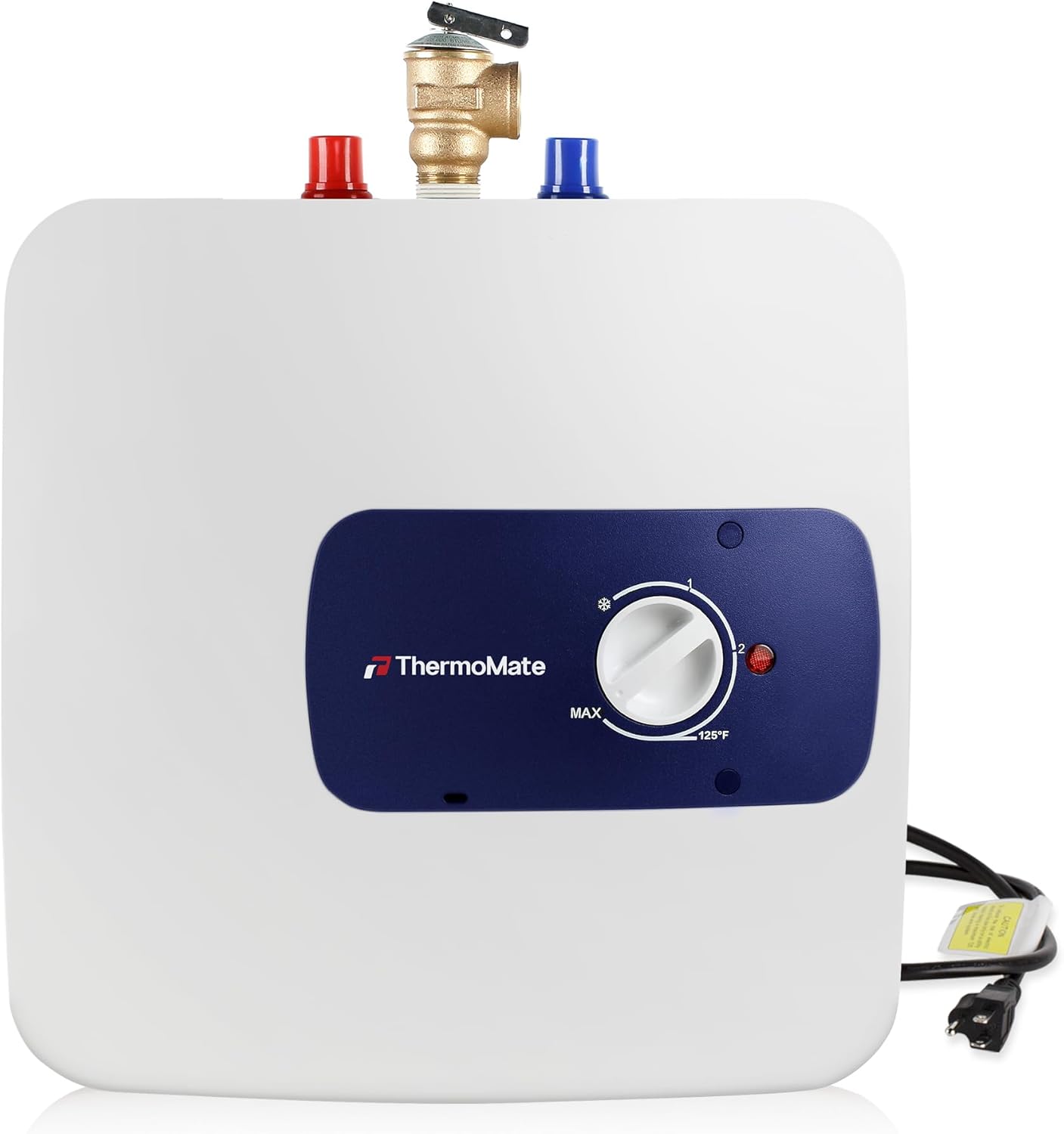
The thermomate ES800 is an 8.0-gallon point-of-use electric tank water heater that provides near-instant hot water for a single fixture or small load. It plugs into a standard 120V outlet and delivers 1440 watts of heating power with an adjustable thermostat that ranges up to about 140 to 149°F, so it is typically used under sinks or in small additions as a booster or dedicated sink heater. The unit is built with a glass-lined tank and a corrosion-resistant Incoloy 800 heating element plus a thick anode rod, which together reduce scale and corrosion concerns common in hard-water areas. Wall or floor mounting and included mounting kit and T&P valve make installation straightforward for DIYers who have a nearby outlet and 1/2" NPT plumbing. Limits: the small 8-gallon capacity and modest flow rate mean it is not suitable for showers or multiple fixtures simultaneously, and its 120V/12A electrical requirement provides slower recovery than 240V models. For single faucet boost and reduced cold-water wait time, it is effective and compact.
Best for: Buyers who want a simple, space-saving solution to eliminate cold-water lag at a single sink and who prioritize durability against corrosion in hard-water conditions.
Less Ideal for: Homes needing whole-house hot water, multiple simultaneous fixtures, or shower service should choose a larger tank or a dedicated higher-capacity heater.
- Compact point-of-use design for under-sink or small-space installation
- Glass-lined tank and thick anode rod for improved corrosion resistance in hard water
- Incoloy 800 heating element with high corrosion resistance and efficient heating
- Plug-in 120V connection and included mounting/T&P components simplify installation
- 8-gallon capacity cannot support showers or multiple simultaneous fixtures
- 120V/1440W power limits recovery speed compared with 240V units
Verdict: Choose the ES800 when you need a compact, corrosion-resistant point-of-use heater to deliver fast hot water to a single sink in hard-water environments.
MRCOOL 50-Gallon Electric Water Heater

| Power Source | Electric |
|---|---|
| Heat Output | 9000 watts |
| Capacity | 50 gallons |
| Special Features | Self-Cleaning System, Rare Earth Anode Rod |
This MRCOOL 50-gallon electric water heater is built around reliable, high-capacity performance for a typical household. It uses dual 4500W elements (9000W total) for faster recovery when multiple fixtures run at once, and the rare earth anode rod plus a self-cleaning flow guide are aimed at reducing corrosion and sediment buildup in hard water conditions. Practical touches like a brass ball valve and ceramic-coated stainless elements improve durability and make maintenance easier. The unit is designed for steady daily use—showers, sinks, and laundry—with energy-conscious element staging to keep running costs reasonable. Keep in mind this is a standard tank heater, so it occupies floor space and will have standby heat loss unlike tankless options, and proper installation and periodic maintenance are important to realize the longevity benefits in hard water environments.
Best for: Homeowners who prioritize a dependable, high-capacity tank heater that handles frequent hot water demand and includes features to resist corrosion in hard water.
Less Ideal for: Those seeking the smallest footprint or the highest energy efficiency available should consider tankless or heat pump alternatives instead of a conventional electric tank.
- Dual 4500W heating elements provide faster recovery for simultaneous hot water use
- Self-cleaning flow guide and ceramic-coated stainless elements help reduce sediment buildup
- Rare earth anode rod improves corrosion resistance in mineral-rich water
- Brass ball valve and durable construction support long-term reliability
- Standard tank design has standby heat loss compared with tankless units
- Requires regular maintenance to keep self-cleaning and anode protection effective
Verdict: Choose this unit if you want a durable, high-capacity electric tank water heater with built-in measures to combat sediment and corrosion in hard water households.
Bosch Tronic 3000 T ES2.5 2.5-Gal
| Capacity | 2.5 gallons |
|---|---|
| Wattage | 1440 watts |
| Voltage | 120 volts |
| Maximum Temperature | 140 °F |
| Efficiency | 98% |
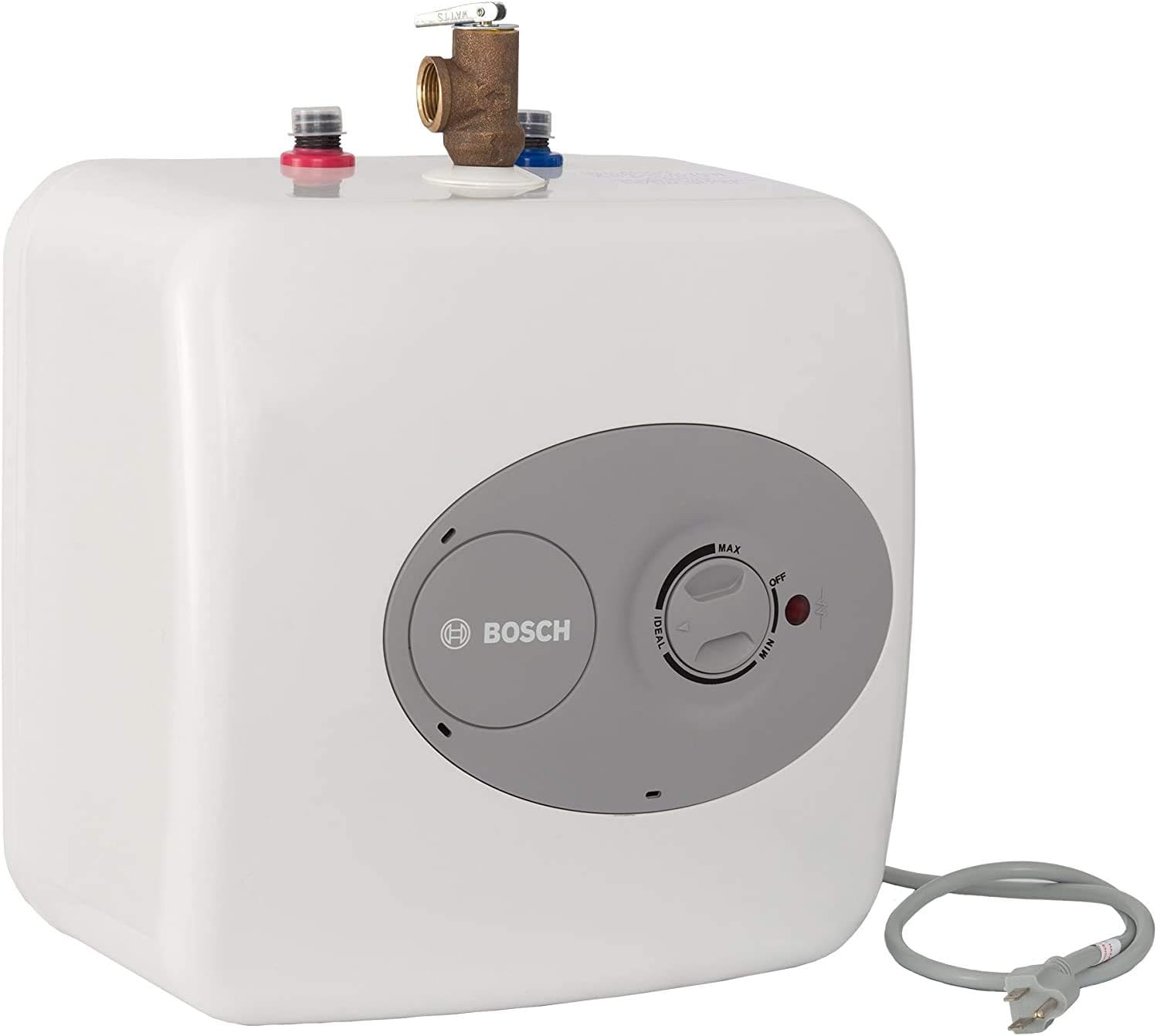
The Bosch Tronic 3000 T ES2.5 is a compact electric mini-tank that installs under a sink or on a wall to deliver immediate hot water where a full-size heater is impractical. It plugs into a 120 V outlet or can be hardwired in-line with a larger system, and the external temperature dial and temperature-and-pressure relief valve make operation straightforward and safe. The glass-lined tank and 98% thermal efficiency help reduce standby heat loss and extend service life, while the 1440 W element offers a fast recovery rate suitable for one or two nearby fixtures. Practical mounting options and a 36–37 inch cord simplify placement. Limitations include the small 2.5 gallon capacity, which will run out quickly under sustained use, and the 120 V/1440 W electrical rating that is less powerful than larger point-of-use heaters, so it is best for light to moderate hot-water demands rather than heavy continuous use. Overall it is a tidy, easy-to-install solution for short-run hot water at sinks or vanities.
Best for: Buyers who prioritize proven, well-reviewed equipment and want a simple, low-effort way to get near-instant hot water at a sink or vanity with minimal electrical changes.
Less Ideal for: Homes needing hot water for long, continuous demands such as full bathrooms, tubs, or multiple high-flow fixtures used simultaneously.
- Compact 2.5-gallon mini-tank fits under sinks or mounts on wall for point-of-use hot water
- Glass-lined tank for durability and corrosion resistance
- Plugs into a standard 120 V outlet for independent installation without special wiring
- External temperature dial and T&P relief valve for easy temperature control and safety
- Fast recovery rate and 98% thermal efficiency reduce wait time and standby heat loss
- Small capacity not suitable for long showers or high-flow continuous use
- Lower wattage limits peak hot-water output compared with larger electric units
Verdict: A compact, easy-to-install point-of-use heater that reliably delivers quick hot water at sinks for buyers who want a low-risk, proven solution.
Rheem RTEX-18 Tankless Electric
| Wattage | 18000 watts |
|---|---|
| Voltage | 240 volts |
| Flow Rate | 4.4 gpm |
| Maximum Temperature | 140 °F |
| Efficiency | 99.8% |
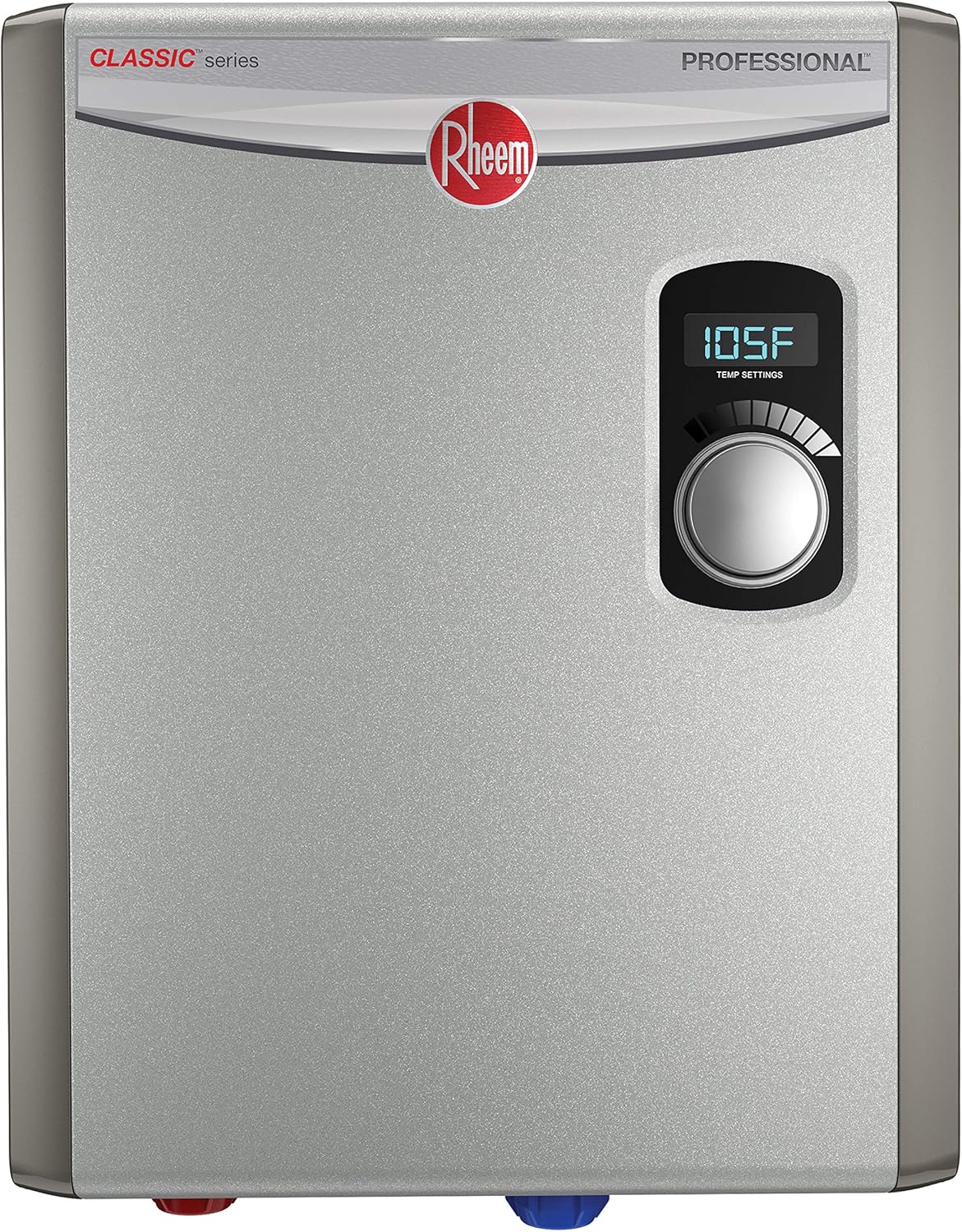
The Rheem RTEX-18 is a compact, wall-mounted tankless electric water heater built to deliver continuous hot water at up to about 4.4 gallons per minute. It uses two field-serviceable copper immersion heating elements with self‑modulating controls so the unit only draws the power needed to reach the set temperature, and a front LED display lets you set outlet temperature precisely. Installation is straightforward with bottom 3/4-inch NPT water connections and no venting required. In real use this model is best for one to two simultaneous fixtures in moderate inlet temperatures — for example a single shower plus a sink — and it saves space compared with a tank. Limitations include the 4.4 gpm flow cap, which may struggle with multiple high‑flow fixtures or very cold inlet water, and copper elements in hard‑water areas will need periodic maintenance or softening to avoid scale buildup. The RTEX-18 is a practical whole‑home tankless option when you want steady on‑demand hot water and energy modulation, but plan for water‑quality care in hard water conditions.
Best for: Buyers who prioritize dependable, on‑demand hot water with energy modulation and want a compact wall‑mounted unit they can maintain or have serviced easily.
Less Ideal for: Homes with multiple high‑flow fixtures running at once or very cold inlet water where higher gpm capacity or a higher‑kW unit is required.
- Continuous on‑demand hot water for mid‑range whole‑home use
- Self‑modulating power adjusts energy use to demand
- Digital LED temperature control with +/-1° accuracy
- Compact wall mount design saves space and needs no venting
- Field‑serviceable copper heating elements for easier servicing
- Maximum flow about 4.4 gpm limits simultaneous high‑flow fixtures
- Copper elements are susceptible to scale in hard water and need maintenance
Verdict: Choose the RTEX-18 if you want a compact, energy‑modulating tankless electric that delivers reliable on‑demand hot water for mid‑range whole‑home use while allowing routine maintenance for hard water care.
Choosing the Right Water Heater for Hard Water: Key Factors to Consider
Tank Material and Lining
The tank material and interior lining determine how well a water heater resists corrosion over time. Glass-lined tanks offer a protective barrier between water and steel, reducing rust risk, but the lining can chip if anode protection is insufficient. Stainless-steel tanks resist corrosion better in many hard-water environments, though costs and repairability differ. Consider the tradeoff between inherent material resistance and the availability of service options for lining or tank repair.
Also consider how the manufacturer protects welds and seams, as these are common failure points in mineral-rich systems. A robust lining plus an easily replaceable anode typically yields the best long-term outcome for hard-water households.
Anode Protection and Replacement
Sacrificial anodes are the primary sacrificial element that prevents tank corrosion by corroding in place of the tank shell. In hard-water conditions, anodes consume faster because mineral deposits accelerate electrochemical reactions. Look for units that offer easy, tool-free access to the anode for inspection and replacement, and check whether there are options for more durable anode materials, such as aluminum-zinc or powered anodes.
Frequent inspection cycles may be necessary in very hard water, so accessibility and the cost of replacement anodes factor heavily into lifecycle maintenance.
Heating Element and Heat-Exchanger Design
How the heater transfers heat affects scale buildup and energy consumption. Exposed electric elements can accumulate scale quickly, reducing heat transfer efficiency and lifespan. Immersed or protected elements and indirect or separate heat exchangers can be easier to service or less prone to encrustation.
For gas or oil-fired units, burner placement and flue-pass design influence how mineral deposits affect heat transfer. Units designed with removable or accessible elements and straight-forward descaling procedures lower long-term maintenance effort.
Maintenance Access and Ease of Descaling
Regular descaling and periodic flushing are the reality for homes with hard water. Units that provide clear access ports, removable heating elements, and straightforward drain valves make routine maintenance faster and safer. Also consider whether the design allows common descaling methods, such as chemical flushes or physical element removal, without complex disassembly.
Easier maintenance reduces service time and costs over the life of the heater and helps preserve performance and efficiency.
Warranty Terms and Service Coverage
Warranty scope and length can reflect manufacturer confidence in a product's ability to withstand harsh water. For hard-water environments, look beyond duration and read coverage details: does the warranty require specific maintenance steps, or are certain failures excluded if mineral buildup is present? Some warranties may be voided if recommended anode replacements or flushes are not performed on schedule.
A clear, supportive warranty combined with reasonable maintenance requirements reduces long-term ownership risk.
Hard Water Effects on Heater Efficiency
Mineral deposits act as insulation on heating surfaces, slowing heat transfer and forcing heaters to run longer to reach set temperatures. Over time, that means higher energy use and more frequent cycling. Understanding how scale impairs efficiency helps you choose a unit whose design minimizes those losses.
When evaluating efficiency, consider both initial thermal performance and the expected decline as scale accumulates. Some designs maintain acceptable efficiency longer because critical components are easier to clean or are less exposed to direct mineral contact.
- Deposits reduce heat-transfer efficiency and increase energy consumption
- Scale can make thermostats and sensors less accurate, causing overheating
- Regular descaling restores performance but requires time and access
Choosing Between Tank and Tankless for Hard Water
Both tank and tankless water heaters have pros and cons in hard-water conditions. Tanks can tolerate a certain amount of scale if they include robust anode protection and accessible elements for descaling. Tankless units have compact heat exchangers that can be more sensitive to mineral buildup and often require inline water-treatment devices or more frequent descaling cycles.
Your decision should factor in how much maintenance you are willing to perform and whether you prefer simpler repairs over potential increased frequency of professional servicing. In either case, pairing the heater with proper water-conditioning equipment can reduce service needs.
- Tanks offer simpler access for flushing and anode replacement
- Tankless units may need regular professional descaling in hard water
- Consider hybrid approaches or pre-treatment to reduce mineral load
Water Treatment Options to Reduce Scale
Pre-treating supply water reduces the mineral load reaching the heater and extends service intervals. Common options range from water softeners that remove hardness minerals to scale-inhibiting devices that alter mineral precipitation behavior. Each approach has tradeoffs in maintenance, footprint, and water chemistry effects.
When a full softener is impractical, consider targeted solutions such as point-of-entry filters or scale-control cartridges designed for the heater type. Evaluate compatibility, maintenance frequency, and whether the treatment affects other household systems.
- Water softeners reduce hardness but require salt and periodic regeneration
- Scale inhibitors lower deposit formation but do not remove minerals
- Point-of-entry systems protect the entire plumbing but need space and upkeep
Installation Tips for Hard-Water Systems
Proper installation reduces future headaches. Leave clear working space around the unit for element removal and flushing. Install serviceable shutoff valves and a dedicated drain line for routine flushes. Good installation also includes accessible anode access and the option to add a water-treatment device upstream.
If replacing an older heater, inspect existing plumbing for heavy scaling. In severe cases, pre-cleaning or pipework replacement may improve long-term performance of the new unit and reduce immediate service calls.
- Install isolation valves to simplify element swaps and flushing
- Provide adequate clearance for maintenance and element removal
- Consider locating treatment devices before the heater for maximum protection
Routine Maintenance Checklist
A predictable maintenance routine keeps heaters operating well in hard-water environments. Key tasks include annual tank flushing, anode inspection or replacement per the manufacturer schedule, checking heating elements for scale, and monitoring energy use for signs of inefficient operation. Keep a log of service dates and any parts replaced.
Following a checklist prevents small issues from becoming failures and helps preserve warranty eligibility when maintenance requirements are specified. If you elect a treatment system, include its service intervals in the same schedule.
- Perform annual flushes and inspect drain valves for blockages
- Check and replace anodes when consumption indicates wear
- Descale or inspect heating elements and heat exchangers regularly
How We Chose the Best Water Heater for Hard Water
We focused on attributes that directly affect longevity and performance in hard-water conditions. Primary evaluation criteria included corrosion resistance of tank and components, scale-control features (such as sacrificial anodes and accessible elements), heat-exchange design that tolerates mineral buildup, and maintenance accessibility for routine descaling or anode replacement. We also considered energy performance when scaling is present, installation flexibility for homes with existing plumbing, and warranty coverage specific to tanks exposed to mineral-laden water. Products that rely solely on short-term coatings or that lacked accessible service points were excluded. We filtered for units whose specifications or design intent explicitly address mineral deposition and corrosion, and we prioritized units that minimize required intervention. The result is a group of models that balance durability, serviceability, and operational efficiency for homes with hard water.
Our full evaluation process is outlined in our review methodology.
FAQ
How often should I flush a water heater in hard water?
Often you should flush the tank at least once a year in moderate hard water. In very hard conditions, flushing every six months may be necessary. Frequency depends on local hardness and observed sediment levels.
Do powered anodes work better in hard-water homes?
Powered anodes can reduce corrosion without consuming sacrificial metal, but they do not prevent scale. They are effective for corrosion control where sacrificial anodes wear rapidly. Consider access, power requirements, and whether the unit's warranty accepts powered anodes.
Will a water softener eliminate all maintenance needs?
A softener significantly reduces scale formation but does not remove all maintenance needs. You will still need periodic inspections and flushing, though intervals are often longer. Softening may also change water chemistry in ways that affect certain appliances.
Can I descale a heater myself?
Many routine descaling tasks are DIY-friendly if the unit provides access panels, removable elements, and a serviceable drain. Chemical flushes and element removal are common homeowner tasks, but complex heat exchangers or confined spaces may require professional service.
What signs indicate scale is affecting my heater?
Common signs are longer heat-up times, noisy operation from boiling pockets, reduced hot water capacity, and rising energy bills. Visible sediment at the drain or poor thermostat response also suggests scale accumulation.
Final Verdict
For homes with hard water, prioritize corrosion-resistant construction, accessible anode protection, and a heating design that tolerates or eases scale removal. Decide how much maintenance you are willing to perform and match the heater design to that level of serviceability. Pairing a properly designed unit with appropriate water treatment will deliver the best balance of efficiency and longevity. Focus on long-term service access and warranty terms when making a final choice. That approach helps ensure the heater you select keeps delivering reliable hot water with manageable upkeep.