
Note: This article contains affiliate links. If you click on these links and make a purchase, we may earn a small commission at no extra cost to you. This helps support our research and content. Read our full affiliate disclosure here.
If you want action figures with crisp detail, durable parts, and repeatable results, the 3D printer you choose matters. Scaling miniature anatomy, capturing facial detail, and producing strong joints require a machine that balances fine resolution, consistent extrusion or curing, and support for figure-friendly materials. This guide shortlists top 3D printers for action figures, each chosen for strengths like print fidelity, material options, and workflow reliability. We evaluate machines across print resolution, material compatibility, ease of finishing, and day-to-day stability to help you pick the right tool for sculpting, prototyping, or small-batch production.
Top Picks at a Glance
| Best Quality Built to a higher standard if you want something more solid | phrozen Sonic Mini 8K S |  |
| Best Value The sweet spot between price and what you get | ANYCUBIC Photon Mono 4 |  |
| Best Budget The cheapest option that still gets the job done reliably | phrozen Sonic Mighty 4K |  |
| Top Rated A top-rated pick with lots of positive feedback | Bambu Lab P1S 3D Printer |  |
| Most Popular A crowd favorite that many people choose with confidence | FLASHFORGE Adventurer 5M |  |
| Best Seller A high-volume bestseller chosen again and again | ELEGOO Saturn 4 Ultra 16K |  |
phrozen Sonic Mini 8K S

| Printing Volume | 6.5 x 2.8 x 6.7 Inch |
|---|---|
| XY Resolution | 22 µm |
| Connectivity | USB, Wifi |
The phrozen Sonic Mini 8K S is a tabletop resin LCD printer aimed at capturing fine detail for miniatures and action-figure scale models. It uses an 8K monochrome 7.1" LCD and a 22µm XY resolution to produce crisp surfaces and sharp features, and the compact build volume is suited to individual figures or small batches. Typical use is model-oriented: slice in Lychee, Chitubox or similar, pour compatible resin, and run short, high-detail prints that show layer lines minimally when post-cured. Notable features include precise Z-axis calibration and open-source software compatibility, which give experienced users control over slicing and print settings. Practical benefits are exceptional surface detail for eyes, facial features and small accessories, plus a small footprint that fits hobby desks. Important limitations are the limited build volume for larger multi-part dioramas and the usual resin workflow overhead of cleaning and post-curing, which adds time and consumable costs compared with filament printers.
Best for: Hobbyists and model makers focused on sculptural quality who prioritize surface detail and fine features for action figures and miniatures.
Less Ideal for: People who need large single-piece prints, want a plug-and-play, low-maintenance solution, or who prefer FDM filament workflows for functional prototypes.
- Very high XY resolution (22µm) for fine-detail miniatures
- 8K monochrome LCD for faster exposures and improved longevity
- Open source and compatible with popular slicers like Lychee and Chitubox
- Compact footprint that fits on a hobby workstation
- Small build volume limits printing larger figures or combined assemblies
- Requires resin handling, cleaning, and post-curing workflows
Verdict: Choose the Sonic Mini 8K S when you need top-tier surface detail on action figures in a small, hobby-friendly resin printer.
ANYCUBIC Photon Mono 4

| LCD Type | 7'' Mono LCD |
|---|---|
| XY Resolution | 9024×5120 (10K) |
| Max Printing Speed | 70mm/h |
| Build Area | 6.04'' x 3.42'' x 6.49'' |
The ANYCUBIC Photon Mono 4 is a desktop resin printer aimed at capturing very fine detail thanks to its 7" 10K mono LCD and LighTurbo matrix light source. It prints at up to 70mm/h and offers a usable build area large enough for multiple small models or detailed action-figure parts. The updated laser-engraved platform improves adhesion while making part removal easier, and the four-point leveling method simplifies initial setup for beginners. Practical features such as resume-on-power-loss reduce failed prints when power interrupts a long job, and the printer is tuned and tested at the factory so you can get started quickly after leveling. Limitations to consider: resin printing requires post-processing and careful handling, the FEP film is a consumable that needs periodic replacement, and the 7" build volume still caps the maximum single-piece figure size. For figure makers focused on crisp surface detail and small to medium multi-part builds, the Mono 4 delivers a strong balance of resolution and everyday usability.
Best for: Figure builders who prioritize ultra-high surface detail and precise small-part printing and want a printer that is easy to set up and keeps prints consistent.
Less Ideal for: Anyone needing to print large single-piece statues or who wants a completely maintenance-free, filament-style workflow without post-processing.
- Very high XY resolution (9024×5120 / 10K) for fine detail and sharp facial features
- LighTurbo matrix light source provides uniform exposure for smoother surfaces
- Laser-engraved platform improves adhesion while keeping part removal straightforward
- Resume-on-power-loss protects long prints from being entirely ruined
- Small-ish build volume limits single-piece figure size and may require multi-part prints
- Requires regular FEP film replacement and post-processing for finished parts
Verdict: For action-figure creators who need exceptional fine detail in small-to-medium prints, the Photon Mono 4 pairs 10K resolution with practical features that make daily resin work easier.
phrozen Sonic Mighty 4K

| XY Resolution | 52 µm |
|---|---|
| Printing Volume | 7.9 x 4.9 x 8.7 inches |
| Screen Size | 9.3 inch monochrome LCD |
| Resin Compatibility | 405 nm third-party resins |
| Connectivity | USB |
The phrozen Sonic Mighty 4K is a tabletop monochrome-LCD resin printer designed for high-detail hobby work like action figures and miniatures. It uses a 9.3" monochrome screen and a claimed 52µm XY resolution, which produces sharp surface detail and fine features when you tune slicing and supports correctly. The reinforced dual linear rails for the Z axis improve stability and reduce layer shifting on taller prints, and the build volume is large enough for multiple small figures or single medium-sized models. It accepts most 405nm resins including standard and engineering resins, so you can choose tougher or higher-temperature materials for functional parts. Setup and basic operation are straightforward, making it approachable for newcomers, though getting the best results still requires learning resin handling, support orientation, and post-processing. Limitations include the toxic and messy nature of resin workflows and a modest build volume compared with larger desktop resin machines, so very large sculpts will need to be split or printed elsewhere.
Best for: Hobbyists and miniature painters who want high surface detail for tabletop figures on a budget and are willing to learn resin post-processing.
Less Ideal for: People who need large single-piece prints, a fully turnkey plug-and-play system with no resin handling, or those unwilling to work with liquid resins and curing steps.
- High 4K-equivalent detail with 52µm XY resolution for crisp miniature features
- Monochrome LCD speeds cure times compared with older color screens
- Dual linear rails on the Z axis for improved vertical stability and cleaner layer alignment
- Compatible with a wide range of 405nm third-party resins for material flexibility
- Build volume is limited for large single-piece figures
- Requires standard resin post-processing and safe handling due to toxicity
Verdict: If you want high-detail resin prints of action figures without stepping up to pro-sized machines, the Sonic Mighty 4K offers sharp results and reliable mechanics at a hobbyist-friendly price.
Bambu Lab P1S 3D Printer
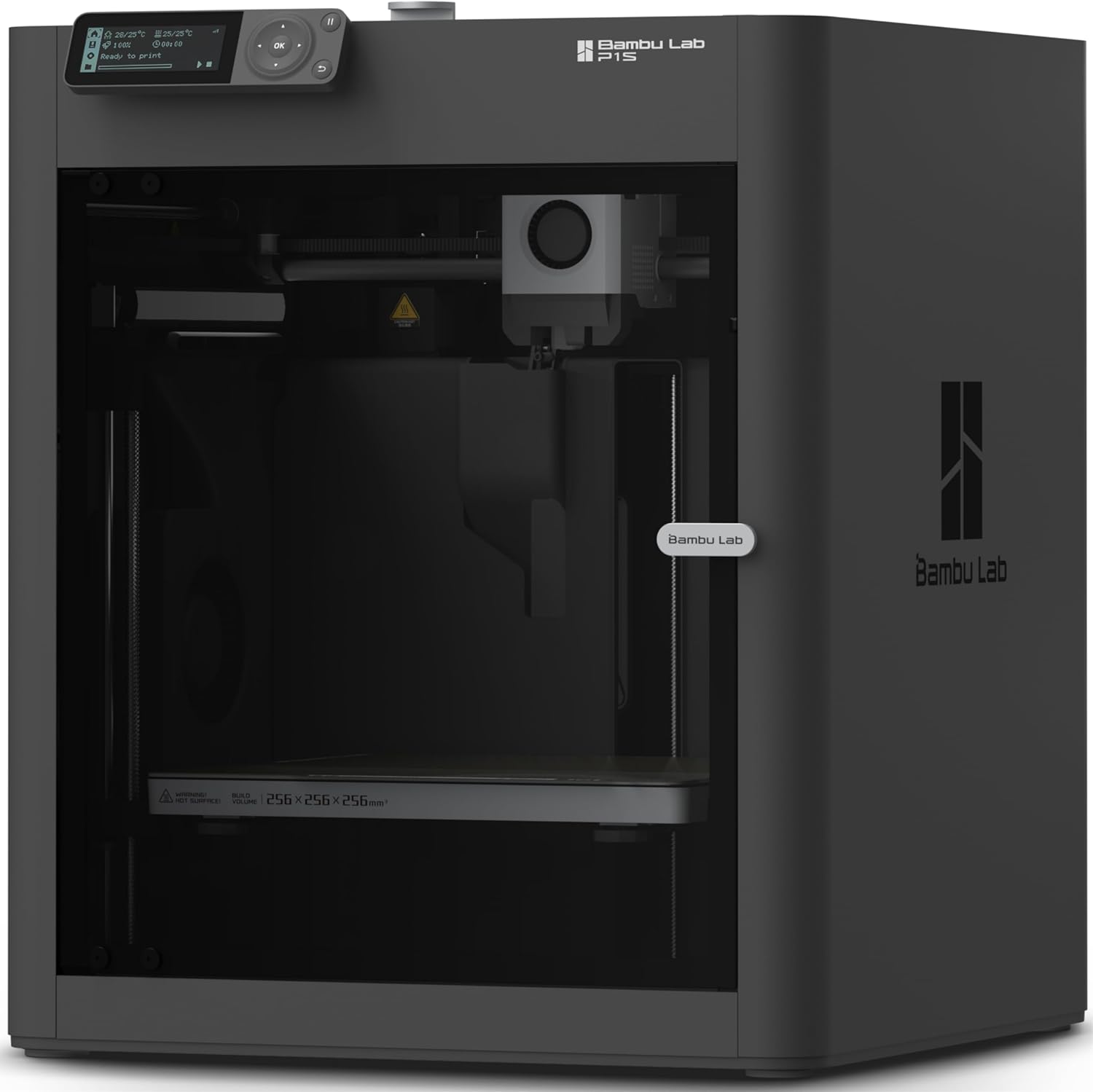
| Build Volume | 256 × 256 × 256 mm |
|---|---|
| Supported Filaments | PLA, PETG, TPU, PVA, PET, ABS, ASA |
| Max Speed | 500 mm/s |
| Max Acceleration | 20 m/s² |
The Bambu Lab P1S is an enclosed CoreXY FDM printer built for speed and dependable results, offering a 256 × 256 × 256 mm build volume and a direct-drive extruder that broadens material compatibility. It targets quick setup and everyday use with features like automatic bed leveling, an onboard camera for timelapse capture, and access to the MakerWorld model library for ready-to-print files. Performance claims include very high top speeds and acceleration that cut print times for small detailed models such as action figures, while the enclosed frame helps with temperature-sensitive filaments like ABS and ASA. Practical benefits include reliable first-layer adhesion from auto leveling, simpler workflow for beginners, and multi-color/multi-material capability when paired with the AMS accessory. Limitations to note are that advanced composite or heavily reinforced filaments are not recommended and multi-color printing requires an additional AMS unit, so true multi-material prints are not out-of-the-box. For hobbyists focused on fast, repeatable prints of figures and parts, the P1S balances speed with user-friendly reliability.
Best for: Buyers who prioritize reliable, repeatable prints for hobby models and action figures and want a machine that minimizes setup time and tuning.
Less Ideal for: Users who need out-of-the-box multi-material/multi-color printing or who regularly print with heavily filled composite filaments should look elsewhere.
- Enclosed CoreXY design improves part consistency and helps with temperature-sensitive filaments
- Direct-drive extruder supports a wide range of common filaments including TPU and ABS
- Automatic bed leveling reduces setup time and increases first-print success
- High top speed and acceleration shorten print times for small, detailed figures
- Built-in camera and MakerWorld library simplify monitoring and finding printable models
- Multi-color or multi-material printing requires purchasing the AMS accessory separately
- Not recommended for carbon or glass fiber reinforced filaments
Verdict: A fast, enclosed CoreXY printer that delivers dependable, beginner-friendly prints ideal for making action figures when you want reliable results with minimal fuss.
FLASHFORGE Adventurer 5M
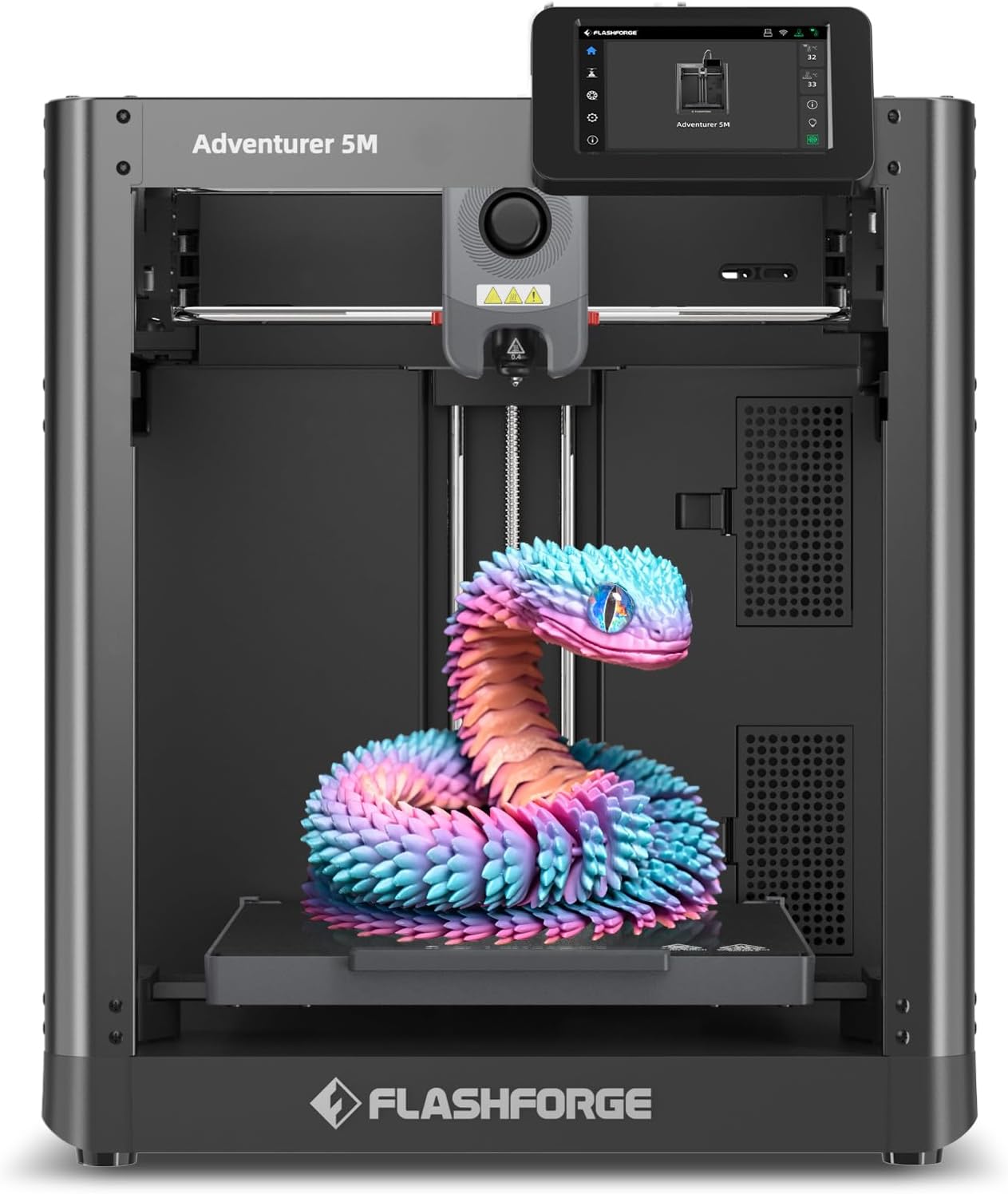
| Build Volume | 220 x 220 x 220 mm |
|---|---|
| Nozzle Max Temp | 280°C |
| Travel Speed | 600 mm/s |
| Extruder Type | Direct drive |
| Platform Type | Double-sided PEI Platform |
The FLASHFORGE Adventurer 5M is a CoreXY desktop printer built for fast, repeatable printing and easier day-to-day use. It combines a one-button automatic bed leveling system, a 280°C direct-drive extruder with quick 3-second nozzle swaps, and a dual-sided PEI platform to speed setup and part removal. The CoreXY all-metal structure plus a claimed 600 mm/s travel speed and high acceleration target quick print cycles, which helps when you need to iterate many action-figure components. The 220×220×220 mm build volume suits single figures or smaller multi-part assemblies, and support for PLA, ABS, PETG, TPU and CF blends makes it flexible for different surface finishes and strength needs. Practical conveniences include a fast warm-up to operating temperature, mobile app monitoring, and a sturdy platform, but buyers should note that advertised top speeds are aggressive and achieving them while keeping fine detail on small figure parts will require tuning and the right nozzle size. Expect routine nozzle and platform maintenance for best results.
Best for: Buyers who prioritize fast prototyping and repeatable prints for small to medium action-figure parts and want a mostly turn-key machine with app monitoring and automated leveling.
Less Ideal for: Those who need very large single-piece figures or buyers seeking plug-and-play ultra-fine resin-level detail should consider other specialized printers.
- Automatic one-button bed leveling reduces setup time and improves first-layer reliability
- 280°C direct-drive extruder with quick nozzle changes for easier material swaps and faster warm-up
- CoreXY metal frame and high travel specs designed for faster print cycles and prototyping
- Dual-sided PEI platform enables straightforward part removal and surface versatility
- Supports a wide range of filaments including PLA, ABS, PETG, TPU and carbon-fiber blends
- Top travel speeds are marketing-forward and will need tuning to balance speed versus fine surface detail
- Build volume is modest for larger multi-part or fully posed figure assemblies
Verdict: Choose the Adventurer 5M if you want a fast CoreXY desktop printer that simplifies setup and speeds iteration for small to mid-size action-figure production.
ELEGOO Saturn 4 Ultra 16K

| LCD size | 10" 16K Mono LCD |
|---|---|
| Build volume | 211.68 x 118.37 x 220 mm³ |
| Printing speed | Max. 150 mm/h |
| Connection method | USB, Wi‑Fi |
The ELEGOO Saturn 4 Ultra 16K is a desktop resin MSLA printer built to deliver very fine detail for small, intricate models like action figures. It uses a 10-inch 16K mono LCD and a COB light source with a Fresnel collimating lens to improve uniformity and reduce astigmatism, which helps produce smooth surfaces and crisp textures on faces and tiny accessories. Practical convenience features include automatic leveling, a self-check routine, and an AI camera for real-time monitoring and time-lapse capture, while a flip-up lid and tilt-release tank make part removal and resin handling easier. The smart tank heater holds resin at 30 °C to improve layer adhesion and reduce print failures from poor flow, and sensors alert you to resin shortage or leveling problems. Trade-offs are the typical resin workflow needs—post-processing, ventilation, and consumable resin and tank replacements—plus the unit is larger and heavier than hobbyist minis, so it needs a dedicated workspace. For collectors focused on high-detail action figures, this printer balances image fidelity and user-friendly automation.
Best for: Buyers who want reliable, high-detail prints of small figurines and prefer a mostly automated, low-fuss setup that reduces calibration and monitoring work.
Less Ideal for: Casual tinkerers who want a compact, maintenance-free unit without resin handling or users who lack space and ventilation for resin printing.
- Very high 16K mono LCD resolution for fine detail and smooth surfaces
- Smart tank heating maintaining 30 °C improves resin flow and layer adhesion
- Auto-leveling and self-check simplify setup and reduce calibration errors
- AI camera with monitoring and alerts helps catch print failures early
- Tilt release technology speeds part release and enables faster print throughput
- Resin workflow requires ventilation, post-curing, and ongoing consumable costs
- Large footprint and heavier build require a dedicated, well-ventilated workspace
Verdict: If you need factory-quality detail for action figures with automated leveling and heated resin management to reduce failed prints, the Saturn 4 Ultra 16K is a strong choice.
Choosing the Right 3D Printer for Action Figures: Key Factors to Consider
Print Resolution & Layer Control
Resolution and the ability to set small layer heights directly affect how well a printer captures the fine sculptural detail of action figures. Smaller layer heights reduce visible stepping on curved surfaces like faces and limbs, but they increase print time and may require adjustments to cooling and exposure settings.
When evaluating this factor, look at the minimum layer height the machine can reliably achieve, the motion system precision, and whether the slicer or firmware supports fine-tuning parameters such as retraction, jerk, and acceleration. A printer with stable, low-backlash mechanics will preserve detail across complex geometry.
Material Compatibility and Durability
Action figures often need a mix of rigid and slightly flexible parts for joints, so material support matters. Printers compatible with a wide range of filaments or resins let you choose tougher plastics for structural pieces and flexible or impact-resistant materials for joints and accessories.
Consider whether the printer supports high-temperature filaments, engineered plastics, or specialized resins. Also check if the machine handles common consumables easily and whether it offers reliable extrusion or curing for thin walls and small features without clogging or delamination.
Mechanical Reliability and Build Stability
Stable mechanics reduce layer shifts, ringing, and other artifacts that ruin small-scale detail. For FDM machines, look for rigid frames, quality linear rails or rods, and a well-mounted extruder. For resin machines, consistent vat leveling and a solid Z axis are crucial to avoid layer misalignment during peeling.
Regular maintenance needs and ease of access to common wear parts also factor into long-term reliability. A design that minimizes vibration and maintains calibration between prints will save time and material when producing multiple figures or detailed prototypes.
Ease of Post-Processing and Surface Finish
Post-processing steps like sanding, priming, and painting are part of making a figure look professional. The printed surface quality and the material's response to sanding and gluing determine how much finishing work is required. Some materials sand and fill more cleanly than others, and resin prints typically produce smoother surfaces at high resolution but may require thorough washing and curing.
Factor in how easy it is to remove supports, clean residues, and bond parts. Also consider compatibility with primers, solvents, and paints used in figure finishing workflows.
Software, Slicing, and Workflow Efficiency
A predictable, efficient workflow reduces failed prints and speeds iteration. Good slicer integration, reliable profiles for figure-scale prints, and useful tooling like support generation and automated resin exposure tables streamline the process. Compatibility with common modeling and slicing tools makes it easier to prepare parts with appropriate orientation and support structures.
Evaluate whether the software provides useful previews, error checking, and straightforward calibration routines. Ease of firmware updates and community or manufacturer resources can also shorten the learning curve.
Support, Community, and Spare Parts Availability
Access to replacement parts, community-sourced profiles, and troubleshooting resources affects long-term ownership. A strong user community provides tested slicer settings for figure-scale prints, mod guides, and troubleshooting tips that can dramatically reduce setup time for new users.
Also consider how easy it is to source common consumables and replacement components like nozzles, vats, or belts. Readily available spare parts and active forums or documentation improve uptime and the overall hobby experience.
FDM Vs Resin for Action Figures
Both FDM and resin printing workflows have merits for action figure production. Resin printers typically excel at capturing ultra-fine detail, making them ideal for small heads, facial features, and intricate accessories. They often require additional post-print washing and curing, and the processed parts can be more brittle depending on the resin choice.
FDM printers produce tougher, more impact-resistant parts when using engineering filaments, which is useful for articulated joints and structural elements. Modern FDM machines with fine nozzles and optimized slicer settings can still achieve impressive detail at small scales, and they generally offer easier material handling and faster post-processing for large parts.
- Resin: Best for highest surface detail and thin features.
- FDM: Best for durable parts, large components, and flexible filament options.
- Consider a mixed workflow: resin for heads and accessories, FDM for bodies and joints.
Orienting and Supporting Miniatures
How you orient a part and generate supports has a big impact on surface quality and finishing time. Orient small, delicate features to minimize unsupported spans and to keep support contact points out of high-visibility areas. For resin prints, angle flat surfaces slightly to reduce suction forces during peel.
Use custom support placement when automatic generators place supports on sculpted detail. For FDM parts, consider adding sacrificial support structures that are easy to remove or printing thin pins for alignment rather than traditional supports where possible.
- Angle large flat panels to reduce warping and suction issues.
- Place supports on non-critical surfaces to minimize sanding.
- Use brim or raft sparingly to improve bed adhesion without increasing cleanup.
Finishing Techniques for Professional Results
Sanding, filling, and priming are the core finishing steps for action figures. Start with coarse sanding to remove major layer lines, then progressively move to finer grits for a smooth surface. Use lightweight putty or filler for seam lines and gouges, followed by a sanding primer to reveal remaining imperfections.
For painted finishes, use adhesion-promoting primers that match the material type. Masking and airbrushing produce the cleanest color separations. Consider clear coats and flexible topcoats if the figure includes moving joints to protect paint from chipping.
- Progressive sanding and filler yields the smoothest surface.
- Choose primers compatible with the print material.
- Use flexible clear coats on articulated areas to prevent cracking.
Scaling, Tolerances, and Fit for Articulated Parts
When designing or printing articulated figures, account for tolerances and post-processing shrinkage. Small pins, ball joints, and socket fits often require an initial clearance allowance that you can fine-tune through test prints. Dimensional accuracy varies between machines and materials, so print calibration pieces to refine fit before final production.
Plan for sanding, paint build-up, and adhesive thickness when specifying hole diameters and joint tolerances. In some cases, designing joints with dovetails or captive features can reduce the need for tight precision during assembly.
- Print and test small fit gauges before final assembly.
- Allow extra clearance for parts that will be painted or primed.
- Design joints to tolerate slight dimensional variance.
Setting Up a Reliable Print Workflow
A repeatable workflow reduces wasted time and material. Start by standardizing calibration steps like bed leveling, extruder calibration, and test prints for dimensional accuracy. Maintain a checklist for pre-print prep, including filament or resin condition checks, bed surface cleaning, and ambient temperature considerations.
Track successful slicer profiles and exposure settings for different materials and figure scales. Keeping organized profiles and print logs helps reproduce results and diagnose issues quickly when a new geometry or material is introduced.
- Create and label slicer profiles for specific materials and figure scales.
- Keep a print log to track successful settings and failures.
- Perform routine maintenance to maintain calibration and reliability.
How We Chose the Best 3D Printer for Action Figures
We prioritized attributes that directly affect the success of printing action figures and miniature models. First, print resolution and layer height control were primary filters because fine facial features, texture, and seam lines depend on small layer heights and precise motion control. Second, material compatibility was critical — we focused on machines that handle a range of filaments or resins including durable, flexible, and high-detail options for joints and thin features. Third, reliability and print consistency were assessed by looking at build platform stability, motion system rigidity, and temperature control for heated beds or resin curing. Fourth, post-processing and finishing friendliness mattered since sanding, priming, and painting are standard for action figures. Finally, workflow and software usability were considered so hobbyists can move from model to finished figure with fewer failed prints. We excluded machines that are strictly toy-grade, single-use novelty printers, or those with minimal community support because they rarely deliver repeatable, high-detail results. Our selection favors printers that balance detail, durable material support, and practical finishing workflows suited to sculptors and miniature painters.
Our full evaluation process is outlined in our review methodology.
FAQ
Is resin or filament better for small facial details?
Resin generally captures finer surface detail at small scales because of its layer curing process, making it better for facial features. Filament can still produce good detail with fine nozzles and slow settings, but may require more post-processing to match resin's smoothness.
How do I prevent fragile thin parts from breaking?
Use tougher or higher-impact materials for structural elements, increase wall thickness where possible, and consider adding internal supports or fillets to distribute stress. For resin prints, choose resins formulated for toughness rather than maximum rigidity.
What layer height should I use for action figures?
For high-detail areas like faces and hands, use very small layer heights such as 0.05 to 0.1 mm on capable machines. For larger, less detailed parts, 0.12 to 0.2 mm balances print time and acceptable surface quality.
Can I mix resin and filament parts in one figure?
Yes, mixing workflows is common: resin for high-detail components and filament for durable structural parts. Plan attachment points and tolerances carefully, and use appropriate adhesives recommended for each material.
How do I achieve consistent color matching across prints?
Use controlled paint mixing and keep environmental factors consistent during painting. Prime all parts the same way and use the same brand and type of paint and clear coat to minimize variation between prints.
Final Verdict
Choosing the right 3D printer for action figures comes down to balancing surface detail, material choices, and long-term reliability. Prioritize resolution and stable mechanics when fine sculptural fidelity matters, and choose machines that accept materials suited to articulated parts when durability is a priority. Keep in mind the tradeoffs between resin detail and filament toughness, and plan a workflow that includes calibration prints and finishing steps to achieve consistent, production-ready figures.