
Note: This article contains affiliate links. If you click on these links and make a purchase, we may earn a small commission at no extra cost to you. This helps support our research and content. Read our full affiliate disclosure here.
Picking the right 3D printer under $1,500 shapes how quickly you move from idea to finished part. For hobbyists, makers, and small-business users, this price band often delivers dependable hardware, decent build volume, and material flexibility without enterprise complexity. You want a machine that prints accurately, is reasonably easy to set up and maintain, and supports the filaments or resins your projects demand. This guide shortlists the top 3D printers in the sub-$1,500 category and explains the practical tradeoffs buyers face. We evaluated machines for print quality, workflow features, and daily reliability so you can pick the option that fits your workspace and expected output. Read on for the criteria we used and the key features to weigh before you buy.
Top Picks at a Glance
| Best Overall The best all-around choice for most situations | Bambu Lab P2S Combo |  |
| Best Quality Built to a higher standard if you want something more solid | Original Prusa MK4S |  |
| Best Value The sweet spot between price and what you get | Creality K1C 3D Printer K1C |  |
| Best Budget The cheapest option that still gets the job done reliably | Estink Beginner 3D Printer |  |
| Top Rated A top-rated pick with lots of positive feedback | Creality Ender 3 V3 SE |  |
| Most Popular A crowd favorite that many people choose with confidence | FLASHFORGE Adventurer 5M |  |
| Best Seller A high-volume bestseller chosen again and again | Bambu Lab P1S 3D Printer |  |
Bambu Lab P2S Combo

| Print speed | up to 600 mm/s |
|---|---|
| Filament drying | up to 65 °C (AMS 2 Pro) |
| Extruder | PMSM servo extruder |
| Features | AI failure detection, quick-swap nozzles, automatic calibration |
The P2S Combo is a performance-focused CoreXY FDM printer bundled with Bambu Lab's AMS 2 Pro for multi-color and multi-material jobs. It targets users who want very fast prints without sacrificing detail, offering a PMSM servo extruder, active flowrate compensation, quick-swap nozzles, automatic calibration, and AI failure detection that make setup and running long prints easier. The AMS 2 Pro adds on-spool drying up to 65 °C and automated filament handling for cleaner multi-spool workflows and fewer failed color changes. Adaptive Airflow maintains a warm chamber for engineering filaments while providing cooling for fine overhangs, and a carbon filter helps keep exhaust air cleaner. The main compromises are that the high top speed and advanced features presume some familiarity with tuning and that the bundled AMS is required for seamless multi-color prints, so the base printer alone does not provide that capability. For buyers focused on quick, high-quality results and a unified software ecosystem, the P2S Combo is a strong, real-world productivity choice.
Best for: Buyers who want a fast, productivity-oriented desktop 3D printer that handles multi-spool workflows and minimizes manual intervention while staying within a balanced budget.
Less Ideal for: Casual hobbyists who only print occasional single-color parts or users who prefer the simplest, lowest-cost plug-and-play printers without extra accessories.
- Very high print speeds up to 600 mm/s with maintained precision
- PMSM servo extruder and active flowrate compensation for consistent extrusion
- AMS 2 Pro provides multi-spool handling and filament drying up to 65 °C
- Automatic calibration, quick-swap nozzles, and AI error detection speed setup and reduce failed prints
- Multi-color printing requires the AMS 2 Pro bundle rather than the base printer
- Advanced speed and tuning may be overkill for total beginners
Verdict: Choose the P2S Combo if you want one of the fastest desktop printers with built-in multi-spool drying and automated workflow features for high-throughput, high-quality prints.
Original Prusa MK4S

| Build volume | 9.84 x 8.3 x 8.6 in |
|---|---|
| Included filament | 1 kg Prusament PLA |
| Model number | MK4S-COM-PEI |
The Original Prusa MK4S is a ready-to-run FDM desktop printer aimed at makers and small shops that need fast, repeatable output. It ships fully assembled and includes a 1 kg spool of Prusament PLA so you can start printing immediately; its 9.84 x 8.3 x 8.6 inch build volume handles both functional prototypes and detailed parts. Input shaping and refined motion control reduce ringing and allow higher print speeds without sacrificing edge quality, while Prusa's mature software and ecosystem make slicing, material selection, and firmware updates straightforward. Designed and built in the EU, the MK4S emphasizes day-to-day reliability and serviceability, with upgrade options through the open-source platform. Expect excellent surface finish and dimensional accuracy for production-oriented tasks, though the printer is focused on FDM workflows and does not include multi-material or resin capabilities. For users who prioritize speed and dependable results in ABS/PLA-style materials, the MK4S is a practical, professionally oriented choice under the $1,500 target.
Best for: Buyers who want a fast, dependable desktop FDM printer for production-style prototyping and small-batch parts and who value a mature software ecosystem and upgrade path.
Less Ideal for: Users needing larger-format builds, resin/detail-oriented printing, or multi-material/color printing workflows should consider other technologies or models.
- Fully assembled out of the box with included 1 kg Prusament PLA for immediate printing
- Input shaping and motion compensation for cleaner edges at higher speeds
- Open-source, upgradeable design with ongoing firmware and ecosystem support
- Designed for consistent, professional-grade reliability in daily use
- Build volume is modest compared with larger production printers
- Focused on FDM thermoplastics so it is not suitable for resin or specialized multi-material workflows
Verdict: The MK4S is the go-to choice under $1,500 for makers who need a fast, reliable FDM printer that delivers professional-quality, consistent prints and easy upgradeability.
Creality K1C 3D Printer K1C

| Print speed | 600 mm/s (max) |
|---|---|
| Max nozzle temperature | 300 ℃ |
| Supported filaments | PLA, ASA, ABS, TPU, PLA‑CF, PET‑CF |
| Build volume | 8.66 x 8.66 x 9.84 inch |
The Creality K1C is a ready-to-run FDM printer aimed at speed and convenience. It ships preassembled so you can plug in and start printing within minutes, and auto Z‑offset plus auto leveling reduce setup fiddling. The machine targets high throughput with a claimed 600 mm/s top speed and high acceleration, while a clog‑free direct extruder with a steel‑tipped copper nozzle and titanium alloy heat break supports higher temperature filaments up to 300 ℃ including carbon‑fiber blends. An onboard AI camera offers real‑time monitoring and can detect print failures for peace of mind, and the upgraded multi‑fan cooling layout helps with bridging, overhangs, and surface finish. Practical benefits include quick first prints, broad filament compatibility, and less time spent tuning. Important limitations are the relatively small build volume (about 8.66 x 8.66 x 9.84 inches) compared with larger hobby printers and the push for very high printing speeds may require tuning slicer settings to balance quality versus speed on detailed parts.
Best for: Buyers who prioritize quick setup and fast turnaround for prototyping or small production runs and who want a machine that handles higher‑temperature and composite filaments with minimal tinkering.
Less Ideal for: Users who need large-format printing or who prioritize maximum fine-detail print quality at stock settings without additional tuning should consider alternatives.
- Mostly preassembled and quick to start with plug‑and‑play setup and auto calibration
- High-speed motion system with 600 mm/s top speed and strong acceleration for faster prints
- Clog‑free direct extruder with high‑temp capability (up to 300 ℃) for carbon‑fiber and other engineering filaments
- Built‑in AI camera for live monitoring and failure detection
- Multi‑fan cooling design improves layer bonding and reduces stringing and warping
- Smaller printable volume limits large parts or batch prints
- Very high top speed may need slicer tuning to maintain fine detail
Verdict: If you want a fast, mostly plug‑and‑play desktop printer that prints engineering and carbon‑fiber blends, the K1C delivers quick prototypes with minimal setup.
Estink Beginner 3D Printer

| Build volume | 100 x 100 x 100 mm |
|---|---|
| Nozzle diameter | 0.4 mm |
| Supported materials | PLA, TPU (1.75 mm) |
| Temperature range | 180–230°C |
| Printing speed | 10–40 mm/s |
This small, fully assembled FDM printer targets first-time users and classroom use by keeping operation simple and visual. Files can be loaded from a memory card or USB and dedicated buttons handle filament loading and unloading so students or hobbyists can start prints without deep software setup. The printer uses a 0.4mm all-metal nozzle, supports 1.75mm PLA and TPU, and reaches 180–230°C with a claimed layer resolution down to 0.05mm, which is useful for small detailed models. The magnetic build plate and manual bed-leveling procedure are important to follow; the manual and included video guide explain the steps but the leveling process is hands-on and can be frustrating for absolute beginners. Print area is limited to 100×100×100mm so larger projects must be split or avoided. Build and controls are simple and the printer heats up quickly, making it a practical, low-cost option for learning, prototyping small parts, and classroom projects, though advanced users may outgrow its small build volume and manual leveling requirements.
Best for: Buyers seeking an inexpensive, ready-to-run desktop printer for learning, classroom projects, or small hobby prints who prioritize simplicity and low upfront cost.
Less Ideal for: Users who need to produce large parts, require advanced features or automated bed leveling, or professionals seeking faster, higher-capacity production should consider larger, more capable models.
- Fully assembled and easy-to-use controls for quick setup
- Supports PLA and TPU filament giving flexibility for rigid and flexible parts
- All-metal 0.4mm nozzle with up to 0.05mm layer resolution for fine detail on small prints
- Quick heating (180–230°C range) reduces wait time before printing
- Compact footprint fits on desks and classroom tables
- Very small 100×100×100mm build volume limits project size
- Manual bed leveling is required and can be fiddly for beginners
- Limited slicing/OS support listed may require users to choose compatible software
Verdict: An affordable, beginner-focused desktop 3D printer that delivers reliable small-print performance for students and hobbyists on a tight budget.
Creality Ender 3 V3 SE

| Max printing speed | 250 mm/s |
|---|---|
| Printing acceleration | 2500 mm/s² |
| Supported filaments | PLA, PETG, ABS, TPU |
| Auto leveling | CR Touch auto leveling |
The Ender 3 V3 SE is a user-friendly desktop FDM printer designed to get prints running quickly with minimal setup. It ships partially preassembled and Creality says you can finish assembly in roughly 3 steps and start printing in about 20 minutes, which helps hobbyists and makers skip lengthy build sessions. The Sprite full-metal dual-gear direct extruder improves filament grip for flexible and standard filaments, and the CR Touch auto-leveling plus strain-sensor auto Z-offset reduce manual bed tramming. A dual Z-axis and reinforced Y-axis linear shafts aim to cut Z wobble and keep taller prints accurate. The unit advertises a high top speed of 250 mm/s with high acceleration, but real-world results will depend on slicer settings and material choice; pushing that speed may sacrifice fine detail. The bundle includes multiple PLA spools so you can test right away. Overall the printer balances convenience and stability for everyday prints, though advanced users chasing ultra-high precision or industrial throughput may tune settings further to match expectations.
Best for: Buyers who prioritize a dependable, easy-to-start desktop printer that minimizes calibration headaches and delivers consistent prints for hobby and prototyping use.
Less Ideal for: Users who need factory-caliber industrial precision or fully networked, high-throughput production printers should consider more specialized models.
- Quick, mostly preassembled setup that gets you to first print fast
- Sprite full-metal dual-gear direct extruder for more reliable filament feeding, including TPU
- CR Touch auto leveling with strain-sensor auto Z-offset reduces manual calibration
- Dual Z-axis and reinforced Y-axis shafts for improved stability on taller prints
- Includes multiple PLA filament spools to start printing immediately
- Advertised top speed may require tuning and can reduce fine detail at maximum settings
- No explicit mention of built-in Wi-Fi or advanced connectivity options in the product data
Verdict: A practical, reliability-focused desktop 3D printer that minimizes setup and calibration so you can start producing consistent PLA prints quickly.
FLASHFORGE Adventurer 5M
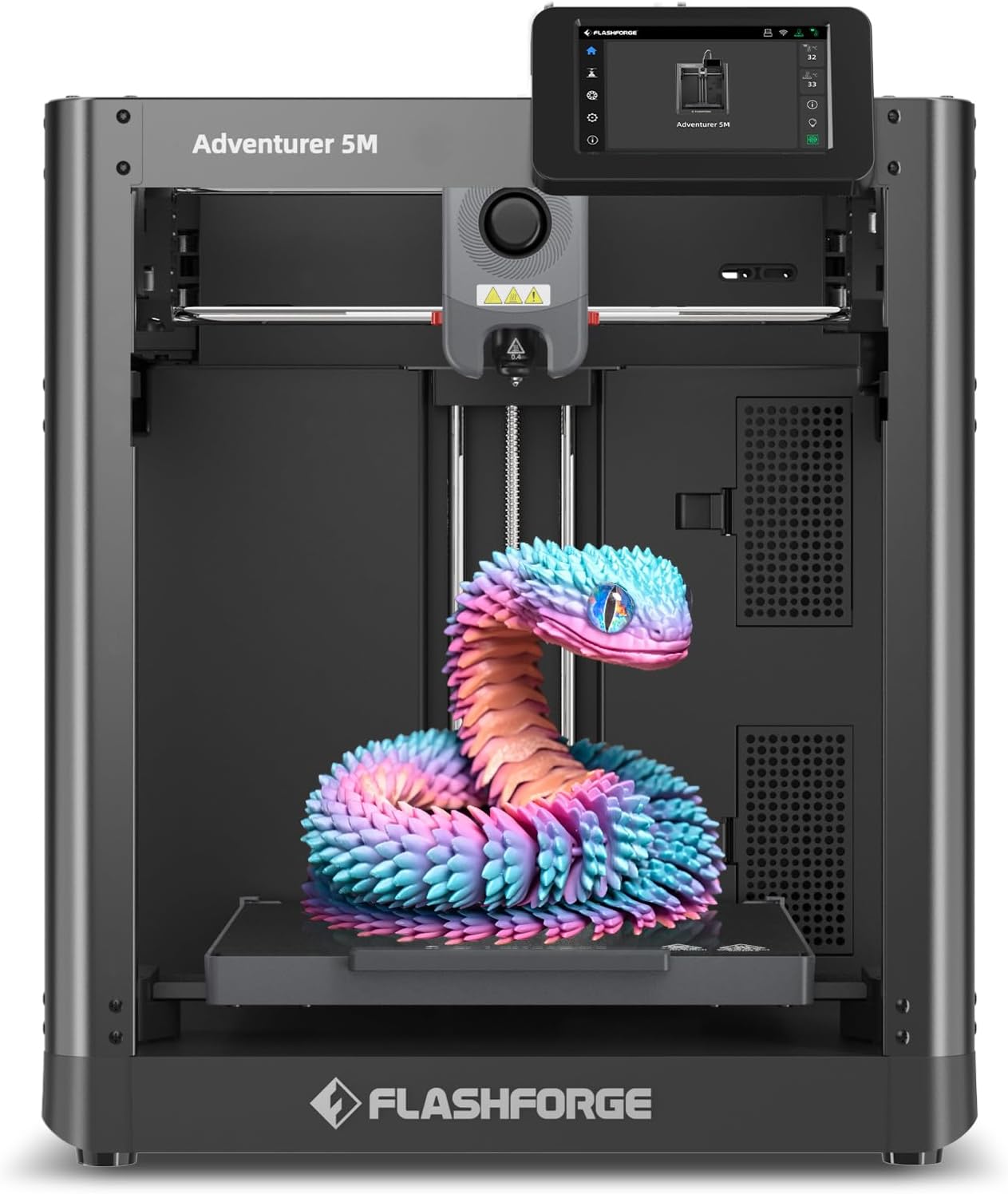
| Build Volume | 220 x 220 x 220 mm |
|---|---|
| Extruder Max Temp | 280°C |
| Travel Speed | 600 mm/s |
| Platform Type | Double-sided PEI Platform |
| Structure | All-metal Core XY Structure |
The FLASHFORGE Adventurer 5M is a CoreXY desktop machine built for fast prototyping and small-batch production. It uses an all-metal CoreXY structure with a 280°C direct-drive extruder and a high-flow nozzle for quicker melt throughput, plus a one-button automatic bed leveling system to simplify first-layer setup. The printer targets speed with reported 600 mm/s travel and aggressive acceleration while keeping print quality via options for multiple nozzle sizes, dual-fan cooling and a double-sided PEI platform for easier part removal. Practical benefits include rapid warm-up, a detachable 3‑second nozzle for quick swaps, and mobile app monitoring for remote job checks. Limitations are that peak speeds are ambitious for detailed prints—fine features may still require slower settings—and the machine focuses on speed over advanced multi-material features unless you pick the Pro variant; higher-temperature specialty materials may need tuning despite the 280°C rating. Maintenance like nozzle cleaning and bed care is important to keep reliable results at high speed.
Best for: Buyers who want a fast, production-minded desktop printer that reduces setup time and offers remote monitoring while still delivering good-quality parts for prototyping and short runs.
Less Ideal for: Users seeking an out-of-the-box multi-material/color printer or those who prioritize ultra-fine, high-detail printing at maximum resolution over throughput.
- CoreXY all-metal structure for stable, high-speed motion
- One-button automatic bed leveling simplifies setup and improves first-layer reliability
- High-flow 280°C direct extruder with quick-change nozzle for faster printing and easy maintenance
- Double-sided PEI platform for secure adhesion and tool-free part removal
- Mobile app support for remote monitoring and job control
- Top travel speeds are optimistic for detailed or small-feature prints and will require slower profiles for quality
- No onboard multi-material system on this model, limiting easy color or material changes
Verdict: Choose the Adventurer 5M if you need a compact CoreXY printer that emphasizes fast, reliable prototyping with easy setup and remote monitoring.
Bambu Lab P1S 3D Printer
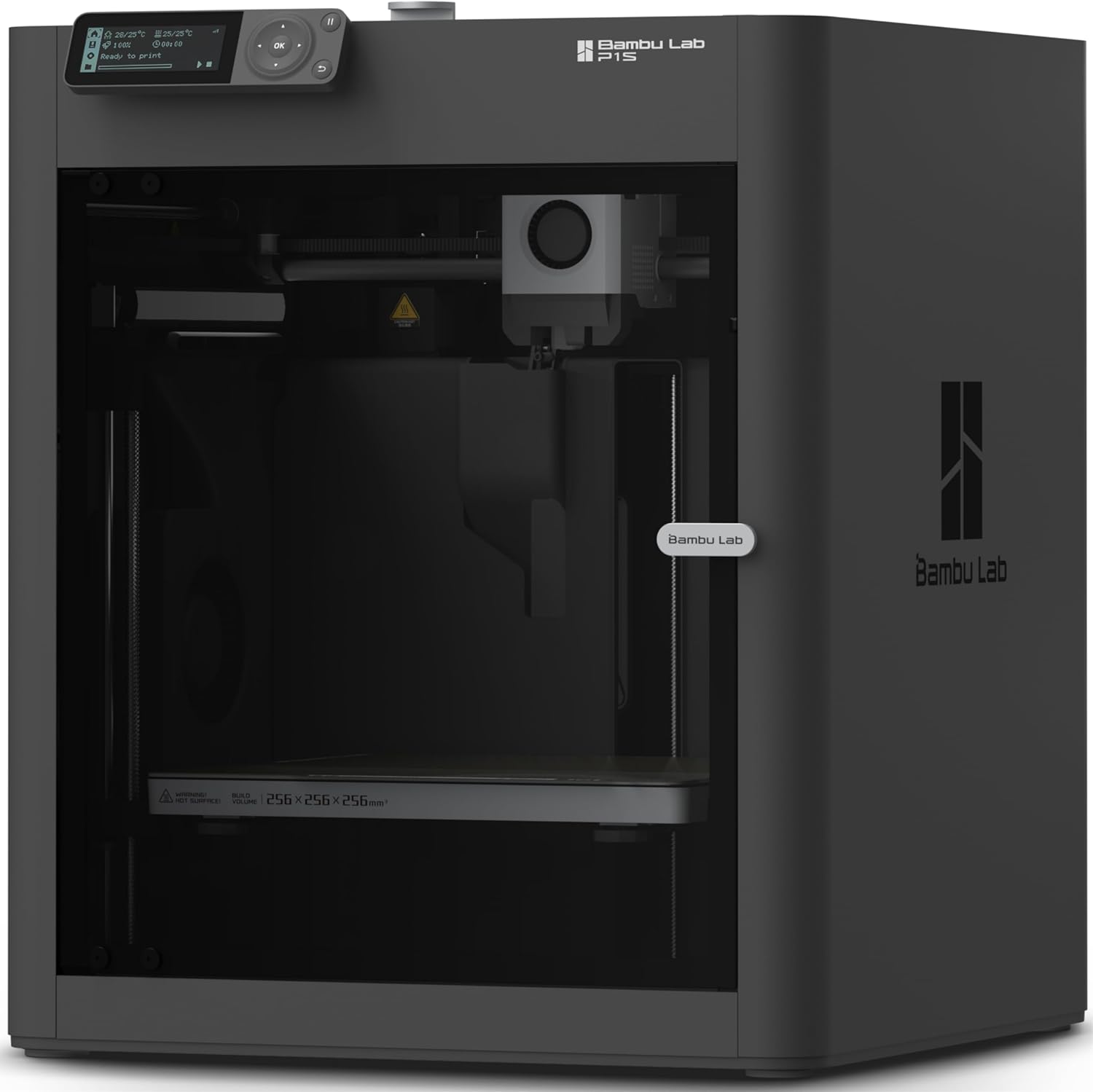
| Build Volume | 256×256×256 mm³ |
|---|---|
| Supported Filaments | PLA, PETG, TPU, PVA, PET, ABS, ASA; capable: PA, PC |
| Body | Enclosed |
| Max Speed | 500 mm/s |
| Max Acceleration | 20 m/s² |
The Bambu Lab P1S is an enclosed CoreXY FDM printer aimed at users who want fast, reliable desktop prints with minimal setup. It ships largely ready to use and claims a 15-minute setup, automatic bed leveling, and a direct-drive extruder that broadens material compatibility to include TPU, PETG, ABS and more. The printer is built for speed with quoted top travel speeds and high acceleration, which can cut print times on medium-sized parts while maintaining good detail when tuned. The enclosure and accessory-ready design make printing temperature-sensitive materials easier and reduce warping. It also integrates a camera for time-lapse capture and connects to Bambu Lab's ecosystem for model libraries and workflow management. Limitations to note are the learning curve for dialing in ultra-fast settings, the large footprint and weight compared with smaller hobby machines, and that very abrasive or fiber-filled composites are not recommended. For risk-averse buyers the strong ecosystem, auto-leveling, and broad filament support make the P1S a practical choice for high-speed, dependable prints under $1,500.
Best for: Buyers who want a dependable, easy-to-start printer that balances fast print times with a supportive software and model ecosystem and who prefer fewer manual setup steps.
Less Ideal for: Users who need a compact, lightweight travel printer or those whose primary goal is printing highly abrasive composite filaments.
- Enclosed CoreXY design improves print stability and makes higher-temperature filaments easier to use
- Automatic bed leveling and mostly ready-to-use setup reduce setup time for beginners
- Direct-drive extruder increases compatibility with flexible and specialty filaments
- High top speeds and acceleration shorten print times for moderately sized parts
- Integrated camera and access to MakerWorld simplify model access and print monitoring
- Very high speeds require tuning to avoid quality issues on detailed prints
- Not recommended for abrasive or fiber-filled filaments
Verdict: If you want a beginner-friendly, factory-ready printer that delivers much faster prints and strong material support within a reliable ecosystem, the P1S is a top pick under $1,500.
Choosing the Right 3D Printer: Key Factors to Consider
Print Quality & Accuracy
Print quality determines how much post-processing you need and whether prints meet dimensional requirements. Look at minimum layer height, nozzle compatibility, and the printer's ability to hold tight tolerances. Metal or rigid frames, high-quality linear guides or rails, and stable motion components reduce wobble and ringing that degrade fine detail.
Consistent extrusion and precise temperature control also matter because material flow variations show up as surface defects. If you plan to produce functional parts, focus on dimensional accuracy specs and the presence of calibration tools that help dial in settings for repeatable results.
Build Volume
Build volume affects what you can produce in a single print and whether you need to split larger models. A larger build area is helpful for prototyping bigger parts or printing multiple items at once, but bigger enclosures can increase heat management challenges and footprint in your workspace.
Consider the balance between usable XY footprint and Z height. If your projects are mostly small functional parts, a compact printer with better rigidity and motion control may yield higher quality than a larger, less rigid machine.
Materials Compatibility
Material support affects the range of functional properties you can achieve. Basic PLA prints fine on most machines, but heated beds, higher nozzle temperatures, and optionally enclosed build chambers are needed for ABS, PETG, nylon, and specialty filaments.
Check whether the printer accepts different nozzle sizes, supports hardened nozzles for abrasive filaments, and whether the extruder type is suited for flexible materials. For businesses, availability of material profiles and community-tested settings reduces time wasted on trial-and-error.
Ease Of Setup And Workflow
Time to first successful print influences how quickly you can start producing parts. Machines with guided calibration, automatic bed leveling, and straightforward bed-adhesion options cut setup friction. A clear, modern user interface and reliable connectivity options also speed daily use.
Slicer compatibility and available material profiles matter for workflow. If a printer includes tested profiles or supports popular slicers, you will spend less time tuning settings. Consider whether you prefer USB, SD card, or network printing based on how you work.
Reliability And Maintenance
A reliable machine maximizes productive printing time and minimizes interruptions. Look at common maintenance tasks: how easy is it to access the hotend, replace a nozzle, clean the bed, or swap drive belts? Modular designs and spare-part availability simplify repairs.
Serviceability also includes firmware update support and community resources. Machines known for stable thermal control, robust extruders, and quality bearings generally require less frequent intervention, saving time and material waste.
Safety And Enclosure
Safety is important for any 3D printer, particularly in shared spaces or around children. Enclosed build chambers improve high-temperature material performance and reduce exposure to fumes. Look for secure enclosures, reliable door interlocks, and cooled electronics.
Consider ventilation and the printer's need for a well-ventilated area when using higher-temperature or composite filaments. Filtration or directed venting may be necessary for prolonged use with certain materials.
Setting Realistic Expectations for Sub-$1,500 Machines
At this price point you can expect solid hobbyist and light professional capabilities but not industrial-grade throughput. Typical strengths include good print detail, useful build volume, and reasonable material support. Tradeoffs often appear in maximum continuous duty cycles, high-end servo motion systems, and some advanced automation features.
Plan projects around the machine's proven strengths. For demanding end-use parts, plan for iterative testing and modest post-processing to achieve tight tolerances. Many printers in this band can serve as reliable shop workhorses when used within their designed duty cycle.
- Look for a balance between frame rigidity and accessible maintenance
- Expect to perform periodic calibrations and occasional part replacements
- Match material choice to the printer's thermal and extrusion capabilities
Filaments and Materials to Prioritize
Choose materials that fit the printer's capabilities and your application. PLA is ideal for rapid prototyping and low-warp decorative parts. PETG offers improved toughness and chemical resistance while remaining easy to print on most heated-bed machines. For functional parts requiring higher heat resistance, ABS and nylons need enclosures and more precise thermal control.
If you plan to use flexible or abrasive filaments, ensure the extruder design supports them. Hardened nozzles and direct-drive or well-tuned Bowden systems reduce filament wear and feeding issues. Also consider spool mounting and filament path design to avoid tangles and inconsistent feeding.
- Start with PLA to validate machine calibration
- Use PETG for durable prototypes with low warping
- Reserve ABS and nylon for printers with enclosures and good thermal control
Workspace, Ventilation, and Noise Considerations
Think about where the printer will live. Even compact machines need stable, level surfaces and clearance for doors or filament spools. Enclosed printers trap heat but may require ventilation when running high-temperature filaments. Position machines in a well-ventilated area or use external ventilation if you plan prolonged printing with materials that emit fumes.
Printer noise varies with motion components and cooling fans. If the machine will sit in a living area, prioritize quieter fans, damped mounts, and slower but smoother motion profiles. For workshop use, noise is less critical than accessibility to maintenance and material storage.
- Provide stable, level support with good airflow
- Plan spool storage to keep filament dry and tangle-free
- Consider noise levels if the printer will operate near living spaces
Maintenance Routines That Save Time
Regular maintenance prevents downtime. Key tasks include keeping the bed surface clean and level, inspecting belts and linear rails for slack or debris, and verifying extruder tension. Lubricate motion components per the manufacturer or community recommendations and maintain a small stock of common spare parts like nozzles, belts, and PTFE tubing.
Log prints that exhibit issues to spot patterns. Problems like layer shifting, under-extrusion, or stringing often have repeatable causes that careful maintenance and tuned slicer settings can correct. A short, scheduled maintenance routine after a set number of print hours will keep machines running smoothly.
- Clean the bed and check adhesion before each print
- Inspect belts and motion components monthly for wear
- Keep replacement nozzles and basic tools on hand
Slicer Tips for Better Results
Slicer settings make a big difference in print outcome. Start with conservative layer heights and slow speeds to validate mechanical limits, then gradually increase speed once calibration shows consistent results. Calibrate printer-specific steps like e-steps for the extruder and flow rate to avoid dimensional discrepancies.
Use retraction, cooling, and support settings tailored to the chosen filament. Many successful users share profiles that can be adapted, but always print a calibration cube and other test geometries when changing materials or major settings.
- Begin with community-tested profiles when available
- Print calibration pieces after any major adjustment
- Adjust cooling and retraction to reduce stringing and blobs
How We Chose the Best 3D Printer
We focused on machines that deliver consistent, usable prints in a home, maker-space, or small workshop environment while staying under the stated budget cap. Evaluation emphasized measurable, buyer-relevant dimensions rather than marketing claims. Our selection criteria included objective print quality indicators such as layer resolution and dimensional accuracy, mechanical stability and frame rigidity, and motion-system quality that affects surface finish and repeatability. We also weighed workflow factors: ease of setup, level of pre-assembly, calibration systems, and slicer software compatibility. Material support and heated build capability mattered for practical use with common filaments and specialty materials. Reliability and maintainability were judged by expected uptime, parts accessibility, and typical maintenance tasks. We excluded machines that narrowly missed the budget limit, experimental prototypes, and units requiring extensive aftermarket upgrades to be useful. The final picks balance dimensional performance, day-to-day usability, and material flexibility so the results reflect what buyers can realistically expect from a well-configured machine in this price range.
Our full evaluation process is outlined in our review methodology.
FAQ
Can a 3D printer under $1,500 handle functional parts?
Often. Many machines in this price range can produce functional prototypes and end-use parts if you choose appropriate materials and tweak print settings. For high-strength applications, use reinforced filaments and ensure the printer supports the required temperatures and nozzle types.
Do I need an enclosure for high-temperature filaments?
Usually. Enclosures stabilize chamber temperature and reduce warping when printing materials like ABS and some nylons. If you plan to use those filaments regularly, choose a printer with an enclosure or add one designed for the machine.
How important is nozzle type and size?
Very important. Nozzle diameter affects surface detail and print time: smaller nozzles give finer detail but slower prints. Hardened nozzles are recommended for abrasive composite filaments to avoid rapid wear.
What maintenance should I expect with regular use?
Expect routine tasks such as bed cleaning and leveling, nozzle changes, and belt inspections. Depending on usage, you may need to replace wearable parts like PTFE tubing or extruder drive gears periodically to maintain consistent performance.
Is automatic bed leveling worth it?
Often yes. Automatic bed leveling reduces setup friction and helps achieve first-layer consistency, which is critical for successful prints. However, it does not replace a properly tuned machine and occasional manual adjustments.
Final Verdict
When shopping for a 3D printer under $1,500, prioritize the attributes that match how you will use the machine. If fine detail and dimensional accuracy matter most, favor rigidity, motion quality, and finer nozzle support. If larger parts or multi-part batches are the priority, give more weight to build volume and consistent thermal management. Accept reasonable tradeoffs in this price range: you can get very capable, reliable machines but may need to perform periodic maintenance and tuning. Focus on print quality, materials compatibility, and workflow features to choose a machine that reliably performs for your projects.