
Note: This article contains affiliate links. If you click on these links and make a purchase, we may earn a small commission at no extra cost to you. This helps support our research and content. Read our full affiliate disclosure here.
If you routinely need parts larger than desktop capacities, choosing the right large-format 3D printer changes how you approach prototyping, jigs, and low-volume production. Large-format machines require different priorities than small printers: stable frame geometry, thermal control across a wide build area, and filament handling that prevents moisture-related failures. This guide shortlists the top large-format 3D printers for heavy-duty builds and larger prototypes, and explains the technical tradeoffs to consider. Below you will find our top picks for different large-build use cases and the evaluation criteria that mattered in our selection. Use the summary to quickly identify which machine type best fits your workflow.
Top Picks at a Glance
| Best Overall The best all-around choice for most situations | QIDI Max4 Combo |  |
| Best Quality Built to a higher standard if you want something more solid | Original Prusa XL 5-Toolhead |  |
| Best Value The sweet spot between price and what you get | Creality K1 Max 3D Printer |  |
| Best Budget The cheapest option that still gets the job done reliably | Creality Ender 5 Max |  |
| Top Rated A top-rated pick with lots of positive feedback | UniFormation GK3 Ultra |  |
QIDI Max4 Combo

| Build volume | 390×390×340 mm |
|---|---|
| Max hotend temperature | ≤370°C |
| Chamber temperature | ≤65℃ |
| Max tool head speed | ≤800 mm/s |
The QIDI Max4 Combo is a purpose-built large-format 3D printer aimed at professional makers and small shops that need to print big, complex parts in engineering materials. It offers a 390×390×340mm build area inside a heated chamber that can reach 65°C and a hotend capable of 370°C, enabling stable prints with PC, nylon, carbon-fiber composites and other high-temperature filaments. The printer combines high-speed motion (up to 800 mm/s head speed and aggressive acceleration) with closed-loop motors and dual Z lead screws for better dimensional accuracy and reduced layer artifacts. Practical touches include a full-surface silicone heated bed for uniform adhesion, a 5-inch touch screen, built-in AI camera that monitors prints and pauses on anomalies, and multiple network options for remote control. Limitations to consider are its large footprint and weight, which make it less portable and require a dedicated workspace, and the Polar Cooler for improved cooling is sold separately rather than included. For those who need big, reliable prints in engineering materials, the Max4 Combo brings industrial-capable hardware in a ready-to-use package.
Best for: Buyers who need a reliable large-format printer that can handle engineering and composite materials for prototyping or low-volume production and who prioritize material capability and print stability.
Less Ideal for: Casual hobbyists looking for a compact, lightweight desktop printer or users who need a plug-and-play unit without space or ventilation considerations.
- 390×390×340mm enclosed build volume suited for large parts and prototypes
- 370°C hotend and 65°C heated chamber support engineering-grade materials like PC and carbon-fiber composites
- High-speed tool head (up to 800 mm/s) with closed-loop motors and dual Z lead screws for improved precision
- Built-in AI camera for print monitoring and automatic pause on detected failures
- Multiple connectivity options including 2.4/5GHz Wi‑Fi, Ethernet, QIDI Cloud and USB
- Large physical footprint and heavy unit require a dedicated, ventilated workspace
- Polar Cooler accessory is optional and must be purchased separately
Verdict: If you need a large-format printer that reliably prints engineering-grade and composite materials, the QIDI Max4 Combo delivers industrial-capable temperatures, motion hardware, and monitoring in one package.
Original Prusa XL 5-Toolhead

| Build volume | 14.17 × 14.17 × 14.17 inches |
|---|---|
| Toolheads | Up to 5 |
| Control platform | 32-bit with Input Shaper and Pressure Advance |
| Included filament | 1 kg Prusament PLA |
The Original Prusa XL 5-Toolhead is a professional CoreXY system built for high-capacity, multi-material printing and industrial prototyping. It supports up to five toolheads so you can switch between materials or colors in a single job, and Prusa's Nextruder with a Loadcell sensor aims to deliver reliable first-layer adhesion across the whole bed. The printer uses an embedded 32-bit platform with Input Shaper and Pressure Advance for faster, more accurate prints, and a segmented heated bed helps reduce warping and improves energy efficiency on large parts. Prusa bundles a Satin print sheet and a 1 kg spool of PLA, and the machine integrates with Prusa's ecosystem and can run offline if needed. This is a capable system for repeatable multi-material workflows, but it is large, heavy, and intended for a workshop or production environment rather than casual desktop use; initial setup includes installing several transit-packed components. Expect a steeper learning curve and higher operational overhead compared with single-extruder hobby machines.
Best for: Buyers who need a high-throughput, multi-material production platform for prototypes or small-batch manufacturing and prioritize print speed, repeatability, and material flexibility.
Less Ideal for: Hobbyists or casual users who want a compact, low-maintenance desktop printer or who lack dedicated workspace and technical experience.
- Five-tool multi-material capability for full-color or functional multi-filament prints
- CoreXY mechanics with Input Shaper and Pressure Advance for faster, more accurate motion control
- Segmented heated bed to reduce warping and improve first-layer reliability on large prints
- Includes Satin print sheet and 1 kg PLA spool plus integration with Prusa software and Printables ecosystem
- Loadcell-equipped Nextruder improves consistent first-layer pressure across the build surface
- Large footprint and 75 lb weight require workshop space and handling
- More complex setup and maintenance compared with single-extruder hobby printers
Verdict: Choose the Prusa XL 5-Toolhead when you need a robust, multi-tool large-format printer built for fast, repeatable multi-material prototyping and small-scale production.
Creality K1 Max 3D Printer

| Build volume | 11.81 x 11.81 x 11.81 inches |
|---|---|
| Max print speed | 600 mm/s |
| Acceleration | 20000 mm/s² |
| Motion system | Core XY |
The Creality K1 Max is a large-format Core XY 3D printer designed to push print speed and simplify setup for bigger projects. It offers an 11.81 x 11.81 x 11.81 inch build volume suited to larger models or running fewer long prints, and a Core XY motion system that improves stability and acceleration. Creality rates the machine for very fast printing up to 600 mm/s with rapid acceleration, and the unit includes an AI LIDAR and camera that scan the first layer and monitor prints for common failures, which helps reduce wasted material. Dual strain-sensor bed auto-leveling removes manual calibration and a directional cooling system and auxiliary chamber fan aim to improve print quality at speed. Practical buyers will appreciate the hands-off features and room to handle larger parts, though achieving high-speed, high-quality results still depends on tuning slicer settings and material choice. The printer is relatively heavy and occupies a noticeable desktop footprint, so plan workspace and ventilation accordingly.
Best for: Buyers who want a pragmatic, high-throughput large-format printer that minimizes setup work and prioritizes faster production of bigger parts with monitoring to reduce failed prints.
Less Ideal for: People who need a compact, lightweight desktop machine for occasional small prints or users unwilling to spend time on slicer tuning to reach top speeds.
- Large 11.81 x 11.81 x 11.81 inch build volume for big parts or longer prints
- Core XY structure with high acceleration for faster, more stable motion
- AI LIDAR and camera monitor first layer and detect print failures in real time
- Hands-free dual strain-sensor auto leveling reduces setup and calibration time
- Very high advertised speeds require careful tuning and suitable filament to maintain quality
- Substantial physical footprint and weight limit easy portability
Verdict: Choose the K1 Max if you need a factory-ready large-format Core XY printer that emphasizes fast prints and hands-off reliability for bigger projects.
Creality Ender 5 Max

| Build volume | 400×400×400 mm |
|---|---|
| Motion system | CoreXY |
| Auto leveling | 64-point automatic leveling |
| Heated bed | 1000W rapid-heating bed |
The Creality Ender 5 Max is a large-format CoreXY 3D printer built for fast, repeatable output and print-farm use. It offers a 400×400×400 mm build volume that lets you print oversized parts or run multiple smaller items in one job, and the CoreXY motion system plus high-torque motors target speeds up to 700 mm/s for quicker turnarounds. Practical features for production include WLAN multi-printer control, a tri-color status indicator for remote monitoring, a rigid all-metal frame with an X-axis linear rail for improved accuracy on wide prints, and a durable dual-gear direct-drive extruder aimed at continuous operation. Auto conveniences such as 64-point automatic leveling with auto Z-offset and a 1000W rapid-heating bed reduce setup time and improve first-layer reliability across PLA, PETG, ABS and other filaments. The printer leans toward commercial and prosumer environments: its size, weight, and power needs mean it is best placed in a dedicated workspace, and achieving the highest speeds may require tuning and well-ventilated conditions when using high-temperature filaments.
Best for: Buyers who need a single large-format printer or a farm-ready machine to boost throughput and print bigger parts without splitting models, and who prioritize production features over compact footprint.
Less Ideal for: Hobbyists constrained by small workspaces, casual users who rarely print large models, or those who prefer plug-and-play desktop printers with minimal setup.
- Very large 400×400×400 mm build volume for oversized parts or batch printing
- CoreXY design and high-torque motors enable high-speed prints up to 700 mm/s
- 64-point automatic bed leveling with auto Z-offset improves first-layer success
- 1000W rapid-heating bed shortens warm-up time and supports a wide range of filaments
- WLAN multi-printer control and tri-color status indicator simplify farm management
- Physically large and heavy, requiring a dedicated, well-ventilated workspace
- Maximum speeds and continuous production may need tuning and careful filament/thermal management
Verdict: Choose the Ender 5 Max when you need a production-minded large-format printer that speeds up batch work and prints full-size models without splitting.
UniFormation GK3 Ultra
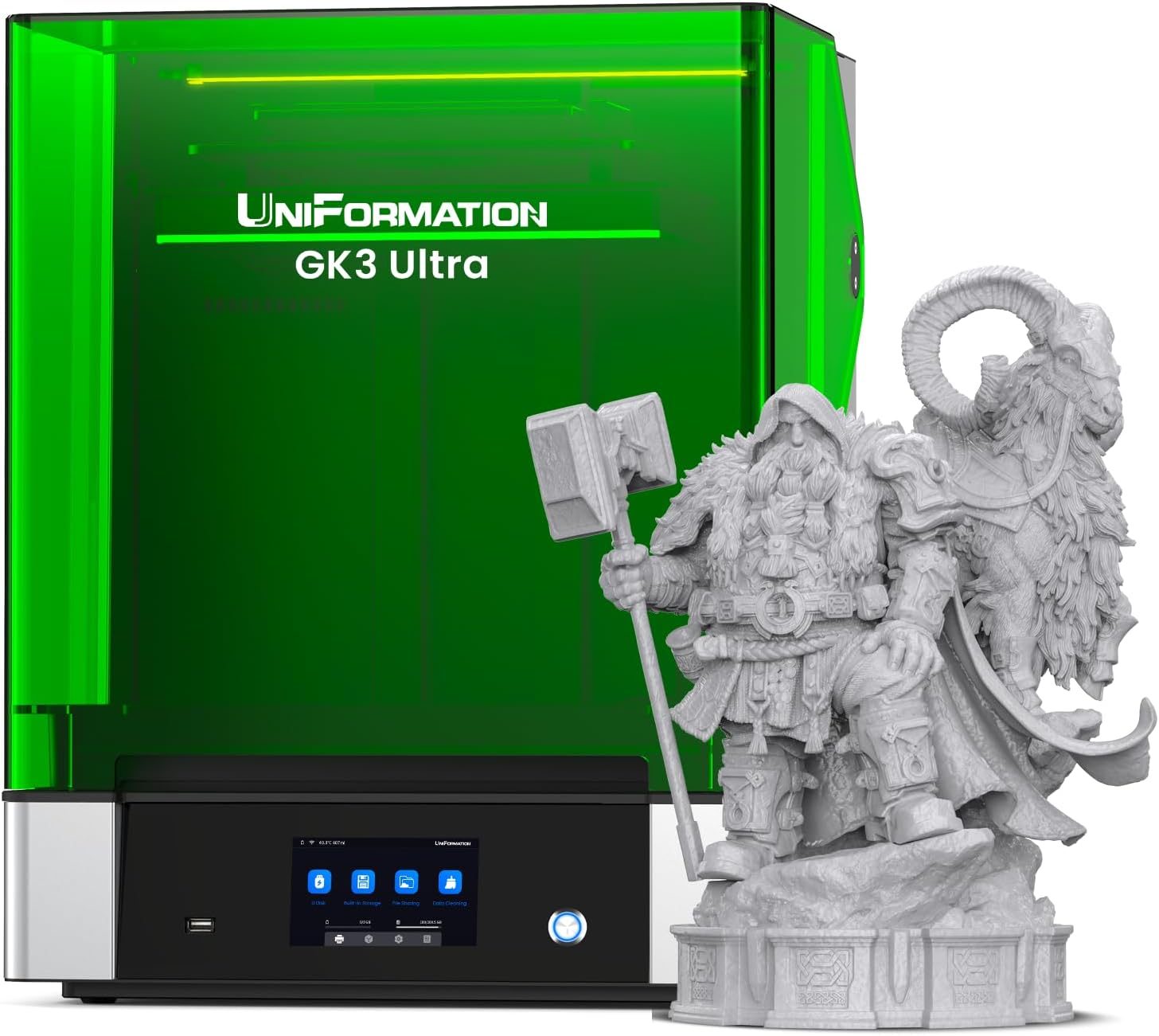
| Build volume | 300 × 160 × 300 mm |
|---|---|
| Screen resolution | 16K monochrome, 20–26 μm pixel size |
| Auto resin feeding | Yes |
| Heating system | Preheats resin to 25℃/30℃ |
| Filtration | Built-in activated carbon filter |
The UniFormation GK3 Ultra is a large-format resin printer designed to handle big models and longer print runs with minimal interruption. It uses a 16K monochrome LCD with 20–26 μm pixel size to deliver high-detail prints across a 300 × 160 × 300 mm build volume, and the KK60 Z-axis module provides extra rigidity for repeatable layer accuracy. Practical features aimed at reliability include an automatic resin feeding system that detects and refills the vat, a quick-replace LCD module to reduce maintenance downtime, and an integrated heating system that preheats resin for consistent cures in cold environments. A built-in activated carbon filter and drip hanger help keep the workspace cleaner during lengthy prints. The printer is heavy and built like a studio machine, so it is best installed on a stable surface; it also requires space and workshop-level handling for resin post-processing and ventilation. For users prioritizing dependable, unattended large prints, the GK3 Ultra brings workflow-focused hardware that reduces common failure points and maintenance interruptions.
Best for: Buyers who need a dependable large-format resin printer for professional prototyping or studio production and want features that reduce failed prints and downtime.
Less Ideal for: Hobbyists with limited space or users who want a lightweight desktop printer for casual, small-scale projects.
- Large 300 × 160 × 300 mm build volume for big models or multi-part batches
- High-resolution 16K monochrome LCD with 20–26 μm pixel size for fine detail
- Automatic resin feeding system prevents interruptions from low resin levels
- Built-in heating ensures consistent resin temperature in cold conditions
- Quick-replace LCD module and carbon filtration simplify maintenance and improve workspace comfort
- Physically large and heavy, requiring a dedicated, stable workspace
- Designed for resin workflows so users must manage ventilation and post-processing safely
Verdict: The GK3 Ultra is the best pick for makers and studios that need a reliable large-format resin printer built to minimize interruptions and maintenance during long, high-detail prints.
Choosing the Right Large-Format 3D Printer: Key Factors to Consider
Build Volume and Work Envelope
The physical build volume determines the maximum single-part size and orientation you can print. For large-format printing, a larger Z height and generous X-Y footprint let you print one-piece components that would otherwise require assembly. Consider the true usable area after accounting for gantry clearance and any print-head overhangs.
A larger envelope also raises demands on part cooling, bed leveling, and motion accuracy. Very large beds need consistent first-layer conditions across the whole surface to prevent adhesion failures, so think not just in liters but in how you will position parts to minimize curling and stress during long prints.
Thermal Management and Enclosure
Large parts are more prone to warping because differential cooling across layers causes internal stresses. An effective enclosure or active chamber heating reduces temperature gradients and improves interlayer adhesion for semi-crystalline and engineering filaments. Evaluate whether the machine offers full enclosure, controlled ventilation, and the ability to maintain consistent internal temperatures during multi-hour or multi-day prints.
Also factor in how the printer handles heat dissipation from motors and electronics. On very large builds, fans and cooling ducts must be balanced so they do not create localized cold spots near the print. If you plan to use high-temperature filaments, chamber-rated thermals and material-compatible seals will be important.
Extruder and Hotend Capability
Extruder design influences how reliably the printer can push filament for long periods. For large-format jobs you may need higher volumetric flow to print thicker layer heights efficiently, so direct-drive or well-geared extruders with high torque matter. Hotend compatibility with larger nozzles preserves print speed while maintaining layer bonding when printing big parts.
Consider whether the hotend supports hardened nozzles or all-metal configurations for abrasive filaments. Also check the modularity of the extrusion system so you can swap in high-flow or multi-material heads if your work evolves.
Build Plate and Adhesion Systems
A large heated build plate must reach and sustain target temperatures evenly. Variations across the surface are a common source of adhesion failure in large prints. Look at the plate material, mounting system, and whether the vendor supplies proven adhesion aids such as textured PEI sheets or removable flexible surfaces that simplify part removal after long runs.
Bed leveling automation is especially valuable on big beds. Automatic mesh or probe-based systems reduce setup time and improve first-layer consistency across the build area. Also consider how easy it is to replace or service the bed if damage occurs during removal of large parts.
Motion System and Frame Construction
Large-format printers put increased mechanical demands on linear rails, lead screws, belts, and gantries. Stiffer frames and well-supported motion systems reduce vibration and layer artifacts when printing tall or wide parts. Examine the type and size of rails, the presence of braces or cross-members, and how the gantry is driven to spot potential flex in long-span axes.
Smooth motor control and proper stepper sizing matter for avoiding missed steps on long prints. Also check for anti-backlash or preloaded components that maintain positional accuracy over many hours of operation.
Filament Storage and Feeding
Large-format jobs consume more filament per print, increasing the likelihood of moisture absorption and feed interruptions. Onboard or integrated filament dry storage, and robust feed paths that minimize filament drag, help maintain continuous long prints. Consider whether the printer uses direct paths with proper filament guides, or external spool mounts that could tangle during long runs.
Also evaluate the ease of switching filament mid-print if you use multi-part jobs, and whether the printer supports remote pause and resume features for filament changes or power interruptions.
When to Choose a Large-Format 3D Printer
Choose a large-format 3D printer when your projects benefit from single-piece large components, longer continuous runs without assembly seams, or when part strength from continuous layers is critical. If you frequently prototype full-size housings, tooling jigs, or fixtures, a large bed and taller Z capacity can simplify fabrication and trim assembly time.
Also consider workflow implications: large prints require more time, attention to environmental control, and sometimes dedicated floor space and power. If your use case is occasional oversized prints, a hybrid approach using modular assembly might still be appropriate.
- Prototyping full-size parts or enclosures
- Printing large jigs, fixtures, or tooling in one piece
- Reducing assembly points to improve structural integrity
Material Choices for Big Prints
Material selection affects both print success and final part performance. PLA can work for proof-of-concept large prints that do not face heat, but stronger engineering materials like PETG, ABS, or nylon often require better thermal control and an enclosure. For very large parts that will see mechanical stress, consider reinforced or composite filaments compatible with your extrusion system.
Also plan for filament logistics. High-capacity spools and dry boxes reduce moisture issues. Some users prefer printing large form factors with coarser layer heights and bigger nozzles to shorten print time while still achieving acceptable strength.
- Use enclosure for ABS and nylon to reduce warping
- Consider larger nozzles for faster throughput
- Store filament dry to prevent print defects
Practical Tips for Successful Large Prints
Preparation and monitoring make the difference on long runs. Use brim or raft strategies to increase first-layer adhesion, and test small calibration prints in multiple positions on the bed before committing to a multi-day job. Routine maintenance on belts, lead screws, and bearings reduces the risk of mechanical issues during extended prints.
Break very large models into logical sections where possible without compromising strength. If you must print a single large piece, inspect slicer settings for appropriate cooling profiles, layer heights, and retraction tuned for high-flow extrusion. Remote monitoring or webcam oversight helps you catch early failures before you waste hours and filament.
- Use brims or rafts for larger contact area
- Calibrate extrusion and bed leveling across the build plate
- Monitor prints remotely and prepare for long run times
Space, Power, and Shop Considerations
Large-format printers occupy more floor space and may require higher power availability depending on heated bed and chamber heater demands. Plan for safe ventilation and clearance for an enclosure door and filament handling. Consider the noise and vibration impact on nearby work areas when placing a large machine.
Accessibility for maintenance is also important. Machines that allow side or front access to the build area and serviceable electronics simplify repairs and reduce downtime when large prints fail or require adjustments.
- Ensure adequate workspace and clearances
- Verify electrical circuits support bed and chamber heaters
- Plan for filament storage and maintenance access
Slicer Strategies for Big Models
Slicer settings scale differently for large prints. Faster infill over large volumes can introduce internal stresses unless wall thickness and layer bonding are tuned accordingly. For large parts, raise wall counts and consider lower infill percentages where strength is not critical, or use honeycomb patterns to balance material use and rigidity.
Use conservative acceleration and jerk settings to reduce vibration artifacts. Test different layer heights and nozzle sizes to find the best balance between surface quality and print time for large surfaces.
- Increase shell thickness for taller parts
- Adjust acceleration for smoother long moves
- Experiment with nozzle size to optimize build speed
How We Chose the Best Large-Format 3D Printer
We prioritized criteria that matter for printing large parts reliably and consistently. First, structural rigidity and frame design were essential because large builds amplify issues like frame flex and layer shifting. Second, heated bed size and uniformity were evaluated to ensure first-layer adhesion across the full platform. Third, hotend and extrusion capability were assessed, including nozzle sizes, high-flow options, and multi-material readiness for thicker prints. Fourth, thermal and airflow management for the build chamber was considered to reduce warping with engineering plastics. Fifth, filament handling and feeder reliability were judged because long prints are more likely to fail when filament feed is inconsistent. We excluded machines that only scale the bed size without addressing thermal control or frame stiffness. We also filtered out hobby-grade builds that lack replacement support options or meaningful documentation for large-format operation. Our picks favored machines with clear serviceability, accessible firmware or control systems, and practical integration of bed leveling and enclosure features. Across selections, build volume, bed temperature consistency, extrusion capability, chamber control, and filament management were the decisive dimensions.
Our full evaluation process is outlined in our review methodology.
FAQ
How large is large-format in practical terms?
Large-format typically refers to machines with significantly bigger X, Y, or Z axes than standard desktop printers, enabling single-piece prints that would otherwise require assembly. Exact dimensions vary by user needs, but expect beds and heights that support functional prototypes and tooling rather than small models.
Do large-format printers need a full enclosure?
Not always, but enclosures greatly improve success with heat-sensitive materials by reducing drafts and temperature gradients. For ABS, nylon, and engineering plastics, an enclosure or heated chamber is highly recommended to minimize warping on large parts.
Can I use standard filaments on a large-format machine?
Yes, common filaments like PLA and PETG work on large-format machines, but prints may require different slicer settings and adhesion strategies. For engineering filaments, ensure the printer supports required hotend temperatures and chamber conditions.
How do I reduce print time for very large parts?
Use larger nozzle diameters and thicker layer heights to increase volumetric throughput, and optimize infill patterns and shell counts for strength where needed. Faster extrusion rates require reliable filament feeding and robust hotend setups to maintain print quality.
What maintenance is unique to large-format printers?
Longer print durations amplify wear on motion components, so regular inspection of belts, linear rails, lead screws, and stepper motor mounts is important. Bed surface replacements and periodic calibration of large-area leveling routines are also common maintenance tasks.
Final Verdict
For large-format 3D printing, prioritize machines that combine a stiff frame, consistent bed temperature across the entire plate, and an extrusion system capable of sustained high volumetric flow. Expect tradeoffs between build speed and surface finish, and plan for the increased maintenance and environmental control that big prints demand. Focus first on the build volume and thermal control that match your materials, then select a machine with reliable filament handling and serviceable construction to keep long prints running successfully.