
Note: This article contains affiliate links. If you click on these links and make a purchase, we may earn a small commission at no extra cost to you. This helps support our research and content. Read our full affiliate disclosure here.
If you want to start printing functional parts, prototypes, or hobby models without overspending, the right 3D printer makes a big difference. Under $700 there are machines that deliver useful print resolution, decent build volume, and tolerable setup time so you can go from filament to finished part quickly. This guide shortlists the top picks in the under-$700 segment and explains the practical tradeoffs you should expect. We evaluated machines for print quality, ease of setup, reliability, and long-term ownership costs. Read on to see the best contenders and a clear breakdown of the decision criteria that matter most for hobbyists, makers, and small workshop users.
Top Picks at a Glance
| Best Overall The best all-around choice for most situations | FLASHFORGE AD5X 3D Printer | 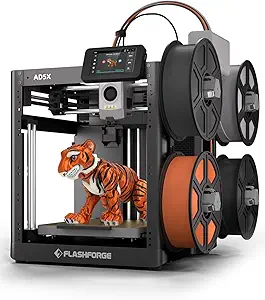 |
| Best Quality Built to a higher standard if you want something more solid | Bambu Lab P1S 3D Printer |  |
| Best Value The sweet spot between price and what you get | Creality K1C 3D Printer |  |
| Best Budget The cheapest option that still gets the job done reliably | Creality Ender 3 V3 SE |  |
| Top Rated A top-rated pick with lots of positive feedback | ANYCUBIC Photon Mono 4 Ultra |  |
| Most Popular A crowd favorite that many people choose with confidence | Bambu Lab P1S Combo |  |
FLASHFORGE AD5X 3D Printer

| Build volume | 220x220x220mm |
|---|---|
| Max nozzle temperature | 300°C |
| Structure | Open, Core XY |
| Max speed | 600mm/s |
| Filament compatibility | PLA/ABS/PETG/TPU/CF |
The FLASHFORGE AD5X is a Core XY desktop FDM printer built for faster prototyping and multicolor projects. It supports up to four-color printing, uses a 300°C direct-drive extruder for a wide range of filaments, and ships with a 0.4 mm nozzle while offering 0.25/0.6/0.8 mm options for fine detail or faster, chunky prints. The machine includes one-click auto leveling, an intelligent filament system with automatic feed/retract, and a resume-printing feature to recover from power interruptions. Flash Maker app support and an expandable camera and chamber lighting make remote monitoring and enclosure upgrades straightforward. The high travel speed and acceleration (600 mm/s and 20,000 mm/s²) enable rapid production runs, though achieving top speeds will depend on tuning and part geometry and may require stiffer workholding to avoid ringing. The printer is open-structure, which helps accessibility but means it will be more sensitive to ambient drafts than enclosed alternatives. For a balanced buyer looking for speed, multicolor capability, and practical usability under a midrange budget, the AD5X is a strong option with a few expected setup and tuning tasks to reach its peak performance.
Best for: Buyers who want a fast, versatile desktop printer that balances multicolor capability, broad filament support, and practical convenience features without moving into high-end industrial prices.
Less Ideal for: Users who need a fully enclosed, temperature-stable printer for ABS-style engineering prints or those who want a completely plug-and-play printer with no tuning.
- Core XY frame with high travel speed and acceleration for faster prints
- Supports up to four-color printing for more complex, multicolor parts
- 300°C direct-drive extruder broadens filament compatibility
- One-click auto leveling and automatic filament feed/retract simplify setup and use
- Open-frame design is more exposed to drafts and temperature fluctuations
- Real-world top speeds require careful tuning and may not be achievable on detailed parts
Verdict: The AD5X is the best pick for buyers who want a speedy, multicolor-capable desktop printer with broad filament support and practical automation features under a midrange budget.
Bambu Lab P1S 3D Printer
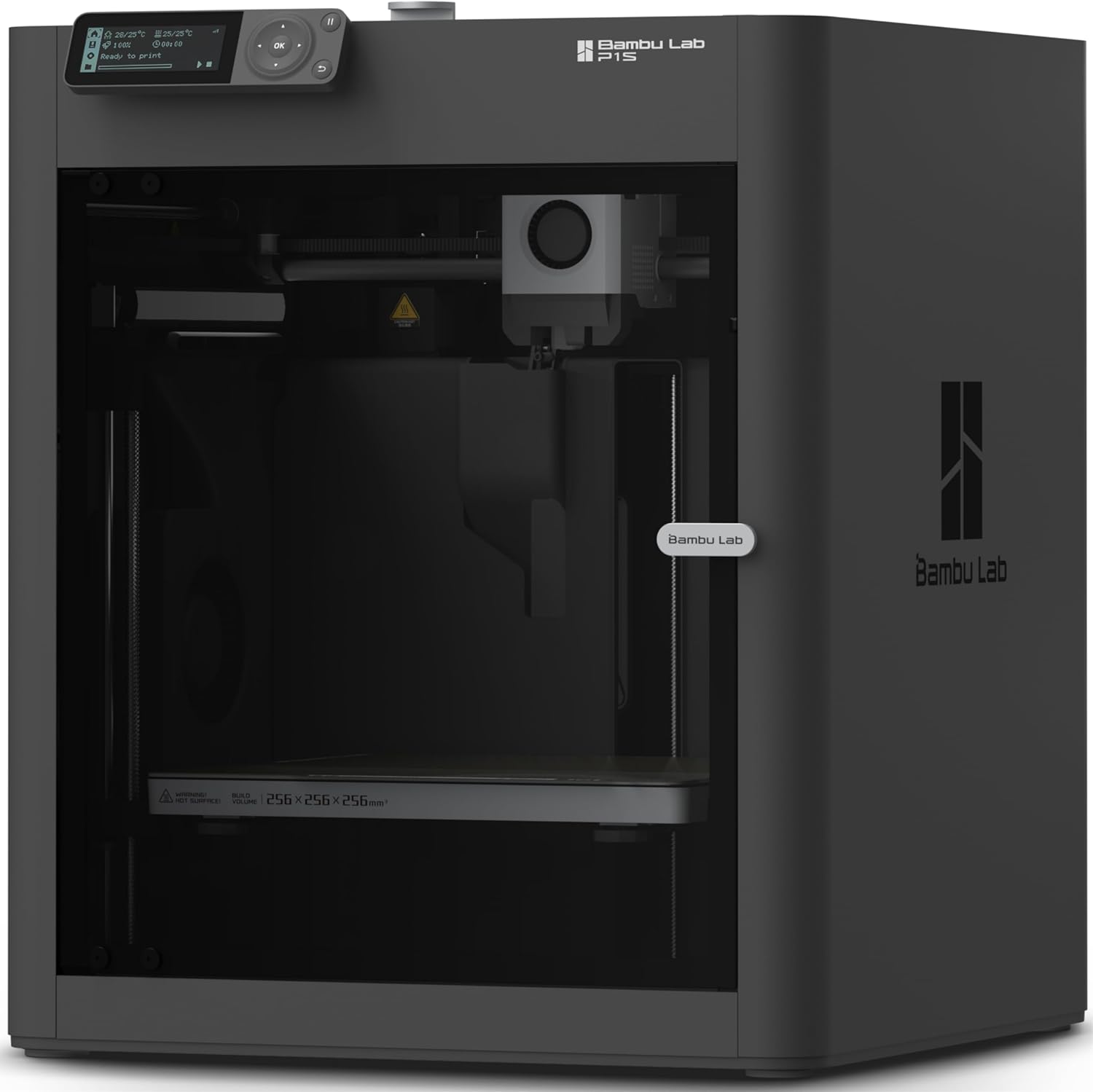
| Build Volume | 256×256×256 mm³ |
|---|---|
| Max Speed | 500 mm/s |
| Max Acceleration | 20 m/s² |
| Supported Filaments | PLA, PETG, TPU, PVA, PET, ABS, ASA |
The Bambu Lab P1S is a ready-to-use enclosed CoreXY FDM printer that targets users who want fast, reliable prints without a steep setup curve. It offers aggressive top speeds (advertised up to 500 mm/s) and high acceleration, which cuts print times on many models, while a direct-drive extruder expands filament compatibility to include flexible materials. The enclosed frame and automatic bed leveling improve success with temperature-sensitive filaments and reduce warping, and the built-in camera and MakerWorld model library make it easy to monitor and download prints. Setup is quick enough for newcomers to start printing within minutes, yet the printer supports a wide range of filaments from PLA and PETG to ABS and ASA for more demanding parts. Important limitations are that truly exotic reinforced filaments are not recommended and some advanced multi-color capability requires connecting the AMS accessory, which adds complexity and cost. For someone prioritizing speed and dependable everyday performance, the P1S brings factory-quality print quality at a fast pace.
Best for: Buyers who prioritize fast, reliable production prints and want a mostly turn-key machine that handles a broad set of filaments with minimal setup.
Less Ideal for: Users who need out-of-the-box multi-material multi-color capability or who primarily print with reinforced composite filaments should consider other specialized systems.
- Very high print speeds and acceleration reduce print times on typical models
- Enclosed CoreXY design improves thermal stability for ABS and other temperature-sensitive filaments
- Direct-drive extruder expands compatibility to flexible filaments like TPU
- Automatic bed leveling simplifies setup and increases first-layer success
- Integrated camera and MakerWorld library make monitoring and finding models convenient
- Multi-color/multi-material printing requires the AMS accessory to reach its full potential
- Not recommended for carbon or glass fiber reinforced filaments
Verdict: Choose the P1S if you want one of the fastest, beginner-friendly enclosed printers that delivers reliable, high-quality prints for everyday production work.
Creality K1C 3D Printer

| Print volume | 8.66 x 8.66 x 9.84 inch |
|---|---|
| Max nozzle temp | 300 ℃ |
| Supported materials | PLA/ASA/ABS/TPU/PLA-CF/PET-CF |
| Extruder type | Direct extruder |
| Auto leveling | Yes |
The Creality K1C is a ready-to-run desktop 3D printer aimed at speedy prototyping and everyday prints. It arrives mostly assembled and boots like a smartphone so you can start printing within minutes; auto Z offset and auto leveling reduce setup fiddling. The machine targets high throughput with a claimed 600 mm/s top speed and strong acceleration, while an upgraded cooling layout and a clog-free direct extruder (300 °C capable) let you run a variety of filaments including carbon-fiber blends. A built-in AI camera monitors prints, detects common failures, and records timelapses for remote oversight. Practical benefits include fast turnaround on small models, less time spent leveling and troubleshooting, and improved filament control from the direct-drive feed. Trade-offs are that the printable volume is moderate at about 8.66 x 8.66 x 9.84 inches so larger parts need splitting, and pursuing top speeds may require dial-in of print settings to maintain surface quality. For buyers seeking a fast, user-friendly machine for functional parts and iterative prototypes, the K1C is a strong option under $700.
Best for: Buyers who prioritize quick iteration and minimal setup time for functional prototypes and small production parts will appreciate the K1C.
Less Ideal for: Anyone who needs to print large, single-piece objects or who prefers a very wide build area should consider a larger-format printer instead.
- Fast top-speed capability and high acceleration for quicker print turnaround
- Plug-and-play setup with auto Z offset and auto leveling reduces initial calibration time
- Clog-free direct extruder with 300 °C support handles abrasive carbon-fiber and common filaments
- Built-in AI camera enables real-time monitoring and timelapse recording
- Upgraded multi-fan cooling improves layer adhesion and reduces stringing on bridges
- Relatively small build volume limits single-piece prints to small-to-medium parts
- Achieving highest claimed speeds may require tuning to preserve surface finish
Verdict: The K1C is the practical choice for makers who want a fast, low-fuss desktop printer that handles engineering filaments and gets you to usable parts quickly.
Creality Ender 3 V3 SE

| Item model number | Ender 3 V3 SE |
|---|---|
| Printing speed | Up to 250 mm/s |
| Extruder | Sprite direct extruder |
| Mainboard | 32-bit silent mainboard |
The Creality Ender 3 V3 SE is a beginner-friendly FDM printer that aims to speed up hobby and light-prototyping work. It prints up to 250 mm/s with 2500 mm/s² acceleration, uses a CR Touch and strain sensor for auto bed leveling and Z-offset, and has a Sprite direct extruder that handles PLA, PETG and flexible filaments. Dual Z-axis hardware and twin Y-axis linear shafts improve stability for taller or detailed prints, while a 32-bit silent mainboard reduces motor noise during long jobs. The PC spring steel build plate is flexible and makes part removal easier, and one-tap auto filament load/unload simplifies filament changes. Expect a fast, straightforward out-of-box setup—assembly is advertised as three steps in about 20 minutes—making it approachable for first-time builders. Important limits are that the machine is a compact desktop printer with modest build volume compared with larger hobbyist machines and that hitting top speeds may require tuning to maintain peak quality with certain filaments.
Best for: Buyers looking for an affordable, ready-to-start desktop 3D printer that balances speed and convenience for hobby projects and quick prototypes.
Less Ideal for: Users who need a large build volume or a factory-calibrated, plug-and-play machine for professional production-grade parts.
- High maximum print speed (up to 250 mm/s) for faster job turnaround
- CR Touch and strain sensor provide easy auto bed leveling and Z-offset
- Sprite direct extruder supports PLA, PETG and TPU for versatile materials
- Dual Z-axis and reinforced Y-axis rails improve stability and print quality
- 32-bit silent mainboard reduces operational noise during prints
- Smaller build volume compared with larger desktop or prosumer printers
- Achieving top speeds may require tuning and can affect surface finish
Verdict: A budget-friendly desktop 3D printer that delivers faster prints and easy auto-leveling, making it a strong value pick for hobbyists and makers under $700.
ANYCUBIC Photon Mono 4 Ultra

| Screen resolution | 9024 x 5120 |
|---|---|
| Print speed | 120 mm/h |
| Screen size | 7 inches |
| Item model number | Mono 4 Ultra |
The ANYCUBIC Photon Mono 4 Ultra is a desktop resin MSLA printer built to push detail and speed for hobbyists and small shops. It uses a 7-inch 10K monochrome screen (9024 x 5120) and a COB light source with Fresnel optics to deliver fine XY detail and improved light uniformity, while an ACF release film and algorithm aim to speed peeling for print rates up to 120 mm/h. The printer includes a 4.3-inch HD touchscreen with a simplified UI and multiple intelligent checks such as residual resin detection, failed-print detection, and lifespan monitoring to help catch problems early. Practical benefits include noticeably finer surface detail compared with lower-resolution mono screens and a faster, more consistent printing workflow thanks to the release film and automated checks. Limitations include the inherent mess and post-processing required with resin printing and the smaller build volume, which makes it better for high-detail small parts than large functional prototypes. Buyers should also plan for consumables and ventilation when running resin workflows.
Best for: A buyer who prioritizes dependable, high-detail resin output and a printer that reduces common failure points through automated checks and tuned factory calibration.
Less Ideal for: Users who need large build volumes, want dust-free filament workflows, or who prefer minimal post-processing and ventilation concerns should consider other printer types.
- Very high XY resolution with a 7" 10K monochrome screen for detailed prints
- COB light source and Fresnel lens design for improved light uniformity and layer consistency
- 120 mm/h maximum print speed and ACF release film to reduce peel forces and speed cycles
- Built-in intelligent detection features to catch failed prints and monitor resin status
- User-friendly 4.3" HD touchscreen with multilingual UI
- Smaller build volume limits large part printing
- Requires typical resin post-processing and careful ventilation/handling
Verdict: Buy this if you want a reliably tuned resin printer focused on very high-resolution, faster small-part printing with built-in safeguards.
Bambu Lab P1S Combo

| Build Volume | 256×256×256 mm³ |
|---|---|
| Max Speed | 500 mm/s |
| Max Acceleration | 20 m/s² |
| Supported Filaments | PLA, PETG, TPU, PVA, PET, ABS, ASA |
The Bambu Lab P1S Combo pairs a high-speed CoreXY printer with an Automatic Material System to enable multi-color and multi-material prints without frequent filament swaps. It is built for fast results, with up to 500 mm/s travel speed and very high acceleration for short print times, and its enclosed frame helps with temperature-sensitive filaments. Auto bed leveling, a direct-drive extruder, and broad filament support (PLA, PETG, TPU, PVA and more) make reliable prints easier for makers who want quality quickly. The included camera is useful for time-lapse captures and remote monitoring, and setup is straightforward enough to get printing in minutes. Limitations to note are the requirement to connect the AMS to access the advertised multi-color capability and the recommendation to avoid carbon or glass-fiber reinforced filaments, which restricts some advanced material options. For buyers focused on speed and multi-color convenience in a mostly plug-and-play package, the P1S Combo delivers strong real-world performance at this price point.
Best for: Buyers who value fast, reliable prints and want easy multi-color or multi-material capability with minimal assembly and setup time.
Less Ideal for: Users needing specialty reinforced filaments or those who prefer open-frame machines for large experimental mods should consider alternatives.
- Very high print speed and acceleration for faster print turnaround
- Enclosed frame improves reliability with temperature-sensitive filaments
- Direct-drive extruder broadens usable filament types including flexible TPU
- Automatic bed leveling reduces setup fiddling and failed first layers
- AMS support enables multi-color/multi-material prints without manual filament swaps
- Multi-color capability requires connecting the AMS hardware
- Not recommended for carbon or glass-fiber reinforced filaments
Verdict: If you want fast, mostly hands-off multi-color printing in an enclosed, ready-to-use package, the P1S Combo is an excellent choice under $700.
Choosing the Right 3D Printer: Key Factors to Consider
Print Resolution and Surface Finish
Layer height, nozzle diameter, and motion system precision determine how fine the printed surfaces look straight from the printer. Higher resolution settings increase print time, so consider what surface finish you actually need for final parts versus prototypes.
For many hobby and functional prints under $700, 0.1–0.2 mm layer heights are a realistic sweet spot. Understand that achieving a smooth finish may also require post-processing, so factor in sanding or chemical smoothing if cosmetic quality is critical.
Build Volume and Project Size
The usable build volume limits the maximum single-part size you can print. Larger build plates let you print bigger objects or multiple parts in one run, which saves time for batch jobs.
If you plan to print large enclosures, prototypes, or multi-part assemblies, prioritize a machine with generous X, Y, and Z travel. Remember that larger volumes can slow print speed and may require stronger frame rigidity to maintain consistent dimensional accuracy.
Filament Compatibility and Hotend Capability
Different projects call for different materials. PLA is forgiving and works for most aesthetic and low-stress parts. For functional parts you may need PETG, ABS, or specialty filaments that require higher nozzle temperatures or an all-metal hotend.
Confirm the printer can reach the required hotend and bed temperatures and supports the filament diameters you intend to use. Ease of switching between materials and accessible extruder components make material swaps less frustrating.
Ease of Setup and User Experience
Time to first successful print matters. Machines with clear documentation, guided calibration routines, and intuitive controls require less trial and error. Automatic bed leveling or assisted manual leveling saves hours for new users.
Also evaluate the software workflow: a straightforward slicing process, good default profiles, and firmware that supports common features reduce the learning curve and make routine printing less error prone.
Reliability and Maintenance
A stable mechanical platform and quality components reduce failed prints and the need for frequent repairs. Look for printers with rigid frames, decent-quality linear motion components, and accessible wear parts such as belts, bearings, and nozzles.
Consider maintenance tasks you will perform regularly, like bed cleaning, nozzle swaps, and belt tensioning. Machines that make these tasks simple will lower ongoing ownership effort and downtime.
Community Support and Documentation
Strong user communities and clear manufacturer documentation make troubleshooting faster. For budget-conscious buyers, community guides can supply proven print profiles, upgrade suggestions, and common-fix walkthroughs.
Even if a printer is mechanically competent, poor documentation can significantly increase setup time. Prioritize models with active forums or abundant third-party resources when long-term support is a concern.
Balancing Build Volume and Footprint
When choosing a machine under $700, consider the physical footprint as well as build volume. A larger build area is useful, but the printer itself must fit your workspace and allow for safe ventilation and filament storage.
Compact printers with well-optimized volume-to-footprint ratios are often the best compromise for home workshops. If you need occasional large prints, check whether splitting models into multiple parts for assembly is practical for your projects.
- Measure the available workspace before choosing a printer
- Factor in clearance for filament spools and post-processing
- Think about how you will transport or move printed parts out of the build area
Firmware and Software Ecosystem
A good software ecosystem simplifies slicing, calibration, and firmware updates. Open-source firmware and widely used slicers provide established profiles and community-tested settings that reduce trial and error.
Look for printers that accept standard G-code outputs and have known compatibility with popular slicers. Firmware features such as thermal protection, resume-on-power-loss, and filament runout detection improve day-to-day usability.
- Confirm slicer compatibility and profile availability
- Check whether firmware updates are straightforward
- Prioritize features that prevent common print failures
Upgradability and Long-Term Improvements
Many budget machines can be upgraded incrementally. Common upgrades include better hotends, stronger extruders, quieter stepper drivers, or improved bed surfaces. Choosing a printer with standardized parts can reduce upgrade cost and complexity.
Consider how easy it is to source replacement parts and whether the machine supports popular aftermarket accessories. Upgrade potential extends the useful life of a budget printer and lets you tailor performance over time.
- Confirm compatibility with common hotend and extruder upgrades
- Look for standard fastener sizes and modular components
- Assess whether community-made parts are available for common improvements
Safety and Ventilation Considerations
Some filaments release odors or ultrafine particles during printing. Ensure your workspace has adequate ventilation, especially when using higher-temperature materials. Enclosures help with temperature stability but can trap fumes without proper airflow.
Also check for basic safety features such as thermal runaway protection and secure wiring. Well-documented safety practices prevent damage and reduce health risks during routine operation.
- Use PLA in poorly ventilated rooms; ensure ventilation for ABS or specialty filaments
- Consider a filtered enclosure if indoor air quality is a concern
- Verify the printer includes thermal protection and clear electrical routing
Speed Versus Detail Tradeoffs
Faster print settings reduce turnaround time but often sacrifice surface finish and precision. Depending on your priorities, tune print speed, acceleration, and jerk settings to balance throughput and visual quality.
For prototyping, faster, lower-resolution prints are useful for fit checks. For end-use parts, slow down and lower layer height to improve tolerance and surface texture.
- Test a few profile combinations to find acceptable tradeoffs
- Use infill and shell settings strategically to speed prints without compromising structural needs
- Recognize that hardware limits will cap how aggressively you can tune speeds
How We Chose the Best 3D Printer
We focused on machines that deliver consistent, usable results within the under-$700 budget range. Key evaluation dimensions included print quality at practical layer heights, out-of-box setup and calibration, and hardware reliability during multihour prints. We also looked at build volume relative to typical project sizes, the range of compatible filament types, and the availability of straightforward maintenance procedures. Excluded from consideration were experimental or prototype rigs that require extensive firmware hacking or supplies that vastly increase total cost beyond the stated budget. We prioritized units with clear documentation, a stable mechanical platform, and common, replaceable wear parts. Our selection favors printers that minimize time spent on troubleshooting while offering upgrade paths for users who want to improve speed or surface finish later. The filters applied reflect what most buyers in this price bracket care about: dependable print quality, predictable setup effort, reasonable print speed for typical projects, and manageable long-term upkeep.
Our full evaluation process is outlined in our review methodology.
FAQ
Can a sub-$700 3D printer produce parts strong enough for functional use?
Often, yes. With the right settings and suitable filament such as PETG or ASA, many budget printers can produce parts with adequate strength for light mechanical uses. Proper print orientation, infill, and layer adhesion are critical to achieving durable parts.
How important is automatic bed leveling on an entry-level printer?
Automatic bed leveling reduces initial setup time and ongoing adjustments, which is particularly helpful for new users. However, a well-leveled manual bed can also deliver good results. Consider automatic leveling as a convenience and reliability feature rather than an absolute necessity.
What maintenance tasks should I expect with a budget 3D printer?
Expect routine tasks like nozzle cleaning, bed surface maintenance, belt tension checks, and occasional calibration. Frequency depends on usage, but planning for basic upkeep keeps print reliability high and prevents small issues from becoming larger problems.
Are all filaments equally easy to print on lower-cost machines?
No. PLA is the easiest and most forgiving for budget machines. Higher-temperature materials such as ABS, Nylon, or flexible filaments often require more capable hotends, reliable heated beds, and sometimes an enclosure to print well.
How do I judge whether a printer's build volume is sufficient?
Start by listing typical parts you want to print and measuring their largest dimensions. Allow some margin for orientation and support structures. If most of your parts fit within the printer's printable area without splitting, the volume is likely sufficient.
Final Verdict
When shopping for a 3D printer under $700, prioritize the features that match how you plan to use the machine. If you need larger parts, emphasize build volume and frame rigidity. If you value low setup time, choose machines with guided calibration and good documentation. Expect tradeoffs between speed, resolution, and material capability, and favor models that offer straightforward maintenance and an upgrade path. With those priorities in mind, you can confidently select a budget printer that delivers dependable prints and grows with your skill set.