
Note: This article contains affiliate links. If you click on these links and make a purchase, we may earn a small commission at no extra cost to you. This helps support our research and content. Read our full affiliate disclosure here.
Picking the right air conditioner thermostat changes how comfortable your home feels and how much you pay for cooling. The right thermostat does more than set a target temperature. It maintains consistent humidity and temperature, reduces unnecessary runtime, and fits how you live and use your home cooling system. This guide shortlists the top thermostats for air conditioners and explains the practical tradeoffs you should expect. We evaluated accuracy, control features, installation scope, and long-term energy behavior to assemble thermostats that perform well in real homes. Read on for the key differences and which features matter most for your setup.
Top Picks at a Glance
| Best Overall The best all-around choice for most situations | ecobee Smart Thermostat Essential |  |
| Best Quality Built to a higher standard if you want something more solid | Sensi Touch ST75 |  |
| Best Value The sweet spot between price and what you get | Garystat G701-B Thermostat |  |
| Best Budget The cheapest option that still gets the job done reliably | Miuputake STN601 Nonprogrammable Thermostat |  |
| Top Rated A top-rated pick with lots of positive feedback | Riseem STN621 Thermostat |  |
| Most Popular A crowd favorite that many people choose with confidence | Google Nest Thermostat |  |
ecobee Smart Thermostat Essential

| Connectivity Technology | Wi-Fi |
|---|---|
| Controller Type | Amazon Alexa, Android, Apple HomeKit, Google Assistant, iOS |
| Power Source | Battery Powered |
| Display Type | LCD |
The ecobee Smart Thermostat Essential is a pared-down smart thermostat aimed at saving energy and simplifying temperature control. It mounts on the wall and connects over Wi‑Fi so you can change settings from the ecobee mobile app or by tapping the color LCD touchscreen, and it integrates with Alexa, Google Assistant, and Apple HomeKit. Key conveniences include auto-scheduling and an Auto-Away mode that helps reduce heating and cooling use, plus eco+ features for schedule assistance and time-of-use adjustments. Installation is straightforward for typical 24 VAC systems and ecobee provides a compatibility checker and an optional Power Extender Kit for homes without a C wire. The Essential omits built-in room sensors and some premium luxuries found on higher-end models, so zone-level temperature balancing requires purchasing SmartSensor accessories separately. For buyers focused on reliable remote control, energy saving schedules, and voice integration without advanced extras, this model covers the essentials in a compact, Energy Star certified package.
Best for: Buyers who want dependable remote and voice control plus automated energy-saving schedules without paying for high-end extras, and who prefer a straightforward, easy-to-install thermostat.
Less Ideal for: Households that need multiroom temperature balancing out of the box or want the most advanced sensors and built-in air quality monitoring included.
- Wi‑Fi connectivity with mobile app and voice assistant control for remote temperature changes
- Auto-scheduling and Auto-Away features that help reduce heating and cooling use
- Energy Star certified with eco+ tools for time-of-use and schedule assistance
- Simple wall-mounted design and generally easy DIY installation with compatibility checker
- Does not include SmartSensor room sensors by default, so per-room balancing requires extra purchase
- Requires optional Power Extender Kit for some systems without a C wire
Verdict: Choose the ecobee Smart Thermostat Essential if you want reliable Wi‑Fi and voice control plus built-in energy-saving schedules at a budget-friendly level.
Sensi Touch ST75

| Connectivity Technology | Wi-Fi (2.4 GHz) |
|---|---|
| Screen Size | 4.3 inches |
| Control Method | App, Touch, Voice |
| Temperature Control Type | programmable |
| Specific Uses For Product | Air Conditioner, Boiler, Furnace, Heat Pump |
The Sensi Touch ST75 is a touchscreen smart thermostat that replaces a standard wall stat and gives you remote control of your HVAC via the Sensi mobile app. It is used for day-to-day temperature scheduling, remote adjustments, and monitoring system performance; setup is aimed at DIY installers and requires a common wire. Notable features include a 4.3-inch color LCD touchscreen, 2.4 GHz Wi‑Fi connectivity, compatibility with Alexa, Google Assistant, Apple HomeKit and other smart home platforms, Energy Star certification, usage reports, geofencing and maintenance alerts. In practice the interface is straightforward and the app makes scheduling and remote changes quick, while the usage reports and alerts help a performance-minded owner track savings and equipment health. Limitations to consider are the C-wire requirement for many installs and reliance on 2.4 GHz Wi‑Fi rather than dual-band support, which could matter in congested networks or unusual HVAC setups. The Sensi Touch balances usability and energy-focused features for homeowners who want app-driven control and insight into HVAC performance.
Best for: Homeowners focused on HVAC performance who want touchscreen control plus app-based scheduling and usage reports to track energy and system health.
Less Ideal for: People without an available common wire or those who need dual‑band Wi‑Fi support and broader network compatibility should consider other options or professional installation.
- Large 4.3-inch color touchscreen with intuitive menus for easy on-wall control
- Wi‑Fi remote access and scheduling through the Sensi mobile app
- Works with major voice assistants and smart home platforms including Alexa, Google Assistant, and Apple HomeKit
- Energy Star certified with usage reports and smart alerts to monitor efficiency and maintenance needs
- Requires a common wire (C‑wire) for most installations, limiting compatibility in some older homes
- Supports only 2.4 GHz Wi‑Fi which may be an issue on congested networks or where only 5 GHz is available
Verdict: Choose the Sensi Touch ST75 if you want a touchscreen smart thermostat that pairs strong app control and energy reporting with broad smart home compatibility.
Garystat G701-B Thermostat

| Control Type | Button Control |
|---|---|
| Temperature Control Type | Manual |
| Voltage | 24 |
| Display Type | LCD |
| Mounting Type | Wall Mount |
The Garystat G701-B is a straightforward single-stage, 1 Heat/1 Cool digital thermostat built for simple temperature control in conventional gas, oil, or electric furnace systems. It uses a large blue backlit LCD and separate buttons for setpoint changes, making it easy to read and operate for most household users. The unit reports real-time room temperature and can optionally display humidity, and it supports both 24VAC power or dual AAA battery backup so a C-wire is not required in many installs. Installers will appreciate labeled terminal blocks (RH, RC, G, Y, C, O, B, W), an easy-access battery compartment, and selectable compressor delay and heating/electric configuration options. Limitations include lack of programmable schedules, no support for heat pumps, multistage systems, or line-voltage baseboard heating, so it only fits standard single-stage HVAC setups. For buyers who want simple, reliable manual control and a clear display without smart scheduling, this thermostat delivers practical performance and straightforward installation.
Best for: Buyers who prioritize a simple, easy-to-read manual thermostat for a conventional single-stage heating and cooling system and want straightforward installation without smart scheduling.
Less Ideal for: Those seeking programmable schedules, smart/home integration, or who have heat pump, multistage, or line-voltage HVAC systems should look elsewhere.
- Large backlit LCD with clear temperature and optional humidity readout
- Dual power options (24VAC or 2 AAA batteries) so C-wire is often not required
- Easy-to-wire labeled terminal block and universal sub-base for simple installation
- Selectable compressor delay and configurable heating mode for basic system protection
- Non-programmable manual control with no scheduling or smart features
- Not compatible with heat pumps, multistage systems, or line-voltage baseboard heating
Verdict: A no-frills, easy-to-install manual thermostat that gives clear temperature and humidity readouts for single-stage HVAC systems.
Miuputake STN601 Nonprogrammable Thermostat

| Controller Type | Push Button |
|---|---|
| Temperature Control Type | Manual |
| Power Source | 24VAC or 2 AAA batteries |
| Display Type | LCD with backlight |
The Miuputake STN601 is a straightforward wall-mounted digital thermostat designed for single-stage heat/cool systems and common forced-air setups. It provides manual temperature control via button inputs and an easy-to-read backlit LCD, and it can run on 24VAC or two AAA batteries which simplifies installation when a C-wire is not present on most systems. The unit includes selectable compressor delay protection, adjustable temperature differential (swing), and a low-battery indicator that help protect equipment and improve comfort with minimal fuss. Installation is DIY-friendly thanks to a universal sub-base and labeled terminals, and the package includes screws, anchors, and a cable label. Limitations are that it is nonprogrammable and not compatible with multi-stage heat pumps, line-voltage or baseboard electric systems, mini-splits, or systems requiring auxiliary/emergency heat, so it is best for standard single-stage furnaces and central AC. For buyers who want a simple reliable replacement without advanced scheduling or smart features, this covers the essentials cleanly.
Best for: Buyers looking for an inexpensive, no-frills replacement thermostat for a standard single-stage central AC or furnace who value easy DIY install and reliable manual control.
Less Ideal for: Users who want programmable schedules, remote/app control, or who have multi-stage heat pumps, mini-splits, or line-voltage heating systems.
- Works with common single-stage forced-air systems and many heating types
- Dual power options (24VAC or 2 AAA batteries) avoid needing a C-wire in most cases
- Backlit LCD and simple button controls make daily use and setup easy
- Universal sub-base and labeled terminals simplify DIY installation
- Nonprogrammable with no scheduling or smart-home features
- Not compatible with multi-stage heat pumps, line-voltage or baseboard electric systems
Verdict: A budget-friendly, easy-to-install manual thermostat that reliably replaces factory units on single-stage central AC and furnace systems.
Riseem STN621 Thermostat

| Controller Type | Push Button |
|---|---|
| Additional Features | 24V Heat Pump Thermostat |
| Power Source | Corded Electric |
| Display Type | LCD |
| Number of Batteries | 2 AAA batteries required. |
This nonprogrammable Riseem STN621 is a straightforward 24V thermostat aimed at users who want reliable basic temperature control for heat pump or single-stage conventional systems. It mounts to a standard wall plate and uses large terminal blocks with a universal sub-base, which makes DIY installation quick and easy for someone familiar with HVAC wiring. The clear backlit LCD and button controls keep everyday operation simple, and dual power options let it run from 24VAC or two AAA batteries so a C-wire is not required in most installations. The thermostat supports heat pump configurations with auxiliary/emergency heat plus several conventional heating types, and it offers an adjustable temperature differential to reduce short cycling. Limitations include no programming schedule, no Wi-Fi or smart-home features, and it is not compatible with multi-transformer, multi-stage, or line-voltage systems, so buyers must confirm system compatibility before purchase.
Best for: Buyers who prioritize a simple, dependable thermostat for a compatible 24V heat pump or single-stage conventional HVAC system and want an easy DIY install without smart features.
Less Ideal for: Shoppers who need scheduling, remote control, or support for complex multi-stage or line-voltage systems should look for a programmable or smart thermostat instead.
- Wide compatibility with many 24V heat pump and single-stage conventional systems
- Large terminal blocks and universal sub-base simplify DIY installation
- Backlit LCD and easy button controls for clear, no-nonsense operation
- Can run on 24VAC or two AAA batteries so a common wire is not required in most setups
- Adjustable temperature differential helps limit short cycling
- Nonprogrammable with no Wi-Fi or smart features for remote control or scheduling
- Not compatible with multi-transformer, multi-stage, or line-voltage heating systems
Verdict: A reliable, easy-to-install nonprogrammable thermostat for straightforward 24V heat pump and single-stage systems where simplicity and dependable control matter most.
Google Nest Thermostat
| Connectivity Technology | Bluetooth, Wi-Fi |
|---|---|
| Power Source | Battery Powered |
| Display Type | LCD |
| Screen Size | 2 inches |
| Control Type | Remote Control, Voice Control |
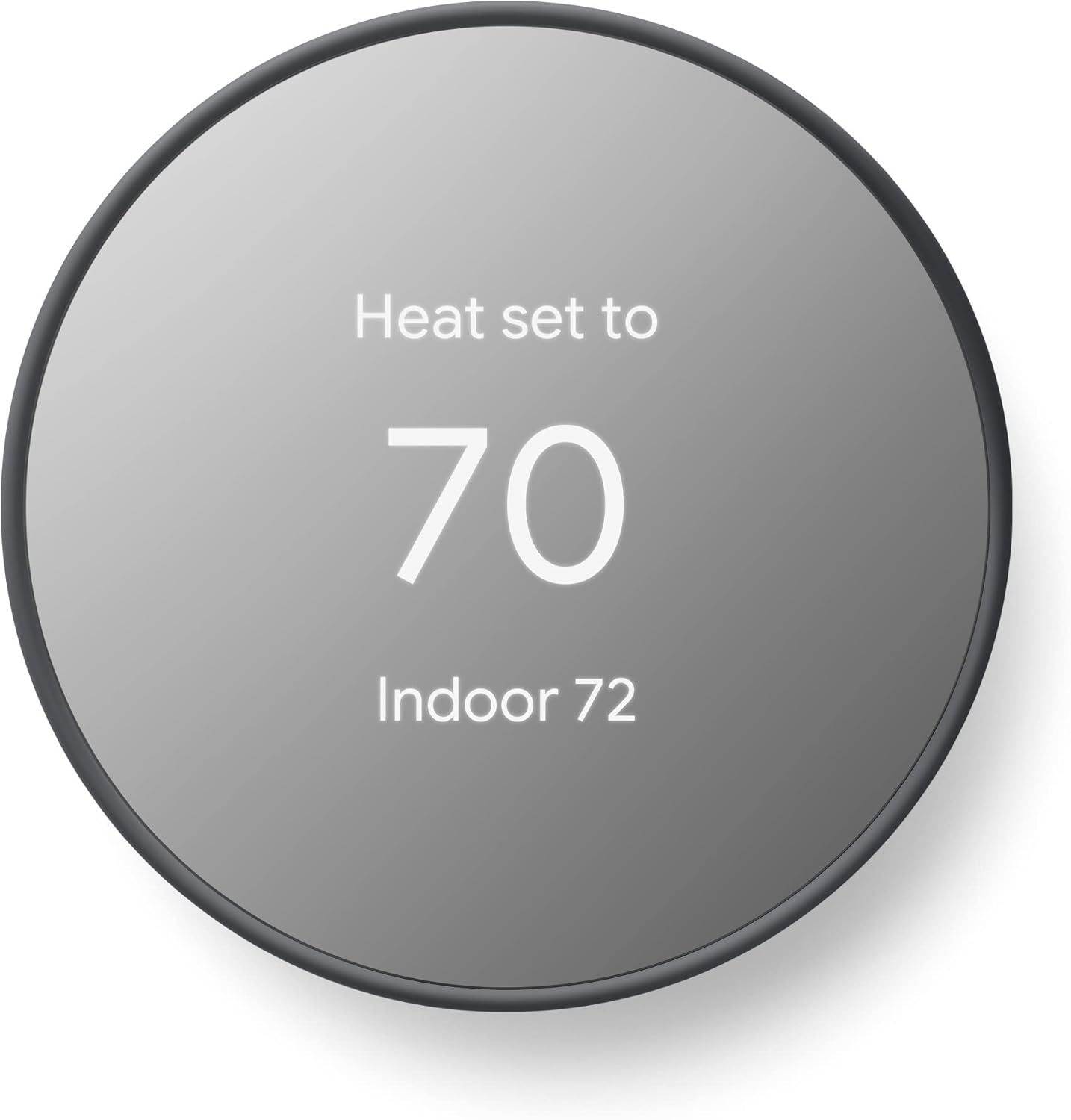
The Google Nest Thermostat is a compact smart thermostat that replaces a standard wall thermostat and lets you control heating and cooling from the Google Home app, compatible voice assistants, or the touch bar on the device. It is typically used to create an energy-efficient schedule, enable remote adjustments while away, and receive simple HVAC alerts that can point out potential issues. Notable features include Wi‑Fi and Bluetooth connectivity, voice control via compatible assistants, Savings Finder suggestions through the app, and battery-powered installation that in many homes works without a C wire. The unit is designed for DIY installation in roughly 30 minutes and ships with mounting hardware and batteries. Limitations to consider are that some HVAC systems still require a C wire or a power accessory, voice and remote features need working internet and compatible devices, and the thermostat provides alerts but not professional diagnostics. For buyers who want straightforward smart control and energy-saving suggestions without a bulky interface, the Nest Thermostat offers an approachable balance of convenience and efficiency.
Best for: Buyers who prioritize easy smart control and energy-saving suggestions backed by broad user adoption and clear product behavior.
Less Ideal for: Homes with uncommon high-voltage or nonstandard HVAC systems that are explicitly incompatible, or buyers who need professional diagnostic tools rather than basic alerts.
- App and voice control for remote temperature changes
- Savings Finder suggests schedule tweaks to reduce energy use
- Compact, DIY-friendly installation with included mounting hardware and batteries
- HVAC monitoring that sends alerts about potential system issues
- May require a C wire or power accessory on some HVAC setups
- Remote and voice features depend on reliable internet and compatible devices
Verdict: Choose the Nest Thermostat if you want an affordable, user-friendly smart thermostat that makes remote control and energy-saving suggestions simple.
Choosing the Right Air Conditioner Thermostat: Key Factors to Consider
Sensor Accuracy and Placement
Accurate temperature and humidity readings are fundamental because the thermostat uses that data to start and stop the air conditioner. A thermostat with poor sensors or one mounted in a drafty, sunlit, or poorly ventilated spot will cause longer cycles, uneven comfort, and higher energy use.
Consider whether the thermostat offers separate remote sensors or averaging across multiple sensing points. Remote or multi-zone sensing helps when your living space has hot or cool spots. Also check the thermostat's stated accuracy range and whether it reports humidity, which matters if you live in humid climates or want to avoid overcooling.
Compatibility and Wiring
Thermostats must match your air conditioner control wiring and the control signals your system expects. Many residential air conditioners use standard low-voltage wiring, but system features like heat pumps, 24V systems, or common-wire requirements differ. Mismatched wiring can lead to nonfunctional controls or require adapters.
Confirm the thermostat supports the control type in your home and whether a common wire is necessary for power. Some modern thermostats need a C wire or a power adapter. If your setup is unconventional, verify documented compatibility or plan for a simple wiring upgrade.
Smart Features and Ecosystem Fit
Connectivity options shape how you interact with the thermostat and the level of automation available. Wi-Fi, Bluetooth, or proprietary hubs each offer different convenience and integration possibilities. Native integration with voice assistants, home automation platforms, or energy management services can simplify scheduling and create energy-saving routines.
Think about whether you want remote temperature control, geo-fencing, or learning schedules. Also consider data privacy and whether the thermostat stores usage data in the cloud. The best choice balances features you will actually use against the complexity of managing another connected device.
Scheduling, Learning, and Automation
A thermostat's scheduling and automation capabilities directly influence comfort and savings. Simple manual schedules let you set fixed temperature changes by time, while adaptive or learning thermostats attempt to infer routines to reduce manual input. Automation that links with occupancy sensors or geolocation can reduce runtime when no one is home.
Decide whether you prefer explicit schedules you control or adaptive systems that optimize over time. Adaptive systems can save energy but may require an adjustment period. Check how easily schedules can be edited and whether temporary hold modes or vacation settings are available.
User Interface and App Experience
The physical interface and companion app determine how easily you change temperatures, view historical usage, and tweak schedules. A clear, responsive touchscreen or straightforward buttons make daily adjustments painless. A capable app should present history data, alert on abnormal conditions, and allow firmware updates.
Prioritize interfaces that match your comfort with technology. If multiple household members will adjust settings, look for simple local controls and optional app locks. Reliable app performance and timely firmware support are signs of a mature product.
Energy Reporting and Maintenance Alerts
Energy reporting helps you understand how thermostat settings affect cooling consumption. Useful reports break down runtime, estimated energy use, and identify unusual patterns that may indicate system problems. Maintenance alerts, like filter change reminders or diagnostic warnings, help protect the air conditioner and maintain efficiency.
If you track energy or care about long-term operating costs, choose a thermostat that provides clear, actionable reports and supports basic maintenance alerts. Those features can prevent preventable waste and extend system life.
Wiring Basics for Residential Air Conditioners
Most residential air conditioners use a standard set of low-voltage control wires that connect to a thermostat. Common terminals control power, compressor call, fan, and accessory stages. Before buying, identify the labels on the wires at your current thermostat and compare them with the thermostat installation documentation.
If your thermostat location lacks a C wire, some thermostats can operate on battery power or include power-extender kits. However, those are workarounds and may not support every advanced feature. When in doubt, consult an electrician or HVAC technician for a brief compatibility check.
- Label and photograph existing wiring before removal.
- Confirm whether you have heat stages or a heat pump; those require different terminal support.
- Consider a pro for multi-stage or zoned systems.
Local Controls Versus Cloud-Dependent Features
Thermostats range from fully local control with basic remote access to deeply cloud-dependent platforms that offload automation to remote servers. Local-first designs continue functioning for basic control even if internet connectivity drops. Cloud-first models may offer richer features but depend on a stable connection for full operation.
Think about how much you rely on remote features such as scheduling edits from your phone or integrations with other home systems. If internet outages are a concern, prioritize devices that maintain manual operation and store simple schedules locally.
- Local control ensures basic operation without internet.
- Cloud features enable advanced analytics and voice integration.
- Check the device behavior when disconnected from the internet.
How Sensor Placement Impacts Comfort
Mounting a thermostat near windows, vents, or in direct sunlight can skew readings and cause overcooling or short cycling. Place the thermostat on an interior wall, about chest height, away from heat sources and direct sunlight. If your home has temperature variance, consider models that support remote or wireless temperature sensors.
Remote sensors can be useful for upstairs rooms, long hallways, or rooms with different occupancy patterns. They allow the thermostat to average temperatures or focus control on the most critical area, improving perceived comfort without overworking the system.
- Avoid mounting above heat-producing appliances.
- Use remote sensors for hot or cool spots.
- Place sensors in representative living areas, not utility closets.
Privacy and Data Considerations
Connected thermostats collect usage data that may include occupancy patterns and temperature history. Review the privacy policy and data retention practices when you pick a connected model. Some products offer local data storage or opt-outs for analytics while others require cloud accounts for basic functionality.
If you prefer minimal data sharing, choose thermostats with local control modes or those that clearly document what data is sent and how it is used. Also check whether firmware updates can be applied manually or automatically and how those updates are handled.
- Check whether an account is required to unlock full features.
- Look for transparent data policies and opt-out options.
- Prefer local control if privacy is a top priority.
Maintenance Tips to Keep Your Thermostat Accurate
Keep the thermostat clean and free of dust that can affect sensors and airflow. Replace batteries promptly if the device uses them, and check for firmware updates that address bugs or improve sensor calibration. Periodically verify temperature readings with a secondary thermometer to confirm ongoing accuracy.
For long-term accuracy, avoid placing decorative covers that block airflow and obstruct sensor function. If your thermostat supports recalibration, perform it following the manufacturer instructions after installation or if you notice consistent temperature offsets.
- Clean the thermostat face and vents gently with a dry cloth.
- Replace batteries annually if used.
- Check firmware updates and install critical fixes.
How We Chose the Best Air Conditioner Thermostat
We applied practical, appliance-focused filters to identify thermostats that reliably control air conditioners in real-world homes. Our evaluation prioritized temperature and humidity sensing accuracy because precise feedback is the core function that determines comfort and cycle length. We also examined connectivity options and smart features, including mobile control and scheduling, since remote access and automation directly affect usability and energy savings. Installation complexity and compatibility with common HVAC wiring configurations were reviewed to ensure a straightforward fit for most systems. We checked user-facing controls and interface clarity because intuitive operation reduces mistakes that drive excessive runtime. Finally, build quality and firmware update practices were considered for long-term reliability. We excluded devices intended solely for commercial HVAC systems or multi-zone controllers that require professional commissioning. We also left out simple non-programmable models that lack modern connectivity. The final shortlist reflects thermostats that balance accurate sensing, sensible smart features, clear user interfaces, and installation practicality for typical residential air conditioner systems.
Our full evaluation process is outlined in our review methodology.
FAQ
Do I need a C wire to install a modern air conditioner thermostat?
Often a common wire is required for many modern thermostats to provide consistent power. Some models work on batteries or include power extenders, but those may limit advanced features. Confirm your current wiring and the thermostat's power requirements before purchase.
Can a smart thermostat save cooling energy on its own?
Smart features like scheduling and geo-fencing can reduce runtime by avoiding unnecessary cooling, but savings depend on usage patterns and correct configuration. Learning features may optimize over time, but manual schedule setup often yields predictable savings sooner.
Will a new thermostat improve uneven cooling in my home?
A thermostat with remote sensors or multi-sensor averaging can help address uneven temperatures by focusing control where it matters. However, persistent imbalance due to ducting or insulation issues will require HVAC or home improvements to fully correct.
How accurate are thermostat temperature readings?
Accuracy varies by device but most quality thermostats provide readings within a narrow tolerance range. Sensor placement and calibration also affect real-world accuracy, so placement and occasional verification with a thermometer are important.
What happens if my internet goes out with a connected thermostat?
Many thermostats retain basic local control and schedules even when disconnected, but cloud-dependent features and remote access will be unavailable until connectivity returns. Check the device behavior in its documentation if offline operation is important.
Final Verdict
Choosing the right air conditioner thermostat comes down to balancing accurate sensing, compatibility with your wiring, and the level of smart features you will actually use. Prioritize sensor accuracy and proper placement first, then confirm the wiring and installation requirements. If you plan to use remote controls or automation, pick a thermostat with reliable connectivity and a clear privacy policy. Tradeoffs are inevitable: simpler models reduce complexity but limit automation, while feature-rich devices require a stable power source and possibly a C wire. Focus on the criteria that affect day-to-day comfort and long-term operating cost to pick a thermostat you will be happy with.