
Note: This article contains affiliate links. If you click on these links and make a purchase, we may earn a small commission at no extra cost to you. This helps support our research and content. Read our full affiliate disclosure here.
If you or someone in your household reacts to cleaning products, paint fumes, or everyday off-gassing, choosing the right air purifier makes a measurable difference in comfort. An air purifier for chemical sensitivity targets volatile organic compounds, odors, and fine particles that can trigger headaches, throat irritation, or breathing discomfort. This guide distills the top shortlisted units across real-world factors such as VOC filtration, airflow for living spaces, and low-noise operation. Below you will find the seven top-rated air purifiers selected for chemical-sensitivity concerns, plus clear guidance on what matters when selecting one for your home. Use the evaluation criteria to match a unit to your room size and sensitivity level before reviewing product details.
Top Picks at a Glance
| Best Overall The best all-around choice for most situations | Coway Mighty AP-1512HH |  |
| Best Quality Built to a higher standard if you want something more solid | Airpura C700 DLX |  |
| Best Value The sweet spot between price and what you get | SIESEAN AP-400 Air Purifier |  |
| Best Budget The cheapest option that still gets the job done reliably | VOOPNU HEPA Air Purifier DH-JH12 |  |
| Top Rated A top-rated pick with lots of positive feedback | ECOSELF HAP603 Air Purifier |  |
| Most Popular A crowd favorite that many people choose with confidence | Levoit Core 300-P |  |
| Best Seller A high-volume bestseller chosen again and again | Levoit Vital 200S-P Air Purifier |  |
Coway Mighty AP-1512HH

| Coverage | Up to 1,748 sq. ft. in 60 minutes |
|---|---|
| HEPA efficiency | 99.97% of 0.3μm particles |
| Filtration stages | Pre-filter, Deodorization (Activated Carbon), Bipolar Ionizer, HEPA |
| Indicators | Air quality LED and filter change indicator |
The Coway Mighty AP-1512HH is a room air purifier built around a four-stage system: a washable pre-filter, deodorization (activated carbon) stage, bipolar ionizer, and a true HEPA filter that captures 99.97% of 0.3 micron particles. It is intended for continuous use in living rooms, bedrooms, or home offices and can cycle the air in spaces up to about 1,748 sq ft within an hour under ideal conditions. The unit includes an air quality sensor with a colored LED indicator and an Auto mode that adjusts fan speed to maintain cleaner air while an Eco mode helps reduce energy use when air is already clean. Practical benefits for chemically sensitive users include the activated carbon stage and tested VOC and formaldehyde reduction claims, plus filter-change alerts and a washable pre-filter that lowers maintenance cost. Limitations are that lab removal rates are context dependent and full VOC removal will vary with pollutant type and room conditions, and the ionizer is an active element some users with severe sensitivities may prefer to disable.
Best for: Buyers who want a proven HEPA purifier with activated carbon and automated controls to reduce allergens, smoke, and many indoor VOCs while minimizing ongoing maintenance effort.
Less Ideal for: People who require guaranteed complete elimination of specific chemicals in all conditions or who avoid any air cleaners with ionization features should consider alternative models or professional ventilation solutions.
- True HEPA filtration capturing 99.97% of 0.3 μm particles
- Activated carbon deodorization stage targeted at VOCs, odors, and gases
- Real-time air quality sensor with Auto and Eco modes for hands-free adjustment
- Washable pre-filter and filter change indicator simplify upkeep
- Lab-tested removal rates for VOCs and gases depend on chamber conditions and may not match home performance
- Includes a bipolar ionizer that some sensitive users may prefer turned off
Verdict: Choose the Coway Mighty AP-1512HH if you want automated HEPA plus activated carbon filtration and real-time air-quality tuning for better indoor air against common allergens and many VOCs.
Airpura C700 DLX

| HEPA efficiency | 99.97% at 0.3 microns |
|---|---|
| Carbon filter | 26-pound carbon filter |
| Airflow | 635 CFM |
| Coverage | Up to 2,000 sq. ft. |
The Airpura C700 DLX is a heavy-duty air purifier built for removing airborne chemicals and fine particles in large rooms. It combines a 26-pound carbon filter for adsorbing a wide range of toxic chemicals with a true HEPA barrier that captures 99.97% of particles down to 0.3 microns, and 360 degree airflow that the manufacturer says can cover up to 2,000 sq ft with multiple air exchanges. Typical use is continuous whole-room filtration in homes or small commercial spaces where VOCs, chemical odors, or wildfire smoke are a concern. The unit emphasizes high airflow (reported 635 CFM) and increased exchange rates, which shortens the time to reduce pollutant concentration. Practical benefits include robust chemical adsorption and thorough particle removal for people with chemical sensitivity or poor outdoor air quality. Trade-offs are the unit size and weight compared with consumer-grade purifiers and the implied need to replace large carbon and HEPA consumables, which can be heavier and more costly than smaller units.
Best for: Buyers who prioritize maximum chemical and particle removal in whole rooms and need a robust, high-flow purifier for serious indoor air quality concerns.
Less Ideal for: People seeking a compact, lightweight or budget purifier for small rooms or occasional use should consider smaller consumer models instead.
- Large carbon filter designed specifically to adsorb a wide range of chemicals and VOCs
- True HEPA barrier captures 99.97% of particles down to 0.3 microns
- High airflow (635 CFM) and 360 degree distribution for faster whole-room air exchanges
- Rated coverage up to 2,000 sq ft for continuous room-scale purification
- Physically large and heavy compared with typical home purifiers
- Replacement filters are substantial in size and likely higher cost
Verdict: Choose the Airpura C700 DLX when you need a high-flow, chemical-focused purifier to rapidly reduce VOCs and fine particles across large rooms.
SIESEAN AP-400 Air Purifier
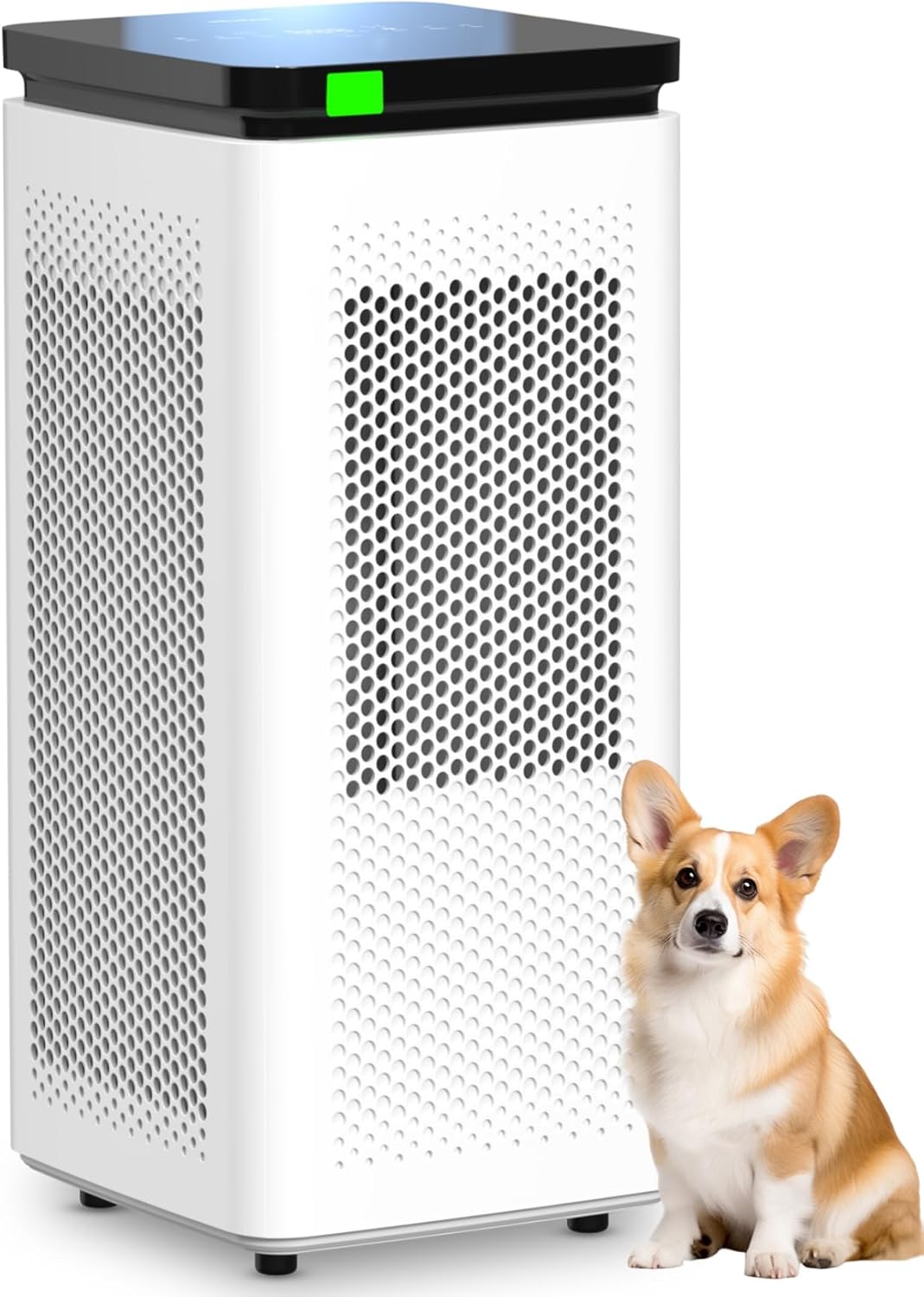
| Filter type | H13 True HEPA + Activated Carbon |
|---|---|
| CADR | 235 CFM |
| Particle retention size | 0.1 micron |
| Coverage | Up to 3500 sq ft |
| Noise (Sleep Mode) | 30 dB |
The SIESEAN AP-400 is a large-room air purifier built around an H13 True HEPA filter and an activated carbon stage to tackle particles and odors, including smoke and VOCs. It uses a 235 CFM CADR and dual-sided airflow to move air quickly—the listing claims it can clean 500 sq ft in about 15 minutes and cover up to 3500 sq ft—so it is intended for living rooms, open plans, basements, and offices. Key conveniences include a PM2.5 air-quality display with auto mode that adjusts fan speed, a 30 dB sleep mode with panel dimmer for nighttime use, and safety features such as child lock and a timer. Independent testing and ENERGY STAR certification indicate attention to performance and energy use, while the built-in filter indicator simplifies maintenance. Limitations to note: carbon capacity for long-term VOC removal depends on filter size and replacement interval, and replacement filters are required every few months for best results, which adds ongoing cost. The unit is relatively tall and designed as a floor model rather than a compact desktop purifier.
Best for: Buyers who prioritize measurable air-quality control and steady VOC reduction in larger living spaces and want an energy-efficient, certified purifier with automatic sensing and quiet night operation.
Less Ideal for: Those needing a compact or portable tabletop purifier for a single small bedroom or travelers who want an ultraportable unit.
- H13 True HEPA plus activated carbon targets particles and common gases/odors.
- 235 CFM CADR with dual-inlet airflow for faster circulation in large rooms.
- PM2.5 air-quality display and auto mode that adjusts fan speed automatically.
- Very quiet sleep mode (around 30 dB) with dimmer for night use.
- ENERGY STAR and independent safety/performance certifications provide validation.
- Long-term VOC removal effectiveness depends on frequency and capacity of carbon filter which requires periodic replacement.
- Floor-standing size is not ideal for small desks or tight spaces.
- Replacement filters are consumables and add ongoing ownership cost.
Verdict: If you need an energy-efficient, independently certified purifier that combines H13 HEPA particle removal with activated carbon and smart sensing for sizable rooms, the AP-400 is a practical choice.
VOOPNU HEPA Air Purifier DH-JH12

| Coverage | Up to 1,076 ft² (per hour claim) |
|---|---|
| Filtration | H13 True HEPA, triple-layer |
| Noise level | Down to 22 dB |
| Speeds | 3 fan speeds |
| Model | DH-JH12 |
The VOOPNU DH-JH12 is a small, straightforward room air purifier that uses an H13 true HEPA triple-layer filter and 360° intake to remove particles like pollen, pet hair, and smoke. It is intended for continuous use in bedrooms, home offices, or living areas and is laboratory-tested to clean roughly 250 ft² every 15 minutes. Controls are simple, with three fan speeds and a timer so the unit is easy to set and forget, and the built-in aroma tray lets you add a few drops of essential oil for scent. The purifier runs very quietly down to around 22 dB, which helps at night, and the product carries several certifications including ETL and CARB. Important limitations are that particle filtration does not guarantee removal of all chemical vapors or gases, and activated carbon capacity (for odor and VOC reduction) is not quantified in the listing, so heavy chemical sources may need a larger dedicated carbon filter or continuous high-speed operation. Filter replacement intervals are quoted generally rather than specifically for VOCs, so expect ongoing maintenance for best performance.
Best for: Practical buyers looking for an affordable, low-noise HEPA purifier for bedrooms or living areas who prioritize easy setup and quiet continuous operation.
Less Ideal for: People dealing with strong chemical odors or high VOC exposure who need a purifier with a documented, heavy-duty activated carbon stage or commercial-strength adsorption capacity.
- H13 true HEPA filtration captures 99.97% of airborne particles down to typical HEPA standards.
- 360° surround intake and lab-tested CADR-style claim for rapid cleaning of small to medium rooms.
- Very quiet operation at low speed suitable for bedrooms and night use.
- Simple controls and timer make it easy for continuous or scheduled use.
- Essential oil tray provides optional scenting without added accessories.
- Listing does not specify active carbon/VOC adsorption capacity or dedicated carbon filter performance for chemical removal.
- Compact form factor limits airflow and adsorption capacity compared with larger models for major chemical sources.
- Filter replacement cadence is given in ranges rather than clear monthly hours or VOC-specific guidance.
Verdict: If you need a budget-friendly, whisper-quiet HEPA purifier for bedrooms or small living spaces, this VOOPNU unit delivers strong particle filtration and simple, reliable operation.
ECOSELF HAP603 Air Purifier

| Item model number | HAP-603 |
|---|---|
| Coverage | Up to 2400 ft² |
| Noise level | 22 dB Sleep Mode |
| Filter efficiency | H13 True HEPA (99.97%) |
The ECOSELF HAP603 is designed to clean large living spaces by pulling air through a multi-stage filtration system and reporting PM2.5 levels on a front display. It is typically placed in a central room or bedroom and run continuously or on auto so the infrared sensor can adjust fan speed as air quality changes. Notable features include a True HEPA H13-grade filter that captures fine particles, a 2X power circulation claim for up to 2400 ft², a quiet 22 dB sleep mode, and an aromatherapy tray for mild scenting. Practical benefits include effective removal of smoke, dust, and pet dander, hands-off operation via smart auto mode, and low-noise overnight use. Important limitations are that VOC and gas removal depends on the filter media and the product emphasizes particulate filtration rather than specific activated carbon capacity for chemicals, and the manufacturer recommends using official replacement filters for best performance which adds ongoing cost.
Best for: Buyers who prioritize consistent, low-noise particulate removal and an automated air-quality response for large rooms and who value a purifier that runs reliably with clear status feedback.
Less Ideal for: People whose primary concern is removing strong volatile organic compounds or chemical odors should consider a unit explicitly specified for high-capacity activated carbon adsorption instead.
- H13 True HEPA filtration for 99.97% particulate capture
- Real-time PM2.5 display and infrared sensor for automatic fan adjustments
- Very quiet 22 dB sleep mode suitable for night use
- Coverage claim up to 2400 ft² with boosted circulation design
- Filter indicator and lock controls simplify routine upkeep
- Manufacturer messaging focuses on particle removal and gives limited detail about activated carbon capacity for VOCs
- Aromatherapy option may reintroduce scents that bother highly chemically sensitive users
Verdict: Choose the HAP603 when you need a quiet, automated HEPA purifier that reliably controls fine particles across large rooms.
Levoit Core 300-P

| Filter Type | 3 in 1 Filtration |
|---|---|
| Floor Area | 1073 square_feet |
| Noise Level | 24 db |
| Particle Retention Size | 0.3 micron |
| Wattage | 56 watts |
The Levoit Core 300-P is a small, plug-in air purifier built around a three-stage filtration system that includes a pre-filter, HEPA-grade filter and activated carbon layer to tackle particles and common household odors. It is intended for bedrooms, living rooms, or offices and uses a 56W motor with a CADR suitable for refreshing a 222 ft² room multiple times per hour and larger spaces less frequently. Notable features include AHAM verification, CARB and ETL certifications, a near-silent Sleep Mode at about 24 dB, a touch control panel, timer settings, and a filter-check indicator. In practice it offers strong particle capture down to 0.3 micron and useful VOC/odor adsorption from the carbon stage, making it practical for allergy relief, smoke cleanup, and routine odor reduction. Limitations include no smart/auto mode on this variant and reliance on genuine replacement filters for rated performance, and while it helps reduce VOCs and odors it is not a substitute for removing chemical sources or for high-performance specialty gas-phase filtration used in severe chemical sensitivity cases.
Best for: Buyers who prioritize independently verified particle removal, quiet night operation, and proven user satisfaction when choosing a compact purifier for bedrooms or common rooms.
Less Ideal for: People with severe chemical sensitivity who need high-capacity gas-phase adsorption or professional-grade VOC removal should consider specialized purifiers with advanced carbon or catalytic filters instead.
- True HEPA-grade filtration capturing 99.97% of 0.1–0.3 μm particles as tested by an independent lab
- Activated carbon layer for basic VOC and odor reduction
- AHAM verified CADR with certified safety listings (CARB, ETL)
- Very quiet Sleep Mode around 24 dB suitable for bedroom use
- Compact, portable design with touch controls and timer settings
- No smart connectivity or automatic air-quality sensing on this model
- Carbon stage is basic and may be insufficient for heavy or continuous chemical exposures
- Requires official replacement filters to maintain published performance
Verdict: A compact, AHAM-verified HEPA purifier that delivers quiet, reliable particle removal and basic odor reduction for anyone seeking a proven, low-noise bedroom or living-room option.
Levoit Vital 200S-P Air Purifier

| Floor Area | 1875 square_feet |
|---|---|
| Filter Type | 3-Stage Filter |
| Noise Level | 27 db |
| Particle Retention Size | 0.1 micrometer |
| Wattage | 51 |
The Levoit Vital 200S-P is a smart air purifier built for whole-room cleaning in large spaces. It uses a three-stage filtration system (pre-filter, activated carbon, and high-efficiency filter) and an additional U-shaped air inlet to capture pet hair, dust, smoke, and common allergens, while AHAM-verified CADR figures show strong smoke, dust, and pollen performance. You can control it with onboard buttons or the app, and it reports air quality while running quietly in sleep mode at around 27 dB. Practical benefits include washable pre-filter media to extend filter life and selectable replacement filters tailored for pets, smoke, or VOCs, which helps target chemical sensitivity concerns when using the toxin absorber or smoke-remover options. The unit is corded and consumes moderate power. Trade-offs are its physical footprint for table or floor placement and the need to buy specialized replacement filters for optimal VOC removal; it does not include claims of medical-grade gas-phase filtration out of the box.
Best for: Buyers who prioritize proven, independently tested air cleaning for allergies and common indoor pollutants and who want the reassurance of app control and selectable filters to tune performance.
Less Ideal for: People needing a compact purifier for a tiny bedroom or buyers who require certified medical-grade gas-phase VOC removal without buying extra filters.
- AHAM-verified CADR for smoke, dust, and pollen indicates reliable whole-room cleaning performance
- Three-stage filtration with washable pre-filter reduces maintenance cost
- App and button controls plus onboard air quality monitoring make operation and monitoring convenient
- Selectable replacement filters (toxin absorber, smoke remover, pet allergy) let you target specific contaminants
- No factory-specified medical-grade gas-phase or activated carbon capacity listed for long-duration VOC adsorption
- Relatively large footprint may not suit very small rooms or crowded surfaces
- Effective VOC removal requires purchasing the specialized toxin-absorber filter separately
Verdict: For risk-averse buyers with chemical sensitivity concerns, the Vital 200S-P pairs AHAM-verified whole-room filtration with optional toxin-absorber filters to give a configurable, trusted solution.
Choosing the Right Air Purifier for Chemical Sensitivity: Key Factors to Consider
VOC and Gas Adsorption Capability
People with chemical sensitivity are often most affected by volatile organic compounds from paints, solvents, new furniture, and cleaning products. A dedicated adsorption stage using activated carbon, impregnated carbon, or other sorbents is essential. The quantity of adsorbent, surface area, and whether the media is treated for specific contaminants alters real-world performance.
Adsorption matters because HEPA alone does not remove gases. Look for detailed manufacturer data on the type and weight of carbon or adsorbent used, any treatments for formaldehyde or other targeted gases, and guidance on how quickly the media saturates under typical household conditions. Units designed for chemical sensitivity prioritize larger or replaceable gas-phase cartridges over minimal or cosmetic carbon layers.
Particle Filtration Efficiency
Although gases cause many symptoms, particles like dust and allergens can exacerbate respiratory irritation. A true HEPA-stage captures 99.97% of particles down to 0.3 microns and will reduce the combined load on the respiratory system. For homes with both chemical and dust triggers, combined gas-plus-HEPA systems provide broader protection.
Assess the HEPA type and whether prefilters are included to trap larger particles and extend the life of the HEPA and adsorption media. Maintenance intervals for HEPA and prefilters will affect long-term performance and cost, so consider how often you must replace or clean these components.
Appropriate Airflow and Room Coverage
Clean Air Delivery Rate and recommended room size determine whether an air purifier can effectively lower contaminant concentration in the spaces where you spend time. A unit with inadequate airflow will struggle to reduce VOC levels quickly, leaving occupants exposed longer.
Match the CADR or manufacturer-quoted coverage to the square footage of the room where the unit will run. For open-plan living areas, choose a higher-capacity unit or use multiple units placed strategically. Consider how furniture placement and open doors affect airflow patterns and contaminant dilution.
Low-Noise Operation and Run Modes
People with chemical sensitivity can be more sensitive to environmental stressors, including noise. An effective unit should deliver good filtration at low or medium fan speeds where noise is acceptable for sleeping or working. Look for measured decibel levels at different fan settings and whether the purifier offers a 'quiet' or 'night' mode that reduces fan speed without disabling gas adsorption.
Variable-speed controls and programmable schedules help maintain steady indoor air quality while keeping noise tolerable. Units with overly loud motors at the speeds required for meaningful CADR are less practical for bedrooms or home offices.
Filter Life, Replacement Ease, and Ongoing Costs
Operational cost and maintenance influence whether a purifier is used consistently. Adsorbent media and HEPA filters have different lifespans depending on pollutant load. A unit that requires frequent, costly replacements may sit unused, negating benefits for sensitive occupants.
Prioritize models with clear replacement intervals, easy-to-replace cartridges, and widely available filter options. Consider whether prefilters are washable to reduce waste and whether the manufacturer provides indicators for end-of-life or remaining filter capacity.
Control, Sensing, and Automation
Automatic operation based on accurate sensors can sustain healthier indoor air without constant manual adjustments. Look for reliable VOC sensors, formaldehyde sensors, or combined gas/particle sensing that adjust fan speed responsively. However, sensor placement and calibration quality vary, so rely on units that allow manual override and fixed-speed presets.
Automation is most useful if it keeps pollutant concentrations down during activities that spike emissions, such as cleaning or cooking. Evaluate whether the purifier has scheduling, smart-home integration, or mobile app controls if that matters for consistent use.
How Air Purifiers Reduce Chemical Irritants
Air purifiers address chemical sensitivity through two main mechanisms: gas-phase adsorption and particulate filtration. Adsorption captures volatile molecules on porous media like activated carbon, while HEPA filters remove particles that can carry adsorbed chemicals or aggravate the respiratory system. Effective systems use both approaches in sequence so gases are trapped before particles accumulate on downstream filters.
The real-world effectiveness depends on the adsorbent type, amount, and the unit's airflow. High airflow improves room turnover but can reduce contact time with the adsorbent. Manufacturers balance these variables by using larger carbon beds, treated sorbents, or dedicated slow-pass cartridges for better VOC capture without sacrificing coverage.
- Adsorbent mass and surface area determine gas removal capacity.
- HEPA filtration reduces particle-bound irritants and protects the adsorbent from premature fouling.
- Airflow and contact time together influence how quickly VOCs are reduced.
Sizing and Placement for Best Results
Correctly sizing and placing the purifier matters as much as the unit's specs. For bedrooms, choose a model with CADR appropriate for the room square footage and place it where airflow is unobstructed. Avoid corners and blockages that reduce effective circulation.
For open-plan living areas, you may need a higher-capacity unit or two smaller units to create consistent air turnover. Position units away from heat sources and keep doors closed where possible during treatment periods to prevent continual influx of new contaminants.
- Match CADR to room size and aim for several air changes per hour for faster reduction.
- Place units centrally in the space or along common circulation paths for even distribution.
- Run continuously at low speed for maintenance and increase speed during known emission events.
Maintenance Routines That Keep Adsorbents Effective
Adsorption media can saturate over time and lose effectiveness. Regular filter replacement based on manufacturer guidance or usage patterns is essential, especially if your home has frequent chemical sources. Some units use modular cartridges that make swapping simple, while others require full filter changes.
A basic maintenance routine includes checking prefilters monthly, replacing HEPA filters on schedule, and monitoring or replacing carbon cartridges more frequently in high-emission homes. Logging replacement dates helps you avoid running on exhausted media and ensures consistent protection.
- Inspect prefilters every 2 to 4 weeks and clean or replace as needed.
- Track HEPA and carbon replacement dates to prevent saturation.
- Consider spare filter purchases if lead times for replacements are long.
When to Use Portable Purifiers Versus Whole-Room Solutions
Portable purifiers are often the most practical choice for managing chemical sensitivity because they can be moved to bedrooms, home offices, or areas where emissions occur. They are typically less expensive and faster to deploy when a problem arises. Whole-house systems integrated into HVAC can provide continuous coverage but require professional installation and appropriate gas-phase media sizing to be effective.
For most households focused on immediate symptom relief, high-quality portable units placed where occupants spend the most time deliver the best combination of coverage and flexibility. Consider your lifestyle, floor plan, and whether you need continuous whole-house treatment when deciding between approaches.
- Portable units offer flexibility and targeted treatment for problem rooms.
- Whole-house solutions can be effective but need correctly sized gas-phase media and professional setup.
- Use portable units to supplement any existing HVAC filtration during high-emission activities.
Interpreting Sensor Readings and Manufacturer Claims
Sensor readouts for VOCs and particulate matter can guide operation but are not always directly comparable between models. Different sensors have different detection ranges and thresholds. Use sensor trends rather than absolute numbers to decide when to increase fan speed or replace filters.
Manufacturers sometimes quote laboratory removal rates or ideal-room performance. Real-world homes have variable sources and airflow patterns, so expect slower reduction times than lab figures. Prioritize specifications like adsorbent mass and CADR over headline removal percentages.
- Treat sensor trends as operational cues more than definitive measurements.
- Look for transparent specs on adsorbent quantity and CADR for realistic expectations.
- Consider third-party test data where available to validate claims.
How We Chose the Best Air Purifier for Chemical Sensitivity
We prioritized units that demonstrably reduce common indoor chemical irritants while remaining practical for daily home use. Key evaluation criteria included measured VOC and gas adsorption performance, particle filtration down to the submicron range, airflow capacity relative to room size, and operational noise at typical fan speeds. We also weighed filter longevity and availability, energy efficiency for continuous use, and controls that allow reliable low-speed or automated operation. Products were excluded if they lacked a dedicated gas-phase adsorption stage, had insufficient airflow for typical bedrooms and living rooms, or if long-term filter replacement data was unavailable. We focused on technologies and configurations that balance VOC reduction with particulate removal, favor low standby power for continuous running, and provide clear replacement intervals. The final list reflects units that meet those technical thresholds across the most relevant home scenarios for chemical sensitivity.
Our full evaluation process is outlined in our review methodology.
FAQ
Can an air purifier remove all chemical odors and VOCs?
No single purifier removes every chemical or odor completely. Effectiveness depends on the type and concentration of the chemical, the adsorbent used, and the unit's airflow. Long-chain or low-concentration compounds may persist even with strong adsorption, so reducing sources and improving ventilation remain important.
How often should I replace carbon or gas-phase filters?
Replacement frequency depends on pollutant load and filter size. In typical homes with occasional emissions, carbon cartridges may need replacement every 6 to 12 months. In higher-exposure environments, expect shorter intervals. Follow manufacturer guidance and replace earlier if odors or symptoms return.
Are HEPA filters necessary if I only have chemical sensitivity?
HEPA filters do not remove gases but are advisable because particles can carry or concentrate irritants and can worsen respiratory symptoms. A combined system that includes both HEPA and gas-phase adsorption offers broader protection for most chemically sensitive households.
Do VOC sensors on purifiers reliably indicate chemical levels?
VOC sensors provide useful trend information but vary in accuracy and what compounds they detect. They are best used to track changes in indoor air quality and trigger fan speed adjustments rather than to measure absolute concentrations of specific chemicals.
Is it better to run a purifier continuously or only when I notice symptoms?
Continuous low-speed operation maintains lower background concentrations and reduces the chance of symptom-triggering spikes. Running at higher speeds during specific activities that generate emissions helps reduce peaks more quickly. Continuous operation also prevents rapid saturation of adsorption media under intermittent heavy use.
Final Verdict
Prioritize units that combine substantial gas-phase adsorption with true HEPA particle filtration, sized appropriately for the rooms where symptoms occur. Balance adsorption capacity against airflow and noise so the purifier can run continuously in living spaces and bedrooms. Consider maintenance commitments and choose models with accessible, well-documented filter replacements. The best choice depends on your primary exposure sources and how you use the space. Focus first on adsorbent mass and CADR for the room, then confirm low-noise performance and straightforward maintenance so the unit protects occupants consistently.