
Note: This article contains affiliate links. If you click on these links and make a purchase, we may earn a small commission at no extra cost to you. This helps support our research and content. Read our full affiliate disclosure here.
Small, enclosed closets trap moisture, odors, and airborne particles that damage clothing and stored items. Selecting an appropriately sized air purifier for a closet helps control musty smells, reduce mold spore counts, and limit dust and lint buildup without overpowering the small space. This guide shortlists seven top options designed for closets and other compact storage areas. We evaluate each pick on filtration effectiveness, footprint and noise, and ongoing maintenance needs to help you pick a unit that fits your closet layout and daily habits. Read on to see the features that matter and which models match common closet scenarios.
Top Picks at a Glance
| Best Overall The best all-around choice for most situations | BLUEAIR Blue Pure 511i Max |  |
| Best Quality Built to a higher standard if you want something more solid | Dyson HushJet Compact Purifier |  |
| Best Value The sweet spot between price and what you get | MOOKA B-D02L Air Purifier |  |
| Best Budget The cheapest option that still gets the job done reliably | FULMINARE H13 Air Purifier |  |
| Top Rated A top-rated pick with lots of positive feedback | Levoit Core 200S-P |  |
| Most Popular A crowd favorite that many people choose with confidence | Levoit Core Mini-P |  |
| Best Seller A high-volume bestseller chosen again and again | VOOPNU DH-JH12 Air Purifier |  |
BLUEAIR Blue Pure 511i Max

| Cleans up to | 1,138 sq ft in 1 hour |
|---|---|
| Particle removal | 99.97% down to 0.1 microns |
| Noise level | As low as 19 dB |
| Filtration tech | HEPASilent dual filtration |
The Blue Pure 511i Max is a compact smart air purifier designed to refresh air in bedrooms, small rooms, and apartments. Its HEPASilent dual filtration combines mechanical and electrostatic capture to remove 99.97% of particles down to 0.1 microns, which helps with dust, pollen, pet dander, smoke, and other common indoor pollutants. The unit circulates air quickly for its size — Blueair states it can clean up to 237 sq ft in about 12.5 minutes and larger small spaces up to 1,138 sq ft in an hour — and a 360° intake lets it draw air from tight spots. Built-in sensors and an auto mode adjust fan speeds as air quality changes, and the mobile app provides remote monitoring, scheduling, and filter reminders. It runs quietly, down to about 19 dB on low, making it suitable for sleep or low-noise areas. Trade-offs are typical for a compact purifier: peak airflow and odor removal are limited by the unit's small footprint, and replacement filters are an ongoing cost. For small, enclosed areas where low noise and reliable particle removal matter, it performs well.
Best for: Buyers who want a quiet, compact purifier that reliably removes particles in small rooms, closets, and bedrooms while offering smart monitoring and simple controls.
Less Ideal for: Not a good fit for spaces that need heavy odor removal or whole-home coverage, or for buyers who prioritize the highest possible CADR over compact size.
- HEPASilent filtration captures very small particles down to 0.1 microns
- Fast air exchange for small rooms with 360° intake
- Quiet operation as low as 19 dB suitable for bedrooms or closets near sleeping areas
- Smart sensors and app control for automatic adjustments and scheduling
- Compact Scandinavian design fits in tight spaces
- Limited capacity for large open areas and heavy odors compared with larger models
- Ongoing cost of replacement filters
Verdict: Choose the Blue Pure 511i Max when you need a quiet, compact smart purifier that delivers fast, effective particle removal in small rooms and closets.
Dyson HushJet Compact Purifier

| Filter Type | Electrostatic |
|---|---|
| Filter Class | Electrostatic, Activated Carbon |
| Floor Area | 203 |
| Particle Retention Size | 0.3 micron |
| Noise Level | 42 db |
The Dyson HushJet Compact Purifier is a small-format, high-performance air cleaner that circulates and purifies the air in rooms up to about 203 square feet. It uses a 360° electrostatic filter to capture 99.97% of particles down to 0.3 microns alongside a 360° activated carbon layer for odors and gases, and the unit is fully sealed to avoid re-releasing trapped pollutants. The purifier is designed for quiet operation with a star-shaped nozzle and a Sleep mode that reportedly reaches as low as 24 dB, while Auto mode and onboard sensors continuously monitor indoor air and adjust output to preserve energy and filter life. Control and monitoring are available through the MyDyson app and compatible voice assistants, and the LCD provides real-time air quality and filter-life information. The main trade-offs are its compact size, which limits coverage to single rooms or closets rather than whole-house use, and the premium positioning that may make it more expensive than basic compact purifiers despite long filter life.
Best for: Buyers who prioritize strong particulate and gas removal in small spaces and want a quiet, app-controlled unit that monitors air in real time.
Less Ideal for: People needing to purify multiple rooms or larger open areas where a larger or multiple-unit solution would be more effective.
- High-efficiency 360° electrostatic filter captures 99.97% of particles down to 0.3 microns
- Activated carbon layer reduces cooking, pet odors and certain gases like NO2
- Very quiet operation with Sleep mode reportedly around 24 dB
- Real-time air quality reporting and remote control via MyDyson app and voice assistants
- Sealed design prevents re-release of trapped pollutants
- Coverage limited to roughly 203 sq ft so not suitable for larger areas
- Premium price compared with basic compact purifiers
Verdict: A quiet, compact purifier with high particle and gas capture tailored for single rooms or closets where strong performance and app control matter most.
MOOKA B-D02L Air Purifier
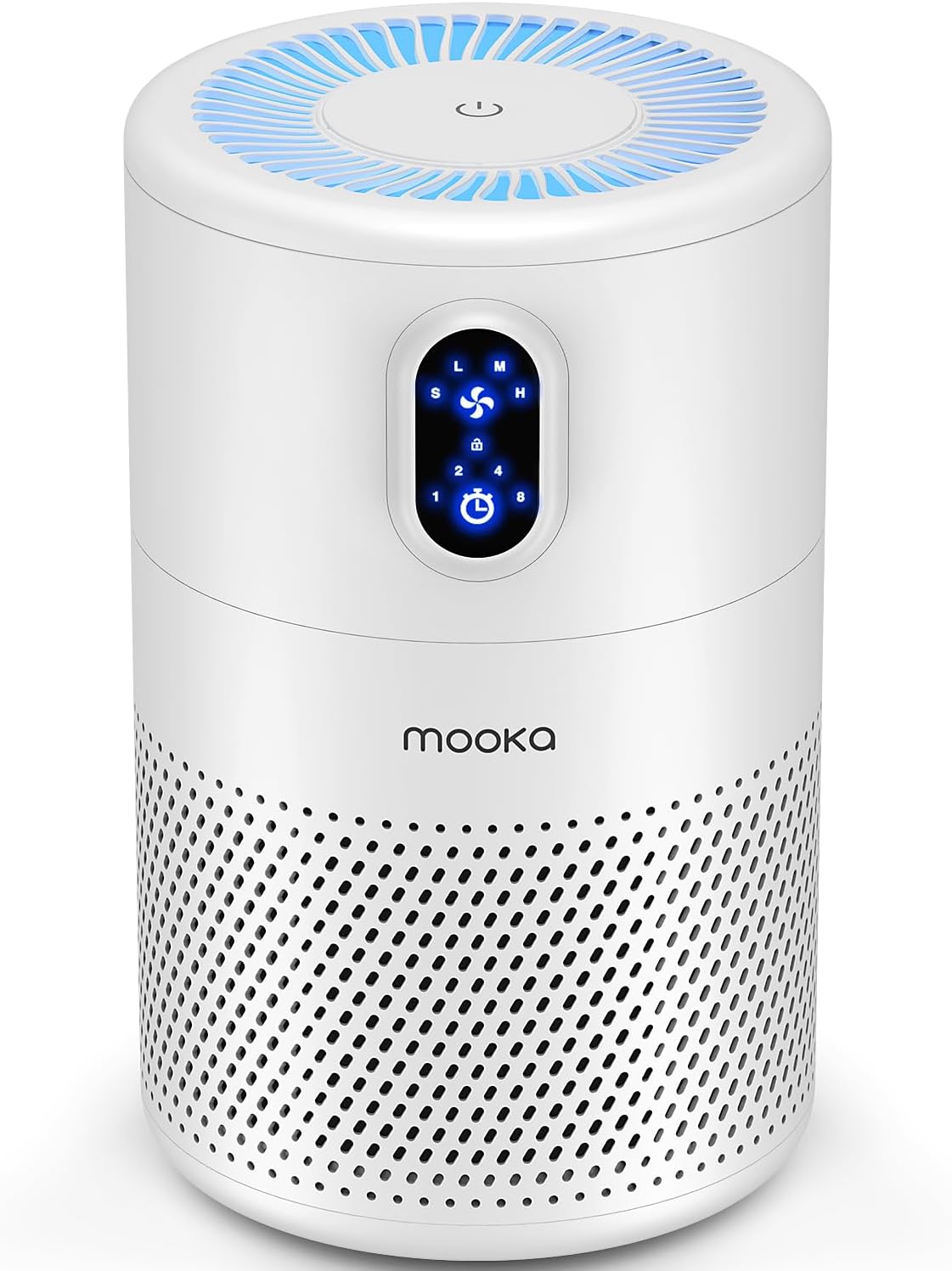
| Effective Area | 1076 sq ft |
|---|---|
| Filter Type | H13 True HEPA + activated carbon + pre-filter |
| Fan Modes | 4 fan speeds (Sleep/Low/Med/High) |
| Timer | 1/2/4/8 hour options |
The MOOKA B-D02L is a compact HEPA air purifier built around an H13 true HEPA filter plus pre-filter and activated carbon, so it captures pet hair, pollen, smoke, and particles down to 0.3 microns while also reducing odors. It is intended for use in bedrooms, closets, living rooms, nurseries, and offices and claims coverage up to 1076 sq ft with varying air-change rates depending on room size. Controls include four fan speeds, a 1/2/4/8 hour timer, a child lock, and a soft night light that can be turned off, and the unit runs quietly thanks to a brushless motor with low-noise sleep settings. The filter is user-replaceable and the manufacturer recommends swapping it every 3 to 6 months depending on use. Practical trade-offs are that the stated coverage is optimistic for sustained high-efficiency cleaning in larger open areas, and replacement filters are an ongoing cost, but for small spaces or point-source cleaning the unit is an energy-efficient, low-noise option.
Best for: Buyers who want a compact, energy-efficient purifier that runs quietly in small rooms, closets, or bedrooms and prioritizes straightforward controls and frequent practical use.
Less Ideal for: People needing whole-house air cleaning or rapid air turnover in large open-plan spaces should consider a higher-capacity unit instead.
- H13 true HEPA plus activated carbon and pre-filter for particle and odor removal
- Claims large nominal coverage with stated air-change rates for smaller rooms
- Multiple timers and four fan speeds for flexible run schedules
- Very quiet operation and low power draw suitable for night use
- Stated 1076 sq ft coverage corresponds to minimal air changes in very large spaces, so results are best in smaller rooms
- Requires periodic replacement filters every 3–6 months which adds to operating cost
Verdict: A quiet, compact HEPA purifier that fits closets and small rooms well for steady, low-energy air cleaning.
FULMINARE H13 Air Purifier

| Filter type | H13 HEPA |
|---|---|
| Recommended room size | 215 sq ft / 20 m² |
| Timer options | 2-4-8-10-12 hours |
The FULMINARE H13 is a compact HEPA air purifier designed for single rooms up to about 215 sq ft and is intended to remove particles like pet hair, smoke and household odors. It uses an H13-grade HEPA filter and a 360-degree outlet with dual-channel airflow to circulate air multiple times per hour, and it offers five timer settings and an independent night light that make it easy to schedule and place in bedrooms or small enclosed spaces. Noise levels are marketed as very low on the sleep setting, making it suitable for light sleepers or overnight use in confined spaces. Practical limits include its coverage area — it is sized for small rooms and closets rather than open-plan living areas — and the filter requires periodic replacement (manufacturer suggests around three months depending on use). The unit is plug-in powered and portable, so it is straightforward to move between a closet, bedroom or office where spot filtration is needed.
Best for: Buyers who need an affordable, portable purifier to control dust, pet dander and odors in small enclosed spaces like closets, bedrooms or home offices and prioritize quiet overnight operation.
Less Ideal for: People seeking whole-home coverage or high airflow for large rooms should look at larger-capacity purifiers with higher CADR ratings instead.
- H13 HEPA filter for high-efficiency particle capture
- 360-degree outlet with dual-channel airflow for steady room circulation
- Very low-noise sleep mode suitable for night use
- Independent night light and multiple timers for flexible placement and scheduling
- Compact, portable plug-in design that is easy to move and install
- Designed for rooms up to about 215 sq ft so not suitable for larger open areas
- Filter replacements are required on a regular schedule and sold separately
Verdict: A budget-friendly, compact HEPA purifier that quietly improves air quality in closets and small rooms.
Levoit Core 200S-P
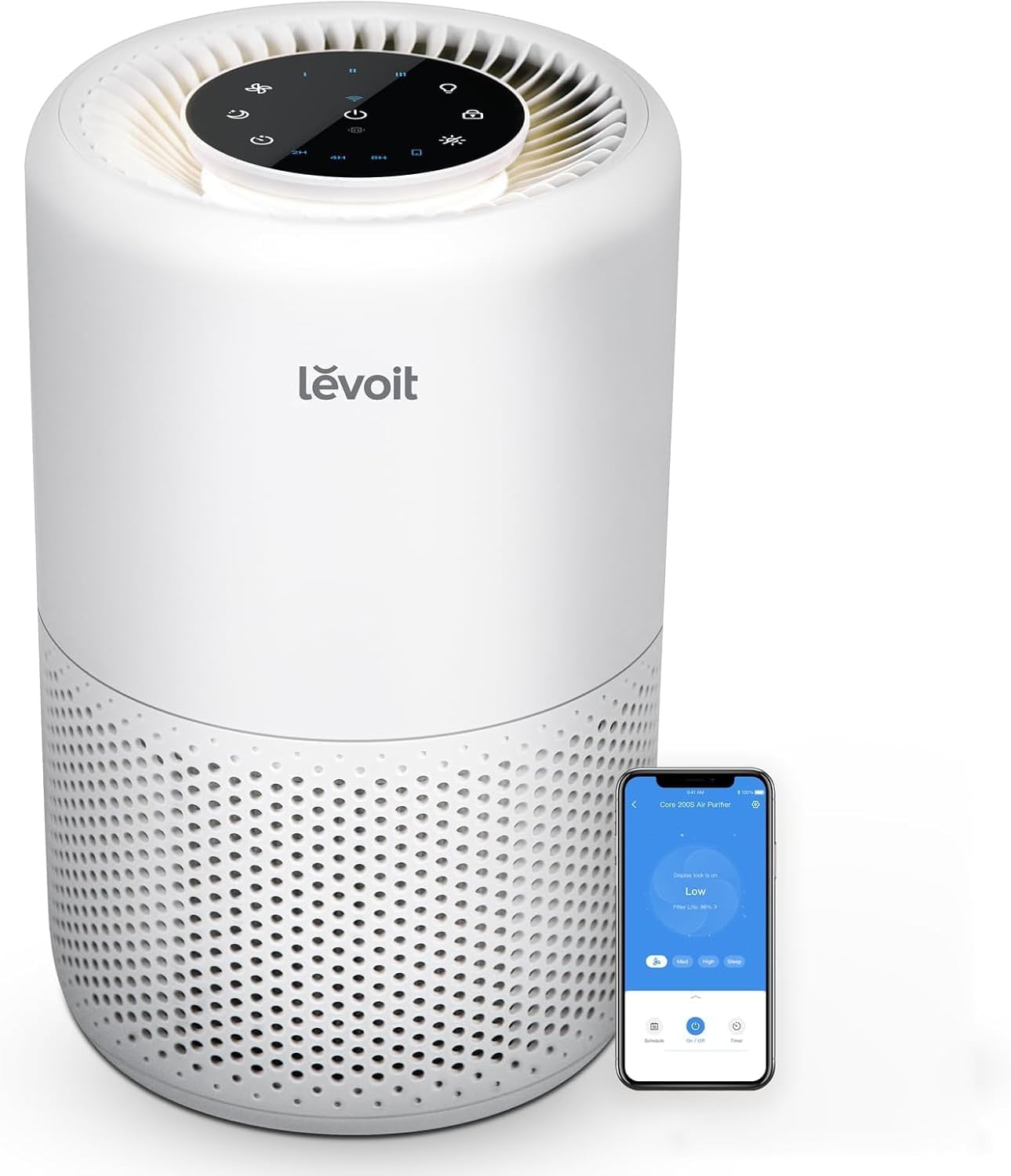
| Room coverage | 140 ft² (4.8 air changes/hour) |
|---|---|
| Filtration | 3-stage (Pre-filter, Activated Carbon, HEPA-grade main filter) |
| Noise level | As low as 27 dB |
| Model | Core 200S |
The Levoit Core 200S-P is a compact smart air purifier built for bedrooms, small apartments, and closets where odor and particle removal matter. It uses a 3-stage filtration stack — pre-filter, activated carbon, and a HEPA-grade main filter — and draws air through 360 degrees to refresh a 140 ft² room multiple times per hour. The unit pairs with an app and supports voice control for convenient scheduling and filter-life monitoring, and it has a sleep mode with noise as low as 27 dB for overnight use. Practical benefits include genuine replacement filters available from the brand, effective removal of dust, pollen, dander and common pet smells, and a small footprint that fits tight spaces. Limitations are typical for small purifiers: it is sized for single small rooms and will not be effective for larger open areas, and higher fan speeds raise noise and energy use. Buyers should plan on periodic filter replacement to maintain AHAM-verified performance.
Best for: Buyers who prioritize dependable, AHAM-verified air cleaning in small, enclosed spaces and want smart controls to monitor filter life and schedule operation.
Less Ideal for: People needing to purify large living rooms, whole-house coverage, or those who want a filterless or maintenance-free solution.
- Three-stage filtration including HEPA-grade main filter for 0.1-0.3 micron particles
- 360-degree air intake for consistent room circulation
- App and voice control with filter-life monitoring for convenient maintenance
- Very quiet sleep mode down to 27 dB suitable for bedrooms or closets
- Designed for small rooms only and cannot effectively clean large open areas
- Requires routine replacement of genuine filters to retain verified performance
Verdict: A compact, AHAM-verified smart purifier that reliably removes pet dander and odors in small closets or bedrooms while giving clear filter-life monitoring.
Levoit Core Mini-P
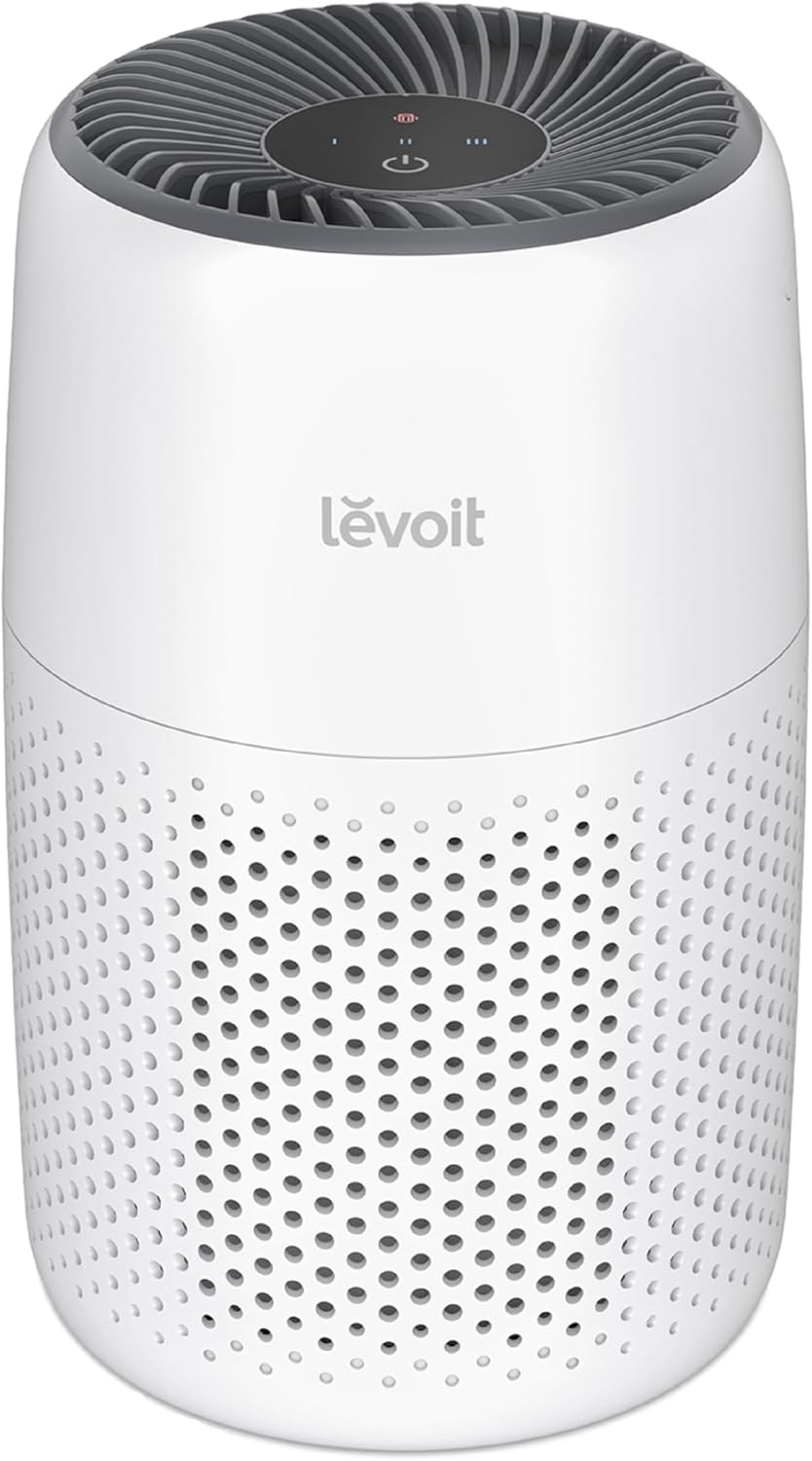
| Rated Power | 7W |
|---|---|
| Noise Level | 27-45dB |
| Adapter Input | 100-240V, 50/60Hz |
| Model | LAP-C161-WUS |
The Levoit Core Mini-P is a small, plug-in air purifier meant for close-range use on a desk, bedside table, or inside a confined space like a closet. It uses a pre-filter plus a main HEPA-style filter to capture lint, hair, fine particles and smoke while an optional fragrance sponge lets you add a light scent. The unit runs quietly—manufacturer noise figures put it between roughly 27 and 45 dB—so it can operate overnight with minimal disturbance and has a sleep mode and auto-off display for low-key use. Power draw is low at 7W and the adapter stores inside the unit for neat placement. Practical limits include coverage area and airflow: this is built for very small rooms or targeted spot cleaning rather than whole-room purification, and the fragrance feature requires careful dosing to avoid damaging plastic. Filters are replaceable but will need periodic replacement depending on use. For tight spaces where quiet, low-power, targeted filtration matters, the Core Mini-P is an effective choice.
Best for: Buyers who want a low-noise, low-power purifier to improve air quality in confined spaces or directly around where they spend time and who value proven performance backed by broad customer adoption.
Less Ideal for: People seeking whole-room or multi-room purification or users who need heavy-duty smoke removal for large areas should choose a larger-capacity purifier instead.
- Compact footprint fits on desks or inside small closets
- Quiet operation with sleep mode suitable for overnight use
- Low power consumption (7W) and integrated adapter storage for tidy placement
- Captures pet dander, dust, smoke and common airborne particles with multi-stage filtration
- Intended for very small spaces so it will not effectively clean larger rooms
- Fragrance sponge must be used sparingly to avoid overflowing or plastic damage
Verdict: Choose the Core Mini-P when you need a quiet, low-power purifier for tight spaces like a closet or desktop where targeted air cleaning matters.
VOOPNU DH-JH12 Air Purifier

| Coverage (per hour) | Up to 1,076 ft² per hour |
|---|---|
| Filtration | H13 True HEPA multi-layer |
| Noise level | As low as 22 dB |
| Speeds | 3 fan speeds |
The VOOPNU DH-JH12 is a small, easy-to-use air purifier built around an H13 true HEPA multi-layer filter and 360 degree intake that the brand says removes 99.97% of airborne particles. It is controlled via a simple panel and runs at three fan speeds plus a timer, making it straightforward to place and leave running in tight spaces such as a closet or small bedroom. Laboratory-style claims state it treats up to 1,076 sq ft per hour (250 sq ft every 15 minutes), and the unit is exceptionally quiet at stated noise levels down to 22 dB on low, which helps for continuous overnight operation. A built-in essential oil tray lets you add fragrance while the purifier runs. Practical limits are the small physical footprint so it is intended for confined areas rather than whole-house use, and filter replacement every few months will be necessary to maintain performance. The unit carries multiple safety and performance certifications that will reassure cautious buyers seeking a reliable, low-complexity purifier for enclosed spaces.
Best for: Buyers who want a low-complexity, certified air purifier they can set-and-forget in small, enclosed spaces where quiet continuous operation and reliable filtration are priorities.
Less Ideal for: Homes needing whole-house or multi-room air cleaning, or buyers who prefer smart features and app control over straightforward manual operation.
- H13 true HEPA multi-layer filtration captures 99.97% of particles for cleaner air
- 360° air intake improves circulation in tight spaces like closets
- Very quiet operation (down to 22 dB) suitable for overnight or continuous use
- Simple one-touch controls and timer make setup and daily use easy
- Includes essential oil tray for light fragrance while purifying
- Compact design limits effectiveness in large open areas despite high coverage claims
- Filters require periodic replacement to sustain filtration performance
Verdict: A compact, quietly run HEPA purifier that gives risk-averse buyers dependable filtration and simple controls for cleaning air in closets and other small enclosed spaces.
Choosing the Right Air Purifier for Closet: Key Factors to Consider
Filtration Type and Efficiency
Closet air cleaners need filters that remove both particles and odors. HEPA or true HEPA-style filtration is effective at capturing fine particles like dust, lint, and mold spores that settle on clothing. For odors and volatile organic compounds created by damp fabrics or storage materials, a dedicated activated carbon stage or integrated odor media is important.
Knowing the filter types helps you match the purifier to the closet problem. If mildew and spores are primary concerns, prioritize high-efficiency particulate filtration. If musty smells are the main issue, look for robust carbon adsorption capacity. Many small units combine both approaches, but confirm rated efficiency and expected filter lifetime before buying.
Room Size and Airflow
Closets vary from small reach-ins to walk-ins, and the purifier must exchange the air in the space often enough to make a difference. Check a unit's recommended coverage or its clean air delivery rate relative to your closet volume. A tiny purifier may be adequate for a 4 to 6 cubic foot linen closet but insufficient for a large walk-in.
Overpowering airflow is usually less of a concern than undersizing. For best results, aim for a purifier that can provide multiple air changes per hour at a low fan speed to balance effectiveness with noise and energy use. Also consider where the unit will sit or mount so airflow is not blocked by clothing or shelving.
Noise and Operation Profile
Closets are often adjacent to bedrooms or living areas, so low noise is essential if the unit will run constantly. Look beyond maximum decibel figures and compare noise at typical low and medium speeds, which is where most closet purifiers run. Fan-only modes and quiet or night settings help maintain 24/7 operation without being noticeable through walls.
Some models use intermittent or sensor-driven cycles to limit runtime. That can reduce noise and energy use while still addressing odors and moisture spikes. Evaluate whether the unit's minimum noise level is acceptable for nearby rooms before committing.
Footprint, Placement, and Mounting Options
Closets have constrained layouts and may need a purifier that fits on a shelf, hangs on the wall, or mounts to a ceiling. Compact, vertical designs take up less shelf space, and slim inline or duct-style units can be tucked behind shelving. Wall- or door-mounted units free up floor and shelf areas but must be compatible with your closet construction.
Consider how the purifier's intake and outlet locations will interact with clothing and storage. Units that draw air from the bottom and exhaust from the top generally circulate air better in tall closets. Confirm clearance requirements so fabric does not block vents or create a fire hazard.
Maintenance Frequency and Filter Availability
Closet purifiers are only effective if filters are changed or cleaned when needed. Check manufacturer-recommended replacement intervals and whether prefilters, HEPA elements, or carbon cartridges are user-replaceable. Ease of access for filter swaps matters in tight spaces; top- or front-access panels are easiest when you cannot move shelving.
Also consider long-term costs and the availability of replacement filters. Some units use proprietary filter modules that raise upkeep cost, while others accept widely available standard sizes. If mold or heavy odors are common, more frequent carbon replacement may be required, so factor that into your maintenance plan.
Safety in Enclosed Spaces
Running electronics in enclosed closets requires attention to heat dissipation and ignition risk. Choose units with thermal protection, certified electrical safety marks, and adequate ventilation for their operating temperature. Avoid placing purifiers directly against fabrics or boxes that could trap heat.
Also consider devices with ozone-free operation. Ozone generators or ionizers can worsen indoor air chemistry and are generally not recommended for occupied or frequently accessed storage areas. Confirm any ionizing or UV elements are safe for continual use in a small enclosure.
Sizing the Right Unit for Reach-In Versus Walk-In Closets
Closet volume drives the needed airflow more than floor area. For small reach-in closets, compact tabletop or shelf units with modest airflow are usually sufficient. For larger walk-ins, choose a purifier with a higher clean air delivery rate to ensure meaningful air exchanges.
Measure your closet's cubic footage to compare against a purifier's recommended coverage. Aim for multiple air changes per hour at a lower fan speed to keep noise down while maintaining constant circulation.
- Estimate cubic feet: width x depth x height
- Target 3 to 5 air changes per hour for walk-ins
- Prefer low-speed continuous operation for reach-ins
Placing and Installing a Closet Air Purifier
Placement affects performance. Put the unit where intake and exhaust are unobstructed and away from fabric that could sag over vents. Shelf-mounted units perform best on an open shelf or near the closet entrance where air exchange with the room is easier.
If using a wall- or door-mounted model, confirm the mounting hardware fits your door thickness and stud locations. Ensure the power cord reaches a nearby outlet without creating a tripping or fire hazard.
- Avoid burying the unit behind stacked boxes or clothes
- Keep at least a few inches of clearance on all sides
- Use cord clips to route power safely out of the way
Dealing with Mold and Persistent Odors
Persistent musty smells often indicate elevated humidity and mold spore presence. A purifier with true particulate filtration and an adequate activated carbon stage will reduce spores and airborne odor molecules, but it will not remove mold growing on surfaces. Pair an air purifier with humidity control and routine cleaning to address root causes.
If you detect recurring mildew, inspect for water intrusion, inadequate ventilation, or organic materials in the closet. Use the purifier for ongoing airborne control while you remediate any sources of moisture.
- Combine purifier use with a dehumidifier or moisture absorbers if humidity is high
- Clean shelves and clothing periodically to reduce settled spores
- Run the purifier continuously on a low setting for best preventive effect
Power and Energy Considerations for Continuous Use
Closet purifiers often run for long stretches, so energy efficiency matters. Look for low-wattage designs or units with eco modes that cut power when air quality is stable. Even small differences in wattage add up over months of continuous operation.
Timers and smart controls can reduce runtime without sacrificing protection. Scheduling the purifier to run more intensely during humid or high-traffic times and lower at other times saves energy and prolongs filter life.
- Check wattage at typical operating speed, not just max power
- Prefer models with auto or eco modes to limit runtime
- Consider a plug-in timer if the unit lacks scheduling features
Maintenance Tips to Maximize Effectiveness
Regular maintenance keeps a closet purifier working as intended. Replace HEPA and carbon filters on the recommended schedule and vacuum or clean any washable prefilters. Inspect the housing and vents for lint accumulation and clear obstructions promptly.
Keep a spare filter on hand if you store seasonal items or anticipate increased mold exposure. Document filter change dates so performance does not degrade unnoticed over time.
- Check washable prefilters monthly in dusty environments
- Track replacement dates to avoid extended use of spent carbon
- Inspect the unit quarterly for lint buildup around vents
How We Chose the Best Air Purifier for Closet
We prioritized compact air cleaners that are practical for confined storage spaces. Important evaluation criteria included filtration effectiveness for particulate and odor control, unit footprint and mounting or placement flexibility, low operational noise for nearby rooms, and maintenance costs and ease of filter replacement. We also considered airflow relative to closet volume to ensure adequate air exchanges without excessive power draw. We excluded full-room purifiers that rely on high airflow and large housings that do not fit typical closet dimensions. Units that require installation work beyond a simple plug-in, extensive ducting, or permanent wiring were not considered. We focused on devices whose specifications and features directly address common closet problems: mold and mildew prevention, odor reduction, dust and lint capture, and simple upkeep. Durability, safety features for enclosed spaces, and manufacturer filter availability were additional tiebreakers.
Our full evaluation process is outlined in our review methodology.
FAQ
Can a small air purifier really control mold in a closet?
A small purifier reduces airborne mold spores and can lower the chance of spore settling on clothing. It does not remove mold growing on surfaces, so you should address moisture sources and clean any visible growth in addition to using a purifier.
How noisy will a closet air purifier be when running 24/7?
Noise varies by model and fan speed, but many closet-focused units are designed for quiet low-speed operation. Expect a gentle hum at night on low settings; check decibel ratings at typical operating speeds when possible.
Should I look for carbon filters or UV features for odor removal?
Activated carbon is the most reliable option for adsorbing odor molecules. UV may inactivate some microbes in the air but does not remove odors. Prioritize carbon stages for smell control and ensure UV, if present, is safe for continuous use.
Where is the best place to put the purifier inside a closet?
Place the unit on an open shelf or mount it so intake and exhaust are unobstructed. Near the closet entrance often improves air exchange with the room and prevents the purifier from being blocked by hanging clothes.
How often should I change the filters in a closet purifier?
Filter life depends on usage and pollutant load, but expect HEPA and carbon elements to need replacement every several months to a year. Check manufacturer guidance and inspect filters periodically for visible buildup.
Final Verdict
For closet use, prioritize filtration that targets both particles and odors, a compact footprint that fits your layout, and quiet continuous operation to protect stored items without disturbance. Balance initial unit size and airflow against maintenance frequency and ongoing filter costs. Choose a purifier sized for your closet volume, with a clear plan for filter replacement and humidity control if mold is a concern. Focusing on these tradeoffs will help you pick a solution that keeps clothes fresher and reduces the risk of damp-related damage.