
Note: This article contains affiliate links. If you click on these links and make a purchase, we may earn a small commission at no extra cost to you. This helps support our research and content. Read our full affiliate disclosure here.
When you are sanding or demolishing drywall, fine gypsum dust fills the air and settles everywhere. The right air purifier for drywall dust can reduce airborne particles, limit cleanup, and help protect lungs on site or at home. This guide covers a short list of the top-performing units suited for drywall dust tasks, focusing on filtration, airflow rates, and real-world usability. Below you will find concise evaluations of each shortlisted option plus clear buying guidance. We explain the criteria used to select these models and what to prioritize for effective drywall dust control.
Top Picks at a Glance
| Best Overall The best all-around choice for most situations | WINIX AT40 Air Purifier |  |
| Best Quality Built to a higher standard if you want something more solid | COWAY Airmega Mighty2 AP-1512N |  |
| Best Value The sweet spot between price and what you get | PuroAir 240 HEPA Air Purifier |  |
| Best Budget The cheapest option that still gets the job done reliably | FULMINARE H13 HEPA Air Purifier |  |
| Top Rated A top-rated pick with lots of positive feedback | Levoit Core 300-P |  |
| Most Popular A crowd favorite that many people choose with confidence | VOOPNU H13 HEPA Air Purifier DH-JH12 |  |
| Best Seller A high-volume bestseller chosen again and again | Levoit Vital 100 Air Purifier |  |
WINIX AT40 Air Purifier

| AHAM verified coverage | 1,968 sq ft per hour |
|---|---|
| Particle capture | Down to 0.01 microns (True HEPA) |
| Filters included | Two 360° all‑in‑one True HEPA filter sets |
| Connectivity | Wi‑Fi with Winix Smart App |
The WINIX AT40 is a tower air purifier built around a 360° four‑stage filtration system that combines a prefilter, True HEPA, activated carbon, and Winix PlasmaWave technology to remove particles, odors, and some airborne impurities. It is typically used in large open rooms where continuous monitoring and automatic fan adjustments are useful; the unit's Smart Sensor and color‑coded display report air quality and Auto Mode varies fan speed to match conditions. The included Wi‑Fi and Winix Smart App let you check air quality, change modes, and track filter life from anywhere, and Sleep Mode reduces noise for overnight use. AHAM-verified circulation figures mean it can refresh very large spaces faster than most small purifiers, and the package includes two 360° all‑in‑one filter sets for extended upfront filtration. Tradeoffs are that the unit is a dedicated whole‑room purifier rather than a focused point‑source device, and PlasmaWave is an optional tech layer that complements but does not replace mechanical filtration.
Best for: Buyers who want a single purifier that can handle very large rooms and provide continuous, app‑based air quality feedback and automatic operation.
Less Ideal for: People who need a compact, targeted purifier for a single desk or a small bedroom where a smaller point‑source unit or personal air cleaner would be more practical.
- 360° four‑stage filtration including True HEPA captures very fine particles down to 0.01 microns
- AHAM‑verified coverage for rapid air changes in large rooms
- Built‑in air quality sensor with color display and Auto Mode for hands‑off operation
- Wi‑Fi and app control for remote monitoring and filter life tracking
- Includes two all‑in‑one filter sets for up to two years of filtration
- PlasmaWave is supplemental and does not replace mechanical filtration effectiveness
- Designed for whole‑room use so it is less effective as a small, targeted unit for one corner or workplace
Verdict: Choose the WINIX AT40 when you need an app‑connected, AHAM‑verified purifier that can rapidly clear drywall dust and other fine particles from very large rooms.
COWAY Airmega Mighty2 AP-1512N
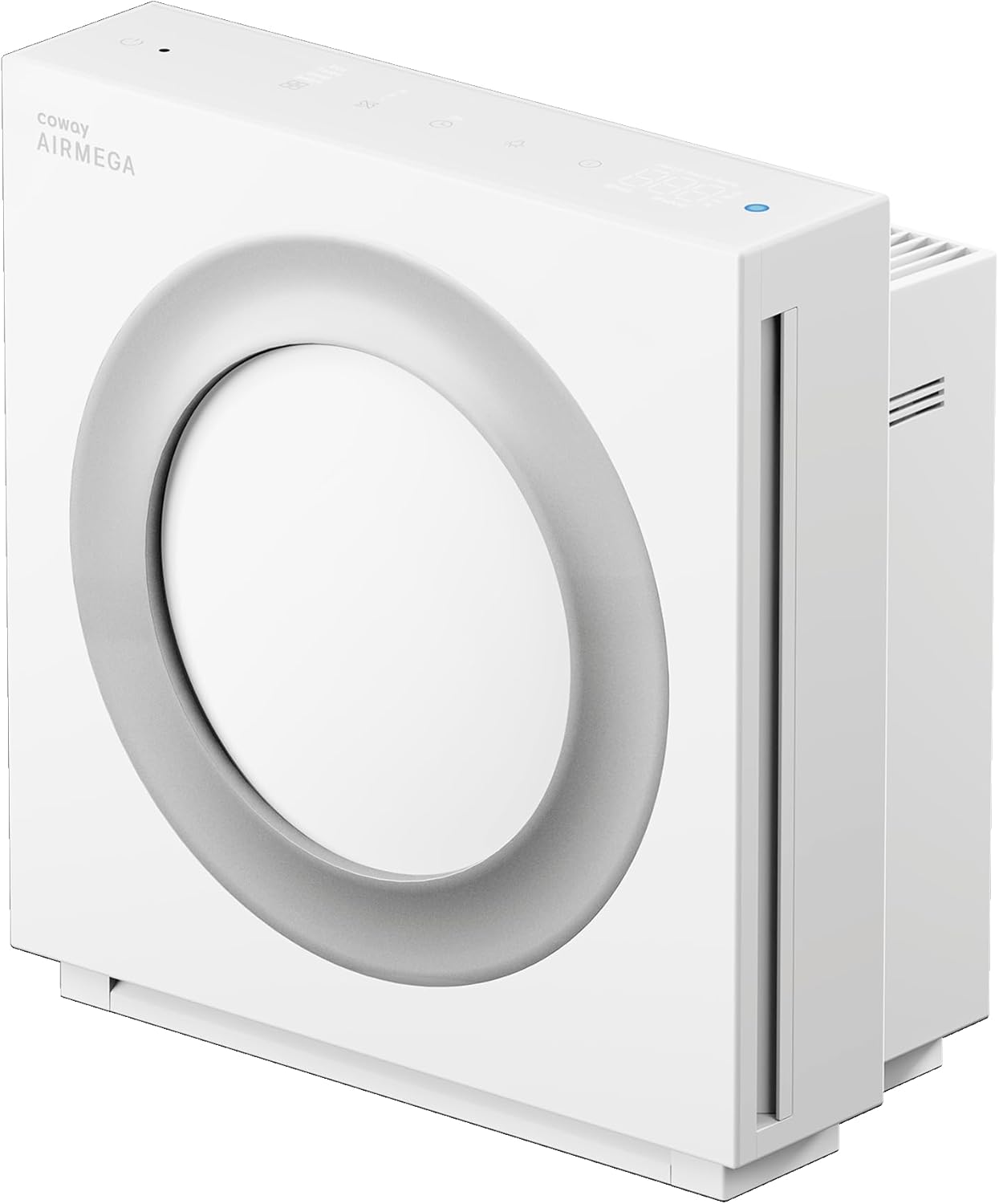
| Max coverage (1 hr) | 1,800 sq. ft. |
|---|---|
| CADR (Smoke/Dust/Pollen) | 240 / 242 / 249 |
| Noise level | 19 dB – 50 dB |
| Power consumption | 56 W |
The Airmega Mighty2 AP-1512N is a room air purifier built to move a lot of air while trapping very small particles and odor-causing gases. It uses a three-stage system with a washable pre-filter plus a combined HEPA and activated carbon Max2 filter that is IEST-certified to remove 99.97% of 0.3µm particles and reduce many VOCs and odors. Coway's Megascan laser sensor reports PM1/2.5/10 in real time and a 4-color LED makes air quality easy to read, while Smart Mode automatically raises fan speed when dust spikes and drops to Eco or Sleep modes to save energy and cut noise to as low as 19 dB. Practical touches include a slide-out washable pre-filter, on-screen filter life percentages, and hidden handles for moving the unit. For drywall dust specifically, the high CADR numbers and precise particle sensing mean faster clearance of fine gypsum dust, though you will still need to change the Max2 filter regularly in high-dust scenarios and expect some maintenance if used in constant dusty conditions.
Best for: People who prioritize measurable performance and fast removal of fine airborne particles like drywall dust and want automated sensing and modes to adapt airflow without constant manual adjustments.
Less Ideal for: Those who need an ultra-lightweight travel purifier for multiple small rooms or who prefer a purely disposable-filter design with no washable pre-filter.
- IEST-certified HEPA that captures 99.97% of 0.3µm particles for effective fine-dust removal
- High reported coverage and CADR allowing clearance of up to 1,800 sq ft in 60 minutes
- Megascan laser sensor and numeric PM readout for accurate, real-time dust detection
- Washable pre-filter and on-screen filter-life indicator simplify maintenance and replacement timing
- Max2 combined HEPA/carbon filter will require replacement more often in heavy dust environments
- Not the lightest or smallest unit for frequent room-to-room portability
Verdict: Choose the Mighty2 when you need a high-CADR, sensor-driven purifier that clears fine drywall dust fast while giving clear, real-time air-quality feedback.
PuroAir 240 HEPA Air Purifier

| Model | PuroAir 240 |
|---|---|
| Coverage claim | Up to 1,000 sq ft |
| Filter type | 3-layer HEPA with CarbonTech |
| Modes | Auto, Sleep, Multiple fan speeds |
The PuroAir 240 is a floor-standing HEPA purifier aimed at improving indoor air in larger rooms up to the model's advertised coverage. It uses a three-layer filtration stack with HEPA and CarbonTech to capture dust, pollen, smoke, and common household odors, while an automatic air quality sensor and auto mode adjust fan speed based on measured conditions. In daily use it sits near a dust source or centrally in a living room or bedroom and can run 24/7 in auto or sleep mode for quieter overnight operation. Notable benefits include strong particulate filtration and an activated carbon stage for odor and VOC reduction, plus app-enabled management on some PuroAir models and certification from multiple safety bodies. Limitations are typical for standalone purifiers: effectiveness depends on placement and room air changes, and filters will need periodic replacement to maintain performance; it is not a substitute for source control or local vacuuming for drywall dust during renovation. For drywall dust jobs you will get meaningful particulate reduction but still should use containment and shop vacs for coarse debris.
Best for: Buyers who prioritize practical, continuous particulate removal in living areas and want an automated purifier they can set and forget while focusing on other tasks.
Less Ideal for: Contractors or renovators who need primary dust control during active sanding or demolition should rely on dedicated jobsite equipment and containment rather than this room air purifier alone.
- Three-layer HEPA plus activated carbon filtration captures fine particulates and reduces odors.
- Automatic air quality sensor and auto mode adjust fan speed without constant user input.
- Quiet sleep mode suitable for overnight use in bedrooms.
- Certified by recognized safety and testing organizations.
- Does not eliminate the need for source control or a shop vacuum when removing coarse drywall dust.
- Filter replacement is required to retain peak performance.
Verdict: A practical, automated HEPA tower that meaningfully reduces fine drywall dust and airborne particles in living spaces when used alongside proper containment and vacuums.
FULMINARE H13 HEPA Air Purifier

| Filter type | H13 HEPA |
|---|---|
| Coverage area | 215 sq ft / 20 m² |
| Noise level | Around 24 dB at low fan speed |
| Timers | 2, 4, 8, 10, 12 hours |
The FULMINARE H13 is a small, portable air purifier built around an H13 true HEPA filter and a 360 degree outlet that refreshes air in rooms up to about 215 sq ft. It is intended for tabletop or floor placement in bedrooms, offices, or living rooms and runs quietly at its lowest fan speed for light sleepers. The unit offers multiple timer settings and a built-in night light, which makes it convenient for overnight use around children or in bedrooms. Practical benefits include a replaceable H13 filter that captures fine particles like dust and pet dander and a compact footprint that is easy to move between rooms. Limitations are its room-size ceiling, so it is not suitable for large open spaces, and reliance on a plug-in power adapter rather than battery operation limits truly portable use. Expect routine filter replacements to maintain performance.
Best for: Buyers looking for an affordable, compact purifier to reduce household dust and allergens in single rooms like bedrooms or home offices who value quiet overnight operation and simple controls.
Less Ideal for: Users who need whole-home coverage, a unit for large open-plan spaces, or cordless portability should consider larger or different designs.
- H13 true HEPA filter captures fine particles and common allergens
- 360° air outlet with rated circulation suitable for rooms up to about 215 sq ft
- Very low noise operation in sleep mode for overnight use
- Multiple timers and an independent night light for bedroom-friendly use
- Designed for small to medium rooms and not effective for large open areas
- Requires regular filter replacements to maintain filtration performance
- No battery option; must be plugged in for use
Verdict: A budget-friendly, quiet H13 HEPA purifier that effectively reduces drywall dust and other fine particles in single rooms up to about 215 square feet.
Levoit Core 300-P

| Power Source | Corded Electric |
|---|---|
| Filter Type | 3 in 1 Filtration |
| Floor Area | 1073 square_feet |
| Noise Level | 24 db |
| Wattage | 56 watts |
The Levoit Core 300-P is a small, well-rounded air purifier built around a three-stage original filter and an efficient fan that delivers solid clean-air performance for bedrooms and living areas. It pulls room air through a pre-filter, HEPA-grade media and an activated carbon layer to capture dust, pollen, pet dander, smoke and household odors, and the unit is AHAM verified for measured CADR performance. Typical use is straightforward: place it in the room you want cleaned, set one of the manual fan speeds or Sleep Mode, and let it run continuously; the display dim and low 24 dB sleep noise level make it unobtrusive at night. Practical benefits include a compact footprint, touch controls, a timer, and filter-replacement indicator for predictable upkeep. Important limitations are that it lacks Auto Mode or smart connectivity on this model so you must change fan speeds manually, and Levoit recommends using official replacement filters for best results which adds ongoing cost. For tackling fine drywall dust in small to medium rooms it offers strong filtration in a simple, reliable package.
Best for: Buyers who want a reliable, easy-to-use purifier for regular removal of fine household dust and allergens and who prioritize measured performance and quiet night operation.
Less Ideal for: People who need smart features or automatic air-quality sensing, or those wanting a unit sized specifically for very large open-plan spaces.
- True HEPA-grade three-stage filtration that captures fine particulates down to 0.3 micron
- AHAM verified CADR and certified safety listings for predictable performance
- Very quiet Sleep Mode with dimmable display suitable for bedrooms
- Compact, portable design that fits small and medium rooms easily
- Touch controls plus timer and filter indicator simplify operation and maintenance
- No Auto Mode or smart connectivity on this model, requiring manual fan-speed control
- Requires OEM replacement filters for best performance which is an added ongoing cost
Verdict: A compact, AHAM-verified HEPA purifier that reliably removes fine drywall dust and common household particulates in small to medium rooms.
VOOPNU H13 HEPA Air Purifier DH-JH12

| Model number | DH-JH12 |
|---|---|
| Filtration | H13 True HEPA, activated carbon, pre-filter |
| Coverage (claimed) | Up to 1,076 ft² |
| Noise level | As low as 22 dB |
| Speeds | 3 speeds, timer, aroma tray |
The VOOPNU DH-JH12 is a small, easy-to-use air purifier built around an H13 True HEPA multi-layer filter and 360 degree intake that the brand says can cover roughly 1,076 square feet. It has a simple control panel, three fan speeds, a timer, and an essential oil tray for light scenting, and the manufacturer reports a lab rate of cleaning 250 sq ft every 15 minutes. In practice this unit is best used in bedrooms, home offices, or smaller open-plan rooms where drywall dust, pet dander, pollen, and smoke are concerns. The unit runs quietly at low speeds (as low as 22 dB), so it can operate overnight, and the washable pre-filter plus HEPA and activated carbon stages help capture both large dust and fine particulates and reduce odors. Limitations include a compact footprint that suggests lower raw airflow than larger tower purifiers, and filter replacement every few months will be required for sustained performance in dusty environments. For buyers who value straightforward controls, quiet operation, and HEPA-level particle removal, this is a practical, no-frills choice for improving indoor air during drywall work or everyday dust exposure.
Best for: A buyer who wants a quiet, easy-to-operate HEPA purifier for tackling drywall dust and general fine particulates in bedrooms or small to medium rooms and who values straightforward real-world performance backed by many customer reviews.
Less Ideal for: People needing a heavy-duty, high-airflow unit for large open-plan homes or long-term construction sites should consider larger commercial-grade purifiers instead.
- H13 True HEPA triple-layer filtration captures fine particles down to 0.3 microns
- 360 degree intake for more uniform room air draw
- Very quiet operation (down to 22 dB) suitable for night use
- Compact footprint makes placement flexible in small rooms
- Simple controls and timer make setup and continuous use easy
- Compact size implies lower maximum airflow than larger whole-room units
- Manufacturer coverage claims are lab-derived and actual performance depends on room layout and continuous run time
Verdict: A quiet, compact H13 HEPA purifier that offers straightforward, effective particle capture for drywall dust and everyday fine particulates in small to medium rooms.
Levoit Vital 100 Air Purifier

| CADR | 105 CFM |
|---|---|
| Particle retention size | 0.3 micron |
| Timer | 2/4/8 hours |
The Levoit Vital 100 is a small-room air purifier that uses a three-stage filtration system—washable pre-filter, efficient particle filter, and activated carbon—to capture dust, pet hair, pollen, odors, and some VOCs. It is intended for bedroom or living-room use where low noise and simple controls matter; the unit offers a 2/4/8-hour timer, a handle for moving between rooms, and a filter check indicator. With an AHAM-verified CADR and stated 105 CFM, it can circulate air in typical rooms repeatedly and help reduce drywall dust buildup when placed near the dust source. The washable pre-filter traps larger debris and extends the life of the main filter, while the carbon layer helps with paint and construction smells. Trade-offs are its compact footprint and basic control set—this is not a heavy-duty whole-house solution and replacement genuine filters are recommended for best performance. For buyers prioritizing quiet, straightforward operation and proven filtration in bedrooms or workspaces, the Vital 100 is a practical choice.
Best for: Buyers who want a quiet, easy-to-use purifier for bedrooms or small work areas and who prefer proven, certified performance and simple maintenance routines.
Less Ideal for: Homes needing whole-house or high-capacity particulate removal during major renovations or very large open-plan spaces should consider higher-CADR commercial units instead.
- Three-stage filtration including washable pre-filter to trap hair and large dust before it reaches the main filter
- Activated carbon layer reduces odors and common VOCs from painting or renovation
- Low noise operation down to 24 dB suitable for overnight use
- Timer and filter-check indicator simplify daily use and maintenance
- Compact, portable design with handle makes it easy to move between rooms
- Designed for single rooms rather than large open areas so it may require multiple units for full coverage
- No advanced connectivity or app control for remote monitoring
Verdict: Choose the Vital 100 if you need a quiet, portable, AHAM-verified purifier that reliably reduces drywall dust and odors in single rooms.
Choosing the Right Air Purifier for Drywall Dust: Key Factors to Consider
Filtration Efficiency and Particle Size Capture
Drywall dust contains very fine particles that can be well under 2.5 microns. A unit's filtration efficiency for particles in the PM2.5 and submicron range determines how much of that airborne gypsum actually gets trapped versus recirculated.
Look for proven HEPA-level capture or certified submicron ratings. Media depth, pleat count, and whether the system uses a prefilter to catch larger debris all influence real-world performance. Higher efficiency is essential when sanding in enclosed spaces or when occupants have respiratory sensitivity.
Airflow Rate and Room Coverage
High filtration efficiency is necessary but not sufficient. The purifier must also move enough air to cycle the room quickly so dust concentrations fall. CADR or measured airflow at working speeds gives a realistic sense of how fast a unit will reduce airborne dust.
Consider the size of the workspace and whether the purifier will be used in a single room, an open-plan area, or moved between sites. A unit with higher airflow will clear dust faster but may be louder or consume more power. Balancing airflow and practical operating time is important for renovation tasks.
Filter Lifetime, Availability, and Replacement Cost
Frequent drywall projects can load filters quickly. Prefilters that capture coarse dust extend the life of the main HEPA media. Check expected filter life under heavy dust loads and how easily replacement filters are obtained.
Long filter life lowers operating costs and reduces downtime. Also confirm whether the purifier has washable prefilters or affordable OEM replacements. Consider the total cost of ownership over the life of the unit, not just the initial purchase.
Noise Levels During Extended Operation
During sanding you may run the purifier for hours. Noise at typical working speeds affects comfort and communication among workers. Some units achieve high airflow with moderate noise through better motor design or airflow path engineering.
Look for published decibel levels at different fan settings and prioritize models that deliver required airflow at tolerable noise. If you need quiet operation during evening or occupied-use cleanup, ensure low-speed performance is still effective for particle reduction.
Durability, Portability, and Jobsite Features
Renovation environments are tougher than living rooms. Sturdy housings, impact-resistant materials, and convenient handles or casters make a purifier easier to move between areas. Intake and outlet placement can affect how well the unit performs around scaffolding or ladders.
Also check for washable/replaceable prefilters, simple filter-access panels, and protective intake screens to prevent premature clogging. Units designed with jobsite deployment in mind reduce the chance of damage and make setup faster.
Operational Controls and Maintenance Alerts
Clear controls and filter-change indicators reduce the risk of running a clogged device that no longer protects the space. Timers, multiple fan speeds, and straightforward filter-replacement procedures are practical features that save time.
Some purifiers include washable prefilters or reusable captures for coarse dust; these lower maintenance frequency. Good labeling and simple tool-free access help when changing filters on site.
Where Drywall Dust Comes From and Why It's Different
Drywall sanding produces a mix of gypsum particles and binder that generates a cloud of fine dust. These particles are often light and slow to settle, which means they remain airborne longer than heavier construction debris.
Because drywall dust is so fine, it can infiltrate ductwork, settle on electronics, and irritate respiratory passages. Controlling airborne concentration during sanding and cleanup reduces the spread of dust and the need for extensive surface cleaning afterward.
- Fine particle behavior increases airborne residence time.
- Dust can bypass coarse filters and accumulate in HVAC systems.
- Containment plus active filtration is the most effective mitigation strategy.
Placement and Setup Tips for Best Performance
Position the purifier so its intake faces the dust source when possible. If you are sanding on a wall, place the unit a few feet away with a clear path for airflow. Avoid corners or blocked intakes that reduce effective circulation.
If the job spans multiple rooms or an open area, consider running two units at lower speeds rather than one at maximum. This creates more uniform airflow and reduces dead zones where dust lingers. Also seal off the work area with plastic sheeting and door sweeps to concentrate filtration where you need it most.
- Keep intake unobstructed and within the same space as sanding activity.
- Use multiple units for larger or open-plan work areas.
- Pair filtration with containment to reduce cross-contamination.
Maintaining Filters After a Drywall Job
After a heavy drywall session, expect prefilters to be visibly loaded. Remove and clean or replace these first to restore airflow. Some models have washable prefilters; others require replacement. Always follow the manufacturer guidance for cleaning to avoid damaging HEPA media.
Check the main filter for dust cake buildup that can significantly reduce capture efficiency. If the unit is used regularly on renovation work, plan a maintenance schedule that shortens replacement intervals and keeps spare filters on hand to minimize downtime.
- Clean or replace prefilters after each heavy use.
- Inspect HEPA media for visible loading and change if airflow drops.
- Keep spare filters available for back-to-back projects.
Combining Filtration With Other Dust-Control Measures
An air purifier is one element of a comprehensive dust-control plan. Wet-sanding methods, local exhaust ventilation, and sealing off the workspace reduce dust generation and make filtration more effective. Controlling the source reduces the burden on the purifier and extends filter life.
Use personal protective equipment such as appropriate respirators when working in dusty conditions. For occupied homes, schedule filtration runs before re-entry to lower airborne concentrations and surface dust.
- Use containment and source control to reduce airborne load.
- Run purifiers continuously during and after sanding for best results.
- Supplement with personal protection for worker safety.
Understanding CADR and Air Changes Per Hour for Renovation Work
CADR gives a standardized sense of how quickly a unit clears airborne particles in a room. For renovation dust, aim for units that provide multiple air changes per hour in the workspace. Calculate needed airflow by matching the unit's CADR or airflow rating to the room volume.
Air changes per hour helps estimate how long it will take to reduce dust concentrations to an acceptable level. For heavy dust events like sanding, target a higher number of air changes and run the purifier for an extended period after finishing work.
- Use CADR and room volume to estimate required airflow.
- Higher air changes per hour shorten cleanup time.
- Run the purifier past visible cleanup to clear lingering fine particles.
How We Chose the Best Air Purifier for Drywall Dust
We limited the selection to air purifiers capable of handling fine particulate generated by drywall work and prioritized measurable performance attributes. The editorial filters emphasized true HEPA or equivalent capture efficiency for submicron particles, rated clean air delivery rate (CADR) or equivalent airflow metrics, and practical deployment features such as port placement and durability for workshop or renovation use. We also weighed maintenance factors like filter lifetime and accessibility, plus noise at typical operating speeds because long runs matter during sanding. Excluded from the list were units designed only for odors or volatile organic compounds without substantive particulate filtration, and compact personal purifiers whose airflow cannot reliably clear workshop-grade dust. We favored devices with documented particulate capture performance, robust build for jobsite use, and clear serviceability. The final picks represent a balance of filtration efficiency, useful airflow coverage, maintenance needs, and operational practicality for drywall dust control.
Our full evaluation process is outlined in our review methodology.
FAQ
Can any HEPA air purifier handle drywall dust?
Many HEPA-rated units can capture fine gypsum particles, but not all are suitable for heavy drywall work. You need sufficient airflow and a prefilter to handle coarse dust without rapidly clogging the HEPA media.
How long should I run a purifier after sanding drywall?
Run the purifier continuously during sanding and for at least one to two hours afterward, depending on room size and airflow. Larger or worse dust loads may require longer runs to reduce airborne concentrations to typical background levels.
Will a purifier eliminate the need for cleanup?
No. An air purifier reduces airborne dust and slows resettling, but surfaces will still collect dust. Filtration reduces the total settled dust and can make cleanup easier, but physical wiping and vacuuming are still necessary.
Should I use a purifier in the same room where people are working?
Yes. Running a purifier in the occupied work area reduces airborne exposure for occupants. Select a model that balances airflow with acceptable noise and place it to draw air away from breathing zones when possible.
Are washable prefilters effective for drywall dust?
Washable prefilters can capture coarse particles and extend HEPA life, but they must be cleaned often to remain effective. They are useful for renovation work because they reduce the frequency of expensive HEPA replacements.
Final Verdict
For drywall sanding and renovation cleanup, prioritize an air purifier that combines true HEPA-level capture with strong airflow and accessible prefiltering. Expect tradeoffs between noise and airflow, and plan for more frequent maintenance when using a unit on heavy dust tasks. Choose a unit sized for the workspace, verify filter availability and serviceability, and integrate the purifier with containment and source-control measures to minimize dust spread and protect occupants.