
Note: This article contains affiliate links. If you click on these links and make a purchase, we may earn a small commission at no extra cost to you. This helps support our research and content. Read our full affiliate disclosure here.
If you keep ferrets, you already know how persistent their unique odor and fine dander can be around cages and play areas. The right air purifier can make living with ferrets more comfortable by reducing airborne odor compounds, hair, and tiny particles that trigger smells or allergies. This guide narrows the field to the top shortlisted options designed to tackle pet-specific odors and capture fine particulates. We evaluate devices by real-world filtration effectiveness, room coverage, and maintenance demands so you can match a purifier to the size of your ferret area, ventilation, and daily habits. Read on to see the top picks and what makes each style suitable for minimizing ferret odor and keeping air fresher.
Top Picks at a Glance
| Best Overall The best all-around choice for most situations | GermGuardian AC4825 22" Tower |  |
| Best Quality Built to a higher standard if you want something more solid | Dyson HushJet Compact Purifier |  |
| Best Value The sweet spot between price and what you get | MOOKA B-D02L Air Purifier |  |
| Best Budget The cheapest option that still gets the job done reliably | VOOPNU Air Purifier DH-JH12 |  |
| Top Rated A top-rated pick with lots of positive feedback | DREO Air Purifier 338S |  |
| Most Popular A crowd favorite that many people choose with confidence | Levoit Core Mini-P |  |
| Best Seller A high-volume bestseller chosen again and again | Winix 5510 Air Purifier |  |
GermGuardian AC4825 22" Tower

| Coverage (cycle times) | 153 sq ft per 12.5 minutes; up to 743 sq ft per hour |
|---|---|
| Filter type | True HEPA with activated carbon pre-filter |
| Fan speeds | 3 speeds including sleep mode |
| Model number | AC4825W |
The GermGuardian AC4825 is a compact tower purifier that combines a True HEPA filter, activated carbon pre-filter, and an optional UV-C bulb to reduce airborne particles, odors, and allergens in living spaces. It is typically used in bedrooms, living rooms, or pet areas where you want continuous background filtration; three fan speeds including a quiet sleep mode let you balance noise and cleaning power. The HEPA Pure filter captures 99.97% of particles down to 0.1 microns, while the carbon layer helps reduce cooking smells, pet scents, and light smoke. The unit is CARB and ETL certified and compatible with several GermGuardian replacement filters and bulbs for straightforward maintenance. Because it is a tower design with modest airflow compared with larger commercial units, it cycles air fastest in smaller rooms and will take longer to turnover very large open spaces. The optional UV-C adds germ-reduction capability but requires bulb replacement over time, and active odor sources may need complementary cleaning or ventilation for best results.
Best for: Buyers who want a reliable, space-saving purifier that reduces airborne allergens and light pet odors in bedrooms or dedicated pet rooms and prioritize low-noise operation at night.
Less Ideal for: Homes needing rapid odor dilution in very large open floor plans or heavy continuous odor sources without additional ventilation or source cleaning should consider higher-capacity systems or supplemental odor control.
- True HEPA filtration captures fine allergens and pet dander down to 0.1 microns
- Activated carbon pre-filter helps reduce household and pet odors
- Compact tower design fits on floors in bedrooms or small living areas
- Three fan speeds including a quiet sleep mode for nighttime use
- Certified safety listings (CARB, ETL) and uses genuine replacement filters for predictable performance
- Best air circulation and fastest clean-air delivery are in small to medium rooms rather than very large open areas
- UV-C bulb is optional and requires periodic replacement to retain sanitizing effect
Verdict: A compact, certified HEPA tower that reliably reduces pet dander and light ferret odors in bedrooms and small pet rooms while running quietly at night.
Dyson HushJet Compact Purifier

| Filter Type | Electrostatic |
|---|---|
| Floor Area | 203 |
| Noise Level | 42 db |
| Particle Retention Size | 0.3 micron |
| Contaminant Filtration Capability | odors, pet_dander, pollen, volatile_organic_compounds_(vocs), wildfire_smoke |
The Dyson HushJet Compact Purifier is a small but powerful room purifier that uses a 360° electrostatic filter plus an activated carbon layer to capture 99.97% of particles down to 0.3 microns and reduce odors and gases. It is engineered to circulate air through spaces up to 203 square feet with a jet-inspired nozzle that prioritizes airflow while minimizing turbulence and noise, allowing Sleep mode operation at very low sound levels. The unit is sealed to prevent captured pollutants from re-entering the room and reports real-time air quality on an LCD and via the MyDyson app, which also enables Auto mode, schedules, and remote control. Filters are rated for long service life under typical use, reducing replacement frequency, and maintenance is simplified by a removable nozzle for cleaning. The main compromises are its compact coverage relative to larger whole-home units and reliance on app and smart-home integration for some functions, which may be unnecessary for buyers who prefer very basic controls.
Best for: Buyers who prioritize strong particle and odor removal in a bedroom or medium-size room and want precise, app-driven control and quiet operation.
Less Ideal for: People needing whole-home or large open-plan coverage or those who prefer a very simple, no-app appliance without smart features.
- Captures 99.97% of particles down to 0.3 microns with a 360° electrostatic filter
- Activated carbon layer targets pet and cooking odors and gaseous pollutants like NO2
- Designed for effective circulation in rooms up to 203 sq ft
- Very quiet operation with Sleep mode noise as low as 24 dB
- Sealed design prevents re-release of trapped pollutants and provides real-time air quality reporting via app and LCD
- Coverage limited to medium rooms rather than large open areas
- Advanced smart features require app, Wi-Fi or compatible voice services
- Electrostatic filters are non-washable and will need eventual replacement
Verdict: Choose the HushJet if you want a compact, quiet purifier that combines high particle capture with activated carbon odor removal for medium-size rooms.
MOOKA B-D02L Air Purifier
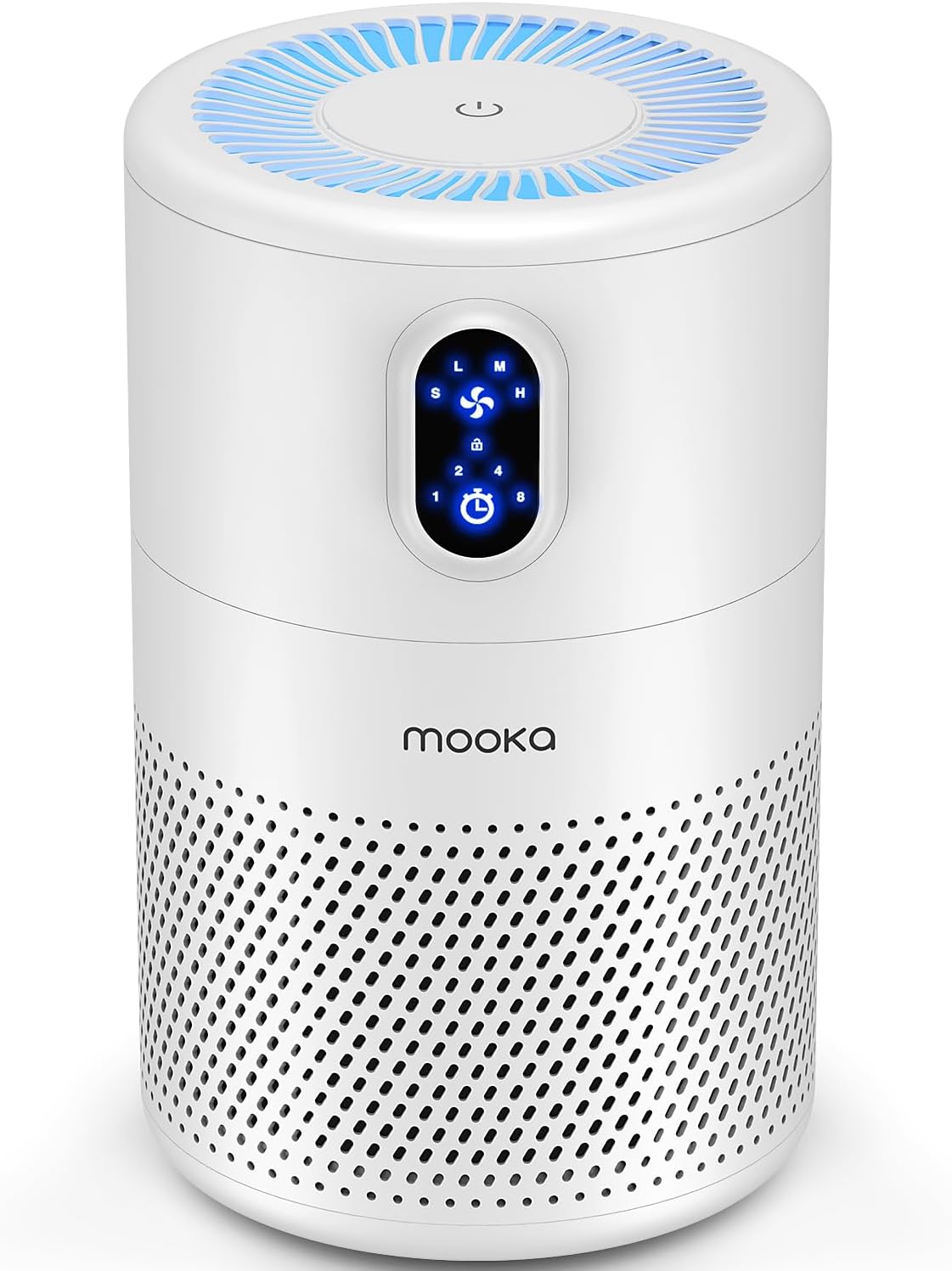
| Effective area | 1076 sq ft |
|---|---|
| Filter type | H13 true HEPA + activated carbon |
| Fan modes | 4 (Sleep/Low/Med/High) |
| Timer | 1/2/4/8 hours |
The MOOKA B-D02L is a portable air purifier built around an H13 true HEPA filter and activated carbon stage, aimed at removing particles, pet dander, smoke and common odors across large rooms. It is typically set on a table or floor in a living room, bedroom or near a pet area and run continuously or on timers to keep air fresh. Controls are simple: four fan speeds including a quiet sleep mode, four timer settings and a child lock, while a soft night light can be turned off. The unit promises up to 6 air changes per hour in a smaller zone and coverage up to about 1076 sq ft at lower exchange rates, and the washable pre-filter plus replaceable HEPA/carbon filter combination helps with hair, dust and odor control. Practical benefits include very low noise on sleep mode and modest energy use from the brushless motor. Expect regular filter replacements every 3 to 6 months depending on ferret odor intensity and environment; for very strong or long-lasting smells you may need to run higher fan speeds or pair it with better room ventilation.
Best for: A practical buyer who wants a quiet, energy-efficient purifier that balances particle removal and odor control for pet areas and living spaces without complicated setup.
Less Ideal for: People needing instant elimination of very strong or persistent ferret odors in poorly ventilated rooms should consider larger commercial units or combining this purifier with active ventilation and cleaning routines.
- H13 true HEPA plus activated carbon filter targets both particles and common odors
- Low noise sleep mode suitable for bedrooms or overnight use
- Multiple fan speeds and timers let you tailor runtime and cleaning intensity
- Washable pre-filter reduces hair and extends main filter life
- Filter replacement recommended every 3–6 months which adds ongoing cost
- Large stated coverage depends on low air-change rates so strong localized odors may require close placement or higher speeds
Verdict: Choose the MOOKA B-D02L when you want a quiet, energy‑smart HEPA purifier that helps control ferret odors and pet dander in living spaces with straightforward controls and regular filter care.
VOOPNU Air Purifier DH-JH12

| Filtration | H13 True HEPA |
|---|---|
| Coverage claim | Up to 1,076 ft² per hour |
| Noise level | 22 dB (low) |
| Speeds | 3 fan speeds |
The VOOPNU DH-JH12 is a small, user-friendly air purifier built around an H13 True HEPA multi-layer filter and a 360 degree intake to capture particles and odors across a room. It is designed for simple, one-touch operation with three fan speeds, a timer, and a built-in essential oil tray if you want light fragrance while cleaning the air. The manufacturer claims the unit can cover up to about 1,076 ft² per hour based on laboratory testing and it operates very quietly down to 22 dB, which makes it suitable for bedrooms or pet areas. Practical benefits include a compact footprint for easy placement, certified safety approvals, and a washable pre-filter option across some SKUs for hair and larger debris. Limitations are the small physical size and correspondingly modest intake volume compared with larger whole-house purifiers, and replacement filters and ongoing runtime are necessary to maintain odor control in consistently smelly spaces like ferret cages.
Best for: Buyers who need an affordable, easy-to-use purifier for a single room or near a pet area and prioritize quiet, simple operation over whole-house coverage.
Less Ideal for: People who need high-volume or whole-home odor removal for severe, continuous pet smells should consider larger commercial-grade units or multiple purifiers.
- H13 True HEPA filtration captures 99.97% of fine particles
- 360° air intake helps pull air from all directions for more even cleaning
- Very quiet operation down to 22 dB suitable for overnight use
- Compact footprint fits on desks, corners, or near pet enclosures
- Built-in aroma tray lets you add a few drops of essential oil
- Smaller unit capacity means it may need continuous runtime or multiple units for persistent pet odors
- Replacement filters and regular operation are required to maintain effectiveness
Verdict: A quiet, budget-friendly HEPA purifier that works well for single-room ferret odor control when run continuously or placed close to the source.
DREO Air Purifier 338S

| CADR | 115 CFM |
|---|---|
| Coverage (1 ACH) | 856 sq ft |
| Room recommendation (4.8 ACH) | 178 sq ft |
| Energy use | ≈125 kWh/year |
The DREO Air Purifier 338S is a small, smart air cleaner designed for bedrooms and living spaces where steady, monitored filtration matters. It uses a 3-in-1 filter pack (pre-filter, true HEPA, activated carbon) and a 360° spiral intake driven by DREO TurboPure to boost intake efficiency and deliver an AHAM-verified CADR of 115 CFM, making it practical for frequent air turnover in rooms up to roughly 178 sq ft at high exchange rates and larger spaces at lower ACH. The built-in PM2.5 sensor and four-color AQI LED give immediate feedback on air quality, while app and voice connectivity let you schedule, monitor 30-day trends, and receive filter-life alerts. Modes include Auto, Turbo, Sleep, and Normal with four fan speeds so the unit can be quiet at night or push harder when odors spike. Important limits are its room-size guidance and that long-term odor control depends on activated carbon capacity and timely filter replacement, so persistent strong odors may need larger units or additional source control. For steady, connected filtration in small to medium rooms it is a capable, reliable choice.
Best for: Buyers who prioritize steady, verified air-cleaning performance and remote monitoring for indoor spaces and who want a connected unit that reliably tracks air quality over time.
Less Ideal for: People needing a heavy-duty odor eliminator for large open-plan areas or for removing very strong, persistent smells without additional odor-control measures.
- AHAM-verified CADR of 115 CFM for validated cleaning performance
- 3-in-1 filter with activated carbon to capture particles and help reduce odors
- High-precision PM2.5 sensor with real-time AQI display and 4-color indicator
- App and voice control with scheduling, 30-day air quality reports, and filter-life reminders
- Activated carbon capacity may be limited for very strong or persistent pet odors
- Performance is optimized for small to medium rooms, not large open areas
Verdict: A reliable, connected HEPA purifier with verified airflow and odor-reducing carbon filtration that is well suited for consistent pet-odor management in small to medium rooms.
Levoit Core Mini-P
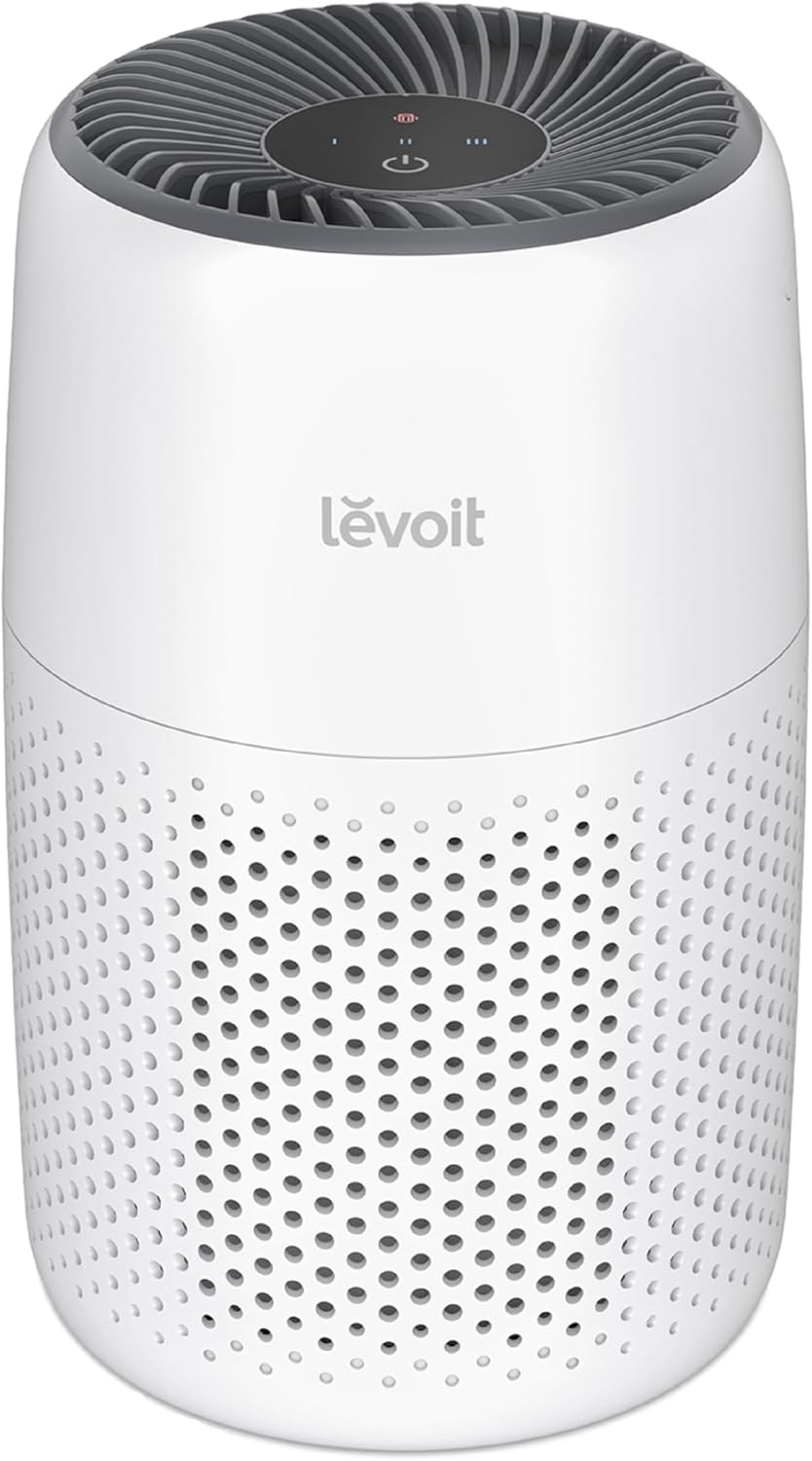
| Rated Power | 7W |
|---|---|
| Noise Level | 27-45dB |
| AHAM Verified | Yes |
| Model number | LAP-C161-WUS |
The Levoit Core Mini-P is a small, desk-friendly air purifier intended for bedrooms, offices, or other small spaces where pet smells and fine particles are a concern. It uses a pre-filter plus a main high-efficiency filter to trap lint, hair, pet dander, and smoke-sized particles, and includes an aromatherapy sponge to help neutralize odors. With a low rated power draw and noise range advertised between 27 and 45 dB, it is quiet enough for sleep mode or close-to-desk use. Practical benefits include simple plug-in operation, automatic display shutoff and a compact footprint that fits on shelves or nightstands. Limitations are inherent to its size: it is optimized for small rooms and will not move or clean air effectively in larger open areas, and filter maintenance or replacement is required to keep odor control effective. The essential oil reservoir accepts only a very small amount, so strong scent masking is limited.
Best for: Buyers who prioritize proven performance and social proof and need a quiet, compact purifier to tackle pet smells and airborne particles in small personal spaces.
Less Ideal for: People needing to control strong odors or pollutants across large rooms or whole apartments should choose a larger-capacity purifier instead.
- Compact footprint fits on desks and nightstands
- Captures pet dander, lint, and smoke-sized particles with pre-filter and main filter
- Quiet operation suitable for sleep mode and bedrooms
- Includes small aromatherapy sponge to help neutralize odors
- Designed for small rooms only, not effective for large spaces
- Aromatherapy tray accepts only a few drops so scent masking is limited
Verdict: For buyers wanting a quiet, well-reviewed tabletop purifier to reduce ferret odor and airborne pet particles in small rooms, the Core Mini-P is a practical, compact choice.
Winix 5510 Air Purifier

| AHAM verified coverage | 1882 sq ft in 1 hr |
|---|---|
| Filtration stages | 4-Stage |
| True HEPA | Captures down to 0.01 microns |
| Smart features | WiFi / Alexa / Google Home |
| Noise (lowest) | 23.5 dB |
The Winix 5510 is a four-stage air purifier aimed at whole-room cleaning in large spaces, combining a washable pre-filter, True HEPA filtration, and an advanced deodorization carbon filter to reduce particles and odors. It uses built-in smart sensors and an air quality indicator to adjust fan speed automatically in Auto Mode, and a Light Automated Sleep Mode reduces noise when the room is dark. The unit is AHAM verified for substantial room coverage and includes Winix PlasmaWave technology intended to reduce airborne contaminants. App connectivity and compatibility with voice assistants let you monitor and control the purifier remotely. Practical benefits include strong particle removal down to 0.01 microns, targeted odor reduction from the carbon stage, and low noise on the slowest setting for overnight use. Important limitations are that long-term performance depends on timely filter replacements and that PlasmaWave is an add-on technology whose effects vary by environment; also the purifier is sized for large rooms so it may be overpowered for small bedrooms.
Best for: Buyers who prioritize reliable, automatic air cleaning and want an appliance that reduces both fine particles and pet-related odors in larger living areas while offering remote monitoring and quiet night operation.
Less Ideal for: Those needing a compact purifier for small bedrooms or travelers who want a highly portable unit should look for smaller, lower-CADR models instead.
- Four-stage filtration including True HEPA for submicron particle capture
- Advanced carbon deodorization filter to reduce VOCs and household odors
- Auto Mode with smart sensors and real-time air quality indicator
- Winix Smart App and voice assistant compatibility for remote control
- Very quiet operation in Sleep Mode for nighttime use
- Effectiveness against persistent strong pet odors depends on filter maintenance and replacement schedule
- PlasmaWave technology results can vary and should not replace ventilation or source control
Verdict: Choose the Winix 5510 if you want an app-connected, four-stage purifier that pairs True HEPA particle removal with an advanced carbon filter for stronger control of pet and household odors in large rooms.
Choosing the Right Air Purifier for Ferret Odor: Key Factors to Consider
Filtration Type and Odor-Adsorbing Media
Filtration is the most important factor when addressing ferret odor. HEPA-style mechanical filters capture fine dander and hair, which reduces the substrate that traps odor. Activated carbon, impregnated carbon, or other adsorbent media are necessary to remove volatile organic compounds and smell-causing molecules rather than just masking them. Multiple stages that pair particle capture with a substantial carbon bed usually perform better in real homes.
Check for clear descriptions of carbon quantity or specialized odor media. Some filters add catalytic or zeolite layers designed for stronger adsorption of specific compounds. For persistent ferret odor, prioritize systems that specify odor-targeting media and provide measurable performance details.
Airflow Capacity and Room Coverage
A purifier with strong filtration but low airflow will still struggle to reduce smells in a room because it cannot cycle enough air. Look for devices with CADR, CFM, or manufacturer-recommended room size ratings that match the square footage where your ferret lives or where you spend time. In small rooms, a modest unit may suffice; in open-plan areas or spaces with poor ventilation, choose higher throughput.
Consider placement too. Positioning near the cage, litter area, or the main activity zone helps capture odors at the source. If you rotate ferrets between rooms, pick a unit with enough capacity to handle the largest area you intend to treat.
Noise Level and Run Comfort
Purifiers often run continuously, so noise matters. Higher fan speeds increase air exchanges but also sound. Compare measured or manufacturer-stated decibel levels at typical fan settings to make sure the unit is tolerable during daytime activity and quieter at night. Some designs use multiple fan speeds or auto modes that ramp up only when needed, which preserves peace while still responding to odor spikes.
If your ferret area doubles as a bedroom or living room, prioritize models with sleep or low-noise modes and predictable acoustic performance. Also consider vibration and structural noise if placing the purifier on shelving or near lightweight cage frames.
Filter Life and Ongoing Maintenance
Operating an air purifier for ferrets requires recurring maintenance. Filter longevity determines long-term cost and convenience. Units with replaceable prefilters that capture hair and large debris can extend the life of HEPA and carbon layers. Check replacement intervals and whether filters are easy to source and swap without complex disassembly.
Also assess how visible or audible filter-change indicators are, and whether the manufacturer supplies guidance for heavy-use scenarios common with pets. A purifier with straightforward maintenance saves time and keeps odor control consistent.
Placement Flexibility and Form Factor
Where you can place the unit affects real-world performance. Tall tower designs sit well beside cages and provide vertical intake and outflow, while compact tabletop units are easier to move and hide in smaller homes. The footprint, weight, and ability to wall-mount or tuck under furniture can matter when space is limited.
Take into account the purifier's intake and exhaust orientation so you do not obstruct airflow. Portability also matters if you plan to use the purifier in multiple rooms or store it when not in use.
Sensing, Controls, and Modes
Smart sensing and convenient controls help maintain air quality with less user intervention. Units with basic particle or odor sensors can adjust fan speed automatically when the air deteriorates, which is useful for intermittent odor spikes after cage cleaning or bedding changes. Manual control options, preset timers, and app connectivity are useful but not required.
Also check whether sensors are calibrated for pet environments; some low-cost sensors may respond poorly to humidity or dust and produce false cycles. Simple, reliable controls are often preferable for steady daily use with animals.
How Air Purifiers Actually Reduce Ferret Smell
Odor reduction relies on two complementary processes: removing particles that carry odor and adsorbing the odor molecules themselves. Dander, saliva, and tiny bedding fragments provide surfaces that retain scent compounds, so mechanical filtration that captures these particles cuts the material that holds smell. Activated carbon and other adsorbents then bind or trap volatile compounds released into the air.
The net effect depends on both filter chemistry and how much air the unit moves. Even strong odor media cannot act on air that does not pass through the purifier, so combining effective media with sufficient airflow and proper placement yields the best results.
- Mechanical filters remove dander and hair that trap odor.
- Activated carbon adsorbs volatile molecules responsible for smell.
- Air changes per hour determine how quickly a room's smell is reduced.
Best Placement Strategies for Pet Areas
Place the purifier near the primary source of odor, such as the ferret cage, litter area, or play tunnel entrance. That reduces the distance odor molecules travel before capture and lowers the concentration in the rest of the room. Avoid placing the intake directly behind furniture or inside cabinets where airflow is restricted.
If you have multiple small rooms, a single high-capacity unit in a central, open location can sometimes outperform several undersized units. For transportable needs, choose a compact unit that is light enough to move between cleaning and resting areas.
- Position intake within a few feet of the cage when feasible.
- Keep at least a few inches of clearance around intake and exhaust.
- Avoid corners and low-lying floor obstructions that block airflow.
Managing Odor Spikes: Cleaning and Routine Habits
Air purifiers reduce airborne odor but do not replace regular cleaning. Frequent bedding changes, thorough cage cleaning, and prompt removal of soiled litter or food scraps cut the source load and make any purifier much more effective. The purifier is most useful as a continuous mitigator, smoothing out residual smells between cleanings.
When you anticipate an odor spike, such as after cage maintenance or deep cleaning, run the purifier at higher fan speeds for a limited period. This helps flush the room air quickly. Pairing this behavior with ventilation, when possible, accelerates odor removal.
- Run purifiers continuously at low speed and ramp up during cleaning.
- Combine purifier use with frequent bedding and litter management.
- Ventilate briefly after deep cleanings if outdoor air quality allows.
When to Consider Extra Odor-Focused Features
Some purifiers include specialized features that can help with stubborn pet smells. Larger carbon beds, catalytic converters, or add-on scent-neutralizing layers can provide measurable benefits over basic charcoal pads. Units that offer replaceable odor cartridges allow you to replenish the adsorbent without changing the particulate filter.
Consider these extras if you encounter persistent, sharp odors despite adequate filtration and cleaning. Keep in mind that specialized media may need more frequent replacement and that claimed longevity can vary based on odor load and room conditions.
- Look for thicker or higher-quantity carbon layers for heavy odor loads.
- Replace odor cartridges more often in high-use pet environments.
- Specialty media helps when general carbon filters underperform.
Noise, Schedule, and Lifestyle Considerations
Match the purifier's noise profile to how you use the space. If the ferret area is in a bedroom or family room, quiet overnight operation is important. If the unit will run in a utility room or basement, higher sound levels may be acceptable for stronger performance. Consider timers or smart scheduling to reduce night-time fan speed automatically.
Also evaluate whether you prefer a simple interface with minimal buttons or a unit with sensors and app control. Simpler controls are often more reliable for everyday use; advanced features can help if you want automatic adjustments based on detected air quality.
- Use sleep modes at night to maintain comfort.
- Timers let you boost airflow during peak odor periods.
- App control adds convenience but is not essential for odor control.
How We Chose the Best Air Purifier for Ferret Odor
We focused on features that directly affect how well an air purifier reduces ferret odor and related particles. Primary evaluation criteria included: filtration type and proven odor-adsorbing media, CADR or equivalent clean-air throughput, recommended room size and airflow design, ongoing maintenance needs such as filter life and replacement ease, noise at common fan speeds, and build quality for continuous operation. We favored units that combine effective particulate removal with carbon-based or specialty odor control media, and that offer adequate airflow to cycle the air in typical indoor ferret rooms. We excluded units that rely solely on ionization without substantive particulate or activated-carbon filtration, because those technologies alone do not reliably remove odor-causing molecules. We also filtered out models with unclear manufacturer guidance on filter type or replacement intervals. The final list emphasizes a balance of measurable airflow, practical maintenance, and components aimed at adsorbing volatile organic compounds and odorants associated with small mammals.
Our full evaluation process is outlined in our review methodology.
FAQ
Will an air purifier eliminate ferret smell completely?
An air purifier can greatly reduce airborne odor and dander, but it rarely eliminates smell entirely on its own. Combining a purifier with regular cleaning, bedding changes, and good ventilation produces the best results.
How big should the purifier be for a typical ferret room?
Choose a unit rated for the square footage of the room where the ferret spends most time. For small bedrooms or dedicated pet rooms, a purifier with moderate CADR and coverage is sufficient. Larger, open areas need higher airflow to achieve the same odor reduction.
Do I need a HEPA filter to control ferret odor?
HEPA filters are important for removing dander and fine particles that hold odor, but they do not remove smell molecules by themselves. Pair HEPA filtration with a good activated carbon or odor media for effective scent reduction.
How often should I replace filters in a pet environment?
Replacement intervals depend on use and the amount of hair and dust produced. In heavy pet environments, expect to change prefilters more often and replace HEPA or carbon filters more frequently than standard timelines. Check indicators and inspect filters visually to decide replacement timing.
Are ozone or ionizers safe to use around ferrets?
Ozone generators and standalone ionizers can create respiratory irritants and are generally not recommended for occupied pet spaces. Focus on mechanical plus adsorbent filtration systems that remove particles and odor without producing reactive gases.
Final Verdict
Picking the right air purifier for ferret odor means balancing filtration chemistry, airflow capacity, and real-life convenience. Prioritize a unit that combines mechanical particle capture with a substantial carbon or odor-adsorbing stage and that offers enough airflow to cycle the room you use most. Also consider noise, filter life, and placement so the purifier fits your cleaning routine and living space. Ultimately, the purifier is one element of a successful odor-control strategy. When paired with consistent cleaning, proper ventilation, and thoughtful placement, a well-chosen unit can noticeably reduce smells and improve comfort for both you and your ferrets.