
Note: This article contains affiliate links. If you click on these links and make a purchase, we may earn a small commission at no extra cost to you. This helps support our research and content. Read our full affiliate disclosure here.
If you want noticeably better indoor air quality, selecting the right air purifier matters more than picking the fanciest model. The best-rated units for home use remove common airborne particles, keep continuous operation quiet enough for daily life, and are simple to maintain. This guide shortlists the top home air purifiers across common room sizes and user needs, and it explains the practical tradeoffs around filtration, noise, and upkeep. Below you will find our top picks and a clear explanation of how we evaluated them, plus the key factors to weigh when choosing an air purifier for your home.
Top Picks at a Glance
| Best Overall The best all-around choice for most situations | WINIX 5530 Air Purifier |  |
| Best Quality Built to a higher standard if you want something more solid | AirDoctor AD3500 Air Purifier |  |
| Best Value The sweet spot between price and what you get | MOOKA B-D02L Air Purifier |  |
| Best Budget The cheapest option that still gets the job done reliably | FULMINARE H13 HEPA Air Purifier |  |
| Top Rated A top-rated pick with lots of positive feedback | ECOSELF HAP603 Air Purifier |  |
| Most Popular A crowd favorite that many people choose with confidence | Levoit Core 300-P |  |
| Best Seller A high-volume bestseller chosen again and again | Levoit Vital 200S-P Air Purifier |  |
WINIX 5530 Air Purifier

| AHAM verified coverage | Cleans up to 1,882 sq ft in 1 hour |
|---|---|
| Filtration stages | 4-stage system |
| Particle capture | Removes particles as small as 0.01 microns |
| Modes | Auto Mode and Sleep Mode |
The Winix 5530 is a four-stage air purifier designed for whole-room cleaning in homes, combining a washable pre-filter, True HEPA filtration, advanced carbon deodorization, and Winix PlasmaWave technology. It is typically used in living rooms, bedrooms, or open-plan spaces where real-time monitoring and automatic adjustment are useful; the built-in smart sensors and LED air quality indicator let the unit ramp fan speeds in Auto Mode and enter a quiet Sleep Mode when the room is dark. Practical benefits include AHAM-verified coverage that can clean large areas quickly, a washable fine-mesh pre-filter that captures larger particles and extends main filter life, and an activated carbon layer targeting household odors and VOCs. App control and the visual air-quality feedback make it easy to keep tabs on conditions without constant manual adjustments. Trade-offs are typical for powerful purifiers: replacement HEPA/carbon filters are a recurring cost, and while PlasmaWave may help reduce some pollutants, it is an adjunct to—not a substitute for—mechanical filtration.
Best for: Buyers who want an all-around, easy-to-manage home air purifier that balances strong particle removal, odor control, and convenient automatic operation for daily living spaces.
Less Ideal for: People who need a no-maintenance option with zero filter replacements or those seeking ultra-compact units for very small rooms should consider other form factors.
- True HEPA filter captures extremely small particles down to 0.01 microns
- Advanced carbon filter reduces common household odors and some VOCs
- Smart sensors with LED indicator and Auto Mode adjust fan speed automatically
- Washable fine-mesh pre-filter lowers maintenance cost by extending main filter life
- Replacement HEPA and carbon filters are ongoing operating costs
- PlasmaWave is additive and should not replace mechanical filtration measures
Verdict: A versatile, sensor-driven home air purifier that combines high-efficiency HEPA filtration and carbon odor control for reliable daily air cleaning.
AirDoctor AD3500 Air Purifier

| Model number | AD3500 |
|---|---|
| Coverage | Cleans up to 2,520 ft2 in 1 hour |
| Filtration | Pre-filter, Activated Carbon, UltraHEPA |
| Particle capture | 99.99% at 0.003 microns |
| Fan speeds | 4 speeds plus Auto Mode |
The AirDoctor AD3500 is built for high-performance home air cleaning, rated to cover up to 2,520 sq ft in an hour and rapidly reduce particulates in living rooms, kitchens, and bedrooms. It uses a three-stage system with a pre-filter, premium activated carbon to trap gases and odors, and a hospital-grade UltraHEPA filter that the manufacturer says captures 99.99% of particles down to 0.003 microns. Real-time PM2.5 sensors feed an Auto Mode and a color-coded Halo so the unit adjusts fan speed and can boost when air quality worsens, which makes it suitable for wildfire smoke, cooking fumes, and pet dander. The unit offers a timer, filter life indicator, and four fan speeds while running quietly for night use. Limitations to consider are size and weight for small apartments and the ongoing cost of genuine replacement filters on the recommended schedule. If you need strong, science-backed particulate removal and gas/odor reduction for large or open spaces, the AD3500 delivers consistent, tested performance.
Best for: Buyers who prioritize top-tier particulate removal and reliable gas and odor control for large rooms or whole-level coverage and want a unit backed by third-party testing.
Less Ideal for: People with very tight space or strict portability needs, or those who only need occasional small-room purification should consider smaller, lighter models instead.
- Very high coverage area up to 2,520 sq ft per hour for large rooms and open plans
- UltraHEPA filtration captures extremely small particles down to 0.003 microns
- Premium activated carbon layer targets gases, VOCs, cooking and pet odors
- Auto mode with PM2.5 sensors and Halo display enables automatic fan adjustments
- Quiet operation suitable for overnight use
- Physically large and relatively heavy compared with small-room purifiers
- Requires replacement carbon and UltraHEPA filters on a regular schedule
Verdict: A performance-first purifier for large spaces that delivers hospital-grade particulate removal plus robust carbon-based gas and odor control.
MOOKA B-D02L Air Purifier
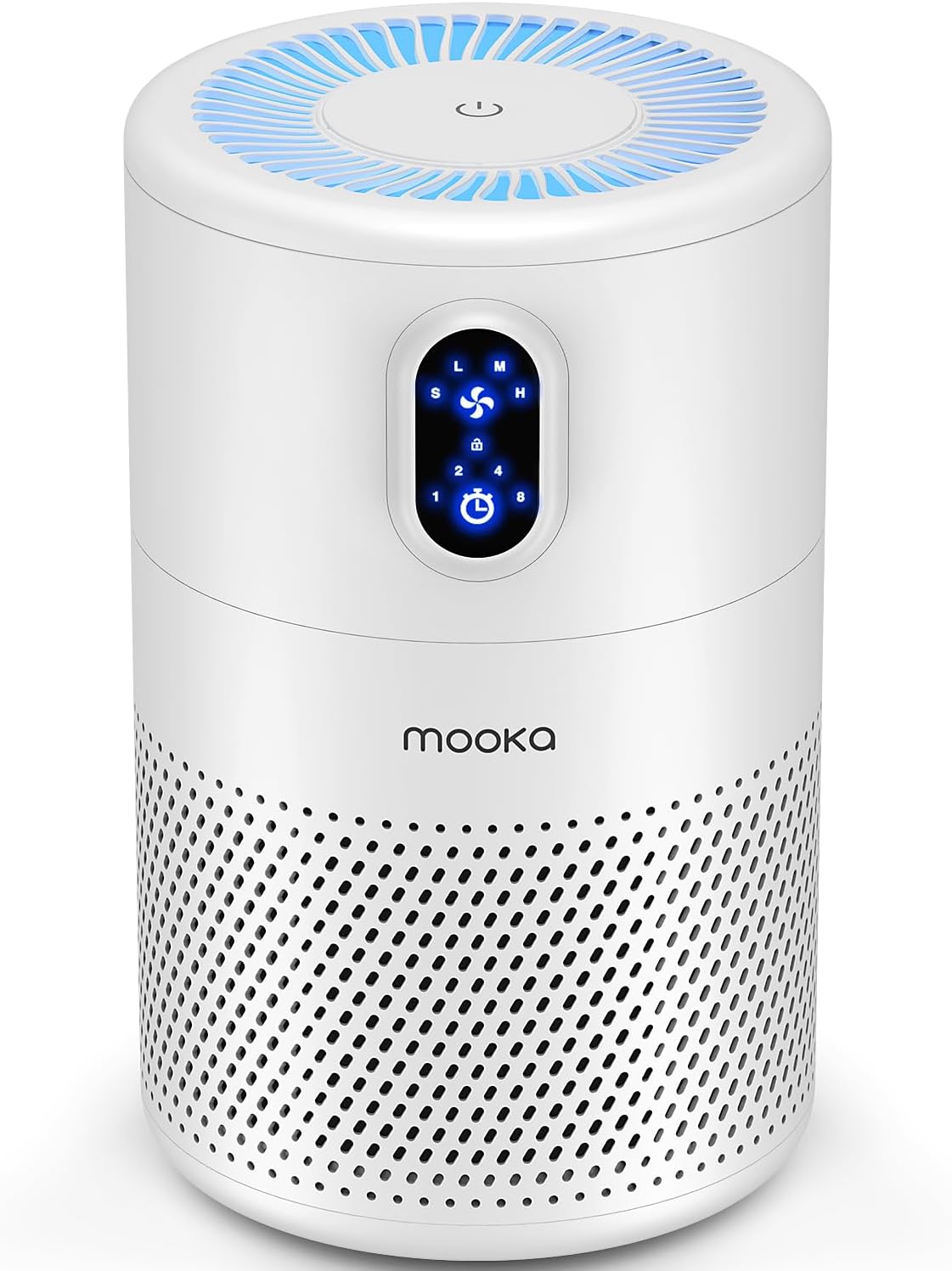
| Effective Area | 1076 sq ft |
|---|---|
| Filter Type | H13 True HEPA + activated carbon |
| Fan Modes | Sleep/Low/Med/High |
| Timer Settings | 1/2/4/8 hours |
The MOOKA B-D02L is a compact air purifier built to clean indoor air in small to large rooms by combining a pre-filter, H13 True HEPA filter, and an activated carbon layer to capture dust, pollen, pet dander, smoke and common odors. It is typically placed on a floor or table in bedrooms, living rooms, nurseries or offices and can run continuously or on timed cycles using one of four timer settings. Practical controls include four fan speeds (Sleep/Low/Med/High), a child lock, filter-change reminder and a soft night light that can be turned off. The unit emphasizes quiet, energy-efficient operation thanks to a brushless motor with a very low noise level on sleep mode, and it offers a claimed coverage up to 1076 sq ft with slower air changes at the upper end and faster circulation in smaller rooms. Limitations to note are that the stated maximum coverage reflects a single air change rate and real-world performance depends on room layout and source strength, and filters should be replaced every three to six months depending on use.
Best for: Buyers who prioritize quiet, energy-efficient air cleaning and simple, dependable controls for bedrooms, living spaces or nurseries and want a unit that is easy to maintain.
Less Ideal for: Users seeking rapid whole-house purification for large open floor plans or those who need integrated smart home connectivity should consider more powerful or networked systems.
- H13 True HEPA plus activated carbon captures particles down to 0.3 microns and reduces odors
- Ultra-quiet brushless motor enables near-silent sleep mode suitable for bedrooms
- Multiple timer and fan speed options allow scheduled, energy-saving operation
- Child lock and filter reminder add simple safety and maintenance convenience
- Specified maximum coverage (1076 sq ft) corresponds to a low air-change rate at that size and may not deliver rapid purification in very large open areas
- Replacement filters require periodic purchase and the 3–6 month lifespan varies with environment
Verdict: A quiet, energy-efficient HEPA purifier with simple controls and practical safety features that fits bedrooms and living spaces where low noise and easy maintenance matter.
FULMINARE H13 HEPA Air Purifier

| Filter type | H13 HEPA |
|---|---|
| Coverage | Up to 215 sq ft / 20 m² |
| Noise level (low) | Around 24 dB |
| Timers | 2, 4, 8, 10, 12 hours |
The FULMINARE H13 is a small, portable air purifier designed for single rooms up to about 215 sq ft. It uses an H13 HEPA filter and a 360 degree outlet with dual-channel airflow to cycle room air multiple times per hour, which helps reduce dust, pet hair, smoke, and odors. Controls include multiple fan speeds, a near-silent sleep mode (roughly 24 dB at low speed), an independent night light, and selectable timers from 2 to 12 hours, making it convenient for bedrooms or offices. Setup is simple: plug in via the base and remove the filter wrap before first use, and replacement filters are available separately. Because it is compact and portable, it is easy to move between rooms, but the modest coverage limits it to smaller spaces and it lacks advanced features like air-quality sensors or Wi-Fi connectivity. Expect routine filter replacements and basic performance appropriate for budget-focused buyers rather than whole-home purification.
Best for: Buyers who want an affordable, simple air purifier for a single bedroom or office and prioritize quiet, easy operation and portability.
Less Ideal for: Homes needing whole-house purification, users who want smart features or real-time air-quality feedback, or larger open spaces over 215 sq ft.
- H13 HEPA filter for fine particle removal
- 360° outlet and dual-channel design for even room circulation
- Very quiet sleep mode suitable for bedrooms
- Built-in night light and multiple timer settings
- Compact and portable for easy placement
- Coverage limited to small rooms (~215 sq ft)
- No air-quality sensor or smart connectivity features
- Requires regular filter replacements
Verdict: A budget-friendly bedroom/office purifier that delivers H13 HEPA filtration, whisper-quiet operation, and simple timer/night-light features for small rooms.
ECOSELF HAP603 Air Purifier

| Item model number | HAP-603 |
|---|---|
| Coverage | Up to 2400 ft² (manufacturer claim) |
| Noise level | 22 dB (Sleep Mode) |
| Filter efficiency | Captures 99.97% of airborne particles |
The ECOSELF HAP603 is a large-room air purifier that combines a True HEPA-style 2X filtration system with automated air-quality sensing and quiet operation. It is typically used in living rooms, open-plan spaces, or bedrooms where continuous removal of smoke, dust, pet dander, and odors is desired; the PM2.5 display and infrared sensor adjust fan speed automatically in Auto/Smart mode. Notable features include a 360-degree outlet, sleep mode rated at 22 dB, timer and child-lock controls, a filter-replacement indicator, and an aromatherapy slot for light scenting. Practical benefits are straightforward: strong claimed coverage for big spaces, low-noise overnight use, and simple maintenance with replaceable factory filters. Important limitations are that the 2400 ft² coverage is a manufacturer claim that depends on room layout and air changes, replacement filters are recommended to be OEM for best performance, and advanced smart-home integrations or specific CADR numbers are not provided in the listing.
Best for: Buyers who prioritize a reliable, easy-to-run purifier for large living spaces and want automatic air-quality adjustments with minimal fuss.
Less Ideal for: Those who need verified CADR ratings, deep technical performance data, or built-in smart-home integrations should consider alternatives offering detailed metrics and connectivity.
- True HEPA-grade 2X filtration intended to capture 99.97% of particles
- Real-time PM2.5 display and infrared sensor for automatic fan-speed adjustment
- Very quiet sleep mode (22 dB) suitable for bedrooms
- Filter indicator and simple controls make maintenance easy
- Manufacturer coverage claim (2400 ft²) may not match real-world ACH/CADR performance
- No CADR or detailed performance metrics specified in the listing
- OEM replacement filters are recommended which may add ongoing cost
Verdict: A dependable, quiet large-room purifier with automatic PM2.5 sensing and factory-replacement filters for buyers who want low-maintenance, reliable air cleaning.
Levoit Core 300-P

| Filter Type | 3 in 1 Filtration |
|---|---|
| Floor Area | 1073 square_feet |
| Noise Level | 24 db |
| Particle Retention Size | 0.3 micron |
| Wattage | 56 watts |
The Levoit Core 300-P is a small, quiet HEPA air purifier built for everyday rooms where allergies, pets, smoke, or odors are a concern. It uses a three-stage filter (pre-filter, HEPA-grade filter, and activated carbon) driven by a 56W motor to deliver a CADR that refreshes air in medium rooms quickly while maintaining a low 24 dB Sleep Mode for overnight use. Controls are touch-based with a timer and display lights that can be turned off for undisturbed nighttime operation. Certifications such as AHAM VERIFIDE, CARB compliance, and ETL listing back the performance and safety claims, and Levoit recommends using their genuine replacement filters for best results. The unit lacks smart connectivity and Auto Mode compared with some variants, so fan speeds are manually adjusted, and the effective coverage figures assume the original filters. It is portable and energy efficient for continuous operation, but buyers should plan on replacing filters every 6 to 8 months depending on use and pollutant load.
Best for: Buyers who value proven, well-reviewed performance and certified filtration in bedrooms or medium rooms and want a quiet, easy-to-use purifier backed by a strong customer track record.
Less Ideal for: Users seeking Wi-Fi control, app features, or automatic air-quality-driven fan control should consider models with smart connectivity and Auto Mode instead.
- True HEPA-grade filtration capturing 99.97% of 0.1–0.3 μm particles
- Quiet Sleep Mode down to about 24 dB for overnight use
- AHAM VERIFIDE and ETL/CARB certifications for verified performance and safety
- Compact and portable design suitable for bedrooms and medium rooms
- Includes pre-installed 3-stage original filter and straightforward touch controls
- No smart connectivity or Auto Mode on this model, requiring manual speed adjustments
- Coverage and CADR figures apply to Levoit original filters and may not hold with third-party replacements
Verdict: A compact, certified HEPA air purifier that delivers quiet, reliable filtration for bedrooms and medium rooms backed by strong customer validation.
Levoit Vital 200S-P Air Purifier

| Floor Area | 1875 square_feet |
|---|---|
| Noise Level | 27 db |
| Particle Retention Size | 0.1 micrometer |
| Wattage | 51 |
| Filter Type | 3-Stage Filter |
The Levoit Vital 200S-P is a whole-room air purifier that combines a three-stage filter stack with smart app control and an onboard air quality monitor to manage allergens, pet dander, smoke, and odors. It is intended for large open spaces and can cycle a room up to 1,875 square feet in an hour using a high CADR; the unit reports a low operating noise level of 27 dB on its quiet setting and draws about 51 watts. Setup is straightforward with a pre-installed washable pre-filter plus an activated carbon and HEPA-style middle filter, and the app and button controls let you check air quality and switch modes remotely. Practical benefits include rapid removal of common household contaminants, replaceable specialty filters for pets or smoke, and CARB and AHAM-verified performance for buyers who prefer proven results. The main compromises are its physical footprint and weight compared with smaller travel-size purifiers and the ongoing cost and effort of replacing specialty filters for targeted problems like wildfire smoke or VOCs.
Best for: Buyers who prioritize verified, reliable whole-room cleaning and want simple smart controls and an air quality display to reassure them the unit is working.
Less Ideal for: People who need a highly portable or very small unit for occasional spot use or who prefer a minimalist appliance with no ongoing filter purchases.
- AHAM verified CADR for smoke, dust, and pollen supports reliable whole-room performance
- Three-stage filtration with washable pre-filter plus activated carbon for odors and a HEPA-grade layer for fine particles
- Smart app control and onboard air quality monitor for remote management and visible feedback
- Low noise level on sleep mode makes it suitable for bedrooms and quiet living areas
- Options for specialty replacement filters (pet, smoke, toxin) to tailor performance to specific problems
- Relatively large and heavier than compact travel-sized purifiers which may limit placement flexibility
- Requires periodic purchase of replacement specialty filters for best results
Verdict: Choose the Vital 200S-P when you want AHAM-verified, smart whole-room air cleaning with configurable filters for pets, smoke, or toxins.
Choosing the Right Air Purifier for Home Best Rated: Key Factors to Consider
Filtration Type and Efficiency
The filter media determines what the purifier actually removes. True HEPA-style filters capture fine particles such as pollen, dust, and many respiratory aerosols, while additional activated carbon layers reduce common household odors and some volatile organic compounds. Knowing the filter type helps you match a purifier to your needs, whether that is allergy relief, smoke removal, or chemical odor reduction.
Filter efficiency also affects long-term cost and performance. Higher-efficiency filters trap more particles but can increase fan work and power draw. Check manufacturer-stated particle capture ratings and whether the unit uses genuine, replaceable filter elements rather than permanent, nonserviceable media.
Room Coverage and CADR
Pick a unit rated for the actual room size where it will run most of the time. Clean Air Delivery Rate or comparable metrics estimate how quickly a purifier can cycle and reduce airborne particles in a space. A purifier undersized for the room will underperform and run continuously at high speed, increasing noise and energy use.
Consider how the purifier will be positioned and whether adjacent rooms share airflow. Open-concept areas need higher coverage or multiple units. Also evaluate how coverage is measured: many ratings assume ideal conditions, so choose a unit with some headroom above your room's square footage.
Noise and Daily Comfort
Air purifiers run continuously in many homes, so noise performance at common settings matters. Manufacturers list decibel levels, but perceived loudness depends on fan speed, motor design, and casing. Look for low-noise modes suitable for sleep, and check how loud the unit is at medium and high speeds for daytime use.
Consider whether you need a sleep-friendly mode with dimmed indicators or automatic fan reduction. Noise also influences placement options; quieter units can sit in bedrooms, while louder high-output units may be better suited to living rooms or basements.
Energy Consumption and Run-Time Costs
A purifier that runs 24/7 can add noticeable energy usage. Energy-efficient motors and fan designs reduce operating costs over time, especially when you need continuous filtration. Compare typical wattage at common fan speeds and whether the unit has features such as programmable timers or occupancy sensors to limit run time when not needed.
Lower energy draw becomes especially important for larger homes or when multiple units are required to cover several rooms. Factor potential electricity cost into long-term budgeting alongside filter replacement costs.
Maintenance, Filter Availability, and Cost
Maintenance frequency and the availability of replacement filters determine the ongoing effort and cost of ownership. Units with simple filter-access panels and clear replacement intervals make upkeep straightforward. Also check whether replacement filters are sold through multiple channels and whether the manufacturer provides clear guidance on when to change them.
Consider whether the purifier uses multi-stage disposable filters or washable pre-filters that extend the life of primary media. Upfront savings on a cheaper unit can be offset by high filter replacement frequency or expensive media, so estimate annual maintenance costs before deciding.
Controls, Automation, and Usability
Usability features influence how often you keep the purifier running and therefore how effective it is. Look for intuitive controls, useful presets (sleep, auto, turbo), and clear filter-replacement indicators. Smart features such as air-quality sensing and automatic fan adjustment can optimize performance without constant manual changes.
However, complexity adds potential failure points. If you prefer a simple, set-and-forget device, prioritize straightforward interfaces and reliable auto modes over extensive app ecosystems. For homes with multiple users, easy-to-read indicators and child-lock options may be valuable.
How Much Filtration Do You Really Need?
Assess your household triggers and room usage before choosing a purifier. For seasonal allergies, a unit focusing on efficient particulate removal is most important. For frequent cooking odors, smoke, or VOCs, prioritize models with activated carbon or dedicated gas-phase media.
Consider whether you need whole-room coverage or targeted filtration. Bedrooms and living rooms are common priorities, but in open layouts you may need units with higher CADR or multiple smaller purifiers placed strategically.
- Bedrooms: prioritize low-noise operation and reliable particulate removal.
- Living areas: emphasize higher CADR and larger coverage area.
- Kitchens or smoke-prone rooms: include carbon or gas-phase filtration.
Placement and Airflow Tips
Proper placement improves performance. Place the purifier where airflow is unobstructed and at least a few inches from walls or furniture. Elevated placement can help distribute cleaned air more evenly in small rooms.
Avoid hiding the intake or exhaust behind large objects. If the unit has directional vents, orient them to promote circulation toward occupied areas. In multiroom homes, place purifiers where circulation paths draw air from adjacent spaces for better whole-home benefit.
- Keep clearances recommended by the manufacturer for intake and exhaust.
- Position units away from heavy dust sources to reduce filter clogging.
- Use multiple smaller units for zoned cleaning in open-plan homes.
Smart Features and Automation: Useful or Gimmick?
Air-quality sensors and automatic fan control are helpful when they are accurate and responsive. Good sensors adjust fan speed to real changes in particulate or VOC levels, reducing noise and energy use when air is already clean.
App connectivity and voice control can add convenience but are not essential. If you value hands-off operation, prioritize reliable auto modes and clear onboard indicators over an expansive app feature set.
- Auto modes reduce manual adjustments and save energy when effective.
- Check whether sensors report particle counts or only relative air-quality levels.
- Opt for units that still provide manual controls in case of connectivity issues.
Maintenance Best Practices
Regularly inspecting pre-filters and following recommended replacement intervals keeps performance consistent. Vacuum or wash pre-filters if the design allows to extend the life of primary filters and maintain airflow.
Keep a maintenance schedule and replace main filter elements before they become severely clogged. Clogged filters reduce airflow and increase motor strain, which can reduce filtration effectiveness and shorten the unit's lifespan.
- Record filter change dates and approximate costs to budget annual ownership.
- Check for replacement filter availability before committing to a model.
- Clean external grills and sensors as part of routine upkeep.
When to Use Multiple Units
Multiple smaller purifiers can be more effective than one oversized unit when you need targeted cleaning in separate rooms. They reduce the need to move a single purifier and can be placed where people spend the most time.
Using multiple units also allows different settings by room. For example, run a quiet unit in the bedroom at night and a higher-output unit in the living room during the day for activity-related pollutant control.
- Match each unit to the room size for predictable coverage.
- Coordinate runtimes so filters age evenly and replacement planning is simpler.
- Consider energy implications of operating multiple devices continuously.
How We Chose the Best Air Purifier for Home Best Rated
We selected units that demonstrate strong, verifiable performance for common home environments. Our editorial filters prioritized measured particle removal and filter composition, consistent low-noise operation at typical fan speeds, and convenient maintenance features that reduce ongoing cost and hassle. We also checked coverage claims against realistic room sizes and assessed energy consumption for continuous use. Evaluation criteria included the type and quality of filters, CADR or equivalent particle removal performance, noise at different fan settings, energy use during continuous operation, and physical usability factors such as filter-change access and control simplicity. We excluded units designed only for vehicles, personal wearables, or single-use specialty devices that do not suit whole-room home use. Units with unclear filtration specifications or unverifiable coverage claims were not considered. The result is a shortlist of practical, home-focused air purifiers that balance effectiveness, quietness, and user-friendly maintenance.
Our full evaluation process is outlined in our review methodology.
FAQ
How often should I run an air purifier at home?
Running a purifier continuously is common for persistent issues like allergies or indoor smoke, but many households use 8 to 24 hours per day depending on needs. Use auto modes and timers to balance filtration with energy use.
Do air purifiers remove viruses and bacteria?
High-efficiency particulate filters capture many airborne particles, including some bacteria and virus-laden aerosols, but removal depends on particle size and airflow. For comprehensive infection control, purifiers are one part of a broader strategy including ventilation and hygiene.
Is a HEPA filter necessary for home use?
True HEPA filtration is recommended for reliable particulate removal, especially for allergy sufferers. For odor and chemical reduction, combine HEPA with activated carbon or dedicated gas-phase media.
How do I know when to replace filters?
Follow the manufacturer's recommended intervals and watch filter-replacement indicators when available. Visible discoloration, reduced airflow, or increased noise at the same fan speed are practical signs it is time to replace filters.
Will an air purifier reduce household odors from cooking?
Units with activated carbon or other gas-phase media can reduce many common cooking odors and VOCs, but heavy or persistent smells may need additional ventilation or source control for full elimination.
Final Verdict
Choose an air purifier that matches the rooms you use most, balancing filtration efficiency with acceptable noise and manageable maintenance costs. Prioritize proven filter media for the pollutants you want to remove, and give some extra coverage headroom for real-world conditions. Ultimately, pick a unit you will keep running. Automated controls, clear maintenance cues, and appropriate room coverage make it easier to maintain continuous filtration and achieve consistently better indoor air quality.