
Note: This article contains affiliate links. If you click on these links and make a purchase, we may earn a small commission at no extra cost to you. This helps support our research and content. Read our full affiliate disclosure here.
If you are trying to reduce mold spores on a tight budget, the right low-cost air purifier can make a measurable difference in indoor air quality. Units under $100 focus on core filtration and compact room coverage, so choosing one that targets mold-sized particles and fits your space is important. This guide shortlists seven top options that balance true HEPA-style filtration or high-efficiency particulate capture, fan performance, and ongoing operating costs. Below you will find concise evaluations of each shortlisted unit and the criteria we used to judge them, helping you pick an affordable purifier that matches the size of the room and your maintenance preferences.
Top Picks at a Glance
| Best Overall The best all-around choice for most situations | Afloia KILO Air Purifier |  |
| Best Quality Built to a higher standard if you want something more solid | GermGuardian AC4825E Tower Air Purifier |  |
| Best Value The sweet spot between price and what you get | MOOKA B-D02L Air Purifier |  |
| Best Budget The cheapest option that still gets the job done reliably | AromaRoom AP103-A Air Purifier |  |
| Top Rated A top-rated pick with lots of positive feedback | Levoit Core 300-P |  |
| Most Popular A crowd favorite that many people choose with confidence | VOOPNU H13 HEPA Air Purifier DH-JH12 |  |
| Best Seller A high-volume bestseller chosen again and again | Levoit Core Mini-P |  |
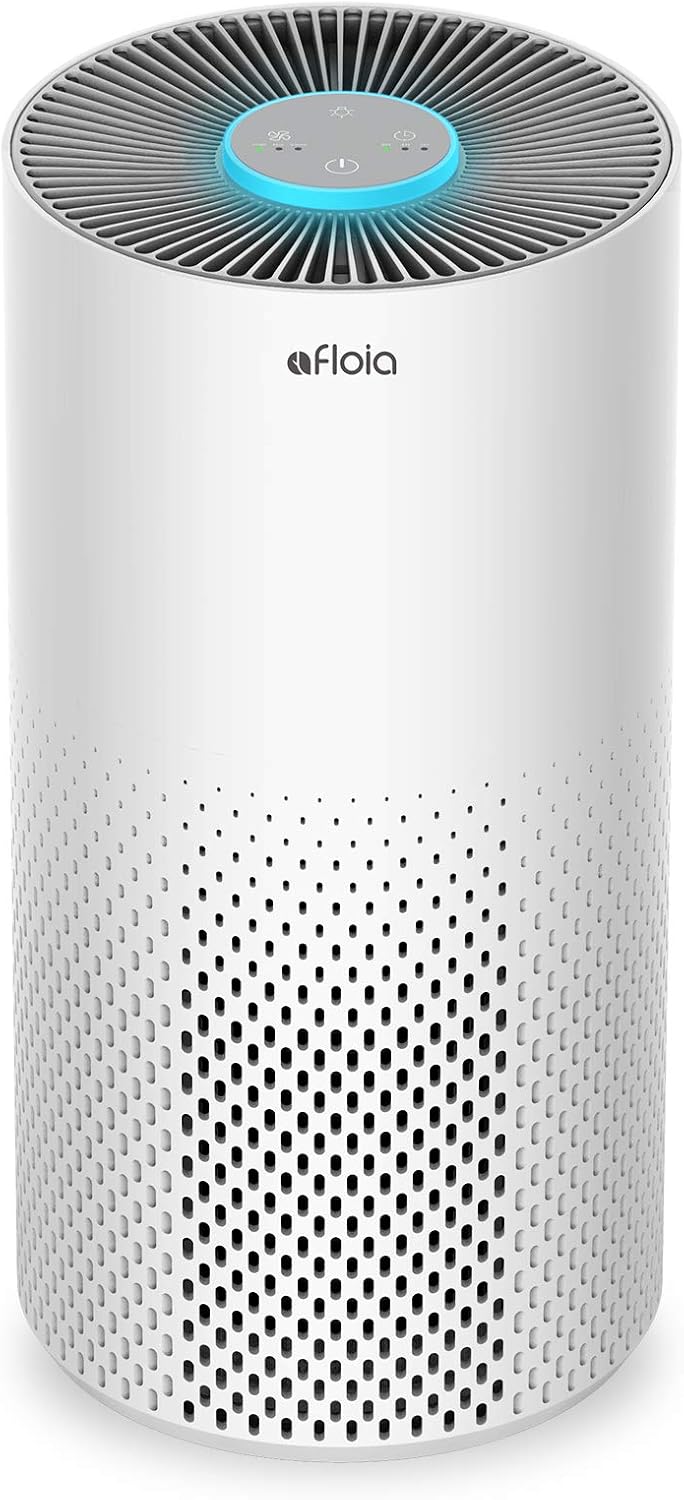
Afloia KILO Air Purifier
| Noise Level | 22 db |
|---|---|
| Particle Retention Size | 0.3 micron |
| Wattage | 23 watts |
| Contaminant Filtration Capability | Dust, Odors, Pet Dander, Pet Hair, Pollen, Wildfire Smoke |
| Filter Type | Activated Carbon |
The Afloia KILO is a compact room air purifier built around a washable pre-filter plus multi-layer filtration that targets dust, pet hair, pollen, odors and smoke down to 0.3 microns. It is designed for everyday use in bedrooms, living rooms and small apartments and offers adjustable fan speeds, a 2/4/8/16-hour timer and an ultra-quiet 22 dB sleep mode for overnight operation. The removable pre-filter reduces maintenance by catching larger particles and is washable, while replacement filter options (standard, pet allergy, antibacterial) let you tailor performance to specific concerns. Practical extras include a seven-color ambient light that auto-dims and simple touch/button controls for straightforward operation. Limitations are its compact footprint and rated coverage, which targets single rooms rather than whole houses, and you will need to replace specialty filters every few months for peak performance. For buyers who want a quiet, easy-to-maintain purifier for a bedroom or living space, the KILO delivers solid everyday cleaning without complicated controls.
Best for: Buyers who want a simple, quiet purifier for a bedroom or living room that is easy to maintain and customizable with specialty replacement filters.
Less Ideal for: People who need whole-house purification or high-CADR performance for very large rooms should consider larger units instead.
- 4-stage filtration including washable pre-filter reduces larger particles and simplifies maintenance
- Very quiet 22 dB sleep mode suitable for overnight use
- Adjustable timer and fan speeds for flexible daily scheduling
- Removable pre-filter and multiple replacement filter options for pet or antibacterial needs
- Intended coverage is for single rooms and may be insufficient for larger open areas
- Replacement filters require periodic purchase to maintain peak filtration
Verdict: A quiet, easy-to-maintain room purifier that gives balanced everyday filtration and sleep-friendly operation for bedrooms and small living spaces.
GermGuardian AC4825E Tower Air Purifier

| Model | AC4825E |
|---|---|
| Fan speeds | 3 |
| HEPA efficiency | 99.97% down to 0.1 microns |
| Room coverage (cycle) | 153 sq. ft. every 12.5 minutes; up to 743 sq. ft. hourly |
The GermGuardian AC4825E is a compact tower purifier that combines a True HEPA filter, activated carbon pre-filter, and optional UV-C sanitizer to tackle airborne particles, odors, and some microbes. It is typically placed in bedrooms, living rooms, or basements and run continuously on one of three fan speeds; the manufacturer reports it circulates air in a 153 sq. ft. room every 12.5 minutes and can service larger spaces on a slower cycle. The HEPA filter captures 99.97% of particles down to 0.1 microns from air passing through the filter media, while the carbon layer helps reduce cooking and pet scents. The unit offers a quiet sleep mode for overnight use and uses widely available GermGuardian replacement Filter B and UV-C bulbs for maintenance. Limitations include reliance on an optional UV-C bulb for additional microbial control and the fact that room circulation time depends on placement and room layout, so it may be less effective in very large open areas or improperly positioned installations.
Best for: Buyers who prioritize proven particle removal and steady continuous operation for bedrooms, basements, or living spaces and want a straightforward unit with replaceable, factory-quality filters.
Less Ideal for: People who need near-instant purification for very large open-plan areas or want built-in advanced sensors and smart-home controls.
- True HEPA filter captures 99.97% of particles down to 0.1 microns
- Activated carbon pre-filter reduces common household odors and VOC-related scents
- Three fan speeds including a quiet sleep mode for overnight use
- Covers small rooms quickly and is rated for much larger rooms on a slower cycle
- Uses standard GermGuardian replacement filters and bulbs for easy maintenance
- UV-C sanitizer is optional rather than built into standard filtration
- Effectiveness depends on room layout and placement for full coverage
Verdict: A reliable, filter-focused tower purifier that delivers proven HEPA particle removal and simple maintenance for rooms where steady, performance-oriented cleaning matters.
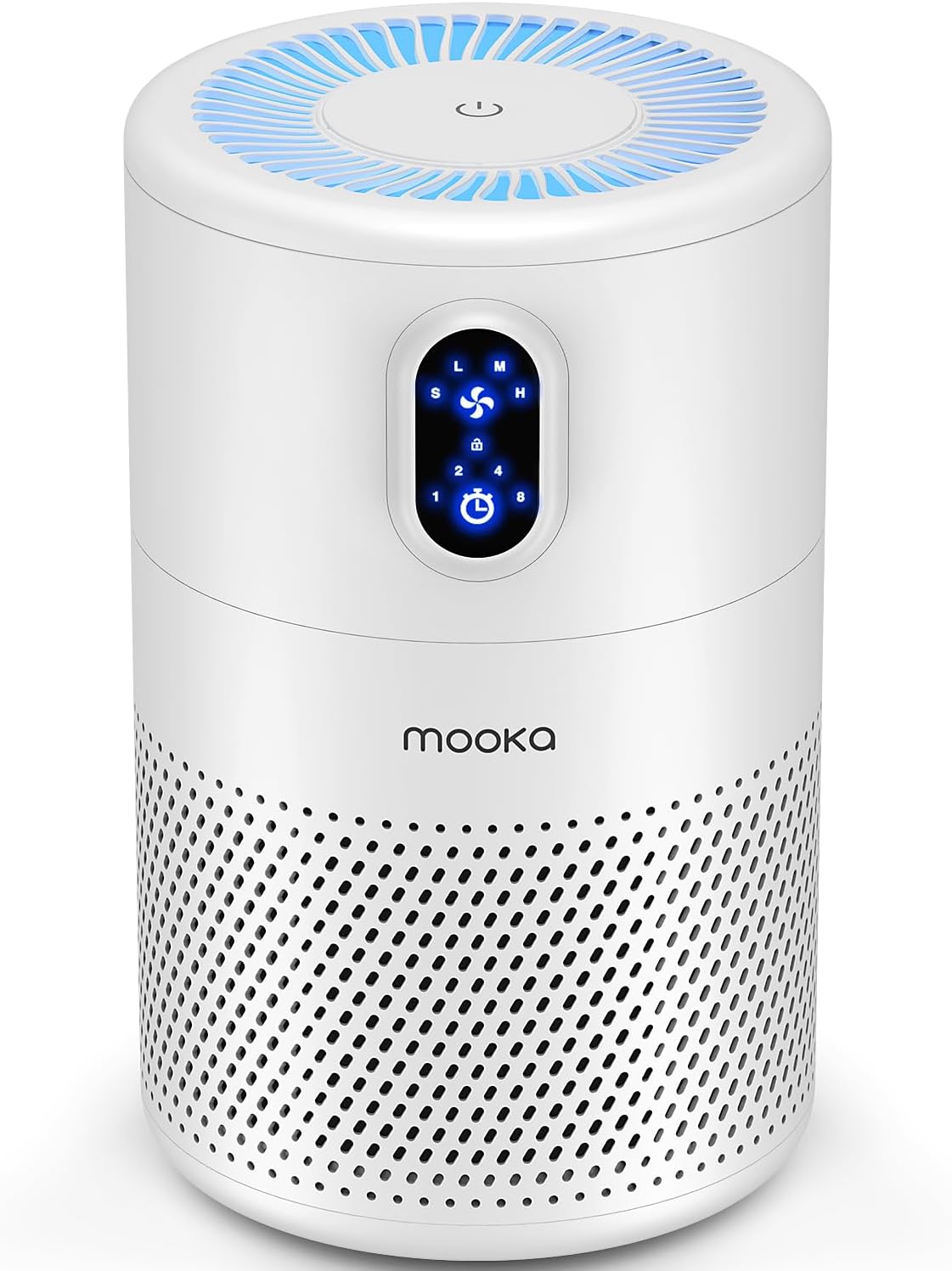
MOOKA B-D02L Air Purifier
| Effective Area | 1076 sq ft |
|---|---|
| Filter Type | H13 True HEPA + activated carbon + pre-filter |
| Noise Level | ~20 dB (low setting) |
| Timer | 1/2/4/8 hours |
The MOOKA B-D02L is a small, energy-efficient air purifier built around an H13 true HEPA filter plus an activated carbon stage and a washable pre-filter to capture dust, pollen, pet dander, smoke and odors. It is intended for whole-room coverage claims up to 1,076 sq ft with higher air-change rates in smaller spaces; typical daily use is continuous or scheduled with its 1/2/4/8 hour timer and four fan speeds including a quiet sleep mode. Practical controls include a child lock, a soft night light you can turn off, and a brushless motor that reduces noise to very low levels on the lowest setting. Filters are user-replaceable and the manufacturer recommends a 3–6 month replacement interval depending on environment. Trade-offs are that actual performance against mold spores depends on placement and room mixing, and replacement filters are required regularly; also the unit is compact so expect lower peak CADR than larger, more powerful purifiers. For someone optimizing cost and quiet operation, it provides solid HEPA filtration in an easy-to-use package.
Best for: Buyers who want a budget-friendly, quiet HEPA purifier that is easy to run on a schedule and fits small-to-medium living spaces where steady particle removal and low noise are priorities.
Less Ideal for: People who need industrial-strength filtration for large open-plan homes or near-immediate removal of heavy mold outbreaks should consider higher-CADR, larger-capacity units or professional remediation instead.
- H13 true HEPA filter captures particles down to 0.3 microns
- Activated carbon layer helps reduce common household odors and smoke
- Multiple timers and four fan speeds including a very quiet sleep mode
- Child lock and simple top controls make operation straightforward
- Room coverage and mold removal depend on proper placement and room air circulation rather than the unit alone
- Requires filter replacements every 3–6 months depending on use
Verdict: A quiet, budget-minded HEPA purifier that delivers practical daily particle and odor control for small to medium rooms under $100.
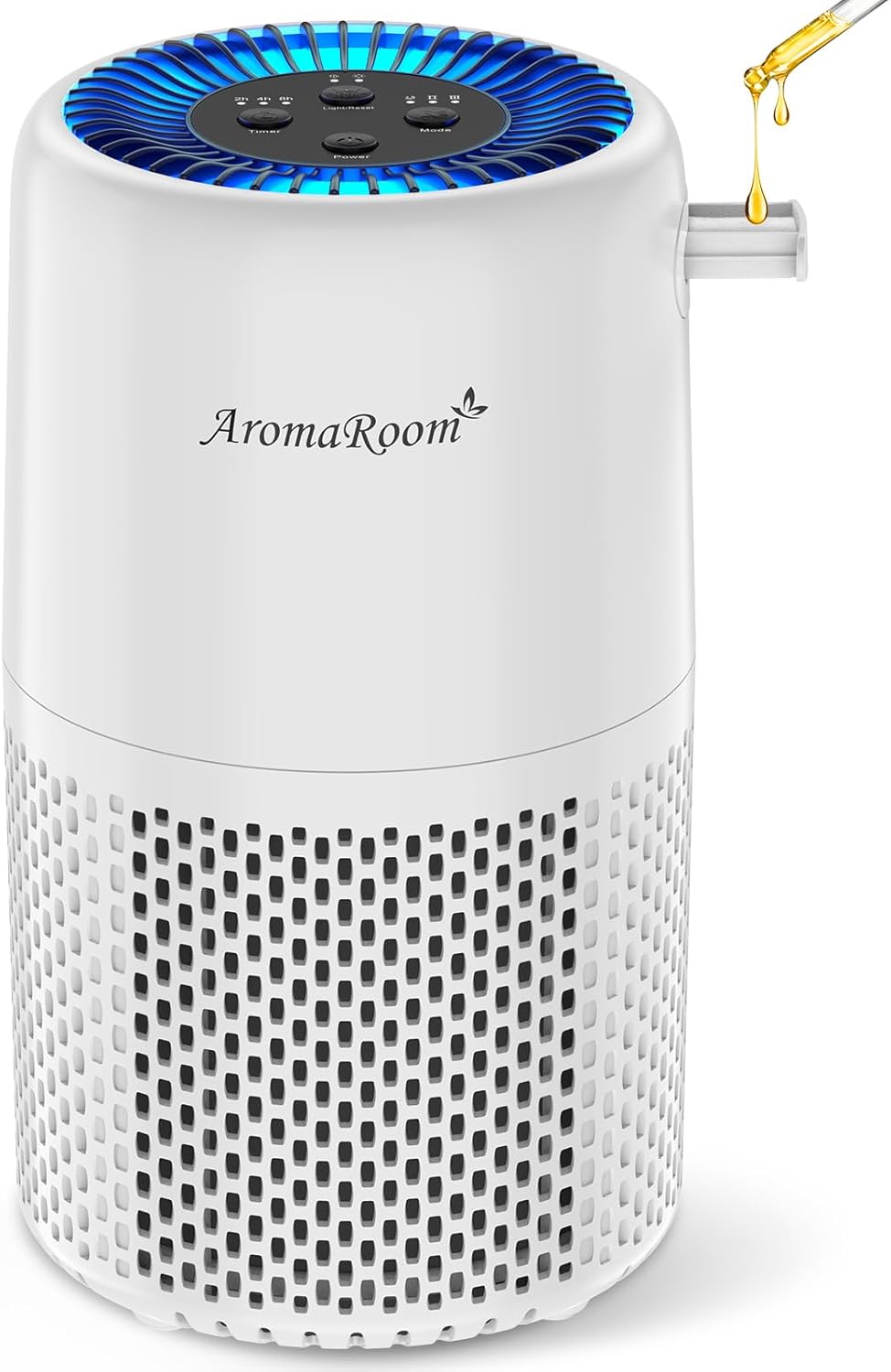
AromaRoom AP103-A Air Purifier
| Filtration | True H13 HEPA 3-in-1 |
|---|---|
| Coverage | Circulates air twice/hour in ~323 ft² |
| Noise (sleep) | 22 dB |
| Timer | 2/4/8 hours |
The AromaRoom AP103-A is a small, budget-friendly air purifier designed for bedrooms and similarly sized rooms. It uses a True H13 HEPA 3-in-1 filter and a dedicated smoke remover layer to capture fine particles including dust, pollen, pet dander, and smoke-sized particulates, and the manufacturer rates it to circulate air twice per hour in a roughly 323 ft² room. Operation is straightforward: power on, choose a fan speed, set a 2/4/8 hour timer, or engage sleep mode that lowers noise to about 22 dB. The unit also includes an aroma pad for light scenting. For everyday use it is quiet, portable, and simple to maintain; the filter is replaceable and the brand recommends changing it every 3 to 6 months. The trade-offs are expected for a compact purifier — it is tailored to small to medium spaces and will not match the CADR or run-time features of larger, more expensive models, and it should be kept out of very humid areas. For buyers on a tight budget looking to reduce airborne mold spores and household particulates in a single room, this offers a solid, quiet option with aroma capability.
Best for: Buyers who need a low-cost, quiet purifier for a bedroom or single living space and prioritize simple operation and compact footprint over high-capacity performance.
Less Ideal for: People seeking high CADR performance for large open-plan areas or continuous whole-house dehumidification and mold remediation should choose a larger, higher-capacity unit.
- True H13 HEPA 3-in-1 filter captures fine particles and smoke-sized particulates
- Rated to circulate air twice per hour in a room up to about 323 ft²
- Very quiet sleep mode down to approximately 22 dB
- Includes aroma pad for optional light fragrance
- Simple controls with 2/4/8 hour timer settings
- Designed for small to medium rooms so it is not sufficient for whole-house purification
- Filter replacement recommended every 3–6 months increases ongoing cost
- Not intended for high-humidity locations such as bathrooms
Verdict: AromaRoom AP103-A delivers quiet, H13 HEPA filtration and aroma capability in a compact, budget-friendly package ideal for cleaning the air in a single room under $100.
Levoit Core 300-P

| Filter Type | 3 in 1 Filtration |
|---|---|
| Floor Area | 1073 square_feet |
| Noise Level | 24 db |
| Particle Retention Size | 0.3 micron |
| Wattage | 56 watts |
The Levoit Core 300-P is a compact HEPA air purifier built to clean indoor air in bedrooms, living rooms, or small open spaces. It uses a 3-stage filtration system with a pre-filter, True HEPA-grade filter and activated carbon to capture 99.97% of particles down to 0.1–0.3 microns and reduce odors and VOCs. The unit runs quietly, dropping to about 24 dB in Sleep Mode, and offers touch controls, a timer, and a filter indicator for practical day-to-day use. Its 56W motor and manufacturer CADR numbers mean it can refresh air in a 222 ft² room multiple times per hour and still cover larger areas intermittently. The Core 300-P is portable and ETL/CARB/AHAM certified, so setup and operation are straightforward and safe for typical home environments. Limitations include the absence of smart or automatic sensing on this model, so you must manually adjust fan speed rather than relying on Auto Mode, and replacement filters are recommended regularly to maintain peak performance.
Best for: Buyers who prioritize a proven, certified purifier that consistently removes fine particles and odors in bedrooms or small living areas and value quiet, reliable operation.
Less Ideal for: People who want smart features or automatic air-quality driven controls or those needing continuous whole-house coverage should consider different solutions.
- True HEPA-grade 3-stage filtration captures ultrafine particles and common allergens
- Activated carbon layer reduces odors and VOCs
- Very quiet Sleep Mode at about 24 dB for night use
- AHAM, CARB, and ETL certifications for verified performance and safety
- Compact and portable footprint for easy placement around the home
- No auto mode or air quality sensor on this model, requiring manual speed changes
- Requires periodic filter replacements to retain stated performance
Verdict: Choose the Core 300-P when you want a compact, certified HEPA purifier that quietly delivers consistent particle and odor removal for reliable day-to-day mold and allergen control.
VOOPNU H13 HEPA Air Purifier DH-JH12

| Model | DH-JH12 |
|---|---|
| Filtration | H13 True HEPA triple-layer |
| Coverage (lab) | 250 ft² per 15 minutes / up to 1,076 ft² per hour |
| Noise | 22 dB (low) |
The VOOPNU DH-JH12 is a small footprint air purifier that uses an H13 True HEPA triple-layer filter and 360 degree intake to capture fine particles and common household pollutants. It is intended for continuous use in bedrooms, home offices, or living areas and the manufacturer reports it can clean roughly 250 ft² every 15 minutes, covering up to about 1,076 ft² per hour in lab testing. Controls are simplified for one‑tap operation, and the unit runs quietly (as low as 22 dB) with three fan speeds, a timer, and a small essential oil tray for mild scenting. It includes certifications such as CARB, ETL, FCC, and DOE, which supports performance and safety claims. Practical limits are its compact size and implied airflow: while the CADR-style coverage figures are strong for its class, a single small purifier will be less effective in large open spaces or heavily moldy areas where source control and ventilation are also needed. Filter replacements are recommended every few months depending on use and air quality.
Best for: Buyers who want a certified, easy-to-use purifier for bedrooms or small living spaces and who weigh real customer feedback and safety credentials when choosing a budget device.
Less Ideal for: Those needing a whole-home solution or remediation-level filtration for active mold outbreaks should look at larger, higher‑capacity purifiers or professional services.
- H13 True HEPA triple-layer filter captures 99.97% of fine particles
- 360° air intake for more even room circulation
- Very quiet operation down to 22 dB suitable for bedrooms
- Simple one‑tap controls with timer and three speeds
- Multiple safety and performance certifications (ETL, CARB, DOE, FCC)
- Coverage claims based on lab testing may not match real-world performance in larger or heavily contaminated rooms
- Compact unit has limited raw airflow compared with larger purifiers
Verdict: A compact, certified H13 HEPA purifier that offers quiet, easy operation and credible performance for bedrooms and small rooms under $100.
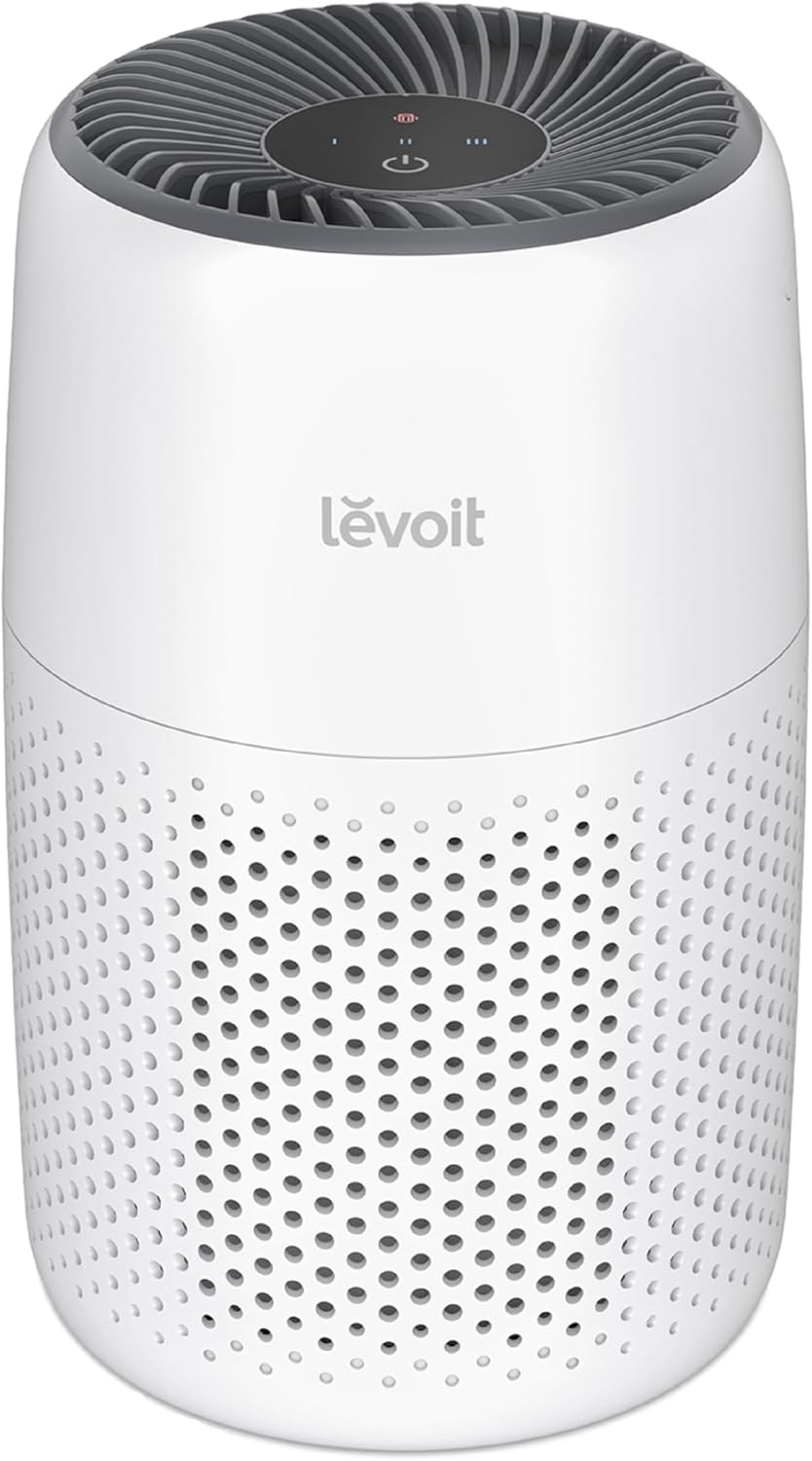
Levoit Core Mini-P
| Rated Power | 7W |
|---|---|
| Noise Level | 27–45 dB |
| AHAM Verified | Yes |
| Model | LAP-C161-WUS |
The Levoit Core Mini-P is a small desktop air purifier built for personal spaces like bedrooms, offices, and dorms. It pulls air through a pre-filter and main high-efficiency filter to capture lint, pet dander, dust, smoke and other fine particles, and it includes a fragrance sponge for light aromatherapy. Its rated power is about 7W, and the unit runs quietly in sleep mode with noise levels reported around 27–45 dB, so it is unobtrusive overnight. Practical features include an auto-off display and an easy-to-access filter for replacement, plus an internal adapter storage. The purifier is AHAM-verified for measured cleaning performance which is helpful if you prefer independently tested devices. Limitations are obvious: this is a personal, small-room unit so clean-air delivery will be limited in larger rooms or whole-home needs, and the fragrance sponge requires only a few drops or it can damage plastic. If you need a low-power, quiet purifier for a single room to reduce airborne mold spores and common allergens, this model is straightforward and simple to use.
Best for: Buyers who want a proven, low-power purifier for a single bedroom, office, or dorm and value quiet overnight operation and independent verification of performance.
Less Ideal for: People who need to clean air in large living rooms, open-plan areas, or multiple rooms at once should choose a larger-capacity purifier instead.
- Compact footprint fits on a desk or bedside table
- AHAM verification for independent performance testing
- Very low power draw (around 7W) for energy-conscious use
- Quiet sleep mode with low noise suitable for overnight operation
- Not sized for large rooms or whole-home air cleaning
- Fragrance sponge must be used sparingly to avoid damaging internal components
Verdict: A compact, AHAM-verified purifier that delivers quiet, energy-efficient particle removal for a single small room.
Choosing the Right Air Purifier for Mold Under $100: Key Factors to Consider
Filtration Type and Efficiency
The core job of an air purifier for mold is to capture airborne spores and other particulate matter. Look for true HEPA or high-efficiency composite filters that specify capture rates for 0.3 micron particles or list MERV-equivalent ratings. Higher stated efficiency means more spores removed per pass and fewer recirculation cycles needed to reach safer indoor concentrations.
A filter-only approach that moves a reasonable volume of air is preferable to ionizers that do not reliably remove particulates. If a unit uses a prefilter plus a HEPA-style stage, that combination helps protect the main filter and maintain long-term efficiency.
Room Coverage and Air Changes Per Hour
An effective purifier must match the size of the room where mold risk is highest. Manufacturers sometimes list square-foot coverage for a single air change per hour or for 4 to 5 air changes per hour. For mold control, more frequent air changes in problem areas reduce spore concentration more rapidly.
Estimate your room volume and compare it to the unit's stated coverage. In many small rooms, compact purifiers suffice. For larger rooms, one low-cost unit may not provide enough circulation, so plan placement or multiple units accordingly.
Noise and Usability
Devices running at higher fan speeds are more effective at reducing particulates quickly but can be noisy. Consider units with multiple fan speeds and a quiet mode for overnight use. Check whether controls are simple to operate and whether indicators for filter replacement or fan speed are clear.
A purifier that is easy to live with will be used more consistently. Consider size and weight too, since portable units are more likely to be repositioned to problem spots.
Maintenance and Filter Availability
Regular filter replacement is essential to maintain capture performance. Look for units with readily available replacement filters and clear replacement intervals. Some filters combine prefilter and HEPA stages in a single cartridge; replacing the whole cartridge is simpler but can increase long-term cost.
Check whether filters are washable or disposable. Washable prefilters can extend the life of the main filter and reduce operating costs, while disposable true HEPA filters offer predictable performance but ongoing expense.
Operating Cost and Energy Use
A low purchase price can be offset by high ongoing costs. Consider power consumption at typical fan settings and the frequency and price of replacement filters. Units with efficient fans that achieve good air changes at moderate wattage save money over time.
Also consider whether the unit has energy-saving features such as auto modes or timers that reduce runtime during low-risk periods. Over the course of months, these features reduce both energy use and total ownership cost.
How Air Purifiers Help With Mold
Air purifiers reduce airborne mold exposure by removing spores and other particulates from circulating air. While they do not address the root cause of mold growth, such as damp surfaces or leaks, they lower the number of spores that can settle and grow elsewhere.
For best results, pair a purifier with humidity control and source remediation. In rooms prone to condensation or high relative humidity, combining dehumidification with filtration reduces both spore production and airborne concentration.
- Targets airborne spores and particulates, not surface mold
- Most effective when combined with moisture control
- Placement near the problem area increases effectiveness
Placement and Setup Tips
Place the unit where air circulates freely and as close as practical to the suspected mold source. Avoid obstructing intake and outlet grills with furniture or curtains. For best coverage, aim to keep the purifier elevated off the floor on a stable surface or small stand to help distribute cleaned air through the breathing zone.
In multi-room layouts, a single low-cost purifier performs best in a single, well-defined space. If mold risk is spread across rooms, staggered placement or multiple units will be more effective than one underpowered device.
- Keep at least 12 inches of clearance around intake and outlet
- Avoid corners where airflow can be stagnant
- Operate at higher fan speeds during activities that raise spore counts, such as cleaning or moving stored items
Managing Humidity Alongside Filtration
Since mold thrives in damp conditions, reducing indoor humidity is an important complementary strategy. Aim to keep relative humidity below about 50 percent to make conditions less favorable for mold growth. Use dehumidifiers, exhaust fans, and ventilation to control moisture sources alongside your air purifier.
Even the best purifiers have limited effect if humidity stays high. In basements, bathrooms, and laundry areas, prioritize moisture removal first, then use filtration to reduce airborne spores that remain after source control.
- Combine a hygrometer with your purifier to track conditions
- Run exhaust fans during showers and cooking to reduce local humidity
- Address leaks and condensation promptly to prevent new growth
Filter Replacement and Care Best Practices
Follow manufacturer guidance for replacement intervals but adjust based on your environment. If you have heavy mold exposure, pets, or smoke, expect filters to saturate faster and require earlier replacement. Inspect prefilters monthly and vacuum or wash them when recommended.
When replacing filters, power down and unplug the unit. Note the filter orientation and track the replacement date so you can manage ongoing costs and ensure consistent performance.
- Keep a replacement schedule and log the installation date
- Use the recommended filter types to preserve airflow and capture rates
- Clean washable prefilters gently and allow them to fully dry before reinstalling
When to Use Continuous Vs Intermittent Operation
Continuous operation provides the most steady reduction in airborne spores, which is helpful in high-risk areas. However, running at lower fan speeds continuously can be an efficient compromise between noise, energy use, and filtration performance.
Intermittent high-speed operation is useful during and after activities that disturb dust and spores. Use timers or scheduled runs to boost air changes during those periods, then revert to a lower continuous setting for background protection.
- Continuous low-speed for background protection
- Temporary high-speed during cleaning or activity
- Use timers to align operation with occupancy and activities
How We Chose the Best Air Purifier for Mold Under $100
We focused on devices that deliver the specific filtration and airflow characteristics most relevant to reducing airborne mold spores while keeping the total purchase price under $100. Selection emphasized measurable filtration efficiency for particles in the 0.3 to 10 micron range, because mold spores are typically within that spectrum. We also prioritized units with documented CADR-equivalent performance or clear stated room coverage, quietness at low-to-medium speeds for night use, and manageable filter replacement costs. Additional filters included build reliability, simple maintenance, and user-focused controls like multiple fan speeds and timers. We excluded units that rely solely on ionization without effective particulate capture, and we filtered out products with unclear filtration specifications or lacking user-serviceable filters. The result is a group of compact, budget-focused purifiers that score well across filtration effectiveness, coverage, noise, ease of maintenance, and operating cost.
Our full evaluation process is outlined in our review methodology.
FAQ
Can an inexpensive air purifier really reduce mold spores?
Yes, budget air purifiers with effective particulate filters can reduce airborne mold spores, especially in small, contained spaces. Their effectiveness depends on filtration efficiency, fan speed, and how well the unit matches the room size.
Should I run the purifier 24/7 in a mold-prone room?
Running continuously at a low speed is often the best balance for ongoing reduction of spores without excessive noise or energy use. Increase to higher speeds during cleaning or when humidity is elevated to boost air changes temporarily.
Do I need a true HEPA filter to capture mold?
True HEPA filters are the most reliable at capturing small spores, but some high-efficiency composite filters offer comparable capture rates. Verify stated efficiency for 0.3 micron particles or MERV-equivalent ratings to ensure adequate performance.
How often should I replace filters in a mold-prone environment?
Replacement frequency depends on exposure and filter type. In mold-prone or high-dust environments, expect to replace main filters more frequently than the nominal interval, and check prefilters monthly for cleaning.
Can air purifiers remove mold on surfaces?
No. Purifiers only remove airborne particles and do not clean mold from surfaces. Surface remediation and moisture control are necessary to address the root cause of growth.
Final Verdict
When shopping for an air purifier under $100 to reduce mold spores, prioritize filtration efficiency and room coverage first, then balance noise, maintenance, and operating costs. A compact unit with a reliable HEPA-style filter and appropriate airflow for your room will lower airborne spore counts while you address moisture sources. Accept tradeoffs: lower-cost models may require more frequent filter changes or cover smaller rooms. Focus on matching the unit to the specific space and pairing filtration with humidity control to get the best real-world results.