
Note: This article contains affiliate links. If you click on these links and make a purchase, we may earn a small commission at no extra cost to you. This helps support our research and content. Read our full affiliate disclosure here.
If you want to lower indoor PM2.5 levels and protect household breathing health, choosing the right air purifier matters. PM2.5 particles are small enough to penetrate deep into lungs and can come from outdoor pollution, cooking, candles, and indoor activities. An effective air purifier reduces those fine particles reliably and fits the size and layout of the room where you need protection. This guide shortlists seven top air purifiers for PM2.5 control and explains the evaluation criteria we used. You will get practical notes on filtration performance, coverage, and daily use considerations to help you pick the best unit for your living room, bedroom, or workspace. Read on for the key tradeoffs and guidance before the product summaries.
Top Picks at a Glance
| Best Overall The best all-around choice for most situations | Levoit Core 600S-P |  |
| Best Quality Built to a higher standard if you want something more solid | Sans True HEPA Air Purifier |  |
| Best Value The sweet spot between price and what you get | GoveeLife Smart Air Purifier H7129 |  |
| Best Budget The cheapest option that still gets the job done reliably | FULMINARE H13 HEPA Air Purifier |  |
| Top Rated A top-rated pick with lots of positive feedback | ECOSELF HAP609 Air Purifier |  |
| Most Popular A crowd favorite that many people choose with confidence | PuroAir 240 Air Purifier |  |
| Best Seller A high-volume bestseller chosen again and again | ECOSELF HAP603 Air Purifier |  |
Levoit Core 600S-P

| Filter Type | 3-In-1 Filtration |
|---|---|
| Floor Area | 2933 square_feet |
| Noise Level | 26 db |
| Particle Retention Size | 0.1 micron |
| Wattage | 66 watts |
The Levoit Core 600S-P is built to scrub fine particulates from extra-large open spaces using a three-stage filter that captures particles down to 0.1 micron. It is typically placed in living rooms, basements, or large open-plan areas and runs either in Auto mode—where onboard sensors and the app adjust fan speed—or on manual settings via the VeSync app, remote, or voice assistants. Notable features include a high CADR (391 CFM) for fast room turnover, a PM2.5 monitor with real-time air-quality color indicators, QuietKEPA technology that keeps noise as low as 26 dB in Sleep Mode, and Energy Star certification for efficient operation. Practical benefits are rapid cleaning of large spaces, useful filter options for smoke, toxins, or pet odors, and smart controls for hands-free operation. Important limitations are its physical size and weight that make it less suited for small rooms or discreet placement, and the recommendation to use genuine Levoit filters for best performance adds ongoing replacement cost and reduces flexibility with third-party filters.
Best for: Buyers who need a single, high-capacity purifier to manage PM2.5 and other fine particles across very large rooms or open-plan homes and who value smart controls and verified performance.
Less Ideal for: People seeking a compact or highly portable unit for small bedrooms, offices, or travel should consider smaller, lighter purifiers instead.
- High CADR (391 CFM) and large coverage for rapid air exchanges in very large rooms
- Three-stage HEPA-grade filtration capturing particles down to 0.1 micron including PM2.5
- Smart control options with VeSync app, Amazon Alexa/Google Assistant voice control, and a PM2.5 monitor for real-time feedback
- Quiet Sleep Mode with light sensor and noise levels as low as 26 dB for nighttime use
- Energy Star and AHAM verified for tested energy efficiency and performance
- Physically large and heavier than typical home purifiers, which limits placement options
- Manufacturer recommends genuine replacement filters, which increases ongoing maintenance cost
Verdict: Choose the Core 600S-P when you need fast, verified PM2.5 removal across very large rooms with smart controls and quiet nighttime operation.
Sans True HEPA Air Purifier

| Filtration stages | Pre-filter, True HEPA, Activated carbon |
|---|---|
| Particle capture | Down to 0.1 microns |
| Coverage | Up to 1,854 sq. ft. |
| Noise | As low as 25 dB in auto/sleep mode |
The Sans True HEPA Air Purifier is a tower-style unit built to scrub large indoor spaces using a three-stage filtration arrangement: a pre-filter, a medical-grade True HEPA element, and an activated carbon layer plus a UV-C light layer. It is intended for continuous home use in open-plan living areas and can run in a whisper-quiet sleep mode or an automatic mode that adjusts fan speed based on onboard air quality sensing. The HEPA filter is rated to capture particles down to 0.1 microns, which addresses PM2.5 and many smoke and allergen sources, while the carbon layer reduces cooking odors, smoke and VOCs. The unit is straightforward to maintain with a front-access filter bay and an indicator for replacement, and its coverage claim targets very large rooms up to about 1,854 square feet. Expect solid particulate removal performance for performance-focused buyers, though the unit's real-world effectiveness will depend on placement and room airflow and replacement filters are required to sustain peak performance over time.
Best for: Buyers prioritizing high particulate removal in large, open areas who want a sensor-driven purifier that runs quietly and handles smoke and pet dander.
Less Ideal for: People seeking the smallest, most portable unit for bedrooms or those wanting a no-maintenance purifier with no filter replacements.
- True HEPA medical-grade filter captures very small particles down to 0.1 microns
- Activated carbon layer and UV-C light for odor, smoke and VOC reduction
- Auto mode with AQI sensing simplifies continuous operation
- Covers very large rooms up to the advertised 1,854 sq ft
- Quiet sleep mode suitable for nighttime use
- Coverage claim assumes ideal placement and airflow which may not match every floorplan
- Replacement filters are required to maintain performance and add ongoing cost
Verdict: A performance-focused purifier for very large rooms that targets PM2.5 and smoke with True HEPA filtration and active odor reduction.
GoveeLife Smart Air Purifier H7129

| CADR | 150 CFM |
|---|---|
| Coverage | 232 sq ft (5 air changes/hr); 581 sq ft (30 min refresh) |
| Noise level | 24 dB (Sleep mode) |
| Filters | 3-stage (HEPA + activated carbon + pre-filter) |
The GoveeLife H7129 is a tower-style smart air purifier that uses a three-stage filtration system including a HEPA-grade filter and activated carbon pre-filter to capture PM2.5, pollen, pet dander, smoke, and odors. It is intended for bedrooms and larger living spaces and can cycle air in a ~232 sq ft room five times per hour or refresh a 581 sq ft room every 30 minutes thanks to a CADR up to 150 CFM. Daily use is straightforward: choose Auto mode and the onboard sensor adjusts fan speed, or switch to Turbo for quick cleaning after a spike in pollutants; Sleep mode runs very quietly at about 24 dB for night use. The unit supports app control, data logging, and voice commands via Alexa or Google Assistant, and a color-changing air-quality LED gives an easy visual status. Practical strengths are the detachable pre-filter for easier maintenance and a compact, award-winning design that suits most rooms. Limitations to note are lack of 5 GHz Wi-Fi support and routine filter replacements required to maintain peak performance.
Best for: Buyers who prioritize effective particle removal and smart automation for maintaining indoor PM2.5 levels with minimal day-to-day effort and clear air-quality feedback.
Less Ideal for: People who need compatibility with 5 GHz Wi-Fi networks or those seeking a truly maintenance-free air purifier with no recurring filter costs.
- CADR up to 150 CFM for rapid air exchange in medium to large rooms
- HEPA-grade filtration with activated carbon pre-filter captures PM2.5, smoke, pollen, and pet dander
- Quiet 24 dB Sleep mode suitable for bedrooms
- App and voice control with air-quality monitoring and Auto mode for hands-off operation
- Detachable pre-filter simplifies cleaning and helps extend filter life
- Does not support 5 GHz Wi-Fi networks
- Filter replacements are required to sustain the stated efficiency
Verdict: A smart, quiet HEPA air purifier that delivers fast PM2.5 reduction for medium to large rooms with convenient app and voice control.
FULMINARE H13 HEPA Air Purifier

| Filter type | H13 HEPA |
|---|---|
| Recommended room size | Up to 215 ft² / 20 m² |
| Noise level (low) | Around 24 dB |
| Timers | 2, 4, 8, 10, 12 hours |
The FULMINARE H13 is a small, budget-friendly air purifier built around an H13 HEPA filter and a 360-degree outlet that the maker says can refresh air up to five times per hour in rooms around 215 sq ft. It is intended for continuous home use in bedrooms, offices, or living rooms and includes multiple fan speeds, a near-silent sleep mode (around 24 dB at low speed), an independent night light, and five timer settings. The practical benefits are straightforward: effective particle capture for common indoor pollutants, portable placement thanks to its compact form, and gentle operation that will not disturb light sleepers. Setup is simple — plug it in, remove filter packaging, and replace filters periodically. Limitations include a stated coverage ceiling that keeps it best for single rooms rather than whole-house use, and replacement filters are a recurring cost. If you need higher CADR performance for larger spaces or advanced smart controls, this model is not aimed there, but for a priced-focused bedroom purifier that targets fine particles it delivers the essentials.
Best for: Buyers seeking an affordable, simple purifier for a bedroom or small living space who prioritize quiet operation and basic PM2.5 filtration over smart features or whole-house coverage.
Less Ideal for: People who need high CADR performance for large rooms, smart-home integration, or multi-room purification should look at more powerful or feature-rich models.
- H13 HEPA filter captures fine particles including PM2.5
- 360° air outlet and dual-channel design for even room circulation
- Very quiet sleep mode around 24 dB suitable for bedrooms
- Portable, compact footprint makes placement flexible
- Built-in night light and multiple timer options for convenience
- Designed for single-room coverage up to about 215 ft², not suitable for larger open areas
- Requires regular filter replacements which add ongoing cost
Verdict: A cost-conscious bedroom air purifier that provides H13 HEPA-grade PM2.5 filtration and whisper-quiet operation for small rooms.
ECOSELF HAP609 Air Purifier

| Model | HAP609 |
|---|---|
| Noise level | 20 dB (Sleep Mode) |
| Timer | 1–24 hours |
| Air intake | 360° |
| Display | PM2.5 numeric with color ring |
The ECOSELF HAP609 is a compact HEPA air purifier built to monitor and reduce PM2.5 and common household pollutants in bedrooms and small to medium rooms. It draws air through a 360 degree intake to speed circulation, reports real-time PM2.5 on a front display, and uses an auto mode tied to its sensor to raise or lower fan speed as pollution levels change. Night use is practical thanks to a dedicated sleep mode that turns off lights and drops noise to about 20 dB. A 1–24 hour timer adds convenience for scheduled runs. In practice the unit works well for continuous background purification and quick responses to spikes from cooking, smoke, or pet dander, and the color ring gives an immediate visual cue of air quality. The trade-offs are its focus on room-level purification rather than whole-house coverage and limited advanced connectivity or smart-home integrations; buyers should plan placement for optimal airflow rather than relying on a single unit for large open areas.
Best for: Buyers who prioritize a reliable, sensor-driven purifier for bedrooms or smaller rooms that quietly maintains low PM2.5 without constant attention.
Less Ideal for: Homes needing whole-house purification or users who require advanced smart-home connectivity and remote management.
- 360° air intake improves room circulation and speeds cleaning.
- Built-in PM2.5 sensor with numeric display and color ring for instant air-quality feedback.
- Auto mode that adjusts fan speed in response to detected pollution levels.
- Very quiet sleep mode (around 20 dB) and an adjustable 1–24 hour timer for overnight use.
- Designed for single-room use and not intended to replace whole-house ventilation.
- No mention of Wi‑Fi or smart-home integration for remote control.
Verdict: Choose the ECOSELF HAP609 when you want a dependable, sensor‑driven room purifier that quietly keeps PM2.5 under control while you sleep.
PuroAir 240 Air Purifier

| Item model number | PuroAir 240 |
|---|---|
| Sq Ft Coverage | 1000 sq ft |
| Filter | 3-Layer HEPA with CarbonTech |
| Modes | Auto, Sleep, Multiple Fan Speeds |
The PuroAir 240 is a floor-standing HEPA air purifier intended for whole-room use up to about 1,000 sq ft, combining a three-layer HEPA filter with CarbonTech to capture particles, smoke, and odors. It runs on multiple fan speeds and offers an auto mode driven by an onboard air quality sensor, so it can ramp up when PM2.5 or odors rise and slip into a whisper-quiet sleep setting at night. The tall tower design and sizable filter area mean it moves a lot of air for its footprint, which helps with faster particulate removal in living rooms and larger bedrooms. Practical benefits include certified safety approvals, a replaceable filter system, and app-enabled management across some models in the line. Expect routine filter replacement and modest ongoing cost for genuine filters, and while the unit is relatively lightweight for a larger purifier, it still needs central placement to deliver the best coverage. The PuroAir 240 is a sensible choice when you need consistent PM2.5 reduction in sizable spaces and want automatic air-quality-driven operation without constant manual adjustments.
Best for: Buyers who prioritize measurable air-quality improvement in larger rooms and want a purifier that responds automatically to poor indoor air rather than one they must adjust constantly.
Less Ideal for: People who need an ultra-compact or travel purifier for very small spaces or those who want a permanently maintenance-free device without filter replacements.
- Large-room coverage suitable for living rooms and master bedrooms
- True HEPA plus activated carbon (CarbonTech) tackles both fine particles and odors
- Auto mode with air quality sensor adjusts fan speed based on conditions
- Quiet sleep mode for overnight use without disruptive noise
- Certified by multiple safety and testing bodies
- Requires periodic replacement filters which add to lifetime cost
- App control is model-dependent and not universal across the lineup
Verdict: Choose the PuroAir 240 when you need automatic, high-coverage PM2.5 reduction in large rooms with quiet overnight performance.
ECOSELF HAP603 Air Purifier
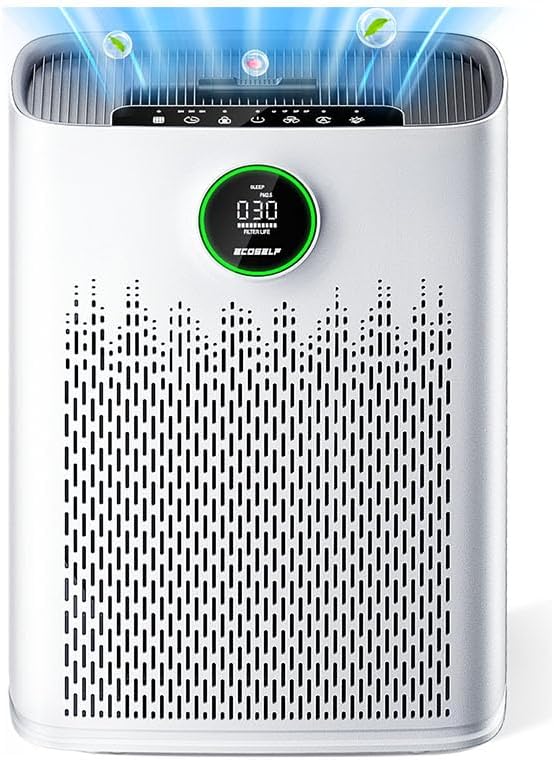
| Coverage | Up to 2400 ft² |
|---|---|
| Noise level (Sleep) | 22 dB |
| Filtration | H13 True HEPA + activated carbon |
| Air quality sensor | PM2.5 display with infrared sensor |
The ECOSELF HAP603 is a tower-style air purifier built to handle large living areas up to 2400 ft² by running a dual-stage filtration cycle that the brand calls 2X-Power Filtration. It uses a True HEPA (H13) filter to capture fine particles including PM2.5 and pairs that with an activated-carbon stage to reduce odors and smoke. An integrated PM2.5 display and infrared sensor let the unit run in Auto Mode, adjusting fan speed to changing air quality; there is also a quiet 22 dB Sleep Mode for night use and a timer and child lock for simple day-to-day control. The aromatherapy tray is a useful extra if you want gentle scenting, and the front filter indicator helps keep maintenance straightforward. Expect solid coverage for wildfire smoke and pet dander, but keep in mind effective long-term performance depends on timely replacement with compatible ECOSELF filters and the unit is a single-appliance solution rather than a whole-home system.
Best for: Buyers who prioritize reliable PM2.5 removal and quiet night operation for large living spaces and want straightforward automatic sensing and controls.
Less Ideal for: People seeking a whole-home HVAC solution or those who need a compact purifier for small rooms or travel use.
- True HEPA H13 filtration captures PM2.5 and other fine particles.
- PM2.5 display with infrared sensor and Auto Mode adjusts fan speed to air quality.
- Covers large areas up to 2400 ft² with a 2X filtration cycle.
- Very quiet Sleep Mode rated at 22 dB for nighttime use.
- Filter indicator and simple controls make routine maintenance easy.
- Requires brand replacement filters for best performance which adds ongoing cost.
- Aromatherapy feature may not suit users who prefer unscented air.
Verdict: Choose the HAP603 if you need a quiet, sensor-driven purifier that reliably targets PM2.5 and smoke across large rooms.
Choosing the Right Air Purifier for Pm2 5: Key Factors to Consider
Filtration Efficiency for PM2.5
How effectively an air purifier captures particles 2.5 microns and smaller directly affects health outcomes. Look for true HEPA filtration or equivalently rated filters that specify particle capture rates at or below 2.5 microns.
Manufacturers that report PM2.5-specific efficiency or provide CADR values for fine particles give a clearer expectation of real-world performance. Higher efficiency reduces the number of cycles required to reach safer concentrations, which in turn affects runtime, noise exposure, and filter replacement frequency.
Room Size and CADR
Match purifier capacity to the room where it will run. CADR or stated coverage indicates how quickly a unit can cycle air in a given space and lower PM2.5 concentration. Undersizing a purifier means it runs longer or never reaches target air quality levels.
For bedrooms, consider units sized for the actual floor area with some margin for furnishings and open doorways. For larger living spaces, a higher CADR or multiple units is often more effective than a single undersized machine.
Noise and Nighttime Use
Noise matters because many people run purifiers 24/7 and expect quiet operation during sleep. Check manufacturer noise ratings at typical operating speeds and whether there is a low-noise or sleep mode.
Lower fan speeds reduce noise but also slow particle removal, so balance the desired quiet with sufficient airflow to maintain lower PM2.5 levels overnight.
Filter Life and Maintenance
Filter lifespan, replacement cost, and ease of access affect total ownership cost and user compliance. Filters that are simple to replace and have clear remaining life indicators make it more likely users will change them on schedule.
Reusable pre-filters that trap large particles can extend HEPA filter life. Consider how easy it is to vacuum or wipe exterior grills and whether replacement parts are common and well-documented.
Energy Consumption and Run Cost
Because purifiers for PM2.5 are often operated continuously during high-pollution events, energy draw influences monthly operating costs. Look for units with efficient motors and multiple fan speeds so you can lower power during off-peak times.
Some models include eco or auto modes that adjust fan speed based on sensed particle levels, which can reduce overall energy use while maintaining acceptable air quality.
Sensors and Auto Modes
Built-in particle sensors and intelligent fan control can maintain lower PM2.5 with less user input. Accurate sensors allow the unit to ramp up when pollution spikes and run quieter when air is clean.
Be aware that sensor accuracy varies by placement and environment. Units with external readouts and adjustable sensitivity let you tailor performance to your comfort and tolerance for noise.
How PM2.5 Remediation Works
PM2.5 refers to airborne particles smaller than 2.5 microns. Effective remediation combines mechanical filtration with adequate air exchange. True HEPA filters physically trap particles, while pre-filters catch larger debris to protect the primary filter.
Airflow design is also important. A purifier must pull room air through the filter bed at a flow rate that produces meaningful reductions in particle concentration within a reasonable time. Placement matters too: positioning near the pollution source or in the breathing zone improves effectiveness.
- True HEPA captures fine particles down to 0.3 microns with high efficiency.
- Pre-filters and activated carbon layers address larger particles and odors.
- Higher airflow reduces particle concentration faster but may increase noise.
Placement and Setup Tips
Place the purifier away from walls and obstructions to preserve airflow. For bedrooms, position it near the bed or the doorway depending on where you spend most time. In open-plan areas, place it centrally or closer to known pollution sources like kitchen openings.
Avoid putting the unit behind furniture or inside cabinets. For multi-room coverage, use multiple smaller units rather than a single oversized machine to create more uniform air cleaning.
- Keep intake and outlet clear for optimal flow.
- Elevate small units off carpet for better intake.
- Run continuously during high pollution events for best results.
Using Sensors and Auto Modes Effectively
Auto modes based on particle sensors reduce user guesswork by adjusting fan speed to maintain target PM2.5. Learn the sensitivity settings and place the purifier so the sensor reads representative room air rather than a clean draft or a pollution hotspot directly.
If your unit offers app control or schedules, use them to run higher speeds when you are away or during heavy indoor activities like cooking, and lower speeds overnight to balance noise and air quality.
- Avoid placing sensors in direct airflow from vents or windows.
- Use higher automatic sensitivity during known pollution events.
Common Misconceptions About Air Purifiers
Air purifiers do not eliminate the source of PM2.5. Removing or reducing sources, such as ventilating during cooking or avoiding indoor smoking, remains the primary control step. Purifiers reduce airborne concentrations but will not stop ongoing emissions at the source.
Another misconception is that larger units are always better. An oversized unit running at a low speed may still perform poorly for a particular room layout. Match CADR and coverage to the intended space for predictable results.
- Purifiers help but do not replace source control and ventilation.
- Correct sizing and placement matter more than raw filter claims.
Maintaining Filters and the Unit
Regular maintenance keeps performance high. Check pre-filters monthly in dusty environments and replace or clean according to the manufacturer schedule. Keep the exterior vents free of dust buildup to avoid reduced airflow.
When replacing primary filters, follow the published guidance for disposal and use only compatible filter types. Record filter-change dates to track true lifespan under your specific conditions, as heavy pollution or pets can shorten filter life.
- Vacuum or wash pre-filters when applicable to extend HEPA life.
- Keep spare filters on hand if you live in areas with seasonal pollution spikes.
How We Chose the Best Air Purifier for Pm2 5
We selected air purifiers that demonstrate measurable reductions in PM2.5 and that address the practical needs of typical home environments. Our editorial filters prioritized devices with high-efficiency particulate filtration, CADR or equivalent clean-air delivery data for fine particles, and clear room coverage guidance suitable for bedrooms, living rooms, or home offices. We also considered noise output across fan speeds, because many users run purifiers continuously or at night. Ease of maintenance was another factor: accessible filter replacement, clear filter life indicators, and straightforward cleaning reduce long-term cost and hassle. Energy use and certified safety features were reviewed to ensure units are practical for daily operation. Units that relied primarily on unproven technology without independent particle-reduction data were excluded. We avoided offerings that lacked clear PM2.5 performance specs or did not publish CADR or particle-removal test results. The final picks balance fine-particle filtration, coverage, noise, maintenance, and energy efficiency.
Our full evaluation process is outlined in our review methodology.
FAQ
How big a unit do I need to reduce PM2.5 in a bedroom?
Choose a purifier with CADR or coverage rated for at least the square footage of the bedroom, with some margin for furniture and door openings. A higher CADR speeds up removal, so aim for a unit that can cycle the room air at least two to four times per hour for moderate pollution.
Can an air purifier remove wildfire smoke PM2.5 effectively?
Yes, units with true HEPA filtration and adequate airflow reduce smoke-related PM2.5. Run the purifier continuously during smoke episodes and avoid opening windows to keep outdoor smoke out while the unit cleans indoor air.
How often should I change the HEPA filter when targeting PM2.5?
Filter life depends on local pollution levels and runtime. Typical replacement intervals range from 6 to 12 months under continuous use, but heavy indoor pollution or smoke events can shorten that. Monitor performance and any manufacturer filter-life indicators to plan replacements.
Do carbon filters help with PM2.5?
Activated carbon filters primarily remove odors and gaseous pollutants, not particles. They can complement PM2.5 filtration by addressing volatile compounds, but particle capture relies on mechanical HEPA or equivalent filters.
Is it better to run a purifier at high speed or leave it on low all day?
High speed removes particles faster but increases noise and energy use. Using a higher speed during pollution events and a lower speed for continuous baseline cleaning is often the most practical approach. Auto modes can manage this balance automatically.
Final Verdict
Reducing PM2.5 indoors requires a purifier that combines true particulate filtration with the airflow needed for your room size. Prioritize PM2.5 filtration efficiency and CADR matched to the intended space, then weigh noise, maintenance, and energy use to find a practical daily driver. Accept tradeoffs: higher airflow cleans faster but can be louder and consume more power; longer filter life reduces running costs but may require a larger initial unit. Use the evaluation criteria above to choose a unit that meets your noise tolerance, maintenance preferences, and coverage needs for consistent PM2.5 reduction.