
Note: This article contains affiliate links. If you click on these links and make a purchase, we may earn a small commission at no extra cost to you. This helps support our research and content. Read our full affiliate disclosure here.
If you want to cut filter waste and lower recurring upkeep, an air purifier with a reusable filter can be a smart alternative to disposable-filter models. These units let you clean and reuse the same filtration media, which reduces long-term cost and landfill burden while still providing steady particulate removal when matched to the right room and usage pattern. This guide shortlists seven top options across common home use cases and highlights the factors that matter for performance and durability. Read on for practical evaluation points—like filtration effectiveness, cleaning effort, and airflow—that helped us select the best reusable-filter air purifiers for everyday rooms and for allergy-sensitive households.
Top Picks at a Glance
| Best Overall The best all-around choice for most situations | Nuwave OxyPure ZERO E500 |  |
| Best Quality Built to a higher standard if you want something more solid | Honeywell AirGenius 5 HFD360 |  |
| Best Value The sweet spot between price and what you get | MOOKA KJ190H Air Purifier |  |
| Best Budget The cheapest option that still gets the job done reliably | AIUZLK P260 Air Purifier |  |
| Top Rated A top-rated pick with lots of positive feedback | Nuwave Forever Air Purifier |  |
| Most Popular A crowd favorite that many people choose with confidence | MOOKA PR1 Air Purifier |  |
| Best Seller A high-volume bestseller chosen again and again | VEWIOR ClearAir-A12 Air Purifier |  |
Nuwave OxyPure ZERO E500

| Power Source | Corded Electric |
|---|---|
| Control Method | App |
| Particle Retention Size | 0.1 micrometer |
| Floor Area | 966 square_feet |
| Noise Level | 21.4 db |
The Nuwave OxyPure ZERO E500 is a large-room smart air purifier built around washable, reusable Bio-Guard filters that eliminate the need for disposable replacements. It draws air through a stainless-steel prefilter and dual Bio-Guard stages plus a cylindrical 360 filter to target smoke, dust, pollen and particles as small as 0.1 microns, and is certified by independent bodies for performance. The unit supports app control and button control, offers six fan speeds, Auto/Eco and Ultimate Clean modes, and claims coverage up to roughly 966 sq ft for fast turnover. In everyday use it is well suited to open living spaces or bedrooms where low noise matters thanks to a reported 21.4 dB level on the lowest setting. Practical benefits include lower long-term consumable costs because filters are washable and reusable and flexibility from multiple fan speeds and scheduling via the app. Buyers should note the purifier is a sizable freestanding unit and consumes 48 watts, so it is not the most compact or minimal-power option for very small rooms.
Best for: Buyers who want a high-capacity, low-maintenance purifier that minimizes ongoing filter costs and is intended for open living areas or large bedrooms.
Less Ideal for: Those seeking the smallest, most portable or lowest-power purifier for closets, bathrooms, or very small rooms should consider more compact models.
- Washable, reusable Bio-Guard filters eliminate recurring filter replacements
- Certified to capture particles down to 0.1 microns for smoke, dust and pollen
- App and button controls with six fan speeds plus Auto/Eco and special cleaning modes
- Designed to cover large rooms (specified around 966 sq ft) with rapid air turnover
- Low reported noise on quiet mode for night use
- Large footprint and weight make it less convenient for small rooms or frequent relocation
- Uses 48 watts which is higher than some compact low-power purifiers
Verdict: Choose the OxyPure ZERO E500 if you want a large-room smart purifier that eliminates recurring filter purchases with washable reusable filters.
Honeywell AirGenius 5 HFD360

| Recommended room coverage | up to 250 ft² |
|---|---|
| Cleaning levels | 5 levels + sleep mode |
| Timer | 2, 4, 6, 8, 10, 12 hours |
| Filter type | Washable particle filter and washable pre-filter |
The Honeywell AirGenius 5 HFD360 is a large-room air purifier that combines high-cleaning airflow with a washable permanent particle filter and washable pre-filter to avoid replacement costs. It offers five cleaning levels plus a whisper-quiet sleep setting, an adjustable oscillating fan for broader circulation, and a 2–12 hour auto-off timer, making it easy to tailor performance and noise for daytime or nighttime use. Honeywell cites capture of 0.3-micron and larger particles and independent smoke CADR testing at the highest setting, and the unit is rated to cycle air in recommended rooms roughly every 12.5 minutes. Practical benefits include strong smoke and particle removal on high, lower operating costs over time due to washable filters, and added comfort from the fan and night-light options. Trade-offs are that the design is focused on air circulation rather than HEPA cartridge swaps, so filter cleaning is required periodically and maximum effectiveness depends on room layout and running speed; larger or oddly shaped spaces may need longer run times or multiple units.
Best for: Buyers who prioritize sustained performance and low operating cost will appreciate a purifier that delivers strong particle and smoke removal while avoiding recurring filter purchases.
Less Ideal for: If you want a plug-and-play disposable HEPA cartridge system or need guaranteed coverage for very large open-plan areas, consider other models or multiple units instead.
- Washable permanent particle filter and washable pre-filter eliminate ongoing filter replacement cost
- Five cleaning levels plus a quiet sleep mode let you balance noise and performance
- Oscillating fan improves air circulation across a wider area
- Auto-off timer and optional night-light add convenience for overnight use
- Independent testing shows strong smoke CADR at the highest setting
- Requires regular washing of filters to maintain performance rather than simple cartridge swaps
- Performance depends on room configuration and may require higher speeds for fastest clearance
Verdict: Choose the AirGenius 5 if you want a performance-focused large-room purifier that cuts smoke and particles while avoiding ongoing filter replacement costs.
MOOKA KJ190H Air Purifier

| Coverage | 2200 ft² per hour |
|---|---|
| Filter type | H13 HEPA + activated carbon + washable pre-filter |
| Noise (Sleep Mode) | 20 dB |
| Fan speeds | 4 speeds |
| Timer | 2/4/6/8 hours |
The MOOKA KJ190H is a room air purifier designed to move large volumes of air while keeping running costs low thanks to a washable pre-filter and H13 HEPA stage. It is typically placed in living areas, bedrooms, or open floor plans where pet hair, dust, smoke, and odors are common; the unit pulls air through wide dual inlets and a three-stage filter train that includes activated carbon for smells. Real-time PM2.5 monitoring with an auto mode adjusts fan speed, and you can choose quiet 20 dB sleep mode or higher speeds for fast cleaning. Practical features such as a timer, filter-life indicator, child lock, and an essential-oil tray for light aromatherapy make it easy to fit daily routines. Expect routine maintenance of the washable pre-filter and periodic replacement of the HEPA/carbon cartridge at manufacturer-recommended intervals, and note that large advertised coverage depends on room layout and run time to reach ideal air changes. For buyers focused on a reusable pre-filter and measurable indoor-air feedback, this unit balances airflow and energy efficiency well.
Best for: Buyers who prioritize lower ongoing filter cost and measurable air-quality feedback for daily home use, and who prefer a practical, easy-to-maintain purifier for pet owners or allergy-prone households.
Less Ideal for: People who need a completely maintenance-free unit or those who require medical-grade isolation for severe respiratory conditions should consider higher-end or specialty systems.
- Washable pre-filter reduces replacement frequency and daily operating cost
- H13 True HEPA plus activated carbon addresses fine particles and common household odors
- Built-in PM2.5 sensor with auto mode adjusts fan speed to real-time air quality
- Very quiet sleep mode (about 20 dB) suitable for bedrooms
- Timer, child lock, and filter reminder add practical convenience for everyday use
- HEPA element is replaceable and will need periodic purchase despite washable pre-filter
- Claimed large-area throughput depends on placement and continuous run time to reach stated coverage
- Aromatherapy tray is light-duty and not a substitute for dedicated diffusers
Verdict: Choose the MOOKA KJ190H if you want strong airflow and lower ongoing filter cost from a washable pre-filter combined with real-time PM2.5 sensing for practical, everyday air cleaning.
AIUZLK P260 Air Purifier

| Motor power | 24W brushless |
|---|---|
| Filtration | 3-stage, washable filter |
| Coverage | Up to 2000 sq ft |
| Noise | 22 dB (lowest setting) |
| Model number | P260 |
The AIUZLK P260 is an affordable large-room air purifier built around a 24W brushless motor and a three-stage filtration pack that includes a washable element, letting you avoid frequent replacement filters. It is intended for living rooms, bedrooms, or offices and claims coverage up to 2000 square feet with a noticeable air-quality change in about 30 minutes. The unit is very quiet at its lowest fan setting, marketed down to 22 decibels, and offers practical controls like a timer, fan speeds, filter replacement reminder, and a child lock. The washable filter reduces ongoing costs compared with single-use filter designs, while the included reminders and replaceable elements simplify maintenance. Expect solid basic performance on dust, pet hair, smoke and odors for the price, but do note that the product description highlights the washable filter life rather than a multi-year factory replacement schedule, so heavy users should plan periodic deep cleaning. Certificates listed include FCC, CE, RoHS and ETL, supporting its safety claims.
Best for: Buyers who want a low-cost large-room air purifier with a washable filter to cut ongoing expenses and prefer simple, quiet operation for bedrooms or living spaces.
Less Ideal for: Users needing certified medical-grade filtration or guaranteed performance for continuous heavy smoke or wildfire conditions should consider higher-tier units designed for those demands.
- Washable three-stage filter reduces ongoing filter replacement costs
- 24W brushless motor with claimed coverage up to 2000 sq ft for large rooms
- Very low noise operation at the lowest setting (around 22 dB)
- User-friendly controls including timer, fan speeds, filter reminder, and child lock
- Coverage and runtime claims are manufacturer-stated and may vary in real-world heavy-pollution scenarios
- Replacement filter model reference is separate, so sourcing factory-quality parts requires the correct part number
Verdict: A budget-friendly large-room purifier with a washable multi-stage filter for buyers who prioritize lower ongoing costs and quiet daily use.
Nuwave Forever Air Purifier

| Coverage | Up to 2,002 sq ft |
|---|---|
| Particle capture | Down to 0.1 microns |
| Filtration stages | 7-stage filtration |
| Weight | 21.85 pounds |
The Nuwave Forever is a large-area air purifier built around a washable, never-replace filter system and a claimed seven-stage filtration stack. It pulls air through stainless-steel prefilters, Bio-Guard filtration media, and an ozone-removal stage to capture particles down to 0.1 microns and reduce odors and ozone, making it suitable for living rooms, basements, and open-plan spaces. Typical use is room-level continuous operation on low or higher fan settings to cycle air in spaces up to roughly 2,002 square feet within an hour. The reusable filters are the main practical benefit because they remove recurring replacement costs and reduce waste, while the unit's lab certification and CARB-compliant low ozone output address safety and performance concerns. At nearly 22 pounds and with a prominent footprint, it is less portable than compact purifiers and requires occasional washing and maintenance of metal and filter elements to keep performance optimal. The unit also focuses on filtration rather than smart-home integrations, so buyers should plan placement and regular cleaning for long-term reliability.
Best for: Buyers who prioritize long-term reliability and low running costs and want a large-room purifier with validated particle capture and low ozone emissions.
Less Ideal for: People who need a lightweight, highly portable bedside unit or who prefer plug-and-play disposable-filter models with no maintenance.
- Washable reusable filter system eliminates regular replacement filter purchases
- Certified to capture particles down to 0.1 microns and reduces ozone to low ppb levels
- Seven-stage filtration including stainless-steel prefilters and ozone removal for odors and chemicals
- Designed to purify very large rooms up to about 2,002 sq ft in one hour
- Relatively heavy and bulky compared with compact purifiers
- Requires manual washing and upkeep of reusable filter elements to maintain performance
Verdict: Choose the Nuwave Forever if you want a durable, reusable-filter air purifier that reliably cleans very large rooms while avoiding ongoing filter replacements.
MOOKA PR1 Air Purifier

| Coverage | up to 2200 ft² (manufacturer claim) |
|---|---|
| Filter type | H13 True HEPA + washable pre-filter + activated carbon |
| Noise level | Sleep mode ~26 dB |
| Fan speeds | 6 modes (Sleep/ I/ II/ III/ Auto/ Pet) |
The MOOKA PR1 is a large-room air purifier built around a 4-stage system that pairs a washable pre-filter with a True H13 HEPA element and activated carbon to tackle pet hair, smoke, pollen, and odors. It is typically placed in living rooms, bedrooms, or open-plan spaces where continuous cleaning is needed and offers six fan speeds including Auto, Pet, and a very quiet Sleep mode at about 26 dB. A built-in PM2.5 sensor and AQI display let the unit adjust fan speed automatically, and the washable pre-filter plus filter-change reminder cut running costs compared with single-use-only designs. Extra features include a child lock, timer, pet mode for heavier shedding, and a small aroma pad for light scenting. Expect strong coverage claims for large spaces and relatively low power use, but like many high-flow purifiers the filter maintenance (washing and periodic H13 replacement) is necessary to keep performance high and the unit may still require replacement HEPA cartridges over time. The PR1 is a feature-rich choice if you want a reusable pre-filter and visible air-quality feedback in a large-room purifier.
Best for: Buyers who value visible air-quality feedback and lower ongoing filter waste will appreciate this unit for continuous home use in rooms where pets or smoke are a concern.
Less Ideal for: If you need a compact purifier for a small bedroom or want a zero-maintenance, filter-free technology, this larger, filter-based model is not the best fit.
- True H13 HEPA plus activated carbon for particle and odor capture
- Washable pre-filter reduces disposable filter frequency and cost
- Built-in PM2.5 sensor with AQI display and Auto fan mode for responsive operation
- Multiple modes including Pet and a very quiet Sleep mode (~26 dB)
- Large-room coverage claims may vary by room layout and should be verified against square footage needs
- The washable pre-filter still requires regular cleaning and the H13 HEPA element will need periodic replacement
Verdict: Choose the MOOKA PR1 when you want a large-room purifier with a reusable pre-filter and live PM2.5 feedback to cut disposable-filter waste while tracking air quality.
VEWIOR ClearAir-A12 Air Purifier
| Coverage area | 1200sq.ft |
|---|---|
| Filtering system | H13 HEPA Washable Filter |
| Noise level | 15dB |
| Timer function | Yes |
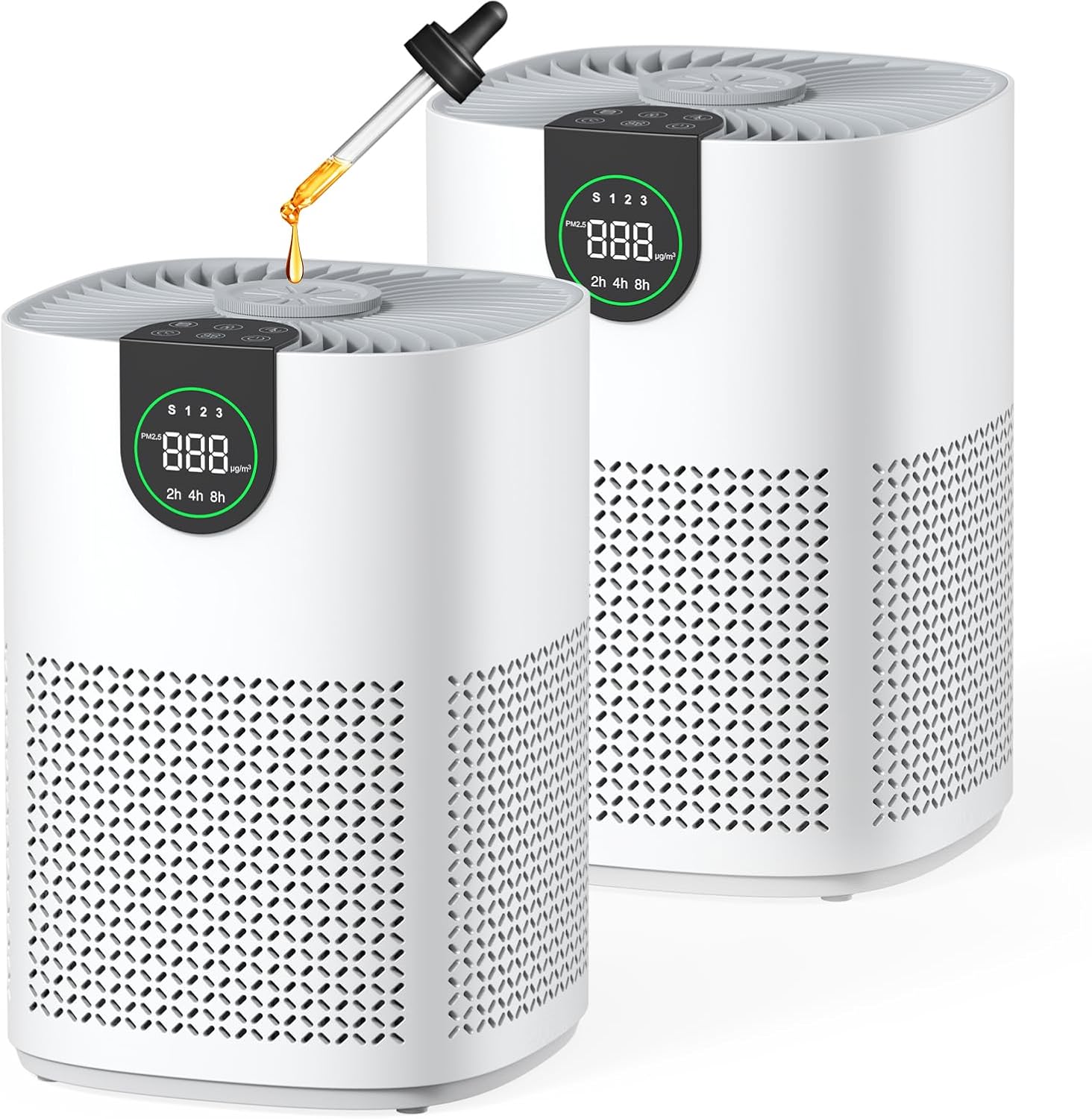
The VEWIOR ClearAir-A12 is a two-pack air purifier designed for whole-room use with a washable H13 HEPA-style filter and a three-stage filtration system that includes a washable pre-filter and activated carbon. It pulls air through a 360° intake and claims to refresh the air about five times per hour in a 1200 sq ft room, making it suitable for living rooms, bedrooms, and basements. Controls include four fan speeds, an Auto mode driven by the built-in PM2.5 sensor with real-time display, a sleep mode that dims the panel and runs very quietly, and a child lock plus three timer settings. The washable filter reduces ongoing replacement costs and the aromatherapy pad is a handy extra for bedrooms. Expect to vacuum or rinse the pre-filter regularly and replace the HEPA element on the manufacturer cadence to keep peak performance; noise and effective coverage will vary with room layout and source pollution. This model balances straightforward features and low operating cost for buyers who prefer reusable filters and simple automatic monitoring.
Best for: Buyers who prefer low ongoing filter costs and an easy, mostly automatic purifier that quietly monitors and reacts to indoor PM2.5 levels.
Less Ideal for: People who need verified CADR figures or medical-grade certification for clinical settings should consider higher-spec models targeted at those uses.
- H13 HEPA three-stage filtration with washable pre-filter to cut replacement costs
- Real-time PM2.5 display and Auto mode that adjusts fan speed to air quality
- Very quiet sleep mode with dimmed panel for nighttime use
- Includes child lock, timers, and aromatherapy pad for practical home use
- Washable filters still require regular cleaning and periodic HEPA replacement to maintain effectiveness
- Manufacturer coverage claim may vary in real rooms depending on layout and pollutant sources
Verdict: Choose this two-pack if you want an affordable reusable-filter purifier with automatic PM2.5 monitoring and very quiet night operation.
Choosing the Right Air Purifier with Reusable Filter: Key Factors to Consider
Filtration Efficiency and Particle Size Capture
A reusable-filter air purifier should still capture the range of particle sizes you care about, especially PM2.5 and larger allergens. Look for systems that combine a mechanical washable prefilter with a fine reusable layer or secondary disposable element when needed. Understand the stated particle-size capture and any independent test results when possible.
Higher filtration efficiency means fewer passes are needed to lower particle concentration, which matters for allergy sufferers and homes with smoke or heavy dust. However, reusable filters often trade peak single-pass efficiency for longevity, so check how many air changes per hour the unit can deliver in your room size.
Ease and Frequency of Cleaning
Reusable filters require periodic cleaning to restore performance, so the ease of that process directly impacts long-term user satisfaction. Some filters rinse clean under a tap and dry quickly, while others need brushing or compressed-air maintenance. The time required, plus whether the filter shape or housing is awkward to remove, matters for regular upkeep.
Also consider how often the manufacturer recommends cleaning under normal conditions. A filter that needs attention every few weeks will demand more hands-on time than one that only needs maintenance every few months. Realistic cleaning expectations help avoid performance loss from neglected filters.
Airflow Capacity and Room Coverage
A reusable-filter design can add resistance to airflow compared with paper disposable filters. Check the unit's clean air delivery rate or stated room size to ensure it can move enough air for your space. Higher airflow offsets lower single-pass efficiency by cycling room air more frequently.
Consider placement too: obstructed intakes or pushing against furniture reduces effective coverage. A unit rated for a larger area gives headroom to maintain performance as dust builds up between cleanings.
Noise and Fan Speed Control
Because reusable-filter models may depend on stronger fans to compensate for washable-media resistance, noise characteristics are important. Look for units with multiple fan speeds and a clear quiet mode if you plan to use the purifier in a bedroom or home office.
Also check whether the fan speed is adjustable in small, useful increments and whether the unit provides an automatic mode that balances noise and filtration when indoor air quality fluctuates.
Durability and Materials
Frequent handling and washing expose reusable filters and housings to wear, so build quality matters. Filters made from resilient synthetic meshes or treated fabrics tolerate repeated cleaning better than fragile materials. The housing should resist warping or cracking when filters are removed and replaced often.
Evaluate how replaceable or serviceable parts are and whether the design minimizes trapped moisture after cleaning. A robust construction reduces the chance of performance decline over time and extends the useful life of the purifier.
How Reusable Filters Differ From Disposable Systems
Reusable filters typically use washable mesh or treated fabrics that capture larger particles and are then cleaned by rinsing, brushing, or shaking out debris. Disposable systems rely on single-use media such as HEPA or activated-carbon cartridges that are swapped out when clogged.
The tradeoff is usually between peak capture efficiency and lifecycle cost and waste. Reusable-filter units can be economical and environmentally friendlier over time, but they need routine maintenance and sometimes supplemental filtration to address odors or ultrafine particles.
- Reusable filters reduce solid waste but require more user maintenance.
- Disposable HEPA filters often capture finer particles in a single pass.
- Some hybrid designs pair a reusable prefilter with a small disposable fine filter for best of both worlds.
Placement Tips to Maximize Performance
Position the purifier away from walls and large furniture so the intake and outlet are unobstructed. Place it closer to the source of pollution when possible—for example, near a smoker, pet area, or kitchen doorway—to reduce the travel time for contaminants.
For whole-room effect, aim to place the unit centrally or where airflow patterns encourage circulation. In bedrooms, choose a spot that balances proximity to the sleeper and minimal noise exposure.
- Leave at least a foot of clearance on all sides where possible.
- Avoid placing behind curtains or inside closed cabinets.
- Elevate small units slightly off the floor to catch airborne dust more effectively.
Cleaning Best Practices for Reusable Filters
Follow the manufacturer's recommended cleaning method, but common steps include vacuuming loose dust first, rinsing under a gentle stream of water, and allowing the filter to dry completely before reinserting. Avoid harsh detergents or scrubbing that can damage filter fibers.
If a filter is slow to release embedded particles, soak it briefly in lukewarm water and agitate gently. Always inspect the filter for tears, permanent discoloration, or material breakdown; once the media begins to fail, performance will drop and replacement may be necessary.
- Vacuum or shake out loose debris before washing.
- Air-dry filters fully to prevent mold growth.
- Keep a maintenance calendar so cleanings are not neglected.
When to Consider Supplemental Filtration
Reusable-filter purifiers can handle dust, pet hair, and many larger particles well, but they may struggle with odors, volatile organic compounds, and some ultrafine particles without supplemental media. If you need odor control or chemical adsorption, look for units that allow adding a carbon insert or that combine a reusable element with a replaceable adsorbent layer.
For environments with wildfire smoke or medical-grade filtration needs, a system that includes or supports a fine disposable filter may be preferable to rely on for acute high-concentration events.
- Use a carbon insert for cooking smells and household VOCs.
- Consider a hybrid unit for occasional high-pollution events.
- Reserve reusable-only systems for routine dust and pet dander control.
Maintaining Performance Over Time
Track cumulative operating hours and clean the filter more often if the unit runs continuously or in dusty environments. Regular inspection of the fan, seals, and housing will catch issues like loose panels or clogged vents that reduce airflow.
Replace any worn filter media or gasket material promptly. Even reusable filters have a finite life; scheduled replacement or refurbishment extends the life of the purifier and maintains safe, efficient operation.
- Inspect seals and gaskets every few months.
- Keep the intake and exhaust grills free of dust buildup.
- Document filter cleanings and replacements for consistent maintenance.
How We Chose the Best Air Purifier with Reusable Filter
We limited our shortlist to air purifiers that use a washable or otherwise reusable primary filter as part of their core filtration system and that are intended for continuous home use. Our editorial filters prioritized filtration effectiveness at capturing fine particles, measured airflow and coverage relative to stated room size, and the long-term maintenance burden of cleaning and reconditioning the reusable filter. We also weighed build quality and materials, noise output during typical fan speeds, and the simplicity of user controls and replacement procedures. Safety features such as sealed filter housings and easy-to-follow cleaning instructions were required for inclusion. Units that relied solely on unproven ionization without a mechanical reusable element were excluded, as were products intended only for industrial or commercial settings. The result is a focused group of household air purifiers chosen for measurable filtration, realistic upkeep expectations, and real-world suitability for bedrooms, living rooms, and small open-plan spaces.
Our full evaluation process is outlined in our review methodology.
FAQ
How often should I clean a reusable filter?
Cleaning frequency depends on usage and pollution levels, but a common schedule is every 2 to 8 weeks. Heavier dust, pets, or continuous operation will push you toward more frequent cleanings to maintain airflow and filtration effectiveness.
Can reusable filters capture fine particles like PM2.5?
Some reusable filters capture a portion of PM2.5, but many do not match the single-pass efficiency of certified disposable HEPA filters. Look at the unit's airflow and stated particle capture to estimate real-world performance, and consider supplemental filtration for consistent PM2.5 reduction.
Will washing the filter damage it over time?
Repeated washing can degrade filter materials eventually, especially if aggressive detergents or scrubbing are used. Follow gentle cleaning instructions and inspect the media for thinning or tears; plan to replace the filter when its integrity or performance declines.
Are reusable-filter purifiers better for the environment?
Reusable filters reduce the number of disposable cartridges sent to landfill, which lowers waste. The environmental benefit depends on the filter's lifespan and how often it must be replaced; proper maintenance increases the sustainability advantage.
Do reusable-filter units require special storage after cleaning?
After washing, filters should be thoroughly air-dried before reinsertion to prevent mold. Store spare or out-of-service filters in a clean, dry place away from direct sunlight to preserve material integrity.
Final Verdict
When choosing an air purifier with a reusable filter, prioritize filtration effectiveness for the particle sizes you care about, and balance that against the time you are willing to spend on cleaning and upkeep. Confirm that the unit can deliver sufficient airflow for your room and that cleaning the filter is simple and practical for your routine. Expect some tradeoffs: reusable media reduces waste and ongoing cost but will usually require more maintenance and occasional replacement. Focus on durable construction, clear cleaning instructions, and adequate airflow so you can confidently pick a system that fits your daily life and indoor air needs.