
Note: This article contains affiliate links. If you click on these links and make a purchase, we may earn a small commission at no extra cost to you. This helps support our research and content. Read our full affiliate disclosure here.
If you live in a large house, choosing the right air purifier has a meaningful effect on indoor comfort and health. Larger floor plans, multiple open rooms, and varied airflow patterns change how quickly airborne particles move and settle, so a unit sized and specified for small rooms will often underperform. This guide presents seven shortlisted air purifiers suited for a large house, selected for their ability to move enough air, capture common pollutants, and integrate into daily living. Below you will find the top picks and an explanation of the criteria we used to evaluate them, including filtration efficiency, claimed room coverage, and noise and maintenance factors. Use the summary to match a unit to your home's layout and needs.
Top Picks at a Glance
| Best Overall The best all-around choice for most situations | Levoit Core 600S-P |  |
| Best Quality Built to a higher standard if you want something more solid | IQAir HealthPro Plus XE |  |
| Best Value The sweet spot between price and what you get | SIESEAN AP-400 Air Purifier |  |
| Best Budget The cheapest option that still gets the job done reliably | AIUZLK P260 Air Purifier |  |
| Top Rated A top-rated pick with lots of positive feedback | AirDoctor AD3500 Air Purifier |  |
| Most Popular A crowd favorite that many people choose with confidence | Honeywell AllergenPlus HPA304 |  |
| Best Seller A high-volume bestseller chosen again and again | Levoit Vital 200S-P Air Purifier |  |
Levoit Core 600S-P

| Power Source | ac |
|---|---|
| Filter Type | 3-In-1 Filtration |
| Floor Area | 2933 square_feet |
| Noise Level | 26 db |
| Wattage | 66 watts |
The Levoit Core 600S-P is built to handle very large open areas and whole-apartment layouts by combining a high CADR, a three-stage filter, and smart controls. It uses VortexAir circulation and a 3-in-1 original filter to capture particles down to 0.1 micron, targeting dust, pollen, pet dander, and PM2.5; Levoit rates it to refresh air in up to 2,933 sq ft once per hour or much smaller zones more frequently. Smart features include the VeSync app, Alexa/Google voice control, an auto mode tied to onboard PM2.5 sensing, and a light sensor that dims the display for true sleep-friendly operation. QuietKEPA technology keeps noise as low as 26 dB on low settings, and Energy Star plus CARB certification mean it runs efficiently and meets safety standards. The unit is relatively large and uses genuine Levoit replacement filters for peak performance, so expect ongoing filter costs and the need to choose the right replacement type for smoke, VOCs, or pet odors. If you need a factory-quality, connected purifier for big rooms or open plans, this is a practical choice.
Best for: Buyers who want a connected, high-capacity purifier for large open areas or whole-apartment coverage and who prioritize automated air-quality sensing and quiet night operation.
Less Ideal for: People who need a compact, portable purifier for small bedrooms or those looking to avoid recurring OEM filter purchases should consider smaller or non-smart alternatives.
- High CADR and VortexAir circulation suitable for extra-large rooms and open floor plans
- 3-stage filtration rated to capture particles down to 0.1 micron for allergens and PM2.5
- Smart app and voice control with real-time PM2.5 monitoring and auto mode
- Quiet operation and light sensor for low-noise night use
- Energy Star and CARB certifications for efficiency and safety
- Large footprint compared with smaller room purifiers
- Requires genuine Levoit replacement filters which adds recurring cost
Verdict: Choose the Core 600S-P when you need a smart, Energy Star certified purifier that reliably cleans very large rooms while staying quiet at night.
IQAir HealthPro Plus XE

| Coverage | Up to 1125 sq. ft. |
|---|---|
| Filtration efficiency | Filters 99.5% of particles ≥ 0.003 microns |
| Air delivery | Up to 300 cfm (max speed) across multi-speed settings |
| App integration | AirVisual app WiFi control |
The IQAir HealthPro Plus XE is a premium air purifier built for heavy-duty air cleaning in large spaces. It uses IQAir's HyperHEPA filtration to capture ultrafine particles down to 0.003 microns with stated efficiency of 99.5%, and combines that filtration with a redesigned, energy-efficient fan and a multi-speed airflow system that moves substantial volumes of air. Typical use is continuous operation in living rooms, open-plan areas, or home offices where persistent pollutants, wildfire smoke, or allergy triggers are a concern. Smart features include WiFi app integration, an advanced particle sensor that reports PM2.5 in real time, and three automatic modes that adjust fan speed to measured air quality, which helps manage filter life and energy use. The unit is made in Switzerland and targets buyers who want near-medical grade performance; the size and weight reflect its capacity and robust build. Limitations are its premium price point and larger physical footprint compared with smaller consumer purifiers, and replacement filters and long-term ownership costs should be considered for frequent heavy use.
Best for: Buyers who prioritize maximum particle removal and reliable performance in large living spaces and who expect continuous, sensor-driven operation to manage indoor air quality.
Less Ideal for: People seeking a compact, budget-focused purifier for small rooms or those unwilling to invest in higher upfront and maintenance costs should consider more compact models instead.
- HyperHEPA filtration captures ultrafine particles down to 0.003 microns with high stated efficiency
- Rated coverage for very large rooms up to 1,125 sq ft suitable for open-plan homes
- Advanced particle sensor and three smart modes enable automatic, sensor-based adjustment
- Redesigned fan system offers substantially improved energy efficiency over prior models
- WiFi and AirVisual app integration let you monitor and control air quality remotely
- Premium cost and ongoing filter replacement can be expensive over time
- Relatively large and heavy unit requires a dedicated floor spot and may be less suitable for tight spaces
Verdict: Choose the HealthPro Plus XE when you need near-medical-grade filtration and smart, energy-efficient performance for very large rooms.
SIESEAN AP-400 Air Purifier
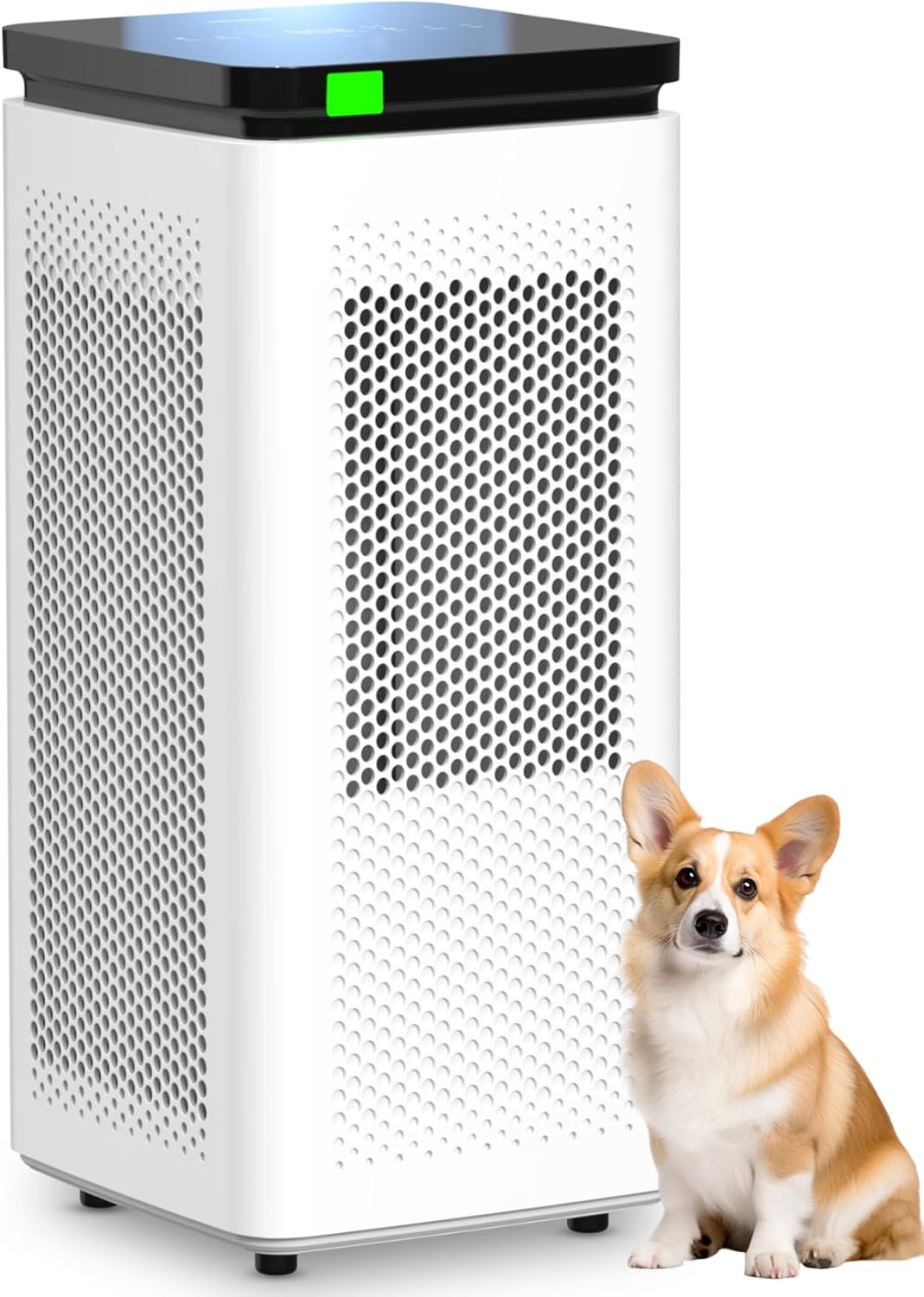
| CADR | 235 CFM |
|---|---|
| HEPA Rating | H13 True HEPA (0.1 μm, 99.97%) |
| Coverage | Up to 3500 sq ft |
| Noise (Sleep Mode) | 30 dB |
| Energy | ENERGY STAR certified |
The SIESEAN AP-400 is a large-room air purifier built around an H13 True HEPA filter plus activated carbon to tackle particulates, smoke, odors, and VOCs. It uses a dual-sided intake and a 235 CFM CADR to circulate air quickly—the manufacturer claims it can clean 500 sq ft in about 15 minutes and cover up to 3,500 sq ft—so it suits open living areas, basements, and busy pet households. Practical controls include a PM2.5 air quality display, Auto Mode that adjusts fan speed to measured conditions, a timer, child lock, and a dimmable panel. Noise is kept low with a 30 dB sleep mode for nighttime use and the unit meets ENERGY STAR and several safety and performance certifications. The main compromises are typical for high-CADR purifiers: filters need replacement every few months depending on conditions, and larger airflow means the unit is physically substantial and best positioned centrally for optimal circulation. For buyers focused on fast cleaning in large spaces, the AP-400 delivers measurable performance with useful smart features.
Best for: Buyers who prioritize fast, certified air cleaning across large open areas and want automatic monitoring and quiet overnight operation.
Less Ideal for: People needing a very compact or portable purifier for single small rooms or those who rarely run the unit and want minimal maintenance.
- H13 True HEPA plus activated carbon removes 0.1 micron particles and reduces odors and VOCs.
- 235 CFM CADR with dual-sided airflow for faster circulation in large rooms.
- Built-in PM2.5 display and Auto Mode provide real-time air feedback and automatic speed adjustment.
- Quiet 30 dB sleep mode and dimmable display make it suitable for night use.
- ENERGY STAR and multiple independent safety/performance certifications.
- Filters require regular replacement (every 3–4 months depending on use).
- Large coverage claims mean the unit is physically substantial and best for centralized placement.
Verdict: Choose the AP-400 when you need fast, certified HEPA and carbon filtration with automatic air-quality control for large rooms.
AIUZLK P260 Air Purifier

| Coverage | Up to 2,000 ft² |
|---|---|
| Motor power | 24W brushless motor |
| Filtration | 3-stage, captures particles ≥0.1 microns |
| Noise level | 22 dB (low setting) |
The AIUZLK P260 is a budget-friendly air purifier aimed at improving air quality in large rooms. It uses a 24W brushless motor and a three-stage filter stack that the manufacturer says captures particles down to 0.1 microns, which helps with smoke, pet hair, dander, and odors. The unit is intended for open living areas, bedrooms, offices and kitchens and claims to noticeably change air quality within 30 minutes in a 2,000 ft² space. Controls include a timer, adjustable fan speeds, a filter replacement reminder and a child lock, and the purifier runs very quietly on low (advertised at 22 dB) for night use. Practical benefits include low power draw and straightforward maintenance with replaceable filters; the listing also points to certified safety marks. Limitations to consider are that CADR numbers are not shown, so real-world clean-air delivery may vary with room layout, and the replacement filter model must be ordered separately for best performance.
Best for: Buyers on a budget who need a simple, low-power purifier for a large open living area and value quiet operation and basic automated controls.
Less Ideal for: Users who require verified performance metrics for clinical allergies or who need integrated smart home connectivity and advanced monitoring features.
- Covers up to 2,000 ft² per manufacturer guidance, suitable for large rooms
- Three-stage filtration aimed at particles down to 0.1 microns for smoke and pet dander
- Low-noise operation (around 22 dB) for bedroom or night use
- Low 24W power draw with basic useful controls including timer and child lock
- No published CADR figures to quantify clean-air delivery
- Replacement filter sold separately and requires ordering by model code
Verdict: A low-cost, quiet purifier with three-stage filtration built to cover very large rooms for buyers prioritizing value and low power use.
AirDoctor AD3500 Air Purifier

| Model | AD3500 |
|---|---|
| Coverage | Up to 2,520 ft2 |
| Filtration stages | Pre-Filter, Activated Carbon, UltraHEPA |
| Particle capture | 99.99% at 0.003 microns |
The AirDoctor AD3500 is a floor-standing purifier built for large rooms and open plans, combining a multi-stage filter stack with a powerful airflow to move and clean air quickly. It uses a Pre-Filter, a premium activated carbon/VOC stage, and an UltraHEPA filter rated to capture 99.99% of particles down to 0.003 microns, which targets smoke, dust, pet dander, pollen, and many ultrafine particles. An Auto mode driven by PM2.5 sensors and a color-coded Halo makes it easy to maintain good indoor air without constant adjustments, and the unit offers four fan speeds, a timer, and a boost function for heavy pollution events. Filter maintenance is straightforward but requires replacing the carbon roughly every six months and the UltraHEPA annually to keep performance consistent. The unit is sizable and meant to deliver rapid coverage across large areas, and while it is described as whisper-quiet in normal use, the higher fan settings will be noticeably louder. For buyers prioritizing long-term reliable filtration and third-party tested performance, this model focuses on proven filter technology rather than budget shortcuts.
Best for: Buyers who prioritize reliable, scientifically backed filtration for whole rooms or open-plan homes and want a unit that runs with automatic air-quality control and predictable maintenance cycles.
Less Ideal for: People seeking an ultra-compact, lightweight purifier for a single small bedroom or those who need minimal upfront and ongoing filter costs.
- Very high particle capture with UltraHEPA down to 0.003 microns.
- Premium activated carbon stage reduces gases, VOCs, and odors.
- Covers large areas quickly with rated cleaning to 2,520 ft2 per hour.
- Auto mode with PM2.5 sensors and visual Halo simplifies hands-off operation.
- Clear filter indicators and straightforward replacement schedule.
- Large physical footprint and weight make it less convenient to move frequently.
- Higher fan speeds produce noticeable noise compared with the lowest settings.
Verdict: Choose the AirDoctor AD3500 when you need proven, high-performance filtration and automatic air-quality control for large homes.
Honeywell AllergenPlus HPA304

| Filter Type | HEPA |
|---|---|
| Floor Area | 465 square_feet |
| Particle Retention Size | 0.3 micron |
| Wattage | 80 watts |
The Honeywell AllergenPlus HPA304 is a large-room HEPA air purifier built to move and clean air in very big spaces. It uses a true HEPA filter to capture up to 99.97% of particles 0.3 microns and larger and offers multiple cleaning speeds including a Turbo mode for faster circulation. Controls are simple touch/button controls with a filter-change indicator, dimmable control panel, and 2/4/8 hour timers for scheduled shutoff. In practice this model is set up on the floor or a low shelf and runs continuously to reduce dust, pollen, pet dander, smoke and similar contaminants in living rooms, open-plan areas or basements. The unit is fairly powerful for its size and Honeywell cites coverage up to 465 sq ft at nearly five air changes per hour, or broader coverage for single-hour air change claims, which makes it practical for homes that need heavy-duty filtration. Limitations include a manual-only feature set with no Wi-Fi or advanced sensing and the unit is relatively large and heavier than smaller purifiers, which affects placement and portability.
Best for: Buyers who want a proven, high-capacity purifier to aggressively reduce airborne allergens and smoke in large open rooms and prioritize reliable filtration over smart features.
Less Ideal for: Users who need a compact, lightweight purifier for small rooms or those who want Wi-Fi, automatic sensors, or app control.
- True HEPA filtration captures particles down to 0.3 microns
- Rated for extra-large rooms with high air-change capability
- Simple touch controls, timer and filter-change indicator for easy operation
- Turbo/high cleaning speed for quick circulation when needed
- No smart features or automatic air-quality sensing
- Large and heavier than compact purifiers, less convenient to move
Verdict: Choose this Honeywell when you need a durable, high-capacity HEPA purifier to clean very large rooms reliably.
Levoit Vital 200S-P Air Purifier

| Floor Area | 1875 square_feet |
|---|---|
| Filter Type | 3-Stage Filter |
| Noise Level | 27 db |
| Particle Retention Size | 0.1 micrometer |
| Power Source | Corded Electric |
The Levoit Vital 200S-P is a smart air purifier built for whole-room use in large homes and open spaces. It uses a three-stage filtration system (washable pre-filter plus HEPA-style and activated carbon stages) and a U-shaped intake to capture fine particles down to 0.1 micrometer, which helps reduce dust, pollen, pet dander, smoke, and odors. The unit is AHAM-verified with high CADR numbers for smoke, dust, and pollen, and it can be controlled via an app or on-device buttons and includes an air quality monitor and sleep mode that drops noise to about 27 dB. In practice it moves a lot of air quickly for its class and is suited to living rooms, basements, and shared spaces where pets or smoke are concerns. Trade-offs are typical for high-output purifiers: it is a larger, heavier countertop/tower unit and will need periodic filter replacements and space for airflow around it. For buyers who prioritize verified performance and quiet night operation, it hits the essential marks.
Best for: Homeowners who want a proven, high-performance purifier for large rooms and prioritize verified cleaning performance and quiet night operation.
Less Ideal for: Buyers who need a compact, portable unit for small bedrooms or frequent relocation between rooms should consider smaller, lighter models instead.
- AHAM-verified with strong CADR performance for smoke, dust, and pollen.
- Three-stage filtration including washable pre-filter and activated carbon for odors and VOCs.
- Smart app control plus on-unit buttons and built-in air quality monitoring.
- Low-noise sleep mode rated around 27 dB for bedroom use.
- Relatively large and heavier than small room purifiers, so it requires floor or counter space.
- Will incur ongoing cost and maintenance for replacement filters over time.
Verdict: Choose the Vital 200S-P when you need a verified, quiet, whole-room purifier that can handle large spaces and pet or smoke concerns.
Choosing the Right Air Purifier for Large House: Key Factors to Consider
Filtration Efficiency and Filter Type
Filter media and certified efficiency determine which particles the purifier actually removes. True HEPA-grade filtration captures most particles down to 0.3 microns, which includes common allergens and many fine particulates. Some models add activated carbon layers to reduce odors and gaseous pollutants, while additional prefilters catch large dust and pet hair to prolong main filter life.
Choosing the right filter types matters because a large house often contains multiple pollutant sources across different rooms. If you have pets, smokers, or cooking-related odors, prioritize units with both HEPA and activated carbon layers. Remember that higher filtration efficiency can mean more frequent filter replacement if the unit draws in a lot of contaminant load.
CADR and Realistic Room Coverage
Clean Air Delivery Rate and claimed room coverage are the best proxy for how quickly a purifier will clean the air in a given space. CADR numbers reflect the rate at which an air cleaner reduces specific particle types and can be compared across models. For a large house, one high-capacity unit may handle an open-plan living area, but multiple strategically placed units often provide more even coverage and faster pollutant removal.
When evaluating CADR and coverage, consider how your home is laid out. Open-concept living areas, cathedral ceilings, or multiple floors change airflow patterns and effective coverage. Look for units whose performance ratings map to the square footage and ceiling heights where you plan to operate them.
Noise Levels and Daily Comfort
Noise is a practical constraint that affects where and how long you will run an air purifier. Higher fan speeds increase airflow and CADR but also raise noise. For whole-home comfort, you want a model that can reach necessary airflow without becoming intrusive in common living spaces or at night.
Check manufacturer noise ratings at different fan speeds and consider how often you will need peak performance. Some purifiers include a quiet or sleep mode with reduced airflow that is adequate for maintenance cleaning overnight, paired with higher speeds during peak pollution events.
Maintenance Requirements and Running Cost
Ongoing upkeep affects the total cost and performance of an air purifier over time. Filter replacement frequency, filter cost, and ease of replacement are all important. Some models use washable prefilters that extend HEPA life, while others rely on disposable replacements that must be budgeted.
In a large house, filters may load faster due to increased dust and activity areas. Consider how easy it is to access filters, whether replacement indicators are reliable, and the expected intervals between changes. Also factor in energy consumption if you plan to run units continuously.
Placement Flexibility and Installation
Where you can place the purifier affects its usefulness in a large home. Floor-standing tower units, compact tabletop designs, and ceiling- or wall-mount options have different airflow footprints and visual impacts. Some high-output units are bulky but necessary for large open spaces, while multiple smaller units may fit better into bedrooms and hallways.
Assess how a chosen unit will fit into actual rooms, how easy it is to move between spaces, and whether it requires any special clearance around the intake and outlet for efficient operation. Portability and caster wheels can be practical if you plan to rotate units among rooms.
Sizing Strategies for Whole-Home Coverage
Estimating the right capacity starts with square footage and ceiling height for the rooms you want to serve. For true whole-house effect you can either place a single high-CADR unit in a central open area or deploy multiple units distributed across frequently used rooms. Multiple units can cut cleaning time and avoid creating negative pressure in one zone.
Place units near pollution sources when possible, such as kitchens, entryways, or rooms with pets. Avoid pushing a single unit to its maximum continuously; instead, use scheduled higher-speed cycles during peak activities and maintain a lower baseline speed the rest of the time.
- Match CADR to the square footage and ceiling height of intended zones
- Use multiple units for multi-level homes or closed-off rooms
- Place near sources like doors, kitchens, or pet areas for faster clearance
Operational Modes and Smart Scheduling
Look for units with programmable schedules, auto modes that respond to real-time sensors, and app-based controls for remote operation. Automated responsiveness helps maintain steady air quality without constant manual intervention, which is especially useful in larger homes where conditions vary by room.
If a purifier supports zoned control across multiple devices, you can prioritize high-use areas during the day and quieter bedrooms at night. Auto modes that use particle sensors will ramp fan speeds only when needed, reducing noise and energy use.
- Prioritize models with reliable auto-sensing and scheduling
- Remote controls and apps allow easy adjustment across the home
- Zone scheduling helps balance noise, energy, and air-cleaning needs
Maintaining Airflow and Avoiding Obstructions
Effective filtration depends on unrestricted airflow through the intake and outlet. Do not tuck units into closed cabinets or tight corners. Maintain recommended clearance from walls and large furniture to ensure the purifier can move air as rated.
Regularly vacuum around intake grilles and replace or clean prefilters as directed. In high-dust environments, check filters more often and consider using a prefilter or protective mesh to catch larger debris and extend main filter life.
- Keep recommended clearance around the unit for optimal airflow
- Clean prefilters and surrounding areas on a schedule
- Avoid placing units where curtains or drapes can block airflow
Energy Use and Continuous Operation
Running multiple purifiers in a large house raises electricity use, so check power draw at typical fan speeds. Many modern units use surprisingly little power on low or auto modes, but high-speed or turbo settings increase consumption. Consider energy-saving settings for overnight and background cleaning.
If you plan continuous operation, prioritize Energy Star rated models or those with lower wattage at standard settings. A low-power baseline combined with intermittent high-speed cycles delivers good long-term performance without excessive energy cost.
- Compare wattage at common operating speeds
- Use auto modes to reduce unnecessary high-speed run time
- Balance number of units against energy budget for continuous use
Addressing Odors and Gaseous Pollutants
HEPA filters capture particles but do not remove gases or odors. If your house experiences cooking smells, volatile organic compounds, or tobacco smoke, look for units that incorporate activated carbon or other adsorbent media to address those concerns. Some high-capacity models offer larger carbon beds or replaceable odor filters to improve longevity.
Place carbon-equipped units near likely odor sources and consider pairing them with HEPA-only units in bedrooms where particle control is the priority. Remember that carbon filters saturate over time and must be replaced to remain effective.
- Choose activated carbon layers for odor and VOC reduction
- Position carbon-equipped units near kitchens and entryways
- Plan for regular carbon filter replacement for sustained odor control
How We Chose the Best Air Purifier for Large House
We focused on practical, measurable attributes buyers need when selecting an air purifier for a large house. Key evaluation criteria included: certified filtration efficiency against fine particles, stated Clean Air Delivery Rate or equivalent airflow performance, realistic room coverage and how that translates to whole-house use, noise levels at typical fan speeds, and ongoing maintenance needs such as filter replacement frequency and cost. We also considered build quality and controls that affect daily use, like programmable schedules and connectivity options. We excluded units designed only for single small rooms or specialty devices not intended for continuous home use. We did not include unverified or unsupported performance claims; instead we prioritized products with clear specifications and manufacturer data that align to buyer expectations. The shortlisted options are those that best balance airflow, filtration, noise, and upkeep for larger homes.
Our full evaluation process is outlined in our review methodology.
FAQ
How many air purifiers do I need for a large house?
It depends on layout and desired response time. One high-capacity unit can serve a large open area, but multiple units placed in key rooms or on each floor provide faster and more even cleaning. Consider how quickly you want pollutants removed when deciding quantity.
Can an air purifier remove household odors and VOCs?
Particle-focused HEPA filters do not capture gases. For odors and volatile organic compounds you need a unit with activated carbon or specialized adsorbents. Carbon layers have limited capacity and require replacement to remain effective.
Are higher CADR numbers always better for large homes?
Higher CADR indicates faster particle removal, which helps in large or open spaces, but it must be balanced with noise and energy use. Very high airflow is useful during pollution events, while lower speeds suffice for continuous background cleaning.
How often should filters be replaced in a busy household?
Replacement intervals vary with usage and contaminant load. Homes with pets, heavy cooking, or high dust will need more frequent changes. Check filter life indicators if available and inspect prefilters monthly for heavy soiling.
Will running an air purifier constantly increase my electricity bill significantly?
Modern purifiers are generally energy-efficient on low or auto modes, so continuous operation has a modest cost. Running multiple units at high speed or using turbo modes frequently will raise energy use, so balance continuous background cleaning with occasional high-power cycles.
Final Verdict
For large houses the right approach pairs adequate airflow with reliable filtration and manageable maintenance. Prioritize units with verified CADR or high airflow ratings that match your most-used spaces, and choose filters that address both particles and, if needed, gases and odors. Plan placement and quantity to suit your floor plan rather than relying on a single undersized unit. Balance noise and energy tradeoffs by using auto and scheduled modes, and budget for regular filter maintenance. With those priorities in mind, you can confidently select air purifiers that improve whole-home air quality without excessive noise or upkeep.