
Note: This article contains affiliate links. If you click on these links and make a purchase, we may earn a small commission at no extra cost to you. This helps support our research and content. Read our full affiliate disclosure here.
Picking the right air purifier for a medium room matters because the wrong size or filter type won't meaningfully lower airborne particles where you spend time. You want a unit that moves enough air to cycle the room regularly, removes the contaminants you care about, and fits your tolerance for sound and upkeep. This guide covers seven shortlisted air purifiers optimized for medium rooms. We evaluated each option against practical factors like filtration performance, clean air delivery, noise, and ongoing maintenance to help you find a model that balances health benefits, comfort, and running cost. Read on for the criteria we used and what to expect from the top picks.
Top Picks at a Glance
| Best Overall The best all-around choice for most situations | WINIX AT40 Air Purifier |  |
| Best Quality Built to a higher standard if you want something more solid | Coway Mighty AP-1512HH |  |
| Best Value The sweet spot between price and what you get | GermGuardian AC4825E 22" Tower |  |
| Best Budget The cheapest option that still gets the job done reliably | FULMINARE H13 HEPA Air Purifier |  |
| Top Rated A top-rated pick with lots of positive feedback | Levoit Core 300-P |  |
| Most Popular A crowd favorite that many people choose with confidence | Levoit Core Mini-P |  |
| Best Seller A high-volume bestseller chosen again and again | VOOPNU H13 HEPA Air Purifier DH-JH12 |  |
WINIX AT40 Air Purifier

| Coverage (AHAM) | Cleans up to 1,968 sq ft in 1 hour (984 sq ft in 30 min) |
|---|---|
| Filtration stages | 4-stage with True HEPA, carbon, prefilter, PlasmaWave |
| Wi‑Fi | Yes, Winix Smart App |
| Included filters | Two 360° all-in-one True HEPA filter sets |
The WINIX AT40 is a 360° four-stage air purifier designed to move a lot of air while tracking indoor air quality in real time. It uses a combined prefilter, True HEPA, carbon/odor stage and PlasmaWave technology, and Winix rates it to clean very large spaces rapidly with an AHAM CADR suitable for whole rooms. A built-in smart sensor drives an auto mode that adjusts fan speed based on detected pollution and a color/number display gives immediate feedback. Wi‑Fi and the Winix Smart App let you monitor air quality and check filter life remotely, and sleep mode drops noise and power when quiet operation is needed. Included filters (two all-in-one sets) cover long initial runtime, but replacement HEPA/carbon sets will be an ongoing cost. The unit is relatively tall and focused on high throughput rather than ultra-compact placement, so it works best as a primary purifier for a single medium to large room rather than for multiple smaller zones.
Best for: Buyers who want a single, powerful purifier for a medium to large room that actively manages air quality and offers remote monitoring and easy filter replacement.
Less Ideal for: People who need a small, ultra-quiet unit for a bedside or very small room or those who prefer a permanently low-cost, filterless solution.
- True HEPA filtration that captures very small particles down to 0.01 microns for effective removal of pollen, dust, smoke and pet dander.
- 360° all-in-one filter design simplifies replacement and provides combined prefilter, HEPA and carbon stages.
- Smart sensor with auto mode and color-coded real-time display for hands-off, responsive operation.
- Wi‑Fi app control for remote monitoring, adjusting settings, and tracking filter life.
- Designed for high airflow so it is larger and less portable than compact bedroom purifiers.
- Replacement filter sets are required periodically and are an ongoing expense.
Verdict: Choose the WINIX AT40 when you want a powerful, app-controlled purifier that actively monitors and clears air in a medium to large room.
Coway Mighty AP-1512HH

| Coverage | Up to 1,748 sq. ft. in 60 minutes |
|---|---|
| Filtration stages | Washable pre-filter, deodorization filter, bipolar device, HEPA filter |
| HEPA effectiveness | 99.97% of 0.3µm particles |
| Air quality indicator | Real-time LED sensor indicator |
The Coway Mighty AP-1512HH is a medium-room air purifier that pulls room air through a washable pre-filter, deodorization stage, bipolar ionizer, and a true HEPA filter to remove particles, odors, and some gases. It is typically placed in living rooms or bedrooms and runs in Auto mode most of the time, where its pollutant sensor ramps fan speed as air quality worsens and slows back down when levels improve. Practical benefits include strong particle capture (HEPA 99.97% at 0.3 micron), an easy-to-clean pre-filter that prolongs HEPA life, and an intuitive air quality LED that provides an at-a-glance view of conditions. Eco and timer modes help reduce energy use and noise during sleep. Trade-offs are that the unit is focused on room air cleaning rather than whole-house circulation and replacement filters are an ongoing cost; the bipolar ionizer and VOC reduction rates are specified by lab tests and actual performance varies with room layout and pollutant sources.
Best for: Buyers who prioritize demonstrable particle removal and responsive automatic control for medium-sized rooms and want a proven, easy-to-maintain purifier.
Less Ideal for: People seeking whole-house ventilation or integrated smart-home control should consider larger HVAC solutions or networked purifiers instead.
- True HEPA filtration capturing 99.97% of 0.3µm particles
- Built-in air quality sensor with Auto mode that adjusts fan speed in real time
- Washable pre-filter extends HEPA life and is easy to maintain
- Multiple modes including Eco and timer for quieter, energy-saving operation
- Replacement HEPA and specialty filters add recurring cost
- Performance for gases and VOCs depends on optional custom filters and room conditions
Verdict: Choose the Coway Mighty AP-1512HH when you need a proven, responsive HEPA purifier to keep medium rooms continuously and automatically cleaner.
GermGuardian AC4825E 22" Tower

| Model | AC4825E |
|---|---|
| Room coverage (cycle) | 153 sq. ft. every 12.5 minutes; up to 743 sq. ft. per hour |
| Filter type | True HEPA with activated carbon pre-filter |
| Fan speeds | Three (including sleep mode) |
The GermGuardian AC4825E is a compact tower air purifier that uses a True HEPA filter with an activated carbon pre-filter and optional UV-C light to reduce dust, pollen, pet dander, cooking smells, and some airborne germs. It is typically placed in bedrooms, home offices, or living rooms and can cycle the air in a 153 sq. ft. room about every 12.5 minutes and circulate air in much larger rooms up to 743 sq. ft. on a slower cadence. Three fan speeds including a quiet sleep mode make it easy to run overnight or during the day, and the tower footprint fits into tight spaces. Filter replacements and UV-C bulbs are specified to GermGuardian filter B and compatible replacement parts for straightforward maintenance. The trade-offs are a modest physical fan capacity compared with larger console purifiers and reliance on periodic filter and bulb replacement to maintain performance, but for a medium room this model balances effective HEPA capture, odor reduction, and simple controls in a small package.
Best for: Buyers who want a practical, space-efficient purifier for bedrooms or medium living spaces that reliably removes allergens and common odors without complicated controls.
Less Ideal for: Those needing the fastest air exchange for very large open-plan areas or who prefer a smart-connected purifier with app control and automation.
- True HEPA filter captures 99.97% of particles down to 0.1 microns from air passing through the media
- Activated carbon pre-filter reduces common household odors and cooking smells
- Optional UV-C light adds an extra sanitizing function
- Three fan speeds including a quiet sleep mode for overnight use
- Compact tower design fits small to medium rooms and tight floor space
- Not the highest CADR compared with larger console units, so longer cycle times in very large rooms
- Requires periodic replacement of HEPA filters and UV-C bulb to retain performance
Verdict: A compact, no-frills HEPA tower that delivers reliable allergen and odor removal for medium rooms with simple controls and easy maintenance.
FULMINARE H13 HEPA Air Purifier

| Filter type | H13 HEPA |
|---|---|
| Recommended coverage | 215 sq ft / 20 m² |
| Noise level (low) | ~24 dB |
| Timers | 2/4/8/10/12 hours |
The FULMINARE H13 is a small, portable air purifier intended to clean the air in bedrooms and similar medium rooms up to about 215 sq ft. It uses an H13 HEPA filter and a 360 degree outlet with dual-channel circulation to refresh room air multiple times per hour, and it includes a low-noise sleep mode that the manufacturer rates at roughly 24 dB on low. Controls include an independent night light and several timer options (2, 4, 8, 10, 12 hours), and the unit plugs in with no internal battery required. In use it is easy to place on a bedside table or desk, offers visible reduction of odors and pet hair particulates when used in the recommended room size, and its quiet operation is well suited for light sleepers. Limitations are its small coverage area relative to large-room purifiers and the need to replace filters periodically; buyers should confirm replacement filter availability and schedule are acceptable for regular use.
Best for: Buyers looking for an affordable, quiet tabletop purifier to improve air quality in a single bedroom, office, or similar medium-size room and who prioritize low-noise operation and simple controls.
Less Ideal for: People who need whole-house or large open-concept coverage or those who want advanced smart features like app control or multi-room integration.
- H13 HEPA filter for high-efficiency particulate capture
- 360° air outlet with dual-channel design to circulate air effectively in small rooms
- Near-silent sleep mode suitable for bedrooms
- Independent night light and multiple timer settings for flexible use
- Compact and portable plug-in design easy to place on tables or shelves
- Rated effective for rooms up to about 215 sq ft, not suitable for larger open-plan areas
- Requires periodic filter replacements and removing packaging from new filters before first use
Verdict: A compact, budget-friendly H13 HEPA purifier that quietly improves air in a single medium room, making it a practical choice for bedrooms and small home offices.
Levoit Core 300-P

| Filter Type | 3 in 1 Filtration |
|---|---|
| Floor Area | 1073 square_feet |
| Noise Level | 24 db |
| Wattage | 56 watts |
| Particle Retention Size | 0.3 micron |
The Levoit Core 300-P is a small, user-friendly air purifier built around a three-stage filtration system with a HEPA-grade original filter that captures 99.97% of particles down to 0.1–0.3 micron. It uses a 56 W motor and delivers a CADR suited to refresh air in medium rooms, and includes a near-silent Sleep Mode that drops noise to about 24 dB for undisturbed nighttime operation. Controls are touch-based with a timer and a filter check indicator, and the unit is AHAM verified and CARB compliant for safe home use. Practical benefits include straightforward maintenance with a single replaceable filter cartridge and true HEPA performance in regular and sleep settings. Limitations are that it lacks smart Auto Mode on this specific variant, so fan speeds must be adjusted manually, and the manufacturer recommends using genuine replacement filters for best performance which adds to long-term cost. The Core 300-P is portable and energy-efficient for continuous use in bedrooms or living rooms, but buyers should plan for periodic filter replacements.
Best for: Buyers who prioritize consistent, proven filtration and quiet operation for bedrooms or medium living spaces and want a reliable, easy-to-maintain purifier.
Less Ideal for: People seeking a smart, automated purifier with app control or Auto Mode or those who need coverage for very large open-plan areas.
- True HEPA-grade filtration capturing 99.97% of 0.1–0.3 μm particles
- AHAM verified CADR performance suitable for medium rooms
- Very quiet Sleep Mode around 24 dB for night use
- Compact and portable footprint with simple touch controls
- No smart connectivity or automatic auto mode on this model
- Depends on Levoit replacement filters for rated performance, increasing operating cost
Verdict: A dependable, quiet HEPA-grade purifier that delivers proven medium-room performance for buyers who value reliability and low-noise operation.
Levoit Core Mini-P
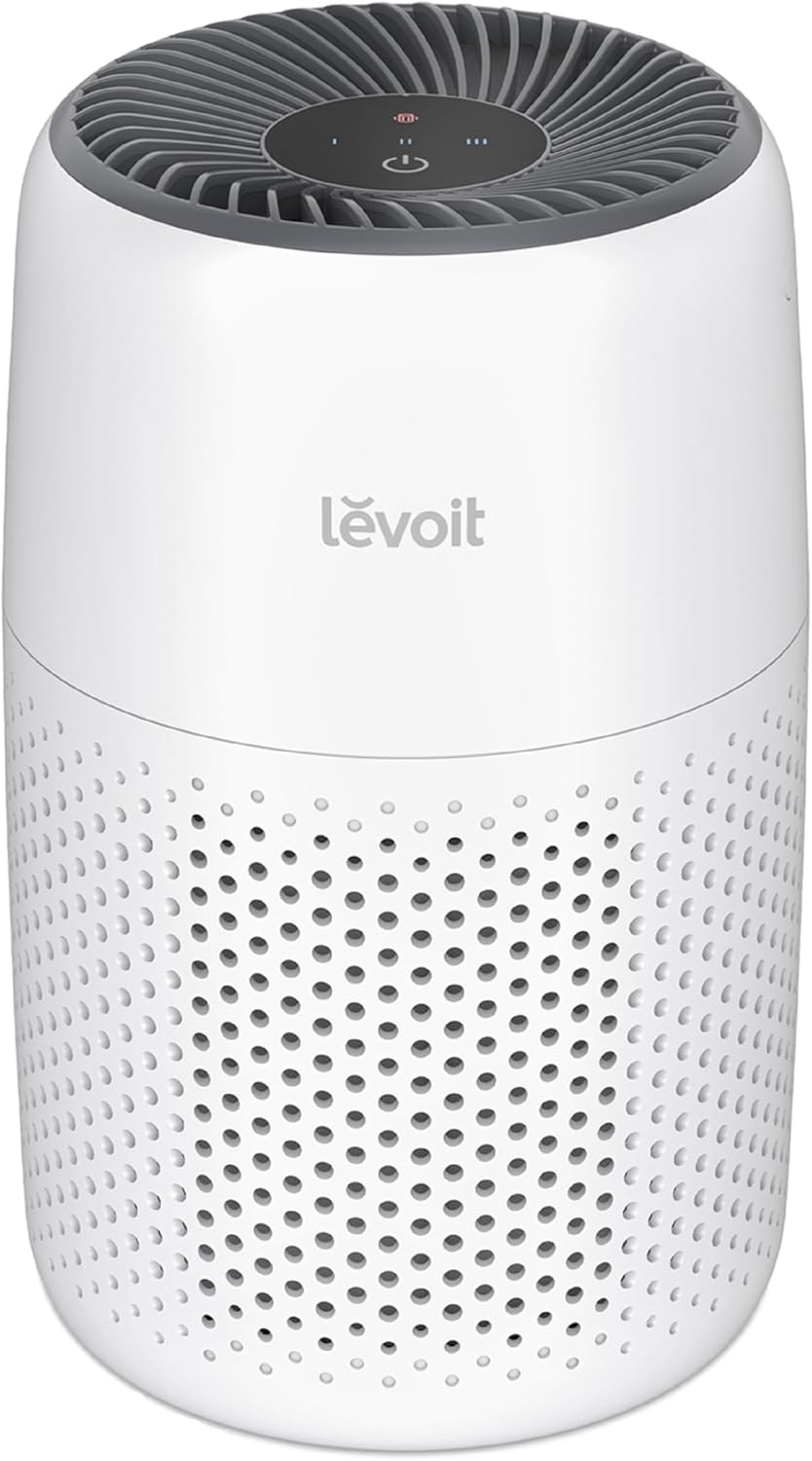
| Rated Power | 7W |
|---|---|
| Noise Level | 27-45dB |
| Particle Retention Size | 0.3 micron |
The Levoit Core Mini-P is a compact tabletop air purifier aimed at reducing common indoor pollutants like dust, pet dander, smoke, and odors in bedrooms, offices, or dorms. It uses a multi-stage filtration system with a pre-filter and main HEPA-style filter to capture fine particles and includes a small fragrance sponge for light aromatherapy. The unit is very quiet, with manufacturer noise figures listed between about 27 and 45 dB, and it draws low power at 7W which makes it suitable for continuous overnight use in sleep mode. Practical benefits include a small footprint that fits on desks or nightstands, an auto-off display and sleep setting to reduce disturbance, and AHAM verification that confirms tested cleaning performance. Limitations are its modest coverage—best for smaller rooms rather than large living areas—and the tiny aromatherapy reservoir that accepts only a few drops and can cause overflow if overfilled. Replacement filters are required over time, and while the purifier is energy efficient, buyers should match it to a room size within its effective range.
Best for: Buyers who prioritize independently tested performance and quiet, energy-efficient operation for bedrooms or small to medium personal spaces and who value broad social proof before deciding.
Less Ideal for: People needing strong air cleaning for large open-plan living rooms or whole-home coverage should choose a larger-capacity purifier with higher CADR.
- AHAM-verified performance for reliable air cleaning
- Very low power draw (7W) suitable for continuous use
- Quiet operation with sleep mode for overnight use
- Compact footprint fits easily on desks and nightstands
- Designed for smaller rooms so coverage is limited for medium to large open areas
- Aromatherapy sponge is small and can overflow if overfilled
Verdict: Choose the Core Mini-P when you want an AHAM-verified, ultra-quiet, energy-efficient purifier for a bedroom or personal workspace.
VOOPNU H13 HEPA Air Purifier DH-JH12

| Coverage | Up to 1,076 ft² (per hour) / 250 ft² per 15 minutes (lab tested) |
|---|---|
| Filter | H13 True HEPA multi-layer |
| Noise level | As low as 22 dB |
| Speeds | 3 fan speeds |
| Item model number | DH-JH12 |
The VOOPNU DH-JH12 is a compact tower air purifier built around an H13 True HEPA multi-layer filter and 360 degree intake to capture particles, pet hair, pollen, smoke, and common odors. It is intended for continuous use in medium to large rooms and—per the manufacturer—can clean roughly 250 sq ft every 15 minutes, equating to coverage up to about 1,076 sq ft per hour. Controls are simple with three fan speeds, a timer, and a quiet low setting that can operate near 22 dB for night use. There is also a small aroma tray for essential oils. Filters are replaceable on a recommended 3–6 month cycle depending on conditions, and the unit carries multiple safety and performance certifications. Trade-offs include a compact footprint that limits raw airflow compared with larger standalone purifiers and ongoing filter replacement costs; buyers should expect best results when the unit runs continuously. For someone seeking a straightforward, low-noise purifier for bedrooms or living rooms, this model delivers effective HEPA filtration in a small package.
Best for: Buyers who prioritize quiet, easy-to-use HEPA filtration for medium rooms and prefer a low-risk, certified product that can be run continuously without fuss.
Less Ideal for: People who need the highest possible CADR for very large open-plan spaces or who want a purifier with advanced smart-home connectivity and remote monitoring.
- H13 True HEPA filtration rated to capture 99.97% of airborne particles
- 360° surround air intake for more even room coverage
- Very quiet operation down to about 22 dB suitable for bedrooms
- Simple controls with three speeds and timer for easy, low-effort use
- Built-in aroma tray for optional essential oil use
- Manufacturer coverage claims are based on laboratory testing and real-world performance depends on room layout and continuous runtime
- Compact footprint limits maximum airflow compared with larger high-CADR units
- Requires periodic filter replacements on a 3–6 month recommended cycle
Verdict: A quiet, certified H13 HEPA purifier that offers easy, continuous filtration for medium rooms where low noise and simple operation are top priorities.
Choosing the Right Air Purifier for Medium Room: Key Factors to Consider
Room Coverage and CADR
Airflow capacity determines whether an air purifier can exchange the air in a medium room frequently enough to reduce pollutant levels. CADR ratings provide a measurable indication of how quickly a unit clears smoke, dust, and pollen. Match the CADR to the room's square footage and ceiling height to estimate how many air changes per hour the purifier will deliver.
Undersized units may offer marginal improvement and can give a false sense of protection. Also consider placement; obstructions like furniture and walls reduce effective coverage, so choose a purifier with a bit of extra capacity for real-world conditions.
Filtration Type and Target Pollutants
A true HEPA filter is essential for removing fine particles such as dust, pollen, pet dander, and many aerosolized allergens. For medium rooms where smoke or odors are a concern, an activated carbon or other gas-phase filter helps reduce volatile organic compounds and smells.
Consider filter layer composition and whether the purifier supports modular filter packs. Some designs combine pre-filters for large particles with HEPA and carbon layers for comprehensive capture. Think about what contaminant types are most important in your space and choose a filtration package that addresses them.
Noise Levels During Normal Use
Noise influences how and when you will run the purifier. A model that performs well but is loud at useful fan speeds often gets turned off or set too low to be effective. Look for manufacturer-provided decibel ratings at different fan speeds and test-mode user feedback when possible.
Also consider variable speed controls and night modes that reduce fan speed and noise. Fan noise spectrum matters too; lower-frequency hums are perceived differently from high-frequency whines. For bedrooms or shared living spaces, prioritize quiet operation at speeds that still deliver enough airflow.
Operating Cost and Energy Use
Runtime energy consumption impacts monthly utility costs, especially if you plan to run the purifier continuously. Compare wattage at typical fan speeds and consider Energy Star ratings when available. Factor in how often filters must be replaced and the cost of replacement packs to estimate ongoing expenses.
Some units use smart features to reduce runtime, such as air-quality sensors and auto modes that lower fan speed when the air is clean. Those features can reduce total energy use and filter wear but check that the auto logic still allows sufficient air exchanges.
Maintenance and Ease of Use
Filter replacement frequency, ease of access to filter compartments, and availability of replacement parts affect the long-term usability of a purifier. Units with tool-free access, clear indicator lights or timers for filter life, and widely available filter replacements reduce friction and the chance of running equipment past recommended maintenance intervals.
Also consider the cleaning needs for pre-filters and housing. Dusty environments might require more frequent pre-filter cleaning, and models with washable pre-filters can save money and hassle over time.
Placement Flexibility and Physical Footprint
Medium rooms have varying layouts and furniture arrangements. The purifier's size, weight, and intake/exhaust orientation affect where it can go and how well it moves air through the occupied zone. Taller, slim units may fit against walls better, while tabletop models can be placed near seating areas to target breathing zones.
Also consider caster wheels or handles if you plan to move the purifier between rooms. Some designs require clearance around the intake and exhaust; read placement guidance to ensure you can position the unit for optimal airflow without disrupting room use.
Sizing a Purifier to Your Medium Room
Estimate your room area by measuring length and width, and multiply by ceiling height to check for unusual tall rooms. Use the CADR guideline relative to square footage to select a unit that can achieve at least 3 to 5 air changes per hour for routine pollutant reduction. If occupants have respiratory sensitivities or there are high pollutant sources, aim for the higher end of that range.
Remember that CADR is given for specific particle types, so balance the numbers with the filter media when you have mixed concerns like smoke and allergens. When in doubt, select a purifier with slightly higher capacity than the nominal room size to allow for furniture and airflow losses.
- Measure room square footage and consider ceiling height.
- Target 3 to 5 air changes per hour for general use.
- Choose higher CADR if allergies, smoke, or heavy cooking are frequent.
Balancing Filtration and Noise
High fan speeds increase particle removal but raise noise. If you will run the purifier while sleeping or during work, prioritize units that offer quiet performance at moderate fan speeds while still delivering reasonable CADR. Night modes and low-noise fan blades help maintain air cleaning without causing distraction.
Some purifiers include air quality sensors that allow the unit to ramp up only when needed. That can reduce time spent at high noise levels while preserving overall air quality, but confirm that auto behavior does not leave the room under-cleaned for long stretches.
- Check decibel ratings at multiple fan speeds.
- Prefer units with night or sleep modes for bedrooms.
- Look for responsive auto modes with conservative thresholds.
Placement Tips to Maximize Effectiveness
Place the purifier away from obstructions and at least a foot from walls when possible so intakes and exhausts have clear flow. Positioning nearer the pollution source, like a window when smoke infiltrates, gives faster local reduction, while central placement helps circulate air throughout the room.
Avoid placing the unit on the floor under heavy furniture or inside shelving that blocks airflow. For targeting breathing zones, consider elevating the purifier on a stable table or stand so air is exchanged at seated or sleeping height.
- Keep clearances around intake and exhaust.
- Place near likely pollutant sources for faster reduction.
- Elevate slightly to target breathing zones if practical.
Understanding Filter Lifespan and Replacement
Filter life varies with use and local particle load. Heavy dust, pet hair, or frequent smoke will shorten filter intervals. Check manufacturer filter-life estimates and plan replacement budgeting accordingly. Some systems use pre-filters to extend HEPA life; cleanable pre-filters reduce waste and cost.
When replacing filters, follow recommended seating and sealing procedures to avoid bypass. Keep spare filters on hand if your environment causes frequent replacements so performance does not degrade while you wait for new parts.
- Track filter change intervals based on local conditions.
- Clean pre-filters regularly when applicable.
- Keep replacement filters available if your environment is variable.
Smart Features and Sensors: Useful or Unnecessary?
Built-in air-quality sensors and Wi-Fi controls can offer convenience by adjusting fan speed automatically and letting you monitor indoor air remotely. For some buyers, that improves long-term use because the purifier runs only as needed. However, sensor quality and placement matter; poorly tuned sensors can cause excessive cycling or insufficient cleaning.
If you prefer a simple, reliable device, manual speed controls with clear performance data may be preferable. Smart features are valuable when they add measurable benefits like energy savings or more consistent air quality, not just connectivity.
- Evaluate whether auto behavior is conservative enough for your needs.
- Use sensors to reduce runtime if they are accurate.
- Manual controls can be preferable for predictable performance.
How We Chose the Best Air Purifier for Medium Room
We prioritized features that directly affect day-to-day performance in medium rooms. First, we looked at Clean Air Delivery Rate (CADR) relative to medium-room square footage to ensure units can cycle air frequently enough to reduce particles. Filtration effectiveness was next, focusing on true HEPA filtration and targeted media for smoke, pollen, or VOCs depending on the configuration. Noise output at typical fan speeds was a key filter because a noisy purifier is often turned down or off, negating its benefits. Energy use and maintenance costs were evaluated to estimate ongoing operating expense and convenience. Finally, airflow design and placement flexibility were considered since real rooms have furniture, doors, and HVAC influences that alter performance. We excluded units that are undersized for the medium room range, single-filter designs that do not include true HEPA or adequate gas-phase options when VOC control was necessary, and products without clear CADR or noise specifications. The final shortlist contains models that meet or exceed the minimum airflow and filtration expectations for regular use in medium-sized living spaces.
Our full evaluation process is outlined in our review methodology.
FAQ
How big should an air purifier be for a medium room?
Match the purifier's CADR to your room's square footage and ceiling height. Aim for a unit that provides at least 3 air changes per hour under normal use and more if you need faster clearance for allergens or smoke.
Is a true HEPA filter necessary for a medium room?
Yes, a true HEPA filter is the most reliable way to remove fine particles like pollen, pet dander, and dust. For odors or gases you should also choose a unit with activated carbon or other gas-phase filtration.
Will running an air purifier all day increase my electricity bill a lot?
Energy use depends on the unit's wattage and how often it runs at high speeds. Many modern purifiers are energy efficient and include auto modes that reduce runtime, but expect some increase in energy use if you run the purifier continuously.
Can I put an air purifier inside a closet or behind furniture?
No. Obstructing intake and exhaust reduces airflow and undermines performance. Place the purifier with recommended clearances and away from heavy blockage to allow proper circulation.
How often do I need to replace filters in a medium room?
Replacement intervals vary with filter type and local pollution. Typical HEPA filters last several months to a year under normal conditions, while pre-filters may need cleaning more often. Monitor filter indicators and local conditions to set a schedule.
Final Verdict
Choosing the right air purifier for a medium room requires balancing capacity, filtration type, noise, and operating cost. Prioritize a unit whose CADR matches your room area and that includes true HEPA filtration for particle removal. If odors, smoke, or VOCs are concerns, add a carbon or gas-phase filter to your criteria. Be realistic about placement and maintenance. A slightly larger, quieter unit with easy-to-replace filters often delivers the best real-world results. Use the factors above to weigh tradeoffs and select a model that you will run consistently, since consistent use is the key to cleaner indoor air.