
Note: This article contains affiliate links. If you click on these links and make a purchase, we may earn a small commission at no extra cost to you. This helps support our research and content. Read our full affiliate disclosure here.
When you want cleaner indoor air without the risk of ozone byproducts, choosing the right air purifier matters for health and daily comfort. An air purifier without ozone focuses on mechanical and electronic filtration methods that capture particles and reduce allergens without producing reactive gases. For bedrooms, living rooms, and allergy-prone spaces, the correct unit balances filtration efficiency, noise, and ongoing operating costs. This guide highlights six top shortlisted air purifiers without ozone and explains the practical tradeoffs to consider. We evaluated units for filtration effectiveness, quiet operation, and upkeep needs so you can select a model that fits your room size and lifestyle. Read on for the evaluation criteria and key buying factors before the product summaries.
Top Picks at a Glance
| Best Overall The best all-around choice for most situations | WINIX 5510 Air Purifier |  |
| Best Value The sweet spot between price and what you get | MOOKA B-D02L Air Purifier |  |
| Best Budget The cheapest option that still gets the job done reliably | MEGAWISE EPI810 Air Purifier |  |
| Top Rated A top-rated pick with lots of positive feedback | Levoit Core 300-P Air Purifier |  |
| Most Popular A crowd favorite that many people choose with confidence | GermGuardian AC4825E 22" Tower |  |
| Best Seller A high-volume bestseller chosen again and again | Levoit Core Mini-P |  |
WINIX 5510 Air Purifier

| Model | 5510 |
|---|---|
| Coverage | Up to 1,882 sq ft in 1 hour |
| Filters | 4-stage (washable pre-filter, True HEPA, carbon) |
| Noise (lowest) | 23.5 dB |
| Certifications | AHAM Verified, UL Certified |
The WINIX 5510 is a four-stage air purifier built to clean large open spaces quickly while keeping operation quiet. It combines a washable pre-filter, a True HEPA filter that captures particles down to 0.01 microns, and a high-deodorization carbon filter that reduces cooking, pet, and smoke odors, plus Winix's PlasmaWave technology. Smart sensors and an AQI indicator let the unit adjust fan speed automatically in Auto Mode and the Smart App enables remote control and monitoring. Sleep Mode dims lights and drops noise for nighttime use, and the unit is AHAM verified and UL certified which supports its coverage and safety claims. Practical downsides are the ongoing cost and maintenance of replacement filters and that PlasmaWave is an active technology some buyers prefer to disable; also its strong coverage is best suited to larger rooms rather than small bedrooms. For someone seeking a smart, high-coverage purifier that handles particles and odors without generating ozone, the 5510 is a capable, real-world performer.
Best for: Buyers who want a quiet, smart purifier that aggressively handles particles and household odors in larger rooms and prefer automatic air-quality control.
Less Ideal for: People who need a simple, ultra-compact bedroom-only purifier or those unwilling to budget for periodic filter replacements.
- True HEPA filtration captures very small particles down to 0.01 microns
- High-deodorization carbon filter reduces VOCs and common household odors
- Smart sensors with Auto Mode and AQI indicator provide automatic, hands-off control
- Winix Smart App and voice assistant compatibility enable remote monitoring and control
- Ultra-quiet Sleep Mode for low-noise nighttime operation
- Replacement filters add recurring maintenance cost
- PlasmaWave active technology may concern buyers who prefer only passive filtration
Verdict: If you need a smart, quiet purifier that cleans large rooms and reduces both fine particles and odors without producing ozone, the WINIX 5510 is a strong all-around choice.
MOOKA B-D02L Air Purifier
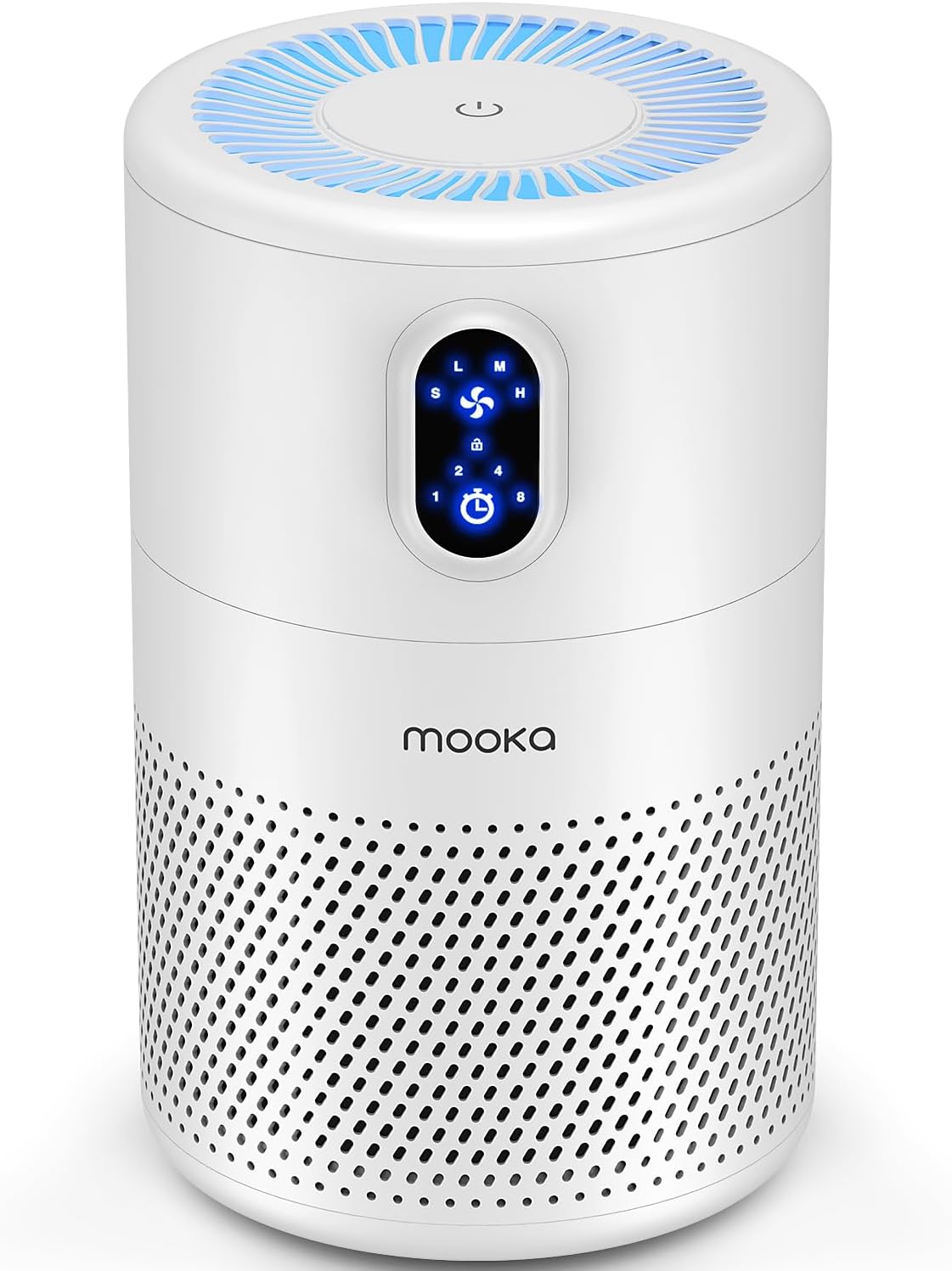
| Effective Area | 1076 sq ft |
|---|---|
| HEPA Filter | H13 TRUE HEPA |
| Filter Lifespan | 3-6 months |
| Timer Settings | 1/2/4/8 hours |
| Fan Modes | Sleep/Low/Med/High |
The MOOKA B-D02L is a plug-in room air purifier built around an H13 true HEPA filter plus an activated carbon layer to capture particles, pet hair, smoke and common odors. It is intended for continuous use in bedrooms, living rooms or offices and claims coverage up to 1076 sq ft with faster air changes in smaller rooms. Controls are simple: four fan speeds including a quiet sleep mode, a 1/2/4/8 hour timer, a soft night light and a child lock for safety. Practical touches include a washable pre-filter option and a filter-replacement reminder; filters are expected to last about 3–6 months depending on conditions. The unit emphasizes low noise and low power draw thanks to a brushless DC motor, making it suitable for overnight use. Limitations are typical for compact standalone purifiers: the stated maximum coverage assumes ideal placement and open airflow, and replacement filters are a recurring cost. Overall it is a straightforward, no-frills purifier that focuses on filtration performance and quiet operation rather than smart features or app control.
Best for: Buyers who prioritize efficient, quiet filtration and straightforward controls for improving home air without needing smart features or ozone-emitting technologies.
Less Ideal for: People who want connected controls, real-time air-quality readouts, or HVAC-integrated solutions should consider models with sensors and app support instead.
- H13 true HEPA plus activated carbon captures particles and odors
- Multiple fan speeds including a very quiet sleep mode for night use
- Timer and child lock add convenience and safety
- Filter reminder and washable pre-filter option simplify maintenance
- Coverage figures assume ideal conditions and may be optimistic in closed or cluttered rooms
- No Wi-Fi, app control, or advanced air-quality sensors included
Verdict: A practical, quiet HEPA purifier for buyers who want reliable particle and odor removal without smart features or ozone-generating tech.
MEGAWISE EPI810 Air Purifier

| Filter Type | HEPA |
|---|---|
| Particle Retention Size | 0.3 micron |
| Floor Area | 250 |
| Noise Level | 32 db |
| Wattage | 8 watts |
The MEGAWISE EPI810 is a small, budget-oriented tabletop air purifier built for bedrooms, dorms, and other small spaces. It uses an H13 True HEPA 3-stage filter with an activated carbon layer to remove dust, pollen, pet dander, smoke and common household odors, and it is rated to cover about 250 square feet. The unit is very quiet on low, with noise levels advertised around 24 to 32 dB, and its low 8-watt power draw makes it inexpensive to run continuously. Controls are simple touch or button operation and the compact design includes a soft night light, making it easy to place on a nightstand or desk. The main compromises are its small coverage area and modest fan power, so it will not be effective for large living rooms or heavy-smoke situations, and replacement filters will be an ongoing cost. For buyers wanting a straightforward, ozone-free purifier that is quiet and energy efficient in small spaces, this is a solid value pick.
Best for: Buyers on a tight budget who need a quiet, energy-efficient purifier for a bedroom, dorm, or small office and prioritize proven particle filtration without ozone.
Less Ideal for: Those who need fast purification for large rooms, heavy smoke removal, or advanced smart controls should consider larger, more powerful units instead.
- H13 True HEPA 3-stage filter captures 99.97% of particles down to 0.3 micron
- Very low noise on sleep mode (around 24–32 dB) suitable for bedrooms
- Ozone-free operation and low 8-watt power draw for continuous use
- Compact, lightweight tabletop design with built-in night light
- Designed for small rooms (around 250 sq ft) so not suitable for large spaces
- Limited fan power means slower air cleaning cycles in polluted environments
Verdict: A quiet, energy-efficient, ozone-free HEPA purifier that delivers reliable particle filtration for small rooms at a budget-friendly price.
Levoit Core 300-P Air Purifier

| Filter Type | 3 in 1 Filtration |
|---|---|
| Floor Area | 1073 square_feet |
| Noise Level | 24 db |
| Particle Retention Size | 0.3 micron |
| Wattage | 56 watts |
The Levoit Core 300-P is a small, user-friendly air purifier that uses a three-stage filtration system with a HEPA-grade original filter to capture 99.97% of particles down to 0.1–0.3 microns and reduce smoke, pollen, dust, and pet dander. It is powered by a 56W motor and offers a reported CADR suitable for refreshing medium rooms, plus a near-silent Sleep Mode rated at about 24 dB for overnight use. Controls are touch-based and the unit includes a timer and a filter check indicator, while lights can be turned off for undisturbed operation. Practical benefits include portable placement around the house, low noise at night, and independent lab-tested filtration efficiency; the product is AHAM verified and ETL/CARB certified for safe indoor use. Limitations are that only Levoit original filters are recommended for peak performance, replacement is suggested every 6–8 months depending on use, and the Core 300-P lacks smart Auto Mode found on some other models so fan speeds must be adjusted manually.
Best for: Buyers who prioritize a dependable, independently tested purifier that runs quietly at night and is simple to operate will appreciate this unit for bedrooms and medium living spaces.
Less Ideal for: Those who want app control, voice integration, or automatic air-quality-driven fan speeds should consider models with smart features instead.
- HEPA-grade three-stage filter captures 99.97% of 0.1–0.3 micron particles
- AHAM verified CADR for smoke, dust, and pollen with independent testing
- Very quiet Sleep Mode at about 24 dB for bedroom use
- Touch controls with timer and filter indicator for straightforward operation
- Certified safe for home use (ETL, CARB) and portable design
- No smart connectivity or automatic Auto Mode on this model
- Replacement filters should be genuine Levoit parts and need periodic replacement every 6–8 months
Verdict: A reliable, AHAM-verified HEPA purifier that quietly cleans medium rooms without ozone-producing technology, ideal when proven performance and low noise are the priorities.
GermGuardian AC4825E 22" Tower

| Model | AC4825E |
|---|---|
| Coverage (small room) | 153 sq. ft. per 12.5 minutes |
| Coverage (large room) | Up to 743 sq. ft. per hour |
| Filter efficiency | 99.97% down to 0.1 microns |
The GermGuardian AC4825E is a compact tower air purifier that uses a True HEPA filter, an activated carbon pre-filter, and an optional UV-C light to reduce particles, odors, and airborne microbes in indoor spaces. It is typically placed in bedrooms, offices, or living rooms and can cycle the air in a 153 sq ft room roughly every 12.5 minutes or handle larger open areas up to the stated coverage when run continuously. Three fan speeds, including a quiet sleep mode, let you balance noise and cleaning speed, and the carbon layer helps reduce cooking and pet scents before air reaches the HEPA media. Replacement filters and UV-C bulbs are available as factory-quality parts for straightforward maintenance. The unit is CARB and ETL tested and zero ozone verified, making it suitable where ozone generation is a concern. Limitations include its tower form factor and airflow rate, which mean very large or heavily polluted rooms may need multiple units or longer run times to see the same effect, and the UV-C feature is optional rather than a constant sanitizer.
Best for: Buyers seeking a proven, safety-tested HEPA tower purifier with clear performance claims and lots of user reviews who prioritize low ozone output and reliable filtration backed by factory replacement parts.
Less Ideal for: People who need ultra-rapid cleaning for very large open-plan spaces or commercial settings should consider higher-capacity systems or multiple units instead.
- True HEPA filter captures 99.97% of particles down to 0.1 microns from air passing through the media
- Activated carbon pre-filter reduces common household odors from cooking and pets
- Optional UV-C light adds another layer of airborne microbe reduction when used
- Three fan speeds including a quiet sleep mode let you tune noise versus cleaning speed
- CARB and ETL tested and zero ozone verified, addressing ozone-safety concerns
- Airflow and stated coverage mean very large or heavily polluted rooms may require multiple units
- UV-C is optional and requires bulb replacement to maintain that function
Verdict: A widely used, ozone-safe tower purifier that delivers reliable True HEPA filtration and odor reduction for bedrooms and typical home rooms.
Levoit Core Mini-P
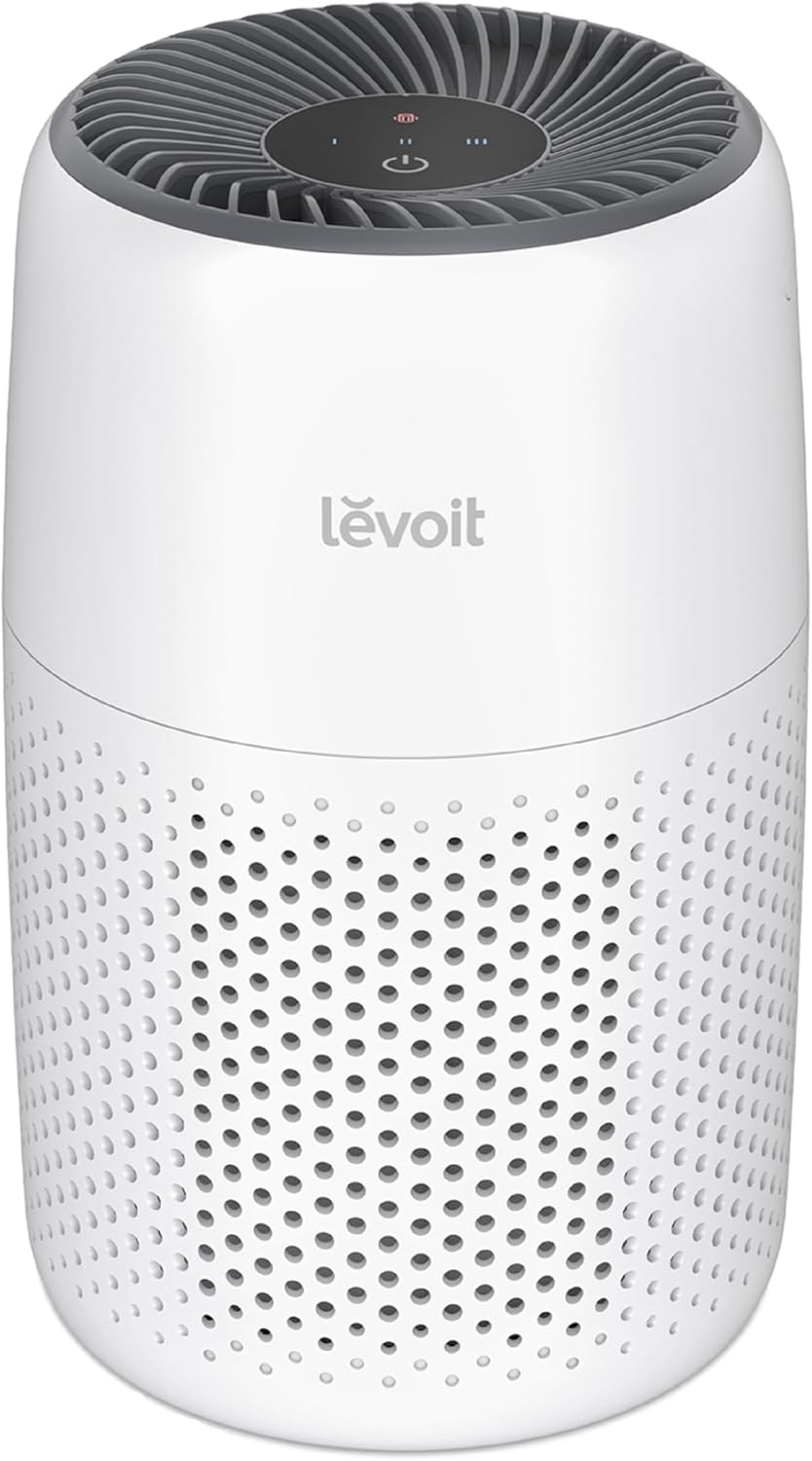
| Rated Power | 7W |
|---|---|
| Noise Level | 27-45dB |
| Particle Retention Size | 0.3 micron |
The Levoit Core Mini-P is a small, plug-in tabletop purifier built for personal spaces like bedrooms, offices, and dorm rooms. It combines a pre-filter and a main high-efficiency filter to capture lint, hair, pet dander, fine particles and smoke, and includes a fragrance sponge for light aromatherapy. The unit is quiet in sleep mode, has an auto-off display to avoid bright lights at night, and draws little power at about 7W, making it convenient to run continuously. Practical benefits include easy placement on a desk or nightstand, low operating noise, and simple filter changes. Limits are its small coverage area—it is intended for localized use rather than whole rooms or open-plan living spaces—and the fragrance feature requires caution to avoid overfilling. The Core Mini-P is AHAM-verified for performance and focuses on straightforward particle and odor removal without adding ozone-producing functions.
Best for: Buyers who prioritize a safe, easy-to-use purifier for a single small room or personal workspace and want a quiet, low-power device they can leave running overnight.
Less Ideal for: People seeking whole-room purification for large living areas or those who need heavy-duty smoke or allergen control across multiple rooms should consider larger purifiers instead.
- Compact desktop form factor fits on nightstands and desks
- Pre-filter plus main filter capture pet hair, lint, and fine particles
- Very low power draw (around 7W) suitable for continuous operation
- Quiet sleep mode and auto-off display reduce nighttime disturbance
- Small coverage area not suitable for larger rooms or open spaces
- Aromatherapy sponge can overflow if overloaded and may damage plastic parts
Verdict: A compact, AHAM-verified purifier that delivers quiet, low-power particle and odor removal for single small rooms.
Choosing the Right Air Purifier Without Ozone: Key Factors to Consider
Filtration Technology
The core of any air purifier without ozone is the filtration method. True HEPA filters capture at least 99.97 percent of particles down to 0.3 microns and are the standard for removing pollen, dust, and many airborne allergens.
Activated carbon layers address odors and some volatile organic compounds but vary in effectiveness depending on carbon quantity and contact time. Look for sealed filter assemblies that force room air through filter media rather than letting unfiltered air bypass the system.
Clean Air Delivery Rate and Room Size
CADR or manufacturer-stated room coverage numbers tell you how quickly an air purifier can refresh the air in a given space. Match the unit's rated coverage to your primary room and consider placing the purifier in the largest frequently occupied area.
A model rated for a larger room will run at lower relative speed and noise while delivering the same air changes per hour, which can extend fan and filter lifespan. When in doubt, choose a unit rated slightly above the square footage of the intended room.
Noise and Fan Speed Control
Noise matters if you plan to run the purifier during sleep or while working. Look for measured decibel ratings at different fan speeds and models with a true low-speed setting that still produces meaningful air changes.
Variable fan speeds, a sleep mode, and a timer let you reduce noise when necessary without disabling filtration. Some units use quieter brushless motors and optimized airflow paths to reduce turbulence-related sound.
Filter Availability and Operating Costs
Upfront cost is only one part of ownership. Replacement filter frequency and retail availability determine ongoing expenses. Check published filter lifespans under normal use and whether filters are proprietary or widely available.
Some models include multi-layer cartridge systems where you replace the whole module, while others let you replace individual components. Consider the annualized cost of filters and the convenience of sourcing them locally or online.
Energy Use and Continuous Operation
Air purifiers often run for long periods, so energy efficiency affects electricity bills and environmental footprint. Look for units with low-wattage eco-modes or ENERGY STAR certification where applicable.
Efficient fans and motors can maintain adequate air changes while consuming less power. If you want continuous 24/7 operation, choose a design optimized for low power draw or incorporate timers and scheduling to reduce runtime without sacrificing air quality.
Controls, Sensors, and Usability
Practical control options make daily use simpler. Built-in particle or VOC sensors with auto mode remove the guesswork by ramping fan speed when pollutant levels rise.
A clear display, easy-to-access filter indicators, and intuitive controls reduce the chance of neglecting maintenance. Mobile app control or voice assistant compatibility can add convenience but should not replace clear onboard indicators and physical buttons.
Why Choose a Non-Ozone Purifier
Choosing an air purifier without ozone reduces the risk of respiratory irritation and chemical byproducts. Ozone can react with indoor compounds to form secondary pollutants, so relying on mechanical filtration and activated carbon avoids that pathway.
Non-ozone units use particle capture and adsorption to address common indoor pollutants, making them better suited for households with asthma, children, or chemical sensitivities. This approach also aligns with most indoor air quality guidance that favors physical filtration over ozone generation.
- Mechanical filtration captures particulate matter like dust, smoke, and pollen
- Activated carbon tackles odors and some VOCs without creating ozone
- Sealed systems prevent bypass and ensure air actually passes through filters
Placement and Setup Tips
For best performance, place the purifier in the main living area or the room where people spend the most time. Keep the inlet and outlet unobstructed and avoid pushing the unit into a tight corner where airflow will be restricted.
If you have multiple rooms of concern, prioritize a single central location or plan for multiple smaller units rather than one undersized machine. Elevating a purifier a few inches off the floor can improve circulation in rooms with low furniture.
- Avoid corners and tight shelving that block airflow
- Match unit coverage to the primary room square footage
- Consider two smaller units for open-plan spaces instead of one large unit placed off-center
Maintenance Best Practices
Follow the manufacturer's recommended filter replacement intervals but also inspect filters visually for excessive dust. Pre-filters are often washable and extend the life of primary HEPA and carbon layers, so clean them on a schedule to reduce costs.
Keep the exterior vents dust-free and use a soft brush or vacuum attachment to remove buildup. Regular maintenance preserves airflow and filter performance and reduces motor strain, which can prevent noisy operation as the unit ages.
- Check pre-filters monthly if your home has heavy dust or pet hair
- Replace HEPA and carbon media per recommended intervals or sooner if performance drops
- Record filter changes to track long-term operating costs
Common Misconceptions About Air Cleaners
High price does not always equal better filtration. The right fit is determined by verified efficiency, CADR, and how the unit matches your room size and pollutant concerns. Some lower-cost models perform well in modest-sized rooms.
Negative-ion generators and some ozone-producing devices are sometimes marketed as odor-fighting solutions, but they can produce unwanted byproducts. Mechanical filtration combined with carbon adsorption typically delivers safer, more predictable results for indoor air quality.
- Look for documented filtration performance rather than hype
- Avoid devices that rely solely on ionization without clear safety data
- Consider the full ownership cost, including filters and electricity
Using Purifiers With Other Home Strategies
An air purifier is most effective when combined with source control and ventilation. Reduce pollutant generation by eliminating indoor smoking, using low-VOC materials, and running ventilation during activities that produce particulates, such as cooking.
When outdoor air quality is poor, keep windows closed and rely on the purifier to maintain indoor air. Conversely, when outdoor air is clean, periodic ventilation can dilute long-lived indoor pollutants that filters do not remove.
- Combine filtration with source reduction for best results
- Use exhaust fans in kitchens and bathrooms to remove moisture and combustion products
- Adjust purifier placement and runtime seasonally as ventilation habits change
How We Chose the Best Air Purifier Without Ozone
We prioritized devices that use proven, non-ozone-generating technologies such as true HEPA filtration, activated carbon, and sealed airflow designs. Equipment that relied on deliberate ozone output or ozone-generating ionization as the primary cleaning mechanism was excluded. We focused on real-world dimensions that affect ownership: particle capture efficiency, clean air delivery rate relative to room size, noise at common fan speeds, and the frequency and cost of filter replacements. Other important filters included verified CADR or equivalent airflow ratings, availability of sealed filter chambers to prevent bypass, and straightforward maintenance procedures. Durability indicators like build quality and warranty coverage were considered to favor long-term value. Finally, we cross-checked energy usage and control flexibility because continuous operation is typical for allergy and asthma management. Units that lacked clear filtration specifications or used ozone-producing methods were not considered for the shortlist.
Our full evaluation process is outlined in our review methodology.
FAQ
Does a purifier labeled without ozone still need filters replaced?
Yes. Non-ozone purifiers depend on physical filter media that accumulate particles and must be replaced or cleaned. Regular replacement maintains efficiency and prevents airflow reduction.
Can these purifiers remove smoke and cooking odors?
They can reduce particulate smoke when equipped with true HEPA and address many odors with activated carbon. Effectiveness depends on carbon quantity and exposure time, so heavy smoke may require higher CADR or additional ventilation.
Are non-ozone purifiers safe for people with asthma?
Often yes. Mechanical filtration reduces airborne allergens and particulate triggers without generating ozone. However, individual sensitivities vary, so monitor symptoms and consult a clinician for severe asthma management.
How loud will a typical unit be at night?
Noise varies by model and fan speed. Many units offer a quiet or sleep mode that runs at low fan speed with modest but effective air changes. Check measured decibel ratings if nighttime use is important.
Is a single purifier enough for an entire house?
Usually not. One purifier sized for a single room can effectively clean that space, but open-plan homes or multiple bedrooms typically require multiple units or moving a single unit between rooms to maintain ideal coverage.
Final Verdict
Focus first on filtration effectiveness and room coverage when choosing an air purifier without ozone. Balance that performance against noise, filter costs, and how you plan to use the unit daily. For bedrooms, prioritize quiet operation and a model rated for the room size. For living areas, prioritize higher CADR and carbon capacity if odors are a concern. Understanding these tradeoffs will help you select a purifier that fits your space and health priorities while avoiding ozone-related risks. Prioritize verified filtration specifications and predictable operating costs to make a confident long-term choice.