
Note: This article contains affiliate links. If you click on these links and make a purchase, we may earn a small commission at no extra cost to you. This helps support our research and content. Read our full affiliate disclosure here.
If you live with seasonal allergies or persistent indoor triggers, choosing the right budget air purifier can cut airborne pollen, dust, and pet dander where it matters most. You want a unit that captures small particles, runs quietly in living spaces or bedrooms, and does not spike your energy bill. This guide shortlists six top options that focus on filtration efficiency, sensible fan performance, and manageable operating costs. Below we cover what made these units stand out, outline the decision factors to weigh for small budgets, and explain the tradeoffs between filter life, coverage area, and noise so you can pick the right model for your home.
Top Picks at a Glance
| Best Overall The best all-around choice for most situations | BLUEAIR Blue Pure 511 |  |
| Best Quality Built to a higher standard if you want something more solid | GermGuardian AC4825E 22" Tower |  |
| Best Budget The cheapest option that still gets the job done reliably | FULMINARE H13 Air Purifier |  |
| Top Rated A top-rated pick with lots of positive feedback | Levoit Core 300-P Air Purifier |  |
| Most Popular A crowd favorite that many people choose with confidence | VOOPNU H13 HEPA Air Purifier DH-JH12 |  |
| Best Seller A high-volume bestseller chosen again and again | Levoit Core 200S-P |  |
BLUEAIR Blue Pure 511

| Power Source | Corded Electric |
|---|---|
| Noise Level | 24 db |
| Particle Retention Size | 0.1 micron |
| Floor Area | 432 square_feet |
The Blueair Blue Pure 511 is a small, user-friendly air purifier that uses HEPASilent dual filtration to remove particles down to 0.1 micron and is intended for bedrooms, nurseries, and home offices. It plugs into standard power and runs via simple button/touch controls, with a washable pre-filter and an installed HEPA-style filter that the unit's indicator will prompt you to replace about every six months. Performance-wise it can deliver multiple air changes in modest rooms—Blueair quotes cleaning up to 432 sq ft on its highest fan speed and about 180 sq ft much faster at recommended settings—while staying very quiet on low (around 24 dB). Practical benefits include low energy use, a compact footprint that fits on a desk or nightstand, and customizable washable pre-filters to blend with decor. Limitations are its modest coverage compared with larger models and reliance on one combined filter rather than separate specialized cartridges for odors, so heavy-smoke or very large open spaces may need a bigger unit or supplemental odor control.
Best for: Buyers seeking an affordable, low-noise purifier that reliably reduces airborne allergens in bedrooms, small living rooms, or home offices and who prioritize compact footprint and simplicity.
Less Ideal for: Those needing to clean large open-plan areas, or users who require intensive odor and chemical removal where a dedicated carbon-heavy system is preferred.
- HEPASilent dual filtration removes particles down to 0.1 micron for effective allergen capture
- Very quiet operation on low (around 24 dB), suitable for bedrooms and nurseries
- Compact, energy-efficient design that fits small spaces and uses little power
- Washable pre-filter for simple maintenance and a visible filter replacement LED
- Coverage is limited compared with larger models so not ideal for big open-plan rooms
- No separate dedicated carbon/odor cartridge included for heavy odors beyond the combined filter
Verdict: A compact, energy-efficient purifier that delivers quiet, effective particle removal for small to medium rooms, making it a strong budget pick for allergy relief.
GermGuardian AC4825E 22" Tower

| Model number | AC4825E |
|---|---|
| Room coverage (stated) | Small bedroom 153 sq. ft.; up to 743 sq. ft. at slower cycle |
| Filter type | True HEPA with activated carbon pre-filter |
| Fan speeds | Three speeds with sleep mode |
The GermGuardian AC4825E is a compact tower purifier that combines a True HEPA filter, activated carbon pre-filter, and optional UV-C sanitizing light to reduce dust, pollen, pet dander, odors, and some airborne microbes. It is designed to cycle air in a small bedroom every ~12.5 minutes and can handle larger spaces on a slower cadence, with three fan speeds including a quiet sleep mode for nighttime use. The activated carbon layer helps cut common household smells from cooking and pets, while the HEPA media captures particles down to 0.1 microns as air passes through the filter. Maintenance is straightforward because it uses GermGuardian replacement Filter B cartridges and replaceable UV-C bulbs and carbon inserts. Expect effective allergen capture in bedrooms, offices, and other small-to-medium rooms, but note that performance on very large open-plan areas will be limited by the unit's CADR and single-fan design, and UV-C is supplemental rather than a primary disinfectant. The unit is well suited as a budget-focused option for improving indoor air during allergy season when paired with timely filter changes.
Best for: Buyers focused on measurable allergy relief in bedrooms or small living areas who prioritize proven HEPA filtration and low-cost ongoing maintenance.
Less Ideal for: People who need whole-house or large open-plan coverage or who require hospital-grade air cleaning should consider higher-capacity units instead.
- True HEPA filter captures 99.97% of many airborne allergens as small as 0.1 microns during air passing through the media
- Optional UV-C light for additional in-air sanitizing support
- Activated carbon pre-filter reduces common household odors from cooking and pets
- Three fan speeds including a quiet sleep setting for night use
- Uses widely available GermGuardian replacement Filter B cartridges for easy maintenance
- Coverage and clean-air delivery are modest compared with higher-CADR, larger room purifiers
- UV-C is optional and supplemental, not a standalone germ-killing solution
Verdict: A budget-friendly tower purifier that delivers reliable HEPA allergen removal for bedrooms and small rooms while keeping replacement filters affordable.
FULMINARE H13 Air Purifier

| Filter type | H13 HEPA |
|---|---|
| Recommended room size | 215 ft² / 20 m² |
| Noise level (low) | ~24 dB |
| Power | Plug-in (no battery) |
The FULMINARE H13 is a small-room air purifier built around an H13 true HEPA filter and a 360 degree outlet to circulate air in spaces up to about 215 sq ft. It is operated from a simple control set and offers multiple timer settings plus an independent night light, which makes it suitable for bedrooms or home offices. The unit emphasizes quiet use with a reported low-speed noise near 24 dB for sleep mode, and its dual-channel design claims faster air exchanges than single-intake designs. Practical benefits include easy placement thanks to its compact footprint, straightforward filter replacement, and a plug-in power arrangement so there is no battery to manage. Limitations are its coverage cap — it is targeted at single rooms rather than whole apartments — and like many compact purifiers it relies on replacing cartridges every few months under typical use, which adds ongoing cost and requires buying the correct replacement filter.
Best for: Buyers looking for an inexpensive, bedroom-friendly purifier that prioritizes quiet nightly use and simple plug-and-play operation.
Less Ideal for: People who need to clean air in large living spaces or want a no-maintenance unit that avoids periodic filter purchases.
- H13 true HEPA filter captures fine particles and allergens.
- 360° air outlet with dual-channel flow for faster room circulation.
- Very quiet low-speed operation suitable for bedrooms.
- Independent night light and multiple timer options for flexible use.
- Compact and portable design that is easy to place in small rooms.
- Rated coverage limited to about 215 sq ft, not suitable for large open areas.
- Requires regular filter replacements (manufacturer suggests around 3 months).
Verdict: A budget-friendly, bedroom-focused HEPA purifier that delivers quiet, effective allergen capture for single rooms.
Levoit Core 300-P Air Purifier

| Filter Type | 3 in 1 Filtration |
|---|---|
| Floor Area | 1073 square_feet |
| Noise Level | 24 db |
| Particle Retention Size | 0.3 micron |
| Wattage | 56 watts |
The Levoit Core 300-P is a small, user-friendly air purifier built around a 3-stage HEPA-grade filtration system that captures 99.97% of particles down to 0.1–0.3 microns and targets dust, pollen, pet dander, smoke, and VOCs. It uses a 56W motor with a CADR optimized for smoke, dust, and pollen and is intended for bedrooms, home offices, or living areas where quiet operation matters. Touch controls include a Sleep Mode that lowers noise to about 24 dB and a timer with selectable run intervals, while a filter check indicator simplifies maintenance. The unit is portable and CARB, ETL, and AHAM verified for performance and safety. Trade-offs are its lack of smart connectivity or an automatic sensor-based Auto Mode on this model and the recommendation to use official replacement filters for best results, which can raise ongoing costs. For buyers prioritizing dependable filtration and low-noise night use, this model delivers reliable, consistent air cleaning in a compact package.
Best for: A buyer who values a compact, consistently performing purifier that runs quietly at night and is easy to operate and maintain for allergy relief in bedrooms or small living areas.
Less Ideal for: People who want built-in smart features, app control, or automatic sensor-driven fan adjustments should consider other models with those capabilities.
- True HEPA-grade 3-stage filter captures 99.97% of 0.1–0.3μm particles
- AHAM verified CADR and safety certifications (CARB, ETL) for proven performance
- Very quiet Sleep Mode at about 24 dB suitable for bedrooms
- Compact and portable footprint for easy placement and moving between rooms
- Touch controls with timer and filter check make operation simple
- No smart connectivity or automatic Auto Mode on this Core 300-P variant
- Replacement filters recommended to maintain performance add to lifecycle cost
Verdict: A reliable, low-noise HEPA-grade purifier that delivers proven particle removal for allergy relief in bedrooms and small home spaces.
VOOPNU H13 HEPA Air Purifier DH-JH12

| Model | DH-JH12 |
|---|---|
| Filtration | H13 True HEPA + activated carbon |
| Coverage (claim) | Up to 1,076 ft² per hour |
| Noise level | As low as 22 dB |
| Speeds | 3 speeds, timer |
The VOOPNU DH-JH12 is a compact HEPA air purifier built for everyday allergy and odor control in homes and bedrooms. It uses an H13 true HEPA triple-layer filter plus activated carbon to capture particles, pet hair, pollen, smoke, and common household odors, and the 360° intake design aims to pull air from all sides for more even room coverage. Laboratory figures claim it cleans 250 sq ft every 15 minutes and can cover up to 1,076 sq ft per hour, which makes it suitable for single rooms or open living areas. Controls are simplified to one-tap operation with three fan speeds, a timer, and a quiet low setting that can run around 22 dB for night use, and there is an essential oil tray for light scenting. Practical limits include the small physical size and modest airflow compared with larger, higher-CADR units, so continuous operation is recommended for best results and frequent filter replacements will be needed on busy or dusty sites. Certifications like DOE, ETL, FCC, CARB, CE, and ROHS provide reassurance about safety and emissions.
Best for: Buyers who want a well-reviewed, budget-friendly bedroom or single-room purifier that is simple to operate and backed by visible certifications and customer feedback.
Less Ideal for: People seeking whole-house air cleaning or very high CADR performance for large rooms should consider larger, more powerful purifiers instead.
- H13 True HEPA triple-layer filter captures 99.97% of fine particles.
- 360° surround air intake for more uniform room coverage.
- Very quiet operation down to about 22 dB suitable for bedrooms.
- Simple one-tap controls with three speeds and timer make it easy to use.
- Includes activated carbon and an essential oil tray for odor control and light scenting.
- Compact unit produces less airflow than larger high-CADR purifiers, so whole-house cleaning is not realistic.
- Filter replacements are recommended every few months in heavy-use environments.
- Coverage claims are lab-tested figures and real-world performance will vary with room layout and placement.
Verdict: A compact, budget-minded HEPA purifier that delivers quiet, certified filtration and strong social-proof for improving air in a bedroom or single living area.
Levoit Core 200S-P
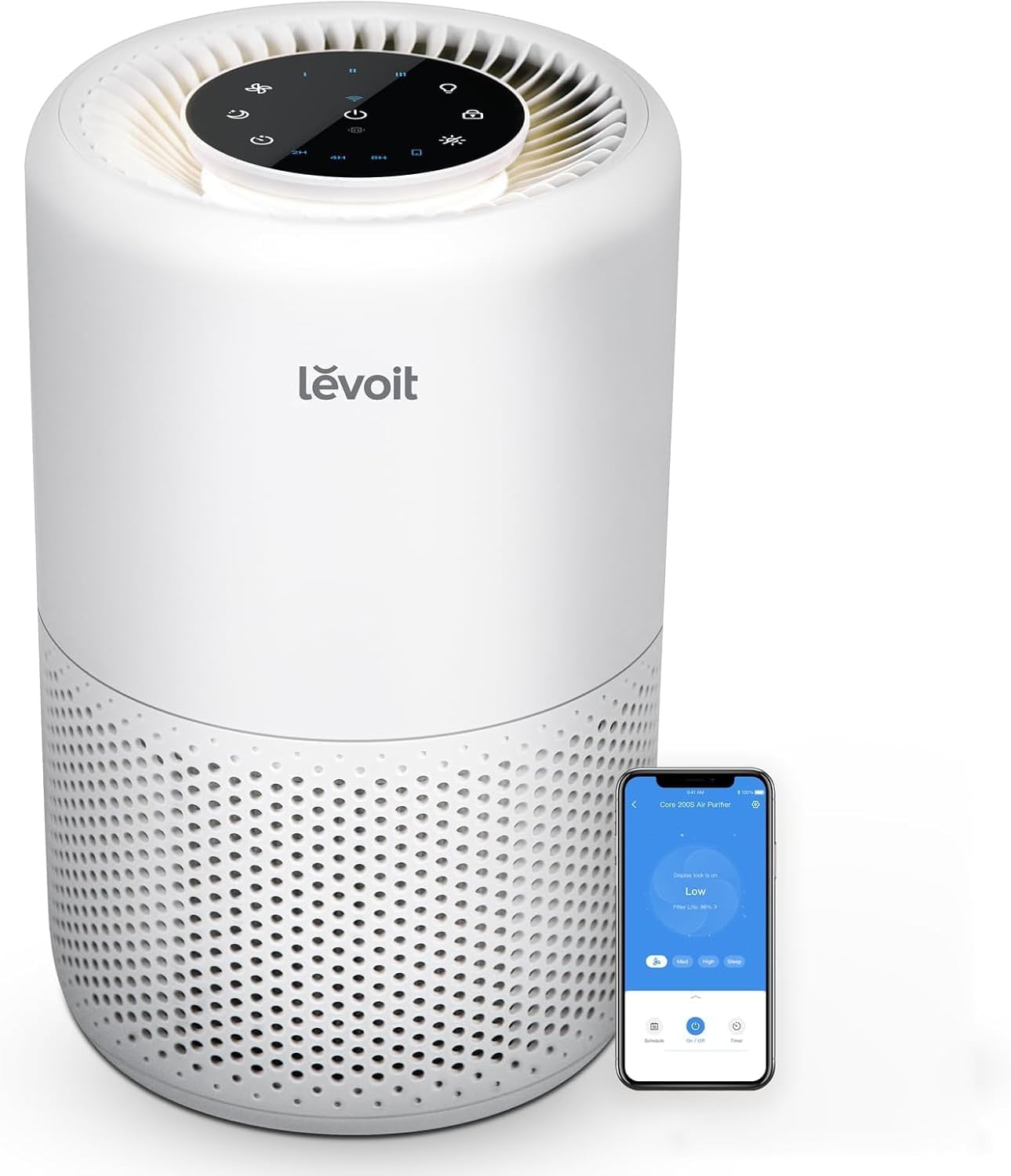
| Item model number | Core 200S |
|---|---|
| AHAM certification | AHAM VERIFIDE |
| Room coverage | 140 ft² (4.8 air changes/hour) |
| Noise level | As low as 27 dB |
The Levoit Core 200S-P is a small, app- and voice-controlled air purifier built for bedrooms, nurseries, and small apartments where quiet, continuous cleaning matters. It draws air through a 360 degree intake and uses a three-stage filtration stack—nylon pre-filter, activated carbon layer, and a HEPA-grade main filter—to capture large particles, odors, and 0.1–0.3 micron particulates. AHAM-verified performance and a stated refresh rate for a 140 ft² room make it a sensible pick for allergy relief in single rooms, and the unit runs as low as 27 dB for overnight use. Smart features include app monitoring of filter life and voice control for convenience, while a Display Off button keeps light and noise minimal at night. The Core 200S-P is lightweight and easy to move, but because it is sized for small spaces it will need multiple units or a larger model for whole-home coverage, and genuine replacement filters are recommended to maintain peak performance.
Best for: Buyers who prioritize reliable, quiet allergen removal in a single bedroom or small living space and want easy app or voice control with monitored filter life.
Less Ideal for: People seeking whole-home air cleaning or faster circulation in large rooms should consider larger-capacity purifiers instead.
- HEPA-grade main filter captures 99.97% of 0.1–0.3 micron particles
- AHAM-verified performance with stated air refresh rate for a 140 ft² room
- Quiet operation down to 27 dB suitable for bedrooms and nurseries
- App and voice control with filter-life monitoring for convenient maintenance
- Designed for small rooms so it is not enough for larger open-plan spaces
- Replacement filters are recommended for best results which adds ongoing cost
Verdict: A compact, AHAM-verified purifier that quietly delivers dependable allergen removal for single rooms with smart controls and easy filter monitoring.
Choosing the Right Budget Air Purifier for Allergies: Key Factors to Consider
Filtration Efficiency and Filter Type
Filtration efficiency determines how well a purifier removes the particles that cause allergy symptoms. Look for units that specify true HEPA or high-efficiency particle capture in the submicron range because those filters trap the smallest pollen, mold spores, and pet dander particles that linger in indoor air.
Filter construction matters too. A combination of a washable prefilter for larger particles and a true HEPA element extends main filter life and keeps replacement costs down. Some budget units advertise HEPA-style filters; verify they meet a true HEPA standard or list particle removal percentages to ensure genuine performance.
Coverage Area and CADR
Coverage area tells you the room size the purifier can handle effectively; CADR gives a standardized measure of how quickly it removes smoke, dust, and pollen. For allergy management, select a purifier whose CADR and stated coverage match or slightly exceed the square footage of your typical rooms so it can cycle the air multiple times per hour.
Undersized units will run continuously without delivering meaningful reductions in airborne allergens, while oversized units may be louder and wasteful. Consider where you spend the most time and size the purifier to that space rather than relying on a single whole-house solution.
Noise and Nighttime Use
Noise is a common tradeoff with air-cleaning power. For bedrooms or home offices, choose models that present low-decibel operation at the speeds you will use most. Many budget purifiers have a quiet or sleep mode that lowers fan speed and noise but still circulates enough air for nightly allergy relief.
Check how manufacturers report noise figures and whether low-noise settings still provide meaningful CADR. A unit that is whisper-quiet but barely moves air will not control allergens effectively overnight.
Operating Cost and Filter Replacement
Upfront cost is only part of the equation. Filter replacement frequency and energy draw determine yearly operating expenses. Budget-minded buyers should estimate annual filter costs based on reported filter life and typical runtime. Choose units with reasonably priced filters or long lifespans to keep total cost low.
Also factor in estimated electricity use if you plan to run the purifier 8 to 24 hours per day. Lower-power fans and efficient motors reduce monthly utility impact and make continuous operation more affordable for allergy control.
Maintenance and Usability
Practical maintenance features reduce hassle and keep performance consistent. Look for accessible filter compartments, clear change indicators, and washable prefilters. Units with simple controls and reliable timer or auto modes make it easier to run the purifier correctly.
A model that is straightforward to clean and maintain will deliver better long-term allergen control, especially if you are managing seasonal peaks and need to ramp usage up and down.
Sizing Your Purifier to Real Rooms
Calculate the actual square footage of the room where you will use the purifier and compare that to the manufacturer's stated coverage. Pay attention to whether coverage is listed for one air change per hour or multiple changes, and aim for at least two to three air changes per hour for meaningful allergen reduction in bedrooms and living areas.
If you plan to move a single budget purifier between rooms, prioritize the space where you spend the most time. Running a small purifier in a large open-plan area is a common mismatch that reduces effectiveness.
- Measure room length and width and multiply for square footage
- Match CADR to room size for 2–3 air changes per hour
- Place purifier near breathing zones and away from obstructions
Where to Position an Air Purifier for Allergies
Placement influences how quickly a unit cleans the air. For sleeping areas, put the purifier near the bed but not directly against walls or curtains to avoid restricted airflow. In living rooms, a central location or a high-traffic pathway gives better coverage than tucking the unit into a corner.
Avoid placing purifiers behind furniture or inside alcoves where intake and outflow are blocked. Elevating small units a few inches off the floor can also improve circulation in rooms with low air movement.
- Keep 12–24 inches clearance around intake and outlet vents
- Position for direct airflow to breathing areas
- Avoid blocked intakes near curtains or upholstery
Filter Types Beyond HEPA
While true HEPA filters are the most important element for particle removal, other filter stages can add benefits. Activated carbon layers help reduce odors and some volatile organic compounds that can aggravate respiratory discomfort. Pre-filters trap larger debris and extend the HEPA life.
Be cautious with technologies that claim allergen removal without a HEPA stage. For budget allergy relief, a reliable HEPA filter paired with a sensible prefilter and optional carbon stage is the most practical combination.
- HEPA for particles, carbon for odors
- Washable prefilters reduce dust on HEPA elements
- Avoid relying solely on ionizers or scent cartridges for allergy control
Running an Air Purifier Efficiently
Continuous operation during high-allergy seasons provides the best relief, but that can increase energy use. Use timers and auto modes to balance performance and cost. Many units have sensors that raise fan speed when particle counts increase and lower it when the air is clean.
For bedrooms, consider running at a moderate speed overnight rather than maximum. This often achieves sufficient air changes quietly and reduces filter loading compared with constant high-speed operation.
- Use auto or sensor modes to adapt to real-time particles
- Run longer at moderate speeds instead of short bursts at max
- Schedule higher speeds during peak allergen hours
Common Misconceptions About Air Purifiers
Air purifiers reduce airborne particles but do not eliminate allergens embedded in carpets, upholstery, or bedding. Regular cleaning and washing of textiles is necessary for comprehensive allergy management. Consider purifiers as part of a layered approach that includes ventilation and surface cleaning.
Another misconception is that higher fan speed always equals better results. While speed increases air exchange, extremely high settings may produce disruptive noise and faster filter saturation with diminishing returns in small rooms.
- Combine purifiers with cleaning and humidity control
- High fan speed helps but has tradeoffs in noise and filter life
- Sensors and proper sizing matter more than raw maximum airflow
How We Chose the Best Budget Air Purifier for Allergies
We prioritized practical, measurable performance for allergy relief while keeping upfront and operating costs low. Selection focused on devices that combine proven particle filtration with realistic room coverage and documented filter maintenance intervals. We favored units with verified removal of common allergens at the 0.3 to 2.5 micron range, because that range captures fine dust, pollen, and pet dander that trigger most symptoms. Key evaluation criteria included filtration specification and verified particle capture, clean air delivery rate relative to stated room size, typical noise levels at bedroom and living-room fan speeds, and total ongoing cost including replacement filters and estimated energy use. We also checked build quality factors that affect maintenance, such as accessible prefilters and simple filter-change indicators. Units that relied solely on unproven technologies or had unclear filter change intervals were excluded. The resulting list balances short-term affordability with realistic expectations for allergen reduction and day-to-day usability.
Our full evaluation process is outlined in our review methodology.
FAQ
How often should I run a budget air purifier to control seasonal allergies?
For meaningful relief, run the purifier continuously during peak allergy times or at least during occupied hours. Using auto or scheduled modes helps balance performance and energy use.
Do I need a HEPA filter to reduce pollen and dust?
Yes. True HEPA or equivalent filtration is the most reliable way to capture pollen, dust, and pet dander that trigger allergies. Look for documented particle capture rather than marketing terms.
Will a small bedroom unit help if my living room is larger?
A small bedroom unit can provide good local protection while you sleep, but it will not effectively clean air in a larger living room. Size the purifier to the specific room where you want relief.
Are ionizers or ozone-producing devices safe for allergy relief?
Ionizers and ozone generators may reduce some particles but can produce byproducts that irritate the respiratory system. For allergy control, prefer mechanical filtration like HEPA and avoid ozone-producing devices.
How do I estimate the annual operating cost of a purifier?
Estimate annual cost by adding filter replacement expense based on stated filter life and the device's estimated daily runtime multiplied by its wattage. This gives a realistic view of yearly upkeep beyond the purchase price.
Final Verdict
When buying a budget air purifier for allergies, prioritize filtration efficiency, correct room sizing, and manageable ongoing costs. True HEPA filtration, a sensible CADR for your main room, and simple maintenance features deliver the best combination of relief and predictability. Accept tradeoffs between peak airflow and noise or filter replacement frequency. Choose the unit that fits the rooms where you spend the most time and offers the lowest long-term cost for reliable year-round allergy management.