
Note: This article contains affiliate links. If you click on these links and make a purchase, we may earn a small commission at no extra cost to you. This helps support our research and content. Read our full affiliate disclosure here.
Choosing the right all-around knife sharpener affects how your knives perform, how often you need to re-sharpen, and how safe routine maintenance feels in the kitchen. Whether you keep a modest set of everyday blades or a larger collection, a versatile sharpener can restore edges quickly and with predictable results. This guide presents our shortlisted top picks for all-around knife sharpeners, each selected for consistent edge geometry, user safety, and practical maintenance needs. Below you will find concise evaluations and the criteria we used to rate each option so you can pick the tool that fits your skill level and kitchen routine.
Top Picks at a Glance
| Best Overall The best all-around choice for most situations | Intelitopia Whetstone Sharpening Kit |  |
| Best Quality Built to a higher standard if you want something more solid | Work Sharp Ken Onion Sharpener MK2 |  |
| Best Value The sweet spot between price and what you get | Sharp Pebble 1000/6000 Whetstone |  |
| Best Budget The cheapest option that still gets the job done reliably | Amazon Basics 4-in-1 Knife Sharpener |  |
| Top Rated A top-rated pick with lots of positive feedback | WORK SHARP Guided Field Sharpener |  |
| Most Popular A crowd favorite that many people choose with confidence | AnySharp Hands-Free Knife Sharpener |  |
| Best Seller A high-volume bestseller chosen again and again | KITCHELLENCE 3‑Stage Knife Sharpener |  |
Intelitopia Whetstone Sharpening Kit

| Included components | Sharpening Stones |
|---|---|
| Number of Packs | 7 |
| Material Type | Stone |
| Grit Type | Coarse |
This kit provides everything a home cook needs to sharpen and finish knives without buying separate components. It pairs a 400/1000 grit dual-sided stone for repairing and sharpening with a 3000/8000 grit stone for honing and polishing, plus a coarse flattening stone to keep the whetstones true. The bamboo non-slip base and angle guide make it easier to hold consistent angles, while the leather strop removes the burr and gives a refined edge. Typical use is wet sharpening on the lower grits, moving to the finer stones for a mirror finish, then stropping to finalize the edge. The stones are corundum (aluminum oxide), which is durable and effective on most kitchen and pocket knives, and the kit includes a short manual to get beginners started. It is a solid all-round package for maintaining a range of blades, though serious users may prefer larger or premium-brand stones for heavy daily use or specialized steels.
Best for: Buyers who want an out-of-the-box sharpening system to maintain kitchen and pocket knives and who value a complete kit that guides through repair, honing, and polishing.
Less Ideal for: Professional sharpeners or users who need very large, heavy-duty stones or brand-name premium abrasives for frequent shop use should look at higher-end standalone stones.
- Includes dual grit stones (400/1000 and 3000/8000) for full sharpening progression
- Comes with a flattening stone to maintain flat stone surfaces
- Non-slip bamboo base and angle guide improve consistency for novices
- Leather strop provided for final deburring and polishing
- Stones and accessories are modest in size, which may slow work on larger blades
- Not positioned as a professional high-end brand for heavy daily sharpening
Verdict: A complete, beginner-friendly whetstone kit that covers the full sharpening progression from repair to polish, making it a convenient all-around choice for home cooks.
Work Sharp Ken Onion Sharpener MK2

| Brand Name | WORK SHARP |
|---|---|
| Model Number | WSKTS-KO2-ATL |
| Material Type | Stainless Steel |
| Grit Type | Fine |
| Manufacturer Warranty Description | 3 Year Warranty |
The Work Sharp Ken Onion Edition MK2 is a benchtop sharpening system built for users who want repeatable, razor-sharp edges on a wide range of blades. It uses flexible abrasive belts with guided sharpening angles and electronic speed control to sharpen kitchen knives, pocket knives, scissors, serrated edges, and small tools. Typical use involves clamping or holding the blade against the precision guide while the selected belt and motor speed remove metal and refine the bevel, then switching to finer belts or a strop for a polished edge. Notable features include the Ken Onion–tuned guides that promote consistent angles, a seven-speed motor control for material removal control, and a compact footprint for workshop or kitchen counters. Practical benefits are fast sharpening that can reshape damaged edges, easy repeatability for multiple knives, and compatibility with replacement belts for different grits. Important limitations are that it is a powered belt system rather than a water stone, so it removes metal more aggressively and requires belt replacements and some learning to avoid over-grinding delicate blades.
Best for: Buyers who prioritize quick, consistent edge restoration and want a single benchtop tool that handles everything from dull kitchen knives to rougher tools.
Less Ideal for: If you prefer traditional waterstone honing, very delicate custom blades that need minimal material removal, or a completely manual sharpening workflow, this powered belt system is not the best match.
- Adjustable guided angles deliver consistent sharpening across different blades
- Variable electronic speed control lets you manage material removal and heat
- Works on knives, scissors, serrated blades, and small tools for broad utility
- Uses replaceable abrasive belts so you can progress from coarse shaping to fine polishing
- Compact benchtop design fits kitchen counters or small workshops
- Powered belt system removes metal faster than stones, which can shorten blade life if misused
- Requires periodic purchase of replacement belts for different grits
Verdict: Choose the Ken Onion MK2 if you want a fast, repeatable benchtop sharpener that delivers pro-level edges across many blade types.
Sharp Pebble 1000/6000 Whetstone

| Grit | 1000/6000 |
|---|---|
| Material Type | Corundum |
| No Oil Required | Yes |
| Included Components | Angle guide, bamboo base, manual |
The Sharp Pebble 1000/6000 whetstone is a two-sided waterstone kit designed to repair and polish kitchen blades at home. It ships with a 1000 grit side for resetting and repairing dull or damaged edges and a 6000 grit side to polish to a razor finish, plus a bamboo non-slip base and angle guide that helps beginners hold a consistent angle. The stone uses corundum abrasive so no oil is required and it is intended for wet sharpening; the included instruction materials and angle guide reduce the learning curve so most users can get sharp results in a short session. Practical benefits include longer-lasting edges compared with many electric or cheap stones and a flatter, more durable stone composition that resists chipping. Limitations are typical for waterstones: they need soaking or lubrication during use and periodic flattening over long-term heavy use to maintain a true surface, and the kit does not include a flattening stone in this listing. For cooks who prefer manual sharpening and want professional-level finishes without paying for service, this kit covers most home needs effectively.
Best for: Buyers who want a cost-effective, hands-on way to keep kitchen knives professionally sharp and prefer a tool that teaches good technique while delivering lasting results.
Less Ideal for: Users who need an instant push-button solution or those unwilling to learn basic whetstone maintenance and occasional flattening should consider other sharpening options.
- Two useful grits (1000 and 6000) for repair and polishing
- Angle guide included to help maintain correct sharpening angle
- Non-slip bamboo base keeps the stone stable during use
- Corundum abrasive that requires water instead of oil for cleaner sharpening
- Comprehensive kit with instructions and support for beginners
- Requires water lubrication and occasional flattening to maintain an even surface
- Not supplied with a flattening stone in the main kit
Verdict: A practical, beginner-friendly two-sided waterstone that delivers professional-grade edges at home for routine knife maintenance.
Amazon Basics 4-in-1 Knife Sharpener
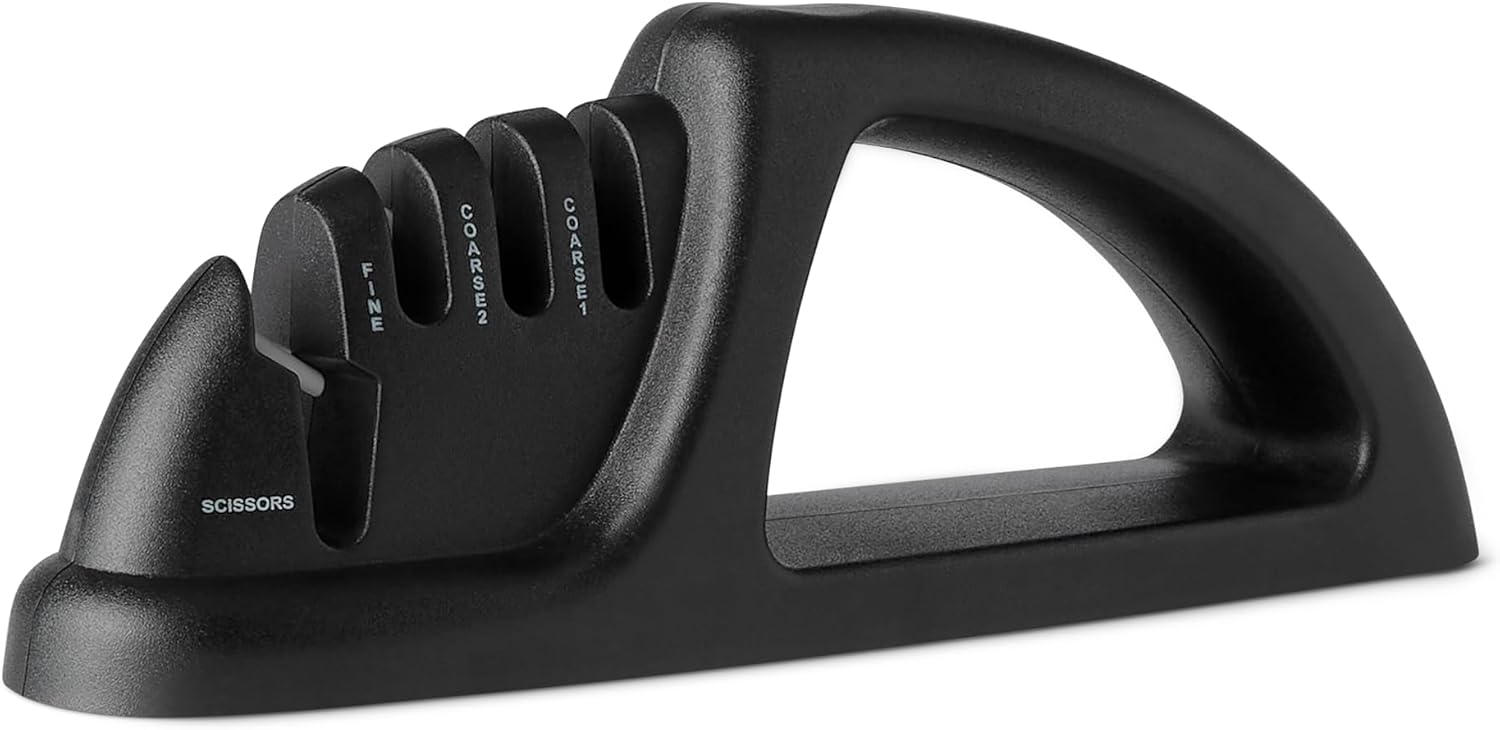
| Grit Type | Coarse, Medium, Fine |
|---|---|
| Included Components | Knife Sharpener |
| Material Type | Metal, Plastic |
This Amazon Basics 4-in-1 Knife Sharpener is a straightforward manual tool for restoring straight-edge blades at home. It uses three stages — coarse, medium, and fine — to reshape and then refine edges, and adds a dedicated slot for scissor blades. The non-slip silicone base keeps the unit stable on countertops and the included cut-resistant glove helps with safe handling. It is easy to use: pull the blade through the matched slots a few times for a dull kitchen knife, then finish in the fine stage for a smoother edge, and rinse to clean. The compact plastic-and-metal build makes it low-maintenance and simple to store, and it works on a wide range of straight knives like kitchen, pocket, and hunting blades. Limitations are it is not intended for serrated knives and a manual clamp-style sharpener cannot reproduce a full professional bevel for very damaged blades, but for everyday resharpening it offers good performance at a low price.
Best for: Buyers looking for an inexpensive, easy-to-use sharpener to keep everyday straight-edge knives sharp without professional tools.
Less Ideal for: People who need to sharpen serrated knives, restore severely nicked blades, or require precise custom bevel angles for high-end cutlery.
- Three-stage sharpening (coarse, medium, fine) covers reshaping and honing
- Dedicated scissor sharpening slot adds versatility
- Non-slip silicone base improves stability during use
- Includes cut-resistant glove for safer handling
- Not suitable for serrated blades
- Manual preset angles cannot fully restore heavily damaged or warped edges
Verdict: A budget-friendly, no-frills 4-in-1 sharpener that reliably refreshes straight-edge knives for everyday kitchen use.
WORK SHARP Guided Field Sharpener

| Material Type | Diamond and Ceramic Sharpener |
|---|---|
| Grit Type | Coarse, Fine |
| Included Components | WSGFS221 |
The WORK SHARP Guided Field Sharpener is a portable, self-contained sharpening kit aimed at hunters, campers, and home users who want reliable edge maintenance without tools. It bundles removable diamond plates, a rotating ceramic honing rod with coarse and fine faces plus a grooved fish-hook surface, sharpening guides set for 20° and 25°, and a leather strop for final polishing. In practice it lets you reprofile and refine blades on the trail or in the kitchen with repeatable angles and a compact footprint; the guided system helps novices hold a steady bevel while the diamond and ceramic abrasives handle both edge repair and finishing. The kit is durable and travel-friendly, with parts that store inside the housing so nothing rattles loose. Limitations include the fixed guided angles (20° and 25°) which reduces flexibility for very narrow or very obtuse specialty blades, and the small abrasive surfaces compared with bench systems, so heavy stock removal takes longer. For routine sharpening and on-the-go maintenance it delivers dependable, predictable results.
Best for: Buyers who prioritize a reliable, no-fuss sharpener for outdoor trips or regular at-home edge maintenance and want a portable kit that produces consistent results with minimal setup.
Less Ideal for: Those who need precise angle control across a wide range of blade geometries or who resharpen heavily damaged edges frequently should consider a larger bench system or adjustable-angle tool instead.
- Complete, self-contained kit with diamond plates, ceramic rod, and leather strop for start-to-finish sharpening
- Guided angle system provides repeatable 20° and 25° bevels for consistent results
- Compact and durable design stores components inside the housing for travel and field use
- Ceramic rod includes grooved surface for fish hooks and dual-face honing for coarse and fine work
- Only two guided angles available, limiting use on specialty blade grinds
- Abrasive surfaces are small so heavy material removal is slower than a bench sharpener
Verdict: A dependable, travel-ready sharpening kit that consistently restores and refines edges for everyday and field use.
AnySharp Hands-Free Knife Sharpener

| Material Type | Plastic, Tungsten Carbide |
|---|---|
| Grit Type | Fine |
| Included Components | 1 x Knife Sharpener |
| Blade Angle Setting | Pre-set at 20 degrees |
The AnySharp hands-free sharpener is a small, user-friendly tool that restores dull kitchen knives with a few simple pulls. It mounts to smooth countertops with a lever-actuated PowerGrip suction base so you can sharpen without holding the unit, which reduces slip risk and keeps fingers away from the blade. The sharpening element uses tungsten carbide edges set to a 20-degree angle, making it suitable for general kitchen knives and many serrated or hardened blades for quick edge restoration. Because it is manual and cordless, it is quiet and portable and fits easily in a drawer when not in use. Limitations are its single pre-set angle and fine grit only, so it is not intended for reshaping badly damaged blades or for flexible specialty knives that need different bevel angles. For everyday cooks who want a fast, safe way to maintain edges without learning sharpening technique, this is a convenient option.
Best for: Buyers who prioritize safe, easy maintenance and want social-proofed reliability will like this as a low-effort way to keep everyday kitchen knives sharp.
Less Ideal for: People who need a full sharpening system for re-profiling, professional chefs seeking multiple angle control, or users of specialty blades that require different bevels should choose a more versatile sharpener.
- Hands-free PowerGrip suction keeps the sharpener stable during use
- Tungsten carbide edges restore a usable edge quickly with minimal effort
- Compact, no-power design stores easily and requires no electricity or batteries
- Easy for novices and seniors to use safely with a single pull motion
- Single fixed 20-degree angle limits use on knives needing other bevels
- Fine grit only may not repair heavily damaged or very dull blades effectively
Verdict: A compact, hands-free sharpener that delivers fast, safe edge maintenance for everyday kitchen knives.
KITCHELLENCE 3‑Stage Knife Sharpener
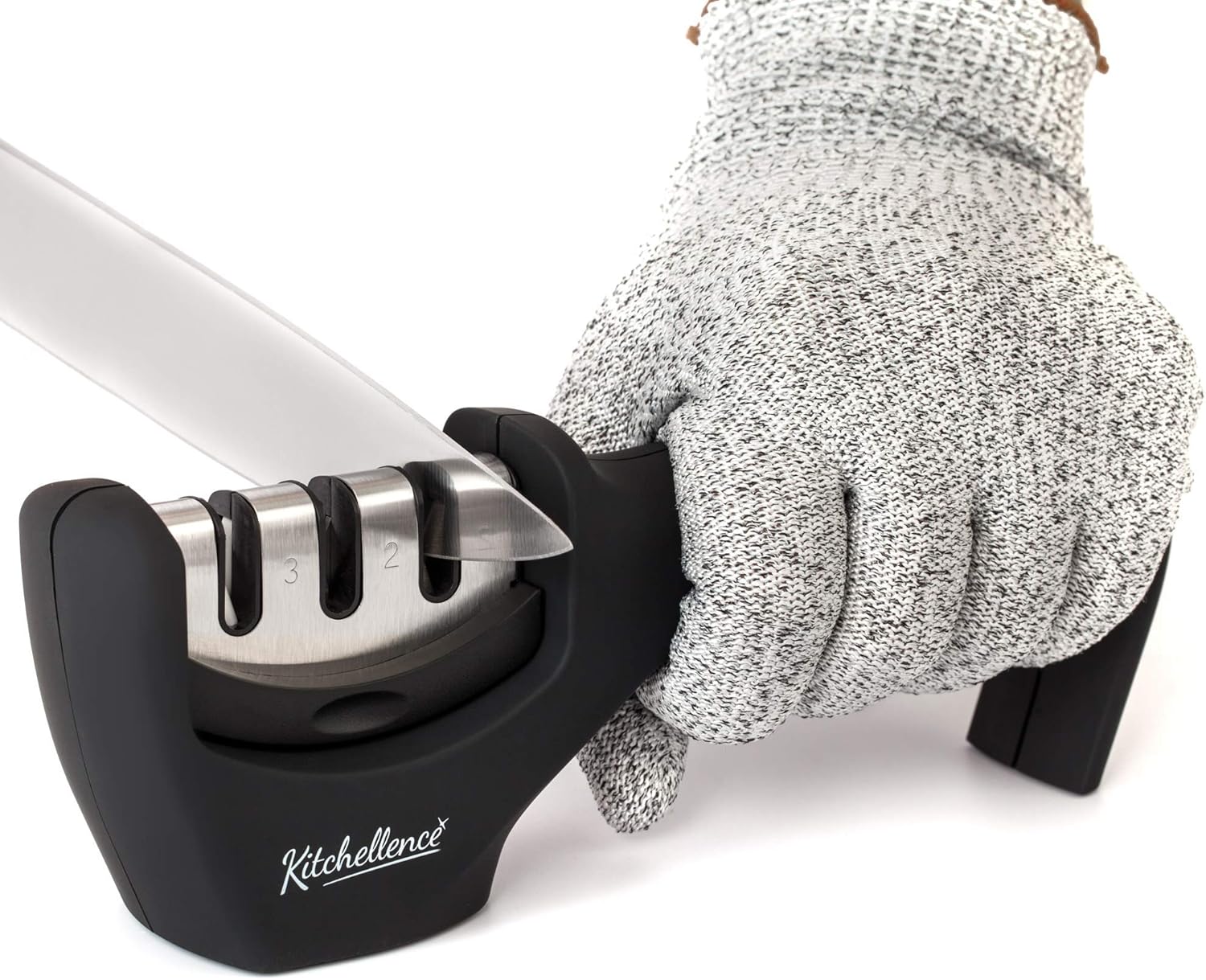
| Material Type | Plastic |
|---|---|
| Included Components | Yes |
| Number of Items | 1 |
This three-stage sharpener provides a simple, step-by-step way to revive dull kitchen knives without technical skill. The first diamond rod slot straightens damaged edges, the second re-establishes the V-shaped bevel, and the third fine-tunes and polishes the edge for everyday cutting tasks. The plastic body has a textured non-slip base and an ergonomic handle so you can pull blades through each slot with one hand while the unit stays stable. It is meant for routine home sharpening rather than professional reprofiling, so it works best on standard straight-edge chef, paring, and utility knives rather than serrated blades. The included cut-resistant glove is a practical safety extra for cautious users. Lightweight and easy to store, this kit is quick to use for restoring performance between more thorough hone or professional services, but it does not replace a full sharpening system for high-end knives or extensive blade repair.
Best for: Buyers who want a low-risk, easy-to-use sharpener to keep everyday kitchen knives performing well without learning advanced sharpening techniques.
Less Ideal for: Collectors, professional chefs, or anyone needing frequent reprofiling of high-end or serrated knives should choose a bench stone or guided sharpening system instead.
- Three distinct sharpening stages (diamond rod, coarse, fine) restore and polish edges quickly
- Ergonomic handle and non-slip base make one-handed use stable and straightforward
- Includes a cut-resistant glove for safer handling during sharpening
- Lightweight, compact design stores easily in a drawer or on a counter
- Plastic construction may feel less durable than metal-bodied sharpeners
- Not suitable for sharpening serrated knives or for precision reprofiling of premium blades
Verdict: A straightforward, safe three-stage sharpener that reliably restores everyday kitchen knives for risk-averse home cooks.
Choosing the Right All Around Knife Sharpener: Key Factors to Consider
Abrasive Progression
Abrasive progression matters because it determines whether the sharpener can handle everything from dull chips to a refined cutting edge. A system with coarse, medium, and fine grits lets you remove nicks or reprofile a worn bevel with the coarse stage, refine the edge geometry with a medium stage, and polish the cutting surface with a fine stage. Without progressive abrasives you may either take too long to restore an edge or never achieve a polished, long-lasting edge, which increases the frequency of maintenance.
Think about the types of blades you own and how dull they get before you sharpen them. If you often rescue neglected knives, prioritize coarse abrasives that are still stable and controllable. If you only touch up lightly used knives, a unit with finer grits and polishing capability will produce better long-term performance.
Angle Control And Consistency
Consistent bevel angle is critical for a sharp, durable edge. Manual sharpening that does not hold a repeatable angle can produce an inconsistent edge that dulls quickly or cuts poorly. A sharpener that guides the blade at a fixed, appropriate angle removes guesswork and reduces the risk of over-abrading one side of the edge.
Consider whether you need a single-angle guide for common kitchen knives or an adjustable-angle system to support multiple blade types. For most home cooks a mid-range angle that balances sharpness and toughness is sufficient, but adjustable systems add flexibility for specialty blades.
Stability And Safety Features
Stability and safety features directly affect how comfortable you feel using the sharpener and the risk of accidents. Non-slip bases, secure clamping, finger guards, and clear blade channels all make it easier to maintain control during sharpening. Systems that require excessive force or awkward handling increase the chance of slips and uneven strokes.
If you sharpen frequently, choose a stable unit that stays put on the counter and protects your hands from the abrasive surfaces. For occasional users, a forgiving guided system reduces the learning curve and improves consistency without compromising safety.
Abrasive Material And Durability
The abrasive material impacts both sharpening speed and longevity. Carbide and diamond abrasives remove material quickly and are ideal for repairing damaged edges, while ceramic and fine stones are better at polishing and raising a keen edge. Durable abrasives that resist glazing and wear will maintain performance over time and require less frequent replacement or reconditioning.
Look for replaceable or serviceable abrasive elements if you expect heavy use. Consider whether the unit allows you to replace or recondition worn parts rather than discarding the entire tool.
Ease Of Use And Maintenance
Ease of use influences how often you will actually sharpen your knives. Tools with simple, repeatable motions, clear stage indicators, and minimal setup lower the barrier for routine maintenance. Maintenance also includes cleaning metal filings and abrasive residues; systems designed for easy disassembly or with accessible surfaces reduce hassle.
If you prefer low-effort upkeep, prioritize systems with clear guides and minimal assembly. If you do not mind a bit of technique work, a more hands-on system can deliver better results but will require practice and occasional cleaning.
Manual Versus Guided Systems
Guided systems hold the blade at a consistent angle and are often the fastest way for a home cook to get repeatable results. They reduce the skill barrier and lower the risk of over-sharpening one side of the edge.
Manual systems, such as freehand stones, offer greater control and can produce a finer polish when used correctly, but they require practice to maintain a consistent angle. Choose guided setups if you want quick, reliable sharpening with minimal learning time, and choose manual stones if you want maximum control and are willing to invest practice time.
- Guided systems: easier to master, consistent angles
- Manual stones: better polish potential, steeper learning curve
- Combination kits: offer both repair and finishing stages
Motorized Options And When To Use Them
Motorized sharpeners can speed up the reprofiling process and are useful for heavier wear or for cooks who need to service many knives regularly. They often pair rapid material removal with multiple abrasive wheels or belts.
However, motorized units demand careful handling to avoid removing too much metal and to maintain correct bevel geometry. Consider them if you value speed and consistency and plan to use the tool frequently, but accept that they may be less forgiving than guided manual systems.
- Best for frequent use or large knife collections
- Require controlled technique to avoid over-abrading
- Look for user-adjustable speed or abrasive stages
Maintaining Edge Geometry Over Time
Regular light maintenance keeps knives cutting well and reduces the need for aggressive reprofiling. Stropping, light honing, or a quick pass through a fine abrasive stage can extend time between major sharpening sessions.
Record keeping helps: note which knives receive regular touch-ups and which need periodic reprofiling. Over time, you will learn how different blades respond to your chosen sharpener and can adapt your maintenance rhythm accordingly.
- Use finer abrasives for routine touch-ups
- Reserve coarse stages for chipped or very dull edges
- Strop or polish to refine the burr after sharpening
Choosing The Right Angle For Your Knives
Different kitchen knives benefit from different bevel angles based on steel hardness and intended use. A lower angle gives cleaner cuts but can be less durable, while a higher angle increases edge toughness at the cost of peak sharpness.
If your sharpener lets you pick from preset angles, choose the one that matches the knife's purpose. For a general all-around kitchen blade, a mid-range angle often balances sharpness and durability effectively.
- Lower angles: better for slicing and fine work
- Higher angles: better for heavy-duty tasks and longevity
- Choose adjustable-angle systems for mixed blade collections
Cleaning And Storage Tips
Regularly remove metal filings and abrasive residue to prevent contamination and maintain abrasive performance. Some systems let you detach cartridges or stones for easier cleaning; others require gentle brushing and wiping.
Store sharpeners in a dry place away from corrosive humidity. Protect abrasive surfaces from knocks and keep small parts together to avoid losing mediating pieces or adjustment screws.
- Brush away filings after every use
- Dry components thoroughly before storage
- Keep user manual and any spare parts in a labeled container
How We Chose the Best All Around Knife Sharpener
We focused on tools that deliver consistent, repeatable edges across common kitchen blades, from thin chef knives to heavier utility knives. Primary evaluation criteria included abrasive progression and grit range to determine how well a sharpener can move from repair to polish, the sharpener's ability to maintain proper blade angle for consistent geometry, and the tool's ease of use for someone sharpening knives at home. We also weighed build quality and stability to ensure safe, wobble-free operation, plus ease of cleaning and long-term durability of abrasive surfaces. We excluded single-use pull-through devices that lack progressive abrasives and specialty systems designed only for very narrow blade types. We also set aside motorized industrial tools that require workshop skills and are impractical for everyday kitchen maintenance. The final list favors tools that balance repair capability with a fine finish, strong safety features, and straightforward maintenance requirements. Scores reflect those concrete factors rather than subjective preference.
Our full evaluation process is outlined in our review methodology.
FAQ
How often should I sharpen my kitchen knives?
It depends on use. For daily home cooking, light honing or a fine abrasive touch-up every few weeks and a full sharpening every 6 to 12 months is common. Heavier use shortens that interval.
Will a guided all-around sharpener damage my knives?
Guided sharpeners are designed to be safe when used correctly. Damage usually results from overuse or using an excessively coarse stage too frequently. Follow the manufacturer's recommended progression and avoid removing more material than necessary.
Can I sharpen serrated knives with these sharpeners?
Most all-around sharpeners do not effectively service serrations. Serrated blades typically require a dedicated tapered ceramic rod or specific serration tools to restore each scallop accurately.
Is a motorized sharpener better than a manual one?
Motorized units can be faster and produce consistent results, but they are less forgiving and can remove more metal quickly. Manual or guided manual systems offer better control and can produce a finer finish when used properly.
How do I know which abrasive grit to use first?
Start with the coarsest grit needed to remove visible damage or to reprofile the bevel. Move to medium grit to refine the edge, then finish with a fine grit or strop to polish. Only use coarse grits when necessary.
Final Verdict
When choosing an all-around knife sharpener, prioritize systems that match the level of repair you need and that help you maintain consistent bevel geometry. Balance abrasive progression and abrasive durability against how comfortable you are with guided or manual techniques. Consider stability and safety features if you sharpen frequently, and favor easy-to-maintain systems if you prefer low-effort upkeep. With these tradeoffs in mind, pick the sharpener that fits your typical blade condition and your willingness to practice technique.