
Note: This article contains affiliate links. If you click on these links and make a purchase, we may earn a small commission at no extra cost to you. This helps support our research and content. Read our full affiliate disclosure here.
Choosing the right all-in-one printer for artists matters because your prints are an extension of your work. A printer that reproduces color accurately, accepts heavier fine-art stock, and handles dependable scanning or copying can save time and preserve the integrity of your pieces. This guide shortlists the top all-in-one printers for artists, focusing on color fidelity, paper handling, and workflow features that matter to illustrators and fine-art printmakers. Below you will find our top picks and the evaluation framework used to compare them, plus practical buying guidance to match a printer to your studio needs.
Top Picks at a Glance
| Best Overall The best all-around choice for most situations | HP OfficeJet Pro 8125 |  |
| Best Value The sweet spot between price and what you get | Epson EcoTank Photo ET-8550 |  |
| Best Budget The cheapest option that still gets the job done reliably | Brother Work Smart 1360 MFC-J1360DW | 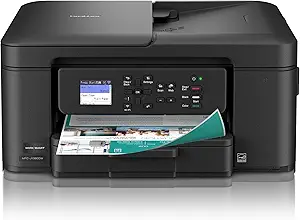 |
| Top Rated A top-rated pick with lots of positive feedback | Canon PIXMA TR8620a |  |
| Most Popular A crowd favorite that many people choose with confidence | HP OfficeJet Pro 8025 |  |
| Best Seller A high-volume bestseller chosen again and again | Epson EcoTank ET-2800 |  |
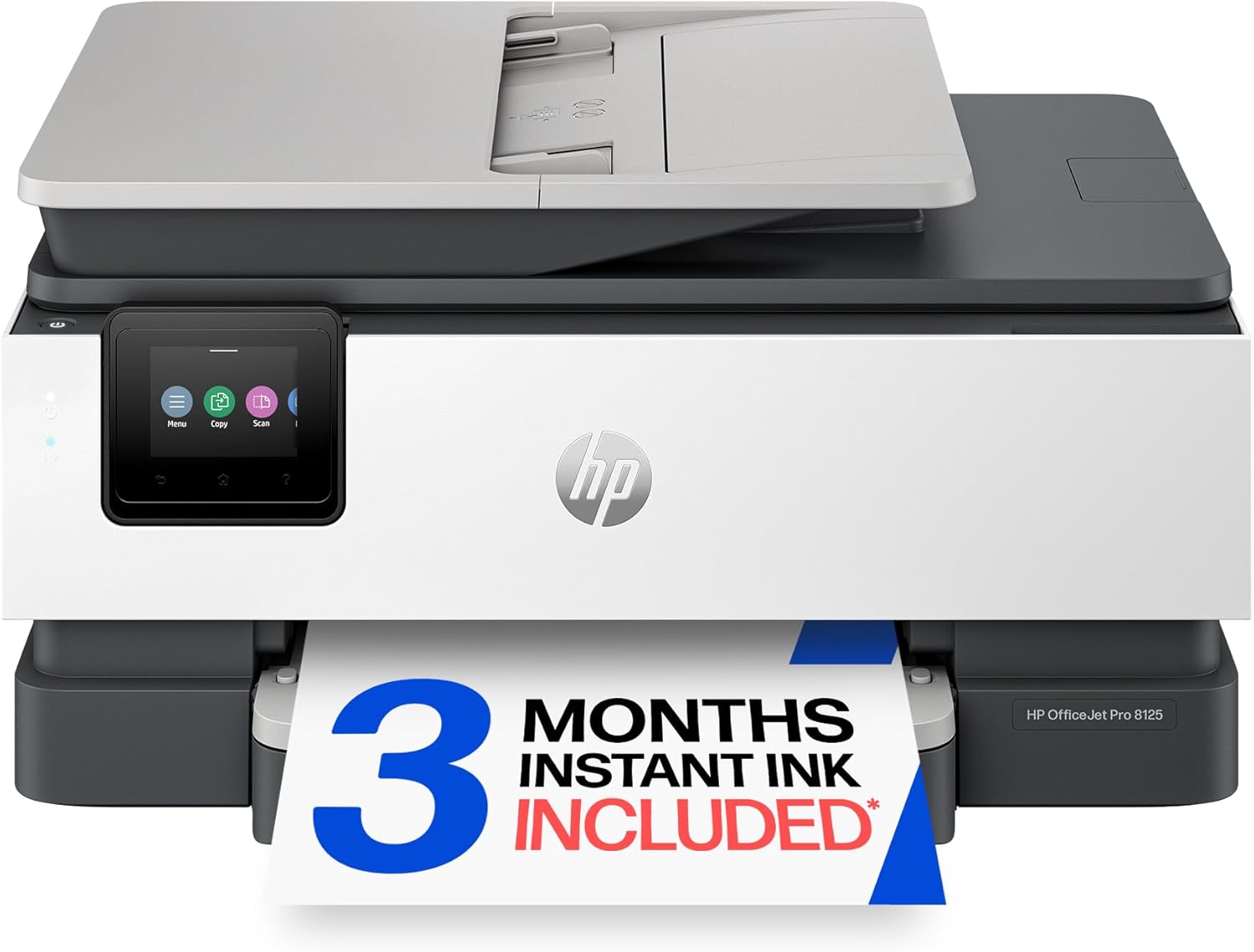
HP OfficeJet Pro 8125
| Print speed (B&W) | 20 pages per minute |
|---|---|
| Print speed (Color) | 10 pages per minute |
| Maximum media size | 8.5 x 11.7 in |
| Maximum sheet capacity | 225 |
| Connectivity | Wi‑Fi, Ethernet, USB, AirPrint |
The HP OfficeJet Pro 8125 is a compact color inkjet all-in-one that handles everyday home office and light creative work. It prints up to 20 ppm in black and 10 ppm in color, supports automatic two-sided printing and a 225-sheet input tray, and includes a one-sided ADF for scanning and copying multi-page documents. The 2.7-inch color touchscreen and HP app make mobile printing and basic adjustments straightforward, and HP AI tools help trim unwanted content from web pages and emails before printing, which saves paper. Photo and color output benefit from high advertised dpi for optimized photo paper, though like most thermal inkjets it performs best with quality paper and original HP inks. The unit is geared toward users who want reliable wireless connectivity, built-in security features, and an eco-friendly design with recycled plastic content, but heavier photo-editing or high-volume photo printing needs may require a dedicated photo printer or higher-end model.
Best for: Artists who need a versatile all-in-one that handles color documents, occasional photo prints, and reliable wireless workflow while balancing speed and convenience.
Less Ideal for: Photographers or artists who require gallery-quality, high-volume photo prints should choose a dedicated photo printer with specialized inks and larger color gamut.
- Fast black and color print speeds for a home-office AIO
- Automatic duplex and 225-sheet capacity reduce frequent paper refills
- 2.7-inch color touchscreen and HP app simplify mobile use and setup
- High optimized color resolution for better-looking prints on quality photo paper
- Includes wireless options plus Ethernet and AirPrint for flexible connectivity
- Not a dedicated photo printer so color-critical photo work may be limited
- Requires original HP cartridges with chips which restricts third-party ink use
Verdict: A practical all-in-one that gives artists dependable color printing, scanning, and mobile-friendly workflow without the complexity of a dedicated photo printer.
Epson EcoTank Photo ET-8550

| Printer Type | Inkjet |
|---|---|
| Printer Output Type | Color |
| Maximum Media Size | 13 x 19 inch |
| Color Pages per Minute | 12 pages_per_minute |
| Duplex | auto |
The Epson EcoTank Photo ET-8550 is a cartridge-free wide-format all-in-one that targets photo enthusiasts and small home studios by combining a 6-color Claria ET Premium ink set with a refillable tank system and a flatbed photo scanner. It prints borderless 13 x 19 inch photos and supports thick media and cardstock, delivering high resolution color prints suited to gallery-style prints and proofs. The large included ink bottles and high-yield replacement bottles greatly reduce running costs and refill frequency compared with cartridge-based models, while wireless and app control make mobile photo printing straightforward. Print speeds are modest for color photo work but reasonable for mixed document use, and the auto duplexing and 100-sheet capacity help for short production runs. Important compromises are size and footprint for a home studio and the recommendation to use genuine Epson inks to maintain quality and warranty coverage. For artists who prioritize print quality and low per-page cost over compactness, this printer is a practical tool for producing large, color-accurate prints at home.
Best for: Artists and home studio creators who want high-quality, large-format photo prints and low ongoing ink costs and are willing to accommodate a larger all-in-one unit in their workspace.
Less Ideal for: People who need a compact or ultra-fast photo printer for tight spaces or high-volume commercial production.
- 6-color Claria ET Premium ink system for rich, accurate photo color
- Refillable EcoTank bottles that cut running costs and refill frequency
- Wide-format support up to 13 x 19 inches and borderless printing
- Built-in scanner and copier for all-in-one studio workflows
- Wireless and mobile app control for printing from smartphones
- Large physical footprint may be awkward in smaller workspaces
- Print speed is moderate for color jobs compared with some dedicated photo printers
Verdict: Buy this if you want gallery-capable, wide-format photo prints at home with very low ongoing ink costs.
Brother Work Smart 1360 MFC-J1360DW

| Printer Type | Inkjet |
|---|---|
| Duplex | Automatic |
| Maximum Sheet Capacity | 150 |
| ADF Capacity | 20-sheet |
| Connectivity | USB, Wi-Fi |
The Brother Work Smart 1360 is a compact all-in-one inkjet that handles everyday color prints, scans and copies while offering features useful for creative workflows. It supports wireless printing, AirPrint and Mopria so you can send images from phones or tablets, and the 20-sheet ADF plus flatbed scanner make digitizing sketches and reference materials straightforward. Automatic duplex and a 150-sheet tray are convenient for batch printing and multi-page projects, and Brother's Page Gauge and mobile app simplify monitoring ink and sending prints on the go. Print speeds favor text and draft work more than high-volume photo production, and the standard LC501 ink yields are modest unless you move to high-yield cartridges. Color resolution is strong for an inkjet in this price class, but artists looking for museum-quality photo prints will find a dedicated photo printer with pigment photo inks produces better longevity and color depth. For sketch reproductions, layout proofs, and color concept prints, the 1360 offers a solid balance of features for the money.
Best for: Artists and illustrators on a budget who need a multifunction device for proofs, sketches, and color concept prints with easy mobile workflow and modest running costs if they use standard or high-yield ink options.
Less Ideal for: Photographers or fine art printmakers seeking archival-grade color accuracy and pigment-based photo output should consider a dedicated photo printer instead.
- Wireless, AirPrint and Mopria support for easy mobile printing
- Automatic duplex and 20-sheet ADF for two-sided and multi-page jobs
- 150-sheet paper tray reduces refills during longer runs
- Flatbed scanner plus ADF covers single pages and bound originals
- Page Gauge and Brother Mobile Connect app make ink monitoring and setup simple
- Standard ink yields are limited without choosing high-yield cartridges
- Not optimized for archival photo prints compared with dedicated photo printers
Verdict: A budget-friendly multifunction inkjet that gives artists a practical, wireless way to print and scan proofs and sketches without the cost or size of a dedicated photo printer.
Canon PIXMA TR8620a

| Printer Type | Inkjet |
|---|---|
| Maximum print Resolution Color | 4800 x 1200 dots_per_inch |
| Color Pages per Minute | 10 pages_per_minute |
| B&W Pages per Minute | 15 pages_per_minute |
| Duplex | Automatic |
The PIXMA TR8620a is a compact all-in-one inkjet that handles everyday documents and photo tasks while offering convenient wireless workflows. It prints color and black-and-white pages at up to 10 and 15 ppm respectively and can produce high-resolution prints up to 4800 x 1200 dpi, which helps when you need sharper photo and art mockup prints. The scanner is a flatbed unit and the 20-sheet ADF speeds multi-page copying and scanning. Paper handling includes two trays and support for borderless photo sizes up to 8.5 x 11 inches, plus automatic duplexing for two-sided jobs. Connectivity covers wireless and USB, and the touchscreen control and mobile compatibility make routine setup and printing straightforward. Practical limitations are typical for consumer photo-capable inkjets: color accuracy and longevity depend on paper and ink choice, the five-cartridge system raises per-page costs for heavy photo use, and faster professional photo labs will outpace its throughput for high-volume art prints. For reliability-focused buyers this model provides solid everyday performance with useful automation features but it is not a substitute for a dedicated pro photo printer.
Best for: Buyers who prioritize a dependable, full-featured home or small-office AIO that can handle occasional photo and art prints while minimizing fuss and downtime.
Less Ideal for: Artists or studios that need high-volume, museum-quality photographic output or the lowest long-term ink cost should consider a dedicated professional photo printer instead.
- High maximum print resolution (4800 x 1200 dpi) suitable for detailed prints and proofs
- Automatic duplexing and 20-sheet ADF speed multi-page scanning and double-sided printing
- Wireless and USB connectivity with touchscreen and mobile printing support for easy setup
- Borderless printing up to 8.5 x 11 and mixed tray options for photos and documents
- Five individual ink tanks increase replacement frequency and cost for heavy color/photo use
- Not designed for high-volume professional photo production due to slower ppm and ink economics
Verdict: A reliable, feature-rich all-in-one that balances high-resolution prints and convenient automation for artists who need dependable home-studio output without stepping up to pro photo hardware.
HP OfficeJet Pro 8025

| Printer Type | Inkjet |
|---|---|
| Maximum print Resolution Color | 4800 x 1200 |
| B&W Pages per Minute | 20 pages_per_minute |
| Color Pages per Minute | 10 pages_per_minute |
| Printer Connectivity Type | Ethernet, Wi-Fi |
The HP OfficeJet Pro 8025 is an all-in-one inkjet meant to handle everyday home office and small-business tasks like printing, scanning, copying, and faxing. It uses Wi-Fi and Ethernet for networked printing, supports mobile printing from smartphones, and includes a 2.65-inch color touchscreen plus Smart Tasks in the HP Smart app for quick scan-to-email or save workflows. The 35-sheet automatic document feeder and automatic two-sided printing help streamline multi-page jobs, while print resolution up to 4800 x 1200 (color) delivers relatively fine detail for color documents and reference images. Paper handling supports up to 225 sheets and legal-size media, but the output speed is modest at about 10 ppm for color which may be slow for large art print runs. Built-in voice control and self-healing Wi-Fi add convenience, and the unit ships with starter cartridges compatible with instant ink enrollment. Expect sensible productivity features and good color quality for proofs and studio documents, but artists needing high-volume, gallery-quality fine art prints should consider a dedicated photo or fine art printer instead.
Best for: Artists and creative professionals who need a networked all-in-one for scanning, proofing, and producing color documents with convenient mobile and app-driven workflows and moderate print volumes.
Less Ideal for: Photographers or artists who require high-volume, museum-grade photo prints or specialty fine art media should choose a dedicated photo printer with archival inks and wider color gamut.
- All-in-one functions: print, scan, copy, and fax in one device
- Automatic two-sided printing and 35-sheet ADF speed up multi-page workflows
- Wi-Fi and Ethernet plus mobile printing and a color touchscreen for easy setup and control
- High color print resolution (4800 x 1200) suitable for clear proofs and studio documents
- Color print speed is relatively slow at about 10 pages per minute
- Not optimized for high-volume gallery-quality photo or fine art printing
Verdict: Choose the OfficeJet Pro 8025 if you want a feature-rich networked all-in-one that handles scanning and color proofs well for a creative studio without requiring gallery-level photo output.
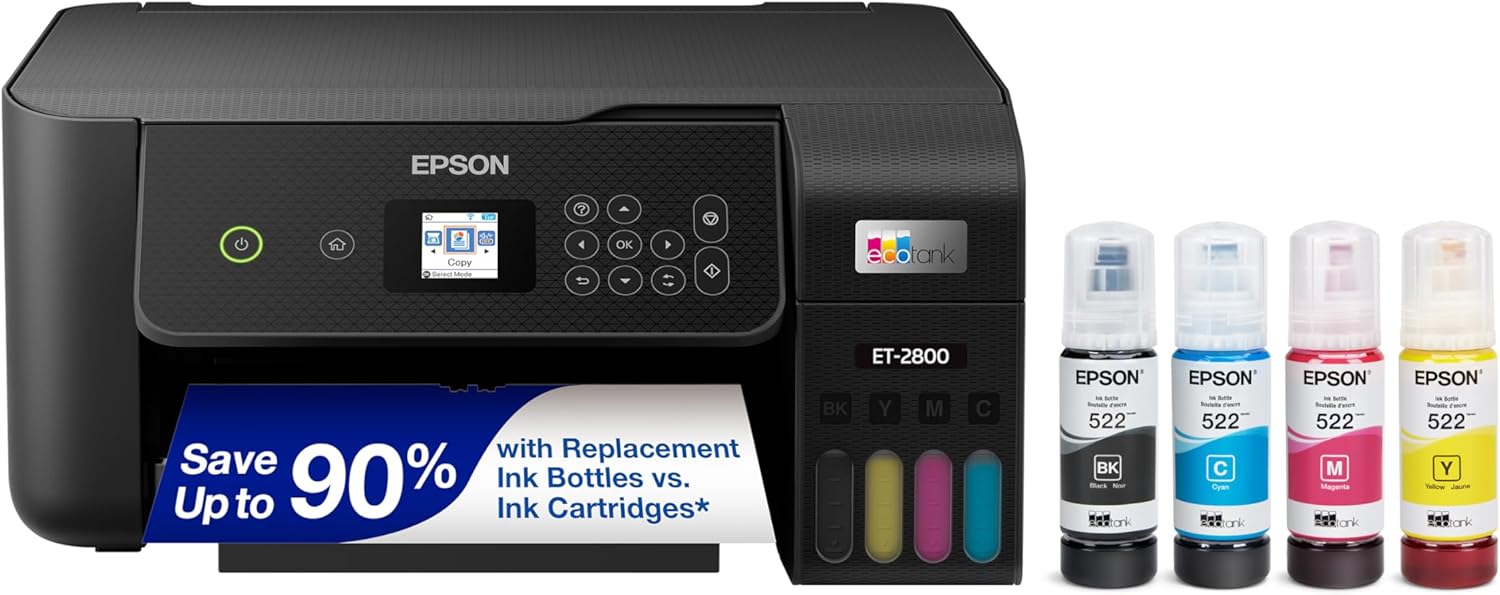
Epson EcoTank ET-2800
| Printer Type | Inkjet |
|---|---|
| Printer Connectivity Type | USB, Wi-Fi |
| Maximum print Resolution Color | 5760 x 1440 dpi |
| B&W Pages per Minute | 10 |
| Maximum Sheet Capacity | 100 |
The ET-2800 is a cartridge-free all-in-one aimed at everyday home printing, copying, and flatbed scanning. It uses high-capacity refillable ink tanks and ships with enough ink to cut down on frequent replacements, which makes it convenient for users who print regularly. Set up is straightforward with Wi-Fi and mobile printing support, and the printer delivers sharp text and decent color photos thanks to Epson PrecisionCore and a high maximum print resolution. The 10 ppm black speed helps with longer document runs, while the flatbed scanner handles artwork previews and basic reproductions. Limitations for artists include simplex-only printing and modest color photo speed and output compared with higher-end photo-focused models, so fine art color-critical work may need a dedicated photo printer. The ET-2800 is best when you want low running costs and reliable everyday color prints rather than gallery-grade photo output.
Best for: Buyers who prioritize low ongoing ink costs and reliable everyday color printing for home studio use and want a fuss-free setup and wireless convenience.
Less Ideal for: Photographers or visual artists who need professional, color-critical gallery prints or automatic duplexing should consider a dedicated photo printer or higher-end multifunction model.
- Cartridge-free EcoTank design reduces cartridge waste and lowers ongoing ink cost
- Includes high-capacity ink bottles that reduce frequency of replacements
- Wireless and mobile printing with voice-activated support for easy home use
- High maximum print resolution for detailed text and decent photo prints
- Flatbed scanner and LCD make copying and basic scanning convenient
- Does not support automatic two-sided (duplex) printing
- Not optimized as a dedicated photo printer for color-critical art prints
Verdict: Choose the ET-2800 if you want a low-cost, cartridge-free all-in-one that delivers reliable home color prints and simple scanning for your art workflow.
Choosing the Right All-in-One Printer for Artists: Key Factors to Consider
Color Accuracy and Ink Type
Accurate color matching is essential for reproducing artwork. Look for printers that offer wide color gamuts and either expanded color ink sets or pigment-based inks that render subtle tones and gradients reliably.
Ink chemistry affects longevity and the appearance of prints. Dye inks typically yield vibrant colors but can fade faster, while pigment inks are more lightfast and better suited to gallery pieces. Consider how the ink type aligns with whether you need archival prints or bright proofs.
Media Handling and Supported Paper Weights
Artists often work with heavyweight fine-art papers, textured stocks, and occasionally thicker board. Confirm the printer supports the paper sizes and thicknesses you use, including manual feed paths or rear trays designed for heavier media.
Also check for borderless printing options and the maximum sheet or roll width if you plan to produce larger prints. Reliable paper handling reduces jams and surface contact during printing, preserving delicate textures.
Print Resolution and Detail Reproduction
High dpi and precise droplet control produce smoother gradients, sharper line work, and finer detail reproduction. This matters for illustrative work, high-resolution scans, and prints intended for sale.
Consider whether the printer offers variable droplet sizes or higher native resolutions, as well as any software sharpening or driver controls that help capture fine lines and textured brushwork without introducing artifacts.
Scanning Bed Size and Optical Quality
A good scanner is important for reproducing originals, creating digital archives, or preparing images for print. Optical resolution, color depth, and evenness of illumination determine how faithfully the scanner captures color and detail.
If you work with larger originals, look for a platen that accommodates your typical paper sizes. Features like removable lids for thick originals or adjustable exposure settings are useful for artwork with texture or three-dimensional elements.
Color Management and Workflow Integration
Color management features, such as ICC profile support, advanced driver controls, and compatibility with external RIP software, let you match monitor previews to printed output more closely. This reduces wasted paper and ink from trial-and-error adjustments.
Workflow conveniences like USB, Ethernet, Wi-Fi, and mobile printing matter depending on your studio setup. Local network access and reliable drivers for your operating system improve day-to-day efficiency.
Durability and Long-Term Operating Costs
Consider build quality and how often consumables will need replacement. While initial cost is relevant, artists should weigh ink consumption and the availability of high-capacity cartridges or refillable systems.
Durable internal paper paths, easily replaceable maintenance parts, and clear maintenance routines help keep a printer functioning consistently in an active studio environment.
Matching a Printer to Your Studio Workflow
Think about how the printer will fit into your daily routine. If you produce limited edition prints or sell originals, prioritize archival-compatible inks and media support. For frequent proofs and tests, faster color-accurate output with economical consumables could be more important.
Also plan for where the printer will live. A compact, top-loading all-in-one may suit a small desk, while a studio with bench space can accommodate wider-sheet printers and larger flatbeds. Plan for ventilation and ink storage near a stable power source.
- Decide whether archival permanence or proof vibrancy is the primary goal.
- Account for physical footprint and media storage near the device.
- Verify OS and driver compatibility with your image-editing setup.
Optimizing Color Matching and Profiles
Accurate matching starts with calibrated monitors and ICC profiles for the specific paper and ink combination you use. Many printers support custom profiles created with color targets and spectrophotometers, which yield the most consistent results.
If you cannot profile, use manufacturer or third-party profiles for close matches, and print test strips to refine driver settings. Pay attention to the rendering intent options in your print dialog; perceptual and relative colorimetric choices affect how colors are compressed from source to print.
- Use soft-proofing in your image editor to preview expected print results.
- Keep a small set of test prints to evaluate profile changes and aging.
Preparing Artwork Files for Print
Set final image resolution to match the printer's recommended dpi for the desired viewing distance. For fine-detail art prints, 240 to 300 dpi at final print size is a common target. Convert files to the appropriate color space if required by your workflow.
Flatten or embed fonts when printing mixed-media pieces with text, and add necessary bleed or crop marks for trimming. For textured originals, capture at a higher resolution to preserve surface detail during scanning or reproduction.
- Export in a high-bit-depth format when possible to preserve gradations.
- Include crop marks and bleed for prints that will be trimmed.
Maintaining Print Quality Over Time
Regular maintenance extends printhead life and keeps color consistent. Run manufacturer-recommended cleaning cycles when you notice banding or color shifts, and store inks and papers in climate-controlled conditions to reduce clogging and paper cockle.
Schedule periodic test prints to catch drift in color output early. Keep spare maintenance consumables on hand if your workflow depends on consistent uptime.
- Use genuine or high-quality replacement inks to avoid clogging.
- Store fine-art paper flat and away from humidity.
Choosing Between Pigment and Dye Inks
Pigment inks tend to be more lightfast and resistant to smudging, making them a strong choice for gallery pieces and prints intended for sale. Dye inks often produce more saturated colors and can be useful for client proofs or portfolios where vibrancy is prioritized over longevity.
Consider how prints will be displayed and stored. If archival permanence is critical, prioritize pigment-based systems and papers rated for archival use.
- Check lightfastness ratings if print longevity is essential.
- Use pigment inks for museum-quality or commissioned prints.
How We Chose the Best All-in-One Printer for Artists
We selected options that meet the specific needs of artists by prioritizing measurable, studio-relevant capabilities. Primary evaluation criteria included color accuracy and gamut, because faithful reproduction of tones and subtle hues is the most important trait for artwork prints. Media handling and paper support were assessed to ensure the printers accept heavyweight fine-art papers, textured stocks, and larger sheet sizes used for prints and proofs. We also evaluated print resolution and ink set versatility since higher dpi and dedicated color or pigment inks produce finer detail and longer-lasting results. Scanning quality and platen size matter for digitizing originals, so we considered optical resolution and copy fidelity. Finally, we reviewed workflow and connectivity features, such as color management support, driver options, and local network access, that affect daily studio productivity. Exclusions: We excluded devices that prioritize office throughput over color fidelity and those that lack explicit support for fine-art media weights. Models without adequate scanning resolution or minimal ink sets were filtered out. The final list emphasizes tools that artists can rely on for accurate, archival-looking prints and consistent studio workflows.
Our full evaluation process is outlined in our review methodology.
FAQ
Can an all-in-one printer produce gallery-quality art prints?
Often, yes. Many all-in-one printers with expanded color sets and pigment inks can deliver gallery-quality results when paired with archival papers and proper color management. The outcome depends on the specific ink chemistry, paper choice, and profiling.
What paper type should artists use for archival prints?
Choose acid-free, archival-rated fine-art papers with the surface texture you want, such as cotton rag or heavyweight matte papers. Check the printer's supported paper weights and feed method to ensure reliable handling.
How important is scanner quality for reproducing originals?
Scanner quality is important if you need faithful digital reproductions. Optical resolution, color depth, and even lighting determine how well a scanner captures texture and tonal range. Higher optical dpi and color bit depth produce better archives and prints.
Do I need special profiles for different papers?
Usually. Each paper and ink combination responds differently, so using ICC profiles tuned to your specific media produces the most accurate results. If custom profiling is not possible, use manufacturer or third-party profiles as a starting point and test print adjustments.
How often should I perform maintenance on an art-printing all-in-one?
Frequency depends on usage, but regular short test prints and periodic printhead checks help prevent clogs and color drift. If you print daily, weekly automated cleaning and scheduled maintenance are advisable.
Final Verdict
When choosing an all-in-one printer for artists, prioritize color accuracy, media compatibility, and the scanning capability that supports your workflow. Understand the tradeoff between pigment permanence and dye vibrancy, and match the printer's paper handling to the stocks you intend to use. Focus on reliable color management tools and maintain the device regularly to preserve consistent output. With those priorities in mind, you can select a printer that meets the demands of fine-art reproduction and studio productivity.