
Note: This article contains affiliate links. If you click on these links and make a purchase, we may earn a small commission at no extra cost to you. This helps support our research and content. Read our full affiliate disclosure here.
Choosing the right All-in-One printer for a home office matters because your device is more than a printer. It handles documents, scans receipts, copies contracts, and must connect reliably to multiple devices while keeping running costs reasonable. A poor fit can slow workflows, raise frustration, and increase maintenance time. This guide presents seven shortlisted All-in-One printers for home office use that fit a range of needs from light weekly printing to steady daily output. We evaluated each option against practical buyer priorities like print and scan quality, connectivity, and ongoing operating cost. Read on to find the right balance of speed, features, and reliability for your workspace.
Top Picks at a Glance
| Best Overall The best all-around choice for most situations | Epson EcoTank ET-4800 |  |
| Best Quality Built to a higher standard if you want something more solid | Epson EcoTank ET-2800 |  |
| Best Value The sweet spot between price and what you get | Brother Work Smart 1360 MFC-J1360DW | 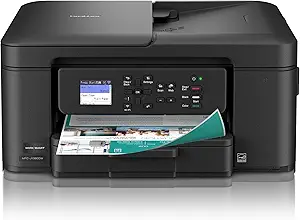 |
| Best Budget The cheapest option that still gets the job done reliably | Canon PIXMA TR4720 |  |
| Top Rated A top-rated pick with lots of positive feedback | HP LaserJet Pro MFP 3101sdw |  |
| Most Popular A crowd favorite that many people choose with confidence | HP DeskJet 2855e All-in-One |  |
| Best Seller A high-volume bestseller chosen again and again | Canon PIXMA TS6520 |  |
Epson EcoTank ET-4800

| Printer Type | Inkjet |
|---|---|
| Printer Connectivity Type | Wi-Fi, wired |
| Maximum print Resolution Color | 5760 x 1440 dots_per_inch |
| B&W Pages per Minute | 10 pages_per_minute |
| Maximum Sheet Capacity | 100 |
The Epson EcoTank ET-4800 is a home-office focused all-in-one inkjet that replaces cartridges with large refillable ink tanks to dramatically extend time between refills. It prints color documents and photos at a rated 5 ppm and black-and-white pages at about 10 ppm, and delivers high optical quality thanks to a maximum 5760 x 1440 dpi resolution. The unit includes a flatbed scanner, automatic document feeder for multi-page scanning and copying, fax capability and an LCD control panel, plus Ethernet and USB alongside Wi‑Fi for flexible placement. Practical benefits are low long-term ink cost and reduced cartridge waste, easy-to-fill keyed EcoFit bottles, and a 100-sheet input capacity useful for batching home-office jobs. Trade-offs include manual duplexing only and modest color photo speed, and the device is relatively compact but not the fastest for heavy duty office volumes. For balanced home-office users the ET-4800 is designed to cut ink expenses while covering standard printing, scanning and copying needs with straightforward setup and connectivity.
Best for: Buyers looking for an economical, low-maintenance all-in-one for a home office who value low ink cost and a complete set of scanning and copying features.
Less Ideal for: Users who need automatic duplexing, very high daily page volumes, or the fastest color throughput should consider more business-oriented models.
- Cartridge-free EcoTank system with high-capacity refillable ink tanks lowers ongoing ink cost
- High maximum print resolution for sharp text and good photo quality
- All-in-one feature set including flatbed scanner, ADF, copier and fax covers typical home-office tasks
- Multiple connectivity options: Wi‑Fi, Ethernet and USB for flexible placement and wired reliability
- Includes one set of ink bottles in the box to get started
- Duplex printing is manual rather than automatic
- Color print speed is relatively slow compared with faster office-focused models
- Not intended for very high-volume commercial printing workflows
Verdict: Choose the ET-4800 if you want a full-featured home-office all-in-one that slashes ink costs with refillable EcoTank reservoirs.
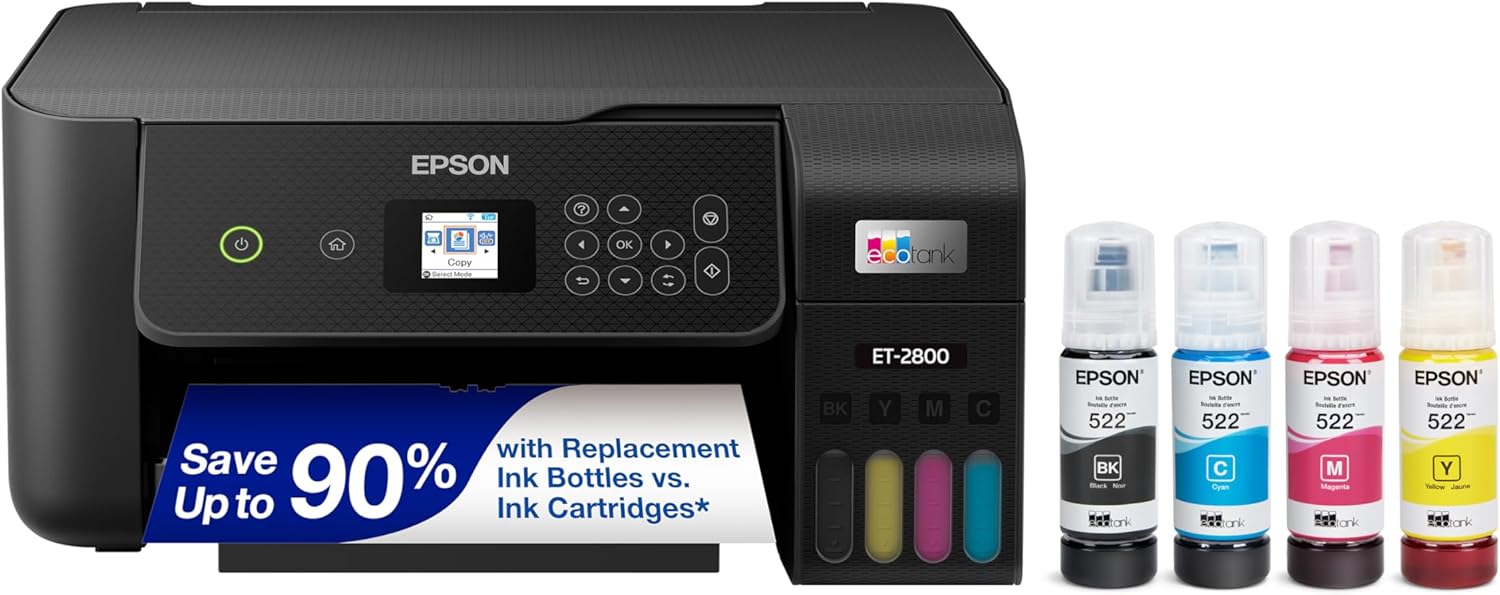
Epson EcoTank ET-2800
| Printer Type | Inkjet |
|---|---|
| Printer Output Type | Color |
| Maximum print Resolution Color | 5760 x 1440 dpi |
| B&W Pages per Minute | 10 |
| Printer Connectivity Type | USB, Wi-Fi |
The Epson EcoTank ET-2800 is a compact all-in-one inkjet that replaces cartridges with high-capacity refillable tanks, making it well suited for steady home-office printing. It prints, scans and copies, offers wireless and USB connectivity, and supports voice-activated printing for quick hands-free tasks. The PrecisionCore-based Micro Piezo print system delivers high-resolution output for photos and documents, and the supplied ink yields thousands of pages before needing a refill, which lowers running costs. A simple LCD and app control make setup and everyday operation straightforward, while the flatbed scanner handles single-sheet scanning and copying. Limitations include simplex-only printing — no automatic two-sided feed — and modest color print speed compared with faster office models, so large duplexed jobs will be slower or require manual intervention. Overall its strength is low-cost, low-waste color printing for home office users who value reliability and long ink life over advanced finishing features.
Best for: Home-office users who prioritize low running costs, high-resolution output, and reliable everyday printing without the hassle of frequent cartridge changes.
Less Ideal for: Small businesses or users who need fast duplex printing, heavy duty monthly volumes, or advanced paper handling and finishing features.
- Cartridge-free EcoTank system with high-capacity refillable ink tanks for long intervals between refills
- High maximum print resolution for detailed color photos and sharp text
- Wireless and USB connectivity with app and voice-activated printing for easy mobile workflows
- Low power consumption at 12 watts
- No automatic duplex (two-sided) printing
- Color print speed is modest at around 5 ppm compared with faster office-focused printers
Verdict: Choose the ET-2800 if you want a reliable, low-cost, cartridge-free color all-in-one for consistent home-office printing and high-resolution output.
Brother Work Smart 1360 MFC-J1360DW

| Printer Type | Inkjet |
|---|---|
| Functions | Print, Copy, Scan |
| Duplex | Automatic |
| Maximum Sheet Capacity | 150 |
| ADF Capacity | 20 sheets |
The Brother Work Smart 1360 is a compact all-in-one inkjet designed for home and small home-office use. It handles everyday tasks—printing documents, scanning via flatbed or the 20-sheet ADF, and making copies—while offering Wi‑Fi and USB connectivity and mobile printing through AirPrint and Mopria. Automatic duplex printing and a 150-sheet tray help reduce trips to the paper bin and save paper, and the 1.8" color display plus Brother Mobile Connect makes basic setup and status checks straightforward. Print speeds are practical for light office workflows (up to 16 ppm mono and 9 ppm color) and Page Gauge helps monitor ink levels so you know when to reorder. Expect typical inkjet limitations: color photo quality is decent but not photo-lab grade, and standard yield starter cartridges mean you may want to buy higher-yield replacements for heavier use. The printer is tuned for convenience and lower footprint rather than high-volume production or advanced finishing features.
Best for: Buyers who prioritize a compact, no-nonsense all-in-one that saves desk space and automates common tasks like duplex printing and scanning for a home office or light business workload.
Less Ideal for: Users who need high-volume printing, professional photo output, or advanced finishing options should consider more robust office printers or dedicated photo printers.
- Automatic two-sided (duplex) printing saves paper and time.
- 20-sheet automatic document feeder and flatbed scanner cover multi-page scanning and copying needs.
- Wireless, Wi‑Fi Direct, AirPrint and Mopria support make mobile printing easy.
- 150-sheet input capacity reduces how often you refill paper.
- Compact footprint and simple 1.8" color display are easy to fit and use in small workspaces.
- Starter ink cartridges have limited yield so ongoing cost depends on replacing with standard or high-yield Brother cartridges.
- Not intended for high-volume or professional photo printing workloads.
Verdict: A compact, practical all-in-one that streamlines common home-office printing, scanning, and duplexing needs with easy mobile connectivity.
Canon PIXMA TR4720

| Printer Type | Inkjet |
|---|---|
| Functions | Print, copy, scan, fax |
| Resolution | 4800 x 1200 |
| Paper Capacity | 100 sheets |
| Connectivity | USB, Wi-Fi |
The Canon PIXMA TR4720 is a space-saving 4-in-1 inkjet that covers everyday home office needs: print, copy, scan and fax. It connects via Wi-Fi or USB and works with the Canon Print app for mobile printing and cloud access, while a 2-line LCD and simple buttons make basic tasks straightforward. Notable features include an automatic document feeder for multi-page scans, automatic two-sided printing to save paper, and a 100-sheet front tray that keeps paper loading simple. Print quality is good for documents and acceptable for borderless photos up to letter size thanks to the hybrid ink system and 4800 x 1200 dpi resolution, though color photo speeds are modest. Where this model shows its budget focus is in slower color print speeds and basic controls instead of a touchscreen, and ink costs can add up if you print photos frequently. For typical home-office documents, study copies and occasional photos it is a practical, compact choice that balances features and footprint for light to moderate use.
Best for: Buyers on a tight budget who need a compact, straightforward all-in-one for everyday home-office tasks like document printing, scanning and occasional photos and want wireless mobile printing.
Less Ideal for: Those who require fast color photo production, heavy monthly print volumes, or advanced touchscreen controls should consider more capable models.
- Auto document feeder and automatic duplex printing for efficient multi-page workflows
- Compact footprint with easy front-loading 100-sheet tray suitable for small desks
- Wireless printing and Canon Print app support for mobile and cloud printing
- High maximum print resolution (4800 x 1200 dpi) for sharp text and decent photo detail
- Slow color print speed compared with higher-end home-office models
- Basic 2-line LCD and controls instead of a more capable touchscreen
Verdict: A compact, budget-friendly wireless all-in-one that handles typical home-office printing and scanning while saving space and paper with duplex and an ADF.
HP LaserJet Pro MFP 3101sdw

| Printer Type | Laser |
|---|---|
| Printer Output Type | Monochrome |
| Maximum Print Resolution Black and White | Up to 1200 x 1200 dpi |
| B&W Pages per Minute | 40 |
| Maximum Sheet Capacity | 250 |
The HP LaserJet Pro MFP 3101sdw is a compact monochrome laser multifunction printer built for steady home office and small team use. It prints, scans (ADF and flatbed), copies and supports automatic two-sided printing, with a 250-sheet input tray and a 50-sheet automatic document feeder for batch jobs. Expect fast output for text documents—up to 35–40 ppm and first-page-out times around seven seconds—while 1200 x 1200 dpi resolution keeps text sharp for reports and invoices. Connectivity covers Wi‑Fi, Ethernet and USB plus mobile options like AirPrint and Mopria, and the HP app provides remote control and setup. The unit ships with an introductory toner cartridge and is positioned for reliable, consistent daily use, and HP notes firmware controls to ensure cartridge compatibility. Trade-offs include monochrome-only output if you need color prints and a focus on business document throughput rather than photo quality or creative tasks.
Best for: Buyers who prioritize dependable, fast black-and-white printing and reliable multifunction workflow for a home office or small team will appreciate this model.
Less Ideal for: Users who need color printing, photo-quality output, or who prefer full third-party consumable compatibility should consider color inkjet or other alternatives.
- Fast black-and-white print speeds suitable for busy home offices
- Automatic duplex and 50-sheet ADF for efficient scanning and double-sided jobs
- 250-sheet input tray reduces frequent paper refills for higher-volume printing
- Multiple connectivity options including Wi‑Fi, Ethernet, USB and mobile printing support
- Monochrome output only so no color printing capability
- Firmware-enforced cartridge compatibility restricts use of third-party toner
Verdict: If you need a dependable, fast monochrome all-in-one for a home office, this HP LaserJet delivers business-grade speed and reliable daily performance.
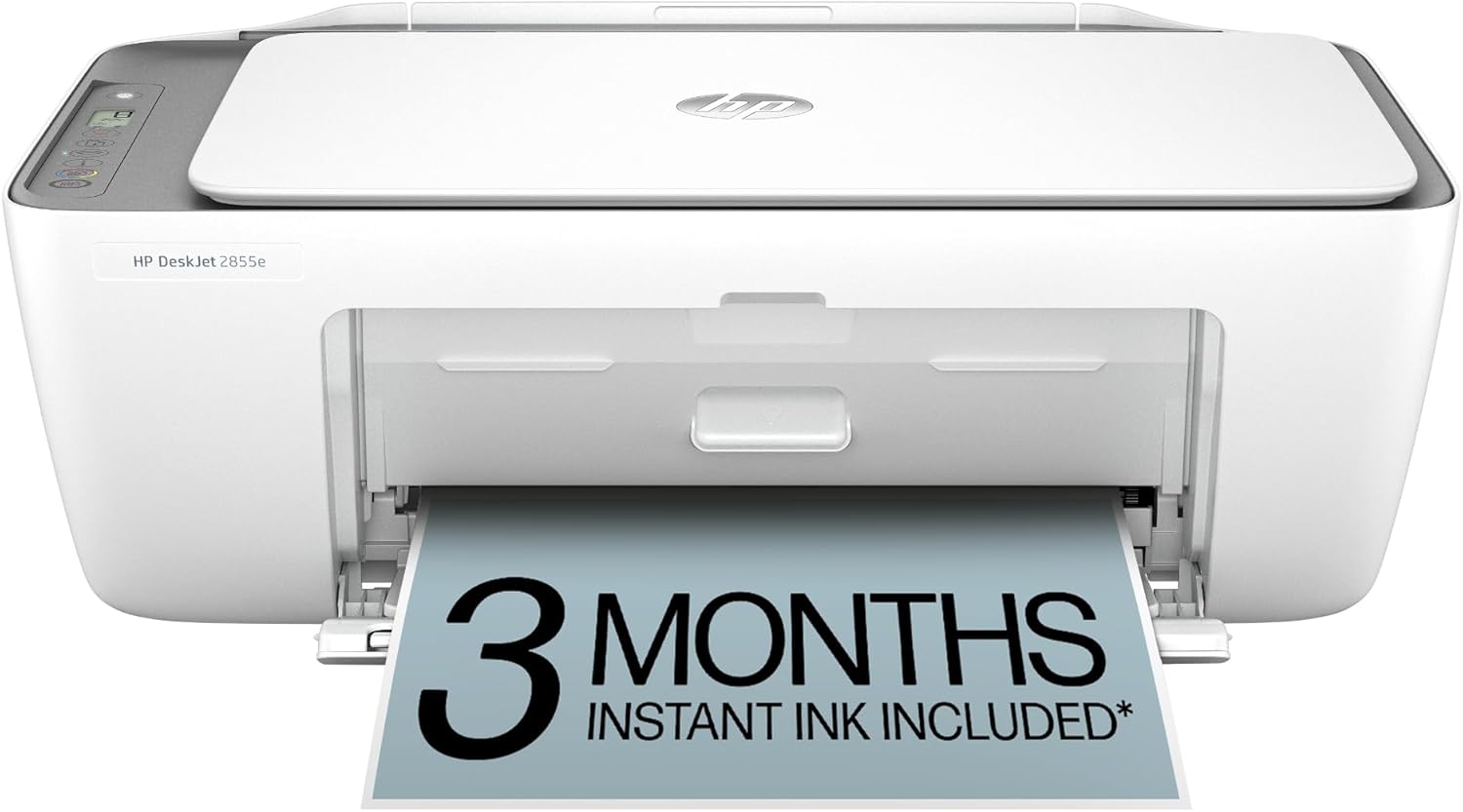
HP DeskJet 2855e All-in-One
| Printer Type | Inkjet |
|---|---|
| Print Speed (B&W) | 7.5 pages_per_minute |
| Print Speed (Color) | 5.5 pages_per_minute |
| Input Capacity | 60 sheets |
| Connectivity | single band wi-fi (2.4ghz only), USB 2.0 |
The HP DeskJet 2855e is a small, budget-oriented all-in-one that handles everyday home office tasks: color and black printing, flatbed scanning, and copying. It connects over single-band 2.4 GHz Wi‑Fi or USB 2.0 and is controlled through the HP app for easy smartphone printing and scanning. Notable features include HP AI formatting to clean up web pages and emails before printing, a 60-sheet input tray, and a three-month Instant Ink trial when you activate HP+. Print speeds are modest — about 7.5 ppm black and 5.5 ppm color — and manual duplexing is required for two-sided jobs. Photo and color output can look good for documents and occasional photos given the stated 4800 x 1200 dpi color resolution, but this is not aimed at high-volume or professional photo work. The unit is compact and energy efficient, making it convenient on a desk, though reliance on single-band Wi‑Fi may limit network placement and some users report variability in app-driven setup. For light to moderate home office use where simplicity and low upfront cost matter, it is a practical choice.
Best for: Buyers who want an affordable, easy-to-use all-in-one for everyday home office tasks and prefer an app-driven setup with a managed ink option to reduce surprise ink runs out.
Less Ideal for: Users who need fast, high-volume printing, built-in automatic duplex, or advanced photo-quality output should consider higher-end models instead.
- All-in-one functionality with printing, flatbed scanning, and copying in a compact footprint
- Simple wireless setup and phone-based control via the HP app
- Includes 3 months of Instant Ink with HP+ activation to reduce ink outages
- 60-sheet input tray suits typical home office paper volume
- High quoted color resolution for sharper-looking documents and images
- Supports only single-band 2.4 GHz Wi‑Fi which can limit network options
- Manual duplexing requires user intervention for two-sided printing
- Not intended for high-volume or professional photo print use
Verdict: A compact, app-first all-in-one that fits light home office needs and includes a trial of Instant Ink to simplify supplies management.
Canon PIXMA TS6520

| Printer Type | Inkjet |
|---|---|
| Duplex | Automatic |
| Printer Connectivity Type | USB, Wi-Fi |
| Display Type | OLED |
| Compatible Cartridge | PG-295 & CL-286 |
The Canon PIXMA TS6520 is a small, user-friendly all-in-one inkjet that handles printing, copying, and flatbed scanning for everyday home office tasks. It uses a two-cartridge hybrid ink system that produces sharp black text and reasonably vibrant color prints, and supports borderless photos up to letter size. Setup is straightforward via the Canon PRINT app, AirPrint, or Wi‑Fi, and the 1.42-inch OLED and simple controls make status checks and basic adjustments easy. Automatic two-sided printing saves paper and the printer supports both 2.4 and 5 GHz networks for more reliable mobile printing. Where it limits itself is capacity and speed: a single 1-sheet tray and modest page-per-minute numbers mean it is best for light to moderate usage rather than heavy multi-user workloads, and it lacks an automatic document feeder for batch scanning or copying. For buyers who prioritize compact size, reliable wireless printing, and good-quality everyday documents and photos, this PIXMA is a sensible pick; power users needing high volume or ADF convenience should look elsewhere.
Best for: Buyers who want a compact, reliable all-in-one for occasional to moderate home office printing and value simple setup, solid wireless connectivity, and good everyday print quality.
Less Ideal for: People who need high monthly page volumes, frequent multi-page scanning or copying, or an office-grade paper handling system should consider larger, business-focused models instead.
- Compact footprint fits easily on a home office desk
- Automatic duplex printing reduces paper use
- Supports dual-band Wi‑Fi and common mobile printing standards for easy phone or tablet printing
- Hybrid two-cartridge ink system yields crisp text and good color for photos and documents
- Only a single tray with very limited sheet capacity, not suited for high-volume printing
- No automatic document feeder, so multi-page scans or copies must be handled manually
Verdict: A compact, easy-to-use all-in-one that delivers reliable wireless printing and good everyday document and photo quality for risk-averse home office users.
Choosing the Right All-in-One Printer for Home Office: Key Factors to Consider
Print and Copy Quality
Print quality governs how professional your documents look and how readable small text becomes. For home office users who print invoices, proposals, or occasional marketing materials, sharp black text and accurate color reproduction matter. Laser engines typically render crisp text for heavy document work, while ink-based systems can deliver richer color photographs and gradients for presentation materials.
Copy performance is tied to print quality and to features like automatic duplexing and multi-page copying. If you frequently produce multi-page handouts, a reliable duplex copier saves time and reduces paper usage. Consider how photo and graphic-heavy documents reproduce if you need client-ready output.
Scan Accuracy and Speed
Scanning is a core function for digitizing receipts, signing contracts, and archiving records. Flatbed scanners capture delicate originals and books, while automatic document feeders speed multi-page scanning. Look at optical resolution and the scanner's ability to auto-detect color versus black-and-white pages to avoid rescans.
Scan speed affects workflow when you process batches of documents. For most home offices, a moderately fast ADF that supports duplex scanning provides the best balance between speed and convenience. Also consider bundled software for OCR and searchable PDFs when you need to index documents.
Connectivity and Mobile Support
A home office printer must integrate cleanly with your devices and network. Wi-Fi is essential for a wireless setup, but stable dual-band support and straightforward network setup reduce headaches. Wired Ethernet is useful if you have a shared wired network or need maximum reliability for heavier print loads.
Mobile printing and cloud integration let you print from phones and tablets or send scans directly to cloud storage. Check compatibility with common mobile printing standards and whether the device provides a dedicated app with scanning and maintenance tools. Network security features such as password-protected access and firmware update support are also important for protecting sensitive documents.
Operating Cost and Consumables
Long-term cost depends heavily on ink or toner yield, cartridge pricing, and whether high-capacity or third-party consumables are supported. Evaluate estimated page yield and how often you will need replacements based on your monthly print volume. Some units offer separate color tanks or high-yield options that lower cost per page.
Also consider maintenance items like waste ink pads or transfer belts for certain technologies. A lower up-front price can be offset by expensive cartridges, so calculate a realistic cost-per-page for your typical mix of color and black-and-white prints.
Setup, Reliability, and Size
Setup should be straightforward, with clear instructions and reliable drivers for your operating systems. A compact footprint is important when workspace is limited; measure available desk or shelf space and account for open trays during use. Evaluate build quality and user-reported reliability for paper handling and ink delivery.
Look for easy access to replaceable parts and visible status indicators for ink or toner levels. Devices that require frequent manual alignment or cleaning will add maintenance time, so factor long-term reliability into the buying decision.
Choosing the Right Duty Cycle for Home Use
Home office needs vary from occasional printing to daily batch jobs. Estimate your typical monthly page count and choose a printer with a recommended monthly volume that exceeds your average by a healthy margin. Running a device continually near or above its duty cycle increases wear and maintenance.
- Light use: under 200 pages per month — small inkjet All-in-One units are usually sufficient.
- Moderate use: 200 to 800 pages per month — look for models with optional high-yield supplies.
- Heavy home use: over 800 pages per month — choose robust engines and consider business-oriented all-in-ones.
Setting Up a Secure Home Network Print Workflow
Place the printer on your primary router network, not a guest network, to maintain stable communication with your devices. Use the device admin interface to change default passwords and enable firmware updates. If multiple users access the printer, consider setting up user restrictions or a management account to prevent accidental configuration changes.
- Prefer WPA2 or WPA3 encryption for wireless networks.
- Assign a static IP for easier discovery in shared setups.
- Enable automatic firmware updates if available.
Optimizing Scans for OCR and Archiving
For searchable archives, scan at a resolution that balances legibility and file size, typically 200 to 300 dpi for text documents. Use the scanner software's OCR feature to convert scans into editable, searchable PDFs. When scanning mixed stacks, enable blank-page detection and auto-rotation to reduce manual cleanup.
- Use duplex ADF for multi-page documents to halve scanning time.
- Save in PDF/A format for long-term document preservation when supported.
- Perform periodic calibration to maintain scan accuracy.
Reducing Running Costs and Waste
Track your ink or toner usage and choose high-capacity cartridges or refillable tank systems where practical. Print in draft mode for internal documents and only use high-quality settings for client-facing materials. Recycle empty cartridges responsibly and keep spare consumables on hand to avoid downtime.
- Use grayscale printing for text-heavy jobs unless color is required.
- Enable duplex printing to conserve paper.
- Check for subscription-free refill or bulk supply options if you print frequently.
Placement and Physical Considerations
Measure available space including open trays and the distance required to access the scanner lid. Consider noise levels if you work in the same room during long print jobs. Ensure adequate ventilation and a stable surface to prevent paper misfeeds.
- Allow clearance above the device for opening the scanner lid.
- Place near a power outlet and within Wi-Fi coverage.
- Avoid enclosed cabinets that trap heat during lengthy runs.
How We Chose the Best All-in-One Printer for Home Office
We selected products that suit typical home office workloads rather than high-volume commercial environments. Our filters prioritized devices that offer true multifunction capability: consistent print output, dependable flatbed or duplex scanning, and practical copy features. We required modern connectivity options such as reliable Wi-Fi, wired Ethernet where applicable, and mobile/cloud printing support to ensure flexible setups in home networks. Key evaluation dimensions included print and scan fidelity for both text and color documents, supported media sizes and duplex handling, daily duty cycle and recommended monthly volume, and the total cost to operate driven by ink or toner yield and replacement ease. We also checked setup complexity, driver and software stability across common operating systems, and physical footprint for small workspaces. We excluded high-volume office laser rigs and single-function devices that lack scanning or copying. Printers with unclear supply availability or undocumented mobile support were removed from consideration. The final picks balance output quality, connectivity, and predictable running costs for home office users.
Our full evaluation process is outlined in our review methodology.
FAQ
How do I choose between inkjet and laser All-in-One printers for a home office?
It depends on your output needs. Laser units typically produce sharper black text and lower cost per page for high-volume monochrome printing. Inkjet systems can offer better color photo reproduction and versatile media support. Consider monthly volume, color needs, and operating cost.
Is an automatic document feeder necessary for home office scanning?
An ADF is useful if you regularly scan multi-page documents because it speeds the process and supports duplex scanning. For occasional single-page scans or delicate originals, a flatbed scanner may be sufficient.
What connectivity should I prioritize for a home office printer?
Reliable dual-band Wi-Fi and mobile printing support matter most for wireless setups. Wired Ethernet helps when you need maximum reliability. Also check for app-based scanning and cloud upload options if you use mobile devices often.
How can I lower the total cost of ownership for a home office printer?
Choose models with high-yield cartridges or refillable tanks, print in draft mode for internal documents, and enable duplex printing. Estimate realistic monthly page counts and buy consumables accordingly to reduce per-page costs.
Will printer drivers work on all operating systems?
Compatibility varies. Many modern all-in-ones provide drivers for common desktop and mobile operating systems, but advanced features like OCR or scanning may require manufacturer software. Confirm driver support for your OS before buying.
Final Verdict
Prioritize the features that match how you work. If you print mostly text, favor models with strong black print fidelity and economical toner or ink options. If you scan and archive documents, emphasize duplex ADF performance and OCR capabilities. Balance connectivity needs against physical footprint and projected monthly volume. Choose a device whose recommended duty cycle and consumable plan align with your typical usage to avoid surprises. A well-matched All-in-One printer for home office use will simplify daily tasks, reduce maintenance time, and keep running costs predictable.