
Note: This article contains affiliate links. If you click on these links and make a purchase, we may earn a small commission at no extra cost to you. This helps support our research and content. Read our full affiliate disclosure here.
Choosing the right wireless printer for home matters because it affects daily productivity, photo printing, and how smoothly devices connect across your household. A poor fit can mean frequent jams, weak Wi-Fi links, or disappointing color output that leaves you reprinting projects. This guide shortlists the top seven wireless printers for home use and explains the key attributes that make each one a practical choice. We evaluated setup, connection reliability, print quality, running costs, and ease of use to help you understand which features matter most. Read on for a concise overview of the picks and the criteria used to rank them.
Top Picks at a Glance
| Best Overall The best all-around choice for most situations | Epson Expression Premium XP-7100 |  |
| Best Quality Built to a higher standard if you want something more solid | Epson EcoTank ET-2800 |  |
| Best Value The sweet spot between price and what you get | Canon PIXMA G3270 MegaTank |  |
| Best Budget The cheapest option that still gets the job done reliably | HP DeskJet 2955 All-in-One Printer |  |
| Top Rated A top-rated pick with lots of positive feedback | HP LaserJet Pro MFP 3101sdw |  |
| Most Popular A crowd favorite that many people choose with confidence | Canon PIXMA TR4720 |  |
| Best Seller A high-volume bestseller chosen again and again | Brother DCP-L2640DW Laser Printer |  |
Epson Expression Premium XP-7100

| Printer Type | Inkjet |
|---|---|
| Maximum print Resolution Color | 4800 dpi |
| Maximum Copies Per Run | 60 |
| Printer Connectivity Type | Wireless |
| Duplex | Automatic |
The Epson Expression Premium XP-7100 is a compact home all-in-one that balances photo quality and everyday document work. It uses a five-color Claria Premium ink set to deliver high-resolution color prints up to 4800 dpi and can produce borderless photos up to 8 x 10 inches, while automatic two-sided printing and a 30-sheet auto document feeder speed routine tasks. Setup and casual mobile printing are straightforward thanks to wireless connectivity, Wi-Fi Direct and a 4.3-inch touchscreen with USB and SD card support for printing without a PC. Practical features include an Ethernet port and basic photo scanning and copying functions. Downsides are modest photo speed in higher-quality modes and reliance on Epson Genuine cartridges, which can raise running costs compared with refillable or high-capacity third-party options. For a household that wants both decent photos and reliable daily printing, the XP-7100 hits the sweet spot; heavy photo studios or users prioritizing the lowest ink cost may want a different class of printer.
Best for: Buyers who want a single home printer that handles both family photos and routine office tasks with simple wireless setup and occasional photo projects.
Less Ideal for: Users who need the lowest long-term ink cost or who print photos professionally at high volume should consider other models tailored to heavy photo or low-cost printing.
- High maximum print resolution up to 4800 dpi for sharp photos and graphics
- 30-sheet auto document feeder and automatic duplex to speed multi-page workflows
- Wireless, Wi-Fi Direct and Ethernet connectivity plus touchscreen, USB and SD card slots for flexible printing
- Borderless photo printing up to 8 x 10 inches and direct photo printing from cards or USB
- Color photo print speed is slow in higher-quality modes compared with document printing
- Requires Epson Genuine cartridges which can be more expensive than some alternatives
Verdict: A versatile home all-in-one that delivers strong photo quality and everyday printing features in a compact wireless package.
Epson EcoTank ET-2800
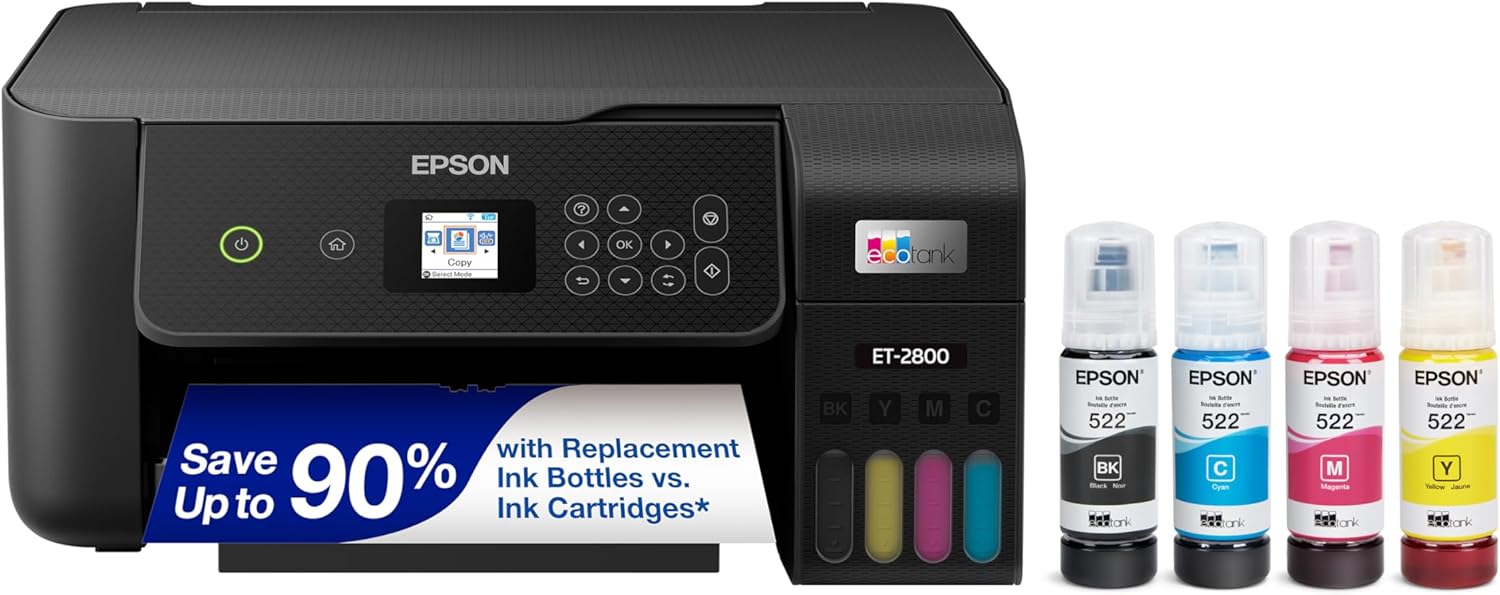
| Printer Type | Inkjet |
|---|---|
| Printer Connectivity Type | USB, Wi-Fi |
| Maximum print Resolution Color | 5760 x 1440 dpi |
| B&W Pages per Minute | 10 |
| Ink Color | Black, Cyan, Magenta, Yellow |
The Epson EcoTank ET-2800 is a wireless all-in-one inkjet that replaces cartridges with high-capacity refillable ink tanks, making it suited for families and busy home users who print regularly. It prints, copies and scans, offers USB and Wi‑Fi connectivity with app and voice-activated printing, and delivers up to 10 ISO pages per minute for faster document jobs. The high-resolution Micro Piezo print engine produces sharp text and good color photos up to 5760 x 1440 dpi, and the flatbed scanner covers typical home scanning needs. The bundled ink bottles are sized to reduce how often you refill and Epson estimates thousands of pages per set, which lowers ongoing ink cost and waste. Downsides are modest photo speed and no automatic duplexing, so two-sided jobs require manual flipping, and advanced office features like ADF or Ethernet are not included. For home users who prioritize low running costs and reliable everyday print quality, the ET-2800 is a practical pick.
Best for: Buyers who want low ongoing ink costs and dependable everyday print performance at home, and who value wireless mobile printing convenience.
Less Ideal for: Workgroups or small offices that need automatic duplexing, an ADF, or wired Ethernet networking for heavier multi-user workflows.
- Cartridge-free EcoTank refillable ink system greatly reduces frequency of ink replacement
- Wireless and app/voice printing for convenient mobile workflows
- High maximum print resolution for sharp text and detailed color prints
- Decent ISO print speed of up to 10 ppm for faster document output
- Includes starter ink bottles that yield many pages before refill
- No automatic duplex printing; manual two-sided printing required
- Lacks advanced office features such as ADF and Ethernet connectivity
Verdict: Choose the ET-2800 if you want a wireless home all-in-one that minimizes ink costs with refillable EcoTank tanks while delivering reliable, high-resolution everyday prints.
Canon PIXMA G3270 MegaTank

| Printer Type | Inkjet |
|---|---|
| Printer Connectivity Type | USB, Wi-Fi |
| Color Pages per Minute | 6 |
| B&W Pages per Minute | 11 |
| Maximum print Resolution Color | 4800 x 1200 dots_per_inch |
The Canon PIXMA G3270 MegaTank is a compact wireless all-in-one inkjet aimed at low-cost home and home-office printing. It uses refillable MegaTank ink bottles that the company rates for very high page yields, so routine running costs are much lower than cartridge-based machines. Setup is primarily wireless with app control and a small 1.35 inch LCD for basic status; typical use cases are everyday document printing, occasional photo prints and flatbed scanning. The rear paper path accepts a wide range of media sizes up to legal and a 100-sheet tray handles normal home volumes. Print speeds are modest—about 11 ipm for black and 6 ipm for color—while resolution and copy quality are strong for text and decent for photos. Duplexing is manual only and there is no automatic double-sided printing. The machine is energy efficient and includes the needed ink bottles and print heads in the box, but its footprint and single tray limit heavy multi-user office workflows.
Best for: Someone prioritizing low ongoing ink costs and reliable home printing who wants wireless convenience and decent scan/copy capability for household or small home-office use.
Less Ideal for: Users who need fast, high-volume duplex printing for a busy multi-user office should consider more robust business-class models instead.
- Built-in refillable MegaTank system with high-yield ink bottles included for low cost per page
- Wireless and app control for printing from smartphones and tablets
- Supports a wide range of media sizes including legal and borderless photo sizes
- Compact footprint with energy-efficient 16-watt power draw
- No automatic duplexing; only single-sided printing is supported
- Print speeds are modest, especially for color documents
Verdict: Choose the PIXMA G3270 if you want a compact wireless home all-in-one that dramatically reduces ink cost with refillable MegaTank bottles.
HP DeskJet 2955 All-in-One Printer

| Printer Type | HP Thermal Inkjet |
|---|---|
| Maximum Sheet Capacity | 60 |
| Scanner Type | Flatbed |
| Color Pages per Minute | 5.5 pages_per_minute |
| B&W Pages per Minute | 7.5 pages_per_minute |
The HP DeskJet 2955 is a compact, budget-focused all-in-one inkjet built for everyday home tasks like homework, letters, recipes, and occasional photos. It offers wireless printing via Wi‑Fi, AirPrint, and Mopria plus a USB port, and the HP app lets you print and scan from a phone. The 60-sheet input tray and flatbed scanner handle small batches and single-sheet scanning or copying, while print speeds are modest at up to 7.5 ppm black and 5.5 ppm color. HP includes a three-month trial of Instant Ink for low-cost cartridge delivery, and the printer supports HP 68 cartridges. Manual duplexing is supported through driver options but not automatic. The unit is lightweight and compact so it fits on a desk or shelf, and HP highlights AI formatting tools to trim unwanted web content before printing. Expect basic photo quality and slower performance for larger jobs, but for sporadic home printing needs this printer keeps setup and everyday use simple.
Best for: Buyers who want an inexpensive, space-saving all-in-one for occasional home printing, scanning, and copying and who prioritize easy mobile setup and low upfront cost.
Less Ideal for: Not a good choice for households that print large volumes regularly or need fast duplexing, heavy-duty photo output, or large paper capacity.
- Wireless printing with AirPrint and Mopria support for easy mobile printing
- Compact footprint and 60-sheet tray suitable for small home spaces
- Includes 3-month Instant Ink trial to reduce early ink costs
- Flatbed scanner and copying functions for basic document workflows
- Supports HP app for printing, scanning, and setup from a smartphone
- No automatic duplex printing; duplex is manual via driver
- Modest print speeds and limited paper capacity for higher-volume use
- Uses HP 68 cartridges which can become costly after the Instant Ink trial
Verdict: A compact, budget-friendly wireless all-in-one that makes simple home printing and mobile setup easy, especially for low-volume users.
HP LaserJet Pro MFP 3101sdw

| Printer Type | Laser |
|---|---|
| Maximum Print Resolution Black and White | Up to 1200 x 1200 dpi |
| B&W Pages per Minute | 40 |
| Maximum Sheet Capacity | 250 |
| Scanner Type | ADF, flatbed |
The HP LaserJet Pro MFP 3101sdw is a compact monochrome all‑in‑one laser designed for fast, reliable document workflows in a home office or small team setting. It prints, scans (ADF and flatbed), copies and supports automatic two‑sided printing, with a 250‑sheet input tray and a 50‑sheet auto document feeder to handle multi‑page jobs without constant refilling. Print speed is strong for the class, with up to 35–40 ppm and a first page in about seven seconds, so it keeps up with heavier print bursts. Connectivity covers Wi‑Fi, AirPrint, Mopria, Ethernet and USB, plus app control for mobile printing and remote management. Print quality is crisp at up to 1200 x 1200 dpi for text. Practical limitations include monochrome output only, so it is not suitable for color documents or photos, and the unit uses HP chip‑protected cartridges which restrict third‑party toner options. For buyers prioritizing dependable, high‑speed black‑and‑white printing in a wireless home office, this model is a sensible fit.
Best for: Buyers who want a dependable, business‑style monochrome MFP for a wireless home office or small team where fast, consistent document printing and scanning matter most.
Less Ideal for: Users who need color printing or photo-quality output or who prefer unrestricted third‑party toner compatibility should consider other models.
- Fast monochrome printing suitable for heavy document workloads
- Automatic duplex printing and a 50‑sheet ADF speed up multi‑page jobs
- Wide connectivity: Wi‑Fi, Ethernet, AirPrint, Mopria and USB for flexible placement and mobile printing
- 250‑sheet input tray reduces the need for frequent paper refills
- Prints only in black and white so no color output
- Cartridge requires HP chip‑protected toner which limits third‑party cartridge use
Verdict: Choose this HP LaserJet Pro MFP if you need fast, reliable monochrome printing and robust wireless connectivity for a busy home office.
Canon PIXMA TR4720

| Printer Type | Inkjet |
|---|---|
| Functions | Print, copy, scan, fax |
| Print Speed B&W | 8.8 pages_per_minute |
| Print Speed Color | 4.4 pages_per_minute |
| Connectivity | USB, Wi-Fi |
The Canon PIXMA TR4720 is a compact 4-in-1 wireless inkjet aimed at home users who need occasional document and photo printing plus basic scanning, copying and faxing. It prints text at about 8.8 ipm and color at about 4.4 ipm, supports automatic two-sided printing and has a 100-sheet front tray and an auto document feeder for multi-page jobs. The hybrid ink system is tuned for sharp black text and decent color photos up to 8.5 x 11 inches, and the printer works with the Canon Print app for mobile and cloud printing as well as standard USB and Wi-Fi connections. Setup and cartridge replacement are straightforward and a small 2-line LCD keeps controls simple. Important limits to note are modest photo and color speeds, basic display and control features, and consumer-grade duty suited for light to moderate home workloads rather than heavy office volumes. For buyers who prioritize easy mobile setup and compact 4-in-1 functionality, the TR4720 covers the essentials reliably.
Best for: Buyers who want a space-saving, easy-to-setup all‑in‑one for home use and mobile printing, with enough features for homework, household documents and occasional photos.
Less Ideal for: Users who need fast, high-volume color or professional photo printing or advanced touchscreen controls should consider more capable models.
- Wireless and mobile printing via Canon Print app plus USB connectivity
- Built-in auto document feeder and automatic duplex for multi-page workflows
- Compact footprint with a 100-sheet front paper tray for home spaces
- Hybrid ink system that produces sharp black text and borderless photos up to letter size
- Color/photo print speed and output are relatively slow compared with higher-end models
- Basic 2-line LCD and limited onboard controls for complex tasks
Verdict: A compact, easy-to-set-up wireless 4-in-1 that reliably handles everyday home printing, scanning and faxing needs.
Brother DCP-L2640DW Laser Printer

| Printer Type | Laser |
|---|---|
| Printer Output Type | Monochrome |
| Print Speed | 36 pages_per_minute |
| Auto Document Feeder | 50 pages |
| Paper Tray Capacity | 250 |
The Brother DCP-L2640DW is a compact black-and-white laser multifunction printer designed for home and small-office use. It handles printing, copying, and scanning in a small footprint while offering fast output up to 36 ppm and automatic duplex to save paper. The 250-sheet tray and 50-page automatic document feeder make batch jobs and multi-page scanning straightforward, and connectivity options include dual-band Wi-Fi, Ethernet, and USB so you can print from phones, tablets, or laptops. Brother Mobile Connect adds mobile control for remote printing and scan management, and Eco features like Toner Save Mode can reduce running costs. Expect sharp monochrome prints at up to 1200 x 1200 dpi for text and standard graphics, but remember this is strictly a black-and-white device so it will not produce color output. The unit ships with starter toner and works with Brother TN830/TN830XL cartridges; high-yield supplies and a toner subscription service are available to simplify reordering. For buyers who prioritize reliable, fast black-and-white printing and straightforward connectivity, this model is a practical choice.
Best for: Buyers who want a dependable, no-frills monochrome printer for steady home or small‑office document work and who value simple networking and straightforward upkeep.
Less Ideal for: Users who need color prints, photo-quality color scans, or an all-in-one device with fax capabilities should consider color inkjets or multifunction models with color support instead.
- Fast monochrome printing up to 36 ppm for quick document production
- 50-page auto document feeder speeds multi-page scanning and copying
- Dual-band Wi-Fi, Ethernet, and USB give flexible connection options
- 250-sheet input tray reduces how often you refill paper
- Supports high-resolution B/W printing up to 1200 x 1200 dpi for crisp text
- Monochrome only so no color printing or color scanning output
- Initial in-box toner is starter yield, requiring replacement sooner for heavy use
Verdict: A fast, reliable monochrome multifunction laser that delivers high-volume black-and-white prints with simple wireless and wired connectivity, ideal for risk-averse buyers seeking dependable home printing.
Choosing the Right Wireless Printer for Home: Key Factors to Consider
Connection Reliability
A stable wireless connection determines whether printing from laptops, phones, and tablets is seamless or frustrating. Home routers, network congestion, and printer firmware all affect whether jobs arrive quickly and without interruption. Printers that support both 2.4 GHz and 5 GHz bands and offer clear status reporting reduce failed jobs and retries.
Consider how often devices in your home switch between networks or use guest networks. If multiple household members print from mobile devices, look for printers with robust wireless handling and the ability to reconnect without repeated manual setup.
Print Quality for Everyday Tasks
Quality needs vary depending on whether you print mostly text, school worksheets, or occasional photos. Sharp black text requires consistent toner or ink deposition, while decent color photos benefit from broader color ranges and finer droplet control.
For a home environment, prioritize machines that produce crisp documents and passable color images without special photo paper. Extremely high-end photo fidelity is not necessary for most families and usually incurs higher running costs.
Setup and Ongoing Usability
The initial setup should be straightforward, ideally involving a guided app or web-based wizard that walks you through Wi-Fi and mobile printing configuration. Clear front-panel controls, an intuitive touchscreen, or a simple companion app reduces the time spent troubleshooting.
Ongoing usability includes how easily you replace cartridges or refill tanks, access jammed paper, and change settings. A model that requires minimal interaction and offers helpful error messages will save time for nontechnical users.
Paper Handling and Scanning Options
Home printers should accommodate the paper sizes and volumes you use most often. Features like a modest input tray capacity, duplex (two-sided) printing, and an automatic document feeder for multi-page scans or copies matter when dealing with homework, forms, and taxes.
If you scan receipts or multi-page documents regularly, an automatic document feeder speeds workflows. For occasional single-sheet jobs, a simpler flatbed scanner is often sufficient.
Consumables Cost and Availability
Long-term cost depends heavily on how ink or toner is priced and how many pages you can expect per cartridge or refill. Some home-focused printers use high-yield cartridges or refillable tanks to lower cost per page. Consider the typical monthly printing volume in your household and match that to the expected page yield.
Also check the ease of obtaining replacement cartridges or refills locally or through standard channels. Printers that use fragile or proprietary cartridges can increase total ownership hassle.
Maintenance and Reliability
Regular maintenance tasks include nozzle cleaning, firmware updates, and occasional alignment checks. A reliable printer minimizes service calls and can perform self-maintenance to keep print heads in working order. Features like replaceable maintenance kits, accessible paper paths, and clear maintenance instructions reduce downtime.
Homes with limited technical skills will benefit from models designed for low upkeep and with good documentation for common issues.
Home Wi‑Fi Setup Tips
To reduce connection issues, place the printer within a reasonable range of your router and avoid physical obstructions like thick walls or metal cabinets. If your home uses a dual-band router, test both 2.4 GHz and 5 GHz connections to see which provides the most stable link for printing.
Use the printer's setup wizard or manufacturer app to join the network rather than entering credentials via USB or older methods. If multiple family members need access, consider adding the printer to a shared family profile or enabling common mobile printing services that integrate with smartphones and tablets.
- Temporarily disable guest networks during initial setup if devices cannot see each other
- Assign a static IP or a DHCP reservation to reduce reconnect issues
- Keep firmware up to date to fix known wireless bugs
Balancing Photo Quality and Ink Cost
If you occasionally print photos, avoid using photo-high settings by default. Choose balanced or draft modes for routine prints and switch to higher-quality settings only when output matters. This practice conserves ink and extends cartridge life.
Consider using standard multipurpose paper for everyday color prints and reserve glossy photo paper for special images. Many home printers deliver acceptable photo results without expensive paper if you manage settings and expectations.
- Use the printer driver's color-management presets
- Preview before printing to crop and adjust brightness
- Print only required pages to save ink
Setting Up for Family Use
For households, prioritize printers with simple sharing options and clear error messages. A front-facing paper tray and easy cartridge access make it simpler for multiple people to reload paper or resolve jams. Look for models that support mobile printing natively so children and guests can print without complex steps.
Establish a basic maintenance routine such as a monthly test print and visual inspection of paper paths. Label replacement supplies and keep a spare cartridge or small ink bottle on hand if you print frequently.
- Enable user permissions if your router supports them
- Keep a quick-start note with Wi-Fi details near the printer
- Train family members on clearing simple paper jams safely
Optimizing for Home Office Tasks
Home offices often need reliable text quality, duplex printing, and decent scanning. Choose settings that favor legibility for multi-page documents and use automatic duplexing to save paper. If you scan receipts and invoices, a built-in ADF saves time compared with single-sheet flatbed scanning.
Digitize important documents regularly to avoid reprinting. Many printers include basic OCR or scanning-to-email features that streamline record keeping without additional software.
- Set default print mode to black-and-white for drafts
- Use duplex to halve paper usage on multi-page documents
- Regularly back up scanner profiles for consistent output
Environmental and Space Considerations
Measure the available shelf or desk space before choosing a model. Some wireless printers are compact but offer limited trays, while others are larger to accommodate higher paper capacity and ADFs. Consider where you will place the printer for easy access and adequate ventilation.
Energy consumption and consumables disposal matter for environmentally minded buyers. Look for energy-saving sleep modes and toner or ink recycling options to lower environmental impact over the device lifetime.
- Check closed and open dimensions to ensure fit
- Position near a power outlet and router
- Look for ENERGY STAR or similar energy-saving features
How We Chose the Best Wireless Printer for Home
We focused on attributes that most directly affect home users and everyday tasks. Our selection emphasized connection stability on home Wi-Fi networks, setup simplicity for nontechnical users, and consistent print quality for both text documents and casual photos. We also prioritized paper handling that fits typical household duties such as scanning, copying, and occasional double-sided printing. Other concrete filters included support for common home operating systems and mobile printing protocols, modest maintenance requirements, and reasonable page-yield expectations from standard cartridges or tank systems. We excluded specialized commercial office machines, heavy-duty photo-lab printers, and models that rely on proprietary, hard-to-find consumables. In short, we shortlisted devices that offer dependable wireless performance, clear everyday output, low-friction setup and upkeep, and practical paper handling for family and home office use. Those qualities shaped our scoring metrics and informed which printers made the list.
Our full evaluation process is outlined in our review methodology.
FAQ
Can I print from multiple phones and laptops over Wi‑Fi?
Yes. Most home wireless printers support multiple devices on the same network and modern mobile printing standards. Ensure each device is on the same Wi‑Fi band or network and that the printer has been added to that network once.
How do I reduce ink or toner costs at home?
Print in draft or economy mode for noncritical documents, use duplex printing to save paper, and choose high-yield cartridges or refillable tank systems when available. Regularly review printer settings to avoid unnecessary color prints.
Is a printer with an automatic document feeder necessary for home use?
It depends on your workflow. An ADF is helpful if you regularly scan or copy multi-page documents. For occasional single-sheet scans, a flatbed scanner is usually sufficient and keeps the machine smaller.
What causes frequent wireless disconnections and how do I fix them?
Disconnections are often caused by weak signal strength, router settings, or interference from other devices. Move the printer closer to the router, update firmware, and try switching between 2.4 GHz and 5 GHz to see which is more stable.
How often should I run maintenance tasks on a home printer?
A monthly quick test print and visual inspection of paper paths is usually enough for typical home use. If you print infrequently, run a nozzle check or cleaning cycle before important jobs to avoid clogged heads.
Final Verdict
When choosing a wireless printer for home, prioritize reliable Wi‑Fi connection, simple setup, and the print quality that matches the types of documents you produce most often. Balance consumables cost against expected monthly volume, and consider paper handling features like duplexing and an ADF if you regularly handle multi-page tasks. Focus on models that minimize maintenance and integrate with the devices your household uses. By weighing connectivity, output needs, and running costs, you can select a home printer that delivers dependable performance and low-friction operation for years of everyday use.