
Note: This article contains affiliate links. If you click on these links and make a purchase, we may earn a small commission at no extra cost to you. This helps support our research and content. Read our full affiliate disclosure here.
Choosing the right attic fan matters for home comfort, roof health, and cooling costs. An appropriately sized attic fan reduces peak temperatures, lowers strain on your cooling system, and helps limit moisture buildup that can shorten roof material life. This guide shortlists the top attic fans across common home situations and explains the practical tradeoffs. We evaluate each option for airflow, energy use, installation complexity, and durability so you can pick the right fan for your attic and climate. Read on for the top picks and the selection criteria used to build this list.
Top Picks at a Glance
| Best Overall The best all-around choice for most situations | Quietcool AFG SMT PRO-2.0 Attic Fan |  |
| Best Quality Built to a higher standard if you want something more solid | Master Flow WHFS24M Whole House Fan |  |
| Best Value The sweet spot between price and what you get | VEVOR 14 Inch Shutter Exhaust Fan |  |
| Best Budget The cheapest option that still gets the job done reliably | Amico 10" Shutter Exhaust Fan |  |
| Top Rated A top-rated pick with lots of positive feedback | QuietCool AFR PRO-1.3 Attic Fan |  |
| Most Popular A crowd favorite that many people choose with confidence | iLiving 10" Shutter Exhaust Fan ILG8SF10V-ST |  |
| Best Seller A high-volume bestseller chosen again and again | iLIVING ILG8G14-12T Attic Gable Fan |  |
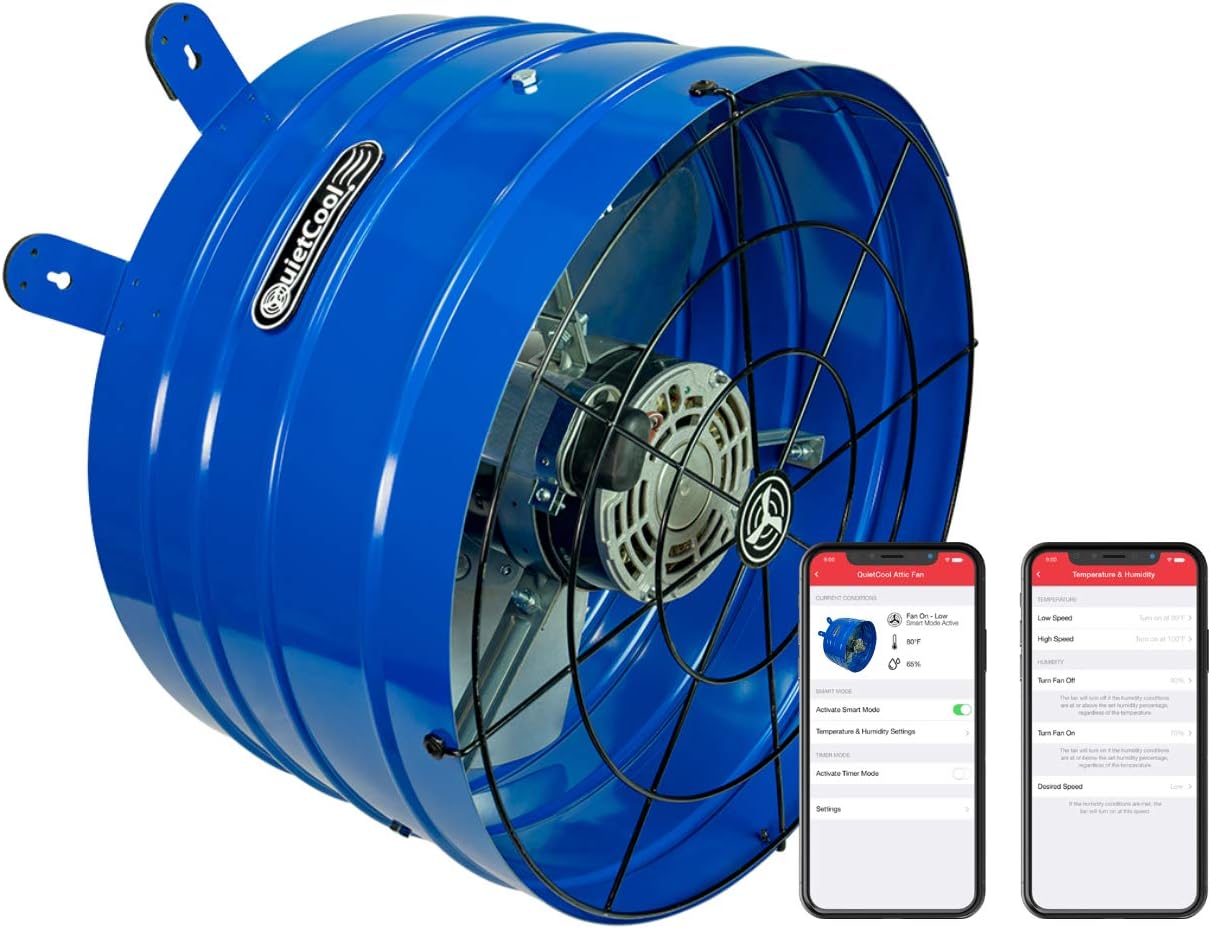
Quietcool AFG SMT PRO-2.0 Attic Fan
| Power Source | AC |
|---|---|
| Number of Speeds | 2 |
| Wattage | 120 watts |
| Air Flow Capacity | 1945 cfm |
| Control Method | App |
The Quietcool AFG SMT PRO-2.0 is a plug-and-play gable attic fan designed to push a lot of air while giving you remote control and automatic climate management. It mounts in a gable vent and includes a smart control hub so you can run the fan from the QuietCool app, set temperature and humidity presets, and monitor attic conditions. On high it moves up to 1,945 CFM at about 120 watts using a two-speed PSC motor, which is effective for lowering attic temperatures and reducing moisture buildup. The unit ships with vent covers and offers a built-in thermostat and humidistat for automated operation, plus a fire-safety shutoff. Practical downsides are its two-speed design instead of a fully variable motor and the need to size the fan to your attic for best results; it also requires a gable installation rather than roof mounting. For homeowners seeking strong ventilation with smart controls and easy installation, this model balances power and convenience without complicated wiring.
Best for: Buyers who want a powerful, app-controlled attic fan that simplifies climate management while avoiding hard wiring and complex setups.
Less Ideal for: If you need roof-mount installation, fully variable speed control, or an off-grid/solar solution, this gable-mounted smart fan is not the best choice.
- High airflow up to 1,945 CFM for substantial attic ventilation
- Smart app control with thermostat and humidistat for automated or remote operation
- Plug-and-play installation with included smart hub and vent covers
- Energy-efficient operation around 120 watts on high
- Built-in fire safety shutoff and two-speed PSC motor for reliable performance
- Only two fixed speeds rather than fully variable speed control
- Designed for gable mounting only, not roof mount
- Requires correct sizing for your attic to achieve claimed cooling benefits
Verdict: Pick this fan if you want strong gable-mounted attic ventilation with smart app controls and automatic temperature and humidity management.
Master Flow WHFS24M Whole House Fan

| Air Flow Capacity | 2920 cfm |
|---|---|
| Number of Speeds | 2 |
| Number of Blades | 3 |
| Motor Type | Permanent split-capacitor (direct drive) |
| Power Source | Hard Wired / 120 V |
The Master Flow WHFS24M is a ceiling-mounted whole house fan designed to ventilate living space by pulling attic air through a 24-inch three-blade assembly. It is normally installed between the living area and the attic with the included aluminum ceiling shutter and plenum boards; operation uses a two-speed pull-chain so you can choose higher airflow for fast cooling or lower speed for quieter continuous ventilation. The permanent split-capacitor direct drive motor is thermally protected and balanced for reduced vibration, which helps keep noise low relative to its airflow. The unit is preassembled and includes hardware and DIY instructions to simplify installation, though it requires sufficient attic exhaust (minimum 562 sq in NFA) and hard-wiring power. Practical benefits include strong airflow that can cool a mid-size house quickly and a shutter that seals when the fan is off to reduce backdrafts. Limitations are the basic pull-chain control with no remote or smart features and the need to plan attic ventilation and wiring during installation.
Best for: Buyers who prioritize strong, reliable airflow and mechanical simplicity to quickly ventilate or cool a mid-size home and who are comfortable planning attic venting and a hard-wired install.
Less Ideal for: People who want remote, app, or timed controls or those who cannot provide the required attic exhaust or hard-wiring access should consider other solutions.
- High airflow up to 2,920 CFM suitable for rapid whole-house ventilation
- Durable permanent split-capacitor direct drive motor with thermal protection
- Balanced aluminum blades and all-metal shroud for reduced vibration and quieter operation
- Includes ceiling shutter, plenum boards, and installation hardware for a mostly preassembled install
- Basic two-speed pull-chain control with no remote or smart integration
- Requires at least 562 sq in of attic exhaust and hard-wired power, which can complicate installation
Verdict: Choose this fan when you need high CFM, durable direct-drive performance for fast whole-house ventilation in a mid-size home.
VEVOR 14 Inch Shutter Exhaust Fan

| Air Flow Capacity | 2000 cfm |
|---|---|
| Number of Speeds | 10 |
| Wattage | 80 watts |
| Motor Type | brushless |
| Voltage | 120 volts |
The VEVOR 14 Inch Shutter Exhaust Fan is a heavy-duty wall-mounted ventilator designed to move large volumes of air from attics, garages, greenhouses, or sheds. It pairs a metal, shuttered housing with a brushless EC motor to deliver up to 2000 CFM while offering up to 10 speed settings and smart programming driven by temperature and humidity sensors. The included controller adds automatic modes, timers, and an alarm so the fan can run responsively without constant user input. In practice the fan is best used to cut heat and humidity quickly in enclosed utility spaces and to help continuous ventilation during hot months; the automatic shutter protects the opening when the unit is off. At 80 watts and a listed noise level near 68 dB it is relatively efficient for its output, though it will be audible at higher speeds. Installation is typical for wall-mounted attic fans and the all-metal construction and UL listing improve durability for exposed locations. If you need a high-flow, programmable attic or shop exhaust solution, this unit provides robust airflow and useful automation features, but expect noticeable noise when operating near maximum speed.
Best for: Buyers who want a powerful, no-nonsense attic or garage exhaust that automates ventilation based on temperature and humidity and prioritizes durable, long-running performance.
Less Ideal for: People seeking near-silent ventilation for living spaces or a fan that mounts in ceilings or duct runs should consider other quieter or differently configured options.
- High airflow capacity at 2000 CFM for rapid heat and humidity removal
- Smart controller with temperature and humidity triggers plus timer and alarm
- Durable all-metal construction with automatic shutter for weather protection
- Brushless EC motor delivers stable, efficient operation with multiple speed settings
- Noise level around 68 dB makes it noticeable at higher speeds
- Designed for wall mounting only, not suitable for ceiling or inline duct installations
Verdict: Choose this fan if you need a rugged, high-flow wall-mounted attic exhaust with automated temperature and humidity control to rapidly clear heat and moisture.
Amico 10" Shutter Exhaust Fan

| Air Flow Capacity | 1000 cfm |
|---|---|
| Wattage | 13 watts |
| Number of Speeds | 9 |
| Noise Level | 42 db |
| Installation Type | Plug-in |
The Amico 10" Shutter Exhaust Fan is a compact wall-mounted ventilator designed to move large volumes of air while using very little power. It pairs a 13W DC motor with aerodynamic blades to deliver about 1000 CFM at up to 2100 RPM, and a 9-speed remote plus 1–8 hour timer makes it simple to dial in airflow without touching a switch. The gravity louver shutter seals when off to keep out rain, dust, and drafts, and the plug-in installation plus included cutting template means you can mount it without hardwiring. In real use it suits garages, attics, greenhouses, workshops, and small barns where you need steady exhaust and low operating cost; the low noise spec (around 42 dB) keeps the fan from dominating the space. Important limits are its 10" size, which targets small to medium spaces, and the plug-in design may not fit installations that require permanent hardwired connections or in-wall thermostat integration. The unit comes with a remote and a three-year manufacturer promise for basic peace of mind.
Best for: Buyers who want a low-cost, energy-efficient attic or garage exhaust solution that is easy to install and simple to control with a remote.
Less Ideal for: Those needing ventilation for large attics or whole-house systems, or projects that require hardwired, code-compliant permanent wiring should look elsewhere.
- High airflow of approximately 1000 CFM for rapid exhaust in small to medium spaces
- Very low power draw via a 13W DC motor for energy savings
- 9-speed remote and 1–8 hour timer provide precise, hands-off control
- Gravity-operated shutter seals when off to block weather, insects, and drafts
- Plug-and-play installation with cutting template avoids specialized wiring work
- 10-inch size limits suitability to small or moderately sized attics rather than large spaces
- Plug-in design may not meet preferences for permanent hardwired installations
Verdict: If you need inexpensive, low-power attic ventilation that installs without wiring and delivers strong exhaust on a budget, this 10" Amico shutter fan is a practical buy.
QuietCool AFR PRO-1.3 Attic Fan

| Air Flow Capacity | 1266 cfm |
|---|---|
| Number of Speeds | 2 |
| Wattage | 120 watts |
| Control Method | App |
| Power Source | Corded Electric |
The QuietCool AFR PRO-1.3 is a roof‑mounted attic exhaust fan designed to lower attic temperature and humidity by moving large volumes of air. It installs into a roof opening and plugs in using the supplied 20‑ft power cord, and operation is set with the included adjustable thermostat or the simple push‑button control. The PSC motor provides two speeds with up to 1,266 CFM on high while drawing as little as 75.5 watts on low, so it balances airflow and energy use for continuous ventilation. Construction uses stamped alloy steel and a one‑piece perforated housing with UV resistant paint for weather durability, and a built‑in fire safety shutoff adds a safety layer. Practical limits include the need for correct sizing and roof flashing compatibility for proper performance and weather sealing, and it is a roof‑mount solution so it will not work where gable or soffit mounting is required. For buyers who prioritize steady, energy‑efficient attic ventilation and straightforward thermostat control, this is a reliable, purpose‑built option.
Best for: Buyers who want a durable, reliably engineered roof‑mount attic fan that provides steady ventilation and simple thermostat control to protect the attic and reduce cooling load.
Less Ideal for: Homes that cannot accommodate a roof‑mounted unit or buyers who need a gable or whole‑house fan solution should consider other mounting styles or product types.
- High airflow up to 1,266 CFM for effective attic ventilation
- Two‑speed PSC motor that offers energy‑efficient operation
- Includes adjustable thermostat and 20 ft power cord for easy setup and control
- Alloy steel one‑piece housing with UV resistant paint for durability
- Built‑in fire safety shutoff for added protection
- Requires proper roof flashing and cutout sizing for weatherproof installation
- Roof‑mount design limits use where gable or other mounts are needed
Verdict: A workmanlike roof‑mount attic fan that delivers high, energy‑efficient airflow and dependable thermostat control for buyers who prioritize long‑term reliability.
iLiving 10" Shutter Exhaust Fan ILG8SF10V-ST

| Air Flow Capacity | 820 cfm |
|---|---|
| Wattage | 65 watts |
| Number of Speeds | 3 |
| Noise Level | 65 db |
| Motor Type | Brushless |
The iLIVING ILG8SF10V-ST is a wall-mounted shutter exhaust fan built to move a lot of air in utility spaces while offering automatic temperature-based control. It delivers up to 820 CFM from a 10-inch aluminum-blade assembly driven by a permanently lubricated brushless motor and includes a Thermospeed controller that manages three speeds and can cycle the fan on and off at a set temperature. Automatic shutters close when the fan is off to block pests and weather, and the galvanized steel housing, OSHA-compliant guards, and UL listing make it suitable for garages, workshops, greenhouses, and attics. Installation requires hardwiring but the fan ships preassembled and the controller provides straightforward push-button operation; noise is rated around 65 dB so it is audible in quieter rooms. The unit is focused on raw airflow and durability rather than silent operation or integrated smart features, and professional wiring may be preferred for safe installation in household electrical systems.
Best for: Buyers who prioritize proven performance and robust ventilation for attics, garages, greenhouses, or workshops and want a controller that automates temperature-based ventilation.
Less Ideal for: If you need an ultra-quiet fan for living areas, a plug-in unit, or smart-home integration, this industrial-style shutter fan is not the best fit.
- High airflow capacity at 820 CFM for rapid air exchange in large spaces
- Thermospeed controller for temperature-based auto on/off and three-speed control
- Durable construction with galvanized steel frame, aluminum blades, and OSHA-compliant guards
- Automatic shutter prevents pests and backdrafts when fan is off
- Permanently lubricated, brushless motor reduces maintenance needs
- Noise level around 65 dB can be noticeable in nearby living spaces
- Requires hardwired electrical installation rather than simple plug-and-play
Verdict: Choose this fan when you need a high‑CFM, durable shutter exhaust with temperature control to reliably ventilate attics and utility spaces.
iLIVING ILG8G14-12T Attic Gable Fan

| Air Flow Capacity | 2339 cfm |
|---|---|
| Motor Type | Brushless |
| Wattage | 230 watts |
| Noise Level | 63 db |
| Voltage | 120 volts |
The iLIVING ILG8G14-12T is a hardwired gable-mount attic fan designed to pull hot attic air out automatically once the built-in thermostat reaches its set point. It uses a 14-inch steel propeller and a thermally protected, permanently lubricated brushless motor to deliver up to 2339 CFM at a single speed, which the manufacturer says covers roughly 3400 square feet of attic space. Typical installation places the unit behind a gable shutter (shutter sold separately) using the included mounting brackets and cutout guide, and electrical hardwiring is required. Practical benefits include strong, continuous ventilation that can shorten air-conditioner run time and a simple automatic thermostat that removes the need for on/off switching. Trade-offs are its single-speed operation and 63 dB noise level, so it is louder and less flexible than variable-speed models and needs careful placement to avoid noise transfer into living spaces. The galvanized steel housing and ETL listing give the unit a durable, safety-certified feel for long-term use.
Best for: Buyers who want a straightforward, safety-certified attic ventilation solution that runs automatically and prioritizes reliable performance over advanced controls.
Less Ideal for: Those who need quiet operation, variable-speed control, or a plug-and-play fan that does not require hardwiring should consider alternatives.
- High airflow capacity rated at 2339 CFM for effective attic ventilation
- Built-in adjustable thermostat enables automatic on/off based on attic temperature
- Galvanized steel housing and thermally protected motor improve durability
- Brushless motor with permanent lubrication reduces routine maintenance
- Single-speed design limits control over airflow and efficiency
- Rated noise around 63 dB may be noticeable inside or near living areas
Verdict: Choose this fan if you want a durable, automatic gable-mounted unit that delivers high airflow and dependable temperature-controlled ventilation.
Choosing the Right Attic Fan: Key Factors to Consider
Attic Size and Required Airflow
Calculating attic volume and required ventilation rate is the first step when picking an attic fan. A fan with insufficient cubic feet per minute will not properly lower attic temperature or control humidity, while one that is oversized can short-cycle controls and waste energy.
Most homeowners should match fan capacity to the attic square footage and roof pitch. Consider whether attic insulation or interior airflow restrictions limit effective ventilation; these will change the practical CFM you need and may call for multiple smaller fans rather than a single large unit.
Type of Mounting and Roof Impact
Attic fans come in roof-mounted, gable-mounted, or inline configurations, and the mounting type influences installation complexity and potential roof penetrations. Roof-mounted fans require careful flashing and sealing to avoid leaks, while gable-mounted options can be easier to service but may have lower extraction efficiency depending on attic layout.
Think about access for future maintenance and how the mount will interact with existing vents, ridge vents, or soffit intake. The mounting approach also affects weather exposure and the need for corrosion-resistant materials.
Power Source and Wiring
Attic fans can be hardwired to the electrical panel, controlled by thermostats or humidistats, or run on alternative power like solar. Hardwiring offers reliable performance but may require a professional electrician and permits. Solar models reduce operating cost and simplify wiring but depend on panel placement and available sunlight.
Evaluate whether you want automatic temperature/humidity control, manual switches, or integration with a home automation system. The type of control affects wiring complexity and the everyday convenience of the fan.
Noise and Vibration
Noise matters if the attic is over living spaces or if you use the attic for storage or a living area. Fans with poorly balanced blades or exposed motors can transmit vibration and audible noise into rooms below. Look for units with sound-dampening mounts, sealed motors, or specifications listing decibel output at a known distance.
Consider also the perceived noise during startup and steady operation and whether intermittent cycling from a thermostat will be disruptive. Proper mounting and anti-vibration hardware are part of achieving quiet performance.
Durability and Weather Protection
Attic fans face temperature extremes, moisture, and airborne debris. Materials and coatings that resist corrosion, sealed bearings, and weatherproof housings extend service life and reduce maintenance needs. Motors rated for outdoor exposure and guards to prevent animal intrusion are practical features for long-term durability.
Check the expected serviceability of moving parts and the availability of replaceable components. A design that allows straightforward motor or blade replacement can save time and expense down the line.
Control Features and Automation
Built-in thermostats, humidistats, and multi-stage controls make it easier to maintain consistent attic conditions without manual intervention. Smart or programmable controls can optimize runtime based on temperature, humidity, or time of day to reduce unnecessary energy use.
Consider whether you need simple on/off thermostatic control or more advanced automation that ties into home systems. Controls impact both comfort outcomes and operating cost over the life of the fan.
Sizing Your Attic Fan Correctly
Match fan capacity to attic volume rather than just floor area. Multiply attic square footage by average ceiling height to estimate cubic feet, then use recommended air changes per hour to determine needed CFM. This ensures the fan can cycle the attic air fast enough to manage heat and moisture.
When an attic has restricted intake vents or complex geometry, divide the space and consider two smaller fans instead of one large unit. Multiple fans can offer better distribution, redundancy, and easier installation in tight rafters.
- Estimate attic cubic feet: area × average height
- Use recommended air changes per hour to compute CFM
- Factor intake vent area—insufficient intake limits extraction
- Consider multiple fans for uneven or compartmentalized attics
Thermostat Vs Humidistat Controls
Thermostats activate fans based on temperature, which is ideal for reducing peak heat in summer. Humidistats run fans when moisture rises, which helps prevent condensation and mold in cooler months. Many homeowners benefit from units that include both sensors or allow adding a separate humidistat.
Placement of sensors matters. For reliable cycling, install the thermostat away from direct sun or local heat sources and in a position representative of average attic conditions, not right beside the fan.
- Thermostatic control targets temperature spikes
- Humidistats prevent moisture buildup
- Combined controls improve year-round performance
- Sensor location affects cycling accuracy
Solar-Powered Attic Fans: Pros and Cons
Solar-powered attic fans avoid additional electrical wiring and cut operating costs by using roof-mounted panels. They are especially attractive for modestly sized attics in sunny climates and for retrofit projects where running new wiring is difficult.
However, solar models depend on sun availability and may underperform on cloudy days or at peak late-afternoon heat if panels are not optimally oriented. Evaluate expected solar output, battery-assist options if present, and whether the solar system provides sufficient runtime during the hottest hours.
- No additional home wiring required
- Low operating cost in sunny climates
- Performance varies with solar exposure
- May need backup power for consistent operation
Maintenance Tips to Prolong Service Life
Regular inspection keeps an attic fan running reliably. Clean debris from screens and inlets, inspect flashing and seals for integrity, and check blade balance and motor bearings per the manufacturer maintenance schedule.
Seasonal checks are useful: verify control calibration before summer, ensure louvers close in cold weather if applicable, and replace worn mounting hardware to prevent vibration-related damage.
- Clean vent screens and housings annually
- Inspect and reseal roof flashing if needed
- Lubricate or check bearings per instructions
- Verify thermostat and humidistat operation seasonally
Permits, Codes, and Roof Work Considerations
Installing a roof-penetrating fan may require a permit and must follow local building codes for ventilation and flashing. Some jurisdictions have specific requirements about net free vent area or the ratio of intake to exhaust that affect allowable fan size and placement.
If you are not comfortable cutting roof openings or working on a pitched roof, plan for professional installation. Improper flashing or sealant use is a common source of leaks and roof damage.
- Check local permit requirements before installation
- Follow code rules for intake-exhaust balance
- Proper flashing and sealing prevents leaks
- Hire a pro for unfamiliar roof work to protect the roof
How We Chose the Best Attic Fan
We focused on attributes that matter for reliable attic ventilation and everyday homeowner experience. Key evaluation criteria included measured airflow capacity relative to attic size, motor efficiency and power draw, durability and weather resistance for long outdoor service, and the typical ease and time required for roof or gable installation. Noise level under load and effective thermostatic or humidistat controls were also considered because they affect comfort and automated operation. We excluded units intended only for crawlspaces, indoor whole-house ventilation, or decorative roof vents that do not provide powered attic extraction. We prioritized fans whose published specs match common attic volumes and climates and favored products with proven component build such as corrosion-resistant housings and sealed motor designs. Finally, we screened for straightforward mounting approaches and clear control options to minimize the need for major roof modifications or complex wiring.
Our full evaluation process is outlined in our review methodology.
FAQ
How big an attic fan do I need for my house?
Size the fan by attic cubic feet and recommended air changes per hour. Calculate area × average height to get volume, then select a fan with sufficient CFM to meet your ventilation target. Intake vent area and attic layout also affect effective sizing.
Can an attic fan reduce my cooling bills?
An appropriately sized and controlled attic fan can lower peak attic temperatures and reduce heat transfer into living spaces, which may reduce cooling load. Savings depend on attic insulation, climate, and how well the fan is matched to the attic.
Are solar attic fans worth it?
Solar fans avoid running new electrical wiring and can be cost-effective in sunny locations. Their performance depends on panel placement and available sunlight, so they work best where peak sun aligns with peak attic heat.
Will an attic fan cause drafts or pull conditioned air from the house?
Properly functioning attic ventilation relies on adequate intake vents. If intake is insufficient, an attic fan can pull conditioned air through ceiling penetrations. Ensure soffit or intake vents are clear and sized to match exhaust capacity.
How noisy are attic fans and can they be quiet enough?
Noise varies by design. Look for fans with balanced blades, enclosed motors, and anti-vibration mounts for quieter operation. Placement and proper mounting significantly reduce transmitted noise into living spaces.
Do attic fans need winter protection?
Yes. In colder climates, ensure louvers or dampers close to prevent cold air infiltration and heat loss when the fan is not running. Some models include automatic shutters; otherwise, seasonal maintenance should include verifying closure mechanisms.
Final Verdict
Choose an attic fan by matching its airflow capacity to your attic volume, ensuring intake vents are adequate, and selecting controls suited to your climate. Balance energy use, noise, and installation complexity when weighing options. Prioritize durable weather-resistant construction and a mounting approach that preserves roof integrity. With the right sizing and reliable controls, an attic fan can lower attic temperatures and reduce strain on your cooling system while providing long-term protection for roof materials.