
Note: This article contains affiliate links. If you click on these links and make a purchase, we may earn a small commission at no extra cost to you. This helps support our research and content. Read our full affiliate disclosure here.
A quiet fan can make the difference between a restful night and constant background distraction. Whether you need a bedside unit for sleeping, a desk fan for focused work, or whole-room circulation without the hum, picking a low-noise option matters. This guide shortlists the top quiet fans built for whisper-quiet operation while still delivering meaningful airflow and sensible controls. Below you will find our top picks, each chosen for measurable noise performance, airflow, and ease of use. Read on for the criteria we used and practical advice to help you pick the best quiet fan for your space.
Top Picks at a Glance
| Best Overall The best all-around choice for most situations | PELONIS 40-Inch Tower Fan PFT40A4AGB |  |
| Best Quality Built to a higher standard if you want something more solid | DREO TurboPoly Pedestal Fan DR-HPF008S |  |
| Best Value The sweet spot between price and what you get | Levoit Classic 36-inch Tower Fan |  |
| Best Budget The cheapest option that still gets the job done reliably | Honeywell TurboForce HT-900 |  |
| Most Popular A crowd favorite that many people choose with confidence | DREO Tower Fan 307 |  |
PELONIS 40-Inch Tower Fan PFT40A4AGB

| Power Source | Corded Electric |
|---|---|
| Number of Speeds | 3 |
| Noise Level | 27 db |
| Wattage | 50 watts |
| Oscillation | 90° |
The PELONIS 40-inch tower fan is a straight‑forward standing fan designed to move air across a room quietly and with remote convenience. It offers three speed levels and multiple airflow modes (Normal, Natural, Sleep) plus a 15‑hour timer and 90° oscillation to spread air through bedrooms or living spaces. Controls are available on a top panel with LED indicators and via the included remote for adjustments from across the room. The fan runs on a brushless motor and lists a low noise figure, making it suitable for overnight use or home offices. Practical benefits include easy freestanding placement, a modest 50W power draw, and a 6‑meter effective range that should cover medium rooms. Limitations are its basic three‑speed design if you want fine-grained control, and the plastic construction may feel less premium than metal alternatives; also some spec fields list different noise or wattage numbers so expect modest variation in reported performance. Setup is simple since it arrives mostly assembled and only needs the cord connected.
Best for: Buyers who want a quiet, easy-to-use tower fan for bedrooms or home offices and prioritize simple remote control and even room circulation.
Less Ideal for: If you need highly adjustable airflow, very high CFM for large open spaces, or a metal build for heavier-duty use, consider a more powerful or feature-rich alternative.
- Quiet operation suitable for bedrooms and offices
- Remote control with visible LED display for easy adjustments
- 90° oscillation and timer for even room coverage and scheduled runtime
- Brushless motor for efficient, low-maintenance operation
- Only three speed settings limit precise airflow tuning
- Plastic construction feels less premium than metal models
Verdict: A quiet, user-friendly tower fan that delivers reliable bedroom and small-room cooling with remote control and simple controls.
DREO TurboPoly Pedestal Fan DR-HPF008S

| Power Source | dc |
|---|---|
| Number of Speeds | 9 |
| Noise Level | 28.2 db |
| Wattage | 24 watts |
| Air Flow Capacity | 1000 cfm |
The DREO TurboPoly pedestal fan is a smart, performance-focused floor fan built around a quiet DC motor and extensive control options. It delivers strong airflow — rated up to 1000 CFM and effective to roughly 100 ft — and offers nine speeds plus six modes (including an automatic mode that adjusts to temperature), so you can dial in steady, powerful circulation for a bedroom or living area. The unit supports simultaneous horizontal and vertical oscillation and an adjustable pedestal for targeted or whole-room coverage, and you can operate it via the included remote, touch controls, the DREO app, or voice assistants. Practical benefits include an energy-efficient 24 W DC motor that runs quietly (reported noise in the high 20 dB range), an easy-to-clean plastic housing, an 8 hour timer and RGB LED illumination for nighttime use. The main compromises are the plastic construction and larger footprint typical of pedestal fans, and advanced smart features require app setup and Wi-Fi to access remotely. For someone prioritizing quiet, strong airflow with smart controls, this fan balances power and low noise well.
Best for: Buyers who want a powerful but quiet fan with flexible controls and smart features to deliver consistent whole-room airflow without drawing attention.
Less Ideal for: People who prefer a minimalist, non-smart fan or a metal industrial-style unit for heavy-duty outdoor use should consider other options.
- High airflow up to 1000 CFM for whole-room circulation
- Quiet, energy-efficient DC motor with reported low decibel operation
- Nine speeds, six modes and Auto Mode for adaptable performance
- Multiple control methods: app, remote, touch, and voice
- 3D oscillation (horizontal and vertical) and adjustable pedestal for targeted coverage
- Plastic construction may feel less premium than metal alternatives
- Smart features require Wi-Fi and app setup for full functionality
Verdict: Choose this fan if you want a high-airflow, low-noise pedestal fan with smart app and voice control for flexible, whole-room circulation.
Levoit Classic 36-inch Tower Fan

| Number of Speeds | 5 |
|---|---|
| Noise Level | 28 db |
| Wattage | 39 watts |
| Air Flow Capacity | 1044 cfm |
| Power Source | Corded Electric |
The Levoit Classic 36-inch Tower Fan is a floor-mounted, bladeless-style fan built for steady, low-noise air circulation in bedrooms and living spaces. It offers five speeds and four modes — Normal, Turbo, Sleep and Auto — plus a built-in temperature sensor that adjusts fan speed automatically to match room conditions. The unit oscillates to move air across a wide area and delivers strong airflow (listed at 1044 cfm) while drawing modest power from its AC motor. Controls are available on the touchpad and with the included remote, and a 12-hour timer and dimmable LED make it convenient for night use. Practical features like a removable rear grille simplify cleaning. On the downside the design is plastic and fairly tall, so it needs a stable floor spot and occasional dusting, and advanced smart integrations are not included. For buyers prioritizing quiet performance and simple automated cooling, this fan balances power and low noise in a compact footprint.
Best for: Buyers who want a quiet, no-fuss bedroom or living-room fan that provides automatic temperature-based speed control and simple remote operation.
Less Ideal for: People seeking metal-bodied, heavy-duty industrial fans or integrated smart-home control should look elsewhere.
- Five speeds and four modes including Auto and Sleep for flexible, automated comfort
- Built-in temperature sensor that adjusts airflow for consistent room comfort
- Near-silent operation on low settings suitable for bedrooms
- Remote and touchpad controls plus a 12-hour timer for convenient use
- Removable back grille for easier cleaning
- Plastic construction may feel less premium than metal alternatives
- No smart home connectivity for voice or app control
Verdict: A quiet, automated tower fan that delivers strong whole-room airflow and easy remote control for people who prioritize low-noise, practical cooling.
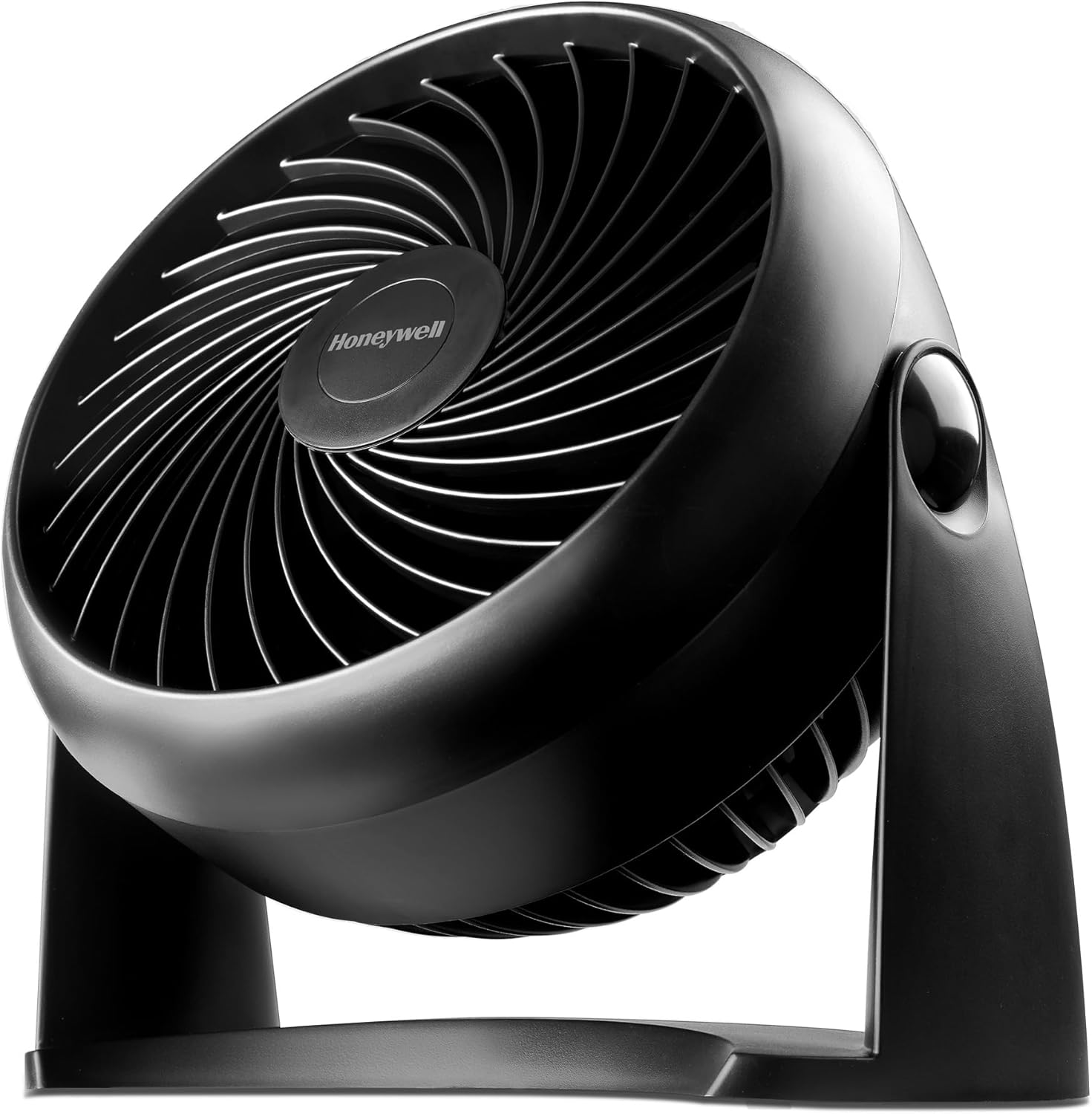
Honeywell TurboForce HT-900
| Power Source | Corded Electric |
|---|---|
| Number of Speeds | 3 |
| Air Flow Capacity | 185 cfm |
| Motor Type | brushless |
| Installation Type | Tabletop or Wall Mount |
The Honeywell TurboForce HT-900 is a small, no-frills tabletop fan built to move air efficiently while staying relatively quiet. It has an aerodynamic turbo blade design and a brushless motor that delivers up to 185 cfm across three speeds, and the 90-degree pivoting head makes it easy to aim airflow where you need it. Typical use is on a desk, bedside table, or mounted on a wall to boost circulation or supplement air conditioning in small to medium rooms. Controls are simple push buttons and the fan runs on a standard NEMA plug, so setup is plug-and-play. Practical benefits include noticeable airflow for its size, a lightweight portable body, and claimed low noise levels that make it suitable for bedrooms or home offices. Limitations are its basic feature set — there is no remote, timer, or oscillation, and the plastic construction shows in the feel and long-term durability compared with higher-end models. For buyers who want quiet, focused airflow on a budget, it delivers solid performance without extras.
Best for: Buyers who want an affordable, quiet personal fan to cool a desk, bedside, or small room without extra features and prefer straightforward plug-and-play operation.
Less Ideal for: People who need wide-area oscillation, programmable timers, smart controls, or a premium build should consider a different model.
- Compact and portable for tabletop or wall mounting
- Aerodynamic turbo blade design provides strong airflow for its size
- Three simple speed settings for easy control
- Brushless motor and low reported noise make it suitable for bedrooms and offices
- No oscillation or remote control
- Basic plastic construction that feels less durable than premium fans
Verdict: A budget-friendly, quiet personal fan that delivers strong focused airflow for small rooms without unnecessary bells and whistles.
DREO Tower Fan 307

| Number of Speeds | 8 |
|---|---|
| Modes | Normal, Natural, Sleep, Auto |
| Oscillation | 90° |
| Wattage | 36 watts |
| Motor Type | brushless DC motor |
The DREO Tower Fan 307 is a compact 36-inch oscillating floor fan built around an upgraded brushless DC motor that pushes strong airflow while keeping noise low. It offers eight speed settings and four modes including Normal, Natural, Sleep, and Auto, so you can dial in anything from a gentle bedroom breeze to a higher-velocity boost; the unit supports remote and touchpad control for easy adjustments. With 90 degree oscillation and a claimed airflow capacity for broad room coverage, it pairs well with an air conditioner to circulate cool air more effectively. Practical touches include a timer, removable rear grille and impeller for easier cleaning, and ETL safety certification. On the downside the fan runs on standard corded power and lists voltage at 240 volts which may matter for some regions, and the plastic construction means it is lightweight but less premium-feeling than metal alternatives. For buyers focused on quiet, adjustable oscillating cooling in bedrooms or living rooms, this model balances airflow and low noise in a small footprint.
Best for: Buyers who want a quiet, adjustable tower fan that delivers wide oscillating coverage and easy remote control for bedrooms and living spaces backed by strong customer feedback.
Less Ideal for: People seeking a heavy-duty, industrial-strength fan or a premium metal build should consider sturdier floor or bladeless alternatives.
- Brushless DC motor for efficient, high-velocity airflow with lower noise
- Eight speed levels and four modes for flexible comfort settings
- 90° oscillation spreads air across a wide area for better room coverage
- Includes remote and touch controls plus a timer for convenient operation
- Removable rear grille and impeller simplify cleaning and maintenance
- Plastic construction feels less durable compared with metal fans
- Corded operation and listed voltage may limit regional compatibility
Verdict: A feature-rich, quiet oscillating tower fan that gives flexible speeds and modes for effective bedroom and living-room cooling.
Choosing the Right Quiet Fan: Key Factors to Consider
Noise Level and Frequency Profile
How loud a fan is at each speed setting is the single most important factor for buyers seeking quiet operation. Look for measured decibel ratings or user reports at low and medium speeds, and be mindful that two fans with similar dB numbers can sound different because of frequency content. Low-frequency rumble is more noticeable and more likely to disturb sleep, while higher-frequency whine can be annoying during focused tasks.
Consider the environment where the fan will run most of the time. Bedrooms benefit from fans that keep steady, low noise at night and offer a silent or near-silent sleep mode, while office use may tolerate a slightly higher sound floor if airflow and directional control are superior.
Airflow Performance and Coverage
Airflow efficiency determines how effectively a quiet fan moves air through a room. Specification sheets often list cubic feet per minute or comparable airflow metrics; higher numbers generally mean faster cooling but can come with more noise. For quiet fans, balance is key: look for models that produce strong airflow at lower RPMs or that focus and direct air so you feel the effect without needing top speed.
Room size and placement change how much airflow you need. A bedside or desk fan aimed at a person needs less total room CFM than a unit intended to circulate air in a medium-sized bedroom. Think about whether you need oscillation to spread airflow or concentrated directional flow for personal cooling.
Control Options and Ease of Use
Accessible and flexible controls help you run the fan quietly when you want. Variable speed settings are essential; many quiet fans include finely stepped or continuously variable controls that let you find the lowest comfortable setting. Timers, sleep modes that gradually reduce speed, and remote or app controls add convenience and reduce the need to interact with noisy controls.
Intuitive controls also reduce frustration during use. Look for clear labeling, tactile buttons or quiet touch-capacitive panels, and memory functions that recall your preferred quiet setting after power cycles.
Physical Size, Design, and Placement
The fan's size and design affect both noise and effectiveness. Larger blades turning slowly often move more air with less noise than small high-speed blades. Tower and bladeless designs can reduce perceived noise by smoothing airflow, while compact desk fans are better for localized cooling but may be louder at equivalent output.
Consider how and where you will place the fan. Units with narrow footprints are good for small bedrooms or desks, while taller or pedestal models are better for whole-room circulation. Weight and stability matter if you will move the fan frequently or place it on uneven surfaces.
Energy Use and Long-Term Cost
Energy-efficient operation matters for fans that run many hours per day. Look for fans with low wattage at typical quiet settings so you can run them overnight without large energy consumption. Brushless DC motors are often more efficient and quieter than older motor types, and some models include eco modes that limit power draw while maintaining gentle airflow.
Long-term costs also include maintenance and potential part replacements. Fans with accessible grilles and brushless motors tend to require less upkeep and remain quieter over time, so factor expected operating hours into your decision.
Which Room Types Benefit Most From a Quiet Fan
Bedrooms and nurseries are the primary spaces where low-noise performance matters most. A fan that keeps a steady low-volume breeze can mask ambient noise and help with sleep without producing distracting mechanical sounds. Shared spaces like open-plan offices will also value fans that provide personal cooling without drawing attention.
Smaller rooms usually need less raw airflow, so a compact quiet fan can be sufficient. Larger rooms or rooms with poor ventilation may require a higher airflow unit or strategic placement near doorways to encourage circulation.
- Bedrooms: prioritize very low decibels and steady airflow.
- Home offices: balance quiet with directional control to cool a seated area.
- Living rooms: consider oscillation and coverage more than absolute quiet.
Placement Tips to Maximize Quiet Cooling
Placement affects both perceived noise and cooling effectiveness. Raise fans slightly above mattress or desk level for better airflow across the occupant rather than down into bedding, which can create turbulence and noise. Pointing a fan toward a wall or corner can circulate air gently while reducing the sensation of direct wind.
Avoid placing a fan on unstable surfaces where vibration can amplify noise. Use rubber feet or a small pad to dampen contact and check for loose grilles or fasteners that might rattle at certain speeds.
- Elevate for circulation: place on a stable stand or shelf.
- Dampen vibration: use rubber pads under the base.
- Aim for airflow path: point toward openings to promote cross-ventilation.
Maintenance to Keep a Quiet Fan Quiet
Regular cleaning and basic upkeep preserve low-noise operation. Dust buildup on blades or inside housings creates imbalance and forces the motor to work harder, which raises noise. Clean accessible grilles and blades on a schedule appropriate to your environment, and follow manufacturer guidance for deeper cleaning if panels or screens need removal.
Check for loose screws and worn mounting points that can introduce new vibrations. If a fan develops a new rattle or increased hum, inspect and tighten fasteners before assuming a motor fault. Lubrication of designated motor bearings can reduce noise in some designs, but only use recommended products and procedures to avoid damage.
- Dust blades and grilles monthly in dusty environments.
- Tighten fasteners if you notice new vibration.
- Follow motor maintenance guidance from the manual.
Design Tradeoffs: Bladed, Bladeless, and Tower Options
Different form factors offer distinct advantages for quiet fans. Traditional bladed fans can move a lot of air for the size and often use larger blades at lower speeds to reduce noise. Tower and bladeless designs smooth airflow and reduce perceived turbulence, though they may be less effective at pushing concentrated air over distance.
Consider the tradeoff between focused cooling and broad air circulation. Personal fans deliver a strong stream to a single spot while many tower units focus on distributing gentler airflow across a wider area. Choose the form factor that matches how you intend to use the fan.
- Bladed: strong directional airflow, good for desks and sleepers who want a breeze.
- Tower: broad distribution and compact footprint for living spaces.
- Bladeless: smooth airflow and reduced noise perception for continuous overnight use.
When to Choose Energy-Efficient Motor Types
Motor type influences both noise and running cost. Brushless DC motors typically run cooler, draw less power, and produce less mechanical noise than older AC motors. They also often allow finer speed control, which helps you find a comfortable, quiet setting without sacrificing airflow.
If you expect to run a fan nightly or for many hours, target models with lower wattage at typical settings and features like sleep modes or eco settings that reduce speed after an initial period. This approach keeps noise down while minimizing energy use.
- Brushless motors for quiet, efficient operation.
- Eco or sleep modes reduce power draw and noise overnight.
- Check wattage at typical operating speeds rather than only maximum ratings.
How We Chose the Best Quiet Fan
We prioritized measurable noise performance, airflow effectiveness, and user convenience when selecting quiet fans. Rated units had to offer documented decibel levels at typical settings or consistent user reports that match objective measurements. Airflow was evaluated by cubic feet per minute or equivalent manufacturer airflow data where available, plus real-world efficacy for cooling a bedroom or office. We also considered control options and usability features that matter in daily use: variable speeds, oscillation modes, and timer or sleep functions. Build quality and footprint were important for placement flexibility and longevity. Energy use at normal operating speeds was another filter to favor efficient designs that run quietly without excessive power draw. Excluded from consideration were noisy high-power circulation fans and novelty units that prioritize looks over thermal performance. We did not include units lacking verifiable noise or airflow information. The resulting selections balance low noise, useful airflow, and practical controls to suit sleeping areas, workspaces, and shared rooms.
Our full evaluation process is outlined in our review methodology.
FAQ
How many decibels is considered quiet for a fan?
Quiet fans typically operate around 30 to 40 dB at low to medium speeds. Below 30 dB is very quiet and suitable for light sleepers, while 40 dB may be acceptable in living spaces. Remember that frequency and tone can affect perceived loudness.
Will a quiet fan actually cool a room or just move air?
Fans do not lower room temperature but increase perceived cooling by moving air across skin. A quiet fan with efficient airflow can feel as effective as a louder unit if it directs air properly and maintains steady flow.
Are bladeless fans quieter than bladed fans?
Bladeless designs often reduce perceived turbulence and can seem quieter, but actual noise depends on motor and airflow design. Some bladed fans with large slow-turning blades can be very quiet as well.
How should I place a quiet fan in a bedroom for best results?
Place the fan slightly elevated and aimed across the bed rather than directly at pillows to reduce turbulence. Use a gentle oscillation or steady low setting so the breeze is consistent and not distracting while you sleep.
Does motor type affect maintenance or lifespan?
Yes. Brushless motors generally need less maintenance and tend to run cooler and longer. Older motor types may require occasional lubrication or more frequent attention to keep noise low.
Final Verdict
Prioritize measured noise performance and airflow efficiency when choosing a quiet fan. Decide whether you need focused personal cooling or broader room circulation, then match the fan form factor and motor type to that use case. Consider controls, placement, and maintenance requirements to maintain low noise over time. Balance the tradeoffs between raw airflow and sound profile so you get a unit that keeps you comfortable without disrupting sleep or work. With attention to noise ratings, motor efficiency, and practical features, you can choose a quiet fan that fits your space and use patterns confidently.