
Note: This article contains affiliate links. If you click on these links and make a purchase, we may earn a small commission at no extra cost to you. This helps support our research and content. Read our full affiliate disclosure here.
Picking the right bathroom exhaust fan matters for comfort, moisture control, and preventing mold in the room you use most after showers. The right fan moves enough air to remove humidity while staying quiet enough that you will actually run it regularly. This guide presents our six shortlisted bathroom exhaust fans, chosen for balanced airflow, sound levels, and long-term reliability. We evaluated ventilation capacity, noise, installation complexity, and energy use to help you find a fan that fits your bathroom size and mounting situation. Read on to see which options match your needs and installation constraints.
Top Picks at a Glance
| Best Quality Built to a higher standard if you want something more solid | KOHLER Atmo Bathroom Exhaust Fan |  |
| Best Value The sweet spot between price and what you get | Amico BPT13-13EN2A 80 CFM Fan |  |
| Best Budget The cheapest option that still gets the job done reliably | Panasonic WhisperCeiling FV-30VQ3 |  |
| Top Rated A top-rated pick with lots of positive feedback | Panasonic WhisperValue DC FV-0510VS1 |  |
| Most Popular A crowd favorite that many people choose with confidence | Broan-NuTone AE110 Bathroom Fan |  |
| Best Seller A high-volume bestseller chosen again and again | Broan-NuTone 50 CFM Exhaust Fan |  |
KOHLER Atmo Bathroom Exhaust Fan

| Air Flow Capacity | 150 cfm |
|---|---|
| Number of Speeds | 3 |
| Noise Level | 0.5 sones |
| Wattage | 20 watts |
| Voltage | 120 |
The KOHLER Atmo is a ceiling-mounted bathroom exhaust fan designed to replace standard cutouts and deliver adjustable ventilation for everyday bathroom use. It offers three discrete speeds—110, 130, and 150 CFM—so you can match ventilation to shower steam or odor control needs, while its lowest setting runs at a quiet 0.5 sones for minimal disturbance. The unit is powered by standard 120V AC with a NEMA 5-15 connector and uses push-button/touch controls for straightforward operation. Plastic construction keeps weight down and installation simple, and Kohler says it fits existing exhaust cutouts so a swap-in is typically straightforward. Practical benefits include strong airflow for faster moisture removal and predictable speed choices for energy-conscious operation; the 20-watt motor indicates modest power draw. Trade-offs are typical for compact ceiling fans: the housing is plastic rather than metal and the design prioritizes easy installation over advanced features like integrated lighting, motion sensors, or smart connectivity.
Best for: Buyers who prioritize strong, quiet ventilation and straightforward replacement installation for typical bathrooms and want predictable, performance-focused operation.
Less Ideal for: Those seeking an exhaust fan with built-in lighting, smart home features, or premium metal construction should consider other models.
- Up to 150 CFM airflow for effective moisture and odor removal
- Three speed settings (110/130/150 CFM) for flexible control
- Very low noise at the lowest setting (0.5 sones) for quiet operation
- Fits standard bathroom exhaust cutouts for easier replacement installation
- Modest 20-watt power draw for efficient operation
- Plastic housing and blades rather than metal construction
- No integrated light or advanced controls such as motion sensing or Wi-Fi
Verdict: Choose the Atmo if you want a simple, performance-focused bathroom fan that delivers up to 150 CFM with very low noise and easy swap-in installation.
Amico BPT13-13EN2A 80 CFM Fan

| Air Flow Capacity | 80 cfm |
|---|---|
| Noise Level | 1 sones |
| Wattage | 23 watts |
| Voltage | 120 volts |
| Control Method | Touch |
The Amico BPT13-13EN2A is a compact ceiling exhaust fan designed to clear steam and moisture from small to medium bathrooms. It produces 80 CFM at about 1.0 sones, which makes it noticeably quieter than older, louder fans while still moving enough air for rooms up to roughly 80 sq ft. The fan installs into a 7.6" x 7.3" ceiling cutout and uses a standard 4" duct, with mounting brackets to secure it between joists for retrofit or direct-to-joist installs. It runs on 120V AC, draws 23 watts, and features a touch control for a single speed setting, so operation is simple and energy efficient. Construction combines metal and polycarbonate parts and the unit is UL listed for safety. Expect straightforward performance and low noise, but note there is only one speed and no integrated light or humidity sensor, so it will not automate moisture control or provide multi-speed ventilation. For buyers wanting a quiet, efficient replacement fan without extra features, this is a practical choice.
Best for: Buyers who want a simple, efficient replacement fan that reduces noise and clears moisture without extra smart features or complicated controls.
Less Ideal for: Homeowners seeking multi-speed ventilation, built-in lighting, or humidity-triggered operation should consider fans with those integrated features instead.
- Quiet 1.0 sones operation suitable for bathrooms where noise matters
- 80 CFM airflow adequate for typical small to medium bathrooms
- Uses standard 4" duct and common ceiling cutout for retrofit installs
- Low power draw at 23 watts for energy-efficient ventilation
- UL listed construction with metal and polycarbonate components
- Single-speed operation with touch control offers no adjustable airflow
- No integrated light, timer, or humidity sensor for automated control
Verdict: A quiet, energy-efficient retrofit exhaust fan that reliably vents small to medium bathrooms without extra bells or whistles.
Panasonic WhisperCeiling FV-30VQ3

| Air Flow Capacity | 290 cfm |
|---|---|
| Noise Level | 2 sones |
| Wattage | 64 |
| Voltage | 120 volts |
| Motor Type | Brushless |
The Panasonic WhisperCeiling FV-30VQ3 is a ceiling exhaust fan built to move a lot of air quietly, making it suited to larger bathrooms or rooms that need strong continuous ventilation. It uses a wide, double-tapered blower wheel and a totally enclosed condenser motor designed to run at lower RPMs, delivering the rated 290 CFM while keeping noise around 2.0 sones. The unit is Energy Star qualified and includes a built-in damper to reduce back draft, plus a permanently lubricated motor and galvanized steel housing for long-term durability. Installation is intended for DIY with detachable adaptors, a 6-inch duct adapter, and an adjustable mounting bracket to fit 2×8 construction. Practical limits include a single-speed design and a 64 watt draw, so it lacks variable ventilation levels and advanced controls that some buyers prefer. For someone needing reliable, quiet high-capacity airflow without extra features, this model performs predictably and is designed for long service life.
Best for: Buyers who prioritize quiet, high-capacity ventilation and long-term durability on a budget and want a straightforward ceiling fan that reliably clears steam and odors.
Less Ideal for: If you need multi-speed control, built-in lighting, or humidity-sensing automatic operation, choose a model with those integrated features instead.
- High airflow rated at 290 CFM suitable for large bathrooms or continuous ventilation
- Relatively quiet operation at about 2.0 sones thanks to the wide blower wheel design
- Energy Star qualification for improved efficiency compared with non-certified models
- Durable construction with galvanized steel housing and permanently lubricated motor for long life
- Built-in backdraft damper and 6-inch duct adapter simplify installation and performance
- Single-speed operation offers no fan speed control or quiet low-speed setting
- No integrated light, timer, or humidity sensor options in this model
- Higher wattage than ultra-efficient low-power models if you run it continuously
Verdict: Choose this fan when you want powerful, quiet, energy-efficient ventilation and a durable, no-frills unit that lasts.
Panasonic WhisperValue DC FV-0510VS1

| Air Flow Capacity | 100 cfm |
|---|---|
| Number of Speeds | 3 |
| Noise Level | 0.9 sones |
| Wattage | 11.1 watts |
| Motor Type | DC |
The Panasonic WhisperValue DC FV-0510VS1 is a ceiling-mounted exhaust fan intended to remove moisture and stale air from bathrooms and similar rooms. It uses a DC (ECM) motor that runs efficiently and quietly, with a pick-a-flow speed selector offering roughly 50, 80 or 100 CFM so you can match airflow to room size and noise tolerance. Measured noise levels are low (under 1 sone at higher settings and lower on quieter settings), and the unit meets Energy Star specifications, which helps reduce electrical draw compared with older AC fans. Installation is multi-mount compatible and it includes a Flexi-Fast bracket and self-drilling screws to simplify fitting into existing joists. Practical benefits are reliable, low-noise continuous or intermittent operation and modest power use. Limitations to consider are that it is a medium-sized single-room fan—it will not replace a whole-house ventilation system—and advanced controls beyond a basic switch or app are limited to the speed selector. For buyers who prioritize dependable, quiet bathroom ventilation, this fan delivers consistent performance and long motor life backed by a multi-year motor warranty.
Best for: Buyers who want a dependable, quiet bathroom exhaust fan that minimizes running cost and requires minimal fuss during installation.
Less Ideal for: Homes needing whole-house ventilation, very large bathrooms, or buyers who require integrated humidity sensing and advanced control features.
- ECM/DC motor for efficient, consistent performance
- Pick-A-Flow selector with three airflow settings (50/80/100 CFM) for flexible ventilation
- Very low noise levels (around 0.3–0.9 sones) suitable for bathrooms
- Energy Star rated for lower power consumption
- Includes mounting bracket and installation hardware for retrofit and new installs
- Medium single-room capacity may be insufficient for very large bathrooms or combined spaces
- Control options are basic—no advanced built-in humidity sensing or timers
Verdict: Choose this fan when you need a reliable, energy‑efficient, and whisper‑quiet bathroom exhaust solution backed by a long motor warranty.
Broan-NuTone AE110 Bathroom Fan

| Air Flow Capacity | 110 cfm |
|---|---|
| Noise Level | 1 sones |
| Wattage | 23.4 watts |
| Voltage | 120 |
| Installation Type | retrofit |
The Broan-NuTone AE110 is a compact, energy-efficient bathroom exhaust fan designed to clear steam and odors from rooms up to roughly 105 sq ft. It delivers a steady 110 CFM on a single speed while running quietly at about 1.0 sones, and the ENERGY STAR qualification keeps operating wattage low. The housing is built for room-side retrofit installation so you can replace an existing fan without attic access, and the included non-metallic damper/duct connector plus TrueSeal damper technology help reduce air leakage and backdrafts. Installation is straightforward for a homeowner comfortable with basic wiring and ceiling work, and the fan is UL listed for use over tubs and showers with a GFCI circuit. Limitations are that it only has one speed and no integrated lighting or heater, so it is a straightforward ventilation unit rather than a multi-function fixture, and advanced features like variable speed or smart controls are not available. For buyers who prioritize reliable, quiet exhaust and easy retrofit installation, this unit performs well; buyers wanting adjustable airflow or integrated lighting should look elsewhere.
Best for: Buyers who want a reliable, energy-efficient replacement fan with easy room-side retrofit installation and quiet continuous operation backed by many positive user experiences.
Less Ideal for: If you need multi-function fixtures with lighting, heating, or variable-speed/smart control, choose a different model with those integrated features.
- ENERGY STAR certified for lower operating power
- 110 CFM airflow clears fog and odors for medium-size bathrooms
- Quiet operation around 1.0 sones suitable for typical bathrooms
- Room-side retrofit installation avoids attic access
- TrueSeal damper reduces air leakage and backdrafts
- Single-speed only with no adjustable airflow
- No built-in light or heater or smart controls
Verdict: Choose the AE110 when you want a quiet, ENERGY STAR qualified 110 CFM fan that installs from the room side and reliably clears moisture and odors.
Broan-NuTone 50 CFM Exhaust Fan
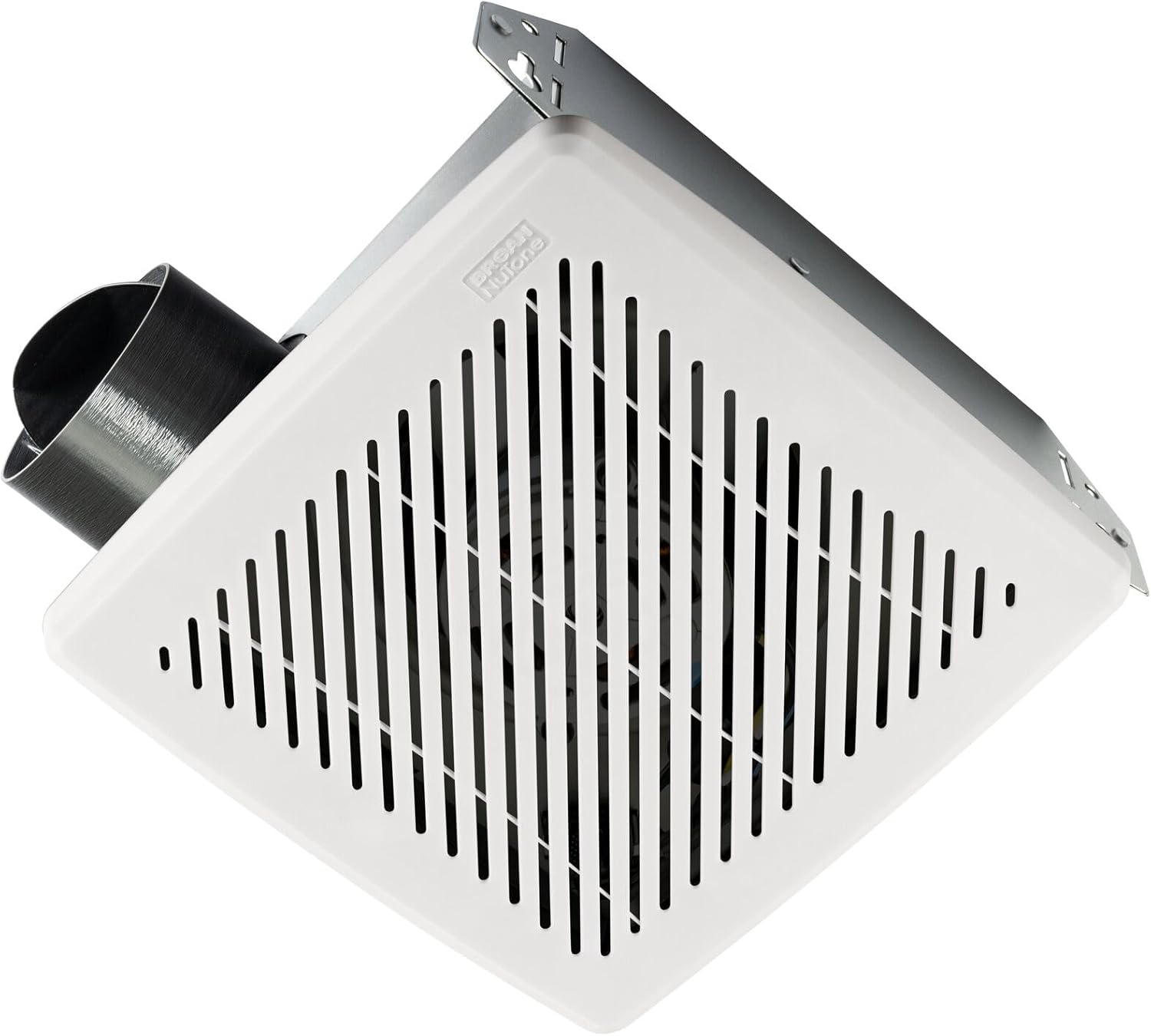
| Air Flow Capacity | 50 cfm |
|---|---|
| Noise Level | 2 sones |
| Wattage | 55 watts |
| Installation Type | No-Cut Ceiling Mount |
| Motor Type | AC |
This Broan-NuTone 50 CFM exhaust fan is a straightforward, no-frills ventilation unit intended to remove moisture and odors from small bathrooms up to about 45 sq ft. It installs with a no-cut ceiling mount and foldable mounting brackets that let you fit the compact galvanized housing without attic access, and the louvered modern grille snaps on with springs for easy removal and cleaning. The permanently lubricated plug-in motor and removable motor assembly simplify servicing compared with sealed units. At 2.0 sones it is reasonably quiet for an economy fan and its Energy Star rating means it runs with modest power draw. The single-speed AC motor and basic touch control keep operation simple but limit flexibility if you want variable airflow or a timer. The fan uses a standard 3 inch duct and plastic grille which keeps weight down but may feel less robust than higher-end metal-trim models. For buyers who prioritize reliable ventilation, simple installation, and low operating cost, this is a practical choice; buyers needing higher airflow, multi-speed control, or integrated lighting should look elsewhere.
Best for: Buyers who want a simple, dependable ventilation upgrade for a small bathroom and who value easy installation, energy efficiency, and low-maintenance components.
Less Ideal for: Homes that need higher capacity ventilation, multi-speed control, integrated lighting, or a premium metal-trim finish should consider different models.
- Energy Star certified for efficient operation
- Compact no-cut ceiling housing with foldable mounting brackets for easy installation
- Removable motor assembly and permanently lubricated motor for easier service
- Quiet operation at 2.0 sones suitable for small bathrooms
- Single-speed operation offers no airflow adjustment
- Plastic grille and trim may feel less durable than metal alternatives
Verdict: A practical, energy-efficient 50 CFM exhaust fan that delivers dependable ventilation and easy no-cut installation for small bathrooms.
Choosing the Right Bathroom Exhaust Fan: Key Factors to Consider
Airflow Capacity
Airflow capacity, measured in cubic feet per minute, determines how quickly a fan can clear humidity and odors from a bathroom. A fan with too low CFM will struggle in larger or frequently used bathrooms, leaving moisture that promotes mildew and paint damage. Choose a fan rated for the square footage and ceiling height of your room. For bathrooms with a separate toilet or shower enclosure, or for frequent heavy use, select a higher CFM rating to provide adequate exchange.
Airflow ratings assume a standard duct layout. Long duct runs, multiple bends, or use of undersized ducting reduces effective CFM, so plan for realistic in-situ performance rather than relying solely on the rated number.
Noise and Sound Profile
Noise level is often expressed in sones or decibels and is a critical factor because overly loud fans go unused. A lower sone rating indicates a quieter fan and makes it more likely you'll run ventilation during and after showers. Consider both the rated noise level and anecdotal reports about tonal quality; some fans produce high-pitched tones that are more annoying than steady low-frequency noise at the same measured level.
Also consider how sound transmits into adjacent rooms. Insulation around the fan housing, insulated ducting, and remote placement can reduce perceived noise in sleeping areas. If you have a small bathroom near bedrooms, prioritize fans with very low noise specifications.
Installation Type and Complexity
Installation ease depends on whether the fan mounts in the ceiling or wall, the existing framing and attic access, and ducting layout. Ceiling-mount fans usually require attic access for wiring and duct attachment. Wall-mount units avoid attic work but need an exterior wall and may require more careful flashing to prevent leaks.
Also consider the housing size and required cutout, whether the unit fits standard joist spacing, and if the fan supports retrofit installation into existing openings. Units that require professional modifications or complicated electrical work increase total cost and project time, so factor DIY skill and access when choosing.
Energy Use and Controls
Energy-efficient motors and options like variable-speed control or integrated timers reduce operational cost and improve comfort. A more efficient fan uses less electricity for the same airflow, which matters for frequent use and for homes aiming to lower energy consumption. Features such as humidity sensors or automatic shutoff make ventilation responsive and reduce run time while maintaining air quality.
Pay attention to motor type—permanent-split capacitor motors are common, while some higher-efficiency models use brushless DC motors. Also verify compatibility with your available wall controls and whether the fan requires special wiring for advanced features.
Durability and Maintenance
Durability reduces the chance of replacement or repair; fans exposed to moist bathroom air should have corrosion-resistant housings and sealed or moisture-rated motors. Look for features that simplify maintenance, such as washable grilles and accessible fan housings for cleaning dust and lint.
Regular maintenance extends service life. Consider how easy it is to remove the trim for cleaning, whether replacement parts like grilles or motors are standard, and whether the manufacturer specifies an expected motor lifetime or warranty coverage.
Ducting and Vent Placement
Proper ducting and vent placement determine how effectively a fan removes moist air from the bathroom. Short, straight runs to an exterior vent minimize flow loss. If you must route through an attic, insulate ducts to avoid condensation and heat loss in cold climates. Vent termination should include a backdraft damper and a screened exterior cap to prevent pests.
Also consider whether you can vent vertically through the roof or horizontally through a wall; the available path will influence which fan housing and duct sizes are appropriate.
Sizing Your Fan to Bathroom Volume
Select a fan that matches the room volume not just floor area. Multiply the square footage by ceiling height and choose a CFM that will exchange the air quickly enough to remove humidity after a shower. For typical ceilings, recommended CFM often scales with room size, but high ceilings require additional capacity.
If your bathroom includes a jetted tub, frequent steam showers, or a large shower enclosure, opt for a higher CFM to ensure fast clearing of moisture. When in doubt, slightly oversize rather than undersize, but verify that ducting and venting can support the higher flow.
- Calculate required CFM based on room volume and usage
- Account for high ceilings or multiple fixtures
- Increase CFM for frequent or heavy steam generation
Retrofit Vs New Construction Installations
Retrofit installations often occur where a simple replacement must fit an existing ceiling opening and joist spacing. Look for models designed for retrofit that include adjustable mounting straps or compact housings.
New construction models usually have mounting systems optimized for joist attachments and may offer larger housings for higher airflow and quieter operation. Plan venting and electrical runs during framing to simplify installation and achieve the best acoustic performance.
- Retrofit: measure existing opening and clearance carefully
- New construction: plan housing position and vent path before drywall
- Ensure electrical and duct runs are accessible for future maintenance
Controls and Smart Options
Modern fans can include timers, humidity sensors, or variable-speed controls that make them more user-friendly and efficient. A humidity sensor can automatically run the fan until moisture drops below a set threshold, which prevents unnecessary runtime and reduces mildew risk.
If you prefer manual control, verify switch compatibility. Some advanced fans require a separate control module or special wiring to support multi-speed or smart features.
- Humidity sensors for automatic moisture-based operation
- Timers to limit run-on time after use
- Variable-speed controls for quieter low-speed ventilation
Acoustic Treatments and Installation Tips
Even a low-sone fan can sound louder if mounted without isolation. Use rubber vibration isolators, insulated ducting, and a solidly mounted housing to minimize transmitted noise. Placing the fan housing away from occupied rooms when possible reduces audible impact.
Seal the duct connections and add a backdraft damper to prevent attic air movement and reduce noise. Routine cleaning of the grille and housing will keep sound from increasing over time due to dust buildup.
- Use vibration isolators to reduce transmitted noise
- Insulate ducts to reduce airborne noise and condensation
- Keep grilles clean to maintain sound and airflow performance
Safety and Code Considerations
Confirm that any replacement fan meets local electrical and building codes, including proper grounding and motor listings for bathroom use. In some areas, fans installed over baths or showers require a ground-fault circuit interrupter-protected circuit or specific mounting ratings.
Vent termination and duct sizing can also be subject to code requirements. Follow manufacturer guidance and local rules for duct material, maximum run length, and vent cap placement to ensure safe, effective operation.
- Check local electrical and ventilation codes before installation
- Use appropriate duct materials and backdraft dampers
- Ensure wet-location and GFCI requirements are met where applicable
How We Chose the Best Bathroom Exhaust Fan
We selected products that meet real-world ventilation needs in common bathroom sizes and mounting types. Our editorial filters prioritized measurable performance over marketing claims and focused on four to six concrete attributes that matter in everyday use. Criteria included rated airflow at standard duct sizes, sound levels measured in sones or decibels, ease of installation for ceiling or wall mounts, energy consumption and motor efficiency, and durability indicators such as sealed motors and corrosion-resistant materials. We excluded units intended only for specialty or nonresidential use and any fan with unclear performance specifications or without basic safety listings. We also filtered out products with limited or impractical mounting options for typical homes. The remaining picks represent a balance of quiet operation, adequate CFM for room size, reasonable installation expectations, and efficient long-term operation.
Our full evaluation process is outlined in our review methodology.
FAQ
How large a fan do I need for my bathroom?
Size fans by required CFM based on room area and ceiling height. For most installations, choose a CFM rating that matches the bathroom volume and increase capacity for frequent heavy use or high ceilings.
Are quieter fans less effective at removing moisture?
Not necessarily. Many modern fans are engineered to deliver high airflow at lower noise levels. Compare rated CFM and sone values to find a unit that provides adequate ventilation quietly.
Can I install a bathroom fan myself?
DIY installation is possible for simple retrofits if you have basic electrical and carpentry skills and attic access. More complex installs, like new duct runs or roof venting, often benefit from a licensed electrician or HVAC professional.
Do I need a damper on the exterior vent?
Yes. A backdraft damper prevents outside air, pests, and cold drafts from entering when the fan is off. Many exterior vent caps include a damper; verify it operates freely and seals properly.
How often should I clean and maintain the fan?
Clean the grille and accessible housing every few months to prevent dust buildup. Inspect the duct and exterior cap annually. More frequent cleaning may be needed in dusty environments to maintain airflow and quiet operation.
Final Verdict
Choose a bathroom exhaust fan that matches your room size, usage patterns, and installation constraints. Prioritize adequate CFM and low noise for regular use, and consider energy-efficient motors or humidity controls to reduce runtime. Balance installation complexity and long-term durability when deciding between retrofit-friendly units and more capable new-construction housings. Ultimately, pick the fan that fits your duct path and mounting type, meets local code, and offers the right mix of airflow, sound level, and features for how you use the bathroom.