
Note: This article contains affiliate links. If you click on these links and make a purchase, we may earn a small commission at no extra cost to you. This helps support our research and content. Read our full affiliate disclosure here.
Choosing the right battery-powered smoke detector matters because it is the first line of defense against home fires when power outages or wiring limits exist. A dependable unit gives you fast detection, clear alarms, and long battery life so you are alerted night or day without surprises. This guide covers six shortlisted battery-powered smoke detectors that represent the best balance of detection reliability, battery longevity, and installation simplicity. We evaluated units on detection performance, false alarm resistance, ease of installation and upkeep, and alarm clarity to help you pick the right device for bedrooms, hallways, and older homes. Read on to see our top picks and what to consider before you install a detector in your space.
Top Picks at a Glance
| Best Overall The best all-around choice for most situations | Kidde 30CUD10-V Smoke & CO Detector | 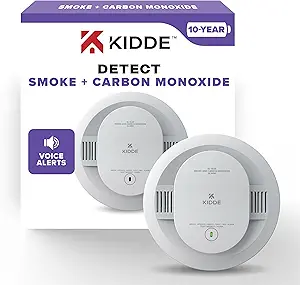 |
| Best Quality Built to a higher standard if you want something more solid | X-Sense SC01 Combination Detector |  |
| Best Value The sweet spot between price and what you get | Kidde 20SD10 Smoke Detector |  |
| Best Budget The cheapest option that still gets the job done reliably | SITERWELL GS509A Smoke Detector |  |
| Top Rated A top-rated pick with lots of positive feedback | HEIMAN Smoke Detector 3-Pack |  |
| Most Popular A crowd favorite that many people choose with confidence | First Alert SMI100 Smoke Alarm | 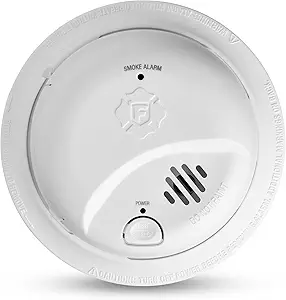 |
Kidde 30CUD10-V Smoke & CO Detector

| Power Source | Battery Powered |
|---|---|
| Sensor Type | Photoelectric, Electrochemical |
| Alarm Volume | 85 decibels |
| Operating Humidity | 10 to 95% RH, non-condensing |
The Kidde 30CUD10-V is a 2-in-1 smoke and carbon monoxide detector built for long-term, low-maintenance protection in homes and rental units. It uses photoelectric sensing for smoke and an electrochemical sensor for CO, and the sealed 10-year battery eliminates regular battery changes and low-battery chirps. The alarm emits an 85-decibel tone and clearly labeled voice alerts saying "Fire" or "Warning, Carbon Monoxide," while a bright red LED gives a visual indicator during an event. Kidde says the sensor firmware improves response to smoldering fires and helps cut down on nuisance alarms from cooking or steam, and the unit is tested to the UL 217 10th Edition and UL 2034 5th Edition standards for reliability. Installation is straightforward with included mounting hardware and the plastic enclosure keeps the unit lightweight. The main compromises are no smart connectivity or interconnect wiring, so it operates as a standalone alarm, and its fixed sealed battery means the whole unit should be replaced after the 10-year life rather than swapping cells.
Best for: Buyers who want a dependable, low-maintenance alarm that combines smoke and CO detection with minimal upkeep and clear voice alerts for everyday home safety.
Less Ideal for: People who need networked or app-connected alarms for remote monitoring or who prefer units that allow battery replacement instead of full-unit replacement after the battery life ends.
- Sealed 10-year battery eliminates regular battery replacements and low-battery chirps
- Dual sensors (photoelectric and electrochemical) detect smoke and CO in one unit
- Clear voice alerts plus an 85-decibel alarm and red LED for unmistakable warnings
- Designed to reduce nuisance alarms with enhanced sensing firmware and UL 217 10th Edition compliance
- No smart connectivity or wireless interconnect capability
- Sealed battery requires replacing the entire unit at end of life rather than swapping batteries
Verdict: Choose this Kidde unit if you want a reliable, low-maintenance combined smoke and CO detector with a sealed 10-year battery and clear voice alerts.
X-Sense SC01 Combination Detector

| Power Source | 10-Year Sealed Battery |
|---|---|
| Alarm | 85 dB |
| Sensor Type | electrochemical, photoelectric |
| Battery Average Life | 10 years |
The X-Sense SC01 is a battery-powered combination smoke and carbon monoxide detector designed for simple, maintenance-light protection. It ships as a 5-pack with mounting hardware and installs on a wall or ceiling without wiring, making it an easy upgrade for multiple rooms. The unit uses a photoelectric smoke sensor and an electrochemical CO sensor and displays real-time CO and battery status on an LCD, so you can verify condition at a glance. The sealed 10-year lithium battery eliminates annual battery swaps and aligns with the detector's service life, while an 85 dB alarm provides a clear audible alert. Because this is the standalone SC01, it does not support wireless interconnection or app control, so each unit must be independently heard and monitored. For users prioritizing low maintenance and reliable sensing performance, the SC01 delivers dependable coverage, though homes that need networked alerts or interconnectivity should choose an RF or Wi-Fi model instead.
Best for: Buyers who want low-maintenance, reliable standalone protection across multiple rooms and value long battery life and clear sensor readouts.
Less Ideal for: Homes that require networked or interconnected alarms for whole-house notification or remote monitoring should consider an RF-interconnected or Wi‑Fi model instead.
- Sealed 10-year lithium battery eliminates the need for yearly battery replacements
- Combination of photoelectric smoke sensor and electrochemical CO sensor covers both hazards
- LCD displays real-time CO concentration and battery status for quick checks
- Simple, no-wiring installation with included mounting bracket and hardware
- No wireless interconnection or app control, so alarms do not communicate with each other
Verdict: Choose the X-Sense SC01 when you want dependable, low-maintenance battery-powered smoke and CO detection with a 10-year sealed battery and on-device readout.
Kidde 20SD10 Smoke Detector

| Sensor Type | Photoelectric |
|---|---|
| Power Source | Built-in 10-year battery |
| Alarm Volume | 85 dB |
| Compatible Devices | Standalone (Not Interconnectable) |
The Kidde 20SD10 is a standalone photoelectric smoke detector built for long-term, low-maintenance protection. It uses advanced sensing to cut down on false alarms from cooking or steam while still detecting smoldering fires faster than typical models, and it signals alerts with an 85 dB horn plus a red LED. The factory-installed 10-year battery eliminates regular replacements and the common low-battery chirp, which simplifies upkeep for renters and homeowners. Installation is straightforward using the included mounting hardware, and the unit is tested to UL 217 10th Edition standards for reliability. Because it is not interconnectable and is a single-sensor alarm, it is best used to supplement a home safety plan rather than as a full integrated system. The detector's plastic enclosure and basic feature set keep it simple and affordable, but buyers seeking voice alerts, smart connectivity, or multi-unit interconnect will need a different model.
Best for: Buyers who want a low-maintenance, code-compliant smoke alarm that minimizes upkeep and nuisance trips while providing reliable local detection in homes or apartments.
Less Ideal for: People who need interconnected alarms, smart/home‑automation integration, or multi-unit systems should choose a different model designed for those capabilities.
- Built-in 10-year battery eliminates regular battery changes and low-battery chirps
- Photoelectric sensor tuned to reduce nuisance alarms from cooking and steam
- Loud 85 dB alarm with LED visual indication for clear alerts
- Meets UL 217 10th Edition safety standards
- Not interconnectable with other alarms so it cannot form a wired or wireless network
- No smart features, voice alerts, or app connectivity
Verdict: Choose the Kidde 20SD10 if you want a simple, low-maintenance photoelectric smoke alarm with a 10-year battery that reduces nuisance alarms.
SITERWELL GS509A Smoke Detector

| Power Source | Battery Powered |
|---|---|
| Alarm | Audible |
| Operating Humidity | 10-95% RH non-condensing |
| Upper Temperature Rating | 37.8 °C |
The SITERWELL GS509A is a basic photoelectric smoke detector designed to catch slow smoldering fires and provide a loud audible alert for household use. It runs on a replaceable 9V battery and is supplied with mounting hardware and a magnetic fastening kit for quick ceiling or wall installation. The photoelectric sensor improves detection of light, smoky fires that may otherwise smolder without much heat, and the unit includes a test/mute button for weekly checks and temporary silencing. The alarm is rated louder than 85 dB so it is audible through most rooms, and the product documentation references UL217 compliance and operating ranges for temperature and humidity. It is a straightforward, no-frills alarm that focuses on dependable detection rather than smart features, and users should expect to replace batteries periodically and perform regular tests to maintain protection.
Best for: Buyers looking for an affordable, straightforward smoke alarm that prioritizes reliable detection of smoldering fires and easy installation.
Less Ideal for: Homes that want sealed 10-year battery alarms, connected or smart detectors, or professional-grade interconnected systems should consider other options.
- Photoelectric sensor better at detecting slow, smoldering fires
- Includes mounting hardware and magnetic fastening kit for easy installation
- Audible alarm >85 dB for clear notification throughout a home
- UL217 listed and built to operate across common household temperature and humidity ranges
- Requires manual battery replacement and weekly testing rather than offering sealed 10-year battery convenience
- No smart features or interconnect capability for multi-alarm networking
Verdict: A cost-conscious, photoelectric battery alarm that delivers reliable smoldering-fire detection and simple installation for basic home protection.
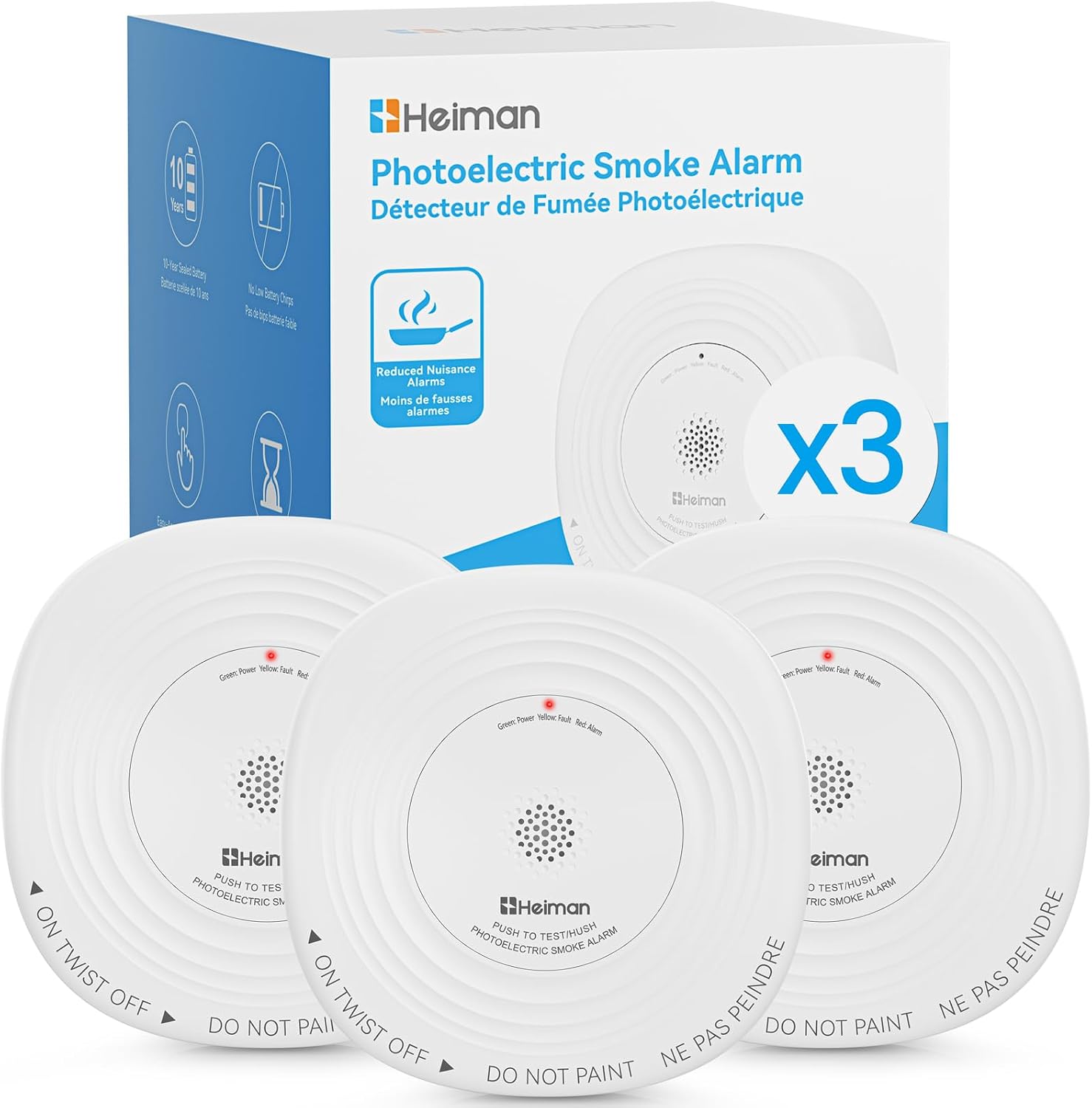
HEIMAN Smoke Detector 3-Pack
| Power Source | 10-Year Sealed Battery Powered |
|---|---|
| Alarm | Audible |
| Battery Average Life | 10 years |
| Operating Humidity | ≤95% RH (non-condensing) |
The HEIMAN 3-pack is a basic, reliability-focused photoelectric smoke detector set built for long service without battery changes. Each unit uses a sealed 10-year lithium battery and meets UL 217 10th edition testing, so you get continuous, maintenance-light protection suitable for bedrooms, kitchens, rentals, and corridors. The dual-beam photoelectric sensor is tuned to reduce cooking nuisance alarms while still responding to smoldering fires, and the 85 dB alarm plus flashing red LED provide clear audio-visual alerts. Installation is straightforward with a supplied mounting kit and a single test/silence button for monthly checks and temporary hush. The detectors include smart memory that flashes every 20 seconds after an alarm and automated fault and end-of-life reminders, which help landlords or busy homeowners keep track of device status over the decade. Limitations: these are standalone battery units so they will not hardwire or interconnect with wired systems, and there is no app or network signaling for remote alerts.
Best for: Buyers who prioritize dependable, low-maintenance smoke protection for homes or rental units and want units that stay sealed and compliant for a full decade.
Less Ideal for: People who need interconnected hardwired systems or remote monitoring via an app should look at wired or smart alarm alternatives.
- 10-year sealed lithium battery for maintenance-free operation
- UL 217 10th edition and CSFM certified for legal-compliant protection
- Photoelectric dual-beam sensor minimizes false alarms from cooking
- Built-in alarm memory, fault reminders, and end-of-life warnings
- Not hardwired or interconnected with other alarms
- No smart connectivity or remote alerting capability
Verdict: Choose this HEIMAN 3-pack when you want certified, year‑after‑year smoke protection with a sealed 10‑year battery and minimal maintenance.
First Alert SMI100 Smoke Alarm

| Power Source | Battery Powered |
|---|---|
| Sensor Type | Ionization |
| Built-In Media | 9V Alkaline Battery |
| Operating Humidity | 10-95% RH |
The First Alert SMI100 is a basic battery-operated smoke alarm that uses ionization sensing with First Alert's Precision Detection to cut down on cooking nuisance alarms while still providing early warning for fast-flaming fires. It installs easily on a ceiling or wall and the front-access 9V battery compartment and single test/silence button make periodic checks and battery changes straightforward. The unit also includes an end-of-life warning so you know when to replace the alarm rather than guessing. In everyday use it behaves like a traditional standalone detector: passive monitoring, loud audible alert when triggered, and minimal setup. Expect no smart features, hardwiring, or networking — this is a simple, reliable backup or primary detector for rooms where you want a self-contained alarm. If you need voice alerts, app connectivity, or dual-sensor coverage, plan to pair it with other devices or choose a different model.
Best for: Buyers who prioritize a proven, easy-to-install standalone smoke alarm with low nuisance triggers and clear maintenance cues, and who value peer recommendations and established reliability.
Less Ideal for: People who want networked alarms, app notifications, or combined photoelectric/ionization sensing in a single unit should consider alternatives.
- Precision Detection reduces nuisance alarms from common cooking events
- Front-access 9V battery compartment simplifies battery replacement
- End-of-life warning indicates when the detector should be replaced
- Easy single-button test and silence function for routine maintenance
- Ionization sensor does not detect slow-smoldering fires as effectively as photoelectric sensors
- No smart features or interconnectivity for whole-home alerts
Verdict: A straightforward, reliable battery smoke alarm that minimizes cooking false alarms and makes battery maintenance simple, ideal for buyers seeking a trusted standalone detector.
Choosing the Right Battery-Powered Smoke Detector: Key Factors to Consider
Sensor Type and What It Detects
Smoke detectors use different sensor technologies, and the choice affects what kinds of fires trigger an alarm. Photoelectric sensors are better at detecting smoldering fires that produce larger smoke particles, while ionization sensors tend to react faster to fast-flaming fires with smaller particles. Knowing the typical risk areas in your home helps you decide which sensor type to prioritize.
For bedrooms and living spaces where smoldering fires from furniture or bedding are more likely, photoelectric or dual-sensor units usually reduce the chance of missing a slow-developing fire. If you choose a detector with a single sensor type, consider supplementing it with a unit of the other type in different parts of the house to broaden coverage.
Battery Life and Low-Battery Notifications
Battery longevity directly affects long-term reliability because a depleted battery renders the detector ineffective. Look for detectors that advertise multi-year battery life or accept long-life lithium batteries. Understand whether the unit uses replaceable AA/AAA cells or a sealed long-life battery, as each approach has tradeoffs for maintenance and lifespan.
Low-battery indicators and end-of-life warnings should be unambiguous and easy to test. A detector that chirps unpredictably can be more of a nuisance than a help, so clear visual indicators or predictable low-battery alerts reduce the chance a necessary replacement gets postponed.
False Alarm Resistance And Smart Silence Features
False alarms from cooking smoke, shower steam, or dusty environments lead users to disable detectors, increasing risk. Detectors designed with hysteresis, adjustable sensitivity, or built-in delays for transient smoke are less likely to trigger unnecessarily. Some units offer a temporary hush or silence button that suppresses nuisance alarms for a set interval without disabling the detector entirely.
Consider where you will install the detector and whether the unit's false alarm mitigation features match that environment. Devices meant for kitchen-adjacent placement should emphasize nuisance resistance to avoid frequent silencing.
Installation Flexibility And Mounting
Battery-powered detectors are valued for easy placement, but mounting options matter. A detector with a twist-lock mounting plate, clear orientation guides, and lightweight design makes installation faster and reduces mistakes. For rental units or temporary placements, tool-free mounting or adhesive-backed options can be useful.
Also consider the detector's size and whether it fits flush with common ceiling or wall junction boxes. Accessibility for battery replacement and test button operation is important; detectors placed too close to a ceiling corner or high soffit can be hard to service.
Audible Output And Multiple-Occupant Considerations
Alarm loudness and tone are critical because occupants must wake and respond. Look for detectors that meet or exceed recognized decibel standards at a certain distance. Tone clarity and frequency content influence how well the alarm penetrates through walls, bedding, and sleeping individuals.
If you have hearing-impaired household members, consider models with visual strobe compatibility or integration options for linked devices. In larger homes, interconnectivity can ensure everyone hears the alarm, but this may increase installation complexity and is not necessary for small apartments.
Maintenance, Testing, And End-Of-Life Signals
Regular testing and straightforward maintenance keep detectors reliable. Choose units with accessible test buttons and clear instructions on how to perform monthly checks. Some detectors include self-test routines or LED status indicators that show sensor health and signal when the unit reaches its operational end-of-life.
End-of-life notifications matter because sensor performance degrades over time. A detector that provides clear end-of-life warnings reduces the risk of leaving an aging, ineffective unit in service.
Where To Place Battery-Powered Smoke Detectors
Placement determines how quickly a detector senses smoke and warns occupants. Install detectors inside each bedroom, outside sleeping areas in hallways, and on every level of the home, including basements. Ceiling mounting in the center of a room is generally best because smoke rises and spreads along the ceiling plane.
- Mount detectors at least 4 inches from the wall when ceiling-mounted and 4 to 12 inches below the ceiling when wall-mounted, following general clearance guidance.
- Avoid installing detectors too close to windows, doors, or ducts where drafts can interfere with detection.
- Do not place detectors directly over kitchens or bathrooms to minimize nuisance alarms from cooking or steam; instead, position them a short distance away where smoke is likely to travel.
Interconnectivity Options And When They Matter
Interconnected alarms sound all units when any one detects smoke, improving response time in larger homes. Battery-powered detectors may offer wireless interconnect via proprietary radio links or support hardwired interconnect only when combined with line power. Consider whether your home size and layout justify linked alarms or whether stand-alone units are sufficient.
- Wireless interconnect is useful for multi-floor homes where a single alarm might not wake residents in distant rooms.
- If you plan to use interconnected units, check compatibility and whether linking requires additional modules or base units.
- Stand-alone battery-only detectors provide the simplest installation for small apartments or single-room coverage.
Testing And Monthly Maintenance Routine
A simple monthly test verifies that the alarm, battery, and electronics are working. Press the test button and listen for a full-volume alarm. Replace batteries according to manufacturer guidance or whenever low-battery chirps begin; avoid postponing replacements to reduce risk.
Regular cleaning with a soft brush or vacuum attachment reduces dust buildup that can cause false alarms or sensor degradation. Keep records of installation dates so you can replace detectors at the recommended end-of-life interval, typically around 10 years.
- Test alarms monthly and replace batteries at least once per year unless the unit uses sealed long-life batteries.
- Gently vacuum detector vents every 6 to 12 months to prevent dust accumulation.
- Record installation dates to track end-of-life replacement timing.
Common Installation Mistakes To Avoid
Placing detectors too close to kitchens, bathrooms, or heating vents leads to nuisance alarms or delayed detection. Mounting detectors at inconsistent heights or in dead air spaces, such as corners where smoke does not collect, can reduce sensitivity. Using the wrong battery type or failing to secure the mounting plate can cause intermittent power issues.
Follow simple installation best practices: mount per guidance, use recommended batteries, and test after installation to confirm the alarm sounds from sleeping areas. These checks prevent common setup errors that compromise protection.
- Do not place detectors directly in high-dust or greasy environments like garages or near forced-air registers.
- Avoid installing detectors in very humid areas where steam can trigger false alarms.
- Ensure the mounting plate is tight and the battery compartment closes securely to prevent connectivity issues.
How We Chose the Best Battery-Powered Smoke Detector
Our editorial process focused on how well battery-powered smoke detectors do the core job of detecting dangerous smoke and alerting occupants under realistic home conditions. We prioritized detection reliability across common fire types, sensor responsiveness under variable smoke densities, and resistance to nuisance alarms from cooking and steam. We also weighed battery life and the availability of long-life battery options because frequent replacement undermines long-term safety. Installation and maintenance factors received attention, including mounting flexibility, audible alarm volume, simple battery replacement, and clear status indicators. Connectivity features were considered only if they improved safety without introducing complexity. Units were excluded if they required wired power or were primarily designed as combination devices where smoke detection was secondary. We filtered out devices lacking clear battery runtime specifications or without basic user-facing test/reset functions. The result is a list of six battery-powered smoke detectors that balance dependable detection, straightforward upkeep, and practical installation for real homes.
Our full evaluation process is outlined in our review methodology.
FAQ
How often should I replace the batteries in a battery-powered smoke detector?
Replace batteries at least once a year for standard alkaline cells, or follow the manufacturer's guidance for sealed long-life batteries. If your detector chirps a low-battery alert, replace the battery promptly rather than delaying.
Can I install a battery-powered detector myself?
Yes. Battery-powered detectors are designed for DIY installation with simple mounting plates and basic tools. Follow the included instructions for placement height and clearances, and test the unit after mounting.
Are battery-powered detectors reliable during power outages?
Battery-powered detectors operate independently of household electricity, so they continue to provide protection during outages. Choose units with proven battery life and clear low-battery alerts to ensure ongoing reliability.
Should I use the same type of detector throughout my home?
It depends. Using the same type simplifies maintenance, but mixing sensor types or using dual-sensor models in different locations can improve coverage by detecting a broader range of fires. Consider room function and typical fire risks when deciding.
How do I reduce false alarms from cooking or showers?
Avoid placing detectors too close to kitchens or bathrooms and select units with nuisance-alarm mitigation features. Use temporary hush functions when needed, and ensure proper placement so transient smoke or steam does not trigger the sensor.
Final Verdict
Prioritize reliable detection, clear low-battery alerts, and installation practicality when choosing a battery-powered smoke detector. Tradeoffs include sensor type versus nuisance resistance and sealed long-life batteries versus user-replaceable cells. For most homes, a detector that combines a sensor suited to the room, predictable maintenance indicators, and adequate alarm loudness will offer the best real-world protection. Focus on placement and routine testing to ensure the device performs when it matters most.