
Note: This article contains affiliate links. If you click on these links and make a purchase, we may earn a small commission at no extra cost to you. This helps support our research and content. Read our full affiliate disclosure here.
If you want truly fresh coffee but have a tight budget, a bean-to-cup coffee maker under $100 can be a smart solution. These compact brewers grind beans immediately before extraction, which preserves aroma and flavor more effectively than preground options. You still need to balance grinder quality, brew temperature stability, and ease of cleaning when shopping in this price bracket. This guide shortlists the seven best bean-to-cup coffee makers under $100 and walks through the practical tradeoffs that matter for everyday use. We evaluate grind-to-cup consistency, cleanup effort, and build durability so you can pick a machine that fits your routine and countertop space.
Top Picks at a Glance
| Best Overall The best all-around choice for most situations | Horavie Grind & Brew Coffee Maker |  |
| Best Quality Built to a higher standard if you want something more solid | AMOSA Portable Espresso Machine AE1201 |  |
| Best Value The sweet spot between price and what you get | HAUSHOF Portable Grind & Brew |  |
| Best Budget The cheapest option that still gets the job done reliably | Mixpresso 2-in-1 Grind & Brew |  |
| Top Rated A top-rated pick with lots of positive feedback | AIRMSEN Grind & Brew CGM501HB |  |
| Most Popular A crowd favorite that many people choose with confidence | Mixpresso 5-Cup Drip Coffee Maker |  |
| Best Seller A high-volume bestseller chosen again and again | ecozy Brezzano DuoSet CM9102TE |  |
Horavie Grind & Brew Coffee Maker

| Operation Mode | Fully Automatic |
|---|---|
| Wattage | 1000 watts |
| Coffee Input Type | Ground, Pod, Whole Bean |
| Compatible Coffee Pods | K-Cup |
The Horavie Grind & Brew is a compact single-serve coffee maker that grinds beans and brews a fresh cup in about two minutes or can brew from pre-ground coffee or K-Cup pods. It is used like a typical single-serve machine: add water to the removable 47oz tank, choose one of six grind times and six brew sizes (6–16 oz), place beans, grounds, or a pod, and start the cycle using simple button controls. Notable features include an integrated grinder with six grind-time settings for coarser to finer results, a reusable bean basket and permanent filter to avoid paper filters, and a removable drip tray that accommodates taller mugs. The practical benefits are fresh-ground flavor on demand, flexible input options, and fewer refills thanks to the large visible tank, all in a space-saving footprint suitable for small counters or offices. Limitations are its single-serve focus—it is not designed for brewing multiple cups at once—and the grinder uses a blade-style mechanism with short timed settings rather than a conical burr, which may give less-consistent particle size than higher-end grinders.
Best for: Buyers who want fresh-ground single cups on a budget and value flexibility to use beans, grounds, or pods without taking up much counter space.
Less Ideal for: Households that need to brew multiple cups at once or coffee enthusiasts who require a precision burr grinder and full espresso capability.
- Built-in grinder with six grind-time settings for on-demand fresh grinding
- Accepts whole beans, ground coffee, or K-Cup pods for maximum flexibility
- Large removable 47oz water tank reduces refill frequency and is easy to monitor
- Permanent reusable filter and removable drip tray simplify daily use and cleanup
- Blade-style grinder (timed grind) may produce less consistent particle size than burr grinders
- Single-serve design cannot brew multiple cups at once
Verdict: If you want a budget-friendly bean-to-cup single-serve brewer that gives fresh-ground coffee and flexible input options, this machine delivers strong value in a compact package.
AMOSA Portable Espresso Machine AE1201

| Output Pressure | 20 bar |
|---|---|
| Power Source | Rechargeable Lithium-ion Battery |
| Voltage | 5 volts_of_direct_current |
| Compatible Coffee Pods | Nespresso Original |
| Capacity | 2 cups |
The AMOSA Portable Espresso Machine AE1201 is a travel-focused, battery-powered espresso kit designed to make two small cups of espresso when you bring your own hot water. It pairs a 20-bar pump-driven brewer with a manual grinder and a handheld electric frother, and is powered by a 1500mAh rechargeable battery with USB-C charging. In practice you add preheated water, choose ground coffee or a compatible Nespresso Original capsule, press the one-button brew cycle and the unit pulls a short extraction with noticeable crema in about 40 seconds. The included 51mm powder bowl and 100ml water tank let you make two small servings per fill, and the kit is compact enough to pack for camping, road trips, or office use. Expect a genuinely portable workflow but plan for the manual steps: no internal water heater means you must supply hot water, and the grinder is manual so preparation is slower than electric all-in-one machines. The design favors portability and extraction pressure over onboard heating, so it is best when you value espresso-style flavor on the go rather than full automation or large-volume brewing.
Best for: Buyers who prioritize extraction quality and portability and are comfortable preparing hot water and grinding by hand for espresso-style shots while traveling or camping.
Less Ideal for: People who want a fully automatic, single-step machine with built-in water heating or those who need larger volume brewing for multiple full-size cups.
- 20 bar pump for strong extraction and visible crema
- Includes manual grinder and handheld milk frother for a near-complete portable setup
- Rechargeable 1500mAh battery with USB-C charging and high stated cup capacity per charge
- Compact, two-cup water tank and 51mm powder bowl for dual servings from one fill
- Compatible with ground coffee and Nespresso Original capsules for flexible use
- Does not heat water internally so you must provide hot water separately
- Manual grinder requires extra time and effort compared with electric grinders
Verdict: If you want a highly portable, pressure-driven espresso kit under $100 that delivers crema and flexible brewing on the go, this AMOSA set is a practical performance-focused choice.
HAUSHOF Portable Grind & Brew

| Capacity | 10 fluid ounces |
|---|---|
| Coffee Input Type | whole bean |
| Power Source | rechargeable battery |
| Filter Type | Double-layer micro mesh collapsible |
| Grind Levels | 5 adjustable |
This HAUSHOF unit combines a ceramic conical burr grinder, collapsible stainless steel pour-over filter, and insulated travel mug into a single portable kit for fresh single-cup coffee on the go. You load up to 15 g of beans in the hopper, select one of five grind settings, and the burr grinder runs until it auto-stops, producing grounds you pour over with preheated water (the unit does not heat water). The collapsible double-layer micro mesh filter fits into the mug for mess-free brewing and folds away for compact storage, and the insulated mug keeps drinks hot or cold during travel. USB-C rechargeable battery operation and included carry bag make it convenient for commuting, camping, or office use. Expect about a three-minute grind cycle for a full hopper and follow the guidance to set grind size before starting to avoid jams. This is a manual pour-over workflow, so it requires preheated water and a bit more hands-on time than an automatic brewer, but it delivers better freshness than instant or preground options in a compact, travel-focused package.
Best for: Buyers who prioritize fresh, bean-to-cup flavor in a compact, travel-ready package and are comfortable doing a manual pour-over with preheated water.
Less Ideal for: People who want a fully automatic, one-button brewer that heats water or who need larger batch brewing for multiple cups at once.
- Integrated ceramic conical burr grinder preserves flavor with low-heat grinding
- Five adjustable grind settings for coarse-to-fine control
- Collapsible double-layer stainless steel filter eliminates paper filters and compacts for storage
- Insulated travel mug brews directly into a leak-resistant cup to keep beverages hot or cold
- USB-C rechargeable cordless operation and included carry bag for true portability
- Does not heat water—requires preheated water for brewing
- Full hopper grinding can take about three minutes, so it is slower than blade grinders or preground options
Verdict: Choose this if you want true bean-to-cup freshness in a compact, rechargeable travel brewer that grinds and brews a single insulated cup.
Mixpresso 2-in-1 Grind & Brew

| Operation Mode | Fully Automatic |
|---|---|
| Wattage | 800 watts |
| Voltage | 110 volts |
| Coffee Input Type | Whole Beans and Pre-Ground Coffee |
| Filter Type | Reusable |
The Mixpresso 2-in-1 Grind & Brew is a compact single-serve drip machine that grinds whole beans and then brews directly into a 14 oz travel mug, making it a space-saving option for travel or small kitchens. Operation is simple: add whole beans or pre-ground coffee, press the illuminated one-touch button and the integrated grinder and brewer run automatically, with an auto shut-off for safety. The unit includes a reusable mesh filter and a removable water tank and grinding chamber for easier cleaning. At 800 watts it delivers a standard drip extraction suited to a single cup, and the stainless travel mug with rubber grip helps keep coffee warm on the go. Limitations include a one-cup capacity so it is not suitable for serving multiple people at once, and the compact grinder and brewer are geared toward convenience rather than precision extraction or cafe-level performance. Build uses plastic exterior parts, so durability will vary with heavy daily use.
Best for: Buyers who want an inexpensive, travel-friendly bean-to-cup solution that simplifies morning coffee into a single automatic step and prioritizes convenience and portability.
Less Ideal for: People who routinely make coffee for more than one person or who demand precise brew control and high-end extraction should consider larger or more advanced machines.
- Built-in grinder for fresh whole-bean brewing
- One-touch automatic grind-and-brew operation with auto shut-off
- Includes 14 oz stainless travel mug with rubber grip for portability
- Reusable permanent mesh filter reduces waste and running cost
- Removable water tank and grinder chamber simplify cleaning
- Single-cup capacity not suitable for multiple servings
- Compact grinder and brewer limit control over extraction and flavor nuances
Verdict: A budget-friendly, travel-oriented grind-and-brew machine that delivers a freshly ground single cup with minimal fuss.
AIRMSEN Grind & Brew CGM501HB

| Capacity | 5 cups |
|---|---|
| Wattage | 900 watts |
| Operation Mode | Whole Bean Mode, Ground Coffee Mode |
| Display Type | Digital Display |
The AIRMSEN Grind & Brew CGM501HB combines a small-footprint 5-cup drip brewer with an integrated grinder so you can use whole beans or preground coffee without extra equipment. It performs like a typical bean-to-cup countertop machine: load beans, choose one of three grind settings, set the 24-hour timer if you want automatic morning brewing, then start a cycle; the glass carafe sits on a hot plate and a two-hour keep-warm mode preserves serving temperature. The unit has a digital touchscreen, a removable filter basket and water filter for easier cleaning, and an auto-descaling reminder after extended use. At 900 watts it brews quickly for its size, and safety features such as a lid safety switch and thermostat protection add peace of mind. Limitations are its 5-cup capacity, which suits one to three drinkers but is too small for larger households, and the grinder is basic compared with dedicated burr grinders, so extremely fine or ultra-consistent grinds are unlikely. For buyers prioritizing compact, programmable fresh-ground coffee and everyday reliability, it delivers predictable performance with straightforward maintenance.
Best for: Buyers who want a compact, dependable bean-to-cup solution that reliably produces fresh-ground drip coffee each morning with minimal fuss.
Less Ideal for: Anyone who needs larger batch brewing for many guests or who wants café-grade grind consistency from a separate high-end grinder should consider other options.
- Built-in grinder with three grind settings for fresh-ground convenience
- 24-hour programmable timer and memory function for scheduled brewing
- Compact 5-cup footprint fits small kitchens, dorms, and offices
- Removable filter basket and water filter simplify cleaning and reduce scale
- Safety features including thermostat protection and lid safety switch
- Small 5-cup capacity is insufficient for larger households or entertaining
- Integrated grinder is basic and less consistent than a dedicated burr grinder
Verdict: A compact, programmable grind-and-brew machine that reliably delivers fresh-ground drip coffee for one to three daily drinkers.
Mixpresso 5-Cup Drip Coffee Maker

| Wattage | 650 watts |
|---|---|
| Voltage | 110 volts |
| Coffee Input Type | ground, whole bean |
| Capacity | 1.6 pounds |
The Mixpresso 5-Cup Drip Coffee Maker combines a blade-style grinder and drip brewer in a small, programmable unit designed for 2–5 cups per cycle. You can use whole beans or preground coffee; the machine grinds beans immediately before brewing for fresher flavor and stores up to 25 ounces of water to fill the included glass carafe. Controls are button-based with an LCD for a 24-hour delayed start, and the unit has an automatic shutoff plus an anti-drip system to protect counters. Practical touches include a removable mesh filter, a nonstick warming plate to hold coffee temperature, and a clear water level indicator. Trade-offs to expect are modest capacity and power—this is aimed at solo drinkers or small households rather than large families—and the grinder and brewer are built into one compact housing so maintenance and cleaning require attention. Noise levels are described as relatively low for an integrated grinder, but the unit is not a commercial-grade grinder and will not match the consistency of higher-end bean-to-cup machines.
Best for: Buyers seeking a budget-friendly bean-to-cup solution for daily single-serve or small-batch brewing who prioritize fresh-ground flavor and programmable convenience backed by visible customer feedback.
Less Ideal for: Those who need large-volume brewing, café-level grind consistency, or fully commercial-grade components should look at higher-capacity, higher-end machines instead.
- Built-in grinder lets you brew from whole beans for fresher flavor
- Programmable 24-hour delayed start and LCD controls for timed brewing
- Compact footprint suitable for small kitchens or limited counter space
- Anti-drip spout and removable mesh filter simplify serving and cleanup
- Limited 2–5 cup capacity not suited for larger households
- Integrated grinder is basic compared with standalone or premium grinders
Verdict: If you want an affordable, compact bean-to-cup drip brewer that grinds beans and offers programmable start times, this Mixpresso model delivers practical fresh-brew convenience for small households.
ecozy Brezzano DuoSet CM9102TE
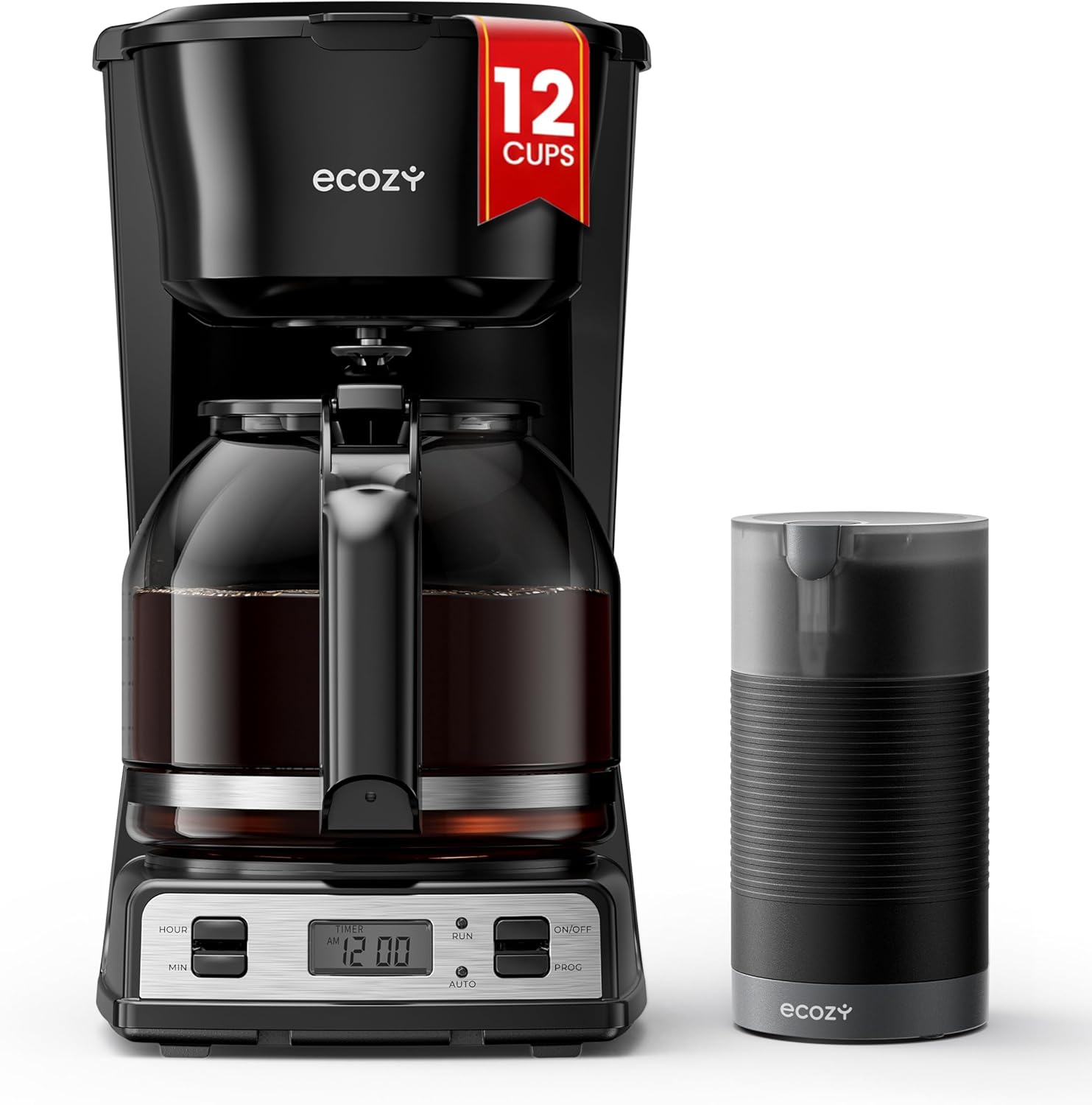
| Capacity | 12 cups |
|---|---|
| Wattage | 900 watts |
| Power Source | AC adapter |
| Filter Type | Washable basket filter |
| Coffee Input Type | Ground |
The ecozy Brezzano DuoSet combines a 12-cup drip brewer and a standalone electric grinder so you can grind beans and brew with one matched set. It is typically used for daily household coffee, with a 24-hour programmable timer that lets you wake to freshly brewed coffee and a Pause & Pour feature that prevents drips when pouring mid-brew. The washable basket filter and removable glass carafe simplify cleanup, and the hot plate keeps coffee warm before an automatic shutoff after two hours for safety. At 900 watts it brews a full carafe quickly, and the included grinder allows fresher grounds than preground coffee. Limitations to note are simple construction and basic controls rather than barista-level settings, and the grinder is a standard electric unit rather than a professional burr grinder, so grind consistency will be adequate for drip brewing but not ideal for espresso or specialty brewing methods.
Best for: Buyers who want a reliable, easy-to-use all-in-one grinder-plus-brewer that delivers consistent drip coffee with minimal fuss and straightforward features.
Less Ideal for: Those seeking specialty brewing precision, advanced grind control, or barista-level espresso performance should consider higher-end grinders or machines instead.
- Includes separate electric grinder for fresher grounds
- 24-hour programmable timer for set-and-forget morning brewing
- Washable basket filter and removable carafe for easy cleaning
- Pause & Pour drip-stop lets you grab a cup mid-brew without spills
- Auto shutoff adds a safety feature after brewing
- Grinder is a basic electric grinder, not a precision burr grinder
- Controls and features are simple with limited customization
Verdict: A dependable, user-friendly grinder-plus-drip brewer that gives risk-averse buyers fresh-ground 12-cup coffee with simple programmable controls.
Choosing the Right Bean-to-Cup Coffee Maker: Key Factors to Consider
Grinder Type and Adjustability
The grinder built into a bean-to-cup machine determines the starting point for extraction. Burr grinders deliver more uniform particle size than blade grinders, which helps avoid over- or under-extraction. In the under-$100 category, many machines use compact blade or small conical burrs, so look for units that offer multiple grind settings or at least a finer-versus-coarser adjustment.
Adjustability matters because different roast levels and brew preferences require different particle sizes. If you drink espresso-style drinks, you need a much finer grind than for drip-style brews. Even modest stepwise control can let you dial in better flavor, whereas a single fixed grind setting often produces inconsistent results across bean types.
Brew Temperature and Extraction Control
Consistent brew temperature is essential to extract the coffee solubles properly. Machines under $100 may not have advanced PID temperature control, so mechanical thermostats and simple heating elements are common. That means you should favor designs that preheat the brew path or emphasize short contact time between heated surfaces and the water.
Look for models that advertise temperature consistency or that include features like pre-infusion or controlled pour routines. Those features help compensate for simpler heating systems by improving extraction uniformity. If you want predictable cup-to-cup results, prioritize units with fewer temperature swings and a reputation for steady brewing.
Ease of Cleaning and Maintenance
Budget bean-to-cup machines can trap oils and grounds in small spaces, which impacts taste and longevity. Easy access to the grinder chamber, removable brew baskets, and a hopper that opens for cleaning make maintenance manageable. Machines that require tools or that have permanently sealed compartments become messy and degrade faster.
Consider how often you will need to descale and whether the machine offers simple descaling access. Removable water tanks and dishwasher-safe parts reduce daily friction. Regular, simple maintenance keeps short-run machines performing well and prevents stale-flavor buildup.
Build Quality and Component Materials
At lower price points, manufacturers often trade heavy-duty materials for lighter plastics. That is acceptable if the internal components that matter most, such as the grinder and water path, use metal or high-grade plastics resistant to heat and oil. Assess whether buttons and moving parts feel robust and whether seams around the hopper and brew head are tight.
Durable components reduce the chance of leaks, clogging, and mechanical failure. Also consider warranty and ease of finding replacement parts. A slightly heavier or sturdier-feeling unit is often worth a small tradeoff in size when you want a machine that lasts.
Size, Capacity, and Countertop Fit
Under-$100 machines are typically designed for small kitchens or single users, so hopper and water capacities tend to be modest. Think about how many cups you brew per session and whether you prefer single-cup focus or brewing multiple cups without refilling. A larger hopper reduces the need to refill often but can expose more beans to air if it has a poor seal.
Footprint matters if you have limited counter space. Measure the intended location and check water tank access and drip tray clearance for mugs of different heights. Compact machines can be convenient, but they must still match your daily brewing volume and cup size preferences.
Control Features and User Interface
Simple, predictable controls are often better than complex menus on budget models. Look for machines that offer clear brew-strength choices, simple size selection, and straightforward grind adjustments. Intuitive interfaces reduce the time required to learn the machine and lower the risk of user error.
Programmability is rare at this price point, but features like auto-start, a pause-and-serve function, or an easily adjustable cup size can improve convenience. Consider whether you want one-button simplicity or a bit more manual control over the brewing steps.
How Bean-to-Cup Machines Save Flavor Compared to Premade Grounds
Grinding beans immediately before brewing preserves volatile aroma compounds that dissipate quickly after grinding. Even short delays between grinding and extraction can noticeably reduce brightness and complexity in the cup. A bean-to-cup workflow reduces that gap so your brewed coffee retains more of the bean's character.
For everyday drinkers, that flavor gain is most noticeable with freshly roasted beans and lighter roasts. If you routinely use preground coffee, switching to bean-to-cup is one of the biggest single improvements in aroma and taste, even on a budget machine.
- Reduced aroma loss by minimizing time between grinding and brewing
- More pronounced fruit and floral notes with fresh beans
- Improved cup clarity because of more uniform particle distribution
Practical Tips to Improve Extraction on Budget Machines
You can get better results from an inexpensive bean-to-cup machine by controlling a few variables. Use freshly roasted beans and store them in an airtight opaque container. Adjust the grind setting in small steps when switching beans, and run a blank cycle to warm the brew path before making your first cup.
Also, rinse the filter basket and pre-wet the coffee puck when possible to reduce channeling. If your machine allows it, slightly finer grinds usually increase perceived strength and body, while coarser grinds decrease bitterness. Small, methodical changes yield clearer differences than large adjustments.
- Use freshly roasted beans and airtight storage
- Preheat the brew path with a warm water cycle
- Adjust grind size incrementally when changing beans
Maintenance Routine to Keep Flavors Fresh
Regular cleaning prevents oil buildup and stale flavors. Empty and wipe the hopper weekly if you use the machine daily. Clean the grinder area to remove fines and oil residue and follow the manufacturer guidance for descaling the water path at recommended intervals.
Keep removable parts accessible and dry when not in use to limit mold or off-flavors. Label a recurring calendar reminder for descaling based on your water hardness and usage; this small habit preserves both taste and the machine's mechanical health.
- Weekly hopper and grinder wipe-down
- Monthly removable-part cleaning for regular users
- Descale every 2–3 months or per water hardness
When a Compact Hopper or Tank Is Actually an Advantage
Smaller hoppers and tanks reduce bean and water exposure to air, which can be beneficial when you only brew one or two cups daily. If you prefer ultra-fresh single cups, a compact machine that encourages daily refilling can outperform a larger-capacity unit that stores beans and water for days.
Compact designs also fit tight counters and are easier to move for cleaning. Choose capacity according to your routine rather than automatically favoring the largest size available in this price range.
- Smaller capacity keeps beans fresher between brew sessions
- Easier cleaning and less countertop real estate required
- Ideal for single users or infrequent brewing
Common Tradeoffs in the Under-$100 Segment
Expect compromises on grind uniformity, component longevity, and advanced temperature control. Many budget units will require more frequent cleaning and may show wear on moving parts sooner than higher-end machines. Accepting these tradeoffs lets you get fresh-ground brewing at a much lower upfront cost.
Decide which features matter most to you. If grind quality is the priority, focus on the best grinder available in the segment. If convenience and minimal maintenance are the priority, look for simple removable parts and clear access to the brew path.
- Less consistent grind particle distribution is common
- Simpler heating systems can cause temperature variability
- Easier maintenance often outweighs a small upgrade in grind quality
How We Chose the Best Bean-to-Cup Coffee Maker
We evaluated bean-to-cup coffee makers under $100 using criteria that reflect real daily use rather than marketing claims. Key filters included the presence of an integrated burr or blade grinder with adjustable grind settings, reliable heating or brew-temperature controls, and accessible components for regular cleaning. We prioritized units that kept the bean-to-brew path short to limit aroma loss and reduce grounds residue. Other criteria were hopper capacity and sealing, which affect freshness for small households, and water capacity versus footprint to ensure a usable cup yield without crowding a countertop. We also assessed user-facing controls and programmability for repeatable results and looked for straightforward maintenance access to parts that contact coffee or water. Units lacking any grinder, with permanently sealed brew chambers, or with materials known to retain stale oils were excluded. Final selections balance grind quality, thermal performance, and practical upkeep for budget-conscious buyers.
Our full evaluation process is outlined in our review methodology.
FAQ
Will a bean-to-cup machine under $100 make better coffee than preground beans?
Often yes. Grinding right before brewing preserves volatile aromatics and usually yields a fresher, more flavorful cup than preground coffee. The improvement depends on the machine's grinder quality and your beans.
How often should I descale a budget bean-to-cup coffee maker?
It depends on water hardness and usage, but most users benefit from descaling every 2 to 3 months. Hard-water areas may require monthly descaling to prevent scale buildup that affects temperature and flow.
Are blade grinders in integrated machines acceptable?
Blade grinders are common in lower-priced models and can produce acceptable results for everyday drip-style drinks. They usually offer less uniformity than burrs, so expect more variability and adjust grind size to compensate where possible.
How can I reduce bitterness from an under-$100 bean-to-cup machine?
Try coarsening the grind slightly, ensuring the brew path is warm before extraction, and using fresher beans roasted within the past few weeks. Also check for any old oils or grounds in the grinder or brew chamber and clean them out.
What maintenance steps will extend the life of a budget unit?
Regularly emptying and cleaning the hopper, wiping the grinder area, descaling on schedule, and keeping removable parts dry will reduce wear and preserve flavor. Avoid forcing parts or using abrasive cleaners on seals and plastic components.
Final Verdict
For buyers seeking fresh-ground coffee on a tight budget, prioritize grinder consistency, straightforward cleaning access, and steady brew temperature. Accept that machines under $100 often require more frequent maintenance and may not match the grind uniformity of higher-end models. Focus on the features most important to you—whether that is single-cup convenience, compact size, or the best possible grinder available in the segment—and choose the unit that balances those tradeoffs for your routine. With sensible expectations and basic upkeep, a bean-to-cup coffee maker under $100 can deliver noticeably fresher coffee than preground options.