
Note: This article contains affiliate links. If you click on these links and make a purchase, we may earn a small commission at no extra cost to you. This helps support our research and content. Read our full affiliate disclosure here.
A properly chosen box fan for a window can move more air into or out of a room, cut indoor temperatures faster, and improve ventilation without major installation work. If you rely on window mounting for seasonal cooling, the right fan makes the difference between a drafty, noisy nuisance and reliable, quiet airflow that complements your existing ventilation. This guide shortlists the top box fans for window use and explains the practical tradeoffs we considered, including airflow, noise, fit and installation, and durability. Use the evaluation criteria below to pick a model that matches your window size, mounting preference, and noise tolerance.
Top Picks at a Glance
| Best Overall The best all-around choice for most situations | Genesis 20" Box Fan G20BOX |  |
| Best Quality Built to a higher standard if you want something more solid | Vornado Model 80X |  |
| Best Value The sweet spot between price and what you get | Hurricane Classic 20in Floor Box Fan |  |
| Best Budget The cheapest option that still gets the job done reliably | Ratiyae 20" Classic Box Fan |  |
| Top Rated A top-rated pick with lots of positive feedback | Hurricane Classic 20" Floor Fan | 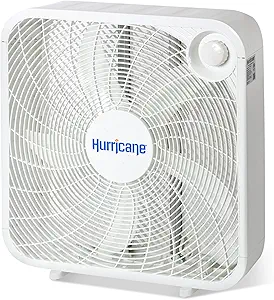 |
| Most Popular A crowd favorite that many people choose with confidence | Comfort Zone 20" Box Fan CZ200A |  |
| Best Seller A high-volume bestseller chosen again and again | Amazon Basics 20-Inch Box Fan DK1901 |  |
Genesis 20" Box Fan G20BOX

| Power Source | Corded Electric |
|---|---|
| Number of Speeds | 3 |
| Wattage | 60 watts |
| Blade Length | 20 inches |
| Motor Type | Copper |
The Genesis 20" Box Fan is a simple, high-velocity floor fan built around a durable copper motor and a 20-inch blade head that can sit on the floor, a table, or a windowsill for spot cooling. It uses a standard two- or three-prong cord and a front knob to switch among three speed settings, so setup is plug-and-play with no complex controls. The fan's lightweight plastic body and built-in handle make it easy to move between rooms, and the copper motor and ETL listing indicate a focus on reliable, long-running performance and basic safety features. Practical benefits include strong airflow for bedrooms or small offices and low power draw at 60 watts. Limitations are a straightforward, manual interface with no oscillation or remote control and a plastic housing that can be noisier on the highest setting compared with bladeless or pedestal fans with more refined engineering.
Best for: Buyers who want a straightforward, powerful fan they can move easily between a bedroom, office, or window and expect reliable, no-frills cooling without advanced controls.
Less Ideal for: If you need quiet, distributed airflow with oscillation, programmable timers, or smart controls, this basic box fan is not the best choice.
- Durable copper motor intended for longer service life
- Large 20-inch head delivers strong, high-velocity airflow
- Compact, lightweight build with a carry handle for easy repositioning
- Simple plug-and-play operation with three clearly labeled speeds
- ETL listed and includes overload safety protection in the plug
- No oscillation or directional pivoting for broader room coverage
- Manual knob control only, no timer or remote features
- Plastic grille and housing may transmit motor noise at higher speeds
Verdict: Choose this Genesis 20" Box Fan if you want a portable, no-nonsense high-velocity fan built for dependable, strong spot cooling.
Vornado Model 80X

| Power Source | dc |
|---|---|
| Number of Speeds | 99 |
| Wattage | 75 watts |
| Motor Type | brushless |
The Vornado Model 80X is a performance-focused 20-inch box fan built to move a lot of air while still offering precise control. It uses a brushless DC motor and Vornado vortex-style airflow to circulate air across a room rather than just providing a narrow breeze, and the integrated kickstand lets you aim airflow vertically for targeted cooling or window-to-room circulation. The touch controls and digital display with a 12-hour timer make it easy to dial in quiet background speeds or higher output when you need strong airflow, and the removable grille simplifies cleaning. At 75 watts and 1400 rpm it delivers notable power for a floor-mounted box fan without relying on a large footprint. Expect solid build quality and straightforward maintenance, though the fan is designed for indoor floor mounting rather than dedicated window installation so you may need to position it carefully to pair with a window for exhaust or intake setups.
Best for: Buyers who prioritize powerful, controlled airflow and durable performance for circulating air in living spaces and who plan to position the fan near a window or doorway for intake or exhaust use.
Less Ideal for: People seeking a compact, lightweight fan specifically engineered for mounting directly in a window or for casual portable use should consider a dedicated window fan or smaller portable model instead.
- High-velocity vortex airflow for whole-room circulation
- Brushless DC motor for efficient, durable operation
- Digital touch controls with 12-hour timer and many speed levels
- Removable grille for easier cleaning and maintenance
- Designed as a floor-mounted box fan rather than a purpose-built window fan
- Larger and heavier than basic box fans, making placement and storage less convenient
Verdict: Choose the Model 80X when you want a durable, high-performance box fan that delivers strong, controllable whole-room airflow for window-assisted ventilation.
Hurricane Classic 20in Floor Box Fan

| Number of Speeds | 3 |
|---|---|
| Noise Level | 45 db |
| Wattage | 60 watts |
| Air Flow Capacity | 2400 cfm |
| Motor Type | DC |
The Hurricane Classic 20-inch floor box fan is a straightforward, high-airflow unit intended to move large volumes of air in rooms, garages, or workshops. It uses a DC motor and polymer blades to produce up to 2400 CFM at about 1100 RPM while offering three push-button speed settings that are relatively quiet at the reported 45 dB level. Typical use cases are boosting cross-ventilation, exhausting stale air, or creating a strong cooling breeze near seating or work areas. The fan's compact, slim frame and included cord make it easy to reposition and store when not in use, and the durable plastic construction keeps weight and maintenance low. Because it is a floor-mounted box fan, it does not include mounting hardware for windows and lacks oscillation or advanced controls, so directing airflow requires manual placement and aiming. For buyers who prioritize raw airflow and a simple, durable design, this model provides effective ventilation without extra features or complexity.
Best for: Buyers who want a simple, effective fan to maximize air movement and improve ventilation in rooms or workspaces without paying for extra smart features.
Less Ideal for: People seeking a window-mounted fan with built-in mounting hardware, oscillation, or advanced controls should consider other designs tailored to window installation.
- High airflow rated at 2400 CFM for strong room circulation
- Three quiet speed settings with push-button control
- DC motor for efficient, consistent performance
- Slim, lightweight plastic design is easy to move and store
- No oscillation or window-mount hardware limits automated directional control
- Basic controls and feature set without timers or remote
Verdict: Choose this fan when you need straightforward, high-volume indoor airflow and reliable ventilation in a portable, no-frills package.
Ratiyae 20" Classic Box Fan

| Power Source | ac |
|---|---|
| Number of Speeds | 3 |
| Mounting Type | Window Mount |
| Indoor Outdoor Usage | Indoor, Outdoor |
| Material | Plastic |
This 20-inch Ratiyae box fan is a straightforward window-capable fan aimed at basic ventilation and spot cooling. It uses simple push-button manual controls to switch between three quiet speed settings, and the weather-resistant motor makes it safe for window placement in mild outdoor conditions. The plastic housing keeps weight low and the built-in carry handle makes it easy to move between rooms or set on a table or floor. The front grill and blades are removable without tools, which simplifies cleaning and maintenance. Expect effective airflow for small to medium rooms and a noticeable boost to an existing air conditioner when positioned in a window. Limitations are its basic feature set — there is no remote, timer, or advanced airflow direction controls — and plastic construction that may not feel as durable as higher-end metal fans. For buyers wanting a no-frills, portable window fan that is easy to maintain, this model covers the essentials reliably.
Best for: Buyers looking for an inexpensive, easy-to-use window-capable fan to improve air circulation in small to medium rooms and who prioritize portability and simple maintenance.
Less Ideal for: People who want premium build quality, advanced controls, or smart features should consider higher-end fan models instead.
- Weather-resistant motor suitable for window use
- Three quiet speed settings for adjustable airflow
- Lightweight, portable design with built-in carry handle
- Tool-free removable front grill and blades for easy maintenance
- Basic feature set with no remote, timer, or advanced controls
- Plastic construction may feel less durable than metal alternatives
Verdict: A budget-friendly, portable window-capable box fan that delivers reliable, no-frills airflow and easy maintenance for small to medium rooms.
Hurricane Classic 20" Floor Fan

| Air Flow Capacity | 2400 cfm |
|---|---|
| Number of Speeds | 3 |
| Wattage | 55 watts |
| Noise Level | 42 db |
| Motor Type | Brushed AC |
The Hurricane Classic 20" Floor Fan is a straightforward box fan built to move a lot of air without fuss. It uses a brushed AC motor and five plastic blades to produce up to 2400 CFM and about 1100 RPM on high, making it useful for circulating air in rooms, ventilating basements or garages, or pushing air through a window. Controls are simple push-button settings for three speeds and the fan sits freestanding for quick placement or temporary window use. At 55 watts and an ETL listing, it is energy efficient and meets safety standards for indoor use. The unit is lightweight and compact enough to store when not in use, and the 5-foot cord and NEMA 5-15 plug give flexible placement. Expect a baseline noise level around 42 dB at lower speeds with louder output on high and no advanced features such as timers, oscillation, or remote control. For buyers who want a high-airflow, no-frills fan that is easy to position and service, this model delivers consistent performance; those seeking quieter operation, smart controls, or multi-speed precision may want different designs.
Best for: Buyers who prioritize a dependable, high-airflow fan for ventilating rooms or window-assisted cross-ventilation and who value straightforward, serviceable equipment over extra features.
Less Ideal for: People who need ultra-quiet operation, smart controls, or built-in oscillation and timers should consider more feature-rich or quieter models instead.
- High maximum airflow rated at 2400 CFM for strong room circulation
- Simple three-speed push-button control for easy operation
- ETL listed and uses modest power draw (55 watts)
- Lightweight, slim freestanding design that is easy to move and store
- No oscillation, timer, or remote control features
- Brushed AC motor and plastic blades can be louder at top speed compared with specialized quiet fans
Verdict: Choose this fan when you need a reliable, high-airflow, no-frills box fan to move a lot of air for window or room ventilation.
Comfort Zone 20" Box Fan CZ200A

| Power Source | Corded Electric |
|---|---|
| Number of Speeds | 3 |
| Air Flow Capacity | 901.8 cfm |
| Noise Level | 63.3 db |
| Motor Type | Brushless |
The Comfort Zone 20" Box Fan (CZ200A) is a straightforward, no-frills floor or window fan built to push a lot of air. Its 20-inch five-blade design and brushless motor deliver high airflow (listed at about 902 CFM) while three rotary speed settings let you dial in a gentle breeze or a powerful blast for fast room circulation. The fan ships fully assembled, has a built-in carry handle for easy repositioning, and a 6-foot cord with a fused plug for safer operation. The metal powder-coated frame and safety grill give it a more durable feel than typical all-plastic box fans. Expect typical box-fan noise at higher speeds given the rated 63.3 dB, and the rotary knob is basic rather than precise. It works well as a window fan for intake or exhaust, to boost AC efficiency, or to ventilate garages and workshops, but it does not have oscillation, remote control, or advanced speed presets. For buyers who prioritize simple, high-volume airflow and a sturdy build, this fan does the job reliably; if you need quiet high-efficiency operation or smart controls, look elsewhere.
Best for: Buyers who want a proven, high-volume box fan to move air quickly in windows, bedrooms, garages, or workshops and who value straightforward, durable hardware over smart features.
Less Ideal for: People seeking whisper-quiet operation, programmable timers, or smart/remote controls should consider other models with quieter motors and more features.
- High airflow rated around 901.8 CFM for fast room circulation
- Sturdy powder-coated steel frame and safety grill increase durability
- Lightweight with integrated carry handle for easy repositioning
- Comes fully assembled with a long 6-foot cord and fused plug
- Louder operation at higher speeds (about 63.3 dB)
- No oscillation, timer, or remote control for convenience
- Basic rotary control limits fine speed adjustment
Verdict: Choose this fan if you need a simple, rugged 20-inch box fan that delivers very high airflow for window intake/exhaust and fast room ventilation.
Amazon Basics 20-Inch Box Fan DK1901

| Number of Speeds | 3 |
|---|---|
| Wattage | 67 watts |
| Number of Blades | 5 |
| Power Source | Corded Electric |
| Voltage | 120 volts |
This Amazon Basics 20-inch box fan is a straightforward floor/table fan designed to move air in small to medium rooms. It offers three front-facing speed settings that are easy to change with a knob, and the five-blade plastic fan produces noticeable airflow on high while remaining light enough to carry between rooms using the built-in handle. The fan is freestanding with optional large feet for extra stability and a recessed cord wrap for tidier storage. Typical uses include boosting window ventilation, circulating air in bedrooms or home offices, and supplementing a central system on hot days. The plastic construction keeps weight and cost down but means the unit is basic—there are no timers, oscillation, or advanced controls. Noise at higher speeds is audible, so it may not be ideal for very quiet sleeping environments. For buyers who want a reliable, no-frills fan to improve window airflow or add cross-ventilation, this model covers the essentials with minimal fuss.
Best for: Buyers who want a reliable, easy-to-use fan to boost window ventilation and circulate air without complexity or setup time.
Less Ideal for: If you need a whisper-quiet bedroom fan, oscillation, smart controls, or a heavier-duty metal build, consider other designs better suited to those priorities.
- Three straightforward speed settings for adjustable airflow
- Lightweight design with a carrying handle for easy room-to-room portability
- Freestanding box shape and optional large feet provide stable placement
- Recessed cord wrap keeps storage tidy
- Wide 20-inch blade span moves a good volume of air for its class
- All-plastic construction feels basic compared with metal fans
- No oscillation, timer, or advanced controls
- Higher speed produces noticeable noise
Verdict: A simple, portable 20-inch box fan that reliably improves window airflow for buyers who prioritize straightforward, risk-free performance.
Choosing the Right Box Fan for Window: Key Factors to Consider
Airflow and Rated CFM
Airflow determines how quickly a box fan can move air into or out of a room. Higher cubic feet per minute ratings generally translate to faster cooling or more effective exhaust, but real-world performance depends on window sealing and placement.
When using a fan in a window, consider both peak CFM and how the fan performs at lower speed settings. A fan that still moves meaningful air at medium or low settings will be more comfortable for longer use and often produce less noise.
Fit, Mounting Options, and Window Type
Not all box fans fit every window. Check the fan's dimensions and available mounting hardware against your window sash, opening height, and sill depth. Some models include adjustable brackets, removable grilles, or reversible frames that make mounting easier.
Window type matters: single- and double-hung windows, casement windows, and sliding windows each present different challenges for securing a fan. A secure, vibration-free mount reduces noise and prevents the fan from shifting during operation.
Noise Output and Speed Control
Noise is a major comfort factor when a fan runs near sleeping areas or workspaces. Look for measured decibel ratings when available, and test or read reports on perceived sound at different speeds. Multiple discrete speed settings or a variable control help you balance airflow and noise.
Lower-speed performance matters because a fan that delivers steady airflow quietly is often more usable overnight or during conversations than one that only achieves adequate airflow at a loud top speed.
Build Quality and Weather Resistance
Window fans are exposed to sunlight, humidity, and dust when installed. Durable housings, corrosion-resistant fasteners, and sturdy grilles extend service life. Removable front grilles for cleaning and simple motor access for maintenance are helpful features.
Also consider how the fan stores when not in use. A stackable or compact profile makes seasonal storage easier and reduces the chance of damage between uses.
Energy Use and Motor Efficiency
Energy consumption affects operating cost, especially if you run the fan for long periods. Compare wattage at typical speeds and look for motors designed for continuous operation. Efficient motors produce less heat and usually last longer under sustained use.
Some fans include low-power modes or eco settings that maintain ventilation while minimizing electricity use, which is valuable for overnight or unattended ventilation runs.
Safety Features and Controls
Safety is important for any window-mounted electrical device. Features to look for include grounded plugs, thermal overload protection, stable mounting hardware, and grills that prevent finger access to the blades. Intuitive, accessible controls reduce the temptation to reach around a running fan and risk contact.
Simple, labeled controls also make it faster to adjust speeds or reverse airflow without taking the unit down from the window.
Which Direction Should the Fan Face?
Decide whether you want to bring cool air in or exhaust warm air out. In daytime heat, exhaust mode often works best by pulling hot indoor air to the outside. During cooler evenings, intake mode draws cooler outside air into the room. Some box fans are reversible or have reversible housings to make this switch easier.
If you try to do both simultaneously with multiple fans, place the intake fan on the shaded side of the house and the exhaust fan on the sunny side to create a cross-breeze.
- Exhaust mode helps lower indoor heat when outdoor air is warmer than indoors.
- Intake mode works well at night or in early morning when outside air is cooler.
- Reversible housings simplify switching between modes without remounting.
Measuring Your Window and Preparing a Mount
Measure window opening height and sill depth before choosing a fan. Confirm the fan's frame dimensions and note whether mounting brackets or extension panels are included. Preparing a cushion of foam or weatherstripping can help close gaps and reduce vibration.
For temporary installations, removable brackets or tension-fit panels let you install and remove the fan without tools. If you need a semi-permanent solution, consider lightweight brackets that screw into the sash or frame, taking care not to damage finishes or compromise window operation.
- Measure twice: height, width, and sill thickness matter.
- Use weatherstripping to seal gaps and cut drafts.
- Test operation before final fastening to ensure the window still opens smoothly.
Maintaining and Cleaning a Window Box Fan
Regular maintenance keeps airflow strong and extends motor life. Clean the front and rear grilles periodically to remove dust buildup. Many models allow the front grille to be removed so you can access the blades for a deeper clean with a damp cloth.
Check and tighten mounting hardware each season. Inspect cords and plugs for wear before reinstalling the fan, and store the unit in a dry place when not in use to prevent corrosion and motor issues.
- Vacuum or wipe grilles monthly during heavy-use seasons.
- Unplug before cleaning and avoid getting electrical components wet.
- Store in a cool, dry place when not in use.
Reducing Noise and Vibration
Vibration and noise often come from loose mounting or warped grilles. Use foam pads or rubber strips between the fan frame and window to dampen vibration. Ensure the fan is level and secured to prevent humming or rattling.
If the fan lacks a variable speed control, run it on medium to find the best balance of airflow and noise. Sometimes angling the fan slightly toward the center of the room improves perceived airflow without increasing speed.
- Use soft mounting pads to cut vibration transfer.
- Tighten fasteners and check grille alignment.
- Operate at lower speeds when quiet is more important than peak airflow.
Using Box Fans with Other Ventilation
Box fans work well alongside ceiling fans, window air conditioners, or whole-house ventilation when used thoughtfully. For example, use a window fan to exhaust hot attic air while a ceiling fan circulates the incoming cooler air for better distribution.
Avoid fighting installed HVAC systems. If you run the fan with a conditioned-space air conditioner, position the fan to support airflow paths rather than oppose them, which can create backpressure and reduce efficiency.
- Coordinate intake and exhaust placements for cross-ventilation.
- Use fans to pre-ventilate spaces before turning on HVAC for peak comfort.
- Avoid placing window fans where they block thermostat sensors or airflow from HVAC vents.
How We Chose the Best Box Fan for Window
We focused on criteria that matter specifically for box fans intended to be used in windows. Primary filters included measured airflow or manufacturer airflow ratings, mounting and fit options for standard window widths and sashes, and noise output at typical operating speeds. We prioritized units with accessible controls and durable housings because window fans are often moved, stored, and remounted seasonally. Energy efficiency and motor durability were considered to project longer-term ownership costs and reliability. Excluded from consideration were specialty inline or whole-house ventilators and fans designed exclusively for floor-only use. We also set aside units that lack clear mounting hardware or have extremely high reported noise levels, since those characteristics reduce real-world usefulness for window applications. The final shortlist balances airflow, installation flexibility, and everyday usability for typical window-mounted cooling and exhaust tasks.
Our full evaluation process is outlined in our review methodology.
FAQ
Can a box fan for window cool a whole house?
A single window box fan is best at moving air in a single room or creating localized cross-ventilation. Multiple fans placed strategically can help ventilate several rooms, but box fans are not a substitute for whole-house cooling systems.
How do I secure a box fan in a sliding window?
Sliding windows typically require a bracket or extension panel to hold a box fan securely. Measure the opening and use weatherstripping to seal gaps. Ensure the fan sits level and cannot slide when the window is moved.
Is it safe to leave a window box fan running overnight?
Many box fans are safe for overnight use if they have a grounded plug and intact cord. Still, inspect the fan for damage before prolonged operation, and avoid running units that produce excessive heat or unusual odors. Using lower speeds can reduce wear and noise during the night.
Will a box fan help with smoke or odors?
A window box fan can exhaust smoke and odors from a room by moving contaminated air outside, provided the fan is positioned and sealed properly. For particulate smoke, consider combining the fan with a portable air cleaner to capture fine particles.
How often should I clean a window box fan?
Clean visible dust from grilles and blades every few weeks during heavy use, and perform a deeper cleaning at the start and end of the season. Regular cleaning maintains airflow and reduces strain on the motor.
Final Verdict
When choosing a box fan for window use, prioritize airflow suited to your room size, a secure mounting method for your window type, and acceptable noise levels for the intended space. Durable construction and energy-efficient motors make seasonal use less of a hassle and reduce long-term maintenance. Balance the tradeoffs between maximum CFM and quiet operation based on when and where you will run the fan. Focus on fit and mounting first, then use the scoring criteria to compare candidates and select the unit that best matches your installation and comfort priorities.