
Note: This article contains affiliate links. If you click on these links and make a purchase, we may earn a small commission at no extra cost to you. This helps support our research and content. Read our full affiliate disclosure here.
Choosing the right fan for your home gym matters more than you might think. The right model can improve comfort during intense workouts, reduce humidity buildup, and help maintain focus by keeping you cool. Because home gyms vary in size and layout, from small corner setups to full spare-room studios, this guide focuses on options that perform well across common home-gym scenarios. We shortlisted seven top-performing fans that prioritize airflow, noise control, and durability. Below you will find practical guidance on what matters, how we evaluated each option, and the tradeoffs to expect when matching a fan to your space and routine.
Top Picks at a Glance
| Best Overall The best all-around choice for most situations | Vornado FLY MAX Floor Fan |  |
| Best Quality Built to a higher standard if you want something more solid | iLIVING 30-Inch Pedestal Fan ILG8P30-72 |  |
| Best Value The sweet spot between price and what you get | Amazon Basics 20" Industrial Floor Fan FN206 |  |
| Best Budget The cheapest option that still gets the job done reliably | Honeywell TurboForce HT-900 |  |
| Top Rated A top-rated pick with lots of positive feedback | DREO TurboPoly Fan 513S |  |
| Most Popular A crowd favorite that many people choose with confidence | DREO Tower Fan 307 |  |
| Best Seller A high-volume bestseller chosen again and again | Hurricane Pro 20" Wall Fan |  |
Vornado FLY MAX Floor Fan

| Air Flow Capacity | 2300 cfm |
|---|---|
| Number of Speeds | 4 |
| Noise Level | 45 db |
| Wattage | 75 watts |
| Motor Type | Brushless |
The Vornado FLY MAX is a purpose-built high-velocity floor fan geared toward workouts and active spaces, delivering up to 2300 FPM of directed airflow across four speed settings. It is typically used in home gyms, garages, or near cardio equipment to simulate outdoor wind resistance and keep you cool during intense sessions. The fan has a 180-degree pivoting head for precise targeting, a brushless motor for steady performance, and an omnidirectional remote with a magnetic cradle and straps so you can adjust settings without stopping your routine. Its blower-style design and non-slip base help it stay stable while producing strong, whole-room circulation when needed. Practical benefits include the ability to tailor airflow intensity for warmups through high-intensity intervals and the convenience of remote control placement on exercise equipment. Trade-offs are modest footprint but still a louder output at higher speeds compared with low-speed circulation fans, and it is intended for indoor use only which limits outdoor versatility.
Best for: Users building or equipping a home gym who want a compact, powerful fan to deliver targeted cooling during intense workouts and training sessions.
Less Ideal for: People seeking a nearly silent bedroom fan for overnight use or buyers who need a weatherproof outdoor fan.
- Very high airflow (2300 FPM) suited to intense workouts and cooling near cardio equipment
- Four speed settings let you match airflow to different training intensities
- 180-degree tilt and pivoting head enable targeted airflow direction
- Includes omnidirectional remote with magnetic cradle and straps for hands-free control
- Not rated for outdoor use, so it cannot be left in garages or patios exposed to weather
- Higher speeds produce noticeable noise compared with quieter room circulation fans
Verdict: Buy this fan if you want a compact, gym-focused floor fan that delivers strong, directional airflow and remote convenience for training sessions.
iLIVING 30-Inch Pedestal Fan ILG8P30-72

| Power Source | Electric |
|---|---|
| Number of Speeds | 3 |
| Wattage | 220 watts |
| Air Flow Capacity | 7261 cfm |
| Voltage | 120 |
The iLIVING ILG8P30-72 is a commercial-grade 30-inch pedestal fan built to move large volumes of air in demanding indoor spaces. It uses a three-blade aluminum propeller and a sturdy alloy steel housing with a powder-coated safety grille to meet OSHA and UL standards, and it mounts freestanding with adjustable height and tilt for aimed airflow. Three speed settings are controlled by a pull chain and the brushed motor produces peak airflow rated at 7261 CFM, which is useful for circulating air across a home gym, garage, or workshop. Expect a robust, industrial feel and straightforward setup; the fan is portable but heavy and has a louder noise profile around 51 dB at typical settings. Power connections are standard NEMA 5-15P and the unit runs on 120V at about 220 watts. The practical benefits are strong, focused cooling and durable construction for frequent use, while limitations are its size, weight, and industrial appearance which may be overkill in small or quiet home environments.
Best for: Someone outfitting a home gym or workout area who prioritizes powerful, reliable air movement to control temperature and remove odor or moisture during heavy workouts.
Less Ideal for: Buyers wanting a compact, quiet fan for small bedrooms or low-noise living spaces should consider smaller, quieter models instead.
- Very high airflow capacity (7261 CFM) for rapid cooling and circulation in large spaces
- Heavy-duty alloy steel housing and OSHA-compliant safety grille for durability and safety
- Adjustable height and tilt let you aim airflow where needed
- Three-speed control with simple pull-chain operation and standard 120V power plug
- Large and heavy, which makes repositioning more effortful
- Brushed motor and industrial design produce noticeable noise compared with quiet home fans
Verdict: Choose this fan if you need industrial-strength airflow to keep a home gym cool and ventilated during intense workouts.
Amazon Basics 20" Industrial Floor Fan FN206

| Power Source | Corded Electric |
|---|---|
| Wattage | 125 watts |
| Air Flow Capacity | 3542 cfm |
| Number of Speeds | 3 |
| Specification Met | ETL |
This Amazon Basics 20" industrial floor fan is a straightforward high-velocity unit built for moving large volumes of air in garages, workshops, and home gyms. Its 125W motor and three heavy-duty aluminum blades produce up to 3,542 CFM at the highest setting, which helps cut down stuffy heat and improves circulation across a wide area. The fan is free-standing with an adjustable tilt head and three speed settings controlled by a rotary knob, so you can aim strong airflow where you need it during workouts or cooldowns. Metal housing and aluminum blades give it a durable, factory-quality feel but also make it louder and heavier than lightweight plastic fans. Assembly is tool-free and the ETL listing provides basic safety reassurance for indoor use. Expect powerful, consistent air movement suited to large open rooms, while smaller bedrooms or noise-sensitive spaces may find it overpowered and noisy.
Best for: Buyers who prioritize powerful, reliable airflow and durable construction to cool and ventilate a home gym, garage, or large workout space rather than silence or portability.
Less Ideal for: Those who need a quiet fan for small rooms, shared apartments, or bedside use should consider lower-noise or smaller designs instead.
- Very high airflow output (3,542 CFM) for rapid circulation in large spaces
- Durable metal construction and aluminum blades suited to heavy use
- Adjustable tilt head lets you direct airflow to workout zones
- Simple three-speed rotary control for quick adjustments
- ETL listed for basic safety compliance
- Metal build and powerful motor make it louder than smaller consumer fans
- Heavier, less portable than plastic or compact models
Verdict: If you need aggressive, wide-coverage airflow and a rugged metal fan for a home gym, this 20-inch industrial floor fan delivers the power and durability to keep workouts cool.
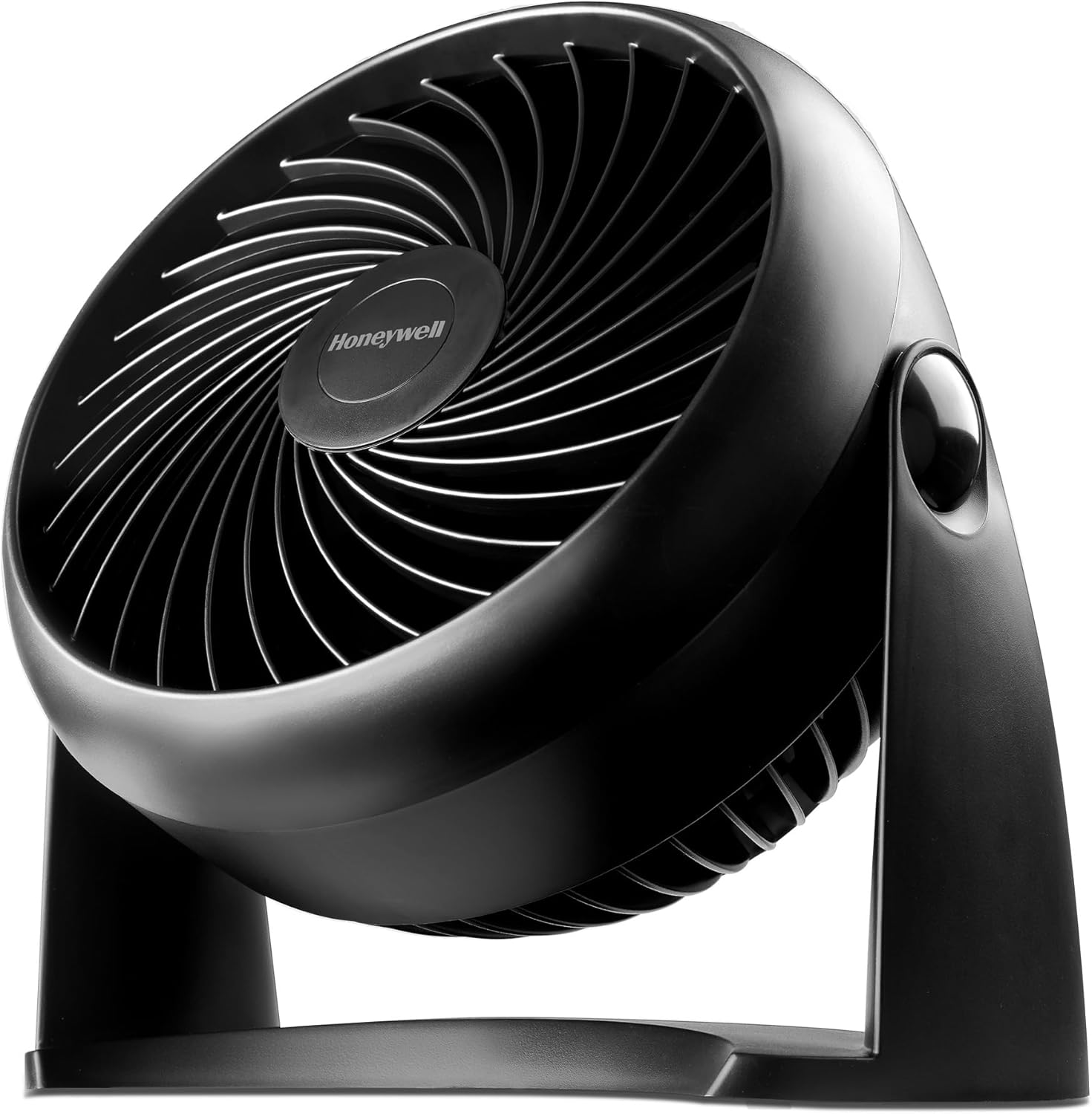
Honeywell TurboForce HT-900
| Number of Speeds | 3 |
|---|---|
| Air Flow Capacity | 185 cfm |
| Wattage | 35 watts |
| Motor Type | brushless |
| Installation Type | Tabletop or Wall Mount |
The Honeywell TurboForce HT-900 is a small tabletop air circulator designed to move a surprising amount of air for its size, making it useful for focused cooling in a home gym or workout corner. It runs on a corded 110V connection and offers three push-button speeds plus a 90-degree pivoting head so you can aim airflow at a training zone, mat, or equipment. The aerodynamic turbo design and brushless motor deliver up to 185 cfm, which is effective at improving ventilation or providing direct cooling during short, intense sessions. It is plastic-bodied and lightweight so you can reposition it or wall-mount it where needed, and Honeywell says it is quieter than comparable fans, which helps during guided workouts or video sessions. Limitations include its small footprint and single-head output, so it is best for personal or small-zone cooling rather than circulating air for a large garage gym or open-plan space.
Best for: Buyers on a budget who need a portable, directional fan to cool a single workout zone or small home gym area during short sessions.
Less Ideal for: Those outfitting a large garage gym, multi-person training area, or anyone who needs whole-room circulation and higher airflow coverage.
- Compact and lightweight for easy placement or wall mounting
- Three speeds and 90-degree pivot allow targeted airflow to a workout area
- Aerodynamic turbo design with brushless motor produces strong 185 cfm airflow
- Quieter operation compared with similar-sized circulators, good for guided workouts
- Small coverage area unsuitable for large or multiple-person gym spaces
- Plastic construction may feel less durable in heavy-use environments
Verdict: A budget-friendly, compact fan that delivers strong targeted airflow for cooling a single home-gym zone during workouts.
DREO TurboPoly Fan 513S

| Power Source | dc |
|---|---|
| Number of Speeds | 8 |
| Air Flow Capacity | 1100 cfm |
| Noise Level | 25 db |
| Wattage | 36 watts |
The DREO TurboPoly Fan 513S is a pedestal air circulator built to move large volumes of air quietly and with flexible control options. It uses a brushless DC motor and a five-blade metal rotor to produce up to 1100 CFM while operating at about 25 dB on low settings, so it can cool a workout area without adding distracting noise. Height adjusts from roughly 37 to 43 inches and the head offers broad horizontal and vertical sweep so you can target a bench or spread air across a whole room. Controls include an app, remote, touchpad and voice assistants for hands-free changes, plus eight speeds and six modes for fine-tuning airflow. Practical benefits include low energy draw (36 W), a timer, and a display to check settings, and the fan is designed for routine disassembly and cleaning. Trade-offs are typical for focused circulators: it is a floor pedestal form factor that requires floor space and it lacks integrated air filtration, so it will not replace a purifier in dusty gyms.
Best for: Anyone setting up a home gym who prioritizes a dependable, quiet fan that can move lots of air and be controlled remotely or by voice during workouts.
Less Ideal for: People who need a combined fan and air purifier or who must conserve every square foot and cannot accommodate a floor-standing unit.
- High airflow up to 1100 CFM for effective whole-room circulation
- Brushless DC motor keeps noise low (around 25 dB) for uninterrupted workouts
- Multiple control methods (app, remote, touchpad, voice) for convenient adjustments
- Wide horizontal (120°) and vertical (105°) oscillation to cover large areas
- Energy-efficient operation at 36 watts with timer and multiple speed/mode options
- Pedestal footprint requires floor space and may not suit tight gym layouts
- No built-in air filtration, so it only circulates existing air rather than cleaning it
Verdict: A quiet, energy-efficient pedestal circulator that reliably delivers high airflow and flexible remote/voice control for home gym cooling.
DREO Tower Fan 307

| Number of Speeds | 8 |
|---|---|
| Modes | Normal, Natural, Sleep, Auto |
| Oscillation | 90° |
| Wattage | 36 watts |
| Motor Type | brushless DC motor |
The DREO Tower Fan 307 is a compact 36-inch oscillating floor fan built around an upgraded brushless DC motor that pushes strong airflow while keeping noise low. It offers eight speed settings and four modes including Normal, Natural, Sleep, and Auto, so you can dial in anything from a gentle bedroom breeze to a higher-velocity boost; the unit supports remote and touchpad control for easy adjustments. With 90 degree oscillation and a claimed airflow capacity for broad room coverage, it pairs well with an air conditioner to circulate cool air more effectively. Practical touches include a timer, removable rear grille and impeller for easier cleaning, and ETL safety certification. On the downside the fan runs on standard corded power and lists voltage at 240 volts which may matter for some regions, and the plastic construction means it is lightweight but less premium-feeling than metal alternatives. For buyers focused on quiet, adjustable oscillating cooling in bedrooms or living rooms, this model balances airflow and low noise in a small footprint.
Best for: Buyers who want a quiet, adjustable tower fan that delivers wide oscillating coverage and easy remote control for bedrooms and living spaces backed by strong customer feedback.
Less Ideal for: People seeking a heavy-duty, industrial-strength fan or a premium metal build should consider sturdier floor or bladeless alternatives.
- Brushless DC motor for efficient, high-velocity airflow with lower noise
- Eight speed levels and four modes for flexible comfort settings
- 90° oscillation spreads air across a wide area for better room coverage
- Includes remote and touch controls plus a timer for convenient operation
- Removable rear grille and impeller simplify cleaning and maintenance
- Plastic construction feels less durable compared with metal fans
- Corded operation and listed voltage may limit regional compatibility
Verdict: A feature-rich, quiet oscillating tower fan that gives flexible speeds and modes for effective bedroom and living-room cooling.
Hurricane Pro 20" Wall Fan

| Power Source | Corded Electric |
|---|---|
| Number of Speeds | 3 |
| Air Flow Capacity | 4500 cfm |
| Wattage | 140 watts |
| Motor Type | Brushless |
The Hurricane Pro 20" wall fan is a heavy-duty, wall-mounted blower built to move a lot of air in garages, greenhouses, and home gyms. It produces up to 4500 CFM at 1450 RPM from a three-blade aluminum propeller and offers three push-button speeds plus adjustable tilt and oscillation to spread airflow across a workout area. The fan is a rugged, all-metal design with a powder-coated finish, a thermally protected brushless motor and overload protection for safer continuous use, and it includes a six-foot cord and heavy-duty mounting bracket for straightforward installation. In practice it provides strong, targeted airflow that can cool equipment and people during intense sessions, but its industrial output is loud compared with small circulating fans and it requires a permanent wall mount rather than portable placement. Control is basic with buttons and an app-listed control method but no remote, so expect simple operation rather than smart automation.
Best for: Buyers who prioritize reliable, high-volume airflow and a sturdy, safety-minded design for a dedicated home gym or workshop where a permanently mounted solution is acceptable.
Less Ideal for: If you need a quiet, portable fan to move between rooms or for a bedroom, this industrial-style wall fan is not a good match.
- Very high airflow capacity (4500 CFM) suitable for cooling larger or active spaces
- Robust all-metal construction and aluminum blades for durability in heavy-use environments
- Thermally protected brushless motor and overload fuse for safer continuous operation
- Wall-mount design keeps floor space clear and directs airflow where needed
- Three speed settings and oscillation let you tailor coverage across a room
- Can be significantly louder than smaller circulation fans at high speed
- Wall-mounted installation limits placement flexibility compared with portable fans
- Controls are basic push-button style with limited smart features
Verdict: Choose this fan if you want a dependable, high‑volume wall-mounted blower that delivers powerful cooling and a rugged, safety-focused build for a home gym.
Choosing the Right Fan for Home Gym: Key Factors to Consider
Airflow and Coverage
How much air a fan moves and how broadly it distributes that air are the most important factors for a home gym. Higher cubic feet per minute (CFM) ratings generally indicate stronger airflow, but blade design, housing shape, and oscillation determine whether that air reaches a treadmill user, a weight bench, or multiple people at once.
Consider whether you need directional airflow aimed at a single workout zone or wide circulation that refreshes the whole room. A fan with adjustable tilt, oscillation, or multiple speed settings gives you more control over flow patterns. In smaller spaces, a lower CFM with focused delivery can feel more effective than a high-CFM unit that pushes air but does not direct it toward people.
Noise and Acoustic Comfort
Noise level is critical because loud fans can disrupt concentration, podcasts, or online workout classes. Look beyond peak decibel claims and consider the character of the sound. A steady, low-frequency hum may be less distracting than an uneven, high-pitched rattle at similar decibel levels.
Variable-speed control and quiet motor designs help tailor performance for different workout intensities. If you often train early morning or late at night, prioritize quieter operation at typical running speeds. Check for vibration-resistant mounts and solid housing, which reduce rattles and extend usable life in a busy exercise space.
Adjustability and Mounting Options
Home gyms come in many layouts, so flexibility in positioning matters. A fan that can be floor-placed, clipped to equipment, or wall-mounted provides more installation choices. Adjustable height, tilt, and oscillation allow you to aim air at different exercises, whether you are on a bike, lifting weights, or stretching on a mat.
Mounting versatility also affects safety and footprint. Wall-mounted or clamp-style options save floor space and keep the unit clear of sweat, dust, and moving equipment. Confirm that the mounting hardware is sturdy and that the fan's controls remain accessible when installed.
Durability and Maintenance
Equipment in a home gym faces dust, perspiration, and frequent use, so build quality and ease of maintenance are important. Sturdy housings, corrosion-resistant fasteners, and sealed motor compartments increase longevity in humid or sweaty environments.
Consider how easy it is to clean the fan. Models with removable grills or simple snap-together assemblies make it straightforward to clear dust and lint, which preserves airflow and reduces strain on the motor. Also check for filters or grille designs that limit dust buildup without impeding air volume.
Control Features and Usability
Controls affect everyday usability. Simple dial or push-button controls are reliable, while digital interfaces, remote controls, and smartphone connectivity add convenience. Timers and preset modes can be useful for interval workouts or when you want the fan to run for a specific duration after finishing a session.
Ergonomic placement of buttons and clear speed indicators matter when you need to change settings mid-workout. Battery-backed remotes or saved presets are helpful if you frequently switch between training styles and want consistent airflow quickly.
Energy Use and Running Cost
Fans generally use less electricity than HVAC systems, but energy draw still matters if you run a fan for long workouts or extended recovery sessions. Look at wattage at typical operating speeds and any energy-saving modes or brushless motor designs that reduce consumption.
Lower power use can also reduce heat output from the fan itself. For home gyms where multiple fans might be used, choosing models with efficient motors and variable-speed control helps manage long-term running costs without sacrificing performance.
Sizing Your Fan to Room and Setup
Match fan capacity to the volume of your gym space rather than just floor area. High ceilings require more powerful airflow to move air down to the workout zone. Measure ceiling height and account for obstacles such as racks, machines, or furniture that interrupt airflow.
In compact home gyms, a focused floor fan placed near the active zone is often more effective than a large circulating fan. For multi-user or open layouts, choose a model with wider coverage or multiple speed levels to maintain comfort across the space.
- Small rooms: focus on directional airflow and portability
- High ceilings: prioritize higher CFM or ceiling-mounted options
- Multi-user spaces: prefer oscillation and wider distribution
Placement, Safety, and Mounting Best Practices
Position fans to direct airflow toward people, not obstacles. Avoid placing units directly behind heavy equipment where they can draw dust from surfaces. When mounting near weight racks, ensure the fan is at a safe distance to prevent contact during exercises.
Use wall or clamp mounts to keep floor space clear and reduce trip hazards. Securely fasten any mounted fan and check mounting points periodically, especially in spaces with vibration from cardio machines.
- Keep fans away from direct sweat paths to prevent corrosion
- Verify clearance for oscillation and tilt
- Check mounting hardware weight ratings before installation
Cleaning and Care for Gym Environments
Regular cleaning preserves airflow and extends motor life. Wipe down housings weekly to remove dust and sweat residue. For heavier buildup, remove the grill per the manufacturer instructions and clean blades with a soft cloth.
Inspect power cords and switches for wear caused by frequent use. If your gym is humid, allow periodic downtime and inspect for early signs of corrosion or motor strain. Replace or service units showing reduced airflow or unusual noises.
- Unplug before cleaning and follow safety guidelines
- Use compressed air for grills and crevices
- Schedule deeper cleans every 3 to 6 months depending on usage
Quiet Operation Strategies
If low noise is a priority, consider fans with brushless motors and balanced blades. Set the fan to the lowest effective speed during guided classes or calls, and use higher speeds only for high-intensity intervals. Positioning the fan so it does not blow directly at reflective surfaces can reduce perceived noise.
Acoustic dampening for the mounting surface can minimize vibration transfer. Small rubber pads or vibration-isolating mounts under floor fans often cut down on rattles and improve the overall sound profile.
- Prefer variable-speed fans to fine-tune noise versus airflow
- Isolate mounts from vibration sources
- Avoid placing fans against thin drywall without backing
When to Consider Multiple Fans
Using two smaller fans strategically placed can outperform a single large unit in many home gyms. One fan directed at the primary workout position and a secondary unit providing background circulation can keep temperatures balanced without excessive noise.
Multiple fans allow different users to tailor airflow to their needs and reduce the need to run a single powerful fan at high, noisy speeds. Ensure that combined airflow does not create uncomfortable drafts or interfere with equipment stability.
- Use separate fans for cardio and strength zones
- Lower individual fan speeds for quieter combined operation
- Maintain clear paths to avoid air conflicts between units
How We Chose the Best Fan for Home Gym
We prioritized criteria that directly affect workout comfort and long-term use in a home gym. Airflow output and distribution were primary considerations because circulation determines cooling effectiveness across different room sizes and equipment layouts. Noise level and acoustic signature were another major factor since excessive fan noise interferes with concentration, virtual workouts, or music. Durability and construction mattered because fans in home gyms face continuous use and occasional exposure to dust and moisture from sweat and humidity. Adjustability and mounting options were included to reflect real-world needs for directing air around stationary equipment or multiple users. Energy efficiency and controls were also considered to ensure that a fan can run for long sessions without undue electricity use. We excluded specialty industrial blowers and small personal desk fans that cannot move air effectively in typical gym spaces. Our shortlist focuses on models intended for continuous household use and those with features that matter to exercisers. The selection filters emphasize measurable performance specifications, real-world noise data, build quality indicators, and practical control options.
Our full evaluation process is outlined in our review methodology.
FAQ
What size fan is best for a small home gym?
For small rooms, a compact but directional fan often works best. Look for models with focused airflow and adjustable tilt so the air hits your exercise zone directly rather than trying to move the entire room's air volume.
How loud is too loud when working out?
Noise tolerance varies, but sustained levels above typical conversation volume can be distracting. Aim for quieter operation during guided classes or calls and accept higher speeds only during intense intervals. Consider the sound character as well as the decibel number.
Can I mount a fan on a weight rack or equipment frame?
Mounting to equipment is possible if the fan has a compatible clamp and the frame can safely bear the load. Verify the mount's weight rating and secure attachment points to prevent movement during use. Avoid mounting where it could be struck by moving parts or interfere with equipment operation.
How often should I clean a gym fan?
Light cleaning such as wiping the housing should be done weekly in active gyms. Perform deeper cleaning, including removing the grille and cleaning blades, every three to six months depending on dust and sweat exposure to preserve airflow and motor health.
Is a ceiling fan better than a floor fan for workouts?
Ceiling fans are good for broad circulation and lowering perceived temperature in whole-room setups. Floor or pedestal fans often provide more direct, stronger airflow to a specific person or zone. Choose based on whether you need overall room circulation or targeted cooling.
Final Verdict
When choosing a fan for a home gym, prioritize airflow delivery and noise characteristics that match your workout style. Think about how you will position the fan, whether you need mounting flexibility, and how often you can maintain the unit. Durable construction and easy cleaning matter in a sweaty, dusty environment. Balance the tradeoffs between raw airflow, acoustic comfort, and energy use. A well-matched fan keeps you cooler and more focused during workouts while avoiding unnecessary noise and maintenance headaches.