
Note: This article contains affiliate links. If you click on these links and make a purchase, we may earn a small commission at no extra cost to you. This helps support our research and content. Read our full affiliate disclosure here.
If you want reliable bottle storage without a big investment, a budget 12-bottle wine cooler can be the most practical solution. You get compact footprint, gentle temperature control, and enough capacity for a small collection or a week of entertaining. Choosing the right unit matters because temperature stability, vibration levels, and usable shelf layout all affect how well wines age and how convenient the cooler is to use. This guide covers the top shortlisted, budget-focused 12-bottle wine coolers and explains the evaluation criteria we applied. Read on for the features that matter, simple setup and placement tips, and the factors to prioritize based on how you plan to store and serve bottles.
Top Picks at a Glance
| Best Overall The best all-around choice for most situations | BLACK+DECKER 12-Bottle Wine Fridge BD60336 |  |
| Best Quality Built to a higher standard if you want something more solid | Schmecke 12-Bottle Wine Cooler |  |
| Best Value The sweet spot between price and what you get | Antarctic Star JC-36 Wine Cooler |  |
| Best Budget The cheapest option that still gets the job done reliably | Winado 12 Bottle Wine Cooler |  |
| Top Rated A top-rated pick with lots of positive feedback | Ivation 12-Bottle Wine Cooler |  |
| Most Popular A crowd favorite that many people choose with confidence | Feelfunn 12-Bottle Wine Cooler |  |
| Best Seller A high-volume bestseller chosen again and again | NutriChef 12-Bottle Wine Fridge |  |
BLACK+DECKER 12-Bottle Wine Fridge BD60336

| Capacity | 12 Bottles |
|---|---|
| Temperature Range | 46°F – 66°F |
| Cooling Method | Thermoelectric |
| Shelves | 5 removable chrome racks |
| Power | 115 volts |
The BLACK+DECKER 12-bottle wine fridge is a small freestanding cooler that uses thermoelectric cooling to keep bottles between 46 and 66°F. It is set up with five removable chrome racks and an LED temperature display for simple electronic control, plus an interior light and a recessed handle for a tidy look. Thermoelectric technology means quieter operation and low vibration, which helps short- to medium-term storage and entertaining use in living rooms, home bars, or offices. The mirrored glass door blocks UV light and gives the unit a sleek, space-conscious presence on a countertop or floor. Because it is thermoelectric rather than compressor-based, it is more energy efficient and avoids refrigerants, but it will struggle to maintain very low temperatures in hot ambient rooms and is not intended for long-term cellar aging. Its 12-bottle capacity and compact footprint make it a practical, affordable option for buyers who want a stylish secondary cooler rather than a high-end cellar-grade appliance.
Best for: Buyers on a tight budget who want a tidy, low-noise secondary cooler for entertaining or short-term bottle storage and who prioritize style and compact footprint over professional-grade performance.
Less Ideal for: Collectors who need long-term, cellar-grade temperature stability or anyone placing the unit in very warm rooms where compressor cooling is required.
- Compact 12-bottle capacity fits small spaces and counters
- Thermoelectric cooling provides quiet, low-vibration operation
- Electronic temperature control with LED display for easy set-up
- Mirrored glass door blocks UV light and adds a modern look
- Five removable chrome racks and interior light improve access and presentation
- Thermoelectric system cannot cool as aggressively as compressor units in hot rooms
- Not designed for long-term cellar aging or strict temperature stability
Verdict: A budget-friendly, compact wine cooler that delivers quiet, low-vibration chilling and a stylish mirrored door for short-term storage and entertaining.
Schmecke 12-Bottle Wine Cooler

| Cooling Method | Compressor |
|---|---|
| Capacity | 1.2 cubic feet |
| Configuration | Freezerless |
| Temperature Range | 41°F to 64°F |
| Power | 120 volts |
This compact freestanding cooler uses a compressor and inverter to maintain stable temperatures between 41°F and 64°F, making it suitable for storing reds, whites, and sparkling wines. It has five wire shelves and removable racks so you can rearrange space for different bottle sizes, and a built-in fan plus automatic defrost help keep temperatures even without manual intervention. The double-paned UV-resistant glass door and soft LED interior light protect labels and reduce light exposure while a key lock adds basic security. Controls are digital and easy to read on the bright LCD display, and the unit runs on standard 120V power. Expect typical compressor noise and modest energy use for the class, and the 1.2 cubic foot capacity limits it to small collections rather than bulk storage. Overall this model delivers sensible temperature control and useful features at a budget-friendly size for everyday cellar needs.
Best for: Buyers who prioritize reliable, performance-oriented temperature control in a compact, budget-friendly cooler for storing a small curated wine selection.
Less Ideal for: People seeking storage for large collections or a silence-first cellar should consider larger or quieter alternatives.
- Compressor cooling with inverter provides stable temperatures across the 41°F–64°F range
- UV-resistant double-paned glass door helps protect wine from light damage
- Removable wire racks and five-shelf layout accommodate different bottle sizes
- Digital touch controls with bright LCD and interior LED make monitoring simple
- 1.2 cubic foot capacity is limited to small collections
- Compressor units produce audible operating noise compared with thermoelectric models
Verdict: A compact, budget-friendly compressor cooler that delivers stable, performance-focused temperature control for small wine collections.
Antarctic Star JC-36 Wine Cooler

| Capacity | 1.3 cubic feet |
|---|---|
| Cooling Method | Compressor |
| Temperature Range | 40°F–61°F |
| Door Orientation | Reversible |
This Antarctic Star JC-36 is a small compressor-driven wine and beverage cooler designed for countertop use where space is tight. It cools in the 40°F to 61°F range via a digital touch panel, so you can set a serving temperature for reds or whites, and the inverter compressor promises relatively consistent performance with low noise. The unit holds either 12 standard wine bottles on horizontal racks or about 48 cans, and the single adjustable wire shelf and reversible glass door make it flexible for different layouts. Blue interior LED lighting shows contents without harsh heat, and the cooler includes a key lock for security. Practical buyers will appreciate the compact footprint and simple manual defrost operation, though the small capacity and modest shelving mean it is best for serving storage rather than long-term cellaring; energy consumption listed is relatively high for its size. Setup is straightforward for countertop placement and the reversible door gives installation options in tight spots.
Best for: Buyers seeking a budget, space-saving beverage or wine cooler to keep a modest serving selection chilled on a countertop and who prioritize usable capacity and straightforward controls.
Less Ideal for: Those who need long-term wine maturation, larger collections, or the lowest possible energy use should consider larger or more efficient models instead.
- Compact countertop footprint fits small kitchens, dorms, or offices
- Compressor cooling with inverter provides steady temperatures across 40°F–61°F
- Holds either 12 wine bottles or about 48 cans for flexible beverage storage
- Reversible glass door and adjustable wire shelf let you adapt internal layout
- Soft blue LED lighting and a key lock add presentation and security
- Small 1.3 cu ft capacity limits long-term cellaring or large collections
- Manual defrost requires occasional maintenance and can add user effort
- Annual energy consumption is relatively high compared with similar small coolers
Verdict: A compact, budget-friendly compressor cooler that gives practical, adjustable chilled storage for a small wine or beverage collection.
Winado 12 Bottle Wine Cooler

| Capacity | 12 Bottle / 34 liters |
|---|---|
| Temperature Range | 5-18℃ / 41-64°F |
| Cooling Method | Compressor |
| Power | 115V / 60Hz, 1.2 A |
| Refrigerant | R-600A |
This Winado 12-bottle wine cooler is a compact freestanding unit built around a compressor cooling system and digital touch controls, aimed at keeping 750 ml bottles between about 41 and 64 degrees F. It is typically used in kitchens, small dining spaces, or office areas where a modest collection needs stable, year-round storage; the compressor and circulating air system help deliver faster, more consistent cooling than thermoelectric units. The chrome-plated removable shelves make loading and organizing bottles simple, the soft LED interior light shows labels without harsh exposure, and an air-tight door seal plus keyed lock help protect inventory. Practical limits include the small 1.2 cu ft capacity and single-zone layout, so you cannot store distinctly different temperature zones for reds and whites, and the rotary-scroll compressor will make some noise compared with silent thermoelectric models. For buyers who want reliable compressor cooling in a footprint that fits tighter spaces, this model offers solid value with straightforward controls and a durable shelf design.
Best for: Buyers who need an inexpensive, space-efficient compressor wine cooler for a modest collection and prioritize consistent, refrigerator-style cooling over multi-zone flexibility.
Less Ideal for: Collectors who need dual-zone storage, large capacity, or near-silent operation should look at larger or different cooling technologies instead.
- Compressor cooling for more stable, faster temperature control than thermoelectric units
- Digital touch temperature control with adjustable range from 41 to 64°F
- Removable chrome-plated shelves that make loading and organizing bottles easy
- Soft LED interior light that illuminates without harming labels
- Freestanding compact design fits small kitchens, offices, or apartment spaces
- Single-zone cooling means you cannot store two distinct temperature zones
- Small 12-bottle capacity limits larger collections
Verdict: A budget-friendly compact compressor wine cooler that delivers reliable, refrigerator-style temperature control for small collections.
Ivation 12-Bottle Wine Cooler
| Capacity | 1.2 cubic feet |
|---|---|
| Temperature Range | 41-64°F |
| Power | 95W / 1.2 Amps |
| Cooling Method | Compressor |
| Refrigerant | R-600A |
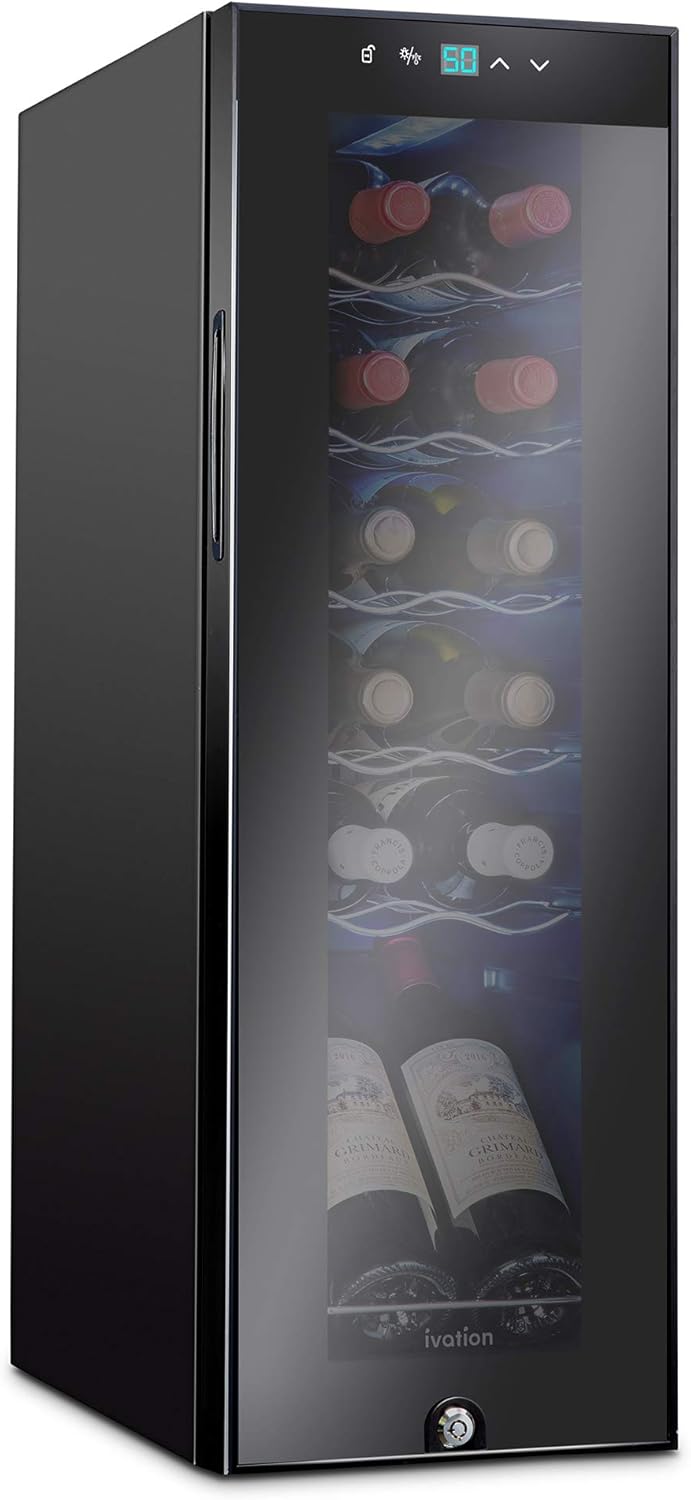
This Ivation 12-bottle cooler uses a compressor cooling system and internal fan to hold a stable 41–64°F range, making it suitable for both chilling and longer-term storage. It installs freestanding and has six removable wire racks so you can fit standard 750 ml bottles or rearrange for larger formats. The digital touch display shows temperature in Fahrenheit or Celsius and can be locked to prevent accidental changes, while the double-paned UV-resistant glass and rubber gasket help keep light and air out. Vibration-reducing compressor operation preserves sediment and the interior LED provides soft illumination for inspections without harsh heat. As a compact unit it draws modest power (rated 95W) and includes a keyed lock for security. Limitations include a small 1.2 cu ft capacity that restricts larger fermentation batches and single-zone control that prevents separate temperature settings for multiple products. The unit is best when you need a reliable, quiet compressor fridge with precise temperature stability in a compact footprint rather than a higher-capacity or dual-zone system.
Best for: Buyers seeking a compact, performance-focused compressor fridge that holds steady temperatures for precise fermentation or small-batch aging and who prioritize stability and quiet operation.
Less Ideal for: Those who need higher capacity, multiple temperature zones, or to run several fermentations at different setpoints simultaneously should look at larger or dual-zone units.
- Compressor cooling with inverter ensures stable, low temperatures suitable for fermentation control.
- Wide adjustable temperature range (41–64°F) with digital touch controls and lock for set-and-forget operation.
- Double-paned UV-resistant glass and airtight gasket protect contents from light and external air.
- Removable wire racks allow flexible bottle arrangement and easier cleaning.
- Quiet, vibration-reducing operation that minimizes disturbance to sediments or sensitive contents.
- Small 1.2 cubic foot capacity limits the number and size of fermentation vessels you can fit.
- Single temperature zone cannot maintain different temperatures for multiple simultaneous projects.
Verdict: Choose this cooler when you want a compact, compressor-driven fridge that delivers stable, low-temperature control for small-batch fermentation and precision cooling.
Feelfunn 12-Bottle Wine Cooler

| Capacity | 1.41 cubic feet / 12 Bottle |
|---|---|
| Temperature Range | 41-64°F (5-17°C) |
| Cooling Method | Compressor |
| Defrost System Type | Frost Free |
| Installation Type | Freestanding |
The Feelfunn 12-bottle wine cooler is a compact freestanding fridge designed to store and chill up to a dozen standard wine bottles. It uses a compressor cooling system with a digital touch panel to set temperatures between 41 and 64°F, and five removable wire shelves let you arrange bottles or fit a few larger formats. Double-glazed glass doors provide UV protection and a built-in soft LED light makes it easy to see contents without warming the interior. The unit is rated to run quietly (under 35 dB) so it can sit in a living room or home bar without drawing attention, and frost-free operation reduces maintenance. Practical limitations are its modest 1.41 cu ft capacity and narrow footprint, so it is best for small collections rather than long-term cellaring or large-format bottles, and the compressor-based cooler will produce some vibration compared with thermoelectric models. For someone who wants simple digital controls, adjustable shelving, and a compact, quiet fridge for everyday chilled wine, this covers the essentials well.
Best for: Buyers who want a reliable, low-maintenance cooler for everyday chilled wine in a small space and prioritize simple digital controls and quiet operation.
Less Ideal for: Collectors who need long-term aging capacity, storage for many bottles, or frequent accommodation of very large-format bottles should look at larger or dedicated cellar units.
- Digital temperature control with 41–64°F range for flexible chilling of reds, whites and sparkling
- Compact freestanding design fits kitchens, home bars or offices
- Double-glazed glass door with UV protection helps preserve wine
- Adjustable removable shelves allow flexible bottle arrangement
- Quiet compressor operation (listed under 35 dB) suitable for living spaces
- Only a 12-bottle capacity, too small for larger collections
- Compressor operation can introduce slight vibration compared with thermoelectric units
Verdict: A compact, quiet 12-bottle cooler with simple digital controls and adjustable shelving for everyday chilled wine in small spaces.
NutriChef 12-Bottle Wine Fridge
| Capacity | 12 Bottle |
|---|---|
| Refrigeration | Compressor |
| Temperature Range | 41 – 64°F |
| Power | 120 volts |
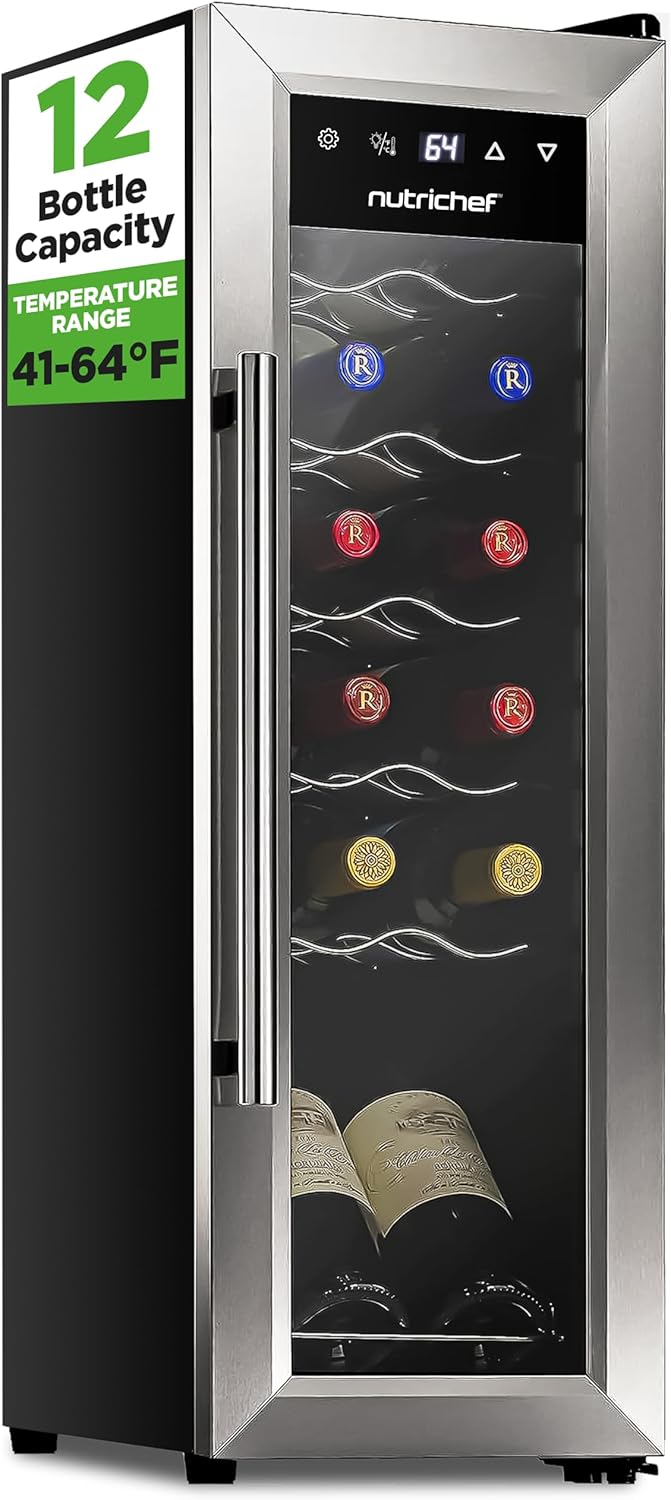
This NutriChef 12-bottle wine fridge is a slim freestanding cooler designed for buyers who want reliable bottle storage without taking up much floor space. It uses a compressor and inverter system to maintain a selectable temperature range (about 41 to 64 F) via a digital soft-touch control panel and internal LED lighting, so you can chill reds and whites to different serving temps. The unit holds a dozen standard bottles on five wire shelves and includes a bottom standing rack, a child-safety lock, and a reinforced glass door with stainless steel trim for a clean look. Practical strengths are its compact footprint for countertops or tight corners, quiet operation for living spaces, and an Energy Star referenced annual consumption figure that keeps running costs modest. Limitations include the modest internal volume that restricts larger or oddly shaped bottles and the narrow form factor that may require careful bottle arrangement to maximize capacity. Buyers should also expect standard compressor cooling behavior rather than long-term cellar-level aging performance.
Best for: Buyers who want a compact, no-nonsense wine cooler that reliably chills both red and white bottles for everyday serving and occasional entertaining.
Less Ideal for: Collectors seeking long-term cellar aging or those who need to store varied bottle shapes and larger formats should look for a larger or full-size cellar.
- Slim countertop-friendly footprint fits tight spaces
- Compressor cooling with inverter provides consistent temperature control
- Digital soft-touch controls and selectable °F/°C make adjustments simple
- Quiet operation suitable for kitchens and living areas
- Limited internal volume restricts large-format or irregular bottles
- Narrow layout means careful bottle arrangement to reach full 12-bottle capacity
Verdict: A compact, energy-conscious 12-bottle cooler that delivers reliable temperature control for everyday red and white serving in small spaces.
Choosing the Right Budget 12-Bottle Wine Cooler: Key Factors to Consider
Temperature Range and Accuracy
Wine requires specific storage and serving temperatures. A cooler that can maintain a stable band of a few degrees is important because frequent or wide fluctuations accelerate aging and change how a wine tastes when served.
When evaluating temperature performance, look for clear digital controls or precise thermostats and evidence of consistent performance across the interior. Units that report only a single vague range are riskier than those with a specific setpoint and a documented operating tolerance.
Cooling Method and Vibration
Two main cooling approaches appear in compact coolers: thermoelectric and compressor. Thermoelectric units are quieter and use less energy at moderate ambient temperatures but struggle in hot rooms. Compressor models cool more strongly and hold steady in warm conditions but can create more vibration.
Low vibration matters because it reduces disturbance to bottle sediments and helps wines age gracefully. If you plan to store wines for months, prefer designs with vibration-damping shelves or quieter compressor cycles. For short-term serving temperatures, a thermoelectric cooler often offers a quieter, more efficient solution.
Interior Layout and Bottle Fit
A stated 12-bottle capacity can mean different things depending on shelf design and bottle orientation. Some units fit only standard Bordeaux bottles while others accommodate larger Burgundy or sparkling bottles with fewer positions.
Consider whether you need removable shelves, how bottles slide in and out, and whether the cooler stores bottles on their sides for proper cork wetting. Flexible shelf spacing and a clear plan for organizing whites, reds, or opened bottles will increase day-to-day usefulness.
Noise and Placement
Noise level affects where you can place a cooler. Quiet models are suitable for kitchens and living areas, while louder compressor-driven units are better kept in basements or utility rooms.
Check published decibel levels where available and note the cooling cycle pattern. Continuous low-level hum is less intrusive than frequent loud starts. Also consider how close the cooler will sit to seating areas or bedrooms before picking a model.
Door Construction and Light Protection
UV and visible light can degrade wine over time. Tinted or UV-resistant glass doors offer protection while still letting you see the collection. Solid doors provide the best light block but reduce visibility.
A tight door seal and good insulation help the cooler maintain steady temperatures and reduce energy consumption. Check for magnetic seals and note whether the manufacturer mentions UV-treated glass or reduced-transmission glazing.
Energy Use and Long-Term Reliability
Budget units vary widely in efficiency and expected service life. Lower initial cost can be offset by higher energy use or early component failures.
Look for basic reliability features such as accessible filters or condensers, simple user-serviceable parts, and manufacturer documentation for maintenance. Energy-efficient designs reduce running costs, important if the cooler will operate continuously.
Where to Put a 12-Bottle Budget Wine Cooler
Placement affects performance. These compact coolers work best in stable ambient temperatures away from direct sunlight, heat sources like ovens, and drafty spots. Keep at least a few inches of clearance on all sides for airflow so the compressor or thermoelectric heat sink can dissipate heat efficiently.
If you plan to place the unit in the kitchen, position it away from the main cooking zone to avoid frequent temperature spikes. For living areas, prioritize quieter models or place the cooler on a solid surface to minimize vibration transfer.
- Avoid direct sunlight and heating vents.
- Provide 2 to 4 inches clearance for ventilation.
- Use a level, stable surface to reduce vibration.
Setting Temperature for Serving Versus Short-Term Cellaring
Decide whether the cooler is mainly for short-term cellaring or for keeping bottles at serving temperature. Short-term cellaring benefits from a slightly cooler, stable setpoint to slow aging. Serving temperatures depend on wine style: whites and sparkling wines benefit from cooler setpoints than most reds.
If you want flexibility, choose a unit with a wide, adjustable range and accurate controls. When moving bottles between a main storage location and the cooler, allow 24 to 48 hours for temperature equalization to avoid shocking the wine.
- Whites: lower setpoint within the cooler's range.
- Reds: higher setpoint, avoid excessive warmth.
- Allow time for bottles to reach the cooler's set temperature before serving.
Shelf Tips and Organizing a Small Collection
With only 12 bottles of capacity, organization matters. Group bottles by style or frequency of use, placing those you reach for most at the front. Consider marking slots or using simple separators for opened bottles to avoid confusion.
Use removable shelves to accommodate larger bottle shapes when needed. Lay bottles on their sides to keep corks moist, unless storage time is very short and the bottles have synthetic caps.
- Store similarly styled wines together for easier serving.
- Reserve a front shelf for current drinking selections.
- Label shelves or use simple tags for opened bottles.
Maintenance and Common Troubleshooting
Regular maintenance is simple but important. Clean the interior periodically with a mild solution, check door seals for debris, and vacuum any external condenser fins if accessible. These steps help maintain cooling efficiency and reduce noise.
If temperatures fluctuate or the unit cycles excessively, verify clearance and room temperature. Excessive loading or frequent door openings are common causes of poor temperature control. For unusual noises, check that the unit is level and that bottles are not contacting interior surfaces.
- Wipe interior and shelves every few months.
- Inspect door seals and clean them gently.
- Keep condenser area free of dust if accessible.
When a Compressor Unit Makes Sense
Choose a compressor-based 12-bottle cooler if you expect to operate the unit in a warm kitchen, garage, or during hot months. Compressors maintain set temperatures more reliably across a wider ambient range and recover faster after the door is opened.
Accept that compressor models may be louder and introduce more vibration. For many buyers, the stronger cooling performance outweighs these downsides, especially when consistent temperature is the top priority.
- Use compressor units in warmer rooms or where frequent door openings occur.
- Expect slightly higher noise and possible vibration.
- Look for models with vibration-damping shelving if aging wines.
How We Chose the Best Budget 12-Bottle Wine Cooler
We focused on compact, cost-conscious 12-bottle wine coolers that deliver core performance without frills. Our primary filters required each unit to reliably hold at least 12 standard 750 ml bottles, provide adjustable temperature control within typical serving and short-term cellaring ranges, and offer low-vibration cooling to avoid disturbing sediments. We also prioritized usable interior layout and door/window construction that reduce light exposure. Key evaluation criteria included temperature accuracy and stability, cooling method and vibration levels, usable storage capacity and shelf design, noise output during normal operation, and build quality for long-term reliability. We excluded units that lack clear temperature controls, have inconsistent capacity claims, or rely on cooling approaches unsuitable for wine (for example, units that only circulate warm air without active cooling). Our selection favored products with straightforward controls, effective insulation or UV protection, and clear manufacturer specifications for temperature range and capacity. We did not include specialty or commercial refrigeration systems, full-size wine refrigerators, or combination beverage centers that do not guarantee wine-friendly temperatures.
Our full evaluation process is outlined in our review methodology.
FAQ
Is a 12-bottle cooler big enough for everyday use?
Often yes. A 12-bottle cooler suits singles or couples who rotate a small selection of whites and reds. It is best for short-term storage and serving rather than large collections.
Can I store sparkling wine or magnum bottles in a 12-bottle unit?
It depends on interior shelf spacing. Many 12-bottle designs fit only standard 750 ml bottles. If you occasionally store larger formats, look for removable shelves or models that explicitly note larger-bottle capacity.
Do thermoelectric coolers keep wine safe in hot rooms?
Thermoelectric coolers are less effective in high ambient temperatures. They work well in moderate indoor conditions but may struggle to maintain setpoints in hot kitchens or unconditioned spaces.
How noisy are budget 12-bottle wine coolers?
Noise varies. Thermoelectric units tend to be quieter with a low hum, while compressor units have louder cycling sounds. Published decibel ratings help, but placement and surface contact also influence perceived noise.
How long should a budget wine cooler run continuously?
Most compact coolers are designed for continuous use, but duty cycle depends on ambient temperature, door openings, and the unit's cooling method. Regular maintenance and proper placement extend reliable continuous operation.
Final Verdict
For buyers focused on value and space efficiency, a budget 12-bottle wine cooler can deliver reliable serving temperatures and convenient storage when chosen for the right priorities. Emphasize temperature accuracy, vibration control, and usable shelving when comparing models, and match the cooling method to your placement and noise tolerance. Prioritize a cooler that meets your intended use whether that is steady short-term cellaring or maintaining serving temperatures for a rotating selection. With careful placement and basic maintenance, a compact budget unit can be an effective and economical addition to a small home wine setup.