
Note: This article contains affiliate links. If you click on these links and make a purchase, we may earn a small commission at no extra cost to you. This helps support our research and content. Read our full affiliate disclosure here.
Choosing the right wine cooler makes a real difference in how your bottles age and how ready they are to serve. Whether you store a modest collection or need tidy access for dinner guests, the correct cooler controls temperature, limits vibration, and fits your available space. This guide shortlists the top wine coolers across common setups and usage patterns, focusing on models that balance precise temperature control, efficient use of space, and quiet operation. Below we evaluate the shortlisted units against practical factors buyers care about, so you can match a cooler to your storage needs and serving habits.
Top Picks at a Glance
| Best Overall The best all-around choice for most situations | EUHOMY 3.2 cu ft Wine Cooler |  |
| Best Quality Built to a higher standard if you want something more solid | Whynter BWR-1002SD 100-Bottle Wine Refrigerator |  |
| Best Value The sweet spot between price and what you get | ROVSUN 18 Bottle Wine Fridge |  |
| Best Budget The cheapest option that still gets the job done reliably | Icyglee Mini Beverage Refrigerator WC-6B |  |
| Top Rated A top-rated pick with lots of positive feedback | Cuisinart Private Reserve 8-Bottle |  |
| Most Popular A crowd favorite that many people choose with confidence | hOmeLabs Beverage Refrigerator HME030065N | 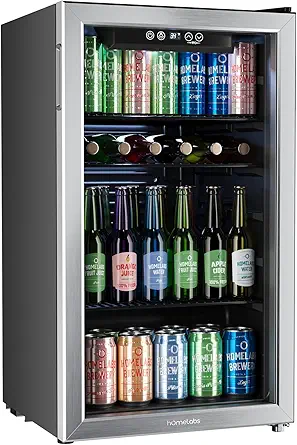 |
| Best Seller A high-volume bestseller chosen again and again | EUHOMY BR013-110 Beverage Refrigerator |  |
EUHOMY 3.2 cu ft Wine Cooler

| Capacity | 3.2 cubic feet |
|---|---|
| Temperature range | 41 to 64 F |
| Cooling method | Compressor |
| Number of shelves | 6 |
| Voltage | 115 volts |
This EUHOMY 3.2 cu ft wine cooler is a compact freestanding unit meant to store and chill wine and beverages at controlled temperatures. It uses a compressor cooling system with a digital touchscreen that lets you set temperatures between 41 and 64 F, while double-pane glass and internal LED lighting protect bottles from UV and make labels easy to read. Interior storage is flexible with four chrome full-width racks, one flat shelf and a bottom compartment so you can rearrange to fit different bottle shapes and up to 25 standard 750 ml bottles. The unit is designed for under-counter or standalone placement, and includes adjustable leveling legs, a reversible door and a built-in handle for placement flexibility. Practical trade-offs are its manual defrosting and midrange energy use, so it requires occasional maintenance and will draw more power than high-efficiency models, but it delivers steady, low-vibration compressor cooling that is good for both short-term chilling and longer-term bottle storage.
Best for: Buyers who want a compact, reliable wine cooler that balances precise temperature control, flexible interior layout, and placement options for an at-home bar or kitchen.
Less Ideal for: Those who prioritize the lowest possible energy use or want a completely maintenance-free unit with automatic defrost should consider other options.
- Compressor cooling provides stable, low-vibration temperatures suitable for wine storage.
- Digital touchscreen lets you precisely set temperatures from 41 to 64 F.
- Adjustable shelves and mixed rack types allow flexible storage for different bottle shapes up to 25 bottles.
- Double-layer thermopane glass blocks UV and insulates while internal LED lighting showcases bottles.
- Reversible door and leveling legs make placement under counters or freestanding simple.
- Manual defrost requires periodic user maintenance.
- Annual energy consumption is relatively high compared with energy-efficient models.
Verdict: A solid midpriced compact wine cooler that balances precise compressor cooling and flexible storage for everyday home wine enthusiasts.
Whynter BWR-1002SD 100-Bottle Wine Refrigerator

| Capacity | 100 standard 750ml bottles |
|---|---|
| Temperature Range | 40F – 65F (5C – 18C) |
| Cooling Method | Compressor with fan-forced circulation |
| Shelves | 12 removable wooden flat slide-out shelves |
| Voltage / Power | 115V / 120 watts |
The Whynter BWR-1002SD is a large-capacity, single-zone wine refrigerator built for collectors who need stable, low-temperature storage for many bottles. It uses a compressor cooling system with fan-forced circulation and an adjustable thermostat that ranges from about 40F to 65F, so it can hold reds, whites, and sparklers at appropriate service or cellar temps. The unit supports built-in or freestanding installation, has a reversible stainless steel framed door with tempered double-pane gray-smoked glass for UV protection, and includes internal LED lighting and a keyed cylinder lock for security. Storage is handled by 12 removable wooden-faced flat slide-out shelves plus a display shelf for open bottles. Practical trade-offs are that it is a single temperature zone, so you cannot set separate temps for reds and whites, and it is a heavy, large cabinet that requires adequate space and ventilation. For buyers prioritizing capacity and consistent compressor cooling, this model delivers straightforward, collector-friendly performance.
Best for: Buyers who want a high-capacity, performance-focused wine cooler to store a growing collection at stable, cellar-like temperatures and who value compressor cooling reliability over multi-zone flexibility.
Less Ideal for: People who need separate temperature zones for reds and whites or those with very limited space or weight restrictions in their installation area.
- Very large capacity up to 100 standard 750ml bottles for substantial collections
- Compressor cooling with fan-forced circulation provides steady, cellar-style temperatures
- Adjustable thermostat (40F–65F) with digital display for accurate temperature control
- UV-protected double-pane tempered glass door and keyed lock protect wine and limit light exposure
- Removable wooden-faced slide-out shelves and a display shelf make organization and access easy
- Single temperature zone cannot accommodate different setpoints for reds and whites
- Large footprint and weight require planning for placement and may not suit compact kitchens
Verdict: Choose the Whynter BWR-1002SD if you need a large, compressor-cooled wine refrigerator that delivers steady, cellar-style temperatures for an extensive bottle collection.
ROVSUN 18 Bottle Wine Fridge

| Capacity | 1.8 cubic feet |
|---|---|
| Size | 18 Bottle |
| Temperature range | 41-64°F |
| Cooling Method | Compressor refrigeration |
| Defrost System Type | Automatic |
The ROVSUN 18 Bottle Wine Fridge is a compact freestanding cooler that uses a compressor refrigeration system to keep bottles between 41 and 64°F, suitable for reds, whites, sparkling wine, and beer. It is typically used in kitchens, home bars, dorms, or small offices where space is limited but you still want stable, cellar-like temperatures. The unit has removable chrome-plated metal shelves that hold up to 18 standard 750 ml bottles and a soft LED interior light for visibility. Temperature is set with an external touch control panel so you can adjust settings without opening the door, and the double-layer glass door with a key lock helps with insulation and security. The compressor design cools faster and across a wider range than thermoelectric models and the quiet compressor is suitable for living spaces. Trade-offs to expect are the modest capacity and the footprint of a freestanding cooler, which limits it to smaller collections and requires planning for placement; also compressor units can run warmer externally and may need a few inches of clearance for airflow.
Best for: Buyers who want a compact, reliable cellar-style cooler to store a small curated selection of bottles at consistent temperatures and who prioritize steady performance over maximum capacity.
Less Ideal for: Collectors who need long-term storage for large wine inventories or built-in installation buyers seeking integrated cabinetry solutions.
- Compressor refrigeration provides faster, wider-range cooling than thermoelectric units
- External touch control lets you change temperature without opening the door
- Removable chrome-plated metal shelves adapt to different bottle sizes
- Double-layer glass door with LED interior light combines visibility and insulation
- Quiet operation suitable for kitchens or small living spaces
- Holds only up to 18 standard bottles so it is not for larger collections
- Freestanding footprint requires dedicated floor or counter space and clearance
Verdict: A compact, compressor-cooled wine fridge that delivers reliable, cellar-style temperatures for a small curated wine collection.
Icyglee Mini Beverage Refrigerator WC-6B

| Capacity | 0.6 cubic feet |
|---|---|
| Temperature Range | 40–61°F |
| Cooling Method | Compressor |
| Defrost System Type | Manual Defrost |
| Installation Type | Freestanding |
The Icyglee WC-6B is a small compressor-based beverage fridge built for tight spaces where you still want reliably cold drinks. It holds about six 12-oz bottles plus six cans or roughly 21 standard 330 ml cans when arranged efficiently, and the removable wire shelf lets you switch between bottle and can layouts. Temperature is set with a one-touch control across a 40–61°F range, so it can handle beer, soda, or cool white wines. The compressor and R600 refrigerant deliver steadier cooling than thermoelectric units, and the unit is marketed as whisper-quiet (under 40 dB), which makes it usable in bedrooms, offices, or a small bar area. Finish and fittings are basic: manual defrost, a single door, and a modest 18-liter capacity, so it is not suitable for storing many bottles or long-term wine cellaring. Its compact footprint and freestanding design make it easy to tuck under counters or on shelves, but buyers should expect limited capacity and simple controls rather than precision wine storage features.
Best for: Buyers on a tight budget who need a true compressor mini fridge to keep a small selection of drinks consistently cold in a dorm, office, or home bar.
Less Ideal for: Anyone who wants to store many bottles, build a wine collection, or needs precise multi-zone temperature control for long-term wine aging.
- Compressor cooling (R600) gives more consistent chill than small thermoelectric units
- Compact freestanding footprint fits under counters or in small rooms
- Removable shelf allows flexible layout for cans or bottles
- One-touch temperature control with a usable 40–61°F range
- Whisper-quiet operation suited for bedrooms or offices
- Very small 0.6 cu ft capacity limits how many bottles or cans you can store
- Manual defrost and single basic shelf mean more hands-on maintenance and limited organization
Verdict: If you want an affordable, space-saving compressor mini fridge to keep a handful of drinks reliably cold, the Icyglee WC-6B is a sensible budget choice.
Cuisinart Private Reserve 8-Bottle
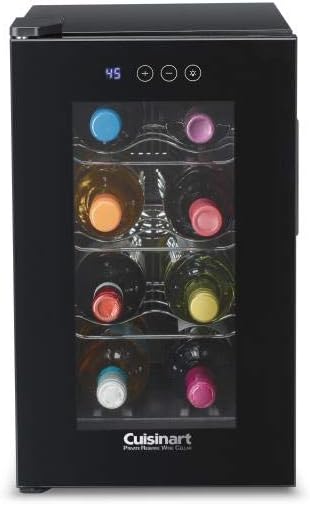
| Capacity | 8 Bottle |
|---|---|
| Cooling Method | Thermoelectric |
| Temperature Range | 39°F to 68°F |
| Power Source | Electric |
The Cuisinart 8-Bottle Private Reserve is a small freestanding wine cellar meant for storing a modest selection of reds, whites, and sparkling wines at controlled temperatures. It uses a thermoelectric cooling system to provide quiet, low-vibration operation and an adjustable temperature range from 39°F to 68°F shown on an LED display. Touch controls and soft interior lighting make it straightforward to set and monitor conditions, and three contoured chrome racks keep bottles organized. In practice the unit is easy to place in a kitchen, home bar, or apartment because it does not require a drain or compressor ventilation. The compact capacity and thermoelectric design mean it is best for short- to medium-term storage and serving temperature control rather than long-term cellar aging. Buyers should also plan shelf space accordingly since it holds eight bottles and has limited internal volume. For someone wanting a quiet, energy-conscious cooler to keep an everyday rotation at proper serving temperatures, this hits the mark.
Best for: Buyers who prioritize a quiet, energy-efficient unit to keep a small set of wines at consistent serving temperatures in a compact space.
Less Ideal for: Collectors who need long-term aging capacity or those who require storage for many bottles should look at larger compressor-based cellars.
- Quiet, low-vibration thermoelectric cooling suitable for bottle stability
- Touchscreen controls and LED display make temperature setting simple
- Soft interior LED lighting and chrome racks provide neat presentation
- Compact freestanding design fits small kitchens or apartments
- Limited 8-bottle capacity not suited for larger collections
- Thermoelectric cooling is less effective than compressor units for long-term aging
Verdict: A quiet, compact wine cooler that reliably holds and maintains an everyday eight-bottle rotation at precise serving temperatures.
hOmeLabs Beverage Refrigerator HME030065N

| Capacity | 3.2 cubic feet |
|---|---|
| Storage Capacity | Up to 120 cans |
| Temperature Range | 34°F-50°F |
| Cooling Method | Compressor |
| Defrost System Type | Automatic |
This hOmeLabs beverage refrigerator is a compact, performance-focused cooler for home bars, offices, or dorms. It uses a compressor-based cooling system with a whisper-quiet compressor and an adjustable digital thermostat that reaches as low as 34°F, so it reliably maintains cold, ready-to-drink beverages. The reinforced double-glazed glass door and bright internal LED let you see contents without opening the unit, and three removable chrome wire shelves give flexible storage for cans or bottles. Setup is simple: it is freestanding, has reversible door hinges, and adjustable feet to level on uneven floors. Practical benefits include steady cooling for long periods and quiet operation suitable for living spaces. Limitations are its compact 3.2 cubic foot capacity if you need larger chilled storage and moderately high annual energy consumption compared with some small fridge alternatives. If you plan to store a mixture of taller bottles and cans you will need to rearrange or remove shelves to fit larger items.
Best for: Buyers prioritizing reliable, low-noise cooling and precise temperature control who need a compact dedicated beverage fridge for a home bar, office, or dorm.
Less Ideal for: Those seeking a high-capacity refrigerator for entertaining large groups or users who need the most energy-efficient mini fridge available.
- Compressor cooling with whisper-quiet compressor for consistent, low-noise performance
- Digital touch temperature control down to 34°F for precise beverage chilling
- Reinforced glass door with bright interior LED for clear display without opening
- Three removable adjustable shelves for flexible can and bottle organization
- Reversible door and adjustable feet for flexible placement and installation
- 3.2 cubic foot capacity may be small for larger households or party use
- Annual energy consumption listed as 288 kWh per year, higher than some compact models
Verdict: Choose this unit when you want a compact, quiet beverage fridge that maintains precise, cold temperatures for ready-to-drink cans and bottles.
EUHOMY BR013-110 Beverage Refrigerator

| Capacity | 3.2 cubic feet |
|---|---|
| Temperature Range | 37°F to 61°F |
| Cooling Method | Compressor |
| Number Of Shelves | 5 |
| Installation Type | Freestanding |
This EUHOMY 3.2 cu ft beverage refrigerator is a compact compressor fridge built to store cans and bottles with steady cooling and easy organization. It uses a compressor cooling system and an internal circulation fan to keep temperature uniform, while a digital touchscreen lets you set temperatures between 37°F and 61°F. Five removable wire shelves slide into multiple positions so you can arrange cans or taller bottles, and the reversible double-layer glass door with a tight seal and foam insulation helps maintain a stable interior climate. For truck use, the unit is freestanding with adjustable feet and a built-in handle for repositioning, and the manufacturer rates daily energy use at about 0.69 kWh and noise around 36 dB, so it runs quietly. Expect the compressor design to handle frequent door openings and warm cabin starts better than a thermoelectric model, but note it is a full compressor appliance and will need secure leveling and stable placement in a truck to avoid vibration issues during long hauls.
Best for: Drivers who prioritize a steady, fridge-style cooling system for keeping drinks cold over long shifts and want a configurable interior and precise temperature control.
Less Ideal for: Drivers who need a purpose-built 12V automotive fridge or an appliance specifically certified for constant vibration and mobile installation should consider truck-rated units instead.
- Compressor cooling with circulation fan for even, reliable temperatures
- Digital touchscreen temperature control from 37°F to 61°F for precise settings
- Five removable shelves for flexible can and bottle organization
- Reversible double-layer glass door and tight seal to retain cold and reduce light exposure
- Relatively quiet operation (~36 dB) suitable for sleeper cabs
- Freestanding compressor units require secure mounting to minimize vibration in trucks
- Not specifically rated for mobile or on-road use which may affect long-term reliability in heavy vibration environments
Verdict: Choose this compressor mini fridge if you want reliable, fridge-quality cooling and precise temperature control for long-haul use, provided you secure it properly in your truck.
Choosing the Right Wine Cooler: Key Factors to Consider
Temperature Range and Accuracy
A cooler that holds a steady temperature across the range you need is essential for both short-term serving and longer-term aging. Small fluctuations can stress corks and accelerate chemical changes in wine. Look for models with digital thermostats or accurate analog controls and readouts so you can set distinct zones for reds and whites when needed.
Temperature accuracy also affects how quickly a bottle reaches serving temperature. A unit that overshoots or cycles wildly will make it harder to predict readiness, so consider how precisely a cooler maintains setpoints and whether it allows separate zones or dual-temperature control.
Vibration Control and Noise
Vibration can disturb sediment and subtly speed oxidation, harming delicate wines. Compressors, fans, and internal mechanics are common vibration sources, so low-vibration design is important for any cellar-grade cooler. If the unit will live in a kitchen or living area, noise levels matter too because constant humming or cycling can be distracting.
Consider coolers explicitly designed for low vibration and check decibel ratings or user reports about hum. Some thermoelectric units are quieter but offer less cooling power at higher ambient temperatures, while compressor systems are stronger but may need better isolation to reduce vibration.
Storage Capacity and Rack Design
Capacity is more than bottle count. Rack design and interior layout determine whether standard Bordeaux bottles, wider Burgundy bottles, or tall Champagne bottles fit comfortably. Pull-out shelves, adjustable racks, and flat storage options let you adapt the cooler as your collection changes.
Think about how you organize bottles: grouped by varietal, vintage, or drinking window. A cooler with removable shelves and mixed-size accommodation provides long-term flexibility. Also consider usable capacity versus the stated maximum, since some configurations reduce the number of bottles you can actually store.
Installation and Placement Constraints
Where you place a cooler affects performance. Built-in models require ventilation planning and possibly trim kits, while freestanding units need clearance around vents and stable, level floors. Ambient room temperature will influence cooling efficiency and may limit a unit's effective operating range.
Measure available space carefully and account for door swing and ventilation paths. Consider whether you need a freestanding model with top or rear vents and whether the cooler will sit in a kitchen, bar area, or basement. Ease of leveling and caster options can simplify installation and future moves.
Door, Seal, and UV Protection
A well-sealed door preserves internal climate and reduces energy use. Look for tight-fitting gaskets and quality hinges that prevent warm air infiltration. Glass doors are common for visibility but should include UV-protective glazing to limit light exposure, which can degrade wine over time.
Consider whether you need a lock or alarm for safety and whether the door swing and handle style fit your space. Solid doors offer better insulation, while glass doors trade some thermal performance for aesthetic display.
Energy Use and Long-Term Cost
Wine coolers run continuously, so energy consumption affects long-term operating cost and environmental impact. Check energy efficiency ratings and look for models with effective insulation and thermostats that minimize cycling. More efficient compressors and well-sealed cabinets reduce runtime.
Balance efficiency with performance: a very energy-frugal cooler that cannot hold steady in summer conditions may cost you in spoiled bottles. Consider how often the cooler will operate in warm ambient conditions and whether improved insulation or higher-capacity cooling is worth slightly higher energy use.
Single-Zone Vs Dual-Zone Units
Single-zone coolers maintain one uniform temperature throughout the cabinet and are a good choice if you primarily store one style of wine or keep bottles at a shared serving temperature. They tend to be simpler, more compact, and often offer slightly better temperature uniformity for that single setpoint.
Dual-zone units provide separate compartments with independent temperature controls, letting you store reds and whites at ideal conditions simultaneously. This adds complexity and can reduce usable space, but it is valuable if you regularly rotate between varietals or need ready-to-serve bottles at different temperatures.
- Single-zone: Simpler controls, usually better uniformity at one setpoint
- Dual-zone: Flexibility for multiple styles, slightly more complex setup
- Consider how often you need different serving temperatures when choosing between the two
Thermoelectric Vs Compressor Cooling
Thermoelectric cooling systems are quieter and have fewer moving parts, which reduces vibration and maintenance. They work best in moderate ambient temperatures and smaller capacities, making them suitable for countertop or small undercounter coolers.
Compressor-based coolers deliver stronger cooling power and better performance in warmer rooms or when larger storage is required. They can introduce more vibration and noise, so look for models with vibration dampening and quiet compressors if noise is a concern.
- Thermoelectric: Quiet, low vibration, limited cooling capacity
- Compressor: Stronger cooling, handles warmer ambient temps, may need vibration control
Rack Types and Bottle Handling
Racks come in fixed, sliding, or removable configurations. Sliding shelves make access easier and reduce the risk of shifting bottles when you remove one. Removable racks allow reconfiguration for large or unusual bottles.
Material matters too. Wooden slats cushion bottles and look traditional, while metal or chrome racks maximize airflow and can support heavier stacks. Evaluate how each rack style fits your typical bottle mix.
- Sliding shelves simplify access and minimize bottle movement
- Removable racks increase adaptability for different bottle sizes
- Wood racks absorb vibration and are visually warm; metal racks optimize space and airflow
Placement Tips for Best Performance
Place the cooler away from direct sunlight, heat sources, and areas with large temperature swings. Even the best unit will work harder and cycle more when exposed to heat, which affects noise and energy use.
Ensure proper clearance and ventilation per the manufacturer's guidance. For built-in installation, confirm that the unit is rated for that configuration and that you leave space for air intake and exhaust. Level the cooler to prevent rattles and uneven door sealing.
- Avoid direct sun and heat-producing appliances nearby
- Leave manufacturer-recommended clearance for vents
- Level the cabinet to keep doors sealing properly and reduce noise
Maintenance and Routine Care
Routine cleaning of racks and interior surfaces prevents mold and odors. Wipe door gaskets periodically to maintain a tight seal and check for wear. If the unit has a drain or defrost tray, inspect it and clear any blockages.
Monitor performance seasonally. Listen for new or louder noises and verify temperature stability with a wine thermometer or data logger. Prompt attention to small problems preserves bottle quality and extends the cooler's life.
- Clean racks and interior annually or as needed
- Wipe and inspect door seals to maintain insulation
- Check temperature stability periodically with an independent thermometer
How We Chose the Best Wine Cooler
We focused on practical, cellar-minded criteria that matter most for preserving and serving wine. Our selection process prioritized accurate temperature control across the recommended range for red and white wines, low-vibration cooling systems that protect sediment and delicate corks, and interior storage flexibility so bottles of varying shapes and sizes fit securely. We also evaluated noise levels for home and open-plan environments, energy efficiency for continuous operation, and build quality including door seals and shelving materials. Units lacking reliable thermostatic control, those with excessive vibration or poor door insulation, and coolers whose storage layouts prevented standard bottle placement were excluded. The final picks represent a balance of temperature precision, usable capacity, quiet daily operation, adjustable storage, and durable construction. These criteria guided inclusion and the scoring dimensions used in our product summaries.
Our full evaluation process is outlined in our review methodology.
FAQ
What temperature should I set my wine cooler to?
Set serving temperatures based on wine style: whites around 45 to 55°F and reds around 55 to 65°F. If you store a mix in a single-zone unit, choose a midpoint and adjust bottles to serving temp before drinking.
How many bottles will a stated capacity actually hold?
Stated capacity often assumes standard Bordeaux-style bottles. Wider Burgundy or Champagne bottles reduce usable capacity. Consider rack layout and removable shelves when estimating how many of your specific bottles will fit.
Do I need a compressor cooler if my kitchen stays cool?
If ambient temperatures are consistently moderate, a thermoelectric unit may suffice and offer quieter operation. However, compressor coolers perform better in warmer spaces or for larger collections where stronger cooling is required.
Can I install a wine cooler under my counter?
Only units rated for built-in or undercounter installation should be used in that location. Proper ventilation and clearance are required to avoid overheating and to maintain temperature stability.
How important is UV protection in a glass door?
UV protection helps prevent light damage, which can negatively affect wine over time. If the cooler sits in a bright area or near windows, choose a unit with UV-filtering glass to reduce light exposure.
Final Verdict
Prioritize accurate temperature control, low vibration, and a rack layout that fits the bottles you actually own. Decide between single-zone and dual-zone designs based on whether you frequently store both reds and whites at serving temperatures. Factor in installation constraints and noise tolerances to ensure the cooler performs well where you place it. By focusing on the core tradeoffs of temperature stability, storage flexibility, and quiet operation, you can choose a wine cooler that protects your collection and makes bottles easy to serve.