
Note: This article contains affiliate links. If you click on these links and make a purchase, we may earn a small commission at no extra cost to you. This helps support our research and content. Read our full affiliate disclosure here.
If you want to store a growing bottle collection without spending much, a budget 50-bottle wine cooler can deliver sensible capacity and reliable cooling in a compact footprint. The right unit preserves wine by keeping temperature and humidity steady, reduces light and vibration exposure, and organizes bottles so you can rotate stock easily. This guide shortlists the top budget 50-bottle wine coolers that meet practical cellar needs. We evaluated units on temperature control, usable capacity, shelving flexibility, and operating noise so you can pick a cooler that fits your space and routine. Read on for the key tradeoffs and what to expect from each shortlisted option.
Top Picks at a Glance
| Best Quality Built to a higher standard if you want something more solid | Allavino Reserva 50-Bottle |  |
| Best Budget The cheapest option that still gets the job done reliably | Garvee 55-Bottle Wine Cooler |  |
| Top Rated A top-rated pick with lots of positive feedback | EORICE 54-Bottle Wine Fridge |  |
| Most Popular A crowd favorite that many people choose with confidence | Yeego 24 Inch Wine Fridge |  |
| Best Seller A high-volume bestseller chosen again and again | NewAir 51-Bottle Wine Fridge |  |
Allavino Reserva 50-Bottle

| Capacity | 50 bottles |
|---|---|
| Temperature range | 41-68 °F |
| Configuration | Dual zone |
| Installation | Front-venting, built-in or freestanding |
The Allavino Reserva BDW5034D-2BSL is a 50-bottle dual-zone wine refrigerator designed for hobbyists who want controlled storage without a large cellar. It features two independently controlled temperature zones with a digital panel that lets you set temps between 41 and 68 F, so you can keep whites and reds at their ideal serving temperatures. Allavino's Tru-Vino cooling aims for low vibration and quiet operation, and the FlexCount shelving provides adaptable bottle layouts to fit diverse bottle sizes. The unit is front-venting for flush built-in installation but also finished on the sides and top for freestanding placement, and the tinted LowE glass plus LED lighting (7 colors, 5 brightness levels) protects wine from UV and heat. Practical limits are typical for this class: it is a mid-size upright that weighs heavily and requires planning for installation, and while efficient, it will not match the insulation or long-term stability of a dedicated cellar. For the price-focused buyer seeking precise temperature control and flexible storage in a single appliance, it delivers solid everyday performance.
Best for: Buyers who prioritize accurate temperature control and flexible storage in a compact 50-bottle cooler and want a unit that can be built into cabinetry or used freestanding.
Less Ideal for: Collectors seeking cellar-grade thermal mass or very large capacity storage should consider a dedicated cellar or larger unit instead.
- Dual independent temperature zones for storing reds and whites at different temperatures
- Digital temperature control with 41–68°F range for precise setpoints
- FlexCount shelving gives flexible bottle arrangement to maximize capacity
- Front-venting design supports built-in installation while finished sides allow freestanding use
- Tinted LowE glass and LED lighting protect wine from UV and heat without adding heat output
- Heavier cabinet requires planning for installation and placement
- Upright cooler does not provide the long-term thermal stability of a full cellar
Verdict: A performance-focused 50-bottle dual-zone cooler that gives precise temperature control and flexible shelving for buyers who want cellar-style storage without a dedicated cellar.
Garvee 55-Bottle Wine Cooler
| Capacity | 55 bottles |
|---|---|
| Defrost System Type | Frost Free |
| Number Of Shelves | 6 |
| Installation Type | Countertop |
| Annual Energy Consumption | 150 watts |
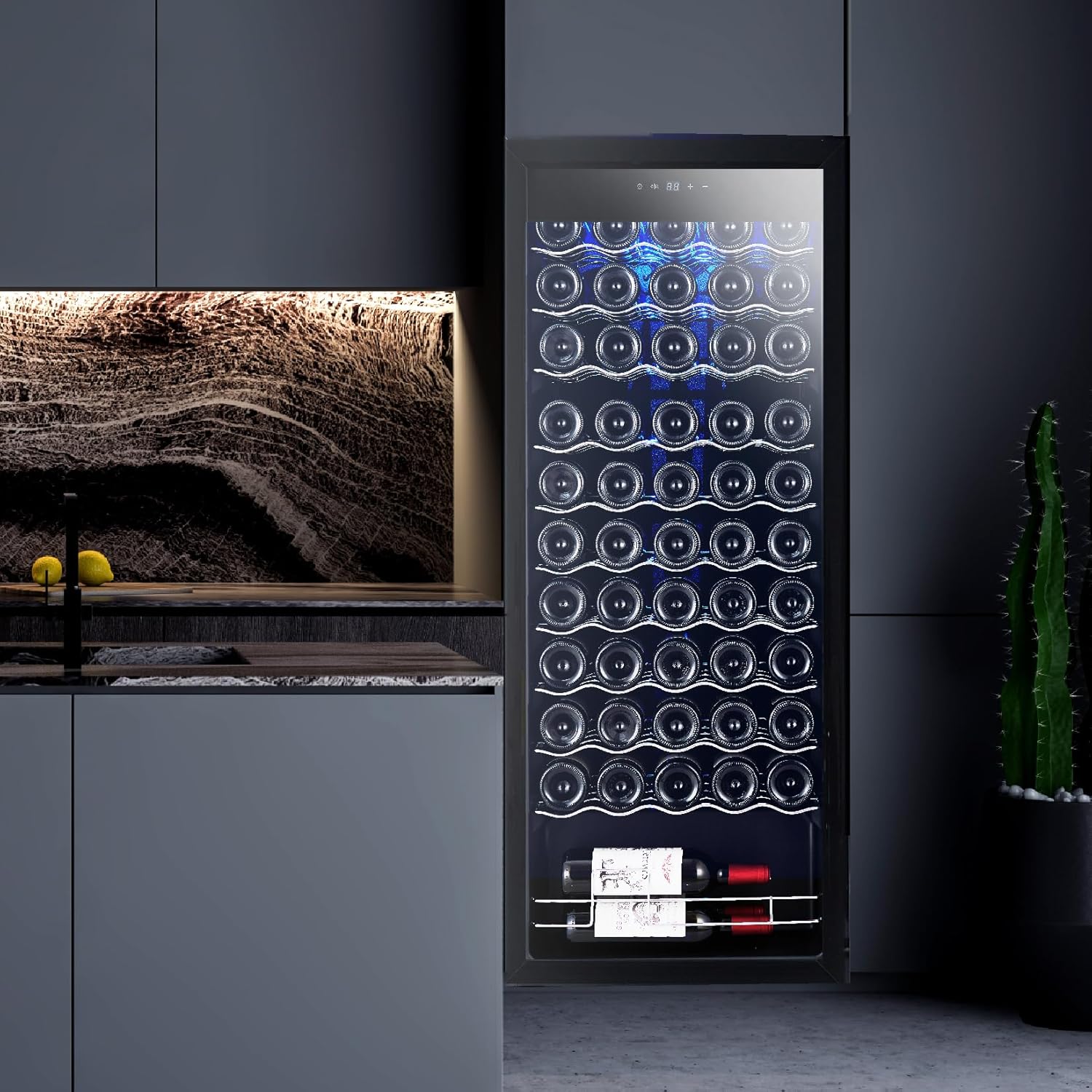
The Garvee 55-Bottle Wine Cooler is a straightforward compressor fridge designed to store a large home collection without bells and whistles. It provides single-zone, frost-free cooling driven by a compressor, so it holds a steady temperature suitable for storing reds, whites, and sparkling wines together. The digital touch control panel makes setting and checking temperature easy, and the UV-protected glass door with interior LED lighting keeps bottles visible while reducing light exposure. Built-in or freestanding placement options and adjustable shelves give flexible installation and racking for varying bottle shapes. Practical trade-offs for the price-conscious buyer include single-zone cooling only, so you cannot set separate temps for reds and whites, and the unit is fairly heavy and sizable, which affects placement and transport. Expect solid capacity and usable features for home or light commercial use without premium multi-zone temperature control or luxury finishes.
Best for: Buyers looking to maximize bottle capacity on a tight budget who prioritize steady compressor cooling and basic controls over premium multi-zone features.
Less Ideal for: Collectors who need separate temperature zones for red and white wines or those wanting a compact, lightweight cooler for small spaces.
- Large 55-bottle capacity for organizing a full home collection
- Compressor cooling with frost-free operation for consistent temperatures
- Digital touch controls for easy temperature setting and monitoring
- UV-protected glass door and LED lighting reduce light exposure while displaying bottles
- Adjustable shelves and freestanding or built-in installation options
- Single-zone cooling limits storing wines that require different temperatures
- Heavy and sizable unit can be difficult to move and needs a dedicated footprint
- Finish and features are utilitarian rather than high-end
Verdict: If you need the most bottle storage for your money and reliable compressor cooling, this 55-bottle Garvee cooler is a practical budget pick.
EORICE 54-Bottle Wine Fridge

| Capacity | 4.9 cubic feet |
|---|---|
| Size | 54 Bottles |
| Temperature Range | 41°F–64°F |
| Cooling Method | Compressor |
| Installation Type | Built-In or Freestanding |
This 54-bottle EORICE wine fridge is a compact 24-inch unit built for steady, everyday storage rather than display theatrics. It uses a compressor cooling system with a 41°F–64°F temperature range, an LCD touch panel, and a memory function that restores the set temperature after a power outage, which helps protect long-term collections. Five hickory wood shelves are adjustable and partly detachable to accommodate different bottle sizes, and the front-vent design allows either built-in or freestanding installation. Practical touches include low-noise operation, reversible stainless steel and glass door, and internal blue LED lighting for visibility. On the downside, the unit is a midweight appliance with modest annual energy use, so it is better for home bars and kitchens than for zero-vibration cellar-grade aging; serious collectors seeking precision dual-zone control or ultra-low vibration may want higher-end models. For buyers prioritizing reliable, budget-friendly bottle storage, this fridge covers the essentials with sensible features and straightforward operation.
Best for: Buyers who want a dependable, budget-conscious wine fridge for a home bar or kitchen that keeps a medium-sized collection at consistent serving temperatures.
Less Ideal for: Collectors who need dual-zone temperature control or a vibration-minimized cellar unit for long-term aging should look at higher-end models.
- Holds up to 54 standard wine bottles in a 4.9 cu ft footprint
- Compressor cooling with 41°F–64°F range for consistent temperatures
- Adjustable hickory wood shelves accommodate different bottle sizes
- Front ventilation and reversible door let you install built-in or freestanding
- Temperature memory function restores settings after power interruptions
- Single-zone cooling so reds and whites cannot be stored at separate setpoints
- Not designed as a vibration-free cellar alternative for long-term aging
Verdict: A reliable, budget-friendly single-zone wine cooler that stores a medium collection with stable compressor cooling and sensible installation options.
Yeego 24 Inch Wine Fridge

| Capacity | 5.12 cubic feet |
|---|---|
| Bottle capacity | 47 Bottles |
| Temperature range | 40-65°F (5-18°C) |
| Cooling method | Compressor |
| Annual energy consumption | 194 kilowatt hours per year |
The Yeego 24 Inch Wine Fridge is a compressor-based wine cooler that holds up to about 52 standard Bordeaux bottles and fits undercounter or freestanding. It uses a reciprocating compressor and 360° air circulation for fast, even cooling across a 40 to 65°F range, controlled from a front LED touch panel with 1°F increments and power-failure memory. Five wooden shelves are adjustable and removable so you can rearrange for larger bottles, and the dual-pane tempered glass door with a stainless-steel frame blocks most UV light while presenting a clean look. Practical touches include automatic defrost, low-noise operation (around 41–43 dB), adjustable leveling feet and an upgraded front grille for airflow. Trade-offs are that the unit is compressor-based so it will vibrate slightly compared with high-end column coolers, and its stated annual energy use (194 kWh) is moderate rather than ultra-efficient. For someone prioritizing steady, accurate cooling and flexible placement, this cooler is a solid option; buyers who need whisper-quiet thermoelectric operation or the absolute lowest energy draw should compare other technologies.
Best for: Buyers who want reliable, accurate cooling and flexible installation for a medium-sized bottle collection and who prioritize steady temperature control over the absolute lowest energy use.
Less Ideal for: Those seeking the quietest possible thermoelectric coolers or the absolute lowest-energy, most eco-friendly option should consider other technologies.
- Compressor cooling with 360° air circulation for consistent temperature control across the cabinet
- Digital touch controls with 1°F adjustment and power-failure memory for precise setpoint management
- Adjustable wooden shelves that minimize vibration and accommodate different bottle sizes
- Dual-pane tempered glass and stainless-steel frame that reduce UV exposure and present a clean built-in look
- Quiet operation rated around 41–43 dB suitable for home use
- Moderate annual energy consumption (~194 kWh) compared with some more efficient models
- Reciprocating compressor can produce slight vibration compared with thermoelectric systems
Verdict: A dependable 24-inch compressor wine fridge that delivers precise, even cooling and flexible undercounter or freestanding installation for medium collections.
NewAir 51-Bottle Wine Fridge

| Capacity | 128 liters (51 Bottle) |
|---|---|
| Cooling Method | Compressor |
| Temperature Range | 37–65°F |
| Number Of Shelves | 6 |
| Power | 120 volts |
This NewAir 51-bottle wine fridge is a compact freestanding cooler aimed at home collectors who want a secure, attractive place to store bottles without taking up too much space. It uses a quiet compressor and internal circulation fan to hold temperatures between 37 and 65°F, so you can store whites, reds, and sparkling wines at appropriate serving or short-term cellar temperatures. The mirrored double-pane glass door reduces UV exposure while adding a sleek look, and the adjustable metal shelves plus a display rack make it easy to fit standard and larger-format bottles. Soft LED lighting helps locate labels without adding heat, and the keyed lock is handy for shared spaces or households with children. Expect typical compressor noise and moderate energy use for a unit this size, and built-in ventilation and clearance should be considered for built-in installs. For buyers focused on reliable cooling and an elegant finish at a budget-friendly capacity, this model delivers sensible features in a compact package.
Best for: Buyers who prioritize dependable, factory-style cooling and a polished appearance for a mid-size home wine collection and who prefer a low-risk, feature-complete unit.
Less Ideal for: Anyone wanting a completely silent, ultra-low-energy cooler or those needing an exact long-term cellar replacement for large collections.
- Compressor cooling with internal fan for consistent temperature control across 37–65°F
- Mirrored double-pane glass door that reduces UV exposure and offers a modern look
- Adjustable metal shelves and a display rack accommodate standard and larger bottles
- Keyed lock and soft LED lighting for security and gentle illumination
- Moderate annual energy consumption compared with thermoelectric units
- Compressor models can produce some vibration and noise compared with cooler-only designs
Verdict: A reliable, budget-friendly compressor wine fridge that balances consistent cooling, a refined mirrored door, and secure storage for a 50-bottle home collection.
Choosing the Right Budget 50-Bottle Wine Cooler: Key Factors to Consider
Temperature Range and Stability
A cooler that can hit and hold the right temperature range matters because different styles of wine need different storage bands. If the unit cannot reliably maintain a stable set point, oxidation and premature aging can occur faster than expected.
Look for a model with tight temperature control and minimal overnight fluctuation. Consider whether the cooler uses a compressor or thermoelectric system, as compressors typically handle higher ambient room temperatures and larger loads more effectively.
Actual Usable Capacity
Advertised bottle counts do not always equal usable space. The way shelves are spaced, whether they are fixed or removable, and how many bottles fit on each shelf in practice determines how much you can store.
Assess whether the cooler accommodates standard Bordeaux, Burgundy, and larger-format bottles. Consider how you plan to arrange mixed bottle sizes and whether you need a few deeper shelves for magnums or boxes.
Shelving Design and Access
Shelving affects both organization and how often you disturb bottles when retrieving one. Pull-out or slide shelves make access easier, while fixed racks may force you to remove multiple bottles to reach one in the back.
Also check for padded or wooden rails that minimize bottle movement and reduce vibration transfer. If you plan to display labels, consider whether the shelves support face-out versus neck-out storage.
Noise, Vibration, and Placement
Noise level is an important comfort factor when the cooler sits in living areas or open-plan kitchens. Vibration can disturb sediment and is a concern for long-term bottle aging. Compressor-driven models generally cool faster but may produce more noise; thermoelectric units run quieter but are less effective in warm ambient conditions.
Plan where you will locate the cooler and measure typical room noise. Some buyers accept a bit more sound for improved cooling performance, while others prioritize near-silent operation for placement near seating areas.
Energy Use and Running Costs
Energy consumption matters over the life of the appliance, particularly when the unit runs continuously. A more efficient cooler reduces electricity use and heat output into the room.
Look for units with efficient compressors, good cabinet insulation, and reliable door sealing. Consider the climate of the room where the cooler will operate because higher ambient temperatures make units work harder and increase power draw.
Installation, Venting, and Fit
Where and how you install the cooler affects its performance and longevity. Some 50-bottle coolers are built for freestanding use, while others are designed for built-in or under-counter installation with front venting.
Ensure you have the clearances required for airflow and that the unit can fit through doorways and into the intended location. Also check whether the cooler's door swing and mounting are compatible with nearby cabinetry or room layout.
Single-Zone Vs Dual-Zone for Mixed Collections
Single-zone coolers maintain one uniform temperature across the cabinet and are usually simpler and less expensive. They work well if you store wines that all prefer similar conditions or if you prioritize maximum usable capacity at a single set point.
Dual-zone units let you set separate temperatures for two compartments. This is useful if you routinely keep both reds and whites at their ideal serving or storage temperatures without buying two separate appliances. However, dual-zone designs can reduce the usable storage in each compartment and sometimes add complexity to layout.
- Choose single-zone for larger number of same-style bottles.
- Choose dual-zone if you need separate storage bands for reds and whites.
- Remember split zones often change how shelves are arranged and accessed.
Door Type, Glass, and UV Protection
Door construction affects insulation and light exposure. Tinted, double-pane glass doors reduce UV and visible light while still letting you see the collection. Solid doors offer the best protection from light but hide labels.
If the cooler will sit in a sunlit area, prioritize a door with UV protection and a tight seal to limit temperature swings caused by solar gain.
- Glass doors are great for display but check for UV filtering.
- Solid doors reduce light exposure and can improve insulation.
- Door seals should compress evenly to prevent warm air infiltration.
Maintenance and Cleaning Tips
Regular wiping of shelves and interior surfaces prevents dust buildup and mold growth in humid conditions. Remove bottles before deep cleaning and follow the manufacturer's guidance for safe cleaners and disinfectants.
Clean the condenser coil if the unit has accessible coils, and check door gaskets periodically for signs of wear. Keep organizing labels or a simple inventory system to rotate stock and minimize how long bottles sit unused.
- Defrost manually if your unit requires it and plan periodic deep cleans.
- Inspect and replace worn gaskets to maintain thermal performance.
- Keep a small humidity monitor inside if you store wines long-term.
Sizing and Where to Put a 50-Bottle Cooler
A 50-bottle cooler is a mid-size option that suits enthusiasts who want meaningful capacity without a full cellar. Consider clearance for ventilation, door swing, and the footprint in relation to traffic flow in the room.
Think about proximity to heat sources and direct sunlight. Placing the cooler in a cool, stable environment improves efficiency and reduces strain on the compressor. For under-counter installations, confirm front-venting capabilities and required cabinet cutout dimensions.
- Measure doorways and installation space before buying.
- Allow recommended clearance on all sides for airflow.
- Avoid tight spaces that trap heat and force the unit to run harder.
Common Long-Term Care Considerations
Long-term ownership includes monitoring energy spend, occasional component service, and adjusting storage strategy as your collection evolves. Expect periodic checks on temperature performance and door seal integrity.
If you plan to age wines for several years, prioritize low vibration and stable temperature over maximum capacity. For short-term storage or frequent serving, ease of access and quick cooling recovery are more important.
- Track interior temperatures over a week to spot drift.
- Service noisy compressors early to avoid accelerated wear.
- Reconfigure shelving as bottle mix changes to maintain efficient use.
How We Chose the Best Budget 50-Bottle Wine Cooler
We focused on models that offer dependable temperature control, sensible internal capacity, and practical shelving while keeping the purchase price low. Our selection criteria prioritized temperature accuracy and stability across the usable range for both red and white wines, since maintaining a consistent environment is the primary duty of any cooler. Usable storage and shelf design mattered next: we looked for units that actually accommodate common bottle shapes and allow straightforward access and organization. Noise and vibration levels were considered because compressors and circulation fans can disturb sediment in older bottles and affect placement in living spaces. Energy efficiency and run-time performance were included to reflect long-term operating cost and heat output, which matters in small or enclosed rooms. We excluded specialty units designed solely for commercial display or single-temp novelty cabinets that lack adjustable shelving. We also ruled out models that advertise impractical bottle counts by counting narrow sections rather than true full-size bottle accommodation. The final shortlist features units that balance measured cooling competence, real-world usable capacity, reasonable sound levels, and straightforward maintenance.
Our full evaluation process is outlined in our review methodology.
FAQ
Can a budget 50-bottle cooler age wine long-term?
It depends. Some budget units provide stable enough temperatures and low vibration for medium-term aging, but for long-term cellaring you should verify temperature stability, humidity, and vibration levels before committing bottles to extended storage.
Will a 50-bottle cooler fit standard Bordeaux and Burgundy bottles?
Most 50-bottle coolers are designed around standard bottles, but shelf spacing and rack design vary. Check usable shelf depth and whether any shelves are removable to accommodate wider or taller bottles.
How noisy are budget wine coolers typically?
Noise varies by cooling method and build quality. Compressor units can be audible when cycling, while thermoelectric units run quieter but may struggle in warm rooms. Expect some operational sound and compare measured decibel levels if sound is a priority.
Do I need professional installation for an under-counter model?
Professional installation is not always required but is recommended if the unit needs cabinet modifications or integrated ventilation. Follow clearance and venting guidelines closely to avoid overheating and shortened component life.
How should I set the temperature for mixed collections?
If you store both reds and whites and the unit is single-zone, choose a middle-ground temperature that suits the majority of bottles or rotate wines between cooler and serving temperatures. Dual-zone models let you set separate bands for each style.
Final Verdict
A budget 50-bottle wine cooler is a practical choice when you need meaningful capacity without specialty pricing. Prioritize temperature stability, usable shelving, and low vibration to protect bottles and preserve quality. Be mindful of where you install the unit and the tradeoffs between single-zone capacity and dual-zone flexibility. Decide which criteria matter most to your routine and storage goals. If long-term aging is your priority, emphasize stability and low vibration. If frequent access and mixed service temperatures matter more, favor shelving flexibility and dual-zone capability. With those choices clarified, you can confidently pick a budget 50-bottle cooler that matches your needs.