
Note: This article contains affiliate links. If you click on these links and make a purchase, we may earn a small commission at no extra cost to you. This helps support our research and content. Read our full affiliate disclosure here.
If allergies disrupt your sleep or make home life uncomfortable, a quiet air purifier for allergies can make a noticeable difference. You want a unit that captures pollen, dust, pet dander, and other triggers without running like a jet engine all night. This guide shortlists the best options focused on low sound output and effective allergen removal so you can pick an appliance that runs quietly in the bedroom or living areas. The selections here reflect real-world tradeoffs between filtration efficiency, quiet operation, and room coverage. Read on to see the top picks and the evaluation points we used to narrow the field.
Top Picks at a Glance
| Best Overall The best all-around choice for most situations | Winix 5510 Air Purifier |  |
| Best Quality Built to a higher standard if you want something more solid | Coway Mighty AP-1512HH |  |
| Best Value The sweet spot between price and what you get | Afloia KILO Air Purifier |  |
| Best Budget The cheapest option that still gets the job done reliably | Purivortex PX500 Air Purifier |  |
| Top Rated A top-rated pick with lots of positive feedback | Levoit Core 300-P |  |
| Most Popular A crowd favorite that many people choose with confidence | Levoit Core 200S-P |  |
| Best Seller A high-volume bestseller chosen again and again | VOOPNU H13 HEPA Air Purifier DH-JH12 |  |
Winix 5510 Air Purifier

| Model | 5510 |
|---|---|
| Filtration stages | 4-Stage |
| AHAM verified coverage | 1,882 sq ft per hour |
| Smart features | WiFi / Alexa / Google Home |
| Noise (low speed) | 23.5 dB |
The Winix 5510 is a four-stage air purifier built to remove fine particles and household odors in large rooms. It uses a washable pre-filter, True HEPA filter rated to capture particles down to 0.01 microns, and an advanced carbon deodorization layer to reduce VOCs, smoke, and pet smells. The unit includes PlasmaWave technology intended to reduce airborne impurities, an air quality LED indicator, and smart sensors that drive an Auto Mode to adjust fan speed based on real-time readings. It also offers Wi‑Fi control through the Winix Smart App and compatibility with voice assistants for remote monitoring. Sleep Mode automatically quiets the unit in darkened rooms, and the lowest fan setting runs nearly silently for night use. Trade-offs are typical for high-CADR purifiers: the 5510 is geared for larger spaces so it is larger and heavier than bedroom-only models, and replacement filters are required periodically to maintain performance. For buyers wanting a quiet but powerful allergy-capable purifier with smart controls, the 5510 balances performance and convenience.
Best for: Buyers who want a quiet, high-performance purifier that cleans large living areas and prefer automated, app-enabled control without sacrificing night-time quiet.
Less Ideal for: People looking for the smallest, most portable bedroom-only purifier or those who want a model with zero supplemental technologies and minimal ongoing filter maintenance.
- True HEPA filtration captures very small particles down to 0.01 microns for strong allergy protection.
- Advanced carbon filter reduces household odors and volatile organic compounds.
- Smart sensors with Auto Mode and an air quality LED give hands-off operation and real-time feedback.
- Winix Smart App and voice assistant support enable remote control and monitoring.
- Sleep Mode and a very quiet low speed make it suitable for night-time use.
- Designed for large-room performance so it is bulkier than compact bedroom purifiers.
- PlasmaWave is a supplemental technology and does not replace regular filter maintenance.
Verdict: Choose the Winix 5510 when you need a quiet, smart air purifier that delivers powerful HEPA filtration and odor control across large rooms.
Coway Mighty AP-1512HH

| Item model number | AP-1512HH |
|---|---|
| Coverage | Up to 1,748 sq. ft. in 60 minutes |
| Filtration stages | Pre-filter, deodorization filter, bipolar device, HEPA |
| HEPA efficiency | 99.97% of 0.3μm particles |
The Coway Mighty AP-1512HH is a room air purifier that uses a four-stage filtration system—washable pre-filter, deodorization filter, bipolar ionizer, and a true HEPA filter—to remove particles, odors, and some gases from the air. It is typically used in living rooms, bedrooms, or home offices where quiet, continuous operation and automated performance matter. The unit continuously measures air quality and adjusts fan speed via Auto Mode, so it ramps up during pollution events and quiets down when air is clean, and an LED indicator provides an at-a-glance status. Practical benefits include high particle removal efficiency, a washable pre-filter that lowers maintenance cost, filter-change alerts, and an Eco mode that reduces noise and power use. Limitations are that the bipolar ionizer and gas/odor reduction claims are based on lab tests and real-world effectiveness can vary, and replacement filters add ongoing cost over time. The purifier is reasonably quiet at low speeds and offers timers, but its footprint and fan noise at high speeds may be noticeable in very small or noise-sensitive rooms.
Best for: Buyers who prioritize measurable particle removal and automated, mostly quiet operation in medium to large rooms and want a proven HEPA system that handles allergies and common indoor pollutants.
Less Ideal for: People seeking a completely silent unit for very small bedrooms or those who want a purifier focused solely on heavy chemical or industrial VOC removal without additional specialized filters.
- True HEPA filtration captures 99.97% of 0.3 micron particles for effective allergy relief
- Auto Mode and air quality sensor provide automatic fan adjustments based on real-time conditions
- Washable pre-filter reduces dust load and lowers maintenance expense
- Compact design rated to cover up to 1,748 sq ft in 60 minutes, suitable for medium to large rooms
- Ionizer and gas/odor reduction performance are based on lab testing and may vary in typical homes
- Replacement filters are required and add recurring cost
Verdict: Choose the Coway Mighty AP-1512HH when you want an automated, quiet-running HEPA purifier that reliably reduces airborne allergens in medium to large rooms.
Afloia KILO Air Purifier
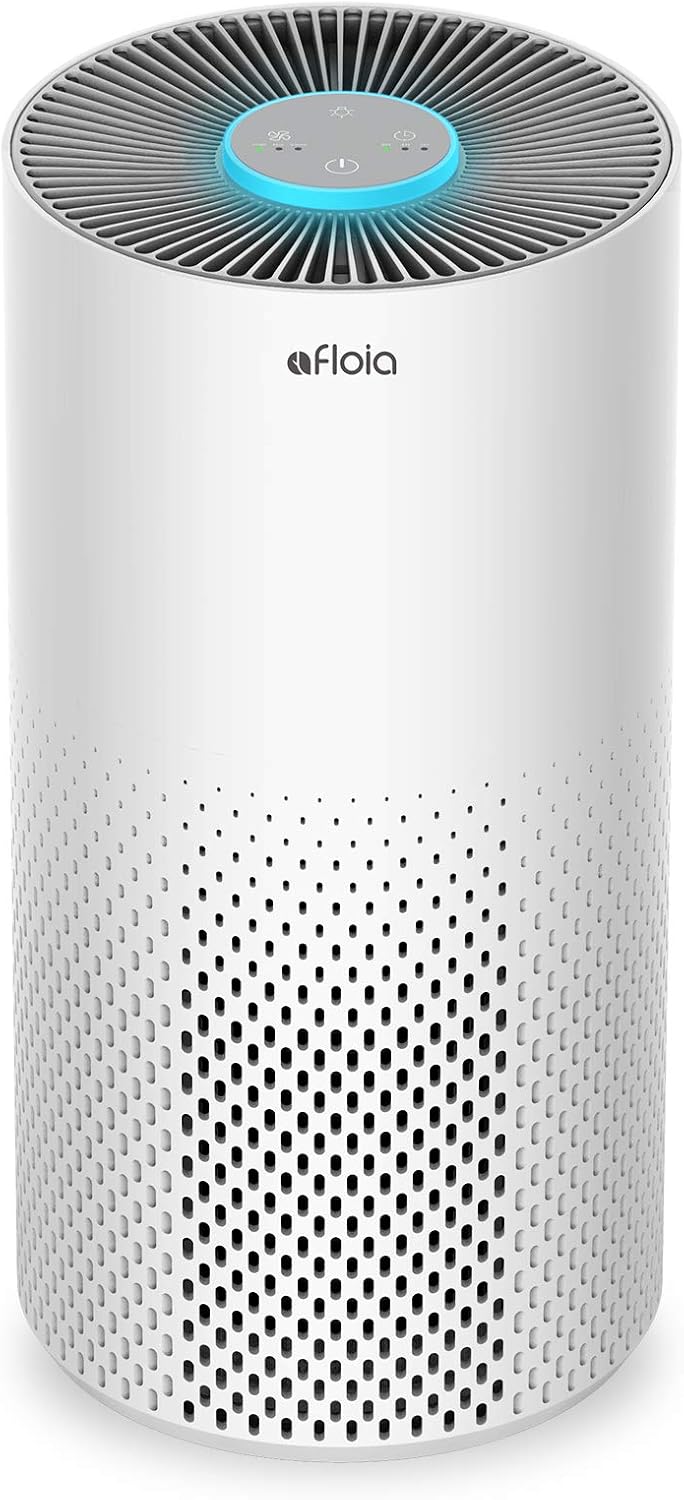
| Noise Level | 22 db |
|---|---|
| Particle Retention Size | 0.3 micron |
| Wattage | 23 watts |
| Floor Area | 60.84 square_feet |
| Filter Type | Activated Carbon |
The Afloia KILO is a small, user-friendly air purifier intended to clean indoor air in bedrooms, living rooms, or offices. It uses a 4-stage filtration system — including a washable pre-filter and activated carbon layers — to capture dust, pet hair, pollen, odors and particles down to 0.3 micron, and offers multiple replacement filter options for pet or antibacterial needs. Controls are simple with touch/button operation, adjustable fan speeds, and 2/4/8/16-hour timers, while a 22 dB sleep mode and seven-color night light make it unobtrusive overnight. The unit runs on 23 watts and is CARB certified for emissions. Practical maintenance is straightforward because the pre-filter is washable and the main filters are replaceable every few months depending on use. Limitations are its modest floor area rating relative to very large open-plan spaces and the reliance on consumable replacement filters for peak performance, but for typical bedrooms and smaller living areas it balances quiet operation with effective basic filtration.
Best for: A practical buyer who prioritizes quiet overnight operation and low-effort upkeep for bedrooms or small living spaces and wants straightforward controls and washable pre-filter convenience.
Less Ideal for: Not the best choice for someone needing to purify very large open-plan rooms or whole-house coverage without multiple units.
- Multi-stage filtration that includes a washable pre-filter for hair and large particles
- Very quiet 22 dB sleep mode suitable for night use
- Simple touch and button controls with multiple timer settings
- CARB certified and captures particles down to 0.3 micron
- Coverage claims vary by listing and may be optimistic for very large open areas
- Requires periodic replacement of main filters to maintain performance
Verdict: Choose the Afloia KILO when you want a compact, very quiet purifier with washable pre-filter and simple controls for bedrooms and small living spaces.
Purivortex PX500 Air Purifier

| Coverage Area | Up to 880 sq.ft |
|---|---|
| Filtration | Pre-filter, HEPA, Activated carbon |
| Decibel | 20db |
| Fan Modes | Sleep/Low/Med/High |
| Timer Settings | 4H/8H/12H |
The Purivortex PX500 is a compact HEPA air purifier that uses a three-layer system (pre-filter, HEPA, activated carbon) to remove dust, pollen, smoke, pet dander and light odors. It is intended for continuous home use and can cycle the air in a large room quickly — the brand reports full-room purification up to 880 sq ft in an hour and faster turnaround in smaller rooms. Practical controls include four fan modes (Sleep/Low/Med/High), three timers and a multicolor night light with separate color settings. The taller 6-inch filter is designed to increase airflow and dwell time compared with shorter cartridges, which helps cleaning speed without a larger footprint. Noise is low enough for bedroom use — a quoted 20 dB setting — and certifications such as ETL, FCC and CARB support safety and energy expectations. Limitations are typical for consumer purifiers: carbon filtration reduces light odors but will not remove strong chemical sources, and replacement filters are required to maintain peak performance over time.
Best for: Buyers who want a quiet, easy-to-use purifier that delivers strong particle filtration across bedrooms and living rooms on a modest budget and values straightforward controls and low noise for night use.
Less Ideal for: People needing industrial-strength odor or chemical gas removal or specialized medical-grade filtration should consider higher-end or dedicated carbon/HEGA systems instead.
- Three-layer filtration with HEPA and activated carbon removes particles and light odors
- Large 6-inch filter for higher airflow and faster purification
- Quiet operation suitable for bedrooms with a low-noise sleep mode
- Multiple fan speeds, timers, and night light modes for flexible daily use
- Carbon filter handles light odors but will not eliminate strong chemical fumes
- Replacement filters are a recurring cost to maintain effectiveness
Verdict: A budget-friendly, very quiet HEPA purifier that effectively reduces common allergens and light household odors in bedrooms and living spaces.
Levoit Core 300-P

| Filter Type | 3 in 1 Filtration |
|---|---|
| Floor Area | 1073 square_feet |
| Noise Level | 24 db |
| Particle Retention Size | 0.3 micron |
| Wattage | 56 watts |
The Levoit Core 300-P is a small, well-built HEPA air purifier intended for bedrooms and other living spaces where low noise and reliable filtration matter. It uses a 3-stage original filter and a 56W motor to capture fine particles including pollen, dust, pet dander, smoke, and VOCs, with independent testing showing 99.97% efficiency for 0.1–0.3 μm particles. Practical touches include touch controls, a timer, a filter-check indicator, and a sleep mode that drops sound to about 24 dB so it can run overnight without disturbing sleep. It is AHAM verified for CADR and certified to common safety standards, which supports consistent, repeatable performance. Limitations are that it lacks smart Auto Mode on this model and requires manual fan speed adjustment, and optimal coverage assumes use of Levoit original filters and timely replacements every 6–8 months. For those wanting a quiet, proven purifier for bedrooms and allergy relief, it balances strong filtration with low operational noise.
Best for: Buyers who prioritize quiet, dependable air cleaning for bedrooms or living rooms and want a straightforward, certified purifier that consistently reduces allergens and fine particles.
Less Ideal for: People who need built-in smart features or automatic air-quality sensing and adjustment should consider models with Auto Mode or Wi‑Fi instead.
- True HEPA-grade 3-stage filter capturing 99.97% of 0.1–0.3 μm particles.
- Very quiet Sleep Mode at about 24 dB suitable for bedrooms.
- AHAM verified CADR and third-party tested filtration figures supporting reliable performance.
- Compact, portable design with touch controls, timer, and filter indicator for easy everyday use.
- Does not include Auto Mode or smart connectivity on this Core 300-P variant.
- Best performance depends on using Levoit original replacement filters and regular changes.
Verdict: A quiet, AHAM-verified HEPA purifier that reliably reduces allergens in bedrooms for buyers who value proven, low-noise performance.
Levoit Core 200S-P
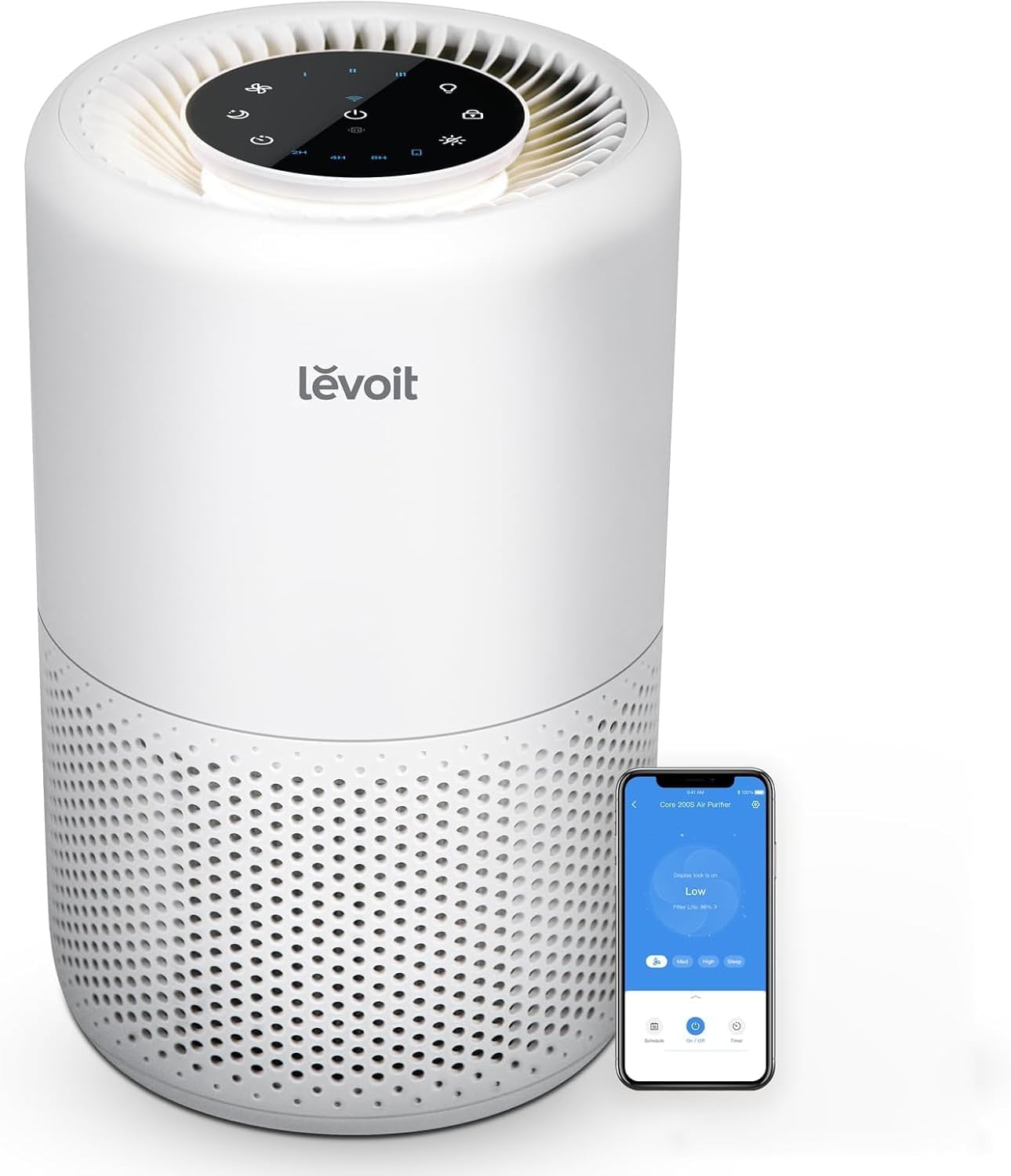
| Model | Core 200S |
|---|---|
| Air changes | Refreshes 140 ft² room 4.8 times per hour |
| Noise level | As low as 27 dB |
| Filtration | 3-stage (pre-filter, activated carbon, HEPA-grade) |
The Levoit Core 200S-P is a compact smart air purifier built for daily use in bedrooms, nurseries, and small apartments where low noise and reliable filtration matter. It draws air in 360 degrees through a three-stage system — pre-filter, activated carbon, and a HEPA-grade main filter — and the manufacturer states it refreshes a 140 ft² room nearly five times per hour. The unit supports app and voice control for remote speed and schedule adjustments and has a Sleep Mode that reduces fan speed and display output so background noise drops to about 27 dB. Practical benefits include effective removal of common allergens like dust, pollen, pet dander, and basic odor control from the carbon stage, plus filter-life monitoring through the app to remind you when to replace filters. Limitations are its focus on small rooms rather than open-plan spaces and the need to buy genuine replacement filters to maintain stated performance. For buyers who prioritize quiet night-time operation and verified particulate capture, this model offers a sensible, easy-to-use package.
Best for: Buyers who want a quiet, easy-to-manage purifier for bedrooms or small living spaces and who rely on proven product performance and social proof when choosing appliances.
Less Ideal for: People needing whole-home or large open-area air cleaning or those who want advanced gas or VOC-specific filtration beyond basic activated carbon.
- Three-stage filtration (pre-filter, activated carbon, HEPA-grade main filter) for particles and basic odors
- Quiet Sleep Mode with noise as low as 27 dB suitable for bedrooms
- Smart app and voice control with filter-life monitoring
- 360° air intake and compact footprint that refreshes a 140 ft² room multiple times per hour
- Designed for small rooms and not intended to cover larger open-plan areas
- Peak performance depends on using genuine replacement filters
Verdict: A quiet, smart small-room air purifier that reliably removes common allergens while running nearly silently at night.
VOOPNU H13 HEPA Air Purifier DH-JH12

| Filter type | H13 True HEPA triple-layer |
|---|---|
| Coverage | Up to 1,076 ft² (laboratory tested) |
| Noise level | As low as 22 dB |
| Speeds | 3 fan speeds |
The VOOPNU DH-JH12 is a small, user-friendly air purifier built around an H13 True HEPA triple-layer filter and 360 degree intake, aimed at removing pet hair, pollen, smoke, and common household odors. It is simple to operate via a streamlined control panel and offers three fan speeds, a timer, and an essential oil tray for light fragrance. VOOPNU claims a laboratory-tested cleaning rate that treats 250 ft² every 15 minutes, covering up to 1,076 ft² per hour, and the unit is designed to run quietly as low as 22 dB for undisturbed sleep. The purifier is certified by multiple safety and emissions agencies which supports reliable performance. In practical use it is easy to place on desks or in corners thanks to its compact footprint, and the washable pre-filter option on some variants helps capture larger particles before they reach the HEPA stage. Limitations are typical for compact purifiers: true coverage and particle removal will vary with room layout and continuous runtime is recommended for best results, and replacement filters are a recurring maintenance cost.
Best for: Buyers who prioritize quiet, certified performance and want a straightforward, low-friction purifier to reduce allergens and odors in bedrooms or living rooms without complicated setup.
Less Ideal for: Those needing whole-house high-CADR filtration or industrial-strength smoke removal should consider larger commercial units or multiple purifiers rather than a single compact model.
- H13 True HEPA triple-layer filtration captures 99.97% of fine particles
- 360 degree intake promotes even air circulation in room-scale spaces
- Very quiet operation down to 22 dB suitable for bedrooms
- Simple control panel with timer and three speeds for easy daily use
- Multiple safety and emissions certifications (DOE, ETL, FCC, CARB, CE, ROHS)
- Coverage claims are based on laboratory testing and real-world results depend on continuous runtime and room layout
- Compact units may not maintain claimed CADR in large open-plan homes without multiple units
- Some variants require periodic filter replacements and the cost is ongoing
Verdict: If you want a quiet, certified bedroom or living-room purifier that removes common allergens with minimal fuss, this compact H13 HEPA model is a reliable choice.
Choosing the Right Quiet Air Purifier for Allergies: Key Factors to Consider
Filtration Technology
The core of any allergy-focused air purifier is the filter media. True HEPA filtration captures at least 99.97% of particles down to 0.3 microns, which is important for pollen, mold spores, and many types of dust and dander. Some units supplement HEPA with prefilters that trap larger particles and activated carbon layers for odors and VOCs. Understanding the layers and particle sizes each stage targets helps set expectations for allergy reduction.
Filter quality also affects operating strategy. Higher-efficiency filters can increase resistance to airflow, which may require a stronger fan to maintain clean-air delivery. That interaction matters when you want both high capture rates and quiet operation at lower fan speeds.
Noise Output at Different Fan Speeds
Noise level is a primary concern for running a purifier in sleeping spaces. Look for measured decibel ratings at multiple fan speeds, especially the lowest or sleep setting. A unit that lists a low dB number but only at “standby” may not provide meaningful cleaning while quiet. Compare how many cubic feet per minute (or CADR) the unit moves at sleep-speed versus higher settings.
Also consider subjective noise qualities. Some fans produce a steady, low hum that is easier to ignore than intermittent rattles or high-pitched tones. Controls like a true low-power sleep mode, programmable night schedule, and dimmable displays reduce disturbances even when the fan is running.
Room Size and Clean Air Delivery Rate
Match the purifier's coverage to the room where you plan to use it. Manufacturers typically state recommended room sizes based on air changes per hour. For allergy relief, higher air changes are better because they reduce particle concentration faster. CADR values for specific particle types give a quantifiable measure of how quickly a purifier can clear the air in a given space.
Oversizing the unit for the room helps keep fan speed—and noise—lower while maintaining cleaning performance. Conversely, an undersized purifier will need to run at higher speeds to be effective, which increases noise and may reduce comfort.
Maintenance and Filter Cost
Regular filter replacement is essential to maintain allergen capture. Check how often primary filters need replacement under typical use and whether prefilters are washable to extend life. Consider the availability and cost of replacement filters, as high ongoing costs can make an otherwise excellent unit impractical for long-term allergy management.
Ease of accessing and replacing filters matters, especially for users who plan to change filters themselves. Simple, tool-free access and clear replacement indicators reduce the chance of degraded performance due to neglected maintenance.
Energy Consumption and Runtime
Because allergy management often requires running a purifier for many hours or overnight, energy use becomes a practical concern. Look for units with efficient motors, low-wattage sleep modes, and Energy Star ratings when available. Lower energy draw reduces operating cost and heat output, which can be important in small bedrooms.
Also consider standby and smart features that affect runtime, such as timers, auto modes based on air quality sensors, and scheduling. These can keep a unit running effectively without wasting power or forcing high-speed operation unnecessarily.
Controls, Indicators, and Placement
Accessible controls and clear indicators improve the daily experience of using an air purifier. Simple, intuitive buttons or app control can make it easier to set nightly schedules or switch to a quiet mode. Look for units with sleep-friendly features like dimmable displays or the ability to turn off lights entirely.
Placement affects performance and noise perception. Position the unit away from walls and obstructions to maximize airflow and reduce reflected sound. In bedrooms, choose a location where airflow is unobstructed but the device is not directly next to the pillow or headboard to minimize perceived noise.
How Noise Ratings Translate to Real Use
Decibel numbers are useful but can be misleading unless you know the context. A 30 dB rating is much quieter than 50 dB, but perceived loudness also depends on fan frequency and room acoustics. In a small bedroom a modest noise can seem louder if the unit sits near the head of the bed.
Compare the CADR or airflow at the fan speeds associated with the listed decibel levels. A very quiet sleep mode that provides minimal airflow may not deliver meaningful allergen reduction overnight, while a slightly louder low mode that sustains higher airflow can be a better compromise.
- Look for multi-speed noise specs with airflow or CADR at each speed.
- Preference raw dB numbers for sleep use but verify actual cleaning performance at that setting.
- Consider subjective sound quality, not just the decibel figure.
Placement Tips for Bedrooms and Living Areas
Correct placement optimizes both cleaning and perceived noise. Keep the unit at least several inches from walls and avoid corners that block intake or exhaust. Elevating a small floor unit onto a stable surface can improve circulation and reduce carpet vibration noise.
For bedroom use, place the purifier near the breathing zone without directing airflow directly at the pillow. If noise is sensitive, choose a placement that puts some distance between the fan and the head of the bed while still allowing the purifier to cycle room air effectively.
- Avoid obstructing intakes with furniture or curtains.
- Position for cross-room airflow when possible.
- Use the lowest effective fan speed to minimize noise.
Interpreting CADR and Manufacturer Coverage
CADR, or Clean Air Delivery Rate, gives an estimate of how quickly a unit can remove particulates of different sizes. For allergy sufferers, the CADR for pollen and dust is most relevant. Higher CADR means faster cleaning and fewer hours at high fan speeds.
Manufacturers often list recommended room size for a single air change per hour. For allergy control, aim for higher air changes—two to four per hour—depending on symptom severity and pollutant load. Running at higher air changes will require more airflow, which influences noise and energy use.
- Use CADR to compare cleaning speed between units.
- Target multiple air changes per hour for allergy relief.
- Match purifier capacity to worst-case room use, such as daytime activity or pet presence.
Sleep Mode and Nighttime Features
A true sleep mode reduces fan speed, dims lights, and limits notifications while preserving enough airflow to continue filtering. Some units also lower motor voltage or change fan blade behavior to produce a deeper, more tolerable hum rather than high-pitched tones.
Programmable timers and schedules let you run stronger cleaning cycles during the day and revert to quieter modes at night. If you are sensitive to LED indicators or control beeps, look for models that allow these to be silenced independently of fan operation.
- Confirm sleep mode maintains adequate CADR for overnight use.
- Look for dimmable or removable displays to reduce light pollution in bedrooms.
- Prefer units with silent alerts or the option to disable sounds.
Air Quality Sensors and Automatic Control
Built-in sensors for particulate matter or combined air quality can automate fan speed to match room conditions. Smart control reduces the need for manual adjustments and can prevent running the purifier louder than necessary when air is already clean. However, sensor accuracy varies and can lag in detecting fast changes.
If relying on automatic modes, make sure the unit's sensors detect the particle sizes relevant to allergies. Some sensors respond primarily to larger dust or smoke, which may not reflect smaller allergenic particles as reliably.
- Use automatic modes for convenience but verify sensor responsiveness.
- Pair sensors with manual override to ensure predictable nighttime behavior.
- Check whether the unit reports particle counts or relative air quality for more precise control.
How We Chose the Best Quiet Air Purifier for Allergies
We prioritized products that specifically balance high allergen capture with low operational noise. Our editorial filters favored true HEPA filtration or equivalent particle-capture technology, verified CADR or airflow figures, and manufacturer-stated decibel levels at common fan speeds. We also considered room coverage claims and how efficiently units clean air relative to their noise output. Practical usability factors were included. We looked for adjustable fan speeds including a dedicated low or sleep mode, simple filter replacement procedures, and accessible controls for bedrooms and living spaces. Energy efficiency and standby behavior were evaluated to ensure a unit can run overnight without excessive cost or heat buildup. We excluded units that only advertise odor removal without documented particulate filtration, and we filtered out products with unclear or missing noise specifications. Units with poor user-serviceability, such as inaccessible filters or proprietary maintenance burdens, were also removed from consideration. In short, the list reflects quiet operation, verified allergen removal performance, sensible coverage for typical rooms, and straightforward upkeep.
Our full evaluation process is outlined in our review methodology.
FAQ
How quiet is 'quiet' for an air purifier used while sleeping?
Quiet typically means a noise level below about 35 dB on low or sleep settings, which is comparable to a whisper. However, perceived quiet depends on fan tone and placement, so aim for units with measured noise specs at the sleep speed and user-adjustable fan control.
Do I need a HEPA filter to reduce allergy symptoms?
Most allergy experts recommend true HEPA or HEPA-equivalent filtration for capturing pollen, dust, and pet dander. Supplemental stages like prefilters and activated carbon help with larger particles and odors but do not replace the particle-capturing role of HEPA media.
Will running a purifier on low actually help with allergies?
Running on low can help if the purifier still delivers sufficient air changes for the room. Low-speed cleaning is better than none, and continuous low-speed operation often removes pollutants more steadily than intermittent high-speed bursts.
How often should I change filters when using a purifier for allergies?
Filter life depends on use and pollutant levels, but typical replacement intervals range from 6 to 12 months for primary HEPA filters under regular residential use. Check prefilter condition more often and replace according to manufacturer guidance or visible soiling.
Can an air purifier remove pet dander and pollen effectively?
Yes, units with true HEPA filtration are effective at capturing pet dander and pollen particles when sized appropriately for the room and run long enough to achieve multiple air changes per hour.
Are air quality sensors reliable for controlling fan speed?
Sensors are useful for automating fan control but vary in accuracy and responsiveness. They are best used as a convenience feature alongside manual controls, especially if you have specific allergy triggers that may not produce large sensor readings.
Final Verdict
For allergy-focused use, prioritize a purifier that pairs verified particle filtration with low-noise operation at meaningful airflow rates. Balance between CADR and decibel ratings, and match unit capacity to room size so you can run it quietly without sacrificing cleaning speed. Consider maintenance burden and energy use as part of the long-term decision. If sleep disturbance is a primary concern, choose models with true sleep modes, dimmable displays, and proven low-noise performance at useful cleaning levels to keep symptoms manageable without undermining rest.