
Note: This article contains affiliate links. If you click on these links and make a purchase, we may earn a small commission at no extra cost to you. This helps support our research and content. Read our full affiliate disclosure here.
If you need steady, affordable access to hot and cold water without a large footprint, picking the right budget water dispenser matters. A good unit saves kitchen space, keeps running costs low, and delivers safe, filtered water for daily use. This guide shortlists the top budget water dispensers available and explains the practical tradeoffs between efficiency, filtration, and convenience. Below we evaluate each pick on energy use, filtration performance, build quality, and ease of upkeep to help you choose the best unit for your counter or freestanding location.
Top Picks at a Glance
| Best Overall The best all-around choice for most situations | Avalon A3 Bottom Loading Water Cooler |  |
| Best Quality Built to a higher standard if you want something more solid | Avalon A4 Bottom Loading Water Cooler |  |
| Best Value The sweet spot between price and what you get | Waterdrop Alkaline Water Filter Dispenser |  |
| Best Budget The cheapest option that still gets the job done reliably | MagicPro Electric Water Dispenser W1 |  |
| Top Rated A top-rated pick with lots of positive feedback | Waterdrop Water Filter Dispenser WD-WFD-40L-L |  |
| Most Popular A crowd favorite that many people choose with confidence | Myvision 5 Gallon Water Dispenser |  |
| Best Seller A high-volume bestseller chosen again and again | Brio Bottom Loading Water Cooler | 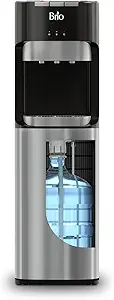 |
Avalon A3 Bottom Loading Water Cooler

| Wattage | 150 watts |
|---|---|
| Installation Type | Freestanding |
| Access Location | Bottom |
| Number of settings | 3 |
| Power Source | Corded Electric |
The Avalon A3 is a freestanding, bottom-loading water cooler built for office or home use where easy bottle changes and three temperature settings matter. It pumps water from 3- to 5-gallon bottles stored in a lower cabinet and offers crisp cold water (about 47°F), near-boiling hot water (about 185°F) and room temperature output through simple push-button spouts. Practical touches include a removable drip tray, 9 inches of clearance under the spouts for large cups or bottles, a nightlight for low-light use, an empty-bottle indicator, and a child safety lock on the hot tap. The unit also uses an ozone-based self-cleaning cycle to sanitize the dispenser interior, reducing manual maintenance. Expect a sturdy stainless steel cabinet and a 150-watt compressor that keeps cold water consistently chilled, but note the cooler is a full-size freestanding appliance so it requires floor space and occasional filter or maintenance checks to keep the ozone cleaning effective. It is a sensible budget-friendly option for users who want reliable hot and cold dispensing without top-loading lifting.
Best for: Buyers who want an affordable, low-effort hot-and-cold dispenser for a small office or household that values easier bottle changes and basic sanitation features.
Less Ideal for: People who need a compact countertop solution, a filter-integrated purifier, or a model for very small spaces should look at other form factors.
- Bottom-loading design makes bottle changes easier and reduces lifting
- Three temperature settings including very hot water with a child safety lock
- Ozone self-cleaning feature helps reduce bacterial buildup
- Built-in nightlight and empty-bottle indicator improve everyday convenience
- Full-size freestanding footprint requires dedicated floor space
- Ozone cleaning and compressor need periodic maintenance to stay effective
Verdict: A budget-friendly, bottom-loading stainless steel cooler that delivers reliable hot, cold, and room-temperature water with easy bottle changes and built-in sanitation.
Avalon A4 Bottom Loading Water Cooler

| Wattage | 400 watts |
|---|---|
| Number of settings | 3 |
| Upper Temperature Rating | 85 °C |
| Lower Temperature Rating | 8.3 °C |
| Capacity | 5 gallons |
The Avalon A4 is a compact bottom-loading water dispenser designed for home or small office use that delivers three selectable temperatures: hot, cold, and room. It fits standard 3 to 5 gallon bottles in a bottom-access compartment to avoid lifting and spills, and the stainless steel cabinet gives it a durable, low-profile look. Controls are manual push buttons and the unit includes a nightlight and an empty-bottle indicator for convenient use after dark. Heating and cooling are handled by separate systems with roughly 420W for hot and 100W for cold, so hot water reaches serving temperature quickly while cold water is adequate for everyday use. The A4 also has BioGuard treatment on high-contact areas to reduce bacterial growth. Expect straightforward setup and basic, reliable dispensing without smart features or advanced filtration, and note the simpler cooling power means it will not chill as rapidly as larger, higher-wattage commercial coolers.
Best for: Buyers who want a simple, durable water dispenser that prioritizes reliable hot and usable cold water with an easy bottom-loading setup for home or small office use.
Less Ideal for: Users seeking rapid industrial-strength chilling, advanced filtration, or smart controls should consider higher-end or commercial models instead.
- Bottom-loading design reduces lifting and spills and hides the bottle from view
- Three temperature options (hot, cold, room) for versatile use
- Stainless steel cabinet for durability and a clean appearance
- Built-in nightlight and empty-bottle indicator improve convenience in low light
- Cooling power is modest so cold water may take longer to reach very low temperatures
- Manual controls only, no digital display or smart features
Verdict: A budget-friendly, no-frills bottom-loading dispenser that reliably provides hot, cold, and room-temperature water with an easy-to-use, durable design.
Waterdrop Alkaline Water Filter Dispenser

| Purification Method | Activated Carbon, Alkaline |
|---|---|
| Power Source | Gravity Filtration |
| Maximum Flow Rate | 0.3 gpm |
| Supported Water TDS Level Maximum (PPM) | 600 |
| Filter Life Cycle | 100 gallons / 2 months |
The Waterdrop Alkaline Water Filter Dispenser is a large-capacity countertop pitcher-style dispenser that uses gravity filtration and a 6-stage cartridge to reduce chlorine, metals and taste while adding alkaline minerals. You fill the top reservoir and water passes through the activated carbon and alkaline filter into the body, then dispenses from a sealed spout — the push-and-pull lid and top handle simplify refilling and carrying. Notable features include a smart LED filter indicator, a double-sealed faucet to prevent drips, and a filter rated for roughly 100 gallons or two months of typical use. Practical benefits are straightforward: it produces better-tasting, mineralized water without plumbing or electricity, fits in most refrigerators, and supplies family-sized volumes between filter changes. Limitations to note are the relatively short listed filter lifespan compared with some premium pitchers, potential pH variation depending on source water, and a modest flow rate around 0.3 gpm that makes refills slower than direct-tap options.
Best for: Buyers who want a low-cost, no-plumbing way to get mineralized, better-tasting water for a household or fridge and who prioritize capacity and simplicity over long filter intervals.
Less Ideal for: People who need very long filter life, high flow dispensing, or tightly controlled TDS/pH reductions should consider other systems designed for high throughput or TDS suppression.
- Large 40-cup capacity for family use or fridge storage
- 6-stage filtration that targets chlorine, metals, and taste while adding alkaline minerals
- Gravity-fed operation requires no power or installation
- LED filter indicator to remind when cartridge needs replacement
- Double-sealed faucet and push-pull lid reduce leaks and make refilling easier
- Filter life listed as about 100 gallons/2 months which may require frequent replacements for heavy use
- Flow rate is modest (around 0.3 gpm), so dispensing a full pitcher can be slow
Verdict: A budget-friendly, large-capacity countertop dispenser that delivers mineralized, better-tasting water without installation, ideal for households wanting simple, fridge-ready filtered water.
MagicPro Electric Water Dispenser W1

| Capacity | 5 gallons |
|---|---|
| Power Source | Battery Powered |
| Material Type | Plastic |
The MagicPro W1 is a compact, battery-powered water pump that converts large bottled water jugs into an easy one-touch dispenser. It installs by fitting the silicone tube and stainless steel spout into the bottle mouth, then charging the internal battery via USB; a single press of the touch button runs the pump and delivers a steady stream. Because it is freestanding and low-profile it works on tabletops or the floor and is easy to carry to picnics or campsites. Construction is mostly ABS plastic with a food-grade silicone hose and a 304 stainless spout, which keeps the water path safe and simple to clean. The practical benefits are clear for anyone who wants to avoid lifting heavy 5-gallon jugs and who needs a portable, rechargeable option without a full dispenser. Limitations are typical for its class: it is not a chilled or heated hot-and-cold dispenser and it relies on periodic recharging and manual bottle replacement rather than a permanent installed system.
Best for: Buyers looking for the cheapest way to get hands-free dispensing from large bottles and who value portability over extras.
Less Ideal for: People who need a full hot-and-cold freestanding dispenser or a permanently installed water cooler should look at larger appliances.
- Simple one-touch operation for fast, consistent pouring
- Rechargeable battery lets you use it away from outlets
- Food-safe materials: ABS body, food-grade silicone tube, 304 stainless spout
- Compact, lightweight design that fits most 2–6 gallon bottles
- No temperature control or insulation for hot or cold drinks
- Not a permanent freestanding cooler—requires manual bottle changes and recharging
Verdict: A very affordable, portable electric pump that makes 5-gallon bottles easy to dispense without lifting.
Waterdrop Water Filter Dispenser WD-WFD-40L-L

| Purification Method | Activated Carbon |
|---|---|
| Power Source | Manual (Gravity-fed) |
| Filter Life Cycle | 200 gallons / 2 months |
| Capacity | 35 cups |
The Waterdrop WD-WFD-40L-L is a manual, gravity-fed countertop dispenser that holds roughly 35 cups and uses an activated carbon filter to cut chlorine, taste, odor and common sediments. You fill the top, water passes through the replaceable cartridge and collects in the lower reservoir for easy pouring via a push-pull spout. Notable design touches include a slim footprint for tight counters or fridge storage, a sloped basin that helps water flow at low levels, and a top cover and handle shaped for simple carrying and one-handed lifting. The filter is NSF-tested to NSF/ANSI 42 and 372 and rated to treat about 200 gallons or roughly two months of use, which keeps replacement frequency low for a budget-oriented system. Because it is manual and gravity-based there is no power, no pumps, and filtration speed and flow depend on head pressure and cartridge condition, so it is not instantaneous like electric systems. For buyers wanting a reliable, low-maintenance dispenser on a modest budget this model delivers consistent, certified chlorine and sediment reduction without complicated setup.
Best for: Buyers who prioritize a dependable, low-maintenance water dispenser that reliably reduces chlorine and sediments on a tight budget and without electronics.
Less Ideal for: Those who need instantaneous high flow, specialized contaminant reduction like TDS or fluoride, or a powered dispensing system should consider other options.
- NSF-tested activated carbon filter for chlorine, taste and odor reduction
- Slim countertop design fits in fridges and tight spaces
- Large 35-cup capacity suitable for daily family use
- Filter life rated to ~200 gallons (about 2 months) reduces replacement frequency
- Gravity-fed flow can be slower than electric or pressurized options
- Does not reduce TDS or provide fluoride removal
Verdict: A reliable, no-frills countertop dispenser that delivers certified chlorine and sediment reduction at a very budget-friendly, low-maintenance price.
Myvision 5 Gallon Water Dispenser

| Wattage | 4 watts |
|---|---|
| Power Source | Corded Electric |
| Capacity | 5 gallons |
| Upper Temperature Rating | 80 °C |
The Myvision 5 Gallon Water Dispenser is a compact, battery-powered pump that mounts to the mouth of standard 3–5 gallon water bottles and delivers water at the push of a single button. It uses a built-in rechargeable 1200 mAh battery and micro-USB charging, and the motor is rated at 4 watts to pump roughly 1.5 liters in about 60 seconds before the unit auto-stops after a minute. Construction mixes 304 stainless steel and food-grade silicone with ABS plastic housing, so the parts in contact with water are BPA-free. Installation is tool-free and portable, making the unit useful for kitchens, offices, camping, or events where a bottled jug is used. Practical benefits include long run time on a full charge (the listing claims 30–40 days or multiple jugs), simple operation for kids or elders, and a two-year replacement service for buyer peace of mind. Limitations are small: charging uses Micro-USB instead of newer USB-C, the pump is single-speed with one setting, and the compact design may not deliver the flow or durability of larger electric coolers under heavy daily commercial use.
Best for: Buyers who want an inexpensive, portable, and easy-to-use bottled water pump for home, office, or occasional outdoor use and who value simple operation and a seller-backed replacement policy.
Less Ideal for: Businesses or heavy-use environments that need continuous high flow or a commercial-grade cooler with hot/cold functions should consider a larger, purpose-built dispenser.
- USB-rechargeable 1200 mAh battery offers long run time between charges
- One-button operation and auto-stop make dispensing simple and safe for all ages
- Food-grade silicone hose and 304 stainless steel parts for BPA-free water contact
- Quick pumping speed (about 1.5 L in 60 seconds) suitable for home and small events
- Two-year replacement service provides extra assurance for risk-aware buyers
- Uses Micro-USB charging rather than newer USB-C standard
- Single-speed pump with limited flow control for precision dispensing
- Smaller plastic housing may be less durable than full-size water coolers under heavy use
Verdict: A low-cost, portable USB-rechargeable pump that makes dispensing from 3–5 gallon jugs effortless and comes with a two-year replacement promise for cautious buyers.
Brio Bottom Loading Water Cooler

| Wattage | 500 watts |
|---|---|
| Installation Type | Freestanding |
| Access Location | Bottom |
| Number of settings | 3 |
| Capacity | 5 gallons |
The Brio Bottom Loading Water Cooler is a freestanding dispenser designed to eliminate heavy lifting by housing 3- or 5-gallon bottles inside the cabinet and offering hot, cold, and room-temperature taps. Typical use is in a small office, kitchen, or breakroom where on-demand hot beverages and chilled drinking water are needed without the hassle of top-loading. Notable features include a stainless steel reservoir for taste preservation, a child-safety lock on the hot spout, an LED display with an empty-bottle alert, and a convenient bottom-access design that makes bottle changes simple. In practice the unit delivers straightforward performance and useful safety and maintenance cues, and the stainless reservoir helps keep water tasting clean. Trade-offs are its footprint and weight for placement and the lack of advanced filtration or touchless dispensing found on higher-end models, but for basic hot-and-cold dispensing this model covers core needs reliably.
Best for: Buyers who want a simple, reliable dispenser that removes the hassle of lifting bottles and provides hot and cold water on demand with basic safety and maintenance features.
Less Ideal for: People who need integrated water purification, touchless or smart-home features, or an ultra-compact, lightweight unit for very small spaces.
- Bottom-load cabinet removes heavy lifting and works with 3- or 5-gallon bottles.
- Stainless steel reservoirs to help preserve water taste and hygiene.
- Hot, cold, and room-temperature outputs cover everyday beverage needs.
- Child-safety lock and empty-bottle alert improve safety and convenience.
- No built-in advanced filtration or purification system.
- Larger footprint and substantial weight may limit placement options.
Verdict: A practical, no-frills bottom-load dispenser that delivers reliable hot, cold, and room-temperature water while avoiding the heavy lifting of top-loading bottles.
Choosing the Right Budget Water Dispenser: Key Factors to Consider
Energy Efficiency and Standby Power
Energy efficiency directly affects monthly operating costs, which is crucial for budget-minded buyers. Look for dispensers with low standby draw and efficient heating and cooling cycles. A model that can maintain temperature without constant compressor or heater cycles will use less electricity over time.
Also consider features like eco or sleep modes that reduce energy use during idle hours. While initial purchase cost is important, lower ongoing electricity consumption often makes a more efficient dispenser cheaper over its lifespan.
Filtration Type and Effectiveness
Filtration determines what contaminants are removed and how the water tastes. Basic carbon filters reduce chlorine and improve flavor, while multi-stage filters can target sediments, lead, and other impurities. Verify the filter's rated contaminants and replacement interval to understand long-term effectiveness.
Budget models may use simpler filters, so factor in how often replacements are needed and whether replacement cartridges are widely available and affordable. Ease of access to the filter housing also influences how often you will actually perform maintenance.
Temperature Range and Stability
Common household needs include cold water for drinking and chilled beverages and hot water for drinks or light cooking tasks. Check the temperature range and how quickly the dispenser reaches set temperatures. More precise temperature control improves usability for hot beverages and reduces the need to reheat on a cooktop or in a kettle.
Stability matters for repeated use. A unit that dips considerably in temperature under frequent dispensing can be frustrating. For families, faster recovery rates for both hot and cold reservoirs are especially useful.
Footprint and Installation Type
Space constraints influence whether a countertop or freestanding dispenser is realistic. Measure the intended location and compare dimensions, paying attention to depth and required clearance for water bottles or refill access. Some budget dispensers are gravity-fed or bottle-based and need vertical space for the bottle; others connect to a water line and require simple plumbing access.
Installation complexity affects cost and convenience. If you cannot or do not want to modify plumbing, choose a self-contained model that only needs occasional refilling.
Flow Rate and Dispense Convenience
Flow rate affects how quickly you can fill a glass, coffee pot, or pitcher. A slow dispense can be irritating during busy mornings. Also consider the height of the dispensing area and whether it accommodates tall containers without awkward angling.
Ease-of-use features such as simple tap action, child locks for hot water, and clearly marked controls improve daily convenience and safety, which matters in households with children or elders.
Maintenance Frequency and Replacement Costs
Routine maintenance includes filter replacement, descaling, and occasional cleaning of drip trays and reservoirs. Understand how often filters must be replaced and whether descaling is required for hot water elements. Frequent replacements or expensive cartridges can quickly negate the benefit of a lower upfront price.
Look for dispensers with user-accessible parts and common filter sizes. Readily available replacements and clear maintenance instructions reduce the time and cost of ownership.
Countertop Vs Freestanding Budget Options
Countertop dispensers are compact and ideal for small kitchens, apartments, or offices where floor space is limited. They typically hold smaller internal reservoirs or accept smaller refill bottles and are easier to move if you need temporary placement in different rooms.
Freestanding units usually offer larger reservoirs and a more substantial cooling or heating system but require a permanent floor location. These are better if you have higher daily water demand or prefer less frequent refilling.
- Countertop: smaller footprint, simpler setup, easier to store
- Freestanding: larger capacity, faster temperature recovery, less frequent refills
Bottle-Fed Versus Direct-Plumbed Dispensers
Bottle-fed dispensers use replaceable water bottles and avoid plumbing changes. They are flexible and portable, but you must factor in bottle storage and the effort of replacing heavy bottles.
Direct-plumbed dispensers connect to a water line for continuous supply and reduce manual refills. That convenience comes at the cost of needing a nearby water connection and sometimes more complex initial setup.
- Bottle-fed: portable, low installation needs, good for renters
- Direct-plumbed: continuous supply, less manual handling, needs plumbing access
Noise and Daily Use Comfort
Compressors and pumps can create noise that affects placement options. If the dispenser will sit near living spaces or a home office, prioritize models known for quiet operation or with compressor isolation to reduce vibration.
Operational noise also correlates with active cooling performance. Quieter models may cool slightly slower but provide a more comfortable daily experience in noise-sensitive environments.
- Look for units with quiet compressor notes
- Consider placement away from workspaces if noise is a concern
Safety Features and Child Protection
Hot water poses burn risks, so child safety locks or two-step dispenses are important in family homes. Look for mechanical or electronic locks that prevent accidental hot-water dispensing.
Electrical safety features such as automatic shutoff during overheating or dry-heating protection also reduce risk and can protect the unit when water levels are low.
- Child lock for hot tap
- Automatic shutoff or dry-heat protection
Filter Replacement and Consumables Lifecycle
Understand the expected lifespan of filters and how often consumables need replacement. Some budget units use inexpensive, easily sourced filters while others rely on specific cartridges. Frequent replacements add to ongoing costs.
Choose models with simple filter-change access and clear indicators or timers for replacements to avoid degradation in water quality over time.
- Check replacement intervals and cartridge availability
- Prefer units with clear filter access and replacement indicators
How We Chose the Best Budget Water Dispenser
We focused on practical criteria that matter to someone buying a budget water dispenser for everyday home use. Primary filters were energy efficiency and filtration performance because lower operating costs and clean water are central to ongoing value. We also prioritized flow rate and temperature control since those affect usability for cooking, beverages, and filling containers. Build quality and footprint were considered to ensure the unit fits small kitchens and withstands regular handling. Finally, ease of maintenance and filter replacement frequency were used to assess long-term ownership effort. Excluded from consideration were premium or specialty dispensers that target commercial settings, units requiring extensive plumbing modifications, and devices with proprietary filter ecosystems that significantly raise lifetime costs. The final list emphasizes clear, measurable specs and user-focused features rather than branding or luxury extras. In short, we filtered for low running cost, proven filtration, practical temperature range, compact design, and straightforward upkeep.
Our full evaluation process is outlined in our review methodology.
FAQ
How often should I replace the filter in a budget water dispenser?
It usually depends on the filter type and usage but most basic carbon filters need replacement every 3 to 6 months. Higher-use households or those with poor incoming water quality may need more frequent changes.
Can a budget dispenser provide both hot and cold water safely?
Yes, many budget dispensers offer both functions with built-in thermostats. Check for hot-water safety locks and temperature stability specifications to ensure safe operation in homes with children.
Are bottle-fed dispensers more cost-effective than plumbed units?
Bottle-fed units avoid plumbing costs but require buying and handling refill bottles, which adds recurring cost and effort. Plumbed units reduce manual refills but may have higher installation complexity.
Will a small dispenser keep water cold enough for regular use?
Smaller dispensers can deliver adequately cold water, but they often have slower recovery after heavy use. If you frequently fill large containers, choose a unit with a higher cooling capacity or larger reservoir.
What maintenance should I perform to keep a dispenser sanitary?
Regularly clean the drip tray and external surfaces, follow recommended filter changes, and periodically sanitize internal reservoirs per the manufacturer maintenance schedule. Descale heating elements if your water is hard.
Final Verdict
When choosing a budget water dispenser, balance upfront cost with ongoing operating expenses such as electricity and filter replacements. Prioritize energy efficiency and reliable filtration first, then match capacity, footprint, and dispense convenience to how you use water daily. Keep safety features and maintenance accessibility in mind if you have children or limited time for upkeep. Focus on the features that will matter most during a year of use rather than the cheapest initial option. That approach helps ensure steady, low-cost hydration with fewer surprises down the road.