
Note: This article contains affiliate links. If you click on these links and make a purchase, we may earn a small commission at no extra cost to you. This helps support our research and content. Read our full affiliate disclosure here.
When you camp away from hookups, a dedicated camping water heater can make mornings and cleanup much easier. The right unit delivers near-instant hot water, fits your campsite packing limits, and runs cleanly on the fuel source you plan to use. This guide spotlights seven shortlisted camping water heaters that meet common outdoor needs, from solo backpacking to family car camping. We evaluated units on how quickly they heat water, how efficiently they use fuel, how easy they are to set up, and how portable they are. Read on to find the options that best match your camping style and water needs.
Top Picks at a Glance
| Best Overall The best all-around choice for most situations | CAMPLUX AY132 Portable Tankless Water Heater |  |
| Best Quality Built to a higher standard if you want something more solid | FOGATTI InstaShower 9 Pro |  |
| Best Value The sweet spot between price and what you get | GASLAND BE158 Portable Propane Heater | 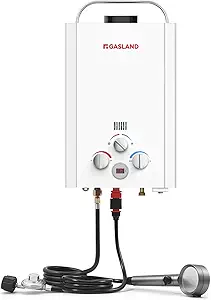 |
| Best Budget The cheapest option that still gets the job done reliably | Eaakkoom Immersion Water Heater MJ-R13 |  |
| Top Rated A top-rated pick with lots of positive feedback | BougeRV Portable Propane Water Heater |  |
| Most Popular A crowd favorite that many people choose with confidence | Hike Crew Portable Tankless Water Heater |  |
| Best Seller A high-volume bestseller chosen again and again | BSEED Immersion Water Heater WH-B |  |
CAMPLUX AY132 Portable Tankless Water Heater

| Flow Rate | 1.32 gpm |
|---|---|
| Power Source | Propane with D‑cell battery ignition |
| Heat Output | 34,000 BTU |
| Water Pressure Range | 3-130 PSI |
| Capacity | 5 liters |
The CAMPLUX AY132 is a compact, battery‑ignited propane tankless water heater built for camping, RVs, cabins, and other off‑grid outdoor uses. It produces up to 1.32 gallons per minute of hot water and runs on a 20 lb propane tank with two D‑cell batteries for ignition, so no household power is required. The unit includes a folding handle and mounting options for hanging or wall installation and ships with a CSA‑certified gas regulator, shower head and hose, and installation hardware for quick setup. Safety features include antifreeze protection, overheat protection, flame failure and low‑flow/low‑pressure protections, which make it practical in colder or low‑pressure conditions; it also lights at very low water pressure so it works with gravity feed or small pump systems. Tradeoffs are its modest flow rate and temperature ceiling, so it is best for single‑person showers or cleaning tasks rather than supplying multiple taps simultaneously, and performance will vary with inlet water temperature and propane burn rate.
Best for: Buyers who want a portable, self-contained hot water solution for camping, RVing, or remote cabins and value safety features and simple installation over high flow output.
Less Ideal for: People needing multi-fixture hot water or consistently high flow and high-temperature output for full bathroom replacement should look at larger or permanently installed units.
- Runs off propane with battery ignition so it needs no electrical hookup
- Lightweight with folding handle and included mounting hardware for easy transport and installation
- CSA certified and multiple built‑in safety protections including overheat and flame failure cutoffs
- Starts at very low water pressure, compatible with gravity bags or small 12V pumps
- Maximum flow rate (1.32 GPM) and temperature limit make it best for single‑user showers rather than multiple simultaneous uses
- Depends on propane supply and batteries for ignition, requiring fuel management on extended trips
Verdict: Choose the CAMPLUX AY132 if you need a lightweight, CSA‑certified propane tankless heater that delivers instant hot showers off the grid with easy setup and safety protections.
FOGATTI InstaShower 9 Pro

| Power Source | Liquid Propane |
|---|---|
| Flow Rate | 3.6 gpm |
| Heat Output | 66,000 BTU |
| Maximum Pressure | 150 psi |
| Voltage | 12 volts_of_direct_current |
The FOGATTI InstaShower 9 Pro is a high-output propane tankless water heater designed for RVs and campers that need near-instant hot water with strong flow. It supplies up to 3.6 gallons per minute and a 66,000 BTU burner that supports simultaneous use in a bathroom and kitchen while the mixing tank smooths temperature swings for steadier showers. Built-in protections include anti-freeze, flame-failure shutoff, dry-combustion protection, overheat protection, and a 150 PSI relief valve, and the unit is CSA certified. The 12 V direct-current controls and included wired remote simplify operation from inside the RV, and the upgraded fan and combustion design are rated for high-altitude operation to about 9,800 feet. Trade-offs are typical of powerful tankless units: it requires proper LP gas plumbing and adequate ventilation, and installation may need a retrofit door opening or trim adjustments depending on your RV model. For campers who prioritize hot-water performance, it brings near-tank capacities without the wait.
Best for: Campers and RV owners who prioritize strong hot-water performance and want near-instant showers and simultaneous fixture use while traveling.
Less Ideal for: Casual campers who need a simple, low-installation water heater or those who do not have LP gas plumbing and venting capacity in their rig.
- High heat output (66,000 BTU) for strong, consistent hot-water flow
- Delivers up to 3.6 GPM so two fixtures can be used without major drop in temperature
- Built-in mixing tank and precise temperature control for stable showering
- Multiple safety features and CSA certification for reliable operation
- Designed for high-altitude use with upgraded fan and forced exhaust
- Requires LP gas hookups and proper venting, so installation is more involved than plug-and-play units
- May need a retrofit door opening or trim adjustments to fit some RVs
Verdict: Choose the InstaShower 9 Pro when you want a high-output, performance-focused RV tankless heater that delivers strong, near-instant hot water for multiple fixtures.
GASLAND BE158 Portable Propane Heater

| Power Source | Liquid Propane |
|---|---|
| Flow Rate | 1.58 gpm |
| Heat Output | 41000 |
| Capacity | 6 liters |
The GASLAND BE158 is a compact, tankless propane water heater meant for camping, RVs, farms, and other off-grid outdoor uses where instant hot water is needed. It runs on a standard liquid propane supply and uses battery-powered electronic ignition, producing about 1.58 gallons per minute with a peak heat output listed as 41,000 BTU. The unit includes a bright LED temperature readout and several safety systems such as overheat, dry combustion, flame failure, low flow, and high pressure protection, which make it safer to operate outside. It ships with a regulator, hose, showerhead, mounting hardware, and adapters so you can hook it to a garden hose or a shower set quickly. Practical buyers will appreciate the low-pressure startup and portability for washing, showering, or cleaning chores away from a house. Limitations are typical for small tankless units: flow and temperature rise are modest at the stated 1.58 GPM, so it will feel best for single-person showers or tasks rather than supplying multiple fixtures simultaneously, and the unit should be kept dry and stored indoors in freezing weather.
Best for: Buyers who want a practical, easy-to-set-up source of hot water for solo camping, RV trips, outdoor showers, or cleaning tasks and value portability and safety features over high flow performance.
Less Ideal for: People who need hot water for multiple fixtures at once, full household replacement, or permanent wet-location outdoor installations should consider larger or permanently plumbed options.
- Portable tankless design runs on standard liquid propane for off-grid hot water
- Electronic ignition with LED temperature display for easy monitoring
- Multiple built-in safety protections including overheat and flame failure
- Includes regulator, hose, shower head, and adapters for quick setup
- Maximum flow rate and temperature rise are limited to 1.58 GPM, best for single uses
- Not designed for prolonged exposure to rain or continuous outdoor wet conditions
Verdict: A compact, safety-minded portable propane tankless heater that delivers convenient single-user hot water for camping and off-grid chores.
Eaakkoom Immersion Water Heater MJ-R13

| Wattage | 2000 watts |
|---|---|
| Voltage | 110 volts |
| Power Source | ac |
| Capacity | 5 gallons |
| Special Features | Anti-Scald Functionality, Efficient Heating Design |
This compact immersion heater plugs into a standard 110V outlet and uses a 2000W element to heat small volumes of water quickly, making it useful for camping, portable tubs, buckets, and above-ground kiddie pools. The unit is UL-certified and wrapped in a perforated stainless steel protective guard to reduce direct contact with the heating element and help prevent scalding. A built-in digital LCD thermometer lets you monitor water temperature as it heats, and the product ships with a cleaning brush and thermometer accessory. Because it is portable and lightweight, setup is simply immersing the heater in a container with sufficient water and switching it on; the manufacturer warns not to operate it unattended or in large pools. Practical limitations include the need for a grounded AC outlet and close supervision while heating, and it is only intended for small volumes—it will be slow or inadequate for full-size pools or continuous household hot water use. For campers who need a fast, inexpensive way to warm up small amounts of water, this is a straightforward option.
Best for: Buyers on a tight budget who need a simple, portable way to heat small amounts of water while camping or using inflatable tubs and buckets and who prioritize fast, compact heaters over integrated systems.
Less Ideal for: People needing whole-house hot water, fast heating for large above-ground pools, or wireless/automated temperature control should look at other solutions.
- High 2000W power for relatively fast heating of small volumes
- UL certification and stainless steel guard for added safety
- Includes digital LCD thermometer for temperature monitoring
- Compact, portable design suitable for travel and outdoor use
- Requires a grounded 110V AC outlet and constant supervision during use
- Not suitable for heating large pools or providing continuous household hot water
Verdict: A budget-friendly, UL-certified immersion heater that delivers fast, portable heating for small camping tubs and buckets.
BougeRV Portable Propane Water Heater

| Power Source | Liquid Propane |
|---|---|
| Maximum Temperature | 122 °F |
| Special Features | Overheat Protection |
| Mount Type | portable |
The BougeRV portable propane water heater supplies on-demand hot water for camping showers and quick rinses by mixing a liquid propane burner with an internal 4000mAh battery for ignition and controls. It starts heating in about three seconds and can raise water temperature up to 45°F per use with a maximum outlet temperature near 122°F while offering ±1°F stability for steady temperatures. Setup is quick and the built-in handle and suitcase-style metal case make it easy to carry and position at a campsite or over a portable shower rig. The unit includes three water-flow modes so you can conserve propane and water or select a stronger rinse when needed. Practical protections include overheat protection and an IPX4 splash-resistant all-metal housing for better durability outside. Limitations to note are that it runs on disposable or refillable propane canisters that are not included and the hot-water capacity is governed by fuel and flow rate, so extended family showers may require frequent cylinder swaps.
Best for: Campers and outdoor users who prioritize a dependable, fast-heating shower solution that holds temperature consistently for single or small-group use.
Less Ideal for: Large groups or extended off-grid stays where a large continuous hot-water supply is needed without frequent propane refills.
- Very fast heat-up time with 3-second rapid heating for near-instant hot water
- Stable temperature control advertised at ±1°F to avoid sudden temperature swings
- Integrated 4000mAh battery provides portable ignition and up to about 12 eight-minute showers per charge
- Durable all-metal housing with IPX4 splash resistance suited for outdoor use
- Three adjustable water-flow modes to balance water use and rinse power
- Requires a separate propane cylinder which is not included
- Hot-water runtime depends on propane supply and flow setting, so long group showers may be limited
Verdict: Choose this unit if you want a rugged, fast-heating portable propane shower that maintains steady water temperature for reliable campsite use.
Hike Crew Portable Tankless Water Heater

| Power Source | Gas Powered |
|---|---|
| Wattage | 5700 watts |
| Voltage | 12 volts |
| Flow Rate | 3.77 gpm |
| Maximum Temperature | 125 °F |
The Hike Crew Portable Propane Tankless Water Heater is a compact outdoor shower system that provides on-demand hot water for camping, RVing, and other outdoor uses. You connect a standard propane tank and water source, then use the stepless gas/heat control and digital LCD to set a comfortable temperature while the handheld showerhead offers three spray patterns. It can also run from vehicle power via the included 12V car adapter or an AC/DC adapter, which makes setup flexible at campsites or remote locations. Safety features such as an automatic shutoff at high temperatures, a water-flow sensor, fuse protection, and tilt cutoff help reduce accident risk during use. Practical benefits include fast warm-up, a carry case that organizes the heater and accessories, and a nearly continuous flow suitable for quick rinses or showers. Limitations to keep in mind are the need for a separate propane tank and safe ventilation when burning gas, and that performance depends on water source and ambient conditions which can affect output temperature and flow.
Best for: Campers and RV users who prioritize a reliable, controllable outdoor shower and want safety features and flexible power options for use away from standard hookups.
Less Ideal for: People who need an indoor or vent-free solution or those who prefer electric-only heaters that do not require propane handling or outdoor ventilation.
- Instant hot water on demand via propane tankless burner
- Multiple power options including 12V car adapter and AC/DC adapter
- Digital LCD and stepless gas control for precise temperature adjustment
- Built-in safety features: automatic high-temp shutoff, flow sensor, fuse, and tilt protection
- Portable carry case stores heater, adapters, and hoses for easy transport
- Requires a separate propane tank and safe outdoor ventilation
- Output temperature and flow depend on water source and ambient conditions
Verdict: Choose this unit if you want a portable, safety-minded propane tankless shower that delivers on-demand hot water for camping and RV trips.
BSEED Immersion Water Heater WH-B

| Power Source | Corded Electric |
|---|---|
| Wattage | 2000 watts |
| Maximum Temperature | 165 °F |
| Capacity | 5 gallons |
The BSEED immersion water heater is a corded 2000W bucket-style heater intended to warm small volumes of water for camping, foot soaks, baths, or inflatable pools. It uses dual heating tubes and a perforated 304 stainless steel protective cover to speed heat transfer while preventing direct contact with the element, and an LCD thermometer is included for quick temperature checks. In practice it heats a few gallons in minutes and the integrated temperature control automatically cuts power when the water reaches about 165°F, which adds a safety layer. The unit is compact and easy to drop into a non-metallic container, and the package includes a stainless steel cleaning ball to remove scale. Important limitations are that it must be fully submerged before powering and it is not suitable for iron containers, so careful setup and supervision are required; the lower reviewer score suggests some quality or reliability variability across units. For cautious campers who value fast, portable hot water this heater delivers usable performance with built-in safety features, but expect to follow safety instructions closely and monitor operation during use.
Best for: Buyers who prioritize a fast, compact solution for hot water on trips and want built-in safety controls rather than a permanent installation.
Less Ideal for: People seeking a rugged, maintenance-free water heater for continuous household use or those who need a model that works with metal containers should look elsewhere.
- High 2000W power for fast heating of small water volumes
- 304 stainless steel guard reduces risk of direct contact and resists rust
- Built-in LCD thermometer and intelligent temperature cut-off for easier monitoring
- Compact, portable design suitable for camping and small pools
- Must be fully submerged before powering and cannot be used in metal containers
- Quality and reliability appear inconsistent based on customer feedback
Verdict: A portable, high‑power immersion heater that gives quick hot water on trips while adding safety features like a stainless steel guard and auto shutoff.
Choosing the Right Camping Water Heater: Key Factors to Consider
Heat-Up Time and Flow Rate
How quickly a camping water heater brings water to a usable temperature affects everyday comfort and fuel consumption. Faster heat-up reduces waiting time between showers or dishwashing and can lower total fuel used if warm water is delivered on demand. Flow rate influences whether you get a steady stream for rinsing or only a trickle, which matters for washing tasks and shower comfort.
When comparing units, check manufacturer flow-rate specs at different inlet temperatures and any advertised liters-per-minute numbers. Also consider whether the unit maintains temperature at realistic water input temperatures you will encounter at your campsite.
Fuel Type Compatibility and Efficiency
Camping water heaters run on various fuels such as propane canisters, liquid propane bottles, or sometimes wood or battery-assisted systems. Fuel type determines how easy it is to source fuel on a trip and how the unit performs in cold weather. Efficiency affects how long a given fuel source will last and how much weight you must carry.
Consider the logistics of your trips: canister-propane is compact and convenient for car camping, while backpackers may prefer systems that use widely available small canisters. Fuel efficiency ratings and real-world runtime estimates help you plan fuel needs for multi-day outings.
Portability and Packed Weight
How a unit packs and how much it weighs will often be the deciding factor for backpackers and car campers with limited space. Portability covers physical size, component breakdown, and whether hoses and burners stow compactly. A heavier but more capable unit might be right for family car camping, while ultralight options suit backpacking.
Also look at whether the unit requires a separate stand or fittings that add bulk. Compact integrated designs reduce setup complexity and save space in your pack or vehicle.
Ease of Setup and Operation
Simple assembly and intuitive controls matter when you are setting up in wind, rain, or fading light. Key elements include straightforward connections to water sources, secure fuel hookups, and reliable ignition systems. Units that require minimal tools and have clear instructions reduce frustration and speed deployment.
Operational ease also covers how easy it is to adjust temperature and flow on the fly and whether the unit keeps running steadily under variable conditions like wind or colder ambient temperatures.
Safety Features and Stability
Safety is essential when running open-flame burners or pressurized systems at a campsite. Look for pressure-relief mechanisms, overheat protection, and stable bases or mounting points to prevent tipping near cooking or sleeping areas. Safe fuel connections and clear shutdown procedures reduce the risk of leaks or accidental ignition.
Consider how the unit behaves in confined or windy sites and whether additional accessories, such as wind shields or stabilizing brackets, are recommended for safe operation.
Durability and Corrosion Resistance
Outdoor gear faces moisture, dirt, and mechanical stress that can shorten the effective life of a water heater. Materials such as stainless steel, durable plastics, and corrosion-resistant fittings extend longevity. Robust seals and hoses reduce leak risk over repeated use.
Also consider maintenance needs: easily cleanable components and replaceable parts improve long-term value and reduce the chance of failures on trips.
Types of Camping Water Heaters Explained
Camping water heaters generally fall into several practical designs: small tankless units that heat on demand, pump-assisted heaters that pressurize flow from a water bag or bucket, and portable tank systems that preheat a set volume. Each type balances speed, complexity, and weight differently.
Tankless units are compact and deliver hot water continuously while running. Pump-assisted models can pull from a local source and often provide better flow for showers. Portable tank heaters store a finite amount of hot water and can be simpler to use for short tasks but require reheating for additional use.
- Tankless: Continuous flow, typically lighter, needs steady fuel and water supply.
- Pump-assisted: Better flow control, useful with external water sources.
- Portable tank: Simpler interface, limited hot volume, easier for short tasks.
Matching Unit Capacity to Your Group Size
Estimate daily hot water needs based on the number of people and typical activities such as showers, dishwashing, and cleaning gear. Solo campers often need only a small tankless or lightweight pump heater, while groups will want higher flow rates or larger tanks to avoid long waits between uses.
For showers, plan for a continuous flow rate that supports a practical rinse time. For camping chores, short bursts of hot water at moderate flow are usually sufficient. Balance the unit's output against fuel and water-carry limits to find the best match.
- Solo or duo: Ultralight tankless or pump-assisted.
- Small groups: Mid-range tankless with better flow.
- Families: Larger portable tanks or high-flow tankless models.
Setup Tips for Reliable Performance
Place your unit on a stable, level surface sheltered from wind. Wind can significantly reduce burner efficiency, so use natural windbreaks or a small portable shield if available. Secure all fuel and water connections per the instructions and check for leaks before turning the burner on.
Prime pump-assisted systems and purge air from lines to prevent sputtering. Start with a lower flow and increase until you reach a comfortable temperature to avoid sudden scalding. Always follow manufacturer safety guidance for clearances and ventilation.
- Use a low-wind location or windscreen for consistent heat.
- Test connections before lighting and recheck after a few minutes.
- Adjust flow gradually to tune temperature without wasting fuel.
Maintaining Your Camping Water Heater
After trips, drain water and dry components to limit corrosion and bacterial growth. Rinse out sediment from tanks and clean any inline filters. Inspect hoses and seals for cracks and replace them if they show wear.
Store fuel canisters separately and follow safe storage practices. Perform a brief operational check before each season to catch issues early and keep spare seals and connectors in your repair kit.
- Drain and dry to prevent freeze damage and corrosion.
- Clean filters and flush tanks to remove deposits.
- Keep spare fittings and seals in your kit for field repairs.
Environmental and Campsite Considerations
Choose a unit and fuel that align with the environmental impact you are willing to accept. Small canister fuels are convenient but produce emissions. Consider low-consumption units or alternatives if you camp in areas with strict fire regulations or limited fuel availability.
Always follow campground rules about open flames and gray-water disposal. Use biodegradable soap for washing and avoid draining soapy water near water sources.
- Check local fire regulations and fuel restrictions before use.
- Dispose of gray water according to campsite rules.
- Prefer efficient units to reduce fuel burned on multi-day trips.
How We Chose the Best Camping Water Heater
We focused on criteria that matter most to campers who need on-demand hot water in settings without household plumbing. First, heat-up time and flow rate were weighed heavily because fast delivery of usable hot water is the core function. Second, fuel efficiency and compatibility were examined to reflect how long a unit will run from a common canister or tank and what fuel types are practical for different trips. Third, portability and packed weight were measured because packability is critical for backpacking or tight-vehicle storage. Fourth, setup simplicity and reliability were considered, including ignition method, hose and connection design, and how easily units operate in wind or cold. Fifth, safety features such as pressure relief, overheat protection, and stable mounting were assessed for campsite use. We excluded appliances intended strictly for household installation and any industrial or permanently mounted systems that do not offer true portability. The remaining contenders all matched those functional filters and scored well across the practical dimensions above.
Our full evaluation process is outlined in our review methodology.
FAQ
Can a camping water heater be used for showers?
Often yes. Many camping heaters produce enough flow and temperature for quick outdoor showers, though results depend on the unit's flow rate and the ambient water temperature. Choose a model with a higher liters-per-minute rating if showers are a regular need.
How do I choose the right fuel type?
It depends on trip logistics and availability. Small canisters are easy to carry and common, while liquid propane offers longer runtime for car camping. Consider cold-weather performance and how easy it is to source the fuel where you will be camping.
Are tankless units better than tank systems for camping?
Each has tradeoffs. Tankless units are lighter and provide continuous hot water while running, making them good for variable use. Tank systems supply a limited amount quickly and are simpler, which can be preferable for short tasks or sites where you do not want to run a burner continuously.
What maintenance does a camping water heater need?
Regular maintenance includes draining and drying components, cleaning filters, checking seals and hoses for wear, and inspecting burners and fittings. Performing these tasks after each season helps prevent corrosion and failures in the field.
Is it safe to run a camping water heater inside a tent or enclosed shelter?
Usually not. Most camping water heaters require ventilation and should be used in open or well-ventilated areas away from flammable materials. Always follow safety instructions to avoid carbon monoxide buildup and fire hazards.
Final Verdict
Prioritize the functions you use most often when choosing a camping water heater. If you need quick showers, favor higher flow and faster heat-up. If pack weight is the top concern, choose a more compact or pump-assisted design. Balance fuel type, runtime, and safety features against portability to match your trip style. With the right tradeoffs, you can get reliable hot water at camp without carrying unnecessary bulk or complicated gear.