
Note: This article contains affiliate links. If you click on these links and make a purchase, we may earn a small commission at no extra cost to you. This helps support our research and content. Read our full affiliate disclosure here.
If you are planning or upgrading a radiant floor heating system, picking the right water heater matters more than most homeowners expect. The heater is the heart of the system and determines how steady your floor temperatures are, how efficiently the system runs, and how long components last. This guide shortlists seven top water heaters suitable for radiant floor heat and explains the practical tradeoffs you should consider, from steady low-temperature output to control compatibility and serviceability. Below you will find our top picks followed by clear buying guidance and the evaluation criteria we used.
Top Picks at a Glance
| Best Overall The best all-around choice for most situations | VEVOR 30-Gallon Electric Tank Heater |  |
| Best Quality Built to a higher standard if you want something more solid | GE 18 Gallon Lowboy Electric Water Heater |  |
| Best Value The sweet spot between price and what you get | GE 18 Gallon Electric Water Heater |  |
| Best Budget The cheapest option that still gets the job done reliably | VEVOR 8-Gallon Mini Tank Water Heater |  |
| Top Rated A top-rated pick with lots of positive feedback | Bosch Tronic 3000T ES2.5 |  |
| Most Popular A crowd favorite that many people choose with confidence | CAMPLUX ME60 6-Gallon Mini Tank |  |
| Best Seller A high-volume bestseller chosen again and again | Rheem RTEX-06T Tankless Electric |  |
VEVOR 30-Gallon Electric Tank Heater

| Capacity | 30 gallons |
|---|---|
| Heat Output | 5000 watts |
| Power Source | 240 V AC |
| Mount Type | Wall |
This VEVOR 30-gallon electric tank heater is a high-power point-of-use storage unit meant to deliver steady hot water for several fixtures or small commercial needs. It uses a 5000W heating element and a rotary knob for temperature adjustment while an LED indicates heating status, so you can set and monitor output easily. The tank is insulated with a 20 mm foam layer to reduce standby heat loss, and the enamel-lined interior aims to resist corrosion for longer service life. Built-in protections include dry-heat, overheat, and overpressure safety plus an IPX4 splash rating, and the unit ships with a T&P relief valve and other basic installation fittings. Practical limitations are the 240V power requirement and the need for appropriate electrical and plumbing hookup for radiant-floor systems; this is a point-of-use tank rather than a full-house boiler, so plan installation placement and controls accordingly. For buyers wanting a compact, fast-heating storage tank to support a small radiant loop or a few fixtures, it provides a capable balance of power and safety features.
Best for: Buyers who need a compact, fast-recovery storage tank to supply steady hot water to a small radiant floor loop or a few nearby fixtures and value straightforward controls and built-in safety.
Less Ideal for: Homes that need a central boiler-sized unit or multi-zone radiant systems that require larger capacity and integrated controls should look at larger dedicated boilers or commercial-grade systems.
- High 5000W heat output for quick recovery and sustained supply
- 30-gallon capacity suitable for multiple fixtures or small commercial use
- 20 mm foam insulation reduces standby heat loss
- Multiple safety protections including dry-heat, overheat, and overpressure
- Includes T&P relief valve and basic installation components
- Requires 240V supply which may need upgraded electrical circuit
- Designed as a point-of-use tank, not a whole-house boiler replacement
Verdict: A compact, high-power 30-gallon storage tank that delivers fast recovery and built-in safety for small radiant floor loops or several nearby fixtures.
GE 18 Gallon Lowboy Electric Water Heater

| Capacity | 18 gallons |
|---|---|
| Wattage | 3800 watts |
| Voltage | 240 volts |
| Efficiency | 0.93 (Uniform Energy Factor) |
This GE lowboy electric water heater is built for small households and installations where height is limited, delivering quick recovery from a 3800-watt element and an inlet tube that maximizes hot water draw from the tank. It is typically installed on the floor near point-of-use fixtures or a radiant floor manifold when low clearance is required. Notable features include an adjustable thermostat for tuning outlet temperature, a corrosion-resistant anode rod, rust-proof drain valve, and straightforward standard plumbing and electrical connections for relatively simple replacement. The compact side-port design and 0.93 uniform energy factor help keep standby losses low for an 18-gallon unit, while the 240V requirement and dedicated circuit mean it pairs best with properly wired systems. Limitations are its small capacity—best for 1 to 2 people or zoned radiant floor loops rather than whole-house supply—and it requires a 30A minimum dedicated breaker and 240V supply, which may need electrical work in older homes.
Best for: Buyers who need a compact, performance-minded electric heater for a small household or a zoned radiant floor loop and prioritize fast recovery and reliable temperature control.
Less Ideal for: Not a good fit for larger homes or multi-zone radiant systems that require higher storage capacity or whole-house supply.
- Lowboy profile fits under low clearances and in tight mechanical spaces
- 3,800-watt element provides relatively fast recovery for its tank size
- Adjustable thermostat allows precise temperature control for radiant floor demands
- Inlet tube design improves available hot water delivery from the bottom of the tank
- Anode rod and rust-proof drain valve increase long-term durability
- 18-gallon capacity is small and may not sustain multiple high-demand zones
- Requires 240V dedicated circuit and minimum 30A breaker, which can need upgrades
Verdict: Choose this compact GE lowboy when you need a fast-recovering, space-saving electric heater to supply a small radiant floor zone or 1–2 person household.
GE 18 Gallon Electric Water Heater

| Capacity | 45 liters |
|---|---|
| Power Source | Electric |
| Wattage | 14400 watts |
| Voltage | 120 volts |
| Heat Output | 140 °F |
This GE 18‑gallon electric water heater is built for point‑of‑use and small‑home boosting tasks where space and a 120‑V supply matter. It installs with standard 3/4‑in NPT fittings and can serve a single hookup, supplement a main heater for long piping runs, or provide hot water in tight locations like laundry rooms, cabins, or garages. The stainless steel heating element and replaceable anode rod aim to resist corrosion and extend service life, while a simple adjustable thermostat lets you set output up to about 140°F. Because it runs on 120 volts and is relatively compact, it is straightforward to install without specialty wiring, but its modest tank size limits continuous flow for multiple simultaneous demands. For radiant floor heat systems it can act as a localized booster or as a dedicated small loop source in compact installations, though larger systems or whole‑house radiant loads will need a larger capacity or dedicated 240‑V unit. The unit's durable drain valve and straightforward controls make maintenance easy for a practical homeowner.
Best for: Buyers seeking a compact, easy‑to‑install water heater to supply a single hookup, boost a long run, or serve a small radiant floor loop where simple installation and reliability matter.
Less Ideal for: Not a fit for whole‑house radiant systems or installations that need high continuous hot water flow or fast recovery times.
- Compact point‑of‑use design that fits limited spaces
- 120‑volt operation for easy installation without new wiring
- Stainless steel heating element and anode rod for corrosion resistance
- Adjustable thermostat for simple temperature control
- Standard 3/4‑in NPT connections and rust‑proof drain valve simplify service
- 18‑gallon tank limits continuous output for multiple fixtures
- 120‑volt power provides slower recovery compared with 240‑V models
Verdict: A practical compact electric unit that delivers reliable point‑of‑use hot water or localized boosting for small radiant floor loops without requiring 240‑V wiring.
VEVOR 8-Gallon Mini Tank Water Heater

| Power Source | Corded Electric |
|---|---|
| Wattage | 1440 watts |
| Maximum Temperature | 145 °F |
| Capacity | 8 gallons |
| Mount Type | wall, floor |
This compact VEVOR 8-gallon mini-tank is a simple storage water heater intended to provide near-instant hot water at a single point of use. It uses a 1440W electric heating element and 310S stainless steel construction with polyurethane insulation and an enamel-coated inner tank to retain heat; the manufacturer says it reaches usable temperature in about 8 to 15 minutes and can supply continuous hot water for common kitchen and small-bath tasks. Installation is flexible with wall, shelf, or floor mounting and vertical or horizontal orientation, and the unit includes a temperature-pressure safety valve and an adjustable temperature knob for basic control. For buyers on a budget this model gives practical hot-water delivery without complex controls or connectivity, and the included bracket, valve, and screws make it install-ready for many DIY projects. The trade-offs are its modest 8-gallon capacity and 1440W input, so it suits point-of-use service rather than whole-house or large radiant floor loops, and professional plumbing/electrical hookup may be required for safe integration with hydronic systems.
Best for: Buyers who need an affordable, compact point-of-use electric heater to deliver reliable hot water for a single sink or small bathroom and prefer a straightforward, install-and-forget solution.
Less Ideal for: Homes that require central water heating for multiple fixtures or full radiant floor systems should choose a larger tank or dedicated boiler designed for whole-house hydronic heating.
- Compact footprint allows wall, shelf, or floor mounting for tight spaces
- Stainless steel heater and enamel-coated tank resist corrosion for longer life
- Includes temperature-pressure safety valve and adjustable thermostat for basic safety and control
- Comes with mounting bracket and installation hardware for DIY setup
- 8-gallon capacity and 1440W output limit it to point-of-use hot water rather than supplying large radiant floor zones
- No advanced controls or connectivity for scheduling or remote monitoring
Verdict: A budget-friendly, compact 8-gallon electric tank that reliably supplies near-instant hot water at a single point of use.
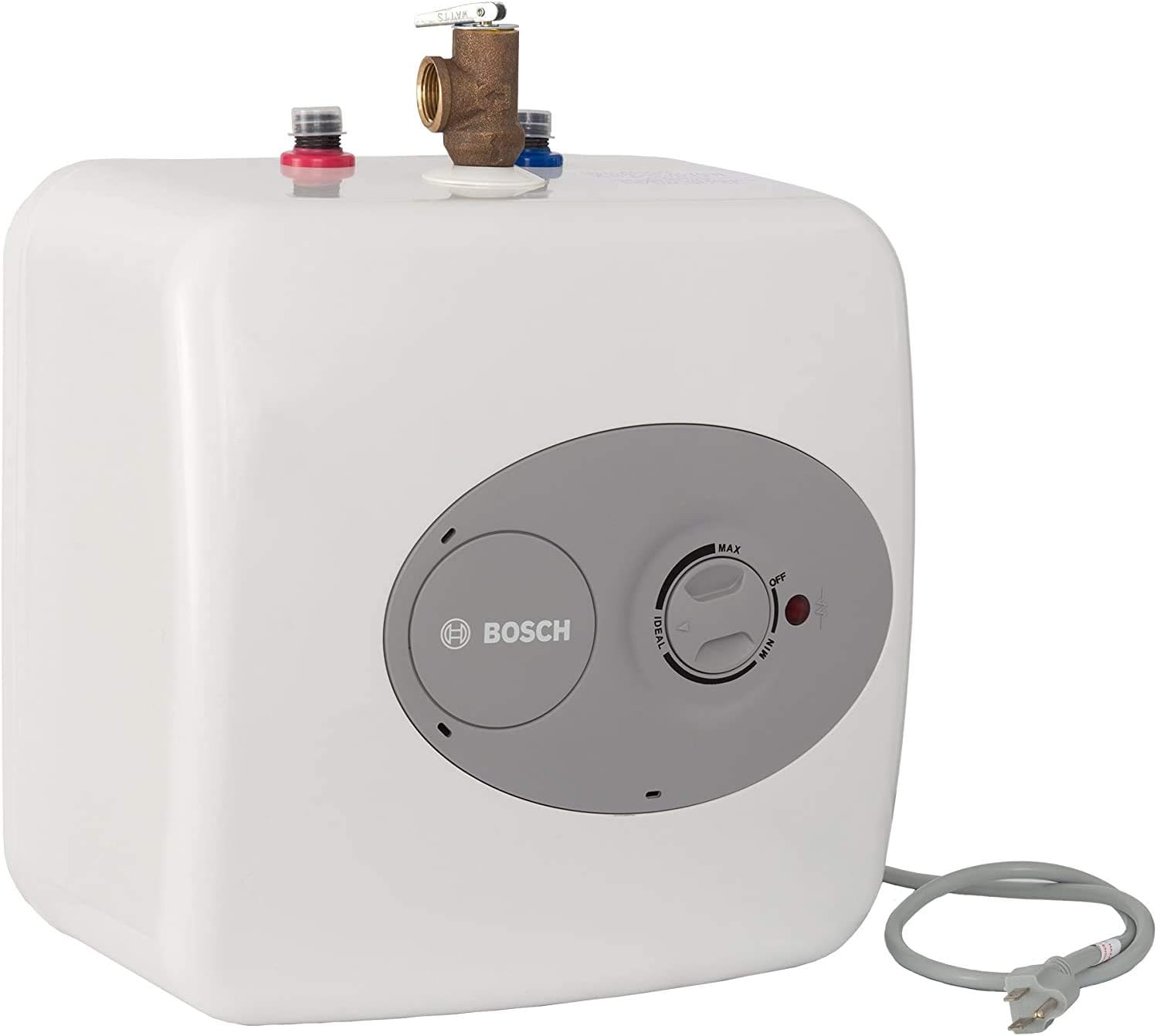
Bosch Tronic 3000T ES2.5
| Capacity | 2.5 gallons |
|---|---|
| Wattage | 1440 watts |
| Voltage | 120 volts |
| Maximum Temperature | 140 °F |
| Efficiency | 98% |
The Bosch Tronic 3000T ES2.5 is a compact electric mini-tank that provides ready hot water at the point of use. It installs under a sink or near a fixture and can be plugged into a standard 120 V outlet or hardwired, making independent installation straightforward. The glass-lined 2.5 gallon tank and 1440 W heating element deliver quick recovery and consistent temperatures up to 140 F, while an external dial lets you set the output without opening the unit. Its 98% thermal efficiency and included mounting bracket mean it wastes little energy when serving one or two nearby fixtures, and the external temperature-and-pressure relief valve adds a safety layer. Limitations are inherent to its size: the small capacity suits short runs or a single sink but will not sustain multiple high-demand outlets or replace a whole-house heater. For radiant floor installations it can serve a localized zone or act as a supplement, but it is not a primary solution for large-area or high-flow radiant systems.
Best for: Buyers who prioritize a reliable, low-maintenance point-of-use heater to eliminate wait time for hot water at a single sink or a small localized zone and want durable, straightforward operation.
Less Ideal for: Homes needing a primary heater for large radiant floor loops or multiple simultaneous hot-water outlets should choose a larger or purpose-built radiant system instead.
- Compact point-of-use design fits under sinks or on a shelf for near-instant hot water
- Glass-lined tank for corrosion resistance and durable service life
- Plugs into standard 120 V outlet for independent installation without special circuitry
- External temperature dial and T&P relief valve for simple control and safety
- High thermal efficiency (98%) reduces standby heat loss
- Small 2.5 gallon capacity cannot support multiple high-flow fixtures or whole-house demand
- 1440 W element limits recovery rate compared with higher-power tankless or larger electric heaters
Verdict: A compact, efficient, and durable point-of-use electric mini-tank that reliably supplies near-instant hot water for a single fixture or small radiant zone.
CAMPLUX ME60 6-Gallon Mini Tank

| Capacity | 6 gallons |
|---|---|
| Wattage | 1440 watts |
| Voltage | 120 volts |
| Maximum Temperature | 140 °F |
| Maximum Pressure | 150 psi |
The CAMPLUX ME60 is a compact 6-gallon electric mini-tank that supplies immediate hot water at a single point of use. It installs under a sink or on a wall and connects to a standard 120V outlet and 3/4" NPT water lines, making it suitable for kitchens and lavatories or as a boost to an existing hot water system. The unit includes a glass-lined insulated tank, a thermostat with three temperature settings up to 149°F, and safety features such as overheat protection and a temperature and pressure relief valve. At 1.44 kW (1440W) its recovery is modest, so it provides short bursts of hot water rather than continuous high-flow service. Practical benefits include simple plug-in installation, included mounting kit and relief valve, and built-in insulation to reduce standby heat loss. Limitations are the small 6-gallon capacity and limited recovery rate, so it is not intended to run showers or large continuous loads; placement near the fixture is important to avoid waiting for hot water.
Best for: Buyers who want a proven, easy-to-install point-of-use heater to reduce wait time at a single fixture and value established user feedback and safety features.
Less Ideal for: Homes needing a primary source for showers, multiple simultaneous fixtures, or a high-capacity supply for whole-house radiant floor systems should choose a larger or dedicated unit instead.
- Compact point-of-use design fits under sinks or mounts on a wall
- Glass-lined insulated tank reduces corrosion and standby heat loss
- 120V plug-in wiring for straightforward installation without hardwiring
- Includes T&P relief valve and mounting kit for out-of-the-box setup
- Thermostat with multiple temperature settings and built-in safety protections
- Small 6-gallon tank and 1440W element limit continuous hot-water flow
- Not suitable for showers or whole-house radiant floor supply on its own
Verdict: A simple, well-supported 6-gallon point-of-use heater that reliably delivers hot water at a single fixture with easy plug-in installation.
Rheem RTEX-06T Tankless Electric

| Wattage | 6500 watts |
|---|---|
| Voltage | 240 volts |
| Flow Rate | 1.5 gpm |
| Maximum Temperature | 140 °F |
| Mount Type | Wall |
The Rheem RTEX-06T is a small, wall-mount tankless electric heater intended for point-of-use installation where quick hot water is needed. It heats water on demand using a 6.5 kW element at 240V and supplies about 1.5 gallons per minute, making it suitable for a single sink or light-duty radiant loop. The unit has thermostatic control and digital temperature display for straightforward setpoint adjustment and it requires no venting, so installation is flexible in closets or under sinks. Practical benefits include reduced standby heat loss compared with tank heaters, compact footprint that frees up space, and lower water waste when placed near the fixture. Limitations are its modest flow rate and kilowatt rating, which mean it cannot support multiple fixtures or high-demand radiant systems by itself, and it requires a dedicated 240V electrical connection. For installations where steady low-flow heat is needed close to the demand point, the RTEX-06T is an uncomplicated, factory-quality option, but larger or whole-house radiant applications will need a higher-capacity model.
Best for: Buyers wanting a reliable, simple point-of-use heater to eliminate wait time for hot water at one fixture and who prefer a low-risk, factory-quality solution with straightforward controls.
Less Ideal for: Do not choose this unit for whole-house radiant floor systems or multi-fixture installations that demand higher flow and sustained output.
- Compact wall-mount design ideal for tight spaces or under-sink point-of-use placement
- Thermostatic digital control keeps outlet temperature consistent within about 1 degree
- No venting required, allowing flexible indoor installation
- Heats water only when needed, reducing standby energy loss compared to tanks
- Low maximum flow (about 1.5 gpm) limits it to a single fixture or very small loop
- Requires a dedicated 240V electrical supply which may need new wiring
Verdict: A compact, easy-to-install point-of-use electric heater that reliably delivers on-demand hot water for a single fixture or small radiant loop.
Choosing the Right Water Heater for Radiant Floor Heat: Key Factors to Consider
Supply Temperature Range
Radiant floor systems normally use lower water temperatures than conventional baseboard or radiator systems. A suitable heater must be able to produce and hold supply temperatures in the typical control band for in-floor tubing, often between 85 and 140 degrees Fahrenheit depending on floor construction and heating load.
If a heater cannot regulate well at low setpoints, floors can overheat briefly or the system may short-cycle. Look for units that offer fine-grained control or modulation to maintain steady low-temperature output.
Modulation and Cycling Behavior
How a unit modulates its output affects comfort and efficiency. Continuous modulation or multiple staged firing avoids frequent on/off cycles and reduces temperature swings in the floor mass, which improves comfort and reduces wear on components.
High minimum firing rates can force cycling in low-load months. Consider heaters with low minimum output, electronic modulation, or compatible external controls that allow proportional output to match the radiant loop demand.
Compatibility With Mixing Valves and Zone Controls
Radiant systems commonly use mixing valves and thermostat-controlled pumps to manage multiple zones and protect floor coverings. A water heater that offers clear pump and control terminals, or integrated interfaces for external controllers, simplifies integration and reduces the need for additional relays.
Confirm the heater's control wiring, available aux outputs, and whether it supports outdoor reset or other advanced control strategies if your design uses them.
Flow Rate and Hydraulic Matching
The heater must support the flow rates required by your loop(s) and maintain temperature rise at the expected circulation rates. Too-high flow can reduce delta-T and force the heater to work harder to meet setpoints, while too-low flow can lead to uneven floor temperatures.
Check pump sizing recommendations, the heater's rated flow capabilities, and whether an internal pump or external circulating pump is expected. Hydraulic compatibility reduces installation complications and improves temperature control.
Durability Under Continuous Low-Temperature Operation
Radiant-floor systems often run for extended periods at lower temperatures. Materials, heat exchanger design, and corrosion resistance determine long-term reliability under these conditions.
Choose heaters with robust heat exchangers, accessible service panels, and clear maintenance intervals. Units designed for hydronic heating duty cycles will generally outlast appliances intended for intermittent domestic hot water use.
Installation, Service Access, and Documentation
Practical installation details matter. Easy access to valves, controls, and common service points reduces labor costs and makes future maintenance simpler. Clear documentation and wiring diagrams are important when integrating into a multi-zone radiant system.
Also consider venting and clearance requirements for the chosen location. Good manufacturer guidance for hydronic or radiant installations reduces the risk of installation errors.
Sizing a Heater for Your Radiant Floor System
Correct sizing starts with a heat loss calculation for the conditioned area and an understanding of how much of that load will be offset by the thermal mass of the floor. Radiant systems usually benefit from slightly oversized heat sources when paired with good controls, because the thermal mass smooths output and protects against underperformance during cold snaps.
When determining capacity, translate required BTUs into the heater output needed at your operating temperature and expected flow rate. Many manufacturers publish capacity curves that show output at different supply temperatures and flow rates; those curves are the right way to match a heater to an in-floor loop.
- Prioritize heaters that list output at low supply temperatures.
- Account for multiple zones and potential simultaneous demand.
- Include pump head and loop flow requirements in sizing calculations.
Controls and Integration With Existing Systems
Think through how the heater will interact with thermostats, zone valves, mixing valves, and outdoor reset. Simpler integration reduces parts and potential failure points. If your system uses separate control panels, pick a heater with accessible dry contacts or auxiliary outputs to interface cleanly.
Some heaters offer built-in outdoor reset or multiple stages that simplify setup. Where the heater lacks advanced controls, external controllers can handle outdoor reset or zone staging but add complexity.
- Verify available control terminals before purchasing.
- Plan wiring and pump relay locations ahead of installation.
- Consider using mixing valves to protect floor coverings from high temperatures.
Maintenance and Common Service Tasks
Routine tasks for hydronic heaters include checking pressure relief devices, verifying expansion tank charge, flushing or treating water where required, and inspecting pump seals and valves. Accessibility to these components reduces service time and cost.
Look for units with replaceable heat exchanger components and straightforward access panels. Clear service documentation and parts availability will improve the experience over the unit's life.
- Schedule annual checks of pump operation and system pressure.
- Flush or treat system water per local best practices to limit corrosion.
- Keep wiring diagrams and parts lists near the unit for quicker service calls.
Noise, Location, and Installation Considerations
Where you place the heater affects living-area noise, venting runs, and ease of routing hydronic piping. Quiet units or those that can be placed in mechanical rooms reduce noise impact. Consider the clearance needs and whether the unit requires direct venting or can use a common chimney.
Also think about how long pipe runs and routing will affect heat loss and the need for insulation. Position the heater to minimize exposed pipe lengths and to keep pump assemblies accessible.
- Plan venting and clearances before final placement.
- Insulate supply and return lines to reduce standby losses.
- Place in a ventilated mechanical space to ease service access.
Water Treatment and System Longevity
Water chemistry plays a major role in the longevity of a hydronic system. Hard water, high oxygen content, or corrosive chemistries accelerate component wear. Treating or conditioning system water reduces scale and corrosion risks to heat exchangers and pumps.
Use corrosion inhibitors and proper filtration where recommended. For systems with untreated water, more frequent maintenance and inspections are usually necessary to avoid early failures.
- Consult local codes for acceptable water treatment approaches.
- Consider installing a system filter or separator to capture debris.
- Follow recommended inhibitor schedules to protect metal components.
How We Chose the Best Water Heater for Radiant Floor Heat
We focused on attributes that directly affect how well a water heater performs in a low-temperature, hydronic radiant floor loop. Key evaluation criteria included heating output control, ability to maintain low and stable supply temperatures, compatibility with zone controls and mixing valves, durability under continuous cycling, and serviceability for routine maintenance. We prioritized units that deliver stable flow temperatures at the lower setpoints typical of in-floor systems and that integrate easily with external thermostats, pumps, and tempering controls. Efficiency and standby losses were considered because they influence running cost and runtime in systems that operate for long periods. Noise and footprint were secondary filters for living-area installations. Units that required specialized, uncommon controls or that lacked clear documentation for hydronic applications were excluded. The end result is a list of models that match common radiant floor system requirements and that offer straightforward installation and long-term reliability.
Our full evaluation process is outlined in our review methodology.
FAQ
What temperature should I set for a radiant floor heating loop?
Typical supply temperatures for radiant floors range from about 85 to 140 degrees Fahrenheit depending on floor construction and desired comfort. Lower temperatures suit well-insulated floors and can improve efficiency, while thicker or poorly conducting floor finishes may require higher setpoints.
Can any water heater be used with radiant floor heat?
Many types of water heaters can be adapted, but not every unit is ideal. The best choices are those that can hold stable low supply temperatures, interface cleanly with zone controls and mixing valves, and are designed for frequent or continuous low-load operation.
Do I need a mixing valve for radiant floors?
A mixing valve is often recommended to prevent sending overly hot water to the floor, protect floor coverings, and allow a higher-temperature source to serve multiple purposes. Mixing valves simplify temperature control and improve safety, especially when the heater also supplies domestic hot water or higher-temperature circuits.
How important is pump selection for a radiant system?
Pump sizing is critical. The pump must deliver the correct flow to achieve the designed delta-T across the loop. An oversized pump can reduce temperature rise and increase energy use, while an undersized pump can cause uneven heating and reduced capacity.
What maintenance helps extend a water heater's life in a radiant system?
Regular inspection of expansion tanks, relief valves, and pumps, periodic flushing or water treatment, and checking for signs of corrosion will extend system life. Promptly addressing leaks and maintaining proper system pressure are also important.
Is outdoor reset control useful for radiant floor heat?
Yes. Outdoor reset adjusts supply temperature based on outdoor conditions, which reduces temperature swings and improves comfort while lowering fuel consumption. It is especially effective when combined with the thermal buffering of a radiant slab.
Final Verdict
For radiant floor heating, prioritize a water heater that can reliably hold low supply temperatures, integrate with mixing valves and zone controls, and modulate output to match load. Pay attention to hydraulic compatibility and service access, because proper pump sizing and routine maintenance have large effects on comfort and longevity. Balance modest oversizing with good controls rather than choosing a unit with a high minimum output. With those priorities in mind, you can select a heater that delivers even floor temperatures, efficient operation, and predictable service life.