
Note: This article contains affiliate links. If you click on these links and make a purchase, we may earn a small commission at no extra cost to you. This helps support our research and content. Read our full affiliate disclosure here.
If you want repeatable brewing and fewer wasted shots, a coffee grinder with a scale can make a measurable difference. Built-in scales remove guesswork from dosing, helping you hit the same dose and brew ratio every time whether you pull espresso, brew pour-over, or use immersion methods. This guide spotlights the top shortlisted coffee grinders with an integrated scale, focused on accuracy, grind uniformity, and everyday usability. We evaluated instruments for dose repeatability, grind quality, and practical features like hopper capacity and cleaning access. Read on to see which grinders met those criteria and why each is a strong option for precise home brewing.
Top Picks at a Glance
| Best Overall The best all-around choice for most situations | KRUPS Auto Dose Grinder GX420851 |  |
| Best Value The sweet spot between price and what you get | MOKKOM Conical Burr Grinder CG020 |  |
| Best Budget The cheapest option that still gets the job done reliably | Greater Goods Morning Groove Grinder |  |
| Top Rated A top-rated pick with lots of positive feedback | Mokkom Conical Burr Grinder |  |
| Most Popular A crowd favorite that many people choose with confidence | OXO Brew Conical Burr Grinder with Scale |  |
KRUPS Auto Dose Grinder GX420851

| Capacity | 14 ounces |
|---|---|
| Grind settings | 39 |
| Material Type | stainless steel conical burrs |
| Power Source | Electric |
The KRUPS Auto Dose Grinder combines stainless steel conical burrs with an integrated scale to deliver consistent, weighted doses for a range of brew methods. You select from 39 grind settings and choose dosing by cups, grams, ounces, or manual operation, and the grinder dispenses the precise amount directly to the grounds container. The large 14 ounce removable hopper and auto shut doors make refilling and temporary storage convenient, and the straightforward interface simplifies daily use so you can grind by weight without fuss. Performance-wise the conical burrs and fine adjustment steps let you dial in settings for espresso through French press, but seasoning and repeatability depend on careful set up and occasional cleaning. The unit is electric and built for countertop use, offering clear advantages for anyone trying to improve extraction by grinding immediately before brewing, though its footprint and weight mean it is less portable than compact manual options.
Best for: Buyers who want a countertop grinder that automates precise dosing by weight and supports many brew styles without technical tinkering.
Less Ideal for: People seeking a compact or ultralight travel grinder or those who prefer a completely manual, splurge-free setup.
- Integrated scale that doses by weight for consistent, repeatable portions
- Wide 39-step grind range suitable from espresso to French press
- Large removable 14 oz hopper with auto-shut doors for easy refilling and storage
- Stainless steel conical burrs designed for consistent grind particle size
- Relatively heavy and large for small kitchens or travel
- Some users may need to calibrate settings to match their brew method for best repeatability
Verdict: Get this if you want a user-friendly burr grinder that automatically doses by weight to improve daily coffee consistency.
MOKKOM Conical Burr Grinder CG020
| Capacity | 5.3 ounces |
|---|---|
| Wattage | 200 watts |
| Grind settings | 31 grind settings |
| Power source | AC adapter |
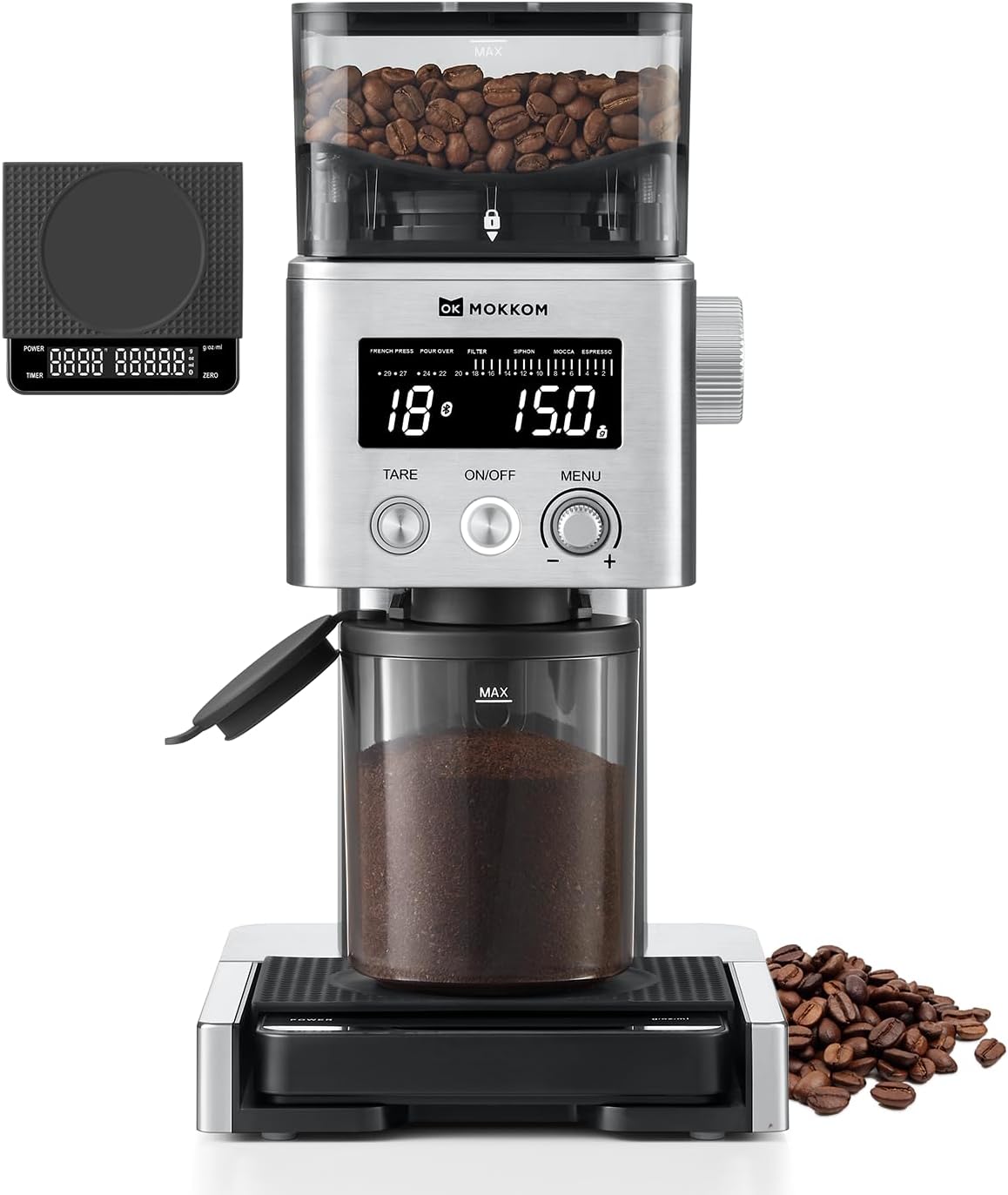
The MOKKOM CG020 is a countertop conical burr grinder built around a removable digital scale and user-friendly dosing controls. It grinds beans into a portafilter, cup, or container using 31 discrete grind settings and a 0.1 second adjustable timer, so you can program doses by cups, ounces, or grams for pour-over, espresso, and French press. The included portafilter cradles make it convenient to grind directly into an espresso basket, and the anti-static system plus stainless steel burrs reduce mess and keep grounds from clinging to the chute. The detachable scale syncs with the grinder to show real-time weight, which simplifies achieving consistent brew ratios. Practical touches include a low-noise motor, removable upper burr and chamber for cleaning, and multiple dosing modes for both single-shot and batch grinding. Limitations to note are that capacity is modest (about 5.3 ounces) and the unit is fairly heavy, so it is best as a dedicated countertop appliance rather than a travel or compact-kitchen choice.
Best for: Buyers who want precise, repeatable dosing and care about accurate brew ratios will appreciate the integrated scale and programmable modes for espresso and pour-over.
Less Ideal for: If you need a lightweight, highly portable grinder or frequently grind large batches, this is not the best fit.
- Built-in removable digital scale that syncs with the grinder for real-time weight-based dosing
- 31 grind settings plus 0.1s timer for precise, repeatable dosing across brew methods
- Anti-static system and stainless steel conical burrs reduce mess and deliver consistent particle size
- Portafilter cradles allow grinding directly into espresso baskets for convenience
- Removable burr and chamber make cleaning simpler
- Relatively small hopper capacity (5.3 ounces) limits large-batch grinding
- Heavier countertop footprint compared with compact blade or travel grinders
Verdict: Choose this grinder when you want an all-in-one countertop grinder with a factory-quality removable scale for precise, repeatable dosing.
Greater Goods Morning Groove Grinder

| Wattage | 550 watts |
|---|---|
| Capacity | 60 g |
This compact burr grinder combines a built-in dosing scale with conical burrs to deliver consistent, repeatable grinds for everything from espresso to French press. You weigh beans on the integrated scale, set the target, and the grinder stops automatically, which removes the guesswork for small, measured batches. The eight grind settings cover fine to coarse needs and a simple grind guide helps match settings to brewing methods. Practical touches like an anti-static grounds chamber and a UV-shaded removable hopper reduce mess and help keep beans fresher between uses. At 550 watts it has enough power for routine home use, and the ABS housing keeps the unit lightweight and countertop-friendly. Limitations include a relatively small 60 g capacity for ground coffee and the plastic construction, which feels less premium than metal-bodied models, but those choices help keep cost and footprint down. For budget-minded home brewers who want precise dosing without buying a separate scale, this grinder delivers a lot of functionality in a compact package.
Best for: Buyers who want precise, scale-measured dosing on a budget and prefer a compact, countertop grinder that handles a range of brew methods.
Less Ideal for: Those who need high-capacity commercial grinding, a metal-heavy premium build, or micrometer-level espresso tuning should consider higher-end models instead.
- Built-in dosing scale that stops at the target weight for repeatable doses
- Conical burrs for uniform grind and better extraction than blade grinders
- Eight grind settings with a grind guide for common brew methods
- Anti-static grounds chamber and UV-tinted hopper reduce mess and protect beans
- Small 60 g capacity may require frequent refills for larger batches
- Plastic ABS housing is less durable and premium-feeling than metal alternatives
Verdict: If you want accurate, repeatable dosing without buying a separate scale, this compact burr grinder delivers scale-driven convenience for budget-conscious home brewers.
Mokkom Conical Burr Grinder

| Wattage | 300 watts |
|---|---|
| Capacity | 2 liters |
| Included Components | Coffee ground cup |
| Material Type | Stainless Steel |
The Mokkom Conical Burr Grinder pairs a stainless steel conical burr with an integrated scale and programmable dosing to make consistent home brewing easier. It grinds beans for everything from espresso to French press with 31 discrete settings and a 5-in-1 dosing system that can measure by grams, ounces, or cup counts; the timer adjusts in 0.1-second increments so repeatable doses are straightforward. The detachable hopper, top burr, and grounds container simplify cleaning, and anti-static technology keeps mess and cling to a minimum. A rechargeable motor is rated around 200–300W for relatively quiet operation, and the unit includes two cradles for portafilter fitting so you can grind directly into an espresso basket. Expect a learning curve dialing in exact grind settings for your recipe and occasional calibration of the scale, but for everyday home use the grinder delivers predictable, uniform particle size and convenient dosing control that speeds morning routines.
Best for: Home brewers who prioritize reliable, repeatable dosing and want an integrated scale to streamline daily espresso or pour-over routines.
Less Ideal for: Users seeking a compact travel grinder or a simple low-cost blade grinder for infrequent use should consider simpler alternatives.
- Built-in detachable scale with Bluetooth sync for accurate dosing
- Wide 31-step grind range suitable from espresso to pour-over
- Conical stainless steel burrs provide consistent particle size
- Anti-static design reduces grounds bounce and cleanup
- Programmable 5-in-1 dosing and 0.1s timer for repeatable doses
- Scale may require occasional calibration to stay accurate
Verdict: Choose this grinder if you want a dependable, scale-integrated burr grinder that delivers consistent dosing and uniform grinds for everyday home brewing.
OXO Brew Conical Burr Grinder with Scale

| Capacity | 125 g |
|---|---|
| Wattage | 151 |
| Voltage | 120 volts |
The OXO Brew Conical Burr Grinder combines a built-in digital scale with a 40 mm stainless steel conical burr system to deliver consistent, measured grounds for a wide range of brew methods. You can grind by weight, by number of cups, or use manual mode via a single dial, and the integrated scale and automatic shutoff remove the guesswork so you get repeatable doses without a separate scale. The low-speed, high-torque motor is designed to limit heat and static, and the unit includes safety features like a no-bean detector and overheating protection. The hopper holds a full supply of beans and the grounds container stores enough for multiple cups. Practical limits are that the grinder is a counter appliance so it needs kitchen space and the feature set focuses on measured dosing rather than advanced programmability for pros who want timed dosing profiles. For home brewers who want a reliable, easy way to grind to weight for pour-over, drip, French press or espresso-adjacent fine grinds, this grinder makes daily dosing straightforward and cleaner than time-based grinders.
Best for: Buyers who prioritize consistent, measured dosing and easy, repeatable daily brewing will appreciate this grinder for home pour-over, drip, French press and fine grind needs.
Less Ideal for: Users seeking pro-level programmability, timed dosing profiles, or a compact travel solution should consider other options.
- Integrated digital scale lets you grind to weight without a separate scale
- 40 mm stainless steel conical burrs produce uniform grounds across 38 settings
- Low-speed high-torque motor reduces heat and static for better flavor and less mess
- No-bean detector and overheating protection add useful safety and longevity features
- Not aimed at advanced users who want highly programmable dosing profiles
Verdict: If you want a home grinder that reliably grinds to weight every time, the OXO Brew Conical Burr makes precise, repeatable dosing simple and convenient.
Choosing the Right Coffee Grinder with a Scale: Key Factors to Consider
Dosing Accuracy and Repeatability
An integrated scale matters because it measures coffee mass directly, eliminating variability introduced by timed dosing or visual estimates. Look for grinders with a scale resolution of at least 0.1 gram and stable readings between shots. Consistent single-decimal accuracy makes it easier to replicate recipes and fine-tune dose for espresso, while slightly coarser tolerance can be acceptable for less dose-sensitive methods like French press.
Repeatability also depends on how the grinder dispenses grounds onto the scale. A design that funnels grounds consistently to the same spot reduces bounce and read errors. Consider whether the grinder tucks the scale into a recessed port or uses a removable dosing cup; both approaches can affect stability and the ability to tare a portafilter or carrier.
Grind Quality Across Settings
Uniform particle size distribution is a key driver of extraction quality. When evaluating grinders, consider how consistent the burr set performs from fine espresso settings through medium and coarse. A grinder that preserves uniformity at extreme settings is more versatile for multiple brew methods.
Also consider burr material and diameter. Larger, high-quality burrs typically generate less heat and wear more slowly, preserving consistent output over time. How easily the grinder allows micro-adjustments matters too, because small changes in grind size often yield noticeable differences in shot balance.
User Interface and Workflow
The presence of a scale adds steps to the dosing workflow, so interface design is important. A clear display, intuitive tare and dose buttons, and programmable presets reduce friction during repeated brewing. Evaluate whether the controls are accessible for one-handed operation and whether the display remains readable under kitchen lighting.
Consider how the grinder integrates the scale with dosing: does it dose directly into a portafilter, a grounds container, or onto an onboard platform? Each approach changes how you manage transfer, tamping, and cleanup. A streamlined workflow saves time during morning routines and reduces interruptions during multi-shot sessions.
Hopper Capacity and Bean Handling
Hopper size affects how often you refill and how fresh your beans remain between sessions. A larger hopper is convenient for households that brew frequently, but excessive capacity can lead to stale beans if you rarely use the full amount. Also note whether the hopper is easy to remove for refilling and cleaning.
Pay attention to how beans feed into the burrs. Consistent feed reduces clumping and helps maintain an even grind distribution. Some grinders include shutoff features or chutes that minimize ground retention when switching beans or grinders, which helps prevent cross-contamination and simplifies cleaning.
Cleaning, Retention, and Maintenance
Integrated scales and dosing ports can introduce extra cleaning considerations. Check how accessible the burr chamber is and whether components like the dosing cup or grounds chute are removable and dishwasher-safe. Ease of dismantling affects how thoroughly you can remove fines and old coffee oils that degrade flavor.
Ground retention matters because retained coffee can stale and affect subsequent doses. Grinders with straightforward backflushing options or minimal retention paths reduce flavor carryover and make it easier to keep consistent dosing without frequent deep cleans.
Durability and Serviceability
A grinder is an investment, so assess build materials and whether wearable parts like burrs are user-replaceable. Look for sturdy housings and bearings that keep the burrs aligned over time. The ability to source replacement burrs or have the grinder serviced locally prolongs useful life.
Also consider warranty coverage and how intuitive it is to perform routine maintenance. A design that allows basic servicing with common tools is preferable to one that requires professional intervention for minor repairs.
How Integrated Scales Change Your Dosing Routine
Built-in scales shift dosing from a time-based approximation to a mass-based workflow. That change improves consistency because mass is the variable recipes actually call for. With a scale, you can dial recipes in grams per cup or grams per liter, then reproduce those settings reliably across sessions.
Practical impacts include fewer wasted shots from under- or overdosing and faster iteration when testing new beans. A scale-equipped grinder also simplifies adjustments when switching brew methods because you can keep grind size constant while varying dose precisely.
- Enables precise repeatable doses
- Simplifies switching between brew recipes
- Reduces wasted coffee from inaccurate timed dosing
Portafilter and Dosing Cup Workflows
Different grinders integrate scales in different ways. Some are designed to accept a portafilter directly on the scale, which is convenient for espresso users who dose and tamp in place. Others use a removable dosing cup or a grounds tray that lets you weigh before transferring.
Portafilter-first workflows minimize transfer loss and are faster for back-to-back shots. Dosing cups are versatile if you brew multiple methods from the same grinder, but they introduce an extra transfer step that can slightly increase retention. Choose the workflow that matches how you prepare coffee most often.
- Portafilter on-scale: fastest for espresso
- Dosing cup: flexible for multi-method brewing
- Removable trays simplify cleanup and collection
Mitigating Ground Retention and Flavor Carryover
Ground retention can undermine the benefits of precise dosing by mixing old grounds with fresh ones. Look for grinders with minimal dead space in the bean-to-chute path and designs that allow easy clearing of retained coffee.
Routine maintenance such as brushing the burr chamber and periodic deep cleaning keeps retention low. If you switch between very different roast profiles, consider a grinder that allows quick burr removal to reduce flavor carryover.
- Check for removable chutes and easy access to burrs
- Use brushes and compressed air cautiously to clear fines
- Plan a cleaning cadence based on roast profiles and usage
Practical Tips for Calibrating Your Grinder Scale
Calibrate the scale periodically to ensure long-term accuracy. Use small, known-mass weights or store-bought calibration weights and follow the manufacturer's instructions for zeroing and calibration routines. If the grinder does not include calibration instructions, perform a tare check with an item of known weight to validate readings.
Place the dosing vessel in the exact position you will use for brewing when calibrating. Minor shifts in placement can change the displayed weight, so consistent placement reduces day-to-day variance. Finally, avoid calibrating on unstable surfaces; a flat, hard countertop yields the best results.
- Use certified weights for calibration when possible
- Always tare with the dosing vessel in place
- Calibrate after moving the grinder or changing locations
Matching Hopper Size to Household Habits
Think about how often you brew and how much you typically use before beans lose peak freshness. If you brew several doses a day, a larger hopper reduces refills. If you brew infrequently or single-dose, a smaller hopper or the ability to lock the hopper is preferable to keep beans fresh.
Single-dosing adapters or removable hoppers help those who rotate beans frequently. These features also make cleaning faster and reduce the risk of stale beans accumulating in the feed path.
- Large hopper for frequent households
- Removable hopper for single-dosing and cleaning
- Consider a hopper lock to control bean flow
How We Chose the Best Coffee Grinder with a Scale
We limited our selection to grinders that include an integrated scale as part of the dosing workflow rather than relying on separate accessories. Primary evaluation criteria emphasized dosing accuracy and repeatability, because consistent mass measurements directly affect brew ratios and extraction. Grind consistency at multiple settings was another core filter, as uniform particle distribution is essential for predictable extraction across brew methods. We also assessed user-facing ergonomics such as hopper capacity, bean path accessibility for cleaning, and the clarity and responsiveness of controls for making micro adjustments. Durability and build quality were considered by looking at material choices and the practical serviceability of key wear parts. We excluded grinders that only offer estimated dosing by time without a true mass measurement, and we omitted models intended solely for commercial settings. The final shortlist balances measurement precision, grind performance, and day-to-day usability so home brewers can reliably reproduce recipes.
Our full evaluation process is outlined in our review methodology.
FAQ
Do I need a grinder with a scale for good espresso?
A scale is not strictly required, but it makes hitting exact doses far easier. Espresso is sensitive to dose, so a built-in scale helps you reproduce shots and track changes. Many home baristas find it accelerates consistent results.
How accurate should the scale be for daily use?
Aim for at least 0.1-gram resolution for espresso and precise pour-over work. For coarser methods like French press, slightly lower resolution is usually acceptable. Stability and repeatability matter as much as raw resolution.
Will the scale affect grind quality or just the dosing?
The scale itself does not change grind particle distribution, but how the grinder routes grounds to the scale can influence retention and transfer. Choose a grinder whose dispensing method complements your brewing workflow to avoid losing consistency.
How often should I clean a grinder that has an integrated scale?
Clean daily or weekly depending on use: a light brush after each session reduces fines and oils, while a deeper disassembly and burr clean every few months is prudent for regular users. Integrated scales may require care to avoid getting moisture or fines into the electronics.
Can I calibrate the built-in scale myself?
Yes. Most grinders allow user calibration using small known weights or built-in calibration routines. Follow the manufacturer's steps and calibrate on a stable surface with the dosing vessel in place.
Final Verdict
A coffee grinder with a scale is a strong tool for anyone who prioritizes repeatable dosing and wants to make brew ratios a reliable part of their routine. Prioritize dosing accuracy and grind consistency first, then assess workflow features like portafilter compatibility, hopper size, and ease of cleaning. Expect tradeoffs: more integrated controls and larger burrs usually improve performance but can require more maintenance. Focus on the combination of stable measurements, low retention, and a workflow that fits how you brew to choose the best grinder for consistent home results.