
Note: This article contains affiliate links. If you click on these links and make a purchase, we may earn a small commission at no extra cost to you. This helps support our research and content. Read our full affiliate disclosure here.
If you want the most nutrients and flavor from leafy greens, root vegetables, and other produce, a cold press juicer for vegetables makes a measurable difference. These slow-speed machines crush and press fibers to extract juice more gently than fast centrifugal models, which helps preserve enzymes and reduce oxidation. The right model also matters for yield, cleanup time, and how well it handles tough vegetables like carrots and beets. This guide highlights seven shortlisted cold press juicers for vegetables chosen for their extraction efficiency, durability, and ease of use. We evaluate each option on yield, cleaning, feeding throughput, and build quality to help you pick the machine that fits your daily routine. Read on to see which features matter most and how to get the best results from vegetable-only juicing.
Top Picks at a Glance
| Best Overall The best all-around choice for most situations | Ninja NeverClog Cold Press Juicer JC151 |  |
| Best Quality Built to a higher standard if you want something more solid | NAMA J2 Cold Press Juicer |  |
| Best Value The sweet spot between price and what you get | AAOBOSI Cold Press Juicer JS2401 |  |
| Best Budget The cheapest option that still gets the job done reliably | SIFENE Mini Slow Masticating Juicer JS3304 |  |
| Top Rated A top-rated pick with lots of positive feedback | ECOSELF Cold Press Juicer |  |
| Most Popular A crowd favorite that many people choose with confidence | TUUMIIST Cold Press Juicer TM-580SJ |  |
| Best Seller A high-volume bestseller chosen again and again | EanOruus 3-in-1 Cold Press Juicer E-18 |  |
Ninja NeverClog Cold Press Juicer JC151

| Maximum Power | 150 watts |
|---|---|
| Number of Speeds | 2 |
| Capacity | 24 fluid ounces |
| Included Components | 24 oz juice jug, 36 oz pulp container, 2 pulp filters |
The Ninja NeverClog JC151 is a slow masticating cold press juicer built to handle fibrous vegetables and fruits with minimal clogging. Its 150-watt high-torque auger runs at low speed to extract juice from hard produce like carrots, beets, and celery while reducing foam and preserving nutrients. Two interchangeable pulp filters let you dial texture between smoother juice and thicker, fiber-rich blends, and the Start/Stop plus Reverse controls make it simple to clear jams or boost extraction. The included 24 oz juice jug and 36 oz pulp container support making multiple servings or meal-prep batches without constant emptying, and anti-drip design reduces mess when pausing mid-press. Parts that contact juice are dishwasher safe, and the unit's compact footprint fits on most countertops. Expect slower throughput than centrifugal models and a heavier, slower extraction process, but that is typical for cold press machines and yields higher juice yield and less oxidation. For a balanced home juicer focused on vegetable-based juices, the JC151 delivers consistent performance and practical conveniences for everyday use.
Best for: Home cooks focused on vegetable-forward juices who want a reliable cold-press machine that maximizes yield and lets them adjust pulp for everyday batch or meal-prep juicing.
Less Ideal for: People who prioritize very fast single-serve juicing, minimal setup, or the lightest possible countertop appliance should consider faster centrifugal or more compact alternatives.
- High-torque 150W motor and auger designed to process fibrous vegetables and dense produce
- Two interchangeable pulp filters for adjustable juice texture and control
- Larger 24 oz juice jug and 36 oz pulp container for batch juicing
- Dishwasher-safe juice-contact parts for easier cleanup
- Slower extraction speed compared with centrifugal juicers
- Heavier, bulkier cleaning and assembly than very compact models
Verdict: Choose the Ninja JC151 if you want a dependable cold-press juicer that handles tough vegetables, boosts yield, and gives clear control over pulp for everyday vegetable juices.
NAMA J2 Cold Press Juicer

| Maximum Power | 200 watts |
|---|---|
| Power Source | Corded Electric |
| Voltage | 120 |
| Number of Speeds | 1 |
| Capacity | 30 fluid ounces |
The NAMA J2 is a masticating cold-press juicer built for steady, high-yield extraction from vegetables and leafy greens. Its self-feeding wide-mouth hopper and single auger allow you to load a full recipe and walk away, while the 200 W motor runs at a slow 50 RPM to minimize heat and preserve nutrients. In typical use it excels at processing fibrous produce with relatively little pulp and captures more juice than many centrifugal models. Practical touches include quick-release parts, a cleaning brush, and included strainers and containers that make assembly and cleanup straightforward, though parts require hand washing. The unit is relatively quiet in operation and feels sturdy with stainless steel and Tritan components. Limitations are a single speed and hand-wash-only parts, so you trade some convenience for gentler extraction and better yield; the 30 fl oz capacity also means frequent emptying for large batches. For someone focused on vegetable juice performance and nutrient retention, the J2 delivers reliable, hands-free extraction with strong juice output.
Best for: Buyers who prioritize maximum juice yield and nutrient retention from vegetables and leafy greens and want a largely hands-free, quiet cold-press workflow.
Less Ideal for: Those who need dishwasher-safe components, multiple speed control for varied textures, or who regularly juice very large batches without stopping.
- Self-feeding wide-mouth hopper lets you load whole recipes for hands-free juicing
- Slow 50 RPM masticating action preserves nutrients and reduces heat
- Designed to extract high juice yield from leafy greens and fibrous vegetables
- Quiet 200 W motor suitable for everyday kitchen use
- Includes multiple strainers, juice and pulp containers, and a cleaning brush
- Parts require hand washing rather than dishwasher-safe cleaning
- Single speed limits control for tougher produce or custom textures
- 30 fl oz capacity may require frequent emptying for large batches
Verdict: Choose the NAMA J2 if you want a hands-free cold-press juicer that quietly extracts high yields and preserves nutrients from vegetables and leafy greens.
AAOBOSI Cold Press Juicer JS2401

| Special Features | Easy to Clean, Masticating, Quiet Motor |
|---|---|
| Model Name | JS2401 |
| Product Care Instructions | Hand Wash Only |
| Included Components | Base |
The AAOBOSI JS2401 is a slow masticating cold press juicer built for everyday kitchen use, especially when you need to process whole fruits and vegetables quickly. Its 6.5-inch feed chute accepts many whole apples and other produce with minimal prep, and the single-auger slow extraction is designed to separate pulp continuously to cut down on clogging. You can use it for straight juices, nut milk, and sorbet thanks to the included detachable parts and a design aimed at easy cleanup. The motor runs quietly, making early-morning juicing less disruptive, and the listed 100 oz collection capacity is convenient for serving several people without stopping. Expect higher yield and smoother juices compared with centrifugal models, but plan to hand-wash parts since care instructions specify hand wash only. For heavy commercial use the throughput will be lower than a high-speed model, and fibrous routines may still need occasional attention despite the anti-clog design.
Best for: Home cooks who prioritize efficient vegetable and whole-fruit juicing with minimal prep and quieter operation, and who want a versatile unit that can also make nut milk and sorbet for family servings.
Less Ideal for: People who need a commercial-speed juicer or want fully dishwasher-safe components should consider different models better suited to heavy daily throughput or easy machine cleaning.
- 6.5-inch wide feed chute reduces prep time by accepting many whole fruits and vegetables
- Slow masticating single-auger design improves juice yield and produces smoother texture
- Ultra-quiet motor suitable for early-morning or shared-space use
- Detachable parts and streamlined internal design that speed up cleaning
- Parts require hand washing rather than being dishwasher-safe
- Lower throughput than high-speed centrifugal juicers for large-volume or commercial use
Verdict: Choose this juicer if you want a quiet, wide-chute cold press that maximizes yield from whole vegetables and fruits while keeping cleanup straightforward.
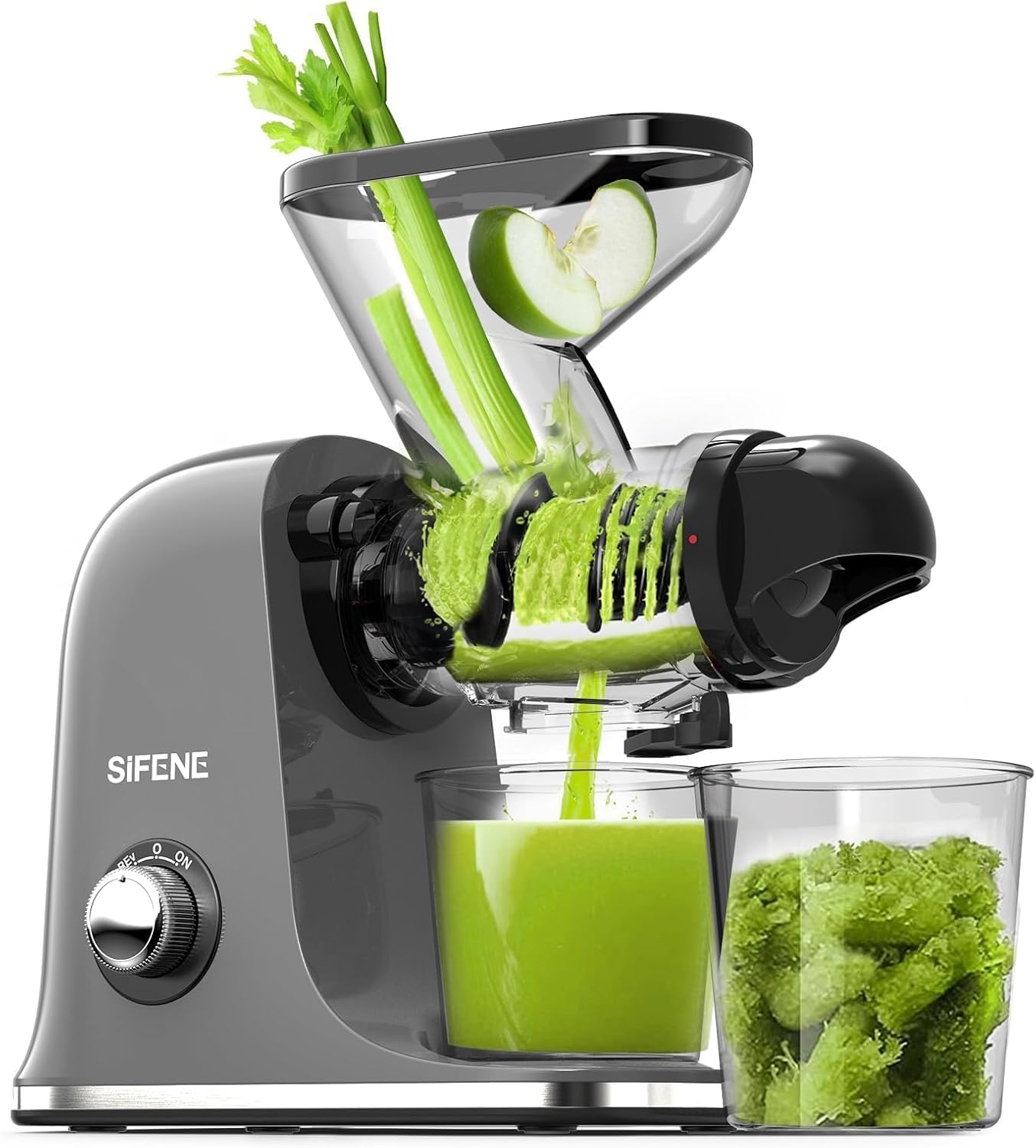
SIFENE Mini Slow Masticating Juicer JS3304
| Wattage | 100 watts |
|---|---|
| Power Source | ac |
| Voltage | 120 volts |
| Capacity | 280 ml |
| Number of Speeds | 1 |
The SIFENE Mini Slow Masticating Juicer is a compact cold-press machine built for everyday vegetable and fruit juicing in small spaces. It uses a low-speed, high-torque 100W motor and a multi-stage auger to gently extract juice with minimal oxidation, and the dual feed chutes reduce prep time by allowing long items like celery and chunked fruit to be fed separately. Practical touches include a reverse function to clear jams, a stainless-steel micro-mesh filter for smoother juice, an anti-drip cap to keep counters clean, and dishwasher-safe removable parts plus a cleaning brush for easier cleanup. Its 280 ml capacity and single-speed knob control keep operation simple but limit throughput for larger batches, so frequent small servings are the likely use pattern. The motor and aluminum body are quiet in operation, making it suitable for morning routines in apartments or RVs, though heavier users may find the small capacity and 100W power restrictive for continuous heavy-duty juicing.
Best for: Buyers on a tight budget who need a compact, quiet cold-press juicer for daily vegetable and single-serve fruit juices in small kitchens or mobile living spaces.
Less Ideal for: Households that need to juice large quantities at once or want variable speed control for heavy-duty or commercial-style juicing.
- Dual feed chutes speed prep for long items and chunked fruit
- Cold-press masticating action preserves nutrients and reduces oxidation
- Quiet, high-torque 100W motor with reverse function reduces clogs
- Dishwasher-safe removable parts and included brush simplify cleaning
- Small 280 ml capacity limits batch size for multiple servings
- Single speed control offers less flexibility for different produce types
Verdict: A compact, budget-friendly cold-press juicer that delivers quiet, nutrient-preserving vegetable juices for single-serve or small-kitchen use.
ECOSELF Cold Press Juicer

| Brand | ECOSELF |
|---|---|
| Special Features | Easy to Clean; High Juice Yield; Reverse Function; Self Feeding; Wide Feed Chute |
| Material | Acrylonitrile Butadiene Styrene (ABS) |
The ECOSELF Cold Press Juicer is a slow masticating, single-auger juicer built to extract juice from whole fruits, vegetables, and leafy greens with minimal prep. Its wide feed chute and self-feeding design let you drop in larger pieces for largely hands-free juicing, while the low-speed motor and upgraded auger aim to reduce heat and oxidation for smoother juice and better nutrient retention. A rotary one-touch control and reverse function help clear jams and keep the machine running continuously during longer sessions. The unit emphasizes easy assembly and cleaning, with an integrated hopper, filter, and a cleaning brush included for quick daily maintenance. Claims of up to 99% juice yield and low noise suggest efficient, quiet operation, though real-world yield will vary by produce and technique. The body uses ABS plastic, so it is lightweight but buyers who prefer all-metal construction should note the material choice. The juicer is geared toward steady, routine use rather than heavy commercial duty, and the included 24-month repair and replacement service adds a practical reliability safety net.
Best for: Home cooks seeking a reliable, easy-to-use cold press juicer for daily vegetable and fruit juices who value steady performance and low maintenance.
Less Ideal for: Those needing a heavy-duty commercial juicer or preferring an all-metal, professional-grade machine should consider higher-end models.
- Wide feed chute and auto-feeding reduce prep time by fitting larger fruits and vegetables
- Slow masticating single-auger design preserves more enzymes and reduces oxidation
- Reverse function and one-touch control simplify operation and help prevent clogs
- Easy to assemble and clean with integrated hopper, filter, and included brush
- Quiet, low-noise motor suitable for morning routines and household use
- Housing is ABS plastic rather than metal, which may feel less durable to some buyers
- Manufacturer juice yield claims may be optimistic depending on produce and prep
Verdict: A user-friendly cold press juicer that delivers quiet, hands-free operation and practical reliability for everyday vegetable and fruit juicing.
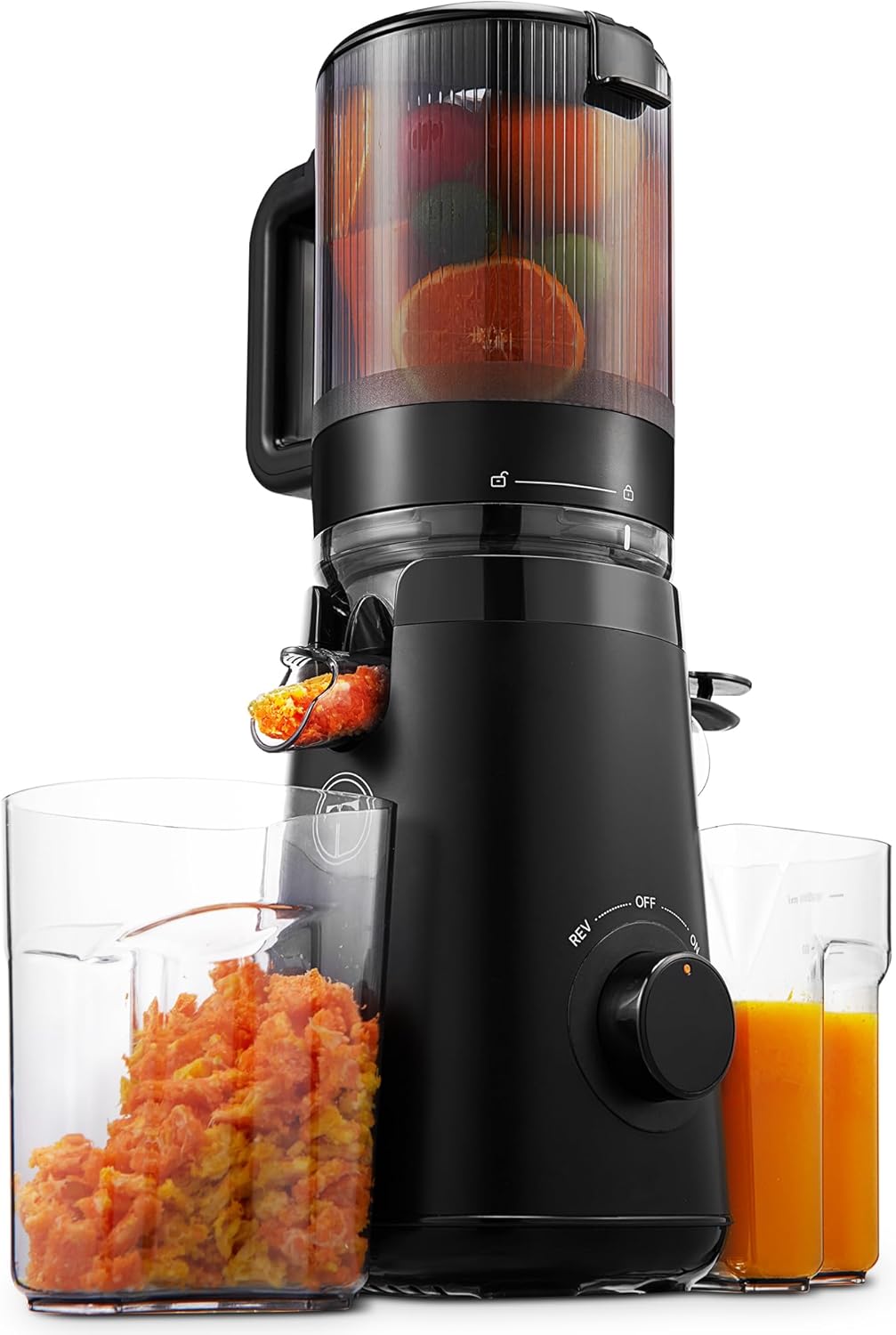
TUUMIIST Cold Press Juicer TM-580SJ
| Maximum Power | 300 watts |
|---|---|
| Wattage | 300 |
| Power Source | AC |
| Voltage | 120 volts_of_alternating_current |
| Number of Speeds | 55 |
The TUUMIIST TM-580SJ is a masticating cold-press juicer built for high-yield vegetable and fruit juicing using a slow 55 RPM auger and a 300-watt motor. It accepts large items through its extra-large feed chute so you can often skip chopping, and the no-mesh-filter design and included cleaning brush simplify cleanup. In practice it produces dense, nutrient-rich juice from leafy greens and hard vegetables thanks to the slow-squeeze action, and the BPA-free construction adds a safety benefit. Assembly is straightforward but requires correct alignment of the hopper and cover to operate reliably. While the single-speed design focuses on gentle extraction rather than fast throughput, it can handle batch juicing for meal prep. Expect a compact footprint and mostly plastic construction, which keeps weight down but may not feel as heavy-duty as higher-end all-metal models. For buyers who value yield and nutrient preservation when juicing vegetables, this unit offers solid performance for everyday use with modest trade-offs in materials and raw power.
Best for: Buyers who prioritize high juice yield and nutrient retention when making vegetable-heavy juices and who prefer easy prep with a large feed chute.
Less Ideal for: People who need heavy-duty, all-metal construction or variable-speed control for specialized juicing tasks should consider more robust or adjustable models instead.
- Extra-large 5.8-inch feed chute reduces prep by fitting whole or large produce
- Slow 55 RPM masticating action preserves nutrients and improves juice yield from vegetables
- No mesh filter design and included cleaning brush make cleaning faster
- BPA-free parts for safer food contact
- Mostly ABS plastic construction can feel less durable than metal-bodied models
- Single-speed operation limits control for different produce textures
Verdict: Choose this juicer if you want a no-fuss cold-press machine that maximizes vegetable juice yield and preserves nutrients with minimal prep.
EanOruus 3-in-1 Cold Press Juicer E-18

| Capacity | 100 fluid ounces |
|---|---|
| Wattage | 250 watts |
| Power Source | ac |
| Voltage | 110 volts |
The EanOruus E-18 is a single-auger cold press juicer aimed at home use and batch prepping. It accepts large whole produce through a 6.5-inch chute into a 100 oz hopper, so you can load multiple apples, carrots, or leafy greens and run longer sessions with fewer refills. The 250 W AC brushless motor is designed for steady, high-torque extraction and includes auto-reverse and overheat protection for safer, uninterrupted use with fibrous vegetables. Two interchangeable strainers let you switch between juice and sorbet or nut milk, and removable parts plus a detachable pulp outlet simplify cleaning by hand. Practical limitations include a heavier countertop footprint and hand-wash-only parts, and the plastic auger and components may not feel as premium as metal alternatives. For vegetable-heavy juicing the wide chute and continuous-feed hopper make prep faster, and the motor features reduce clogging when working through tough produce.
Best for: Buyers who prioritize reliable, low-maintenance vegetable juicing and want a model that handles batch prep with built-in protections and minimal clogging risk.
Less Ideal for: People with very limited countertop space or those who need dishwasher-safe parts and metal-heavy commercial construction should look elsewhere.
- Very large 100 oz hopper reduces refills for batch juicing
- 6.5-inch wide chute accepts whole fruits and many vegetables to cut prep time
- 250 W AC brushless motor delivers steady torque for fibrous vegetables and includes auto-reverse
- Interchangeable strainers expand use to sorbets and nut milk
- Detachable pulp outlet and removable parts make cleaning and pulp removal easier than sealed designs
- All removable parts require hand washing rather than dishwasher-safe cleaning
- Plastic auger and some components may feel less durable than metal parts
- Relatively heavy and sizable unit that needs counter space
Verdict: Choose this juicer if you want a quiet, high-torque cold-press unit that handles large batches of vegetables with minimal refilling and built-in safety features.
Choosing the Right Cold Press Juicer for Vegetables: Key Factors to Consider
Juice Yield and Pulp Dryness
Yield is the primary reason to choose a cold press juicer for vegetables. A higher yield means you get more juice per pound of produce, which affects both cost and convenience over time. Look for measurements or tests showing extraction efficiency, especially with fibrous vegetables like celery, kale, and carrots.
Pulp dryness relates directly to yield. Drier pulp indicates the machine squeezed out more liquid. For vegetable-heavy juicing, aim for models that consistently leave compact, near-dry pulp when processing roots and greens. This reduces waste and improves the nutritional return from each batch.
Feeding Mechanism and Throughput
Feeding design affects how much prep you must do and how quickly you can juice. A wider feed chute reduces chopping time, but for tough vegetables you still want a machine designed to accept denser inputs without jamming. Check whether the juicer accepts long pieces or requires uniform chopping; some auger geometries process fibrous vegetables more smoothly.
Throughput matters if you plan to juice daily or process large batches for meal prep. Slow masticating machines vary in how quickly they handle volume. Balance your time budget against the model's rated continuous run time and how quickly it clears pulp between cycles.
Ease of Cleaning and Maintenance
Vegetable juicing creates compact, wet pulp that can be difficult to remove from strainers and augers. Ease of disassembly, availability of dishwasher-safe parts, and simple strainer geometry speed up cleanup and make daily use sustainable. Consider whether the design traps fibers in crevices or if components are easily rinsed and brushed.
Maintenance also includes how simple it is to inspect and replace wear parts like gaskets or screens. Models with fewer small parts and straightforward assembly help reduce long-term upkeep time and frustration.
Motor Reliability and Thermal Protection
Processing dense root vegetables places continuous load on the motor. A reliable motor with adequate torque at low RPMs ensures steady extraction without overheating. Look for thermal protection features and recommended duty cycles so you do not overload the unit during longer sessions.
Torque is especially important for leafy and fibrous vegetable mixes that can bind the auger. A motor that stalls or struggles will reduce yield and increase wear on mechanical parts.
Build Quality and Materials
Materials and construction affect longevity and food safety. Food-contact components should be BPA-free and robust enough to resist cracking under pressure from hard roots. Metal or reinforced polymer augers and housings typically last longer than thin plastics.
Also evaluate how the machine handles juice flow and pulp ejection. A well-engineered chassis that channels pulp away from seals reduces stress on mechanical parts and minimizes leaks or odors over time.
Noise, Footprint, and Countertop Fit
Cold press juicers are quieter than centrifugal models but can still produce steady mechanical noise. Consider where you will operate the machine and whether sound levels are acceptable for early-morning use. Physical footprint and cord management matter for storage when counter space is limited.
A compact yet accessible machine that fits your countertop layout will be easier to integrate into daily routines. Balance size against feed chute and pulp capacity to avoid frequent stops for emptying or chopping.
Preparing Vegetables for Best Results
Proper prep increases yield and reduces strain on the juicer. Trim woody stems, remove large seeds, and cut roots and dense vegetables into lengths that fit the feed chute. For leafy greens, bundle them to feed in small handfuls so the auger can catch and press them evenly.
Rotate hard and soft vegetables when juicing a mixed batch. Passing a soft item like cucumber between chunks of carrot or beet can help clear fiber build-up and maintain steady throughput.
- Trim tough stems from leafy greens before feeding
- Cut large roots into pieces that match the feed chute
- Alternate hard and soft ingredients to avoid clogs
Maximizing Nutrient Retention
Cold press juicers reduce heat and oxygen exposure during extraction, which helps preserve heat-sensitive vitamins and phytonutrients. To maximize these benefits, drink vegetable juice soon after extraction and minimize exposure to air by using airtight containers if you must store it.
Use gentle packing techniques rather than forcing too much produce at once into the auger. Overfilling can cause inconsistent pressure and increased oxidation from friction.
- Consume juice within 24 to 48 hours stored refrigerated
- Use glass jars with tight lids for short-term storage
- Avoid overpacking the feed chute to reduce oxidation
Managing Pulp and Composting
Vegetable pulp is nutrient-dense and fibrous; plan for disposal or reuse. Many kitchens compost vegetable pulp, add it to soups or broths, or dry it for use in baking. Reducing pulp volume through efficient juicing increases usable juice but still leaves a substantial biomass to manage.
Consider a juicer with a larger pulp collector if you juice in large batches and do not want to stop frequently. Emptying a full pulp bin mid-session interrupts workflow and can be messy.
- Collect pulp in a dedicated bin or compost bag
- Use pulp in stocks, garden compost, or baking recipes
- Choose a model with an easy-to-empty pulp container for large batches
Daily Care to Extend Lifespan
Rinse parts immediately after juicing to prevent dried-on residue that becomes difficult to remove. Periodically inspect seals, screens, and the auger for wear and replace them according to manufacturer guidance to preserve performance.
Avoid running the machine for longer than the recommended duty cycle and let it cool if you are processing multiple batches. Proper storage of removable parts reduces the risk of warping or bacterial growth.
- Rinse and pre-clean right after use
- Inspect and replace worn seals and screens as needed
- Follow recommended duty cycles to prevent overheating
Countertop Setup and Storage Tips
Place the juicer on a stable, level surface with easy access to the feed chute and pulp bin. If you have limited counter space, keep frequently used tools like a brush and small knife nearby to speed prep and cleaning. A dedicated cabinet shelf close to the prep area simplifies storage when not in use.
If sound matters, test noise levels during operation before permanent placement. Some users prefer to store the unit assembled for daily use, while others disassemble for compact storage; choose based on how often you will juice.
- Keep a cleaning brush and prep knife nearby
- Store assembled if used daily, disassemble for compact storage
- Position near a sink for quick rinsing
How We Chose the Best Cold Press Juicer for Vegetables
We prioritized machines engineered specifically for high-yield vegetable extraction and consistent operation under continuous use. Key evaluation dimensions included juice yield from fibrous vegetables, extraction speed for practical kitchen use, and the juicer's ability to handle a mix of leafy greens, hard roots, and soft produce without frequent clogging. We also assessed ease of cleaning and maintenance since vegetable juicing generates dense pulp that affects daily usability. Durability of critical components, such as augers and strainers, was another filter to ensure long-term reliability under regular vegetable juicing. We excluded high-speed centrifugal juicers and compact single-serve models that are optimized for fruits or commercial machines designed for heavy industrial throughput. Models with poor customer-reported reliability or lacking clear serviceability were not considered. Our short list favors machines that balance high extraction efficiency, manageable cleaning, and robust construction for home vegetable juicing.
Our full evaluation process is outlined in our review methodology.
FAQ
Can I juice only vegetables with a cold press juicer?
Yes. Cold press juicers are well suited to vegetable-only use and typically handle leafy greens and root vegetables effectively. You may need to adjust prep and feeding technique for very fibrous or woody stems.
How often should I clean the juicer after vegetable batches?
Rinse components immediately after each use and perform a more thorough cleaning daily if you juice frequently. Regular cleaning prevents residue buildup that reduces yield and increases maintenance needs.
Will cold press juicing preserve more vitamins than other methods?
Cold press extraction reduces heat and oxygen exposure compared with high-speed centrifugal methods, which often helps retain more heat-sensitive vitamins. However, fresh juice still oxidizes over time, so consumption soon after juicing yields the best nutrient retention.
What should I do with the leftover vegetable pulp?
Vegetable pulp is versatile and can be composted, added to stocks or soups, mixed into doughs, or dried for use in baking. Using pulp reduces waste and returns fiber to other recipes.
How can I prevent the auger from clogging on fibrous vegetables?
Feed in smaller amounts, alternate hard and soft ingredients, and avoid overpacking the chute. Periodic pauses to clear pulp during long runs help prevent binding and reduce strain on the motor.
Final Verdict
Choosing a cold press juicer for vegetables comes down to balancing extraction efficiency, cleanup effort, and the machine's ability to handle fibrous produce. Prioritize models with strong low-speed torque, well-designed pulp ejection, and straightforward cleaning if you plan to juice frequently. Accept that higher extraction yields can require slightly more prep and maintenance but deliver better long-term value in nutrient retention and juice volume. Decide which tradeoffs matter most for your routine. If you want maximum yield and are comfortable with a bit more prep, favor machines built for dense vegetable throughput. If quick cleanup and compact storage are the priority, look for simpler assemblies and easy-to-clean strainers. Either way, focus on the factors discussed above to pick a reliable unit that fits your daily vegetable juicing habits.