
Note: This article contains affiliate links. If you click on these links and make a purchase, we may earn a small commission at no extra cost to you. This helps support our research and content. Read our full affiliate disclosure here.
Choosing the right cold press juicer matters if you want higher juice yield, better nutrient retention, and a quieter kitchen routine. A well-chosen model can make fresh vegetable and fruit juices more practical to prepare and easier to fit into a daily routine. This guide highlights seven shortlisted cold press juicers that performed well across extraction efficiency, ease of cleaning, and durability. Read on for our evaluation criteria, what to consider before buying, and practical tips for using a slow juicer at home.
Top Picks at a Glance
| Best Overall The best all-around choice for most situations | Omega Cold Press Juicer J8006HDC |  |
| Best Quality Built to a higher standard if you want something more solid | NAMA J2 Cold Press Juicer |  |
| Best Value The sweet spot between price and what you get | AMZCHEF Cold Press Juicer 1902B |  |
| Best Budget The cheapest option that still gets the job done reliably | NEWBULIG Cold Press Juicer |  |
| Top Rated A top-rated pick with lots of positive feedback | anybear Cold Press Juicer SJ054C |  |
| Most Popular A crowd favorite that many people choose with confidence | ACOQOOS AMJ-90 Masticating Juicer |  |
| Best Seller A high-volume bestseller chosen again and again | EanOruus 3-in-1 Cold Press Juicer E-18 |  |
Omega Cold Press Juicer J8006HDC

| Wattage | 200 watts |
|---|---|
| RPM | 80 RPM |
| Capacity | 32 fluid ounces |
| Power Source | Corded Electric |
| Number of Speeds | 1 |
The Omega J8006HDC is a versatile low-speed masticating juicer built for people who want nutrient-rich juice and a multiuse kitchen machine. It runs at 80 RPM with a triple-stage extraction system and an adjustable end cap so you can squeeze more juice from fruits, vegetables, leafy greens and wheatgrass while reducing heat and oxidation. The unit handles continuous juicing with automatic pulp ejection and includes attachments for nut butters, baby food, pasta extrusion, and grinding coffee or spices, which expands its usefulness beyond just juicing. Removable parts are dishwasher-safe for straightforward cleanup, and the stainless steel construction feels durable. Expect a heavier countertop footprint and some motor noise despite lower speeds, and it operates with a single speed rather than variable RPM controls. If you want high yield, gentle processing for longer-stored juice and the ability to make other fresh foods, this model delivers; if you need a compact, ultra-quiet or multi-speed appliance, consider alternatives instead.
Best for: Buyers who want a high-yield, health-focused cold press juicer that also doubles as a multiuse kitchen tool for nut butters, baby food and pasta extrusion.
Less Ideal for: If you need a very compact, lightweight or multi-speed juicer primarily for occasional single-serving use, this machine is likely more than required.
- Low 80 RPM masticating action preserves enzymes and reduces oxidation for longer-lasting juice
- Triple-stage extraction and adjustable end cap maximize juice yield from produce and leafy greens
- Includes multiple attachments for nut butter, baby food, pasta extrusion and grinding, increasing versatility
- Removable parts are dishwasher-safe and stainless steel construction offers durability
- Single-speed operation limits control compared with variable-speed juicers
- Relatively heavy and not the quietest appliance despite low RPMs
Verdict: Choose the Omega J8006HDC if you want a durable, nutrient-preserving cold press juicer that also performs as a versatile kitchen nutrition system.
NAMA J2 Cold Press Juicer

| Maximum Power | 200 watts |
|---|---|
| Power Source | Corded Electric |
| Voltage | 120 |
| Number of Speeds | 1 |
| Capacity | 30 fluid ounces |
The NAMA J2 is a single-auger cold press juicer built for hands-free batch juicing. Its large self-feeding hopper lets you load an entire recipe and walk away while the 200 W motor turns the auger slowly to extract juice at low RPM, which helps preserve nutrients and reduces foam. The included coarse strainer and juice containers make it easy to separate pulp and collect juice, and most removable parts are simple to rinse or hand wash with the supplied cleaning brush. In use the unit runs quietly and handles leafy greens, fruits, and harder produce with consistent yield and relatively dry pulp. The design emphasizes durability with stainless steel and Tritan parts and a compact footprint for a higher-capacity model. Limitations include a single speed control—no variable speeds for finetuning—and hand-wash-only components, so expect manual cleaning after each use; it is also heavier than compact models. For someone focused on efficient, nutrient-preserving extraction and reliable daily performance, the J2 delivers strong juice output with minimal monitoring.
Best for: Buyers who prioritize extraction efficiency and nutrient-preserving cold-press performance and want a hands-free, higher-yield juicer for regular home use.
Less Ideal for: Users who need multiple speed settings for delicate recipe control or who prefer fully dishwasher-safe cleanup should consider other options.
- Self-feeding wide hopper for hands-free batch juicing
- 200 W masticating motor optimized for low-RPM cold pressing and quiet operation
- Designed to maximize juice yield with effective pulp separation
- Durable materials (stainless steel and Tritan) and included cleaning brush for easier maintenance
- Compact footprint for a larger-capacity cold press model
- Only one speed setting limits fine control for different produce types
- Parts require hand washing rather than dishwasher-safe cleaning
Verdict: Choose the NAMA J2 when you want a hands-free, high-yield masticating juicer that prioritizes quiet, nutrient-preserving extraction.
AMZCHEF Cold Press Juicer 1902B

| Capacity | 5 pounds |
|---|---|
| Wattage | 300 watts |
| Maximum Power | 350 watts |
| Power Source | Electric |
| Voltage | 120 volts |
The AMZCHEF 1902B is a slow masticating juicer built to handle whole fruits and vegetables with minimal prep thanks to its 5.4-inch wide feed chute and robust single-auger design. In everyday use you can feed apples, carrots, oranges and leafy greens directly for steady juice extraction; the upgraded spiral auger and stainless steel blade aim to maximize yield while producing dry pulp and smooth juice. The unit offers one-button operation, auto-reverse to clear jams, and removable parts that rinse quickly for faster cleanup. A quiet, heavy-duty motor keeps noise low during morning use and the stainless-steel body and blade improve perceived durability. Practical limits include a moderate motor rating (300 to 350 watts) that may slow processing of very hard or frozen items, and hand-wash-only parts rather than dishwasher-safe components. For cooks who want reliable high-yield cold-pressed juice without complicated settings, this model delivers consistent performance and easy maintenance.
Best for: Home cooks who prioritize efficient prep and high juice yield and want a straightforward, low-noise cold-press juicer that is easy to clean and use regularly.
Less Ideal for: Those who need the fastest processing of frozen or extremely hard ingredients or who require fully dishwasher-safe parts should consider a different model.
- Extra-wide 5.4-inch feed chute reduces chopping and speeds prep
- Upgraded spiral auger and stainless steel blade for higher juice yield and drier pulp
- Auto-reverse and overheat protection help prevent clogs and protect the motor
- Quiet heavy-duty motor suitable for early-morning use
- Detachable parts enable quick rinsing for easier cleaning
- Not all parts are dishwasher-safe; hand wash recommended
- 300–350W motor may be slower on very hard or frozen produce
Verdict: Choose the AMZCHEF 1902B if you want a practical, high-yield cold-press juicer that handles whole fruits with minimal prep and is easy to operate and maintain.
NEWBULIG Cold Press Juicer
| Wattage | 200 watts |
|---|---|
| Voltage | 120 volts |
| Feed chute | 4.25 inches |
| Special Features | Reverse function, Safety Lock, Quiet Motor |
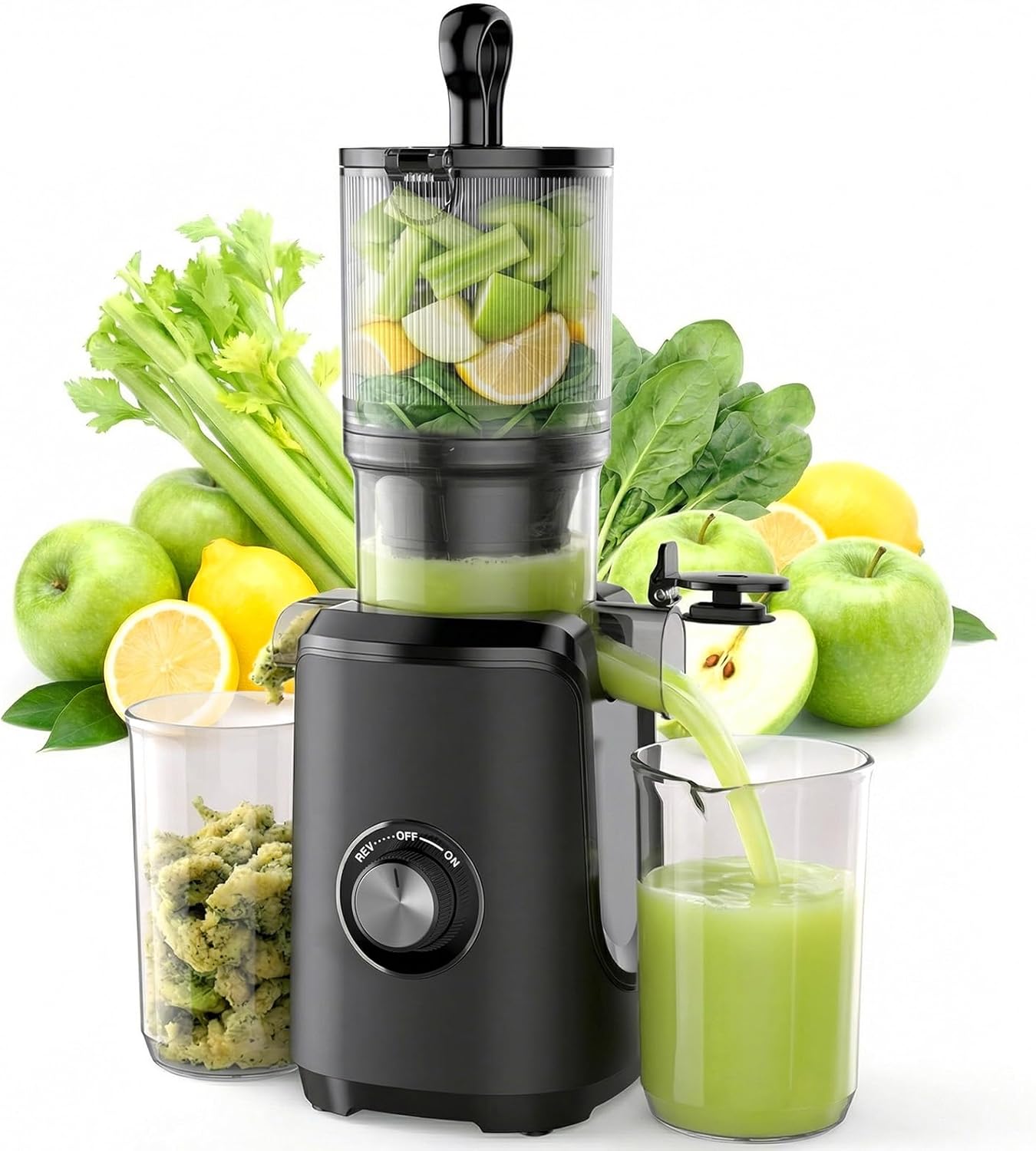
The NEWBULIG Cold Press Juicer is a single-auger masticating machine designed to extract juice from whole fruits and vegetables with minimal prep. It uses a slow 200-watt motor and a 4.25-inch feed chute so you can fit longer produce like carrots and apples without slicing, and the low-speed action reduces heat and oxidation for fresher-tasting juice. A reverse function clears clogs quickly without full disassembly, and the unit includes a pulp cup, juice cup, and cleaning brush for straightforward cleanup; parts detach for rinsing and hand wash only is recommended. Safety-minded features include a blade-free design and an automatic safety lock that stops the motor when opened, making it suitable for families. Expect quieter operation than centrifugal juicers and higher yield from leafy greens, though it is not dishwasher-safe and the motor is modestly powered so very large-volume or commercial use will be slow. Overall it offers practical, nutrient-focused juicing at an affordable entry level.
Best for: Buyers seeking an affordable cold-press juicer that emphasizes nutrient retention and easy everyday use will appreciate this unit for home kitchens and small families.
Less Ideal for: If you need rapid, high-volume or commercial-grade juicing, or want fully dishwasher-safe components, look at more powerful or professional models instead.
- Wide 4.25-inch feed chute reduces prep time by fitting whole or long produce
- Slow masticating motor preserves nutrients and minimizes oxidation for better flavor
- Reverse function clears jams instantly without teardown
- Quick-disassembly and included cleaning brush simplify hand-clean maintenance
- Safety lock and blade-free design improve user safety in family kitchens
- Hand wash only; not dishwasher-safe
- 200-watt motor is modest so juicing large batches takes longer
Verdict: A budget-friendly masticating juicer that delivers higher-yield, nutrient-preserving juice with easy cleanup and clog clearing.
anybear Cold Press Juicer SJ054C
| Wattage | 200 watts |
|---|---|
| Maximum Power | 200 watts |
| Voltage | 110 volts |
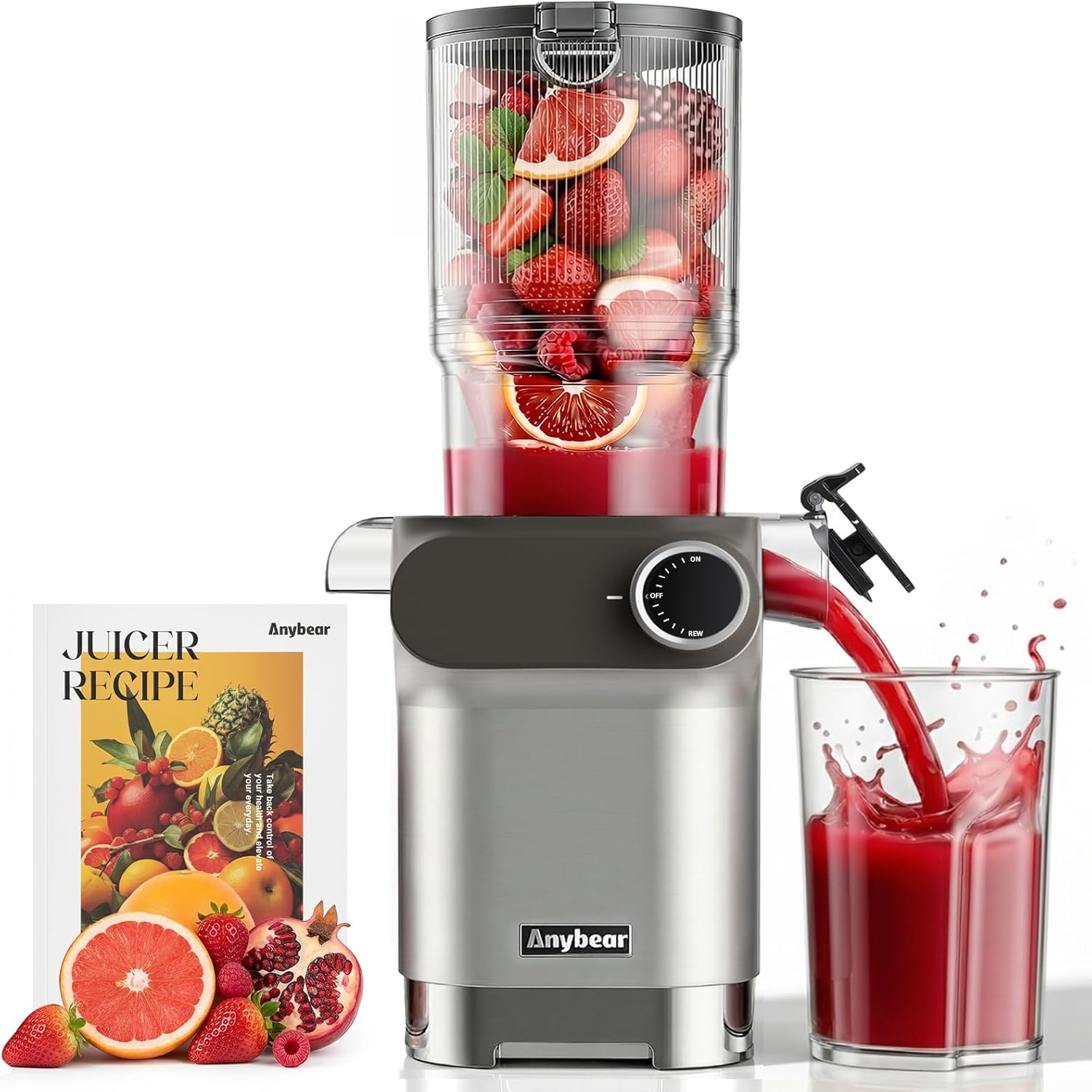
The anybear Cold Press Juicer SJ054C is a single-auger masticating juicer built for steady, everyday use. It runs on a 200W motor with high torque and a slow 65 RPM extraction to reduce oxidation and preserve flavor, and the 4.3-inch feed chute accepts larger fruits and vegetables so you can often skip pre-cutting. The unit uses Tritan and stainless steel parts in the juice path and includes a one-piece stainless filter intended to simplify cleaning; disassembly is described as three steps and a brush is included for rinsing. Practical benefits include higher juice yield and fresher-tasting results from slow extraction plus a compact footprint for counter use. Important limitations are that cleaning still requires hand washing and the motor power and single speed mean it is optimized for soft produce and leafy greens rather than heavy-duty commercial throughput. If long warranty support matters, the product notes an extended 5-year warranty and around-the-clock customer service.
Best for: Someone who prioritizes consistent, fresh-tasting home juice and wants a durable, well-supported cold press that minimizes oxidation and prep time.
Less Ideal for: People who need a commercial-grade juicer for heavy daily throughput or those who prefer dishwasher-cleanable parts for minimal maintenance.
- Slow 65 RPM masticating extraction preserves flavor and reduces oxidation
- 200W high-torque motor for steady juice yield
- Large 4.3-inch feed chute accepts bigger produce with less prep
- Tritan and stainless steel materials in juice path for food-safe contact
- One-piece stainless filter and included brush simplify cleaning steps
- Requires hand washing; not fully dishwasher-safe
- Single speed and consumer-grade motor limit high-volume or commercial use
- May struggle with very hard produce without extra prep
Verdict: Buy this juicer if you want a reliable, low-speed masticating machine that maximizes juice quality and comes with extended warranty support.
ACOQOOS AMJ-90 Masticating Juicer

| Special Features | 6.5-inch Extra-wide Feed Chute; 100 OZ; Juice, Sorbet & Nut Milk 3-in-1; Overheat Protection; Pre-cut System |
|---|---|
| Maximum Power | 350 watts |
| Number of Speeds | 60 |
| Material | ABS, BPA-Free |
The ACOQOOS AMJ-90 is a single-auger cold-press juicer designed for high-volume home use and multi-function kitchen tasks. It runs at 60 RPM to minimize heat and oxidation for higher juice yield and drier pulp, and its 6.5-inch feed chute plus 100 oz gravity-fed hopper let you load whole or large pieces for longer unattended batches. Beyond juice, the unit includes attachments and modes for making sorbet and nut milk, and most removable parts are dishwasher-safe for faster cleanup. Practical benefits include the walk-away hopper that speeds morning routines and the slow-speed extraction that preserves nutrients and reduces foam. Important limitations are the moderate 350-watt motor, which means very hard pits or seeds must be removed to avoid stress on the auger, and the included controls are basic rather than offering advanced programing. Build appears focused on food-grade ABS and BPA-free plastics rather than premium metal components, so buyers seeking commercial-grade durability may prefer heavier-duty models.
Best for: Buyers who prioritize nutrient retention and high-yield home juicing with minimal prep and want a single machine that can also make sorbets and nut milks, backed by visible customer feedback and straightforward features.
Less Ideal for: People seeking commercial-grade construction or heavy continuous daily use should consider sturdier, higher-power models instead.
- Large 6.5-inch feed chute and 100 oz gravity-fed hopper enable minimal prep and long unattended batches
- 60 RPM cold-press extraction for higher juice yield and reduced oxidation
- 3-in-1 functionality supports juice, sorbet, and nut milk without separate appliances
- Most removable parts are dishwasher-safe and made from BPA-free materials for easier cleaning
- 350-watt motor may struggle with very hard pits or seeds which should be removed
- Plastic ABS construction rather than metal components may feel less durable for heavy daily use
Verdict: Choose the AMJ-90 if you want a high-yield cold-press juicer that handles large batches with minimal prep and also doubles as a sorbet and nut milk maker.
EanOruus 3-in-1 Cold Press Juicer E-18

| Capacity | 100 fluid ounces |
|---|---|
| Maximum Power | 250 watts |
| Power Source | ac |
| Voltage | 110 volts |
The EanOruus E-18 is a single-auger cold press juicer built for high-capacity home use and multi-function prep. It accepts whole produce through a 6.5-inch wide chute into a 100 oz hopper so you can batch large volumes with less chopping and fewer refills. The 250W AC motor runs quietly and is designed for steady, low-speed extraction to preserve nutrients and maximize yield, while included strainers let you switch between juice, nut milk and sorbet. Practical touches include an auto-reverse for jams, a detachable pulp outlet for easier cleaning and overheat protection for longer runs. Most components are plastic and hand-wash only, so cleanup is straightforward but requires disassembly and rinsing rather than dishwasher convenience. At about 12 pounds it is a substantial countertop appliance that suits regular use, and the brushless AC motor should handle fibrous produce well, but buyers expecting fully metal internals or compact storage will find it bulkier than single-serving models. For cautious buyers this model balances performance and built-in protections with everyday usability.
Best for: Buyers who want a high-capacity cold-press juicer for regular family use and prefer machines with safety features and reliable motor performance over minimalist or travel-friendly models.
Less Ideal for: If you need a very compact, travelable juicer or prefer mostly metal construction for long-term durability, this larger plastic-bodied unit is not the best fit.
- Extra-large 100 oz hopper reduces loading and allows batch juicing
- 6.5-inch wide chute accepts whole fruits to cut prep time
- 250W AC brushless motor provides quiet, steady cold-press extraction and high yield
- Auto-reverse and overheat protection reduce jams and protect the motor
- Removable parts are hand-wash only, no dishwasher-safe claim
- Major components are plastic rather than metal, which may feel less premium
Verdict: Choose the EanOruus E-18 if you want a quiet, high-capacity cold-press juicer that handles whole fruit and multitasks into nut milk and sorbet with built-in protections.
Choosing the Right Cold Press Juicer: Key Factors to Consider
Juice Yield & Nutrient Retention
A cold press juicer works by slowly crushing produce to extract liquid while minimizing heat and oxidation. Higher yield means you get more juice from the same amount of fruits and vegetables, which affects both cost of use and convenience.
Nutrient retention is closely tied to extraction speed and heat generation. Slower-masticating machines typically preserve more vitamins and enzymes than high-speed centrifugal juicers. Look for machines and features that minimize air incorporation and reduce exposure to heat during extraction because those factors influence both flavor and nutrition.
Ease Of Cleaning
Daily usability is greatly affected by how quickly and easily the juicer can be cleaned. Models that require minimal disassembly and include dishwasher-safe components will reduce the friction of regular use.
Pay attention to trap areas where pulp accumulates and how accessible seals and screens are for rinsing. If cleaning is time-consuming or awkward, you are less likely to use the juicer consistently, which undermines its value.
Durability And Materials
Cold press juicers have moving parts that experience stress, so the construction material of the auger, housing, and gears matters. Metal or reinforced augers and sturdy housings typically last longer under frequent use than thin, brittle plastics.
Also consider the quality of seals and bearings, since wear in those parts causes performance losses over time. Durable parts and clear guidance on replacement components extend the appliance's useful life and protect your investment.
Noise Level And Operation Smoothness
One advantage of slow juicers is quieter operation compared with high-speed centrifugal models, but noise and vibration still vary by design. A quieter unit is more suitable for early-morning juicing or open-plan living spaces.
Stable motor mounts, balanced augers, and solid housings reduce vibration and help the machine run smoothly. Excessive noise or shaking often signals poor assembly or undersized components that may affect longevity.
Pulp Management And Feed Chute Design
Efficient pulp ejection and a practical feed chute reduce prep time and make multi-item juicing sessions easier. Larger chutes let you process longer pieces with less chopping, while effective pulp separation yields clearer juice and less clogging.
Consider whether the design allows continuous feeding and whether pulp collection is tidy and easy to empty. Clogging-prone designs interrupt workflow and require more intervention during juicing.
Maintenance And Parts Availability
Routine maintenance often includes seal replacement, screen cleaning, and occasional part swaps. Choosing a model with accessible replacement parts and straightforward maintenance procedures reduces downtime.
Check how simple it is to access wear components and whether the design allows for nontechnical removal and reinstall. Even with careful use, parts age, so availability and clarity of maintenance instructions matter for long-term ownership.
Cold Press Juicer Types And How They Differ
Slow or masticating juicers use a single auger that turns at low RPM to crush produce and press juice out of cell walls. Within this category there are differences in auger geometry, motor torque, and feed-chute design that influence performance for different produce types.
Some designs emphasize high-torque extraction for leafy greens while others are optimized for fruits and citrus. Understanding these mechanical differences helps you match a juicer to the kinds of produce you plan to use most often.
- High-torque augers: better for dense or fibrous vegetables and continuous operation.
- Wide feed chutes: reduce prep but can slightly lower extraction for leafy greens.
- Low-speed, narrow-auger designs: excel at minimizing oxidation and preserving enzymes.
Preparing Produce For Best Results
Proper preparation increases yield and reduces clogging. Trim tough stems, remove large pits, and cut items into pieces that fit the feed chute without forcing them. For leafy greens, roll them into a compact bundle to feed more efficiently.
Cold fruits with high water content like cucumber and pineapple usually need only light trimming. Hard root vegetables benefit from smaller pieces to avoid overloading the auger.
- Remove large pits from stone fruit to prevent damage to screening components.
- Chop hard roots into chunks that match the chute to avoid jamming.
- Feed soft leaves together with a firmer item to help push them through the auger.
Troubleshooting Common Issues
Clogging, slow feeding, and poor pulp dryness are common complaints that often have simple fixes. If the juicer clogs, stop and disassemble the relevant sections to remove compacted pulp and rinse the screen. Reassemble carefully to ensure seals are aligned.
If juice yield seems low, check for worn seals or screens and verify that produce is prepared correctly. Some machines require occasional tightening of parts or simple realignment after heavy use.
- If the motor stalls, reduce feed rate and clear the auger before restarting.
- Inspect seals and gaskets for wear if you notice decreased extraction over time.
- Clean the screen promptly after use to prevent hardened pulp buildup.
How Noise And Placement Affect Use
Even quiet cold press juicers produce some sound and vibration. Place the unit on a level, solid surface away from edge overhangs and avoid thin countertops that amplify vibration. Rubber feet help isolate minor shaking.
If you plan to juice early in the morning, consider acoustic performance as a practical factor. A quieter unit also tends to indicate smoother mechanical operation and better long-term reliability.
- Use a small mat under the juicer to reduce transmitted vibration.
- Keep the unit on a flat surface to prevent misalignment and noise.
- Avoid placing the juicer under wall cabinets where noise can echo.
Storage, Warranty, And Long-Term Care
Think about cabinet or countertop storage space before buying. Some units are bulky and benefit from dedicated counter real estate, while others disassemble for compact storage. Frequent users will prefer accessible placement over stowing the machine away.
Review warranty terms and the availability of replacement parts when considering long-term ownership. Knowing how to service or replace high-wear components keeps performance consistent and reduces lifecycle cost.
- Store disassembled parts dry and ventilated to prevent odors.
- Rotate usage between tougher and softer produce to avoid stressing the auger repeatedly with the same type of load.
- Keep manufacturer maintenance instructions handy for periodic checks.
How We Chose the Best Cold Press Juicer
We evaluated candidates using criteria that matter most to cold press juicer buyers: extraction efficiency, build and component durability, ease of cleaning, noise level during operation, and design features that affect everyday use such as feed-chute size and pulp handling. Each machine had to demonstrate consistent slow-masticating action to reduce heat and oxidation, and deliver measurable juice yield from a range of produce including leafy greens and harder fruits. We prioritized units with robust auger materials and BPA-free juice paths, and we favored designs that simplify cleaning without sacrificing sealing performance. Models that required excessive disassembly, used fragile plastics, or lacked clear pulp separation were excluded. Warranty support and readily available replacement parts were considered where applicable. The resulting list focuses on machines that balance efficient extraction, manageable upkeep, and reliable construction for routine home juicing.
Our full evaluation process is outlined in our review methodology.
FAQ
Are cold press juicers better for leafy greens?
Often. Cold press juicers with high-torque augers and fine screens typically extract more juice from leafy greens with less oxidation than high-speed centrifugal models. Leafy produce benefits from slow, steady crushing rather than high-speed shredding.
How often should I clean my cold press juicer?
Usually after every use. Rinsing parts immediately prevents pulp from drying and clogging screens. A quick disassembly and rinse typically takes only a few minutes and keeps performance consistent.
Can cold press juicers handle frozen fruit?
It depends. Many cold press juicers can process partially frozen fruits if they are small pieces and fed slowly, but large frozen blocks can stress the auger and motor. Thaw and cut frozen items before feeding for safer operation.
Will a cold press juicer produce drier pulp than a centrifugal juicer?
Usually yes. Masticating extraction is designed to press more liquid out of fibrous material, resulting in drier pulp. Actual dryness varies by produce type and machine design.
What maintenance extends a cold press juicer's life?
Regular cleaning, inspecting seals and screens for wear, and avoiding overfeeding dense items will extend life. Replace worn gaskets or screens promptly and follow recommended duty cycles to prevent motor strain.
Final Verdict
Prioritize juice yield, ease of cleaning, and durable construction when choosing a cold press juicer. Your typical produce mix and how often you plan to use the machine should determine whether you favor wide chutes for convenience or high-torque augers for leafy and fibrous items. Balance extraction efficiency against maintenance needs and noise preferences. Focusing on the factors outlined here will help you pick a model that delivers reliable, nutrient-rich juice and fits smoothly into your daily routine.